
A complete issue · 20 pages · 1906
Life — August 23, 1906
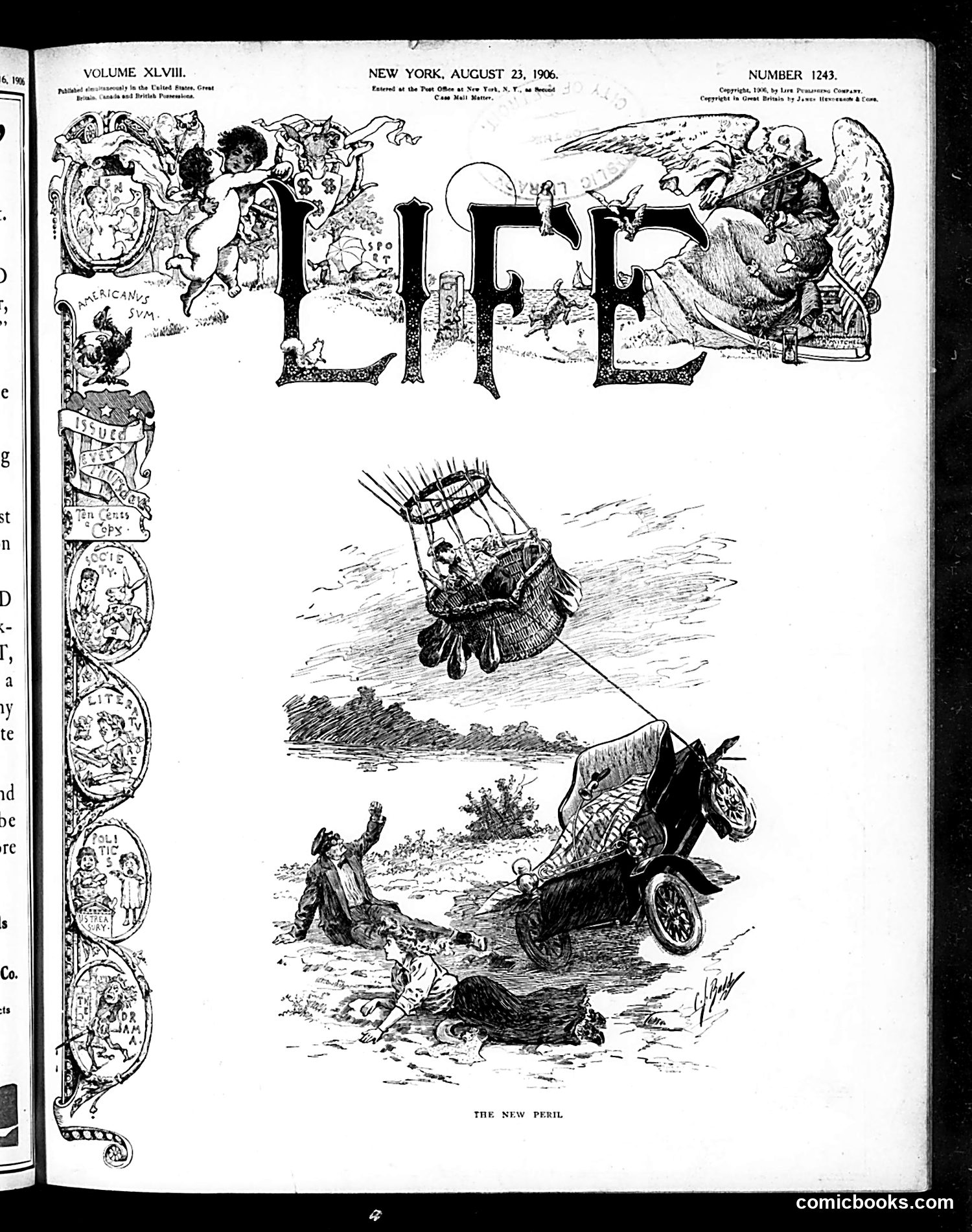
This cartoon satirizes the emerging danger of automobiles in early 1900s America. The illustration shows a motorcar descending upon rural travelers with a balloon hovering above, suggesting both new technologies pose unexpected hazards to ordinary people. The title "The New Peril" refers to the automobile as a novel threat—at this period, cars were still relatively rare and unpredictable, often frightening horses and pedestrians. The figures on the ground appear to be country folk caught off-guard by the speeding vehicle, their traditional way of life disrupted by modern industrial progress. The satirical point critiques how rapidly advancing technology creates unforeseen dangers for the public before adequate safety measures exist.
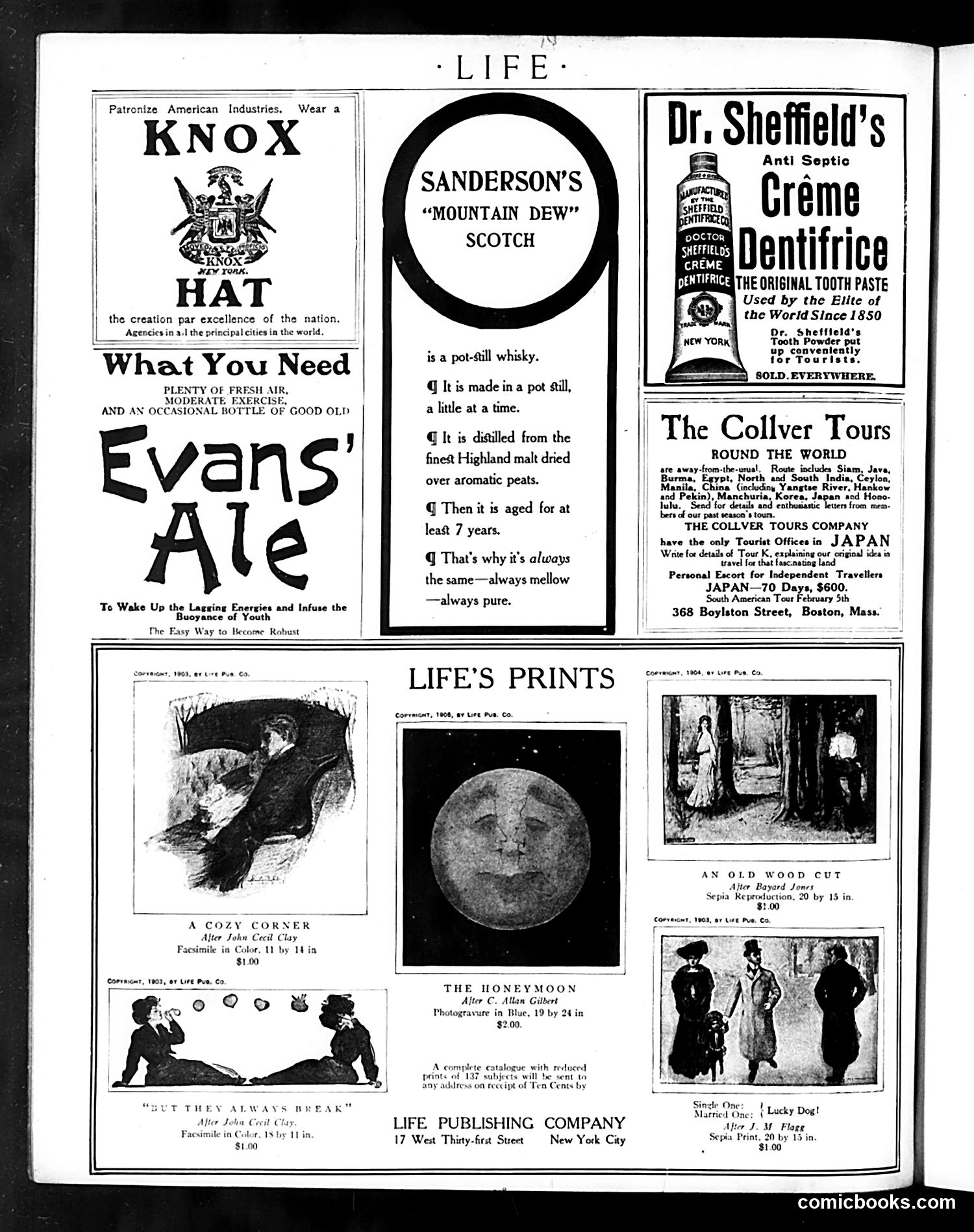
This page is primarily **advertisements** rather than editorial content or political satire. The top section features ads for Knox Hats, Evans' Ale, Sanderson's Scotch whisky, Dr. Sheffield's toothpaste, and Collyer Tours travel services. Below is a section titled "LIFE'S PRINTS" showcasing art reproductions available for purchase, including works titled "A Cozy Corner," "The Honeymoon," "But They Always Break," "An Old Wood Cut," and "Lucky Dog!" These appear to be decorative prints marketed to middle-class homes. The page reflects early 1900s consumer culture and Life magazine's business model—mixing advertising with editorial content. There is **no apparent political satire or social commentary** present on this particular page.
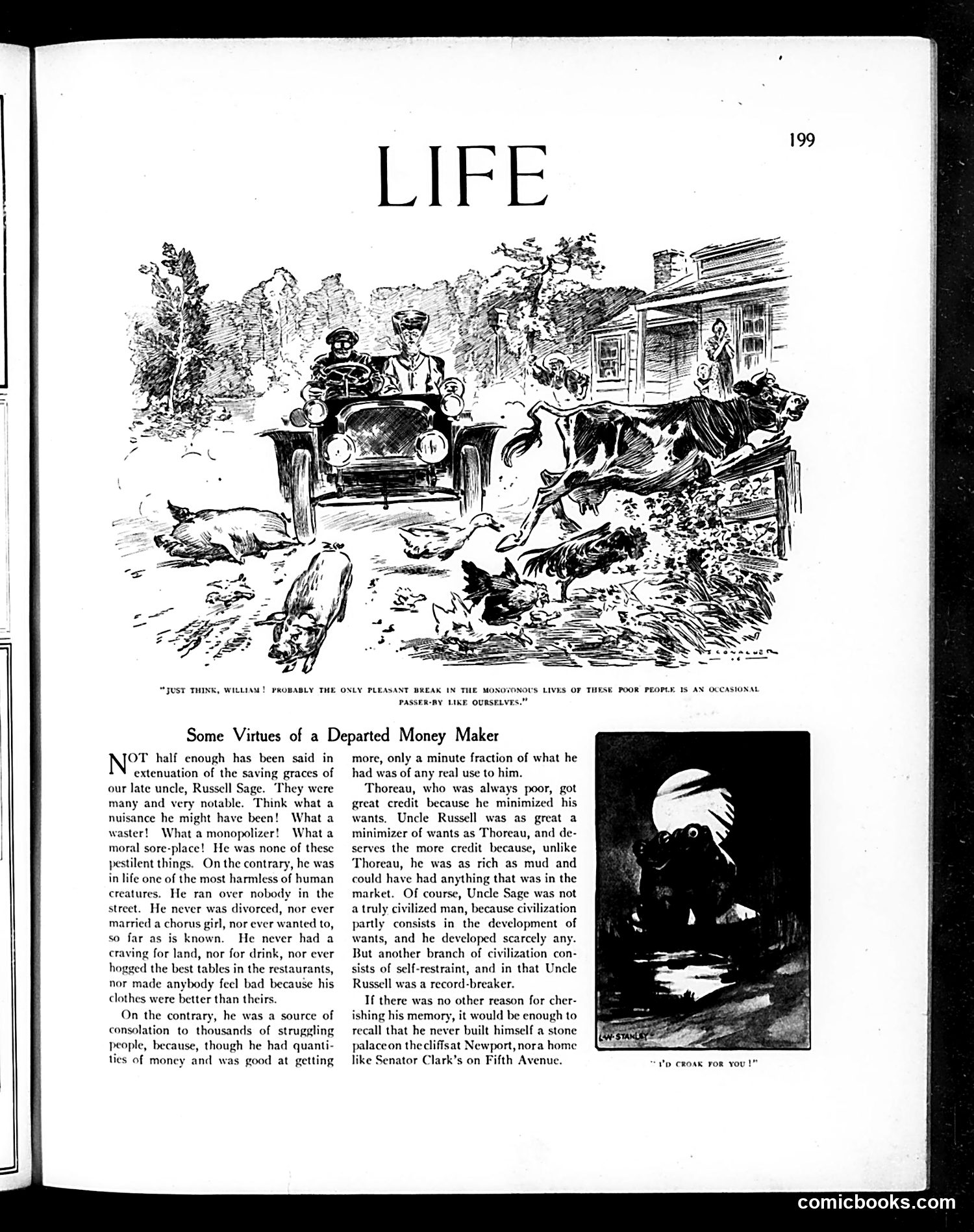
This page commemorates **Russell Sage**, a wealthy financier who recently died. The top cartoon shows a wealthy man in an automobile passing poor people and animals in a rural setting—satirizing how Sage's presence brought little benefit to struggling communities despite his vast wealth. The article praises Sage's virtue of *minimizing wants* rather than accumulating possessions. It compares him favorably to Thoreau (the philosopher), crediting Sage for self-restraint and lack of ostentation. The satire is subtle: while calling Sage virtuous for not building mansions or displaying wealth, the cartoon ironically shows his indifference to poverty surrounding him. The piece suggests Sage's greatest virtue was simply leaving people alone—a backhanded compliment about his limited positive impact.
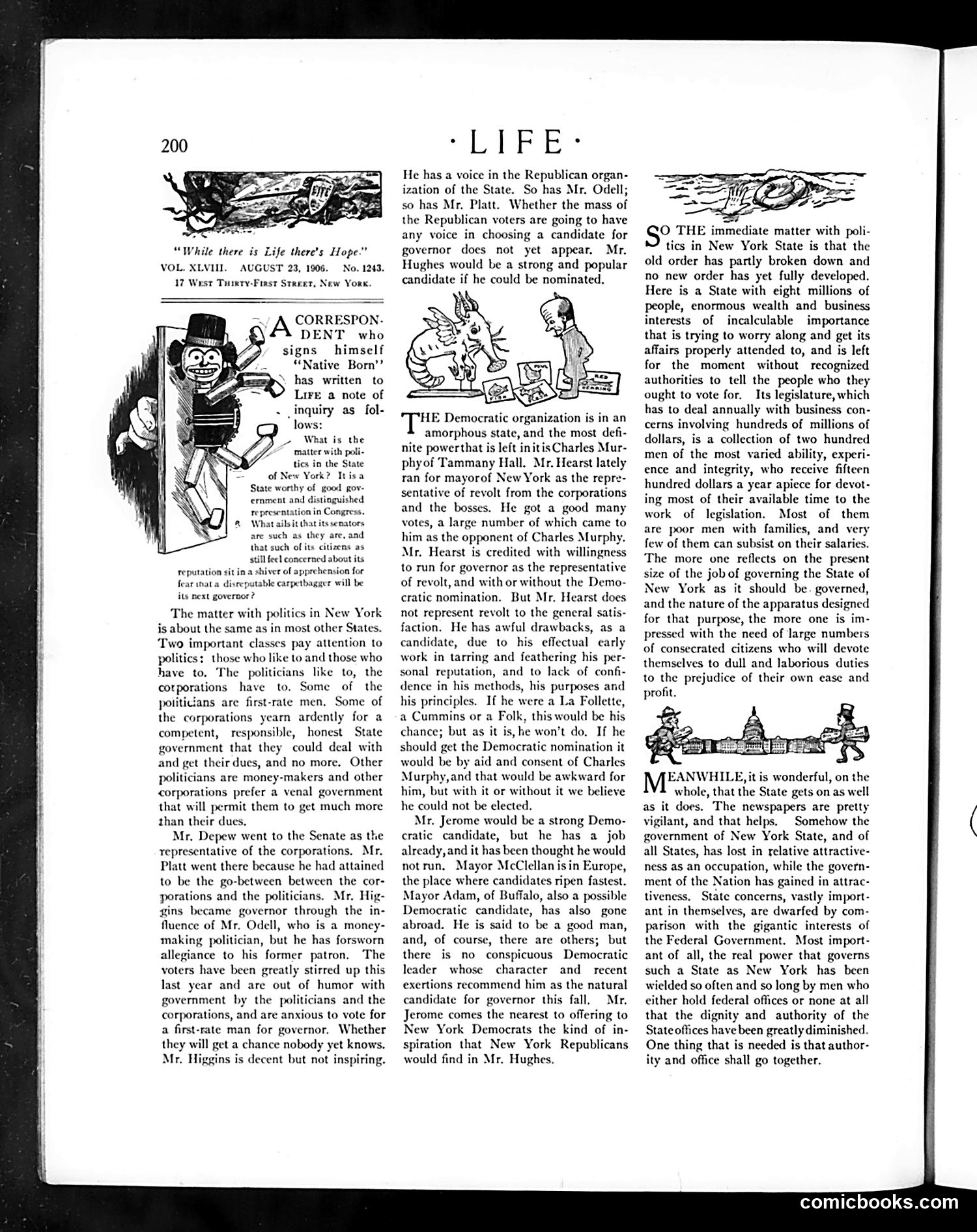
This page from *Life* magazine (August 23, 1906) satirizes New York State politics through a correspondent's letter discussing gubernatorial candidates. The left cartoon depicts a caricatured figure labeled as representing "Native Born" politicians—likely commenting on xenophobia or nativist politics of the era. The text discusses Charles Murphy's influence over Democratic nominations, Charles Hearst (running for governor as a corporate revolt candidate), and Jerome as a potential Democratic nominee. The piece criticizes the weakness of New York's political apparatus and argues the state needs conscientious, capable citizens in government rather than politicians beholden to corporations or machines. The satire targets machine politics, corporate influence, and the inability of competing political factions to produce strong leadership.
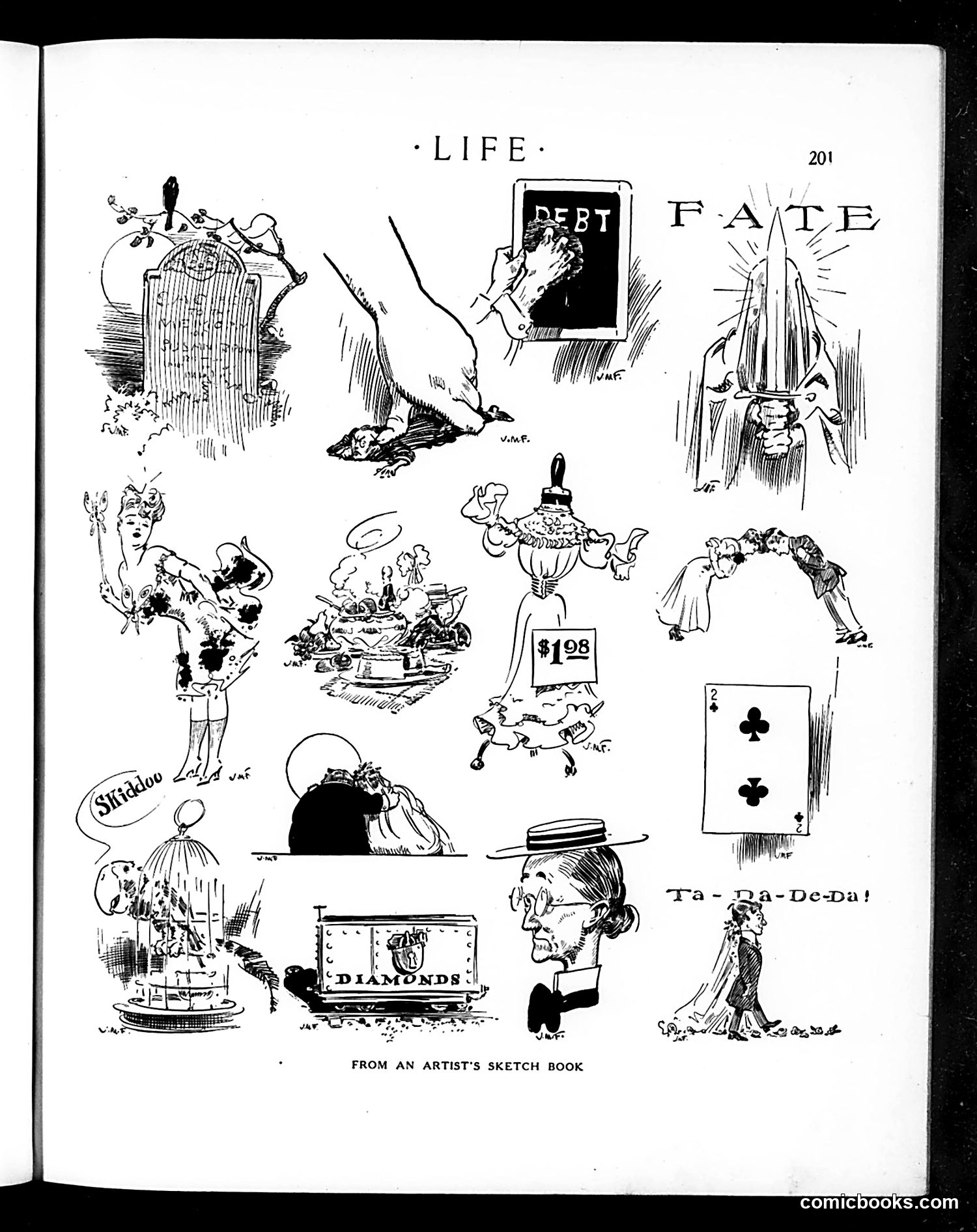
This page from *Life* magazine presents satirical sketches on themes of "Life" and "Fate." The cartoons mock various aspects of early 20th-century society: - **Debt/Financial ruin**: A gravestone labeled "DEBT" and images of financial collapse - **Fate's arbitrariness**: A mystical fortune-teller figure with a "$1.98" price tag, suggesting false hope - **Wealth inequality**: Contrasting scenes of lavish dining and poverty - **Gambling/chance**: A playing card (2 of clubs) and references to luck determining outcomes - **Social pretension**: Figures in formal dress alongside crude or undignified situations The overall message critiques how ordinary people's lives are controlled by forces beyond their control—debt, luck, fate, and economic circumstance—while charlatan fortune-tellers profit from false promises. The sketchy art style and sardonic tone are characteristic of *Life*'s satirical approach to social commentary.
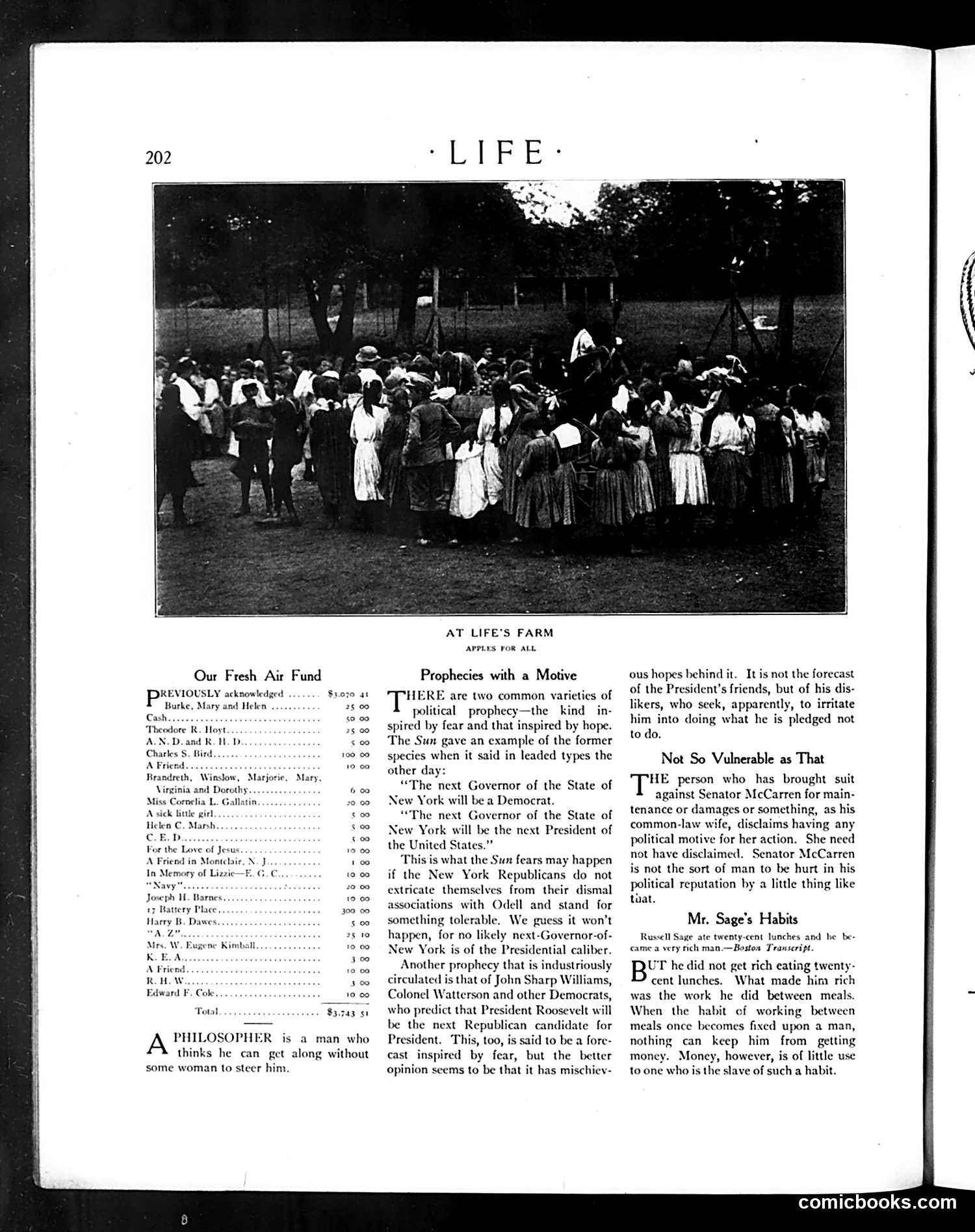
This page from *Life* magazine (page 202) features a photograph titled "At Life's Farm" showing a large group gathering, alongside three satirical articles. The articles critique political prophecies and Senator McCarran. "Prophecies with a Motive" mocks both Democratic and Republican predictions about New York's next governor and presidency, suggesting these forecasts are fear-based rather than genuine. "Not So Vulnerable as That" defends Senator McCarran against his wife's potential lawsuit, implying she lacks grounds for legal action and that McCarran is politically resilient. "Mr. Sage's Habits" humorously describes Russell Sage's frugal lifestyle—working through lunch and eating cheap meals—suggesting that obsessive money-saving makes one a "slave" to the habit itself. The page satirizes political opportunism, marital discord among the powerful, and wealthy misers' contradictory psychology.
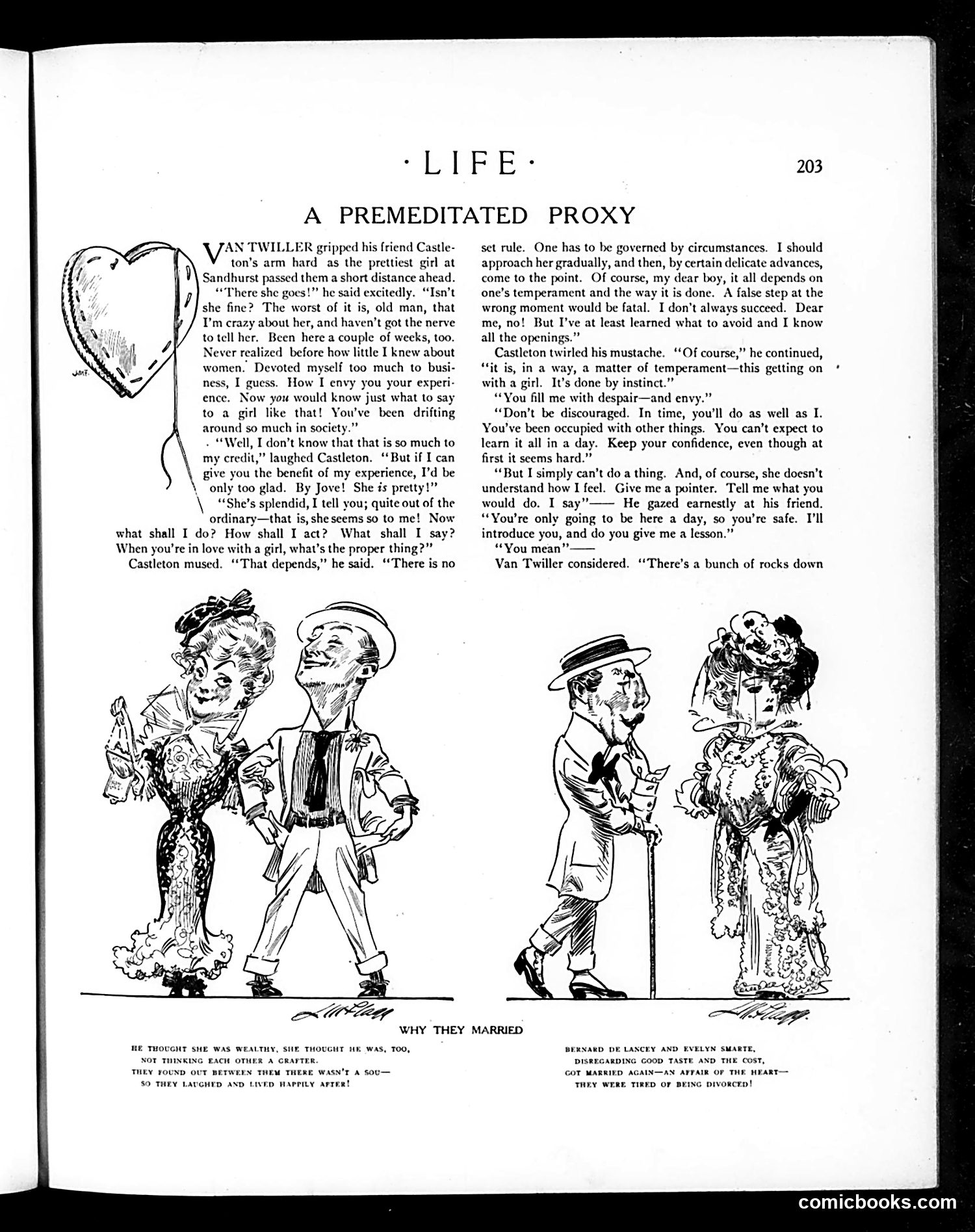
This page satirizes courtship and romantic strategy among the wealthy. The main story features Van Twiller advising his friend Castleton on how to approach a woman named Sandhurst. Castleton is anxious about proper conduct, fearing missteps. Twiller counsels patience and "delicate advances," suggesting Castleton use Twiller himself as an intermediary—a "proxy"—to introduce himself safely and gauge her interest first. The two cartoons below mock marriage motivations: the left shows a couple who married for perceived wealth (neither actually had money); the right depicts a remarriage between divorced parties, suggesting they wed again out of familiarity rather than genuine affection. Both captions humorously undercut romantic ideals with financial or practical reality.
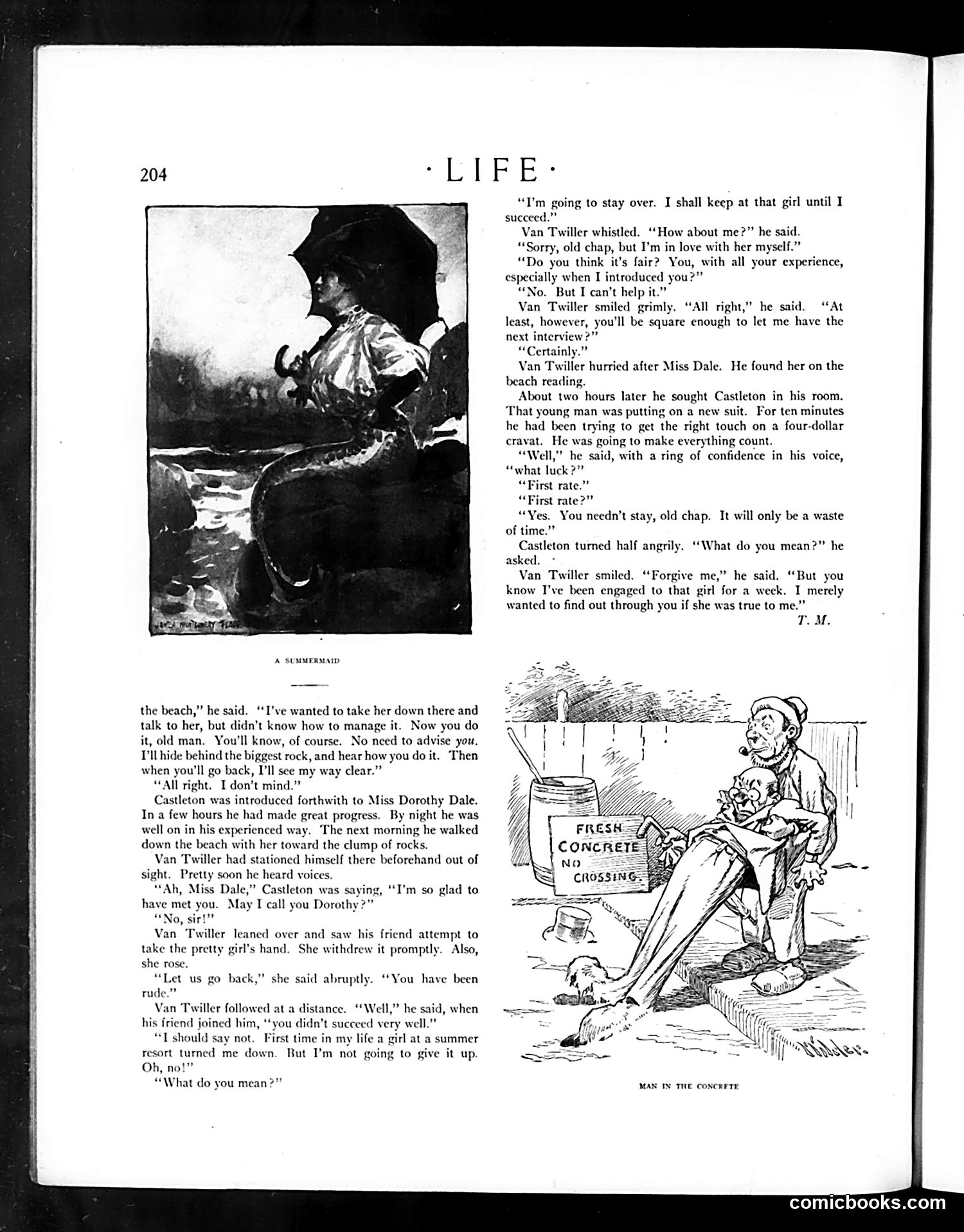
This page contains two separate illustrations satirizing romantic and class dynamics in early 20th-century America. The upper photograph-based illustration shows a couple—a woman with an umbrella and a man—depicting a narrative about courtship and social maneuvering among the upper classes. The text describes Van Twiller's romantic pursuits and his attempt to determine a woman's faithfulness through social intermediaries. The lower cartoon, titled "Man in the Concrete," depicts a working-class man trapped or stuck in fresh concrete, being observed by another figure. This appears to be satirizing the plight of manual laborers or the rigidity of class divisions—the man is literally trapped within the "concrete" structures of society, unable to escape his lower social position. Both illustrations contrast romantic entanglements among the wealthy with the immobility of working-class life.
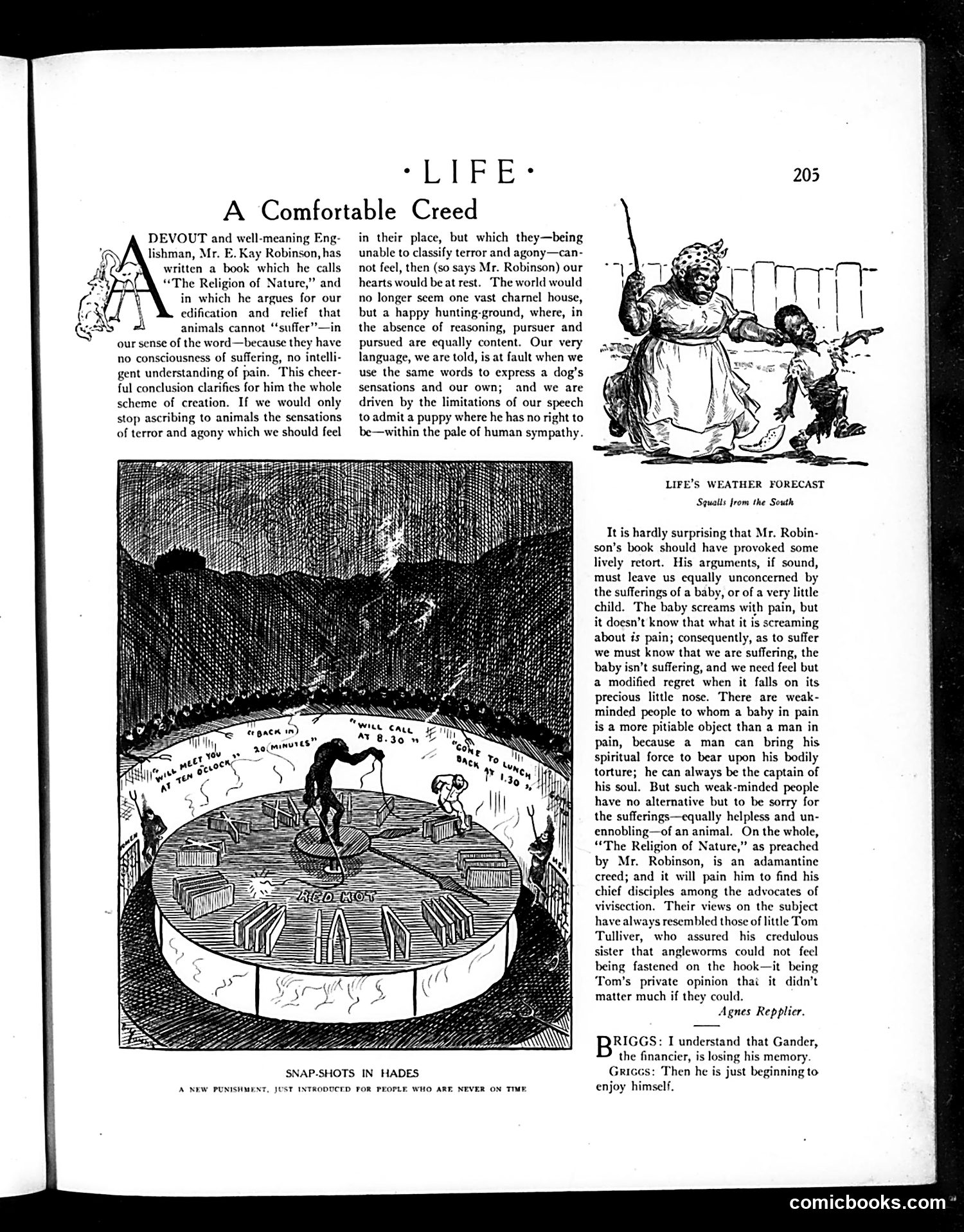
This page satirizes E. Kay Robinson's book "The Religion of Nature," which argues animals don't suffer like humans because they lack human consciousness of pain. The main cartoon, "Snap-Shots in Hades," depicts this philosophy as absurd: it shows the underworld with people and animals in equal torment, suggesting Robinson's comforting doctrine is false. The text mocks Robinson's logic—that a baby screaming doesn't *know* it's in pain, so we needn't feel concerned. The reviewer (Agnes Repplier) argues this is willful delusion used to justify indifference to animal suffering. The satire attacks both Robinson's book and the comfortable self-deception it provides to those wishing to ignore animal pain.
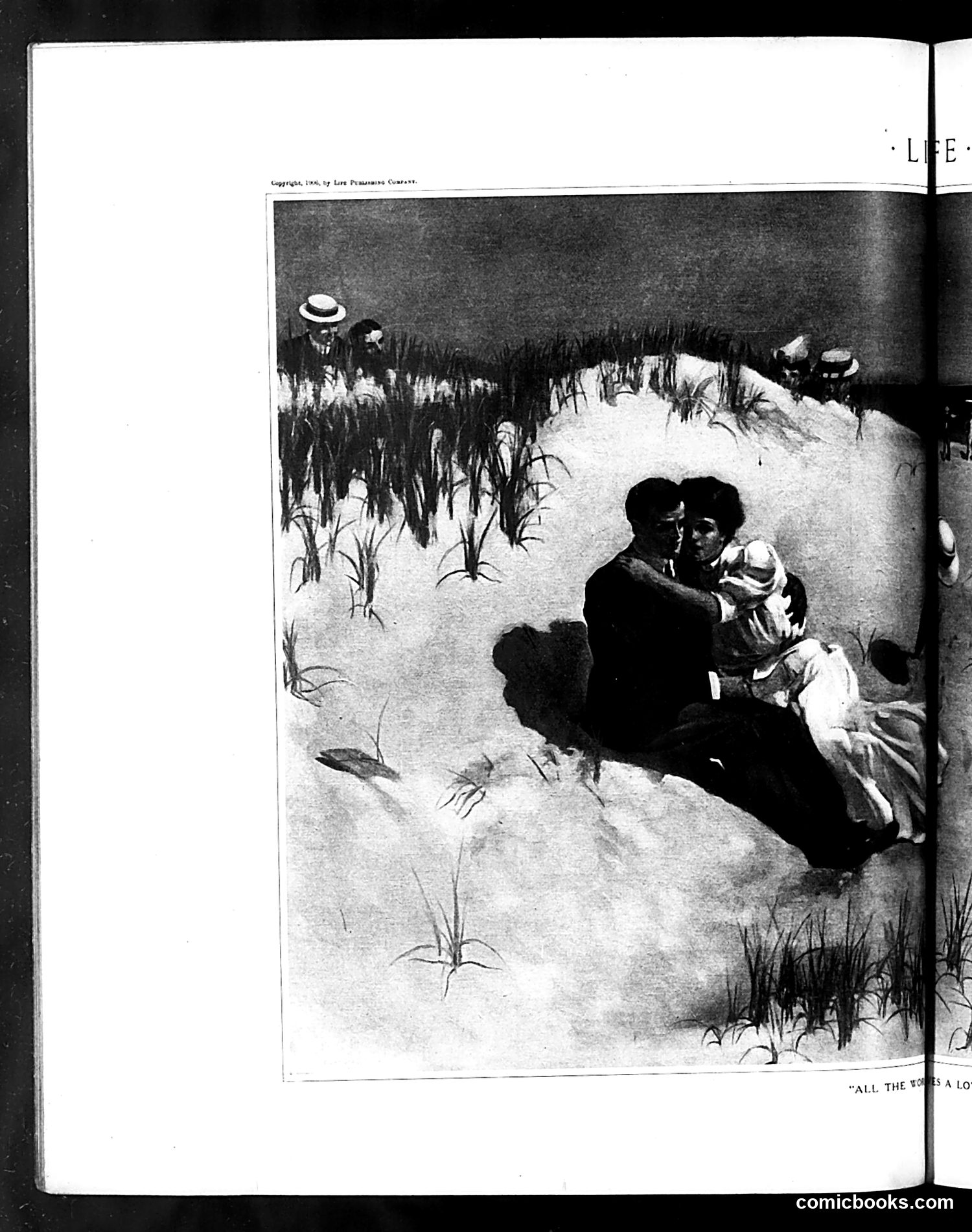
This Life magazine page shows a beach scene with several figures observing something in the sand dunes. The image appears to be satirical social commentary, though the specific caption at the bottom is partially cut off, reading only "ALL THE [?] A LO..." The composition depicts what looks like well-dressed observers (including someone in a straw hat) watching figures in darker clothing among beach grass and sand. The style and setting suggest this is commentary on leisure class behavior or beachgoers, typical of Life's satirical approach to American social customs. Without the complete caption visible, the precise satirical target remains unclear—whether this mocks the wealthy observing ordinary people, inappropriate public behavior, or class differences at recreational spaces. The formal dress of observers suggests mockery of their formality in casual settings.
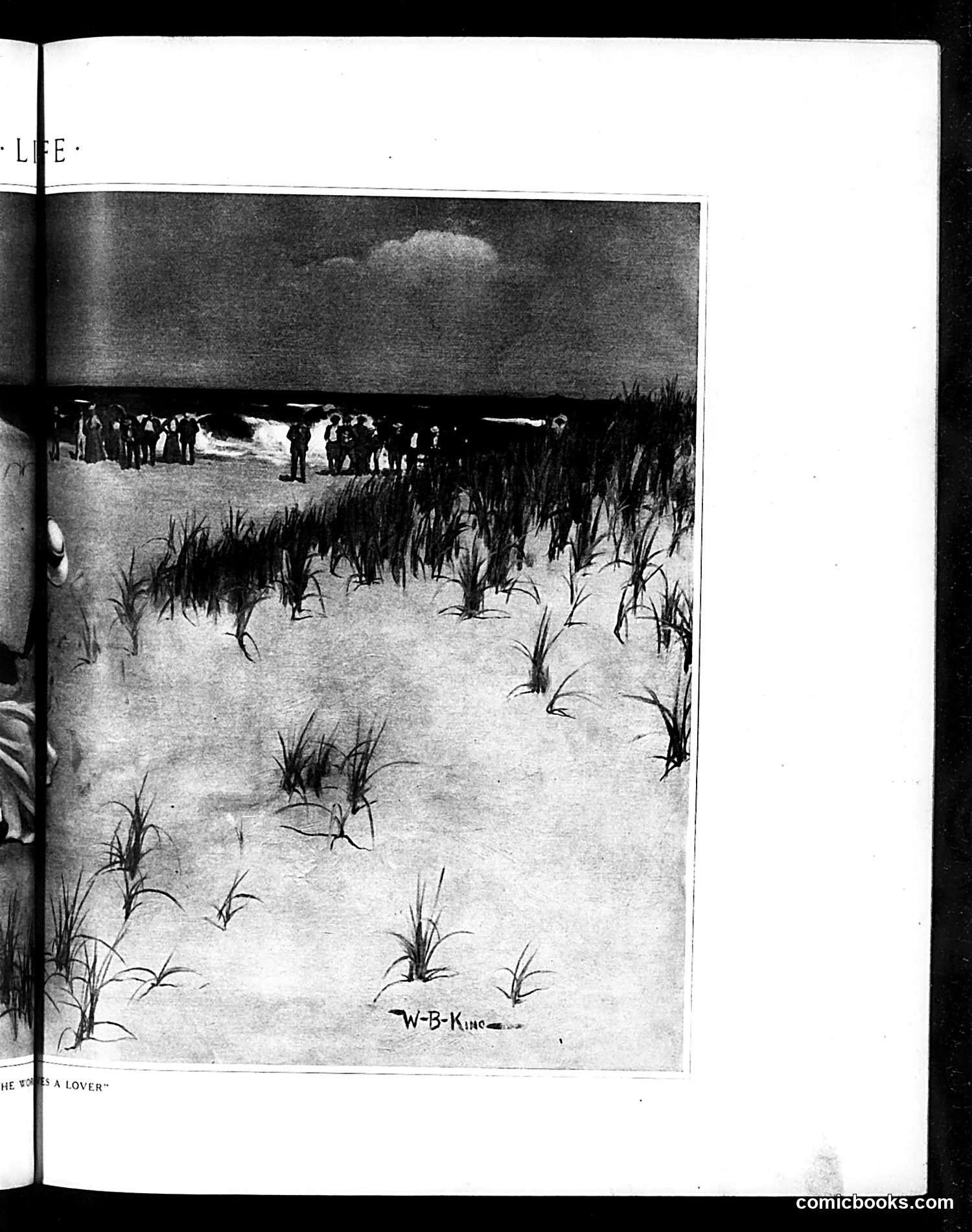
This page from *Life* magazine shows a black-and-white photograph credited to "W-B-King." The image depicts a sandy beach or shoreline with marsh grass in the foreground and a group of people gathered in the middle distance along the water's edge. A dark cloudy sky dominates the background. Without visible text directly accompanying this image on the page, the specific satirical or political commentary is unclear. The photograph appears documentary in nature rather than a traditional political cartoon. The gathering of figures suggests a social event or public occasion, but the exact context—whether this references a historical event, social commentary, or contemporary incident from *Life*'s publication period—cannot be determined from the image alone. Additional caption text may have been lost in reproduction.
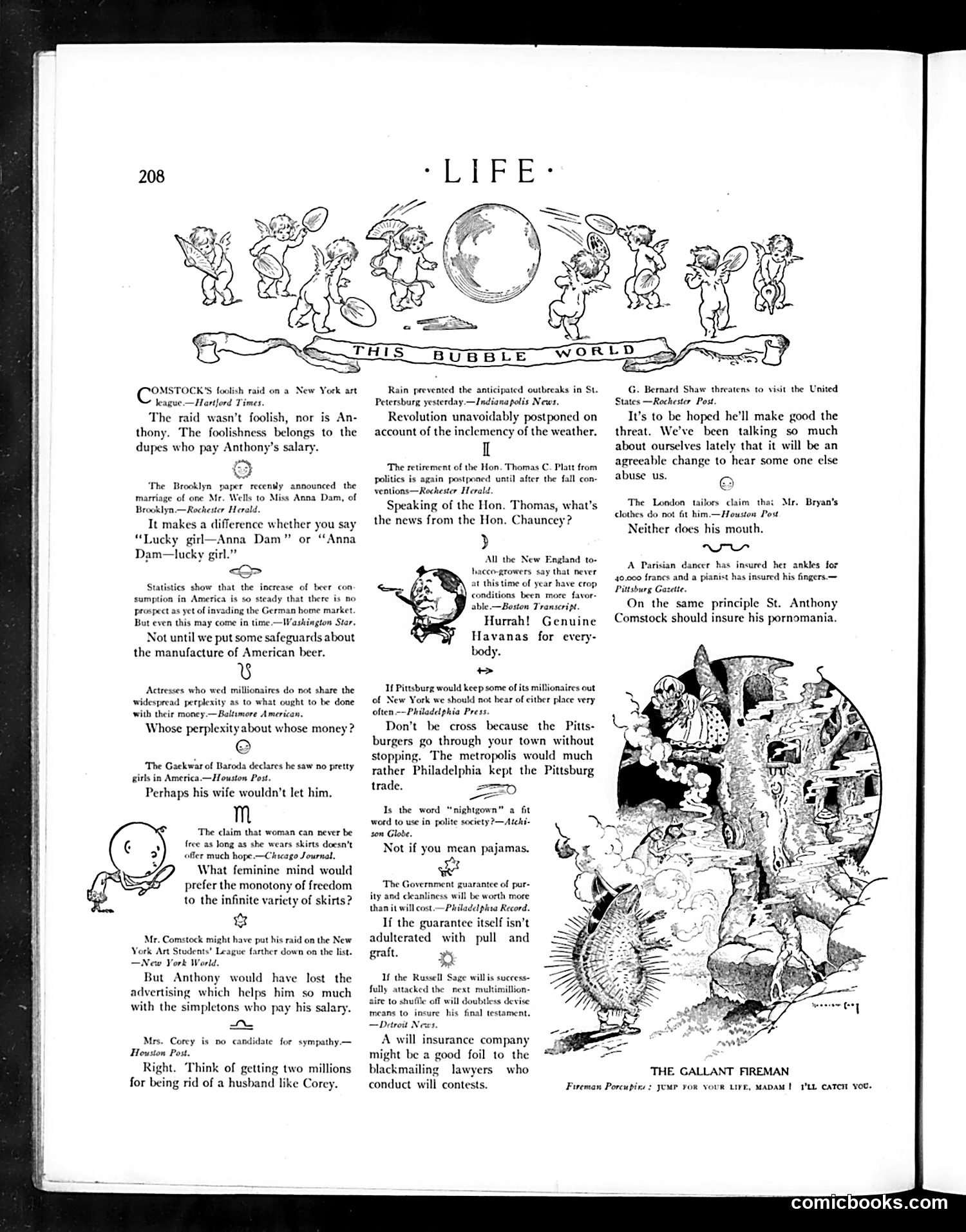
This page satirizes early 20th-century American social and political absurdities. The header illustration shows cherubs surrounding a soap bubble labeled "This Bubble World," suggesting society's fragility. The text contains brief satirical items mocking various figures and topics: - Anthony Comstock's salary and moral crusades - Brooklyn's wealthy class - Gender relations ("Lucky girl—Anna Dam") - Labor conditions - Manufacturing concerns - A critique of "feminine mind" preferring skirts "The Gallant Fireman" cartoon (right) depicts a firefighter in what appears to be a comedic rescue scenario, with the caption "Jump for your life, madam! I'll catch you." The overall tone mocks hypocrisy, pretension, and social contradictions of the era through brief witticisms and cartoon commentary.
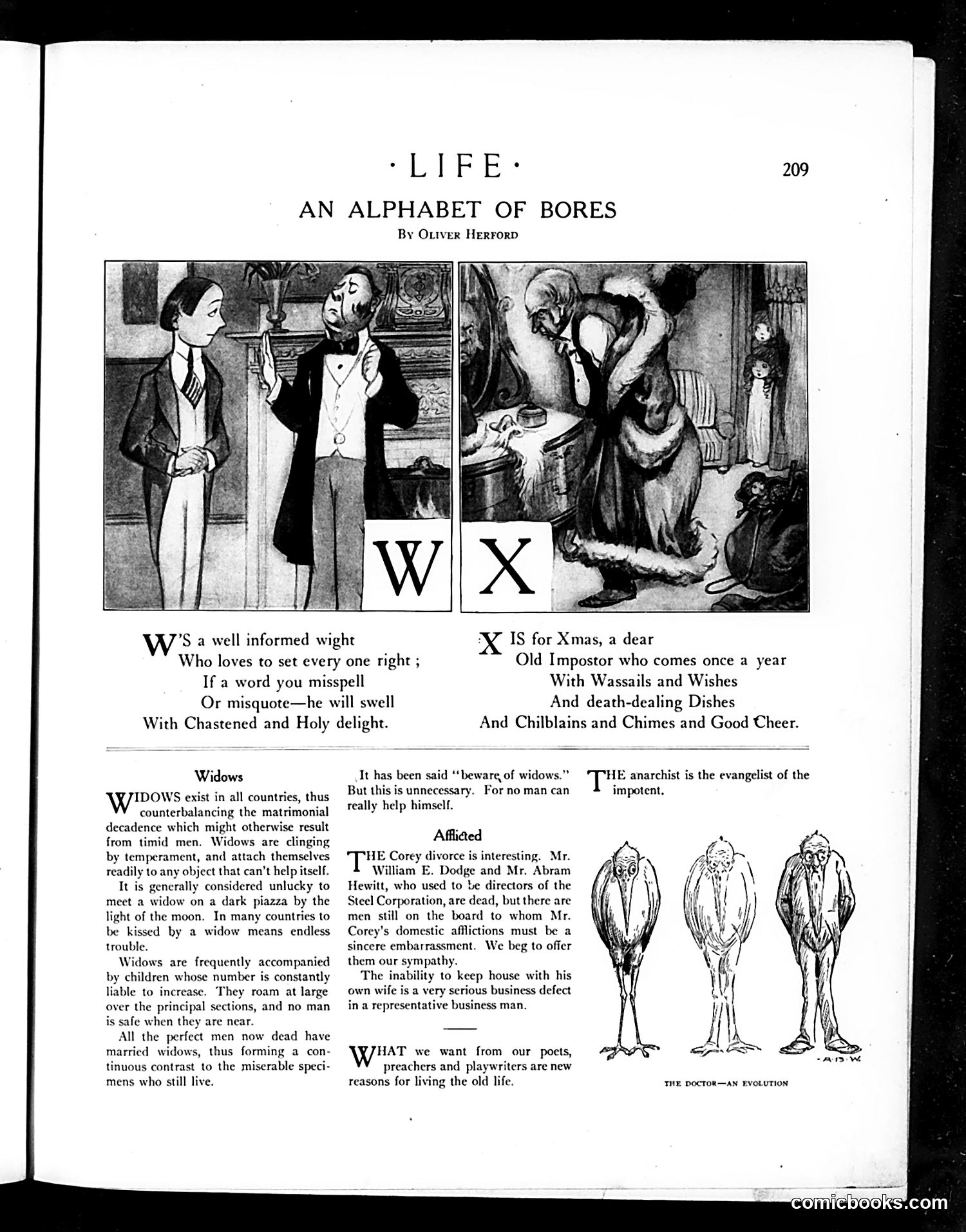
This page satirizes tedious social types through illustrated vignettes. **W (Widows)**: The text mocks widows as perpetually complaining about their deceased husbands while creating domestic chaos—"roaming at large" through society and causing endless trouble. The illustration shows a widow in black dress monopolizing a gentleman's attention. **X (Christmas)**: Depicts the commercialized chaos of the holiday season—unwanted "Wassails and Wishes," excessive meals ("death-dealing Dishes"), and forced cheerfulness from servants and children. The bottom sections continue the "bores" theme, attacking divorce, incompetent businessmen who can't manage home life, and artists/writers lacking originality. The page uses humor to critique social hypocrisy and tedium in early 20th-century American life.
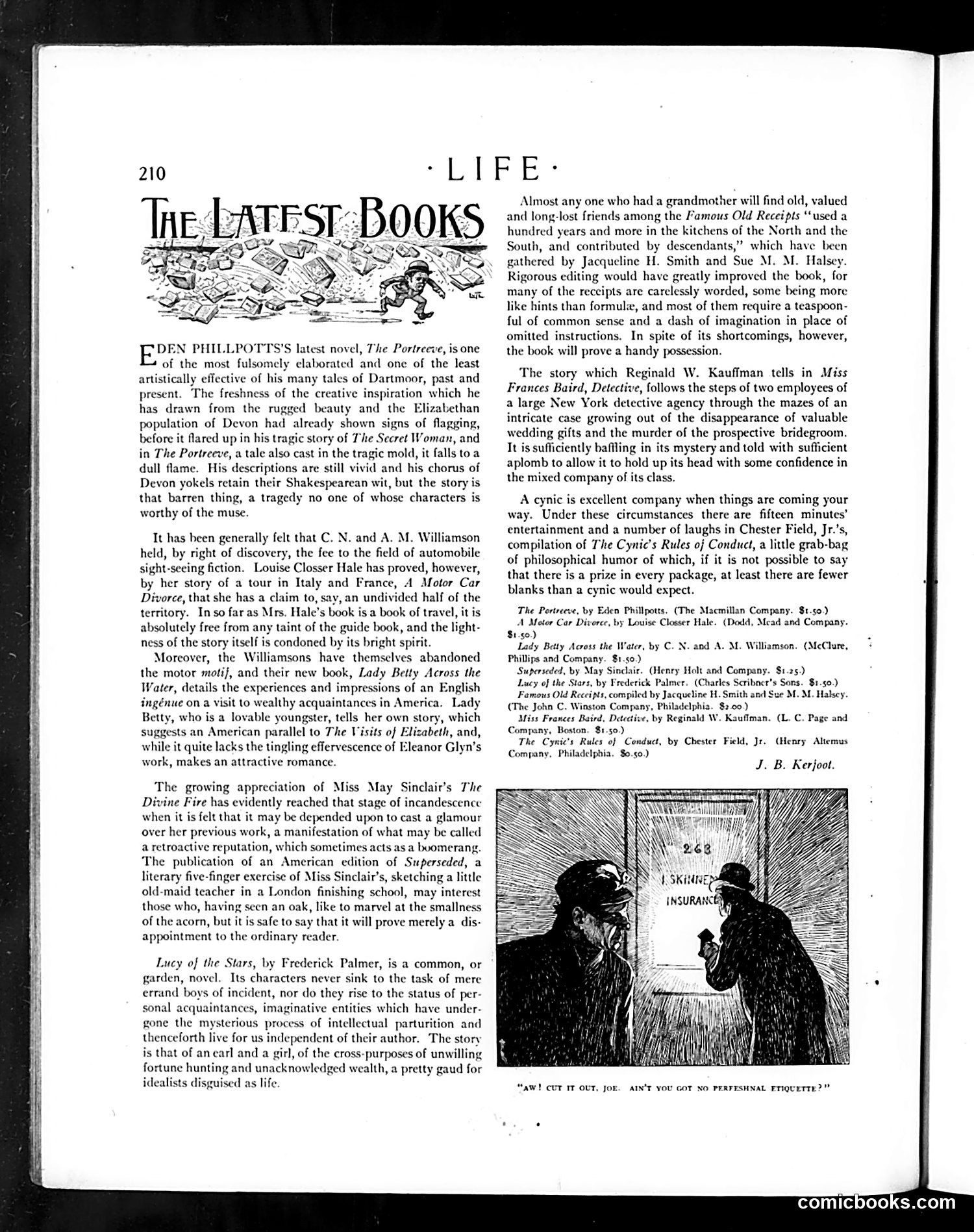
This page reviews recent novels and includes a single cartoon at the bottom. The cartoon depicts two men in formal attire examining what appears to be an insurance document marked "268." One man says to the other: "Aw! cut it out, Joe—ain't you got no professional etiquette?" The joke appears to reference *professional ethics* regarding insurance—likely satirizing aggressive or improper sales tactics or claims practices common in the insurance industry at that time. The cartoon suggests one man is being overly pushy or unethical in his professional conduct, while his colleague calls him out for violating unwritten professional standards. The bulk of the page comprises literary criticism of contemporary novels by authors like Eden Phillpotts and May Sinclair, making this primarily a book review section with a sidebar cartoon on an unrelated commercial/business topic.
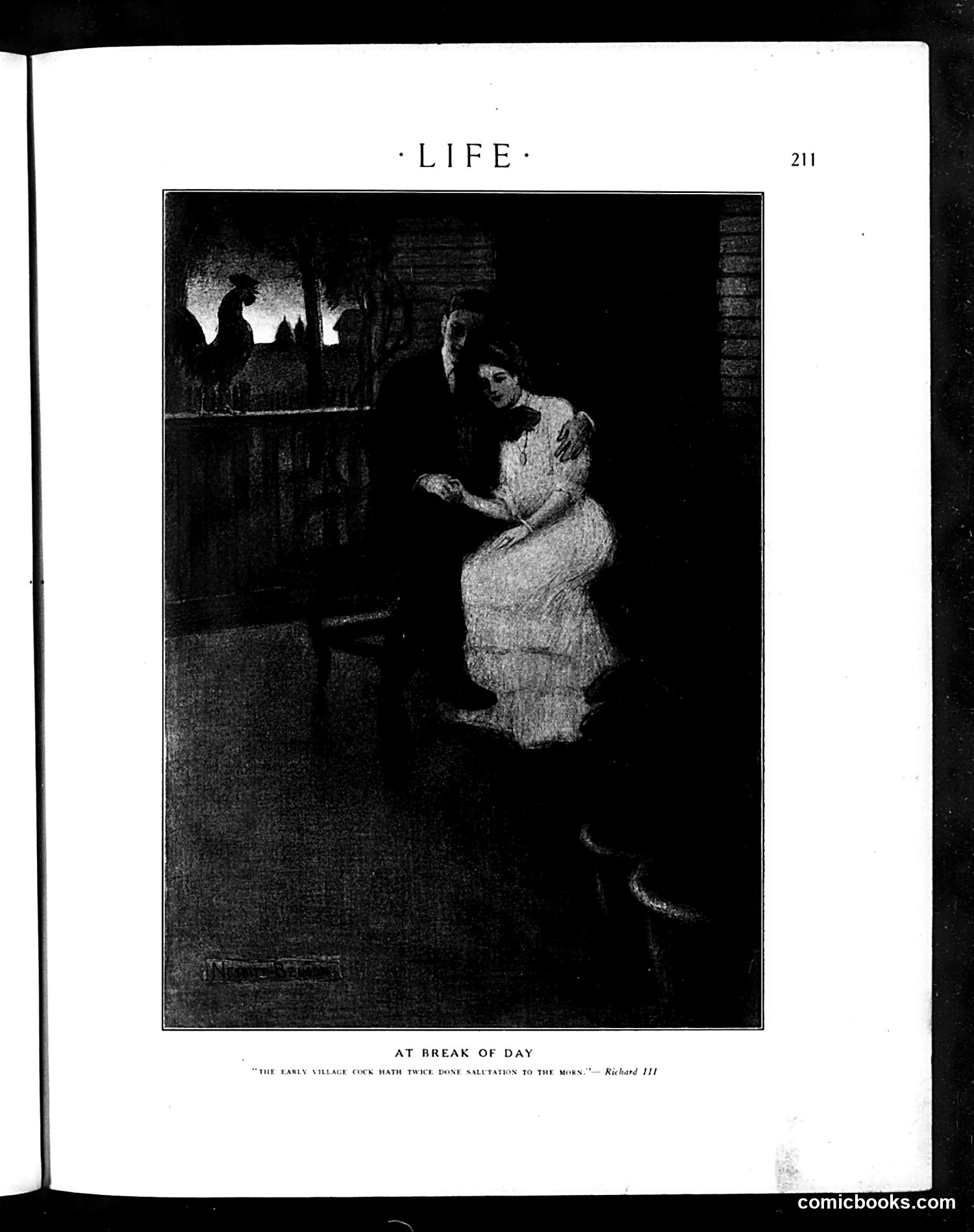
This page presents a dramatic illustration titled "At Break of Day" accompanying a Shakespeare quotation from *Richard III*. The image shows a woman in light clothing in an interior setting, with silhouetted figures visible in the background near what appears to be a window or opening. The caption quotes Shakespeare's reference to a rooster's morning salutation, suggesting themes of dawn, awakening, or new beginnings. However, without additional context about Life magazine's publication date or surrounding articles, the specific satirical or political commentary remains unclear. The image's dramatic lighting and composition suggest it may accompany a literary piece or social commentary rather than direct political satire. The page number (211) indicates this is interior content rather than a cover or standalone cartoon.
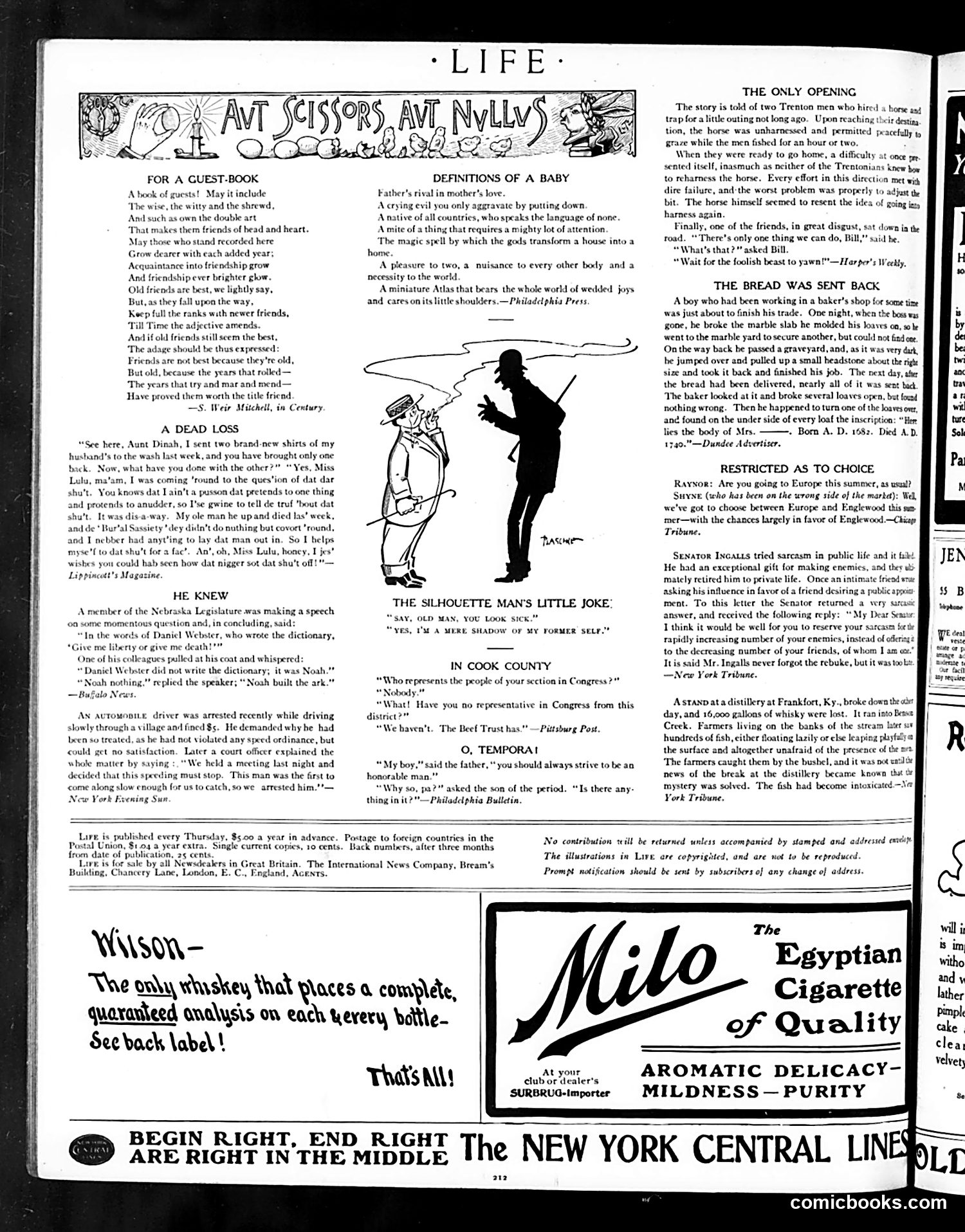
This page from *Life* magazine collects humorous short pieces and satirical commentary typical of early 20th-century American humor. Key items include: **"A Dead Loss"**: A racist dialect joke about an enslaved or formerly enslaved woman explaining she used her employer's shirt to bury her husband. The "humor" relies on offensive caricature and stereotyping. **"He Knew"**: Mocks a Nebraska legislator misquoting Daniel Webster, confusing him with Noah (the biblical figure), suggesting ignorance among politicians. **"In Cook County"**: Political satire suggesting the Beef Trust (a corporate monopoly) effectively controls Congressional representation from Illinois, implying corruption. **"Definitions of a Baby"**: Humorous observations about infants and parenthood. The cartoons and advertisements on the page reflect period advertising and visual humor now unfamiliar to modern audiences.
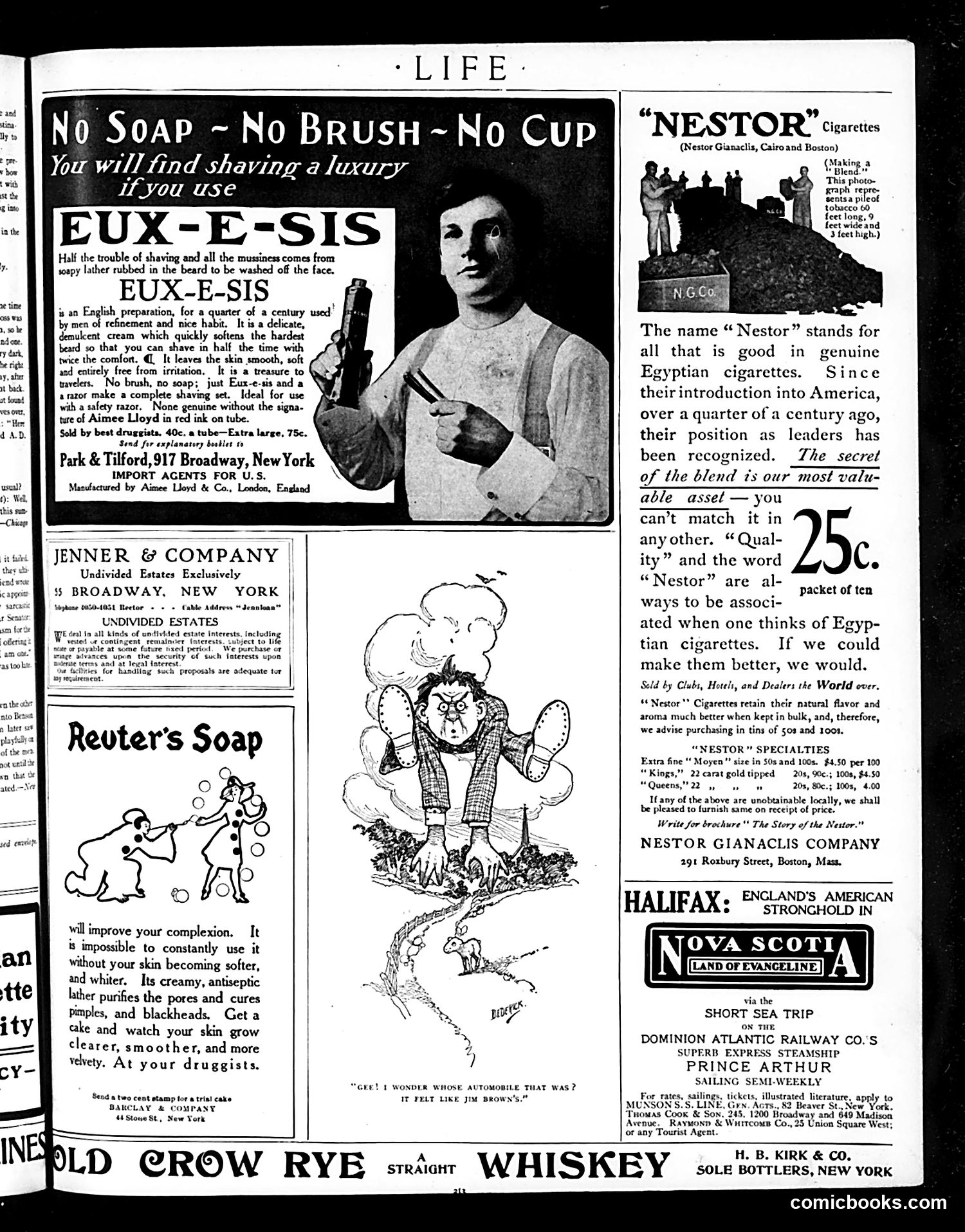
This page is primarily **advertising**, typical of early 20th-century magazines. The main satirical content is a single cartoon showing a man emerging from mud/water with the caption "GEE! I WONDER WHOSE AUTOMOBILE THAT WAS? IT FELT LIKE JIM BROWN'S." The joke appears to be slapstick humor: the muddy man likely drove or was hit by an automobile belonging to someone named Jim Brown, and the mud-covered state is played for comedic effect. This reflects early automobile-era humor mocking the dangers and chaos of motor vehicles on roads. The surrounding advertisements promote grooming products (Eaux-E-Sis shaving cream, Reuter's Soap), cigarettes (Nestor Egyptian cigarettes), real estate services, whiskey, and travel to Nova Scotia. These ads reveal consumer culture priorities of the era and the products marketed to genteel audiences. The page contains no identifiable political satire or caricature of specific public figures.
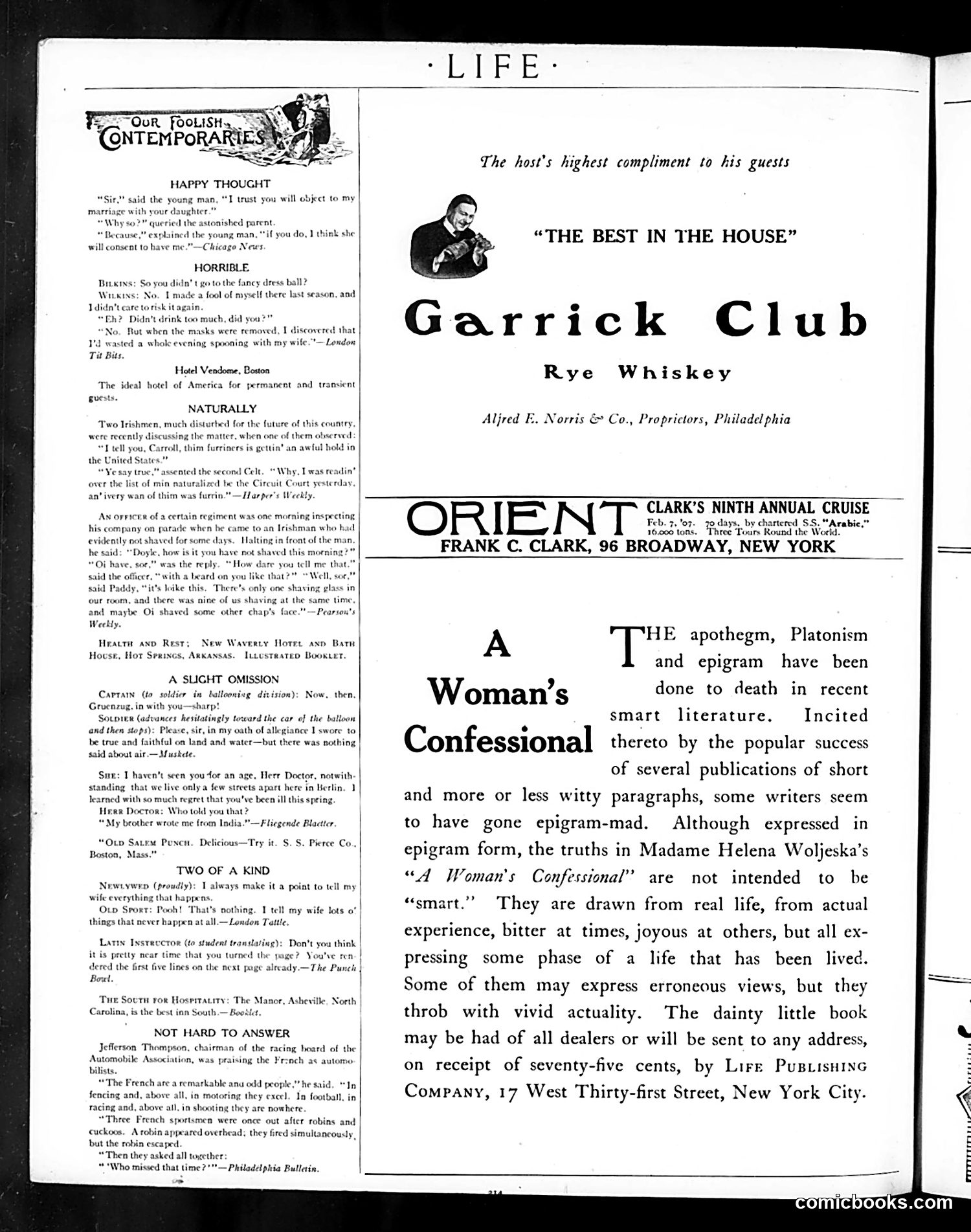
This page from *Life* magazine consists primarily of **satirical humor columns** and **advertisements** rather than political cartoons. The left column presents brief comic anecdotes—"Our Foolish Contemporaries"—mocking various social situations: a young man's marriage proposal logic, a husband's complaint about spooning with his wife, Irish immigrants' confusion about naturalization, military incompetence, and marital dishonesty. These jokes target common social types and domestic humor typical of early 20th-century American satire. The right side features **advertisements** for luxury goods (Garrick Club whiskey, a world cruise, a Boston hotel) and promotes Madame Helena Woljeska's book *"A Woman's Confessional,"* defending it against charges of being mere epigram-driven "smart" writing—claiming instead it expresses genuine lived experience. The humor relies on recognizable stereotypes (Irish dialect, incompetent soldiers, marital discord) rather than specific political references. This appears to be a **humor and advertising issue** rather than topical political satire.
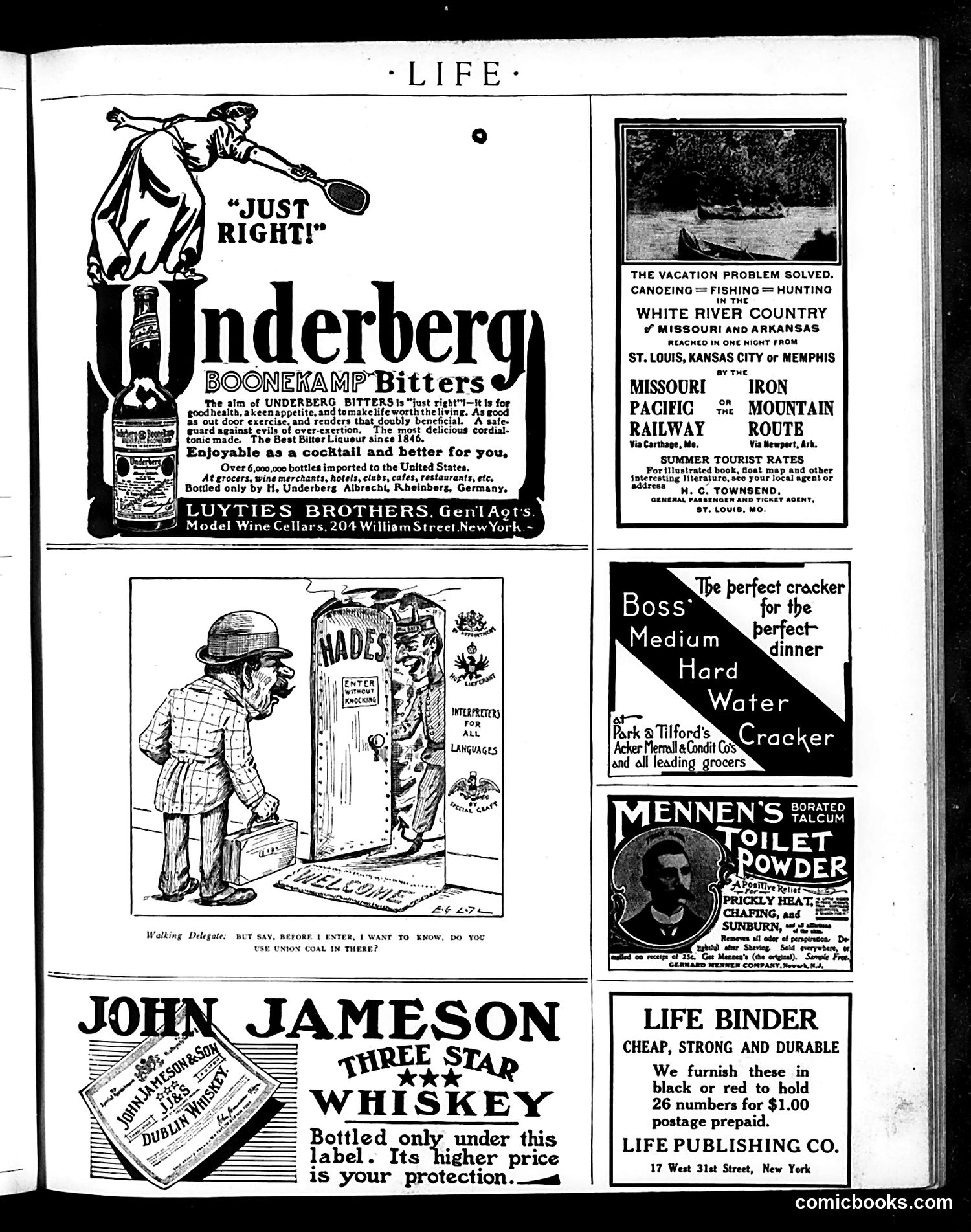
This page is primarily **advertisements** interspersed with one political cartoon. The main cartoon (center-left) depicts a "Walking Delegate"—a union representative—confronting a doorman at what appears to be an exclusive club or establishment. The delegate demands to know if the venue uses "union coal," reflecting early 20th-century labor activism and union enforcement of worker solidarity through consumption practices. The satire targets the tension between organized labor's attempts to control supply chains and the resistance of elite institutions. By insisting on union materials even for basic utilities like heating fuel, the walking delegate represents labor's growing institutional power—yet the cartoon's tone suggests amusement at this intrusion into privileged spaces. The page otherwise features period advertisements for spirits (Underberg Bitters, John Jameson whiskey), toiletries (Mennen's talcum powder), crackers, and vacation packages—typical of *Life* magazine's commercial content circa early 1900s.
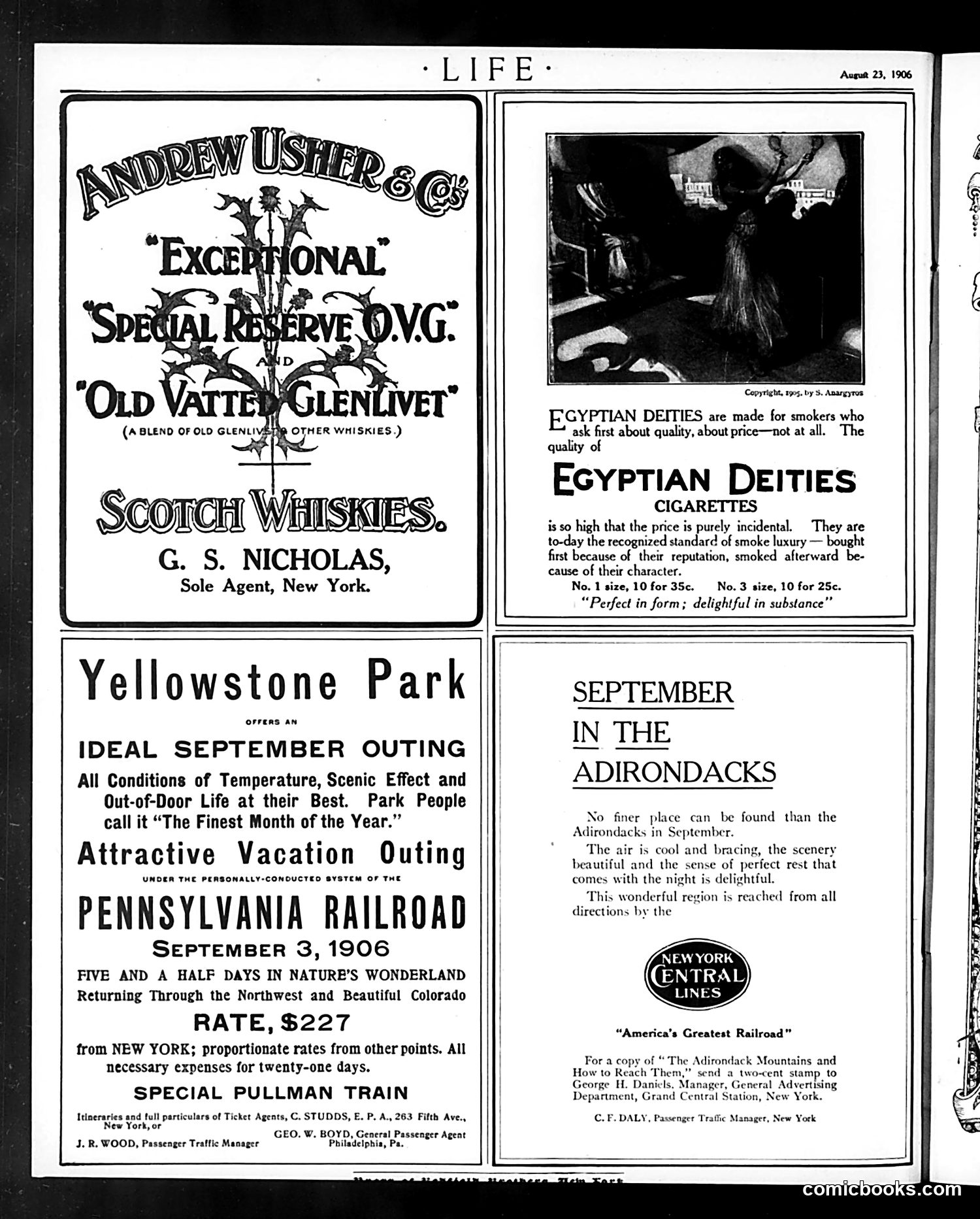
This page contains no political cartoons or satire—it is entirely **advertisements and travel promotions**. The content includes: **Commercial ads**: Andrew Usher whisky ("Old Vatted Glenlivet"), Egyptian Deities cigarettes (claiming superior quality and "smoke luxury"), positioned as aspirational luxury goods. **Travel promotions**: Two competing railroad vacation packages—the Pennsylvania Railroad advertising a 5.5-day Yellowstone Park trip ($227, September 3, 1906) and the New York Central promoting the Adirondacks as a September destination, both emphasizing scenic beauty and comfort. The page reflects early-1900s advertising conventions: appeals to refinement and leisure for affluent readers, and railroad competition for tourist dollars. Modern readers should note: cigarettes were openly marketed as quality products; train travel was the primary vacation conveyance for the wealthy.