
Life, 1906-08-23 · page 14 of 20
Life — August 23, 1906 — page 14: what you’re looking at
What you’re looking at
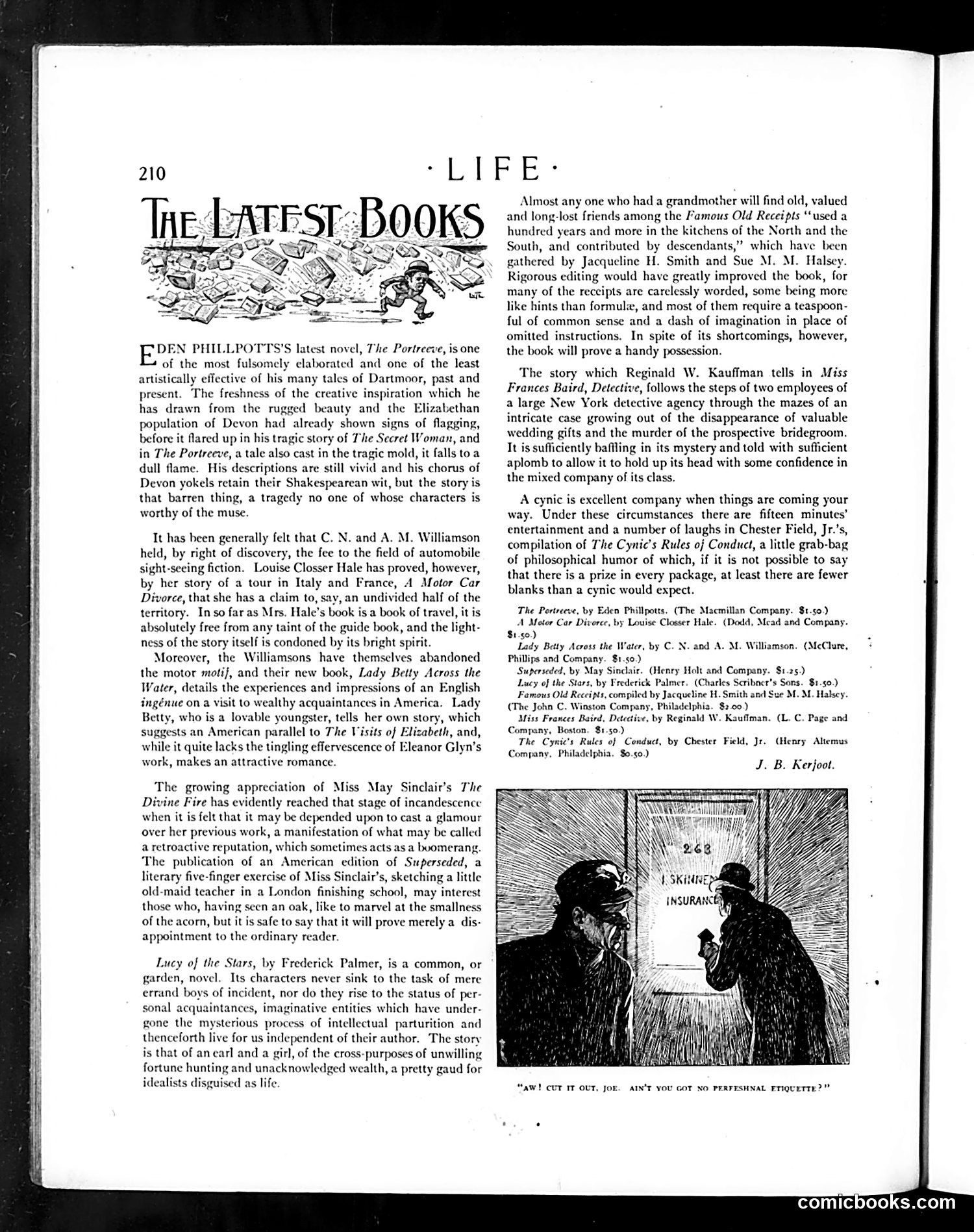
This page reviews recent novels and includes a single cartoon at the bottom. The cartoon depicts two men in formal attire examining what appears to be an insurance document marked "268." One man says to the other: "Aw! cut it out, Joe—ain't you got no professional etiquette?" The joke appears to reference *professional ethics* regarding insurance—likely satirizing aggressive or improper sales tactics or claims practices common in the insurance industry at that time. The cartoon suggests one man is being overly pushy or unethical in his professional conduct, while his colleague calls him out for violating unwritten professional standards. The bulk of the page comprises literary criticism of contemporary novels by authors like Eden Phillpotts and May Sinclair, making this primarily a book review section with a sidebar cartoon on an unrelated commercial/business topic.
📄 Transcribed text from this page (OCR, searchable)
Machine-transcribed from the original scan — historical spelling and the odd misread are preserved.
~LIFE * DEN PHILLPOTTS'S latest novel, The Portreeve, is one of the most fulsomely elaborated and one of the least artistically effective of his many tales of Dartmoor, past and present. The freshness of the creative inspiration which he has drawn from the rugged beauty and the Elizabethan population of Devon had already shown signs of flagging, before it flared up in his tragic story of The Secret Woman, and in The Portreeve, a tale also cast in the tragic mold, it falls toa dull flame. His descriptions are still vivid and his chorus of Devon yokels retain their Shakespearean wit, but the story is that barren thing, a tragedy no one of whose characters is worthy of the muse. It has been generally felt that C. N. and A. M. Williamson held, by right of discovery, the fee to the field of automobile sight-seeing fiction. Louise Closser Hale has proved, however, by her story of a tour in Italy and France, A Motor Car Divorce, that she has a claim to, say, an undivided half of the territory. In so far as Mrs. Hale’s book is a book of travel, it is absolutely free from any taint of the guide book, and the light- ness of the story itself is condoned by its bright spirit. Moreover, the Williamsons have themselves abandoned the motor motif, and their new book, Lady Betty Across the Water, details the experiences and impressions of an English ingénue ona visit to wealthy acquaintances in America. Lady Betty, who is a lovable youngster, tells her own story, which suggests an American parallel to The Visits of Elizabeth, and, while it quite lacks the tingling effervescence of Eleanor Glyn’s work, makes an attractive romance. The growing appreciation of Miss May Sinclair's The Divine Fire has evidently reached that stage of incandescence when it is felt that it may be depended upon to cast a glamour over her previous work, a manifestation of what may be called a retroactive reputation, which sometimes acts as a buomerang. The publication of an American edition of Superseded, a literary five-finger exercise of Miss Sinclair’s, sketching a little old-maid teacher in a London finishing school, may interest those who, having seen an oak, like to marvel at the smallness of the acorn, but it is safe to say that it will prove merely a dis- appointment to the ordinary reader. Lucy of the Stars, Frederick Palmer, is a common, or garden, novel. Its characters never sink to the task of mere errand boys of incident, nor do they rise to the status of per- sonal acquaintances, imaginative entities which have under- gone the mysterious process of intellectual parturition and thenceforth live for us independent of their author. The story is that of ancarl and a girl, of the cross-purposes of unwilling fortune hunting and unacknowledged wealth, a pretty gaud for idealists disguised as life. Almost any one who had a grandmother will find old, valued and long-lost friends among the Famous Old Receipts “used a hundred years and more in the kitchens of the North and the South, and contributed by descendants,” which have been gathered by Jacqueline H. Smith and Sue M. M. Halsey. Rigorous editing would have greatly improved the book, for many of the receipts are carelessly worded, some being more like hints than formule, and most of them require a teaspoon- ful of common sense and a dash of imagination in place of omitted instructions. In spite of its shortcomings, however, the book will prove a handy possession. The story which Reginald W. Kauffman tells in Miss Frances Baird, Detective, follows the steps of two employces of a large New York detective agency through the mazes of an intricate case growing out of the disappearance of valuable wedding gifts and the murder of the prospective bridegroom. It is sufficiently bafiling in its mystery and told with sufficient aplomb to allow it to hold up its head with some confidence in the mixed company of its class. A cynic is excellent company when things are coming your way. Under these circumstances there are fifteen minutes’ entertainment and a number of laughs in Chester Field, Jr.’s, compilation of The Cynic’s Rules of Conduct, a little grab-bag of philosophical humor of which, if it is not possible to say that there is a prize in every package, at least there are fewer blanks than a cynic would expect. The Portreeve, by Eden Phillpotts. (The Macmillan Company. $1.50.) A Motor Car Divorce, by Louise Closser Hale. (Dodd, Mcad and Company. $1.50.) Lady Betty Across the Water, by C. N. and A. M. Williamson. (McClure, Phillips and Company. $1.50.) Superseded, by May Sindair. (Henry Holt and Company. $1.25.) Lucy of the Stars, by Frederick Palmer. (Charles Scribnct’s Sons. $1.50.) Famous Old Receipts, compiled by Jacqueline H. Smith and Sue M. M. Halsey (The John C. Winston Company, Philadelphia. $2.00.) Miss Frances Baird, Detective, by Reginald W. Kauffman. (L. C. Page and Boston. $1.50.) ‘ynie’s Rules of Conduct, by Chester Field, Jr. (Henry Altemus Company, Philadelphia. $0.50.) J. B. Kerjoot. “aw! CUT IT OUT, JOE. AIN'T YOU GOT No PERFESHNAL ETIQUETTE?” comicbooks.com