
Life, 1906-08-23 · page 3 of 20
Life — August 23, 1906 — page 3: what you’re looking at
What you’re looking at
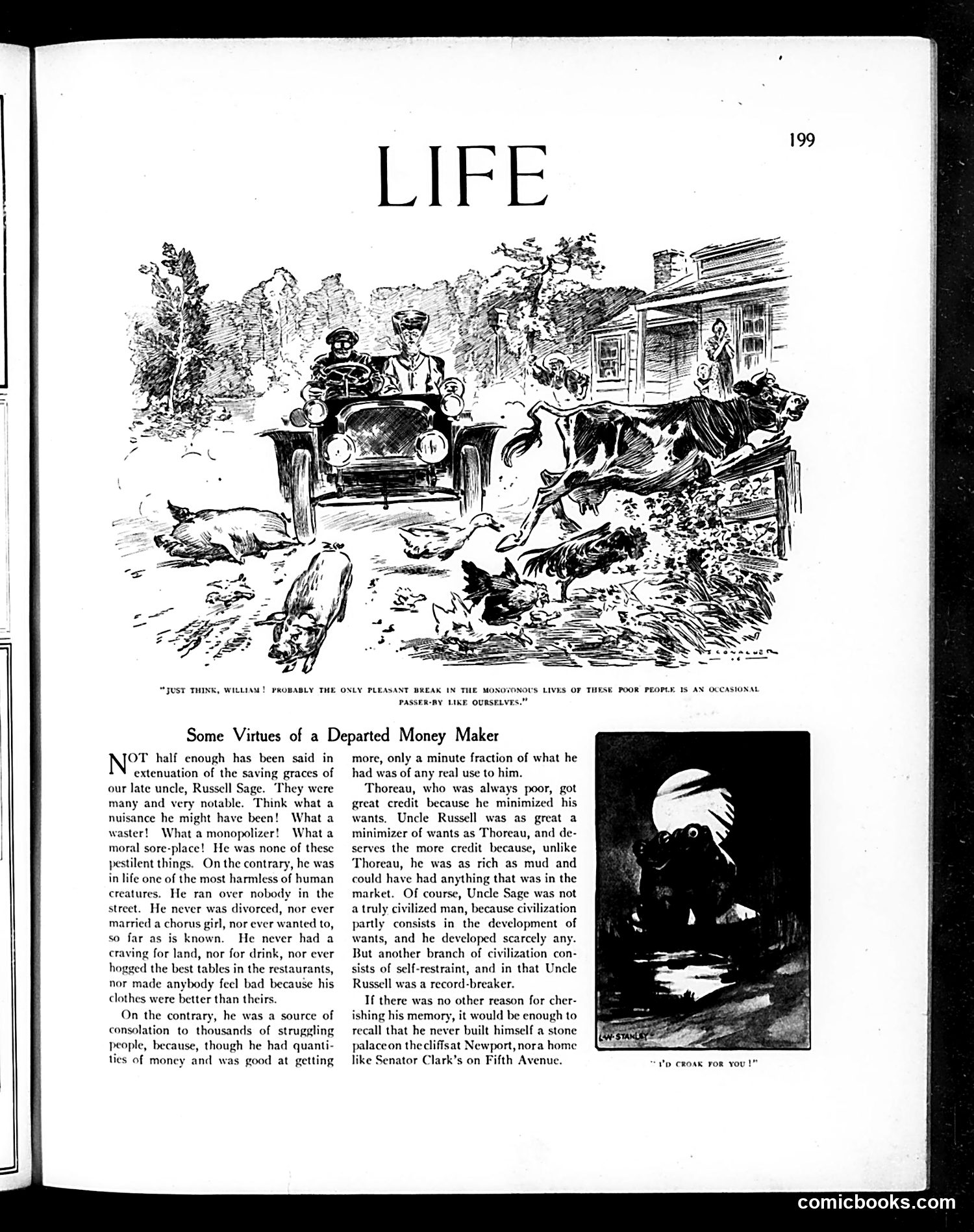
This page commemorates **Russell Sage**, a wealthy financier who recently died. The top cartoon shows a wealthy man in an automobile passing poor people and animals in a rural setting—satirizing how Sage's presence brought little benefit to struggling communities despite his vast wealth. The article praises Sage's virtue of *minimizing wants* rather than accumulating possessions. It compares him favorably to Thoreau (the philosopher), crediting Sage for self-restraint and lack of ostentation. The satire is subtle: while calling Sage virtuous for not building mansions or displaying wealth, the cartoon ironically shows his indifference to poverty surrounding him. The piece suggests Sage's greatest virtue was simply leaving people alone—a backhanded compliment about his limited positive impact.
📄 Transcribed text from this page (OCR, searchable)
Machine-transcribed from the original scan — historical spelling and the odd misread are preserved.
“JUST THINK, WILLIAM! PROBABLY THE ONLY PLEASANT BREAK IN THE MONO’ PASSER-RY LIKE OURSELVES.’ Some Virtues of a Departed Money Maker No half enough has been said in extenuation of the saving graces of our late uncle, Russell Sage. They were many and very notable. Think what a nuisance he might have been! What a waster! What a monopolizer! What a moral sore-place! He was none of these pestilent things. On the contrary, he was in life one of the most harmless of human creatures. He ran over nobody in the street. He never was divorced, nor ever married a chorus girl, nor ever wanted to, so far as is known. He never had a craving for land, nor for drink, nor ever hogged the best tables in the resta ts, nor made anybody feel bad because his clothes were better than theirs. On the contrary, he was a source of consolation to thousands of struggling people, because, though he had quanti- ties of money and was good at getting more, only a minute fraction of what he had was of any real use to him. Thoreau, who was always poor, got great credit because he minimized his wants. Uncle Russell was as great a minimizer of wants as Thoreau, and de- serves the more credit because, unlike Thoreau, he was as rich as mud and could have had anything that was in the market. Of course, Uncle Sage was not a truly civilized man, because civilization partly consists in the development of wants, and he developed scarcely any. But another branch of civilization con- sists of self-restraint, and in that Uncle Russell was a record-breaker. If there was no other reason for cher- ishing his memory, it would be enough to recall that he never built himself a stone palaceon theclifisat Newport, nora home like Senator Clark’s on Fifth Avenue. 'S LIVES OF THESE POOR PEOPLE 1S AN OCCASIONAL “1'p CROAK FoR You!" comicbooks.com