
A complete issue · 20 pages · 1906
Life — July 26, 1906
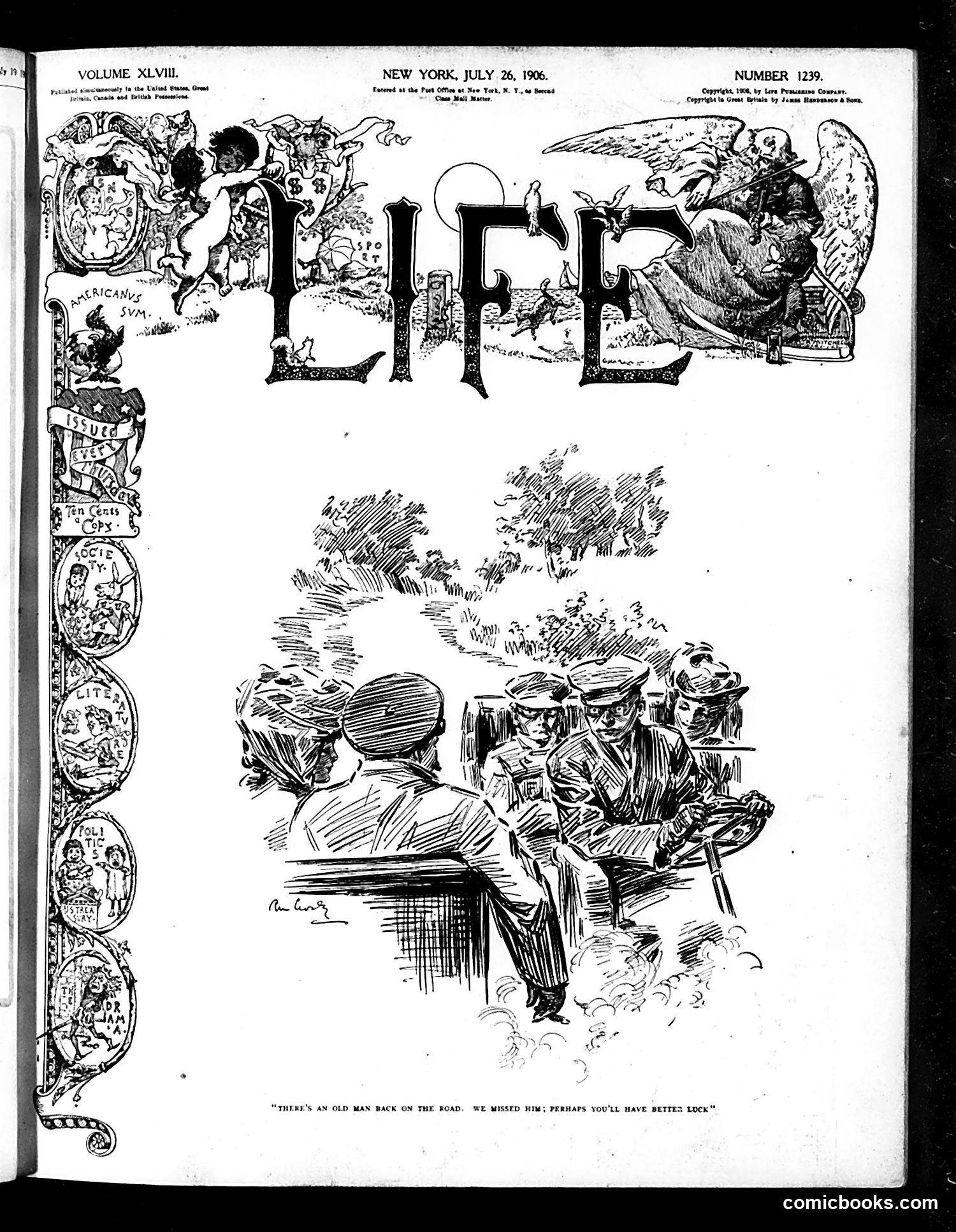
This page features a cartoon captioned "There's an old man back on the road. We missed him; perhaps you'll have better luck." The sketch shows what appears to be soldiers or military men on horseback encountering travelers on a road. The "old man" reference likely pertains to a contemporary political or military figure—possibly related to the Roosevelt administration's foreign policy activities in 1906, though without clearer identification I cannot specify which event is satirized. The ornate left border contains period decorative elements typical of Life's design. The cartoon's satirical point seems critical of military operations or police action, suggesting someone was "missed" in an official pursuit, implying incompetence or escape. Without additional context about 1906 events, the specific target remains unclear.
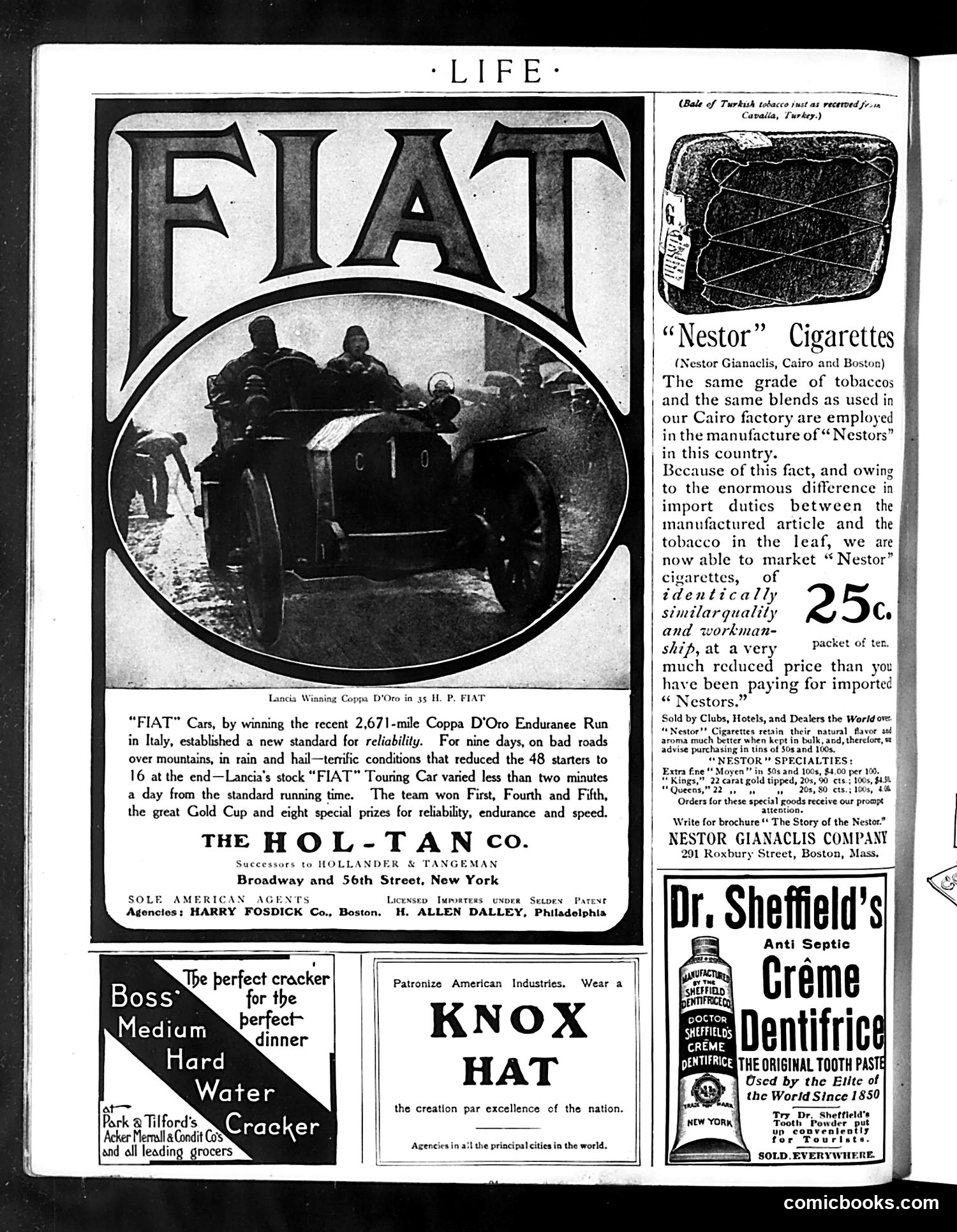
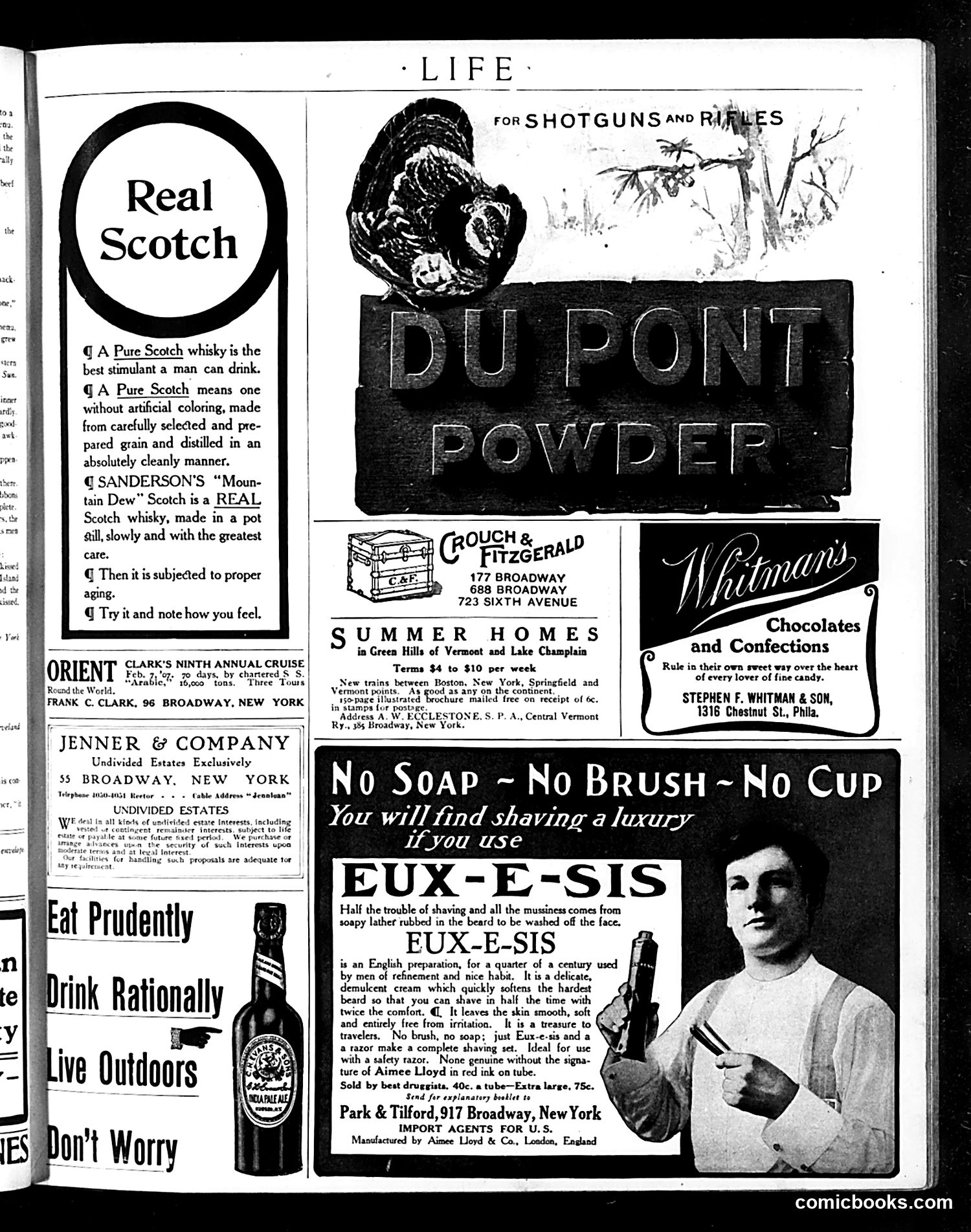
This page is primarily **advertising rather than satire or political commentary**. The main content features three advertisements: 1. **FIAT automobiles** - promoting their racing victory in the Coppa d'Oro endurance race in Italy, emphasizing reliability under extreme conditions 2. **Nestors Cigarettes** - highlighting their Egyptian tobacco and competitive pricing (25¢) compared to imported brands 3. Smaller ads for **Boss crackers, Knox hats, and Dr. Sheffield's tooth paste** The FIAT ad uses a photograph of a racing car to sell reliability to consumers, a common early automotive marketing strategy. There is no political satire visible on this page—it represents typical commercial advertising from Life magazine's revenue model rather than editorial content.
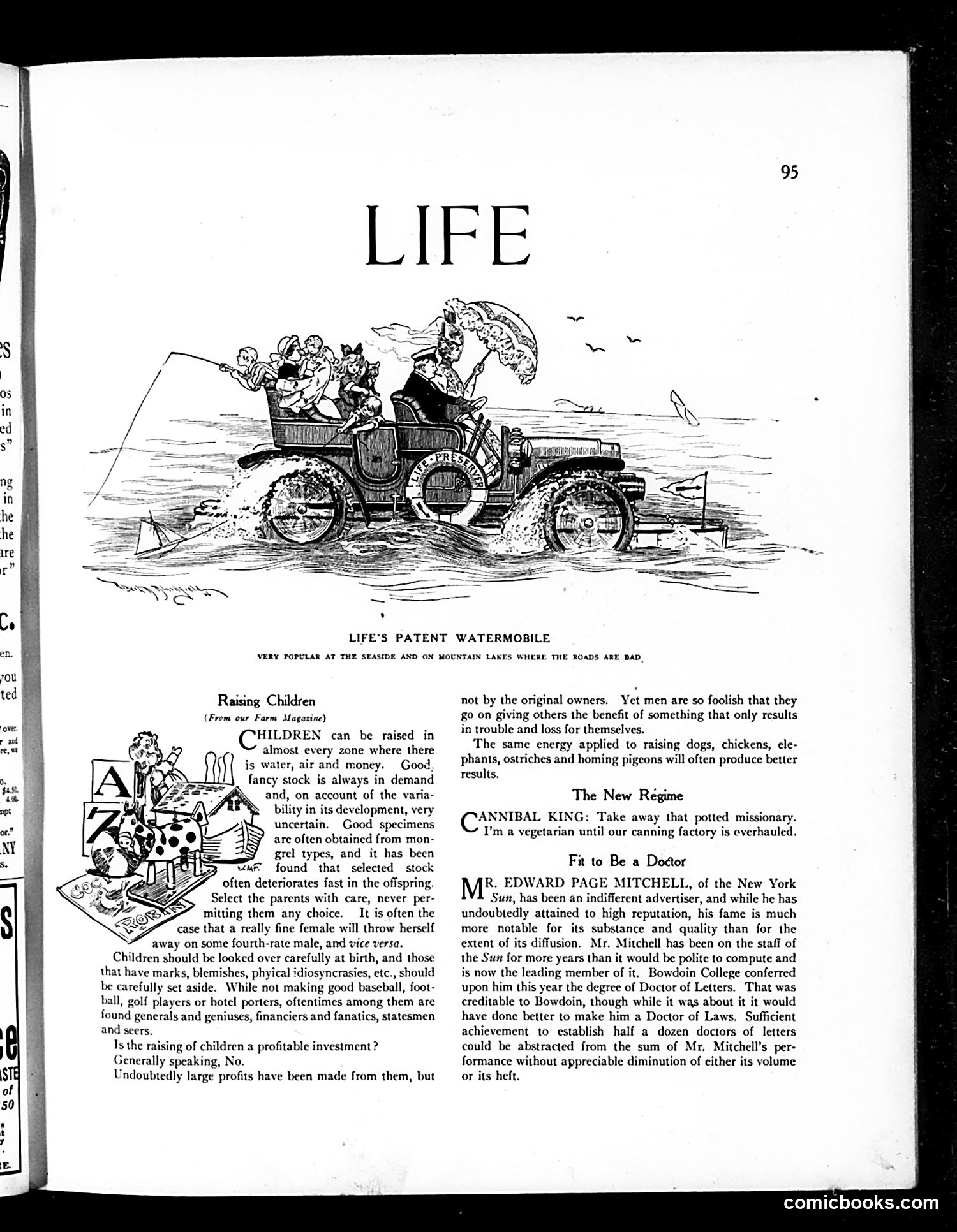
**Main Illustration**: "Life's Patent Watermobile" depicts an early automobile amphibiously traversing water with passengers, umbrellas, and cargo. This satirizes primitive early-1900s automobiles' unreliability and the absurd inventions promoted during the automotive boom. **"Raising Children" Section**: The text humorously discusses breeding children like livestock for desirable traits—a troubling reference to then-popular eugenics pseudoscience. It treats child-rearing as a financial investment while mocking parents' actual profits. **"The New Régime" Section**: Sarcastically congratulates Edward Page Mitchell of the *New York Sun* for receiving an honorary doctorate, implying his journalistic credentials alone shouldn't merit academic honors. The overall tone is satirical commentary on contemporary social trends: automotive fads, pseudoscientific parenting theories, and unwarranted prestige-seeking.
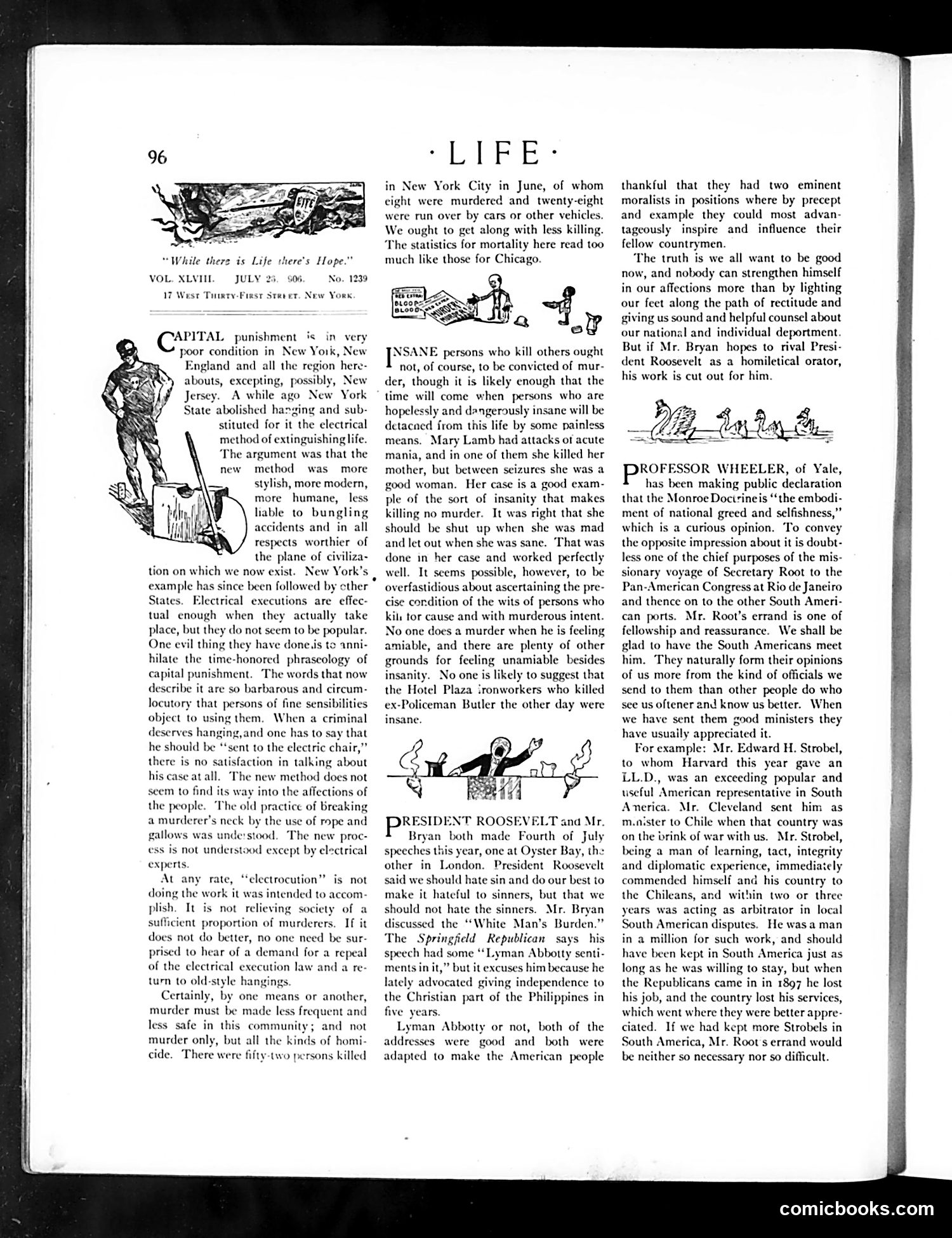
The page contains editorial commentary on capital punishment and criminal justice rather than traditional political cartoons. The main arguments discussed include: **Key Topics:** - Capital punishment's effectiveness as deterrent in New York - A case involving Mary Lamb, who killed her mother during a mental health crisis—presented as an example of how insanity complicates murder convictions - Criticism of electrical execution methods as inhumane **Political References:** - President Roosevelt and Mr. Bryan (William Jennings Bryan) are mentioned regarding their differing views on criminal punishment and morality - Reference to Edward H. Strobel's diplomatic work in South America under Cleveland administration The small decorative illustrations appear to be generic vignettes rather than specific political caricatures. The page focuses on serious policy debate about justice and punishment rather than satirical cartoon commentary.
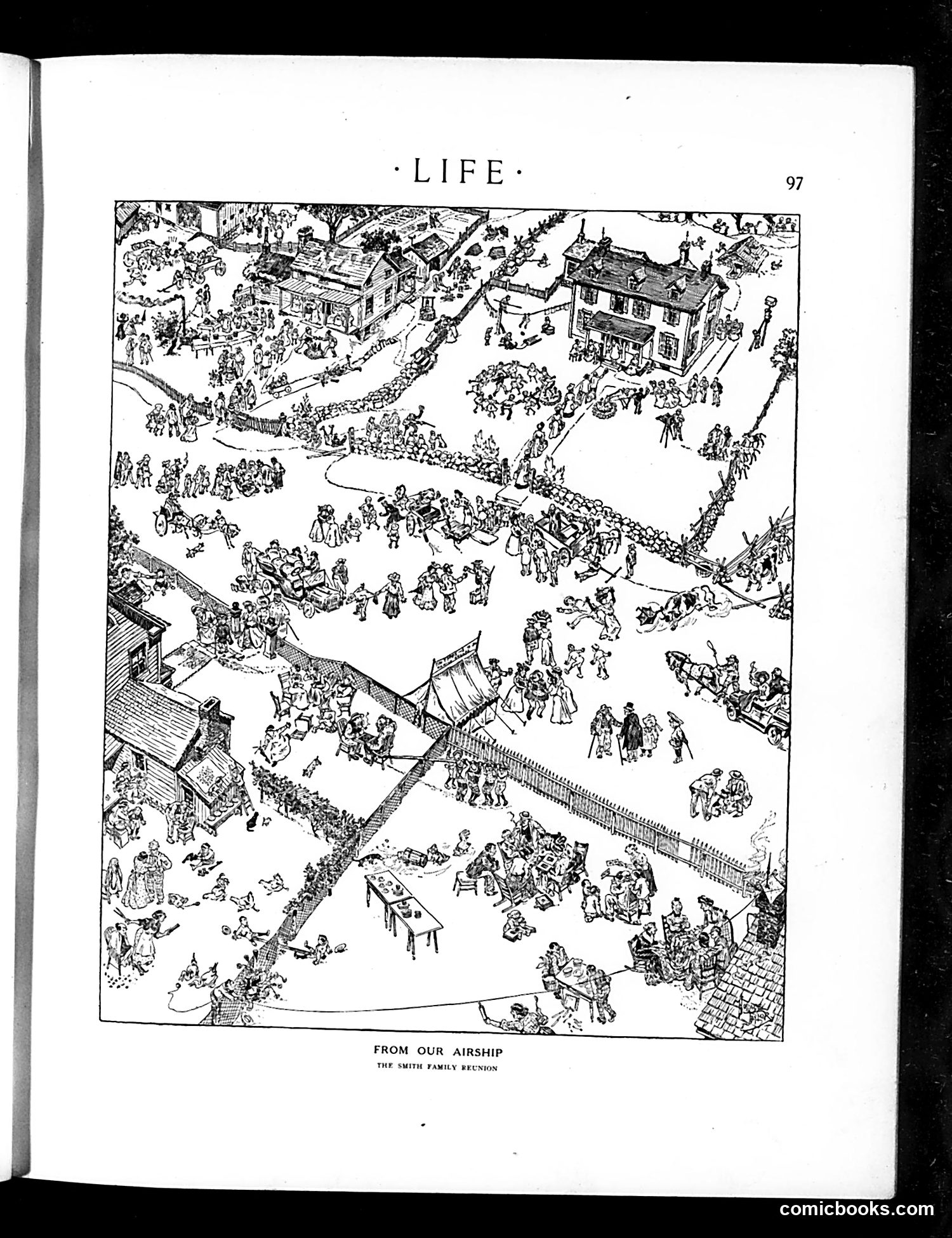
This is a humorous bird's-eye illustration depicting a large family gathering viewed from above, as if from an airship. The title suggests the perspective of aerial photography, a relatively novel technology in the early 20th century when Life magazine was popular. The joke appears to be satirizing the chaos and scale of family reunions—hundreds of tiny figures are scattered across grounds with buildings, creating an overwhelming scene of domestic gathering. The aerial viewpoint transforms an intimate family event into a sprawling, almost comical spectacle. The "Smith" name suggests this is a generic Everyman family, making the satire relatable to readers who've experienced similarly chaotic family events. The humor lies in the contrast between the orderly intention of a reunion and its actual messy reality.
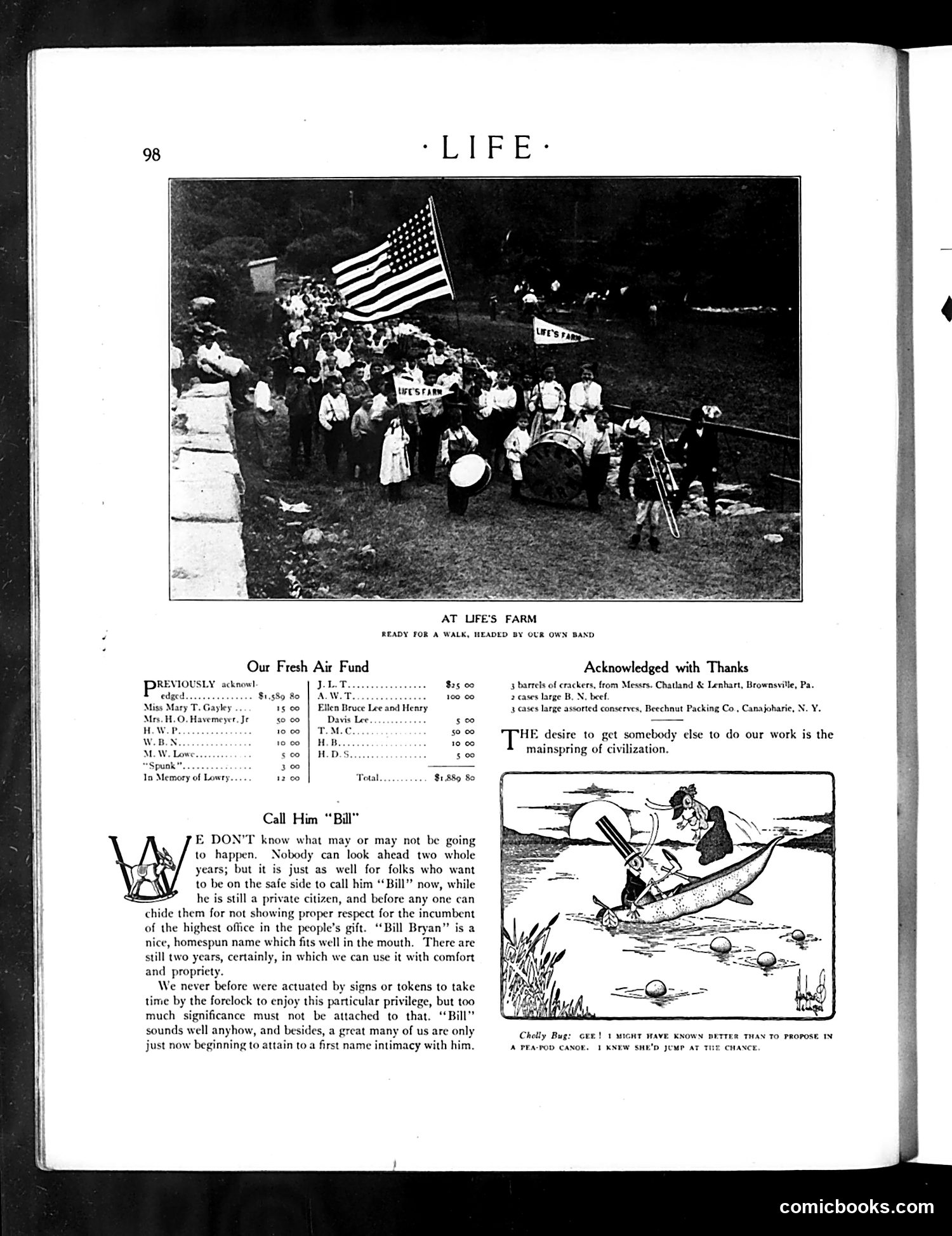
**Top Image:** "At Life's Farm — Ready for a Walk, Headed by Our Own Band" shows a large group gathered around an American flag, apparently preparing for a procession or march. The caption suggests this depicts a civic or patriotic gathering. **Main Article:** "Call Him 'Bill'" discusses William Jennings Bryan (the "Bill Bryan" referenced). The text argues against attaching excessive symbolic importance to calling him by an informal name—a plea for measured respect regardless of his political position. This suggests contemporary debate about Bryan's status and how to properly address him. **Bottom Cartoon:** A humorous illustration of someone fishing, with a caption about a caddy bag and a jump shot, appears to be an unrelated sporting joke. The page reflects early 20th-century American political and social commentary.
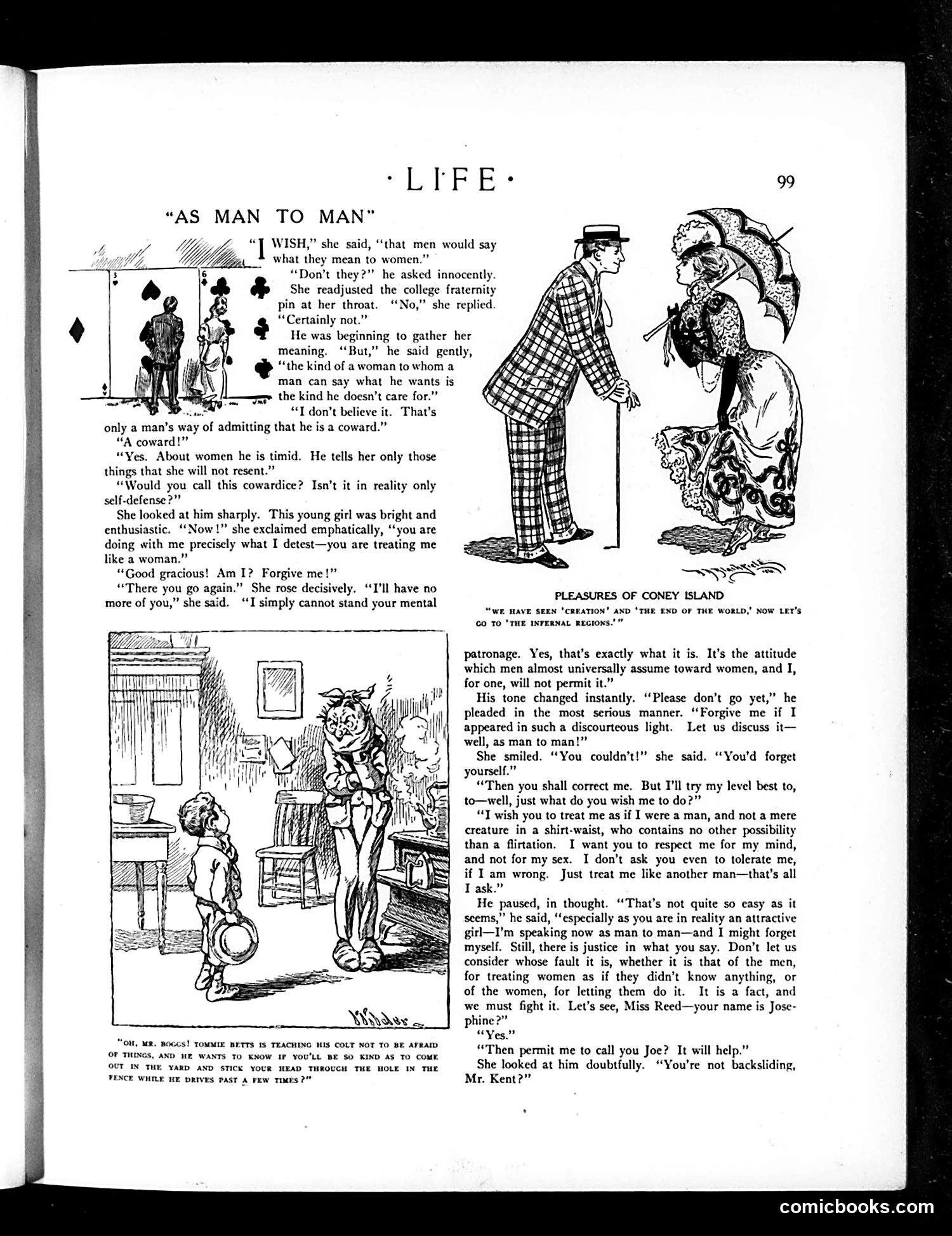
This page presents a dialogue between a young woman (Josephine Reed) and a man (Mr. Kent) debating gender equality and respect in relationships. The text satirizes traditional male attitudes toward women: men speak candidly with other men but hide their true feelings from women, whom they treat as delicate creatures rather than equals. The woman challenges this as cowardice masquerading as chivalry. The two cartoon illustrations depict domestic scenes—one showing what appears to be a devil-figure teaching a child, the other illustrating the ongoing conversation. The satire targets early 20th-century gender dynamics, mocking men's patronizing "protection" of women while advocating for honest, respectful treatment of women as intellectual and moral equals—a progressive stance for the era.
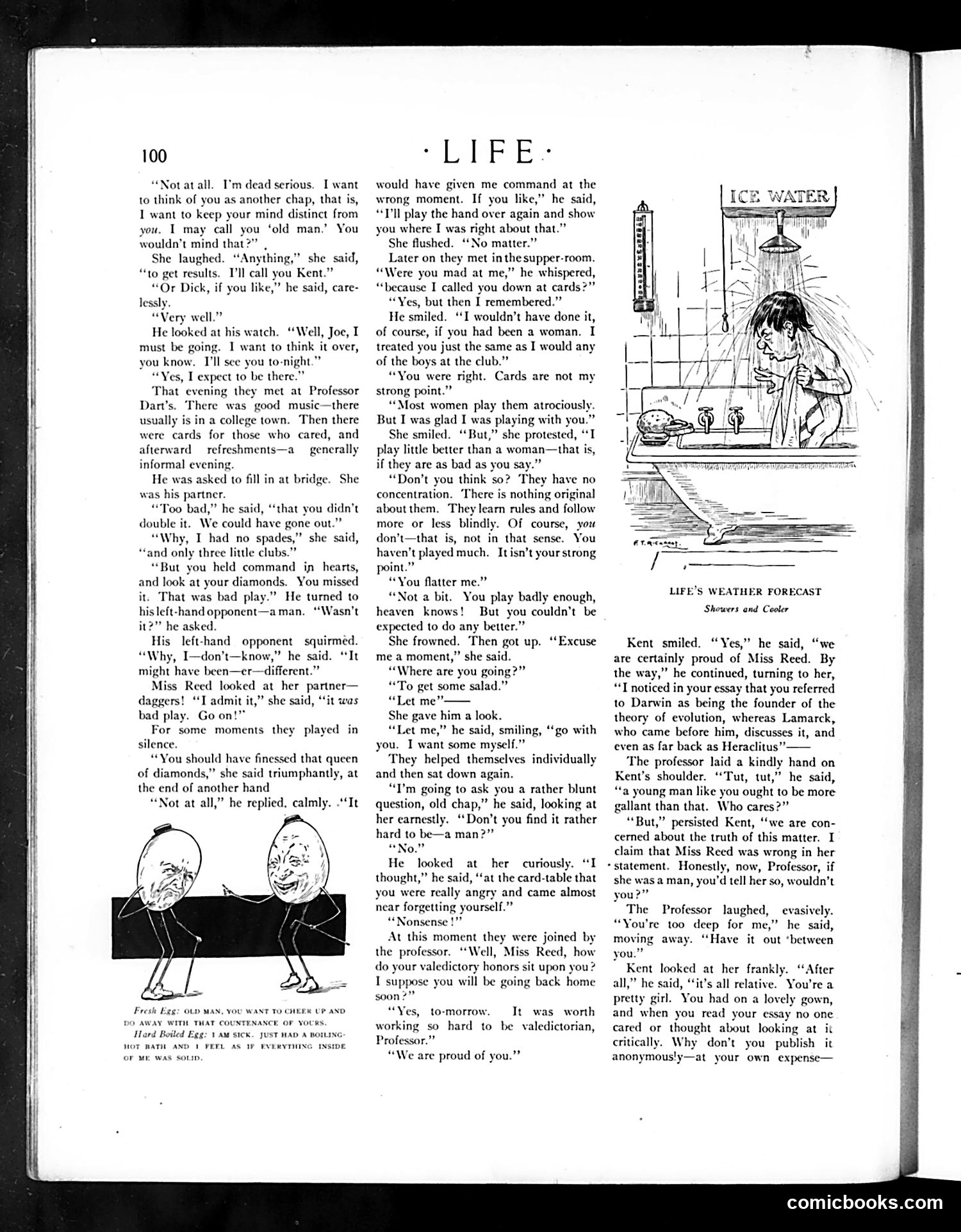
This page contains a short story with two accompanying illustrations. The main cartoon (lower left) shows two caricatured figures in formal dress engaged in conversation, illustrating a scene from the narrative about card-playing and social etiquette. The illustration titled "LIFE'S WEATHER FORECAST" (right side) depicts a woman at what appears to be a weather station or observation post, likely a visual pun connecting meteorological forecasting to personal/romantic "forecasting." The story itself is a romantic comedy about miscommunication between a young man and woman regarding card games, diamonds, and proper courtship behavior. The humor stems from their differing perspectives on gender roles and appropriate conduct in early 20th-century society—she views his treatment as patronizing, while he believes he's being gentlemanly. No specific political content is evident; the satire targets social conventions of the era.
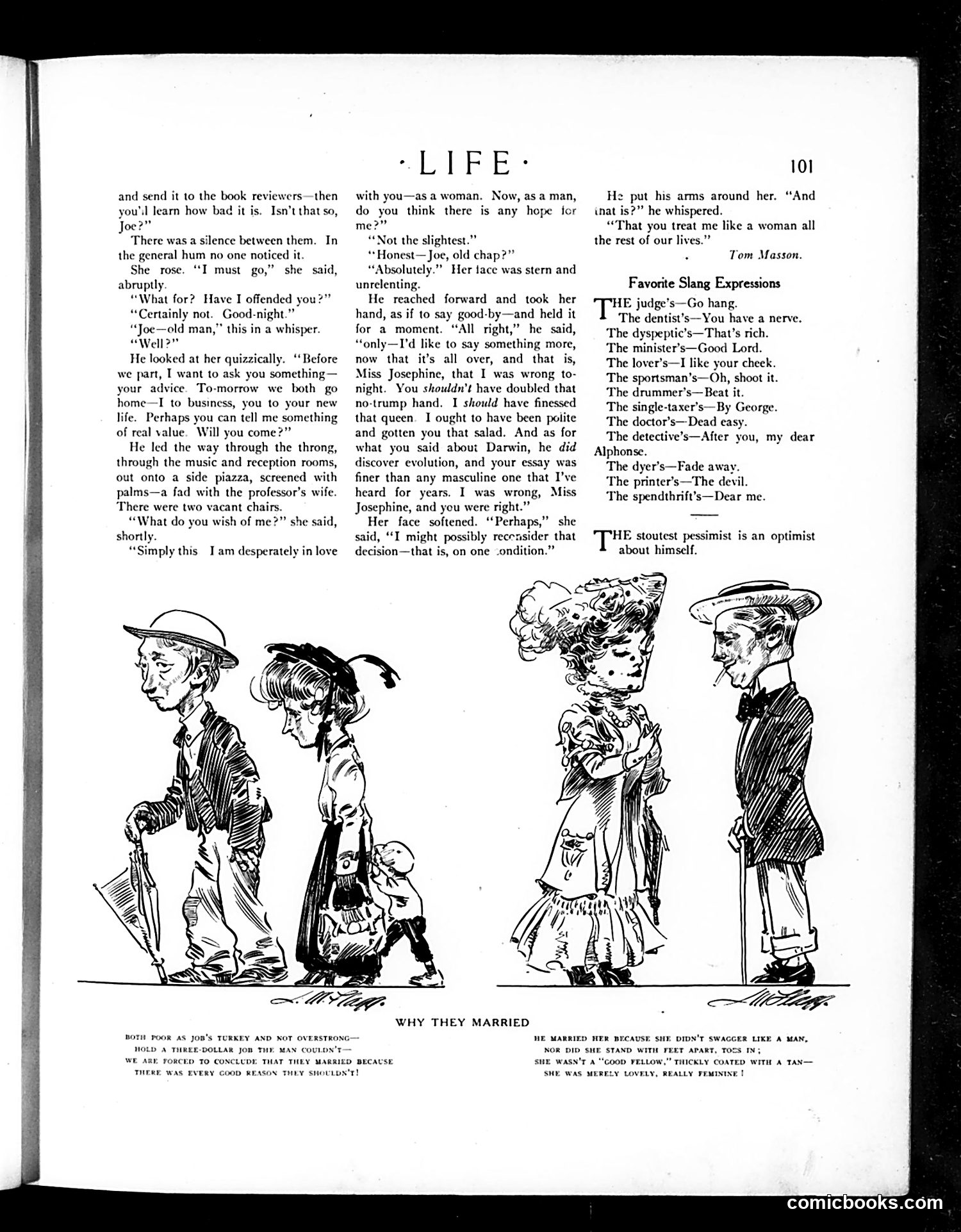
This two-panel comic uses exaggerated caricature to mock marriage motivations. The left panel depicts a poor, older man with a younger woman and child, captioned with crude reasoning about economic security. The right panel shows a woman with elaborate dress marrying a plain man, with the caption suggesting she married him because he was financially stable ("good fellow") despite being unattractive. The satire targets mercenary attitudes toward marriage prevalent in early 20th-century society—suggesting both genders married for financial rather than romantic reasons. The grotesque facial caricatures emphasize the couples' incompatibility, implying marriage was fundamentally a business transaction rather than a love match.
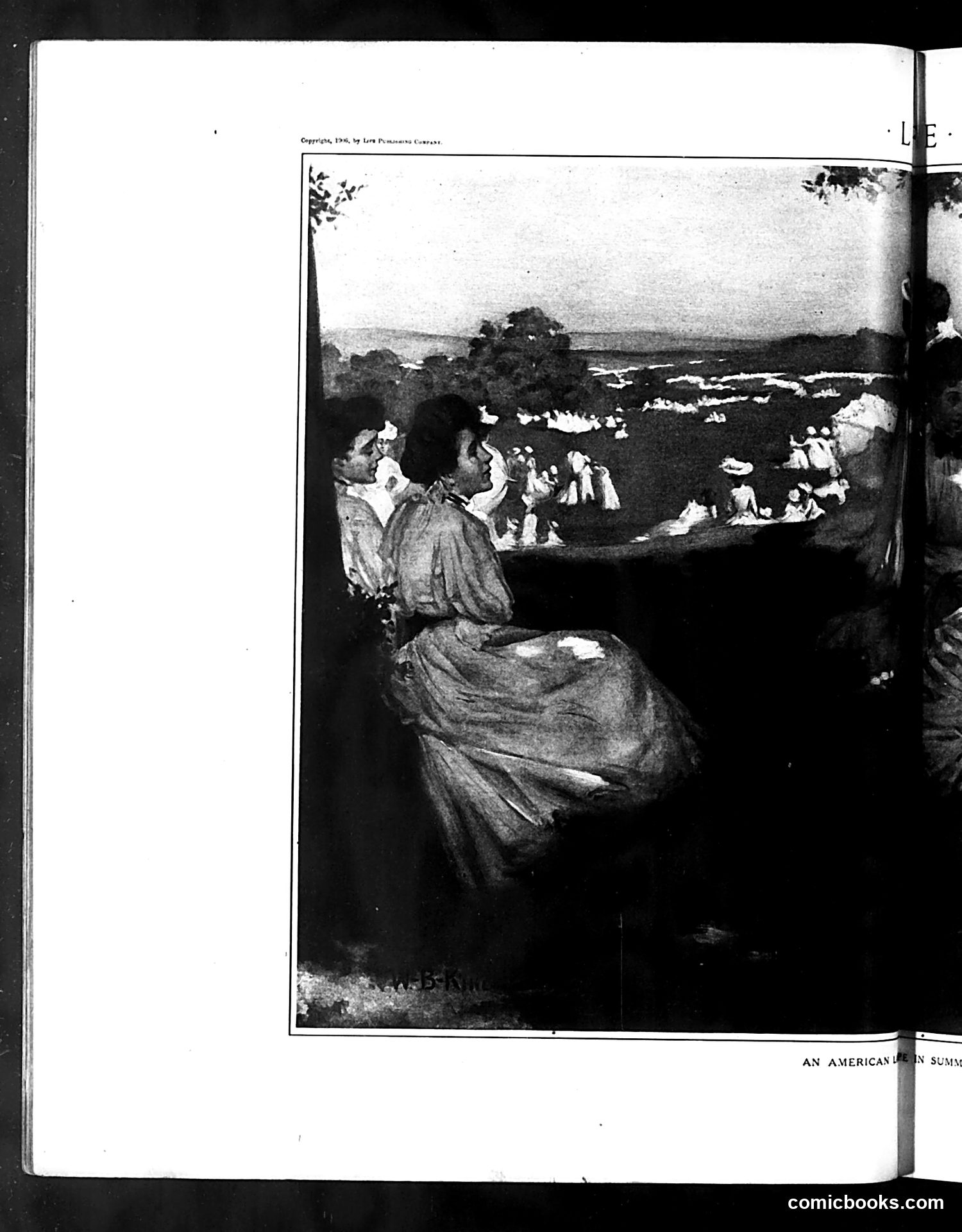
This page appears to be from Life magazine and shows a black-and-white illustration titled "AN AMERICAN IN SUMM[ER]" (text cut off). The image depicts figures in period dress observing a landscape scene. Two women in the foreground wear flowing garments suggesting late 19th or early 20th-century clothing. They gaze toward a pastoral scene with numerous figures scattered across a field or meadow, with trees and water visible in the distance. Without complete text or caption, the specific satirical intent is unclear. The composition suggests commentary on American leisure, tourism, or social observation, possibly satirizing how Americans experience or regard pastoral or rural settings. The detailed rendering of onlookers suggests the humor may derive from their reactions or the contrast between observers and observed, though the precise reference remains uncertain.
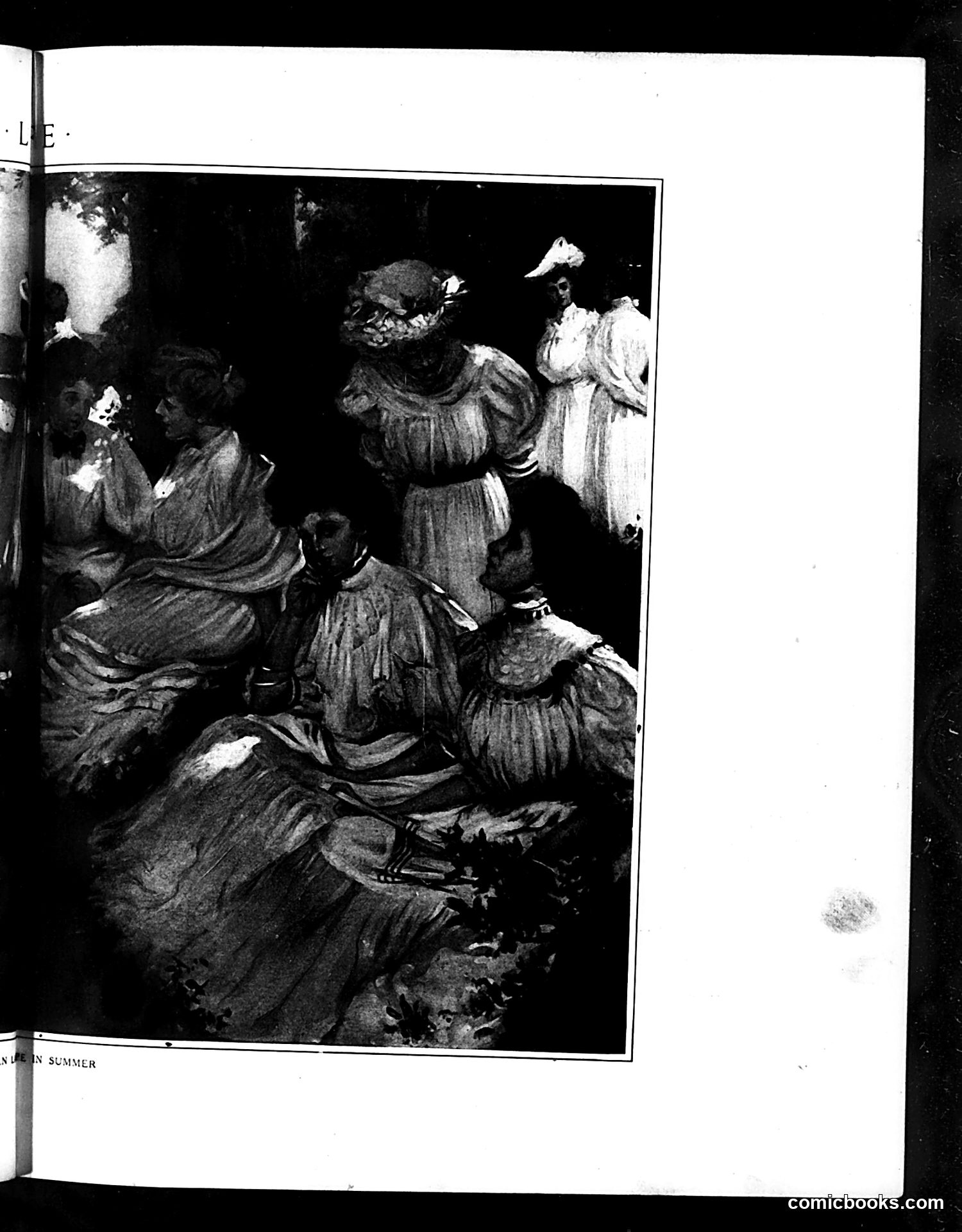
This appears to be a classical or allegorical illustration rather than a political cartoon. The image shows multiple female figures in draped Greco-Roman style clothing arranged in an indoor scene with dramatic lighting. The partially visible caption reads "...IN SUMMER," suggesting this is likely illustrating a seasonal theme or literary reference. The figures' poses and classical dress suggest this may be depicting a scene from mythology, literature, or an allegorical representation of summer activities among the leisure class. However, without seeing the complete caption or article title, I cannot definitively identify the specific subject matter or satirical intent. The image quality and style are consistent with early-to-mid 20th century Life magazine illustration.
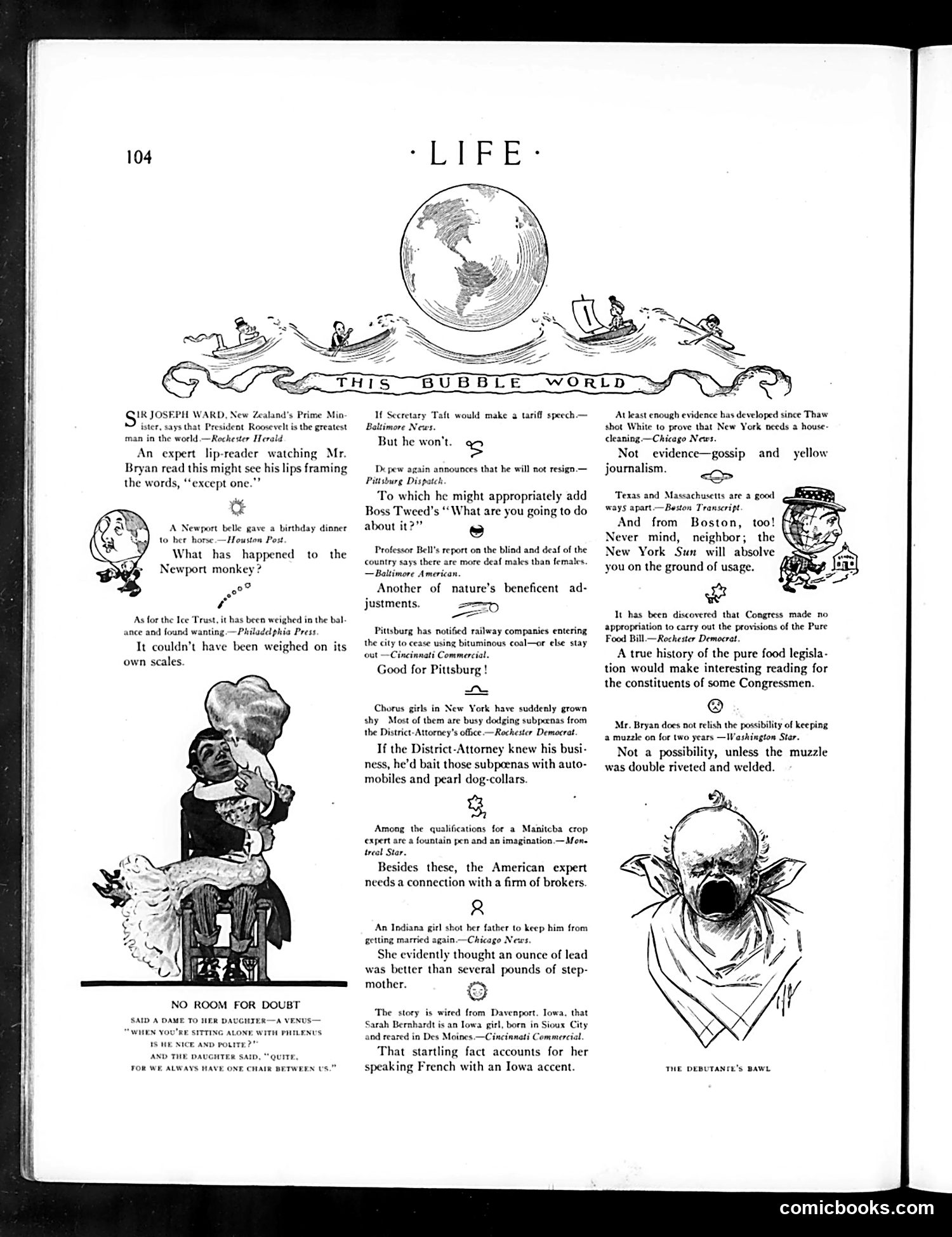
This page satirizes American news and social commentary through short quips and illustrations. The central globe labeled "This Bubble World" suggests fragile, transient news cycles. Key references include: - Roosevelt being called "the greatest man in the world" - Criticisms of tariff speeches and railroad regulation - Mockery of New York society (chorus girls, District Attorney subpoenas) - A joke about an Iowa girl speaking French with an accent The illustrations—including caricatured faces and a "debutante's bawl"—accompany these brief satirical items poking fun at politicians, high society, and regional American stereotypes. The overall effect ridicules contemporary news, pretension, and political figures through humor rather than explicit naming or serious commentary.
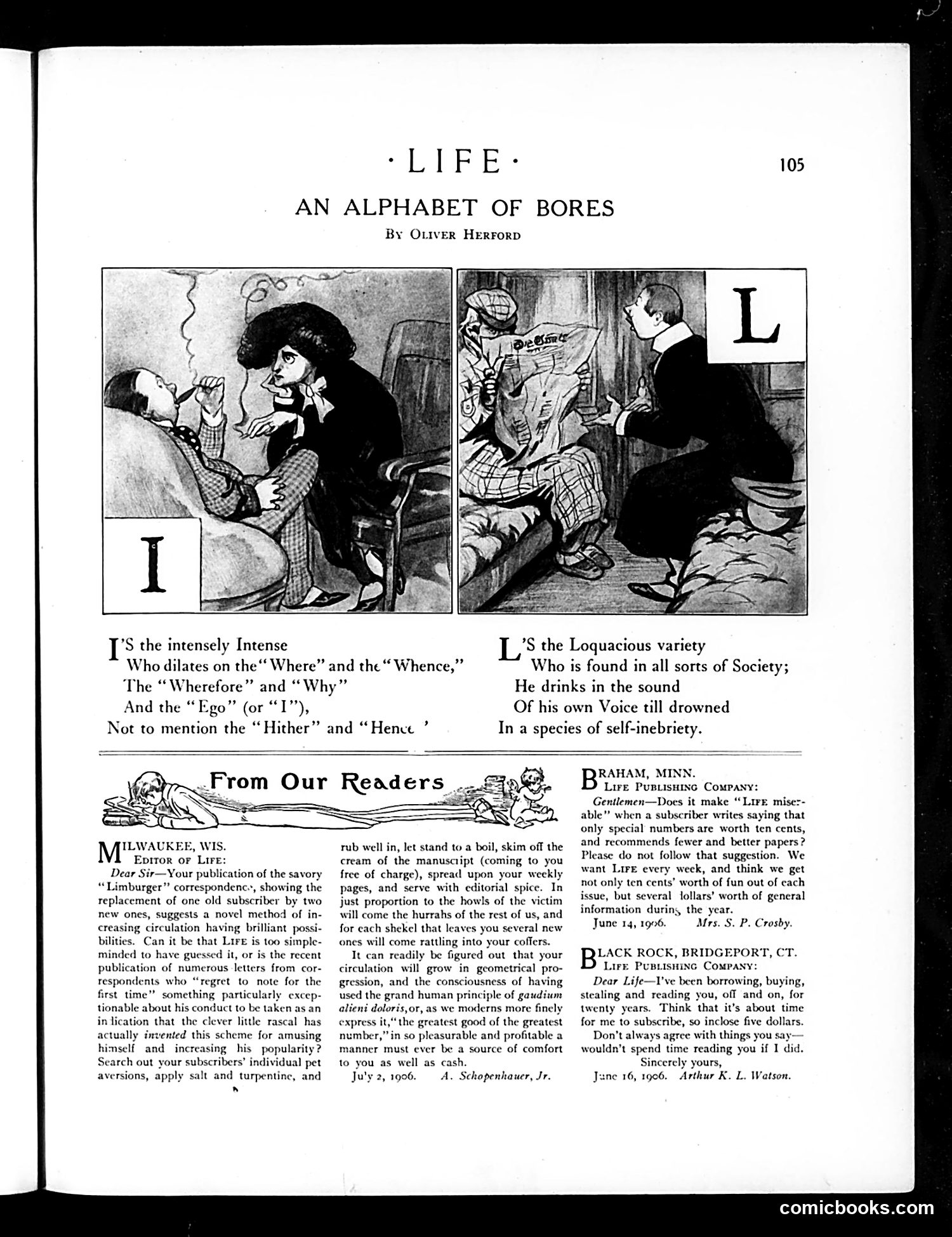
This page presents satirical character sketches defining social types through letters I and L. **"I"** depicts "the intensely Intense" person who obsessively dilates on abstract concepts like "Where," "Whence," "Why," and "Ego"—essentially a pretentious intellectual bore who speaks in philosophical jargon. **"L"** shows "the Loquacious variety" found in high society—a chronic talker who drowns out others with constant chatter, exhibiting "self-inebriety" (self-intoxication through his own voice). Both sketches mock early 20th-century social archetypes: the pseudo-intellectual and the insufferable conversationalist. The accompanying reader letters discuss *Life* magazine's circulation and content quality, suggesting this was a popular recurring feature satirizing recognizable personality types readers encountered socially.
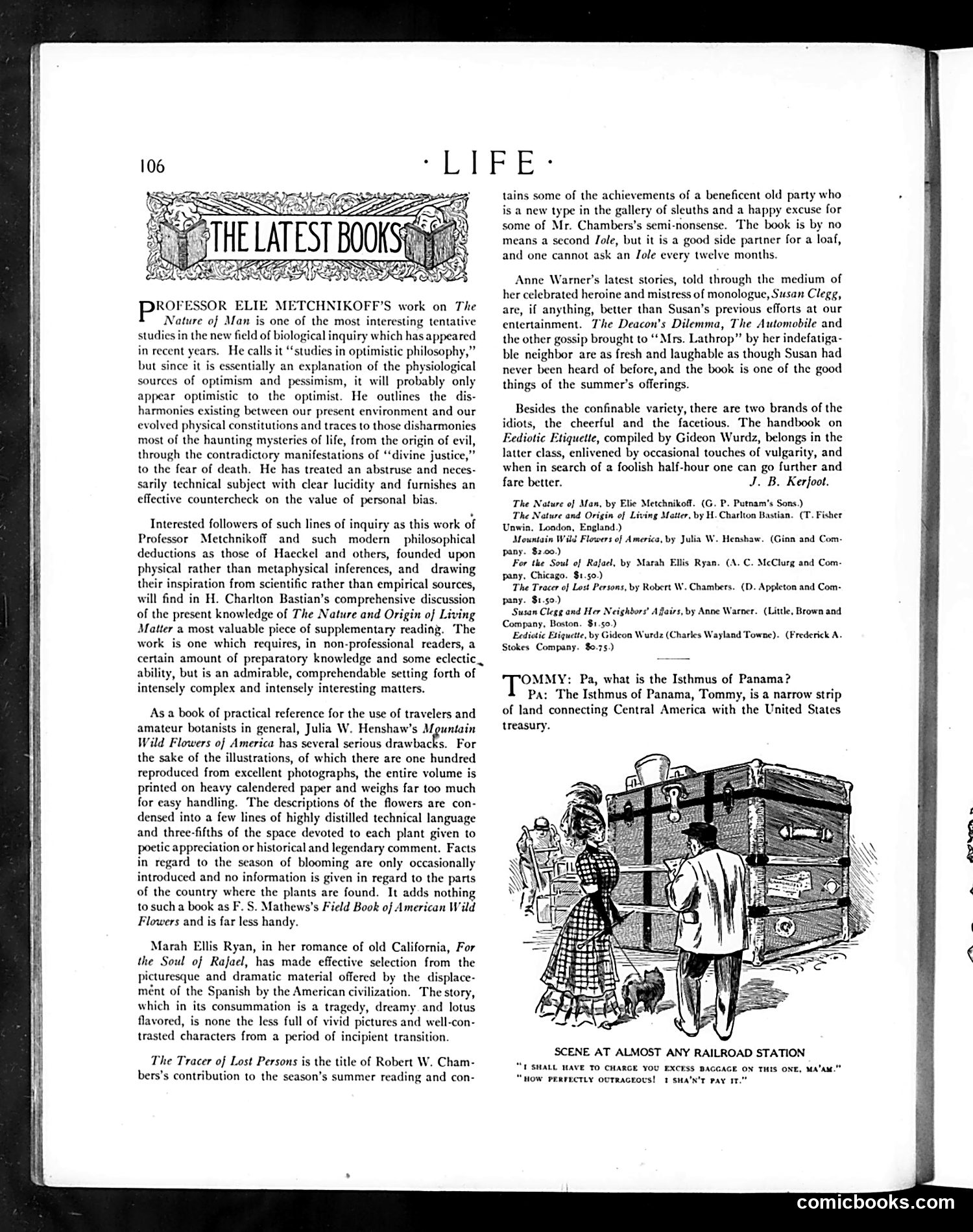
This page is primarily a **book review section** titled "The Latest Books," not a political cartoon. It contains literary criticism of contemporary works, including: - Professor Elie Metchnikoff's philosophical study *The Nature of Man* - Julia W. Henshaw's *Mountain Wild Flowers of America* (criticized for being too heavy and technically dense for practical use) - Marah Ellis Ryan's *For the Soul of Rafael* (a historical romance about Spanish displacement in California) - Robert W. Chambers's *The Tracer of Lost Persons* (a detective novel) - Anne Warner's stories featuring the character Susan Clegg The only illustration is a **small cartoon at page bottom** showing a railroad station scene with a woman and porter arguing over excess baggage charges—a humorous domestic vignette unrelated to the reviews above. The page reflects turn-of-the-century literary interests: scientific philosophy, nature study, historical romance, and popular detective fiction.
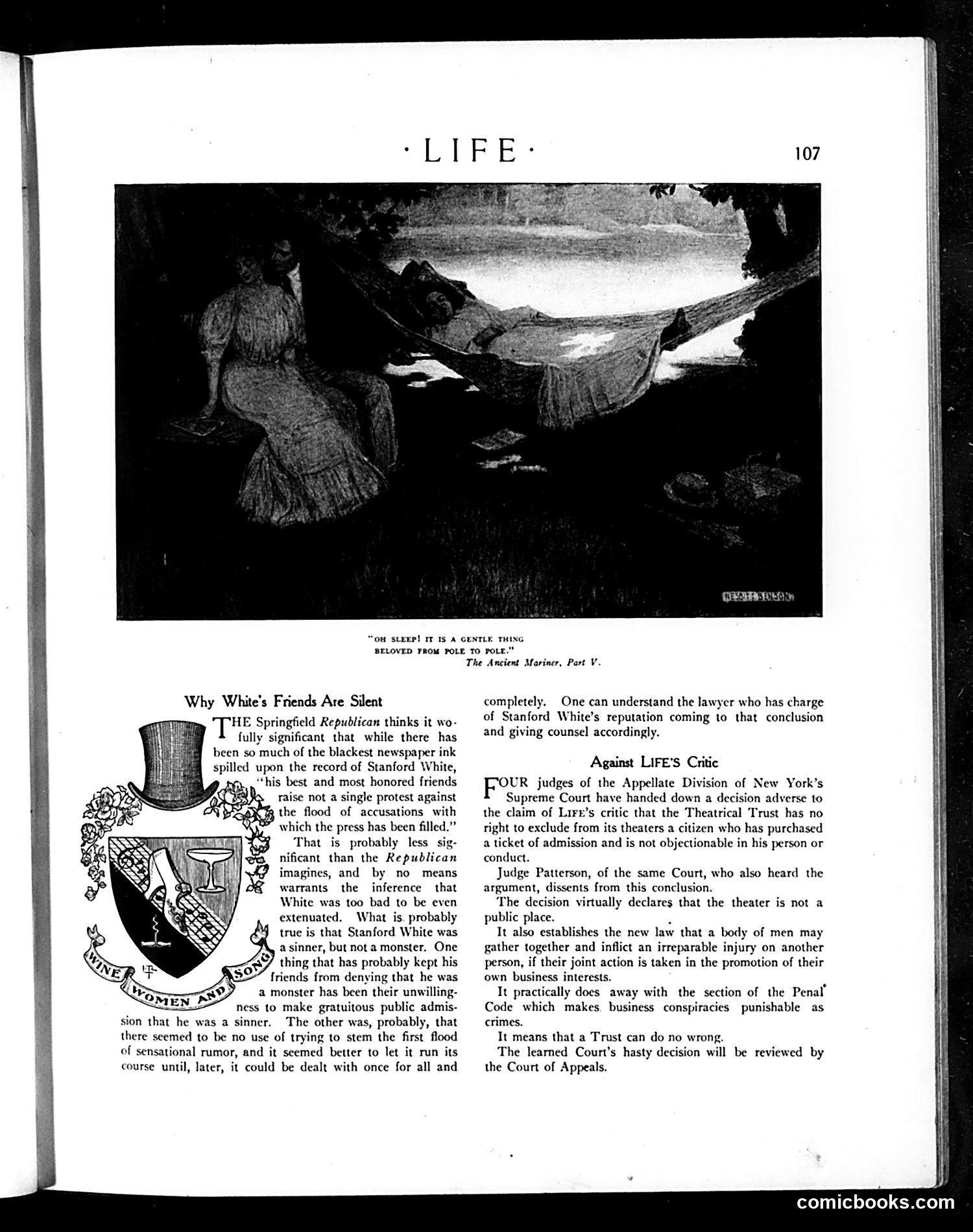
This page contains two distinct articles addressing prominent scandals of the era. **"Why White's Friends Are Silent"** discusses **Stanford White**, the famous architect accused of serious misconduct. The piece defends White's prominent friends' public silence, arguing it reflects strategic restraint rather than admission of guilt—they couldn't deny he was "a sinner" without making damaging public confessions, so they waited for legal resolution instead. **"Against LIFE's Critic"** attacks a recent New York court decision favoring the **Theatrical Trust** (a monopolistic theater consortium) against a paying customer they'd excluded. Life's editors denounce the ruling as establishing dangerous precedent: that theaters aren't public spaces, that business conspiracies can cause harm without legal consequence, and that trusts face no accountability. They announce the decision will be appealed. The **decorative image** at top (captioned from *The Ancient Mariner*) appears unrelated—likely a standard literary illustration typical of Life's design aesthetic.
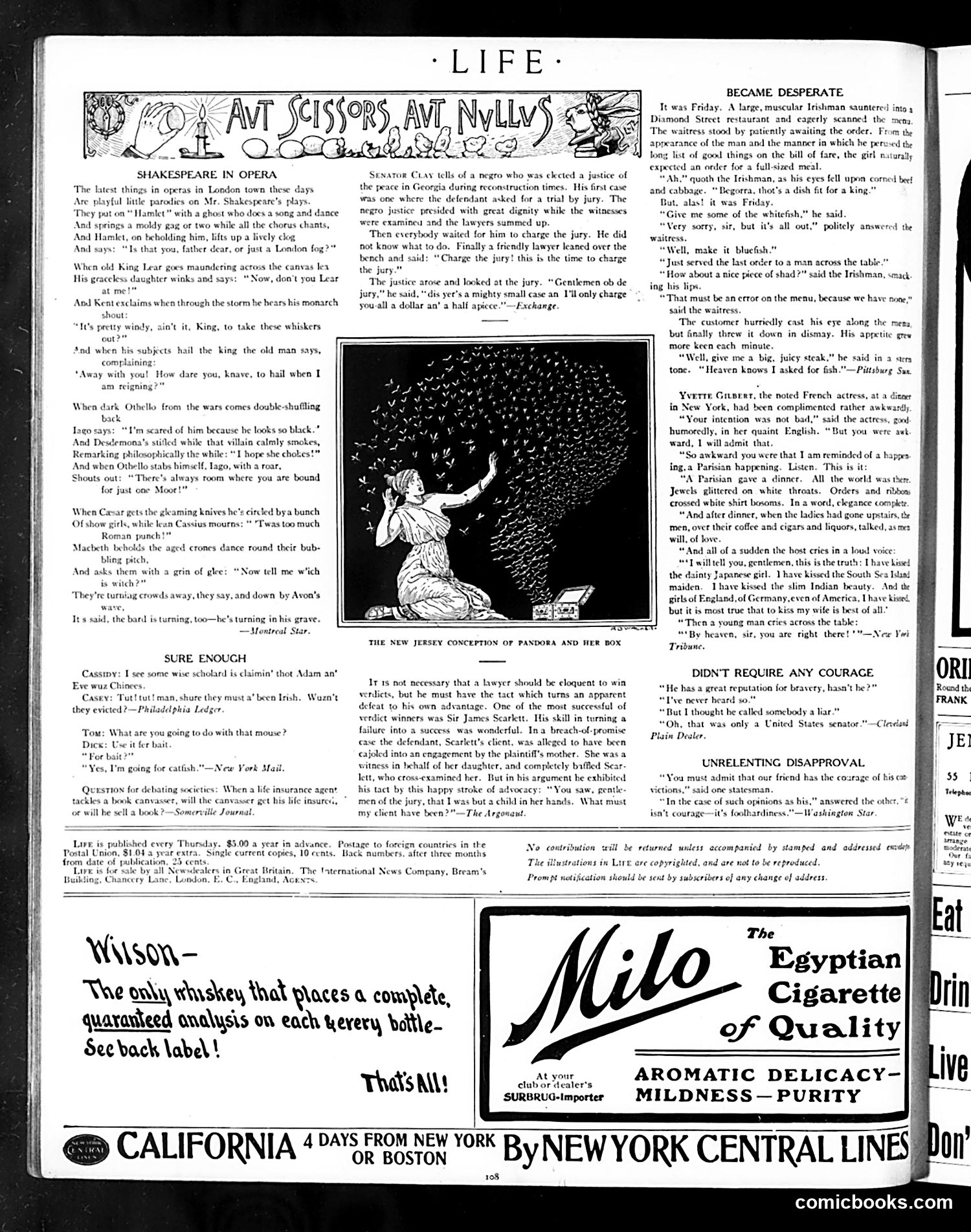
This page contains several satirical pieces mocking different subjects: 1. **"Shakespeare in Opera"** (left column): A joke about theatrical productions that butcher Shakespeare's plays with crude modern humor and slapstick comedy, turning dignified works into lowbrow entertainment. 2. **"Sure Enough"** (middle): A humorous anecdote about a Black judge during Reconstruction who, unfamiliar with legal procedure, charges jurors a dollar-fifty per person instead of instructing them on the law—satirizing the perceived incompetence of formerly enslaved people given positions of authority. 3. **"Became Desperate"** (right): An Irish immigrant at a restaurant desperately seeking fish on a Friday (implying Catholic dietary restrictions), only to find each option unavailable, eventually settling for steak—mocking Irish-Catholic stereotypes about religious observance. 4. **"Unrelenting Disapproval"** (bottom right): A brief anecdote about a French actress's awkward compliment at a dinner party. The page reflects early 20th-century satirical magazine conventions targeting immigrant groups and Reconstruction-era racial anxieties.
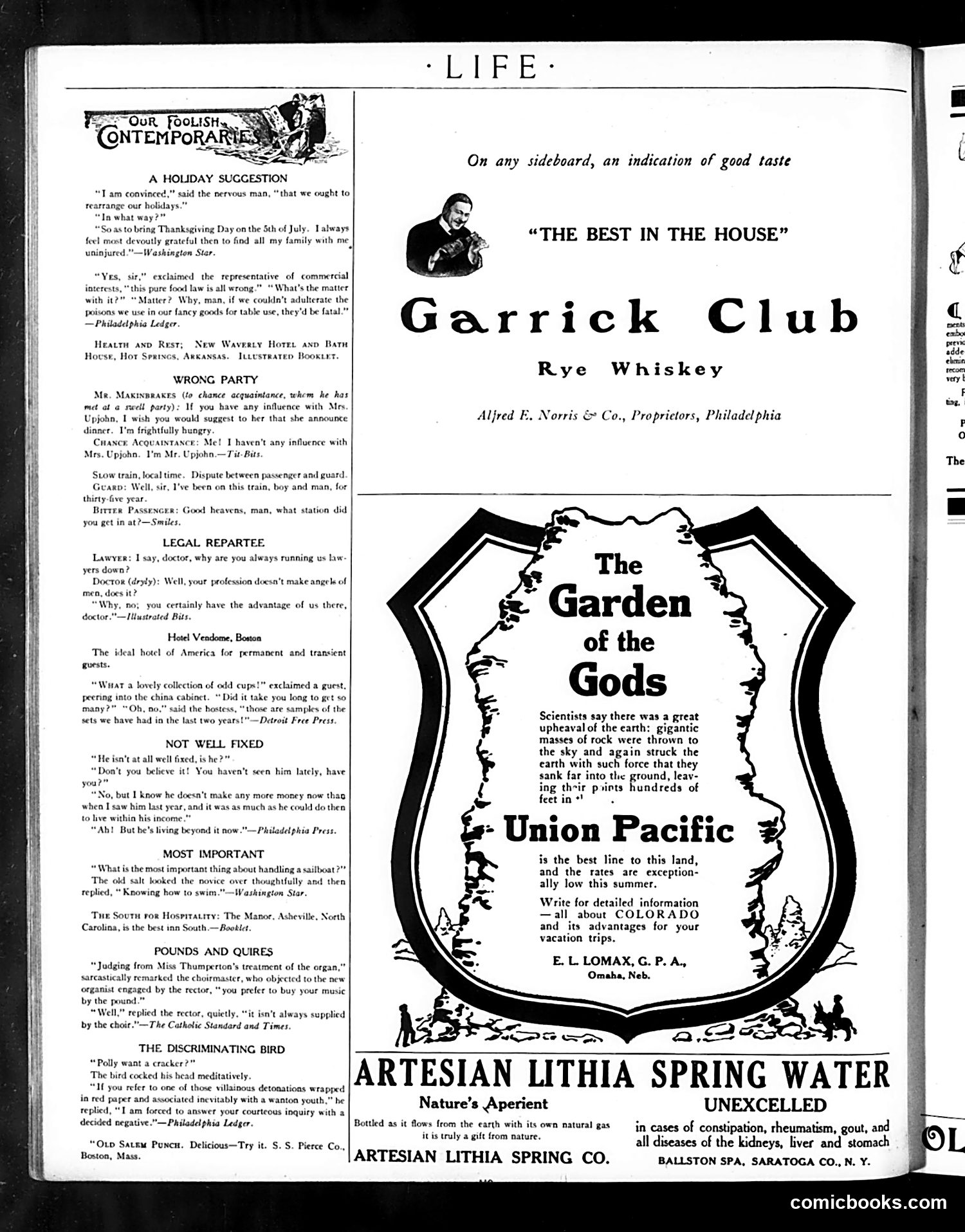
This page from *Life* magazine consists primarily of **short humorous anecdotes** ("Our Foolish Contemporaries") rather than political cartoons. The jokes satirize early 20th-century American social attitudes and behaviors: **Key satirical points:** - **"A Holiday Suggestion"**: Mocks anxiety about family gatherings by suggesting moving Thanksgiving to July so the writer can be grateful his relatives arrive "uninjured" - **Food safety**: References the Pure Food Law by having a commercial representative complain that food regulations prevent them from poisoning customers with "adulterants" - **Class humor**: "Wrong Party" depicts social awkwardness at wealthy gatherings - **Financial pretense**: "Not Well Fixed" jokes about people living beyond their means while claiming prosperity The page is **largely advertising** (Garrick Club whiskey, Union Pacific Railroad, Artesian Lithia Spring Water, Hotel Vendome), interspersed with these brief, genteel satirical vignettes typical of *Life*'s humor aimed at educated, upper-middle-class readers. The satire is mild social commentary rather than sharp political critique.
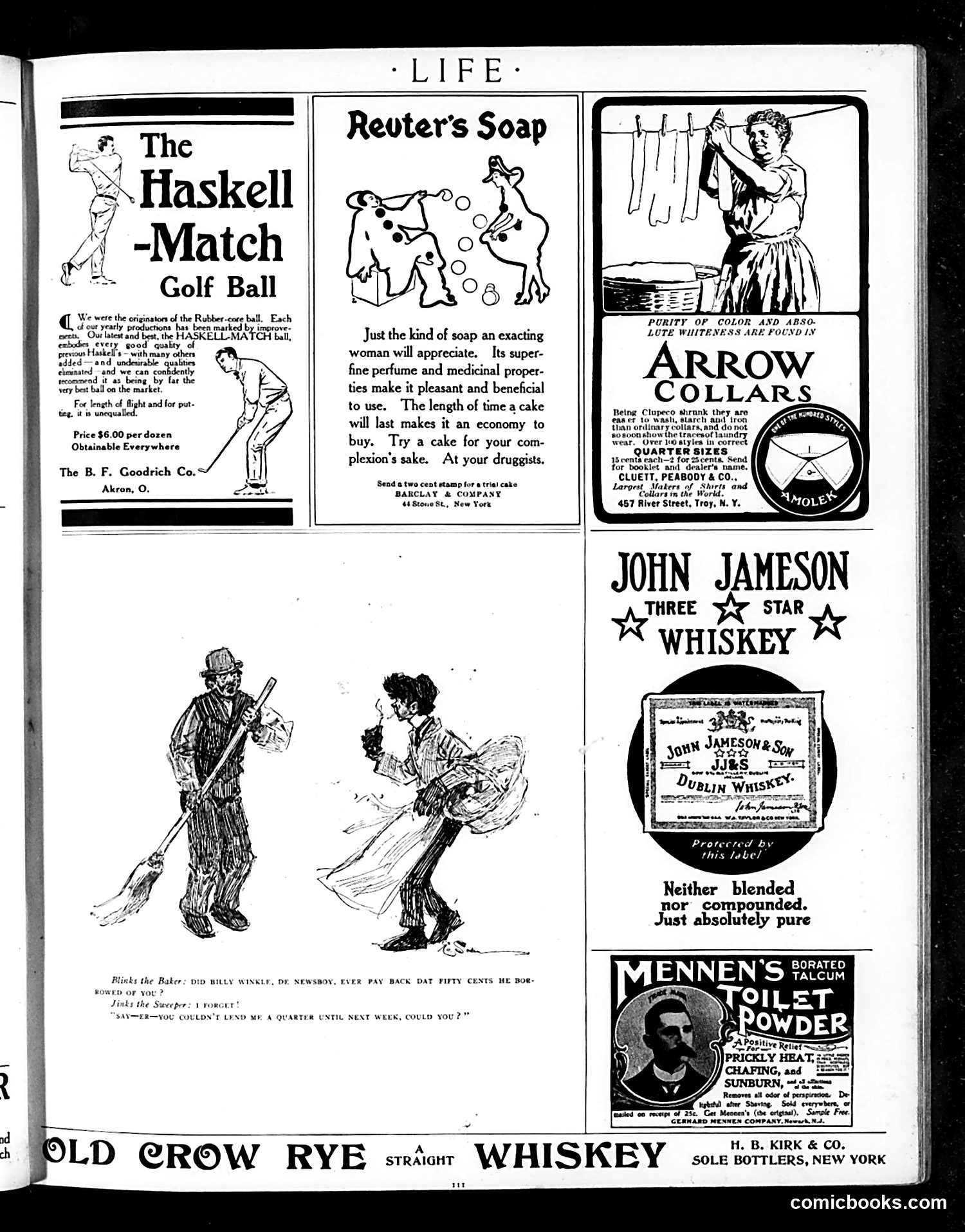
This page is primarily **advertising**, not political commentary. The main content consists of commercial ads for products typical of the early 20th century: golf balls, soap, shirt collars, whiskey, and talcum powder. The only satirical element is a small **comic dialogue** between two working-class characters—a baker and a sweeper—discussing unpaid debts. The baker asks if the newsboy "Willy Winkle" ever repaid fifty cents; the sweeper says no. The baker then ironically asks the sweeper for a quarter loan, implying chronic money problems among laborers. This gentle humor reflects early Life magazine's satirical focus on everyday financial struggles of ordinary people. The advertisements showcase consumer products marketed with appeals to quality, purity, and respectability—typical early 1900s marketing tactics emphasizing refinement and health benefits.
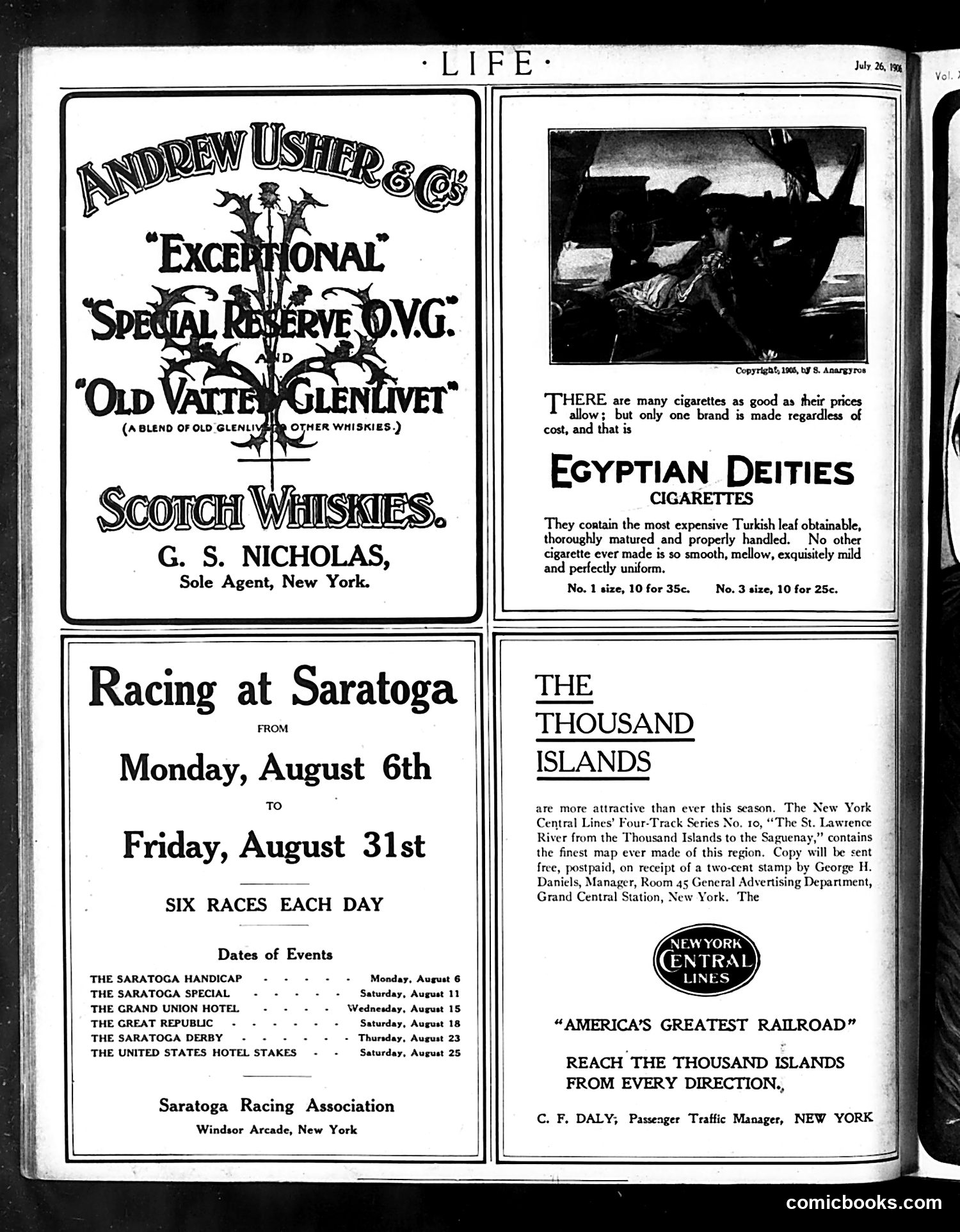
This page is primarily **advertisements** rather than satire or political commentary. It contains four separate ads: 1. **Andrew Usher & Co. Scotch Whiskies** — promoting blended whisky brands through G.S. Nicholas in New York 2. **Egyptian Deities Cigarettes** — marketing premium Turkish tobacco cigarettes, claiming superior quality regardless of cost 3. **Saratoga Racing** — announcing horse racing events at Saratoga Springs, New York (August 6-31), listing six major races including the Saratoga Derby and Handicap 4. **New York Central Lines** — promoting tourist travel to the Thousand Islands region via their railroad, marketed as "America's Greatest Railroad" The small photograph accompanying the cigarette ad appears to show people in a social setting, likely meant to associate the product with leisure and sophistication. There is no discernible political satire or social commentary on this particular page.