
Life, 1906-07-26 · page 14 of 20
Life — July 26, 1906 — page 14: what you’re looking at
What you’re looking at
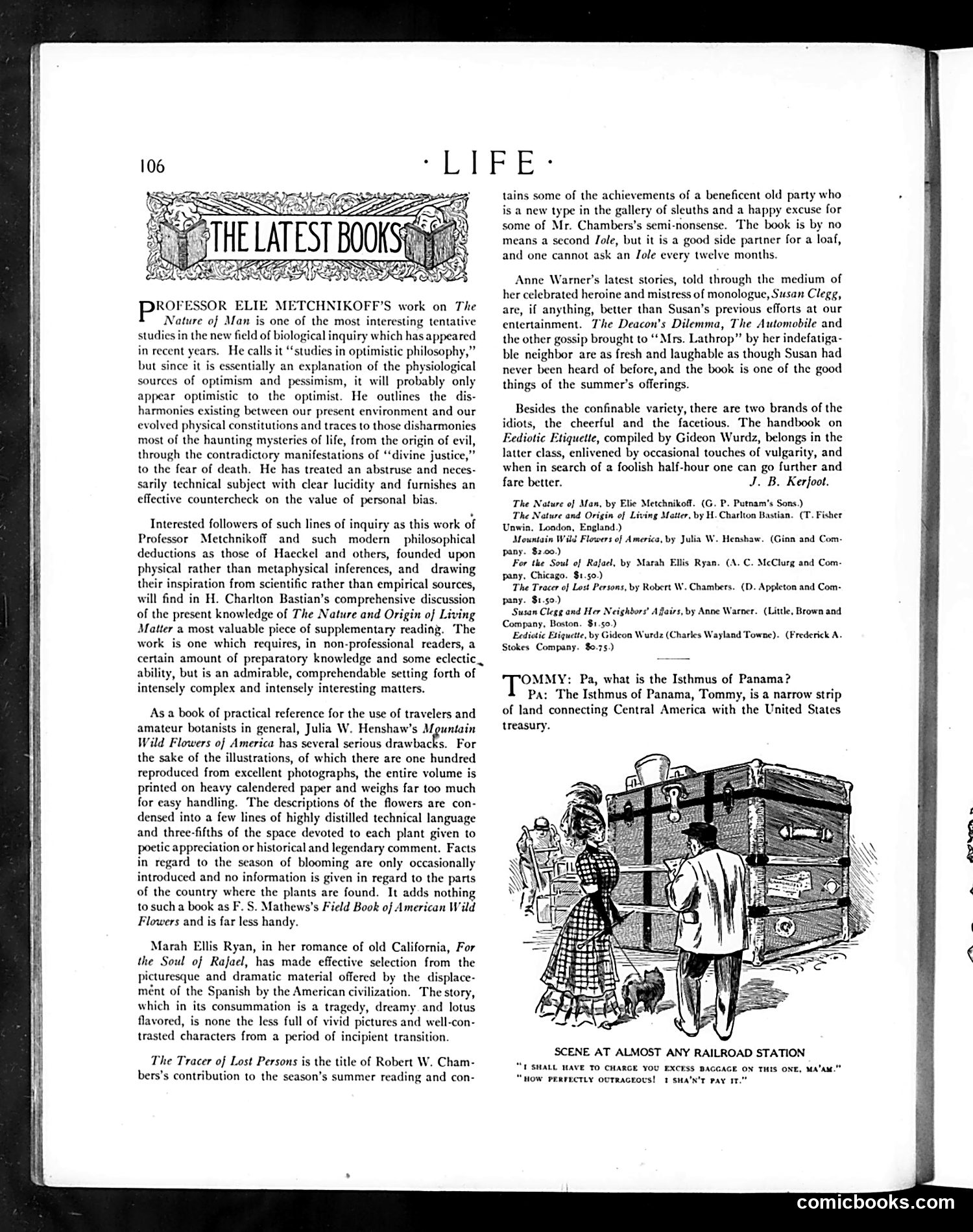
This page is primarily a **book review section** titled "The Latest Books," not a political cartoon. It contains literary criticism of contemporary works, including: - Professor Elie Metchnikoff's philosophical study *The Nature of Man* - Julia W. Henshaw's *Mountain Wild Flowers of America* (criticized for being too heavy and technically dense for practical use) - Marah Ellis Ryan's *For the Soul of Rafael* (a historical romance about Spanish displacement in California) - Robert W. Chambers's *The Tracer of Lost Persons* (a detective novel) - Anne Warner's stories featuring the character Susan Clegg The only illustration is a **small cartoon at page bottom** showing a railroad station scene with a woman and porter arguing over excess baggage charges—a humorous domestic vignette unrelated to the reviews above. The page reflects turn-of-the-century literary interests: scientific philosophy, nature study, historical romance, and popular detective fiction.
📄 Transcribed text from this page (OCR, searchable)
Machine-transcribed from the original scan — historical spelling and the odd misread are preserved.
FESSOR ELIE METCHNIKOFF’S work on The Nature of Man is one of the most interesting tentative studies in the new field of biological inquiry which has appeared in recent years. He calls it “‘studies in optimistic philosophy,” but since it is essentially an explanation of the physiological sources of optimism and pessimism, it will probably only appear optimistic to the optimist. He outlines the dis- harmonies existing between our present environment and our evolved physical constitutions and traces to those disharmonies most of the haunting mysteries of life, from the origin of evil, through the contradictory manifestations of ‘divine justice,” to the fear of death. He has treated an abstruse and neces- sarily technical subject with clear lucidity and furnishes an effective countercheck on the value of personal bias. Interested followers of such lines of inquiry as this work of Professor Metchnikoff and such modern philosophical deductions as those of Haeckel and others, founded upon physical rather than metaphysical inferences, and drawing their inspiration from scientific rather than empirical sources, will find in H. Charlton Bastian’s comprehensive discussion of the present knowledge of The Nature and Origin of Living Matter a most valuable piece of supplementary reading. The work is one which requires, in non-professional readers, a certain amount of preparatory knowledge and some eclectic, ability, but is an admirable, comprehendable setting forth of intensely complex and intensely interesting matters. As a book of practical reference for the use of travelers and amateur botanists in general, Julia W. Henshaw’s Mountain Wild Flowers oj America has several serious drawbacks. For the sake of the illustrations, of which there are one hundred reproduced from excellent photographs, the entire volume is printed on heavy calendered paper and weighs far too much for easy handling. The descriptions of the flowers are con- densed into a few lines of highly distilled technical language and three-fifths of the space devoted to each plant given to poetic appreciation or historical and legendary comment. Facts in regard to the season of blooming are only occasionally introduced and no information is given in regard to the parts of the country where the plants are found. It adds nothin; to such a book as F. $. Mathews’s Field Book of American Wild Flowers and is far less handy. Marah Ellis Ryan, in her romance of old California, For the Soul of Rafael, has made effective selection from the picturesque and dramatic material offered by the displace- mént of the Spanish by the American civilization. The story, which in its consummation is a tragedy, dreamy and lotus flavored, is none the less full of vivid pictures and well-con- trasted characters from a period of incipient transition. The Tracer of Lost Persons is the title of Robert W. Cham- bers's contribution to the season’s summer reading and con- FE: tains some of the achievements of a beneficent old party who is a new type in the gallery of sleuths and a happy excuse for some of Mr. Chambers’s semi-nonsense. ‘The book is by no means a second Jole, but it is a good side partner for a loaf, and one cannot ask an Jole every twelve months. Anne Warner’s latest stories, told through the medium of her celebrated heroine and mistress of monologue, Susan Clegg, are, if anything, better than Susan’s previous efforts at our entertainment. The Deacon's Dilemma, The Automobile and the other gossip brought to “ Mrs. Lathrop” by her indefatiga- ble neighbor are as fresh and laughable as though Susan had never been heard of before, and the book is one of the good things of the summer’s offerings. Besides the confinable variety, there are two brands of the idiots, the cheerful and the facetious. The handbook on Eediotic Etiquette, compiled by Gideon Wurdz, belongs in the latter class, enlivened by occasional touches of vulgarity, and when in search of a foolish half-hour one can go further and fare better. J. B. Kerjoot. The Nature of Man, by Elie Metchnikoff. (G. P. Putnam’ ) The Nature and Origin of Living Matter, by H. Charlton Bastian. (T. Fisher Unwin, London, England.) Mountain Wild Flowers of America, by Julia W. Henshaw. (Ginn and Com- pany. $2.00.) For the Soul of Rafael, by Marah Ellis Ryan. (A. C. McClurg and Com- pany, Chicago. $1.50.) The Tracer of Lost Persons, by Robert W. Chambers. (D. Appleton and Com- pany. $1.50.) Susan Clegg and Her Neighbors Affairs, by Anne Warner. (Little, Brown and Company, Boston. $1.50.) Ecdictic Etiquette, by Gideon Wurdz (Charles Wayland Towne). (Frederick A. Stokes Company. $0.75.) ‘OMMY: Pa, what is the Isthmus of Panama? Pa: The Isthmus of Panama, Tommy, is a narrow strip of land connecting Central America with the United States treasury. SCENE AT ALMOST ANY RAILROAD STATION HALL MAVE TO CHARGE YOU EXCESS BAGGAGE ON THIS ONE, MATAM. IOW PERFECTLY OUTRAGEOUS! 1 SMA'N'T PAY IT.” comicbooks.com