
Life, 1906-07-26 · page 4 of 20
Life — July 26, 1906 — page 4: what you’re looking at
What you’re looking at
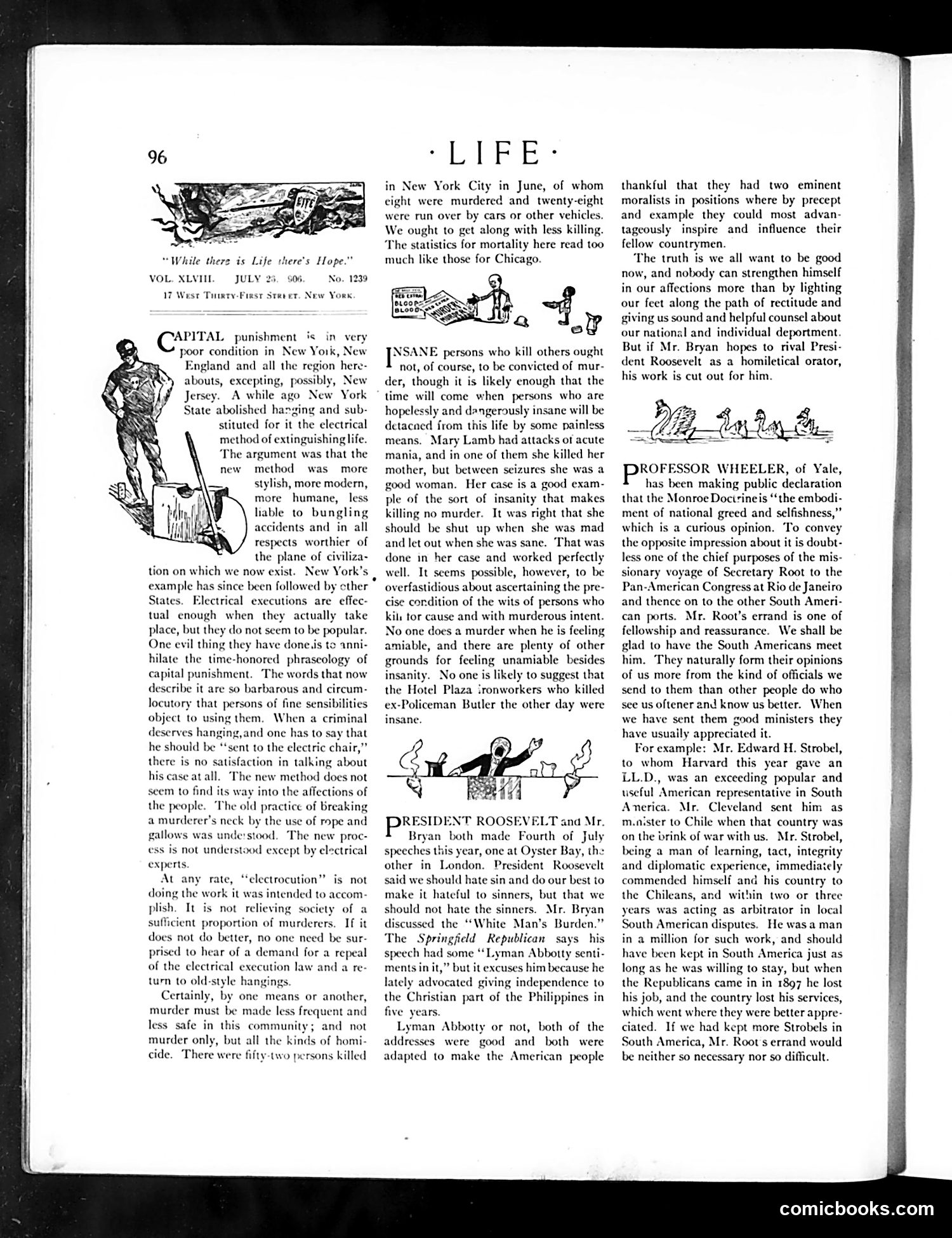
The page contains editorial commentary on capital punishment and criminal justice rather than traditional political cartoons. The main arguments discussed include: **Key Topics:** - Capital punishment's effectiveness as deterrent in New York - A case involving Mary Lamb, who killed her mother during a mental health crisis—presented as an example of how insanity complicates murder convictions - Criticism of electrical execution methods as inhumane **Political References:** - President Roosevelt and Mr. Bryan (William Jennings Bryan) are mentioned regarding their differing views on criminal punishment and morality - Reference to Edward H. Strobel's diplomatic work in South America under Cleveland administration The small decorative illustrations appear to be generic vignettes rather than specific political caricatures. The page focuses on serious policy debate about justice and punishment rather than satirical cartoon commentary.
📄 Transcribed text from this page (OCR, searchable)
Machine-transcribed from the original scan — historical spelling and the odd misread are preserved.
“While there is Life there's Hope.” VOL. XLVI. JULY 2 1239 17 West Tuixty- 906. No. test Steet, New Yors ‘APITAL punishment isin very poor condition in New York, New England and all the region here- abouts, excepting, possibly, New Jers A while ago New York State abolished harging and sub- stituted for it the electrical method of extinguishing life. ‘The argument was that the method was more stylish, more modern, more humane, less liable to bungling accidents and in all respects worthier of the plane of civiliza- tion on which we now exist. New York’s . example has since been followed by cther States. Electrical executions are effec- tual enough when they actually take place, but they do not seem to be popular. One evil thing they have done.is to anni- hilate the time-honored phraseology of pital punishment. The words that now escribe it are so barbarous and circum- locutory that persons of fine sensibilities object to using them. When a criminal ,and one has to say that nt to the electric chair,” there is no satisfaction in talking about his case at all. The new method does not seem to find its way into the affections of the people. The old practice of breaking a murderer's neck by the use of rope and gallows was unde:stood, The new proc- ess is not understood except by electrical experts. At any rate, “electrocution” is not doing the work it was intended to accom- plish. It is not relieving society of a sufficient proportion of murderers. If it does not do better, no one need be sur- prised to hear of a demand for a repeal of the electrical execution law and a re- turn to old-style hangin; Certainly, by one means or another, murder must be made less frequent and less safe in this community; and not murder only, but all the kinds of homi- cide. There were fifty-two persons killed ‘LIP in New York City in June, of whom cight were murdered and twenty-eight were run over by cars or other vehicles. We ought to get along with less killing. ‘The statistics for mortality here read too much like those for Chicago. ues | ARGON Reece of [NSANE persons who kill others ought not, of course, to be convicted of mur- der, though it is likely enough that the time will come when persons who hopelessly and dangerously insane will be detacned from this life by some painless means. Mary Lamb had attacks of acute mania, and in one of them she killed her mother, but between ures she was a good woman. Her case is a good exam- ple of the sort of insanity that makes killing no murder. It was right that she should be shut up when she was mad and let out when she was sane. That v done in her case and worked perfect well. It seems possible, however, to be overfastidious about ascertaining the pre- cise condition of the wits of persons who kil tor cause and with murderous intent. No one does a murder when he is feeling amiable, and there are plenty of other grounds for feeling unamiable besides insanity. No one is likely to suggest that the Hotel Plaza ironworkers who killed ex-Policeman Butler the other day were insane. a RESIDENT ROOSEVELT ana Mr. Bryan both made Fourth of July speeches this year, one at Oyster Bay, the other in London. President Roosevelt said we should hate sin and do our best to make it hateful to sinners, but that we should not hate the sinners. Mr. Bryan discussed the ‘“‘White Man's Burden.” The Springfield Republican says hi speech had some ‘‘Lyman Abbotty senti- in it,” but itexcuses him because he advocated giving independence to the Christian part of the Philippines in five years. Lyman Abbotty or not, both of the addresses were good and both were adapted to make the American people thankful that they had two eminent moralists in positions where by precept and example they could most advan- tageously inspire and influence their fellow countrymen. The truth is we all want to be good now, and nobody can strengthen himself in our affections more than by lighting our feet along the path of rectitude and giving us sound and helpful counsel about our national and individual deportment. But if Mr. Bryan hopes to rival Presi- dent Roosevelt as a homiletical orator, his work is cut out for him. ROFESSOR WHEELER, of Yale, has been making public declaration that the Monroe Doctrineis “the embodi- ment of national greed and selfishness,” which is a curious opinion. To convey the opposite impression about it is doubt- less one of the chief purposes of the mis- sionary voyage of Secretary Root to the Pan-American Congress at Rio de Janeiro and thence on to the other South Ameri- can ports. Mr. Root’s errand is one of fellowship and reassurance. We shall be glad to have the South Americans meet him. They naturally form their opinions of us more from the kind of officials we send to them than other people do who see us oftener and know us better. When we have sent them good ministers they have usuaily appreciated it. For example: Mr. Edward H. Strobel, to whom Harvard this year gave an LL.D., was an exceeding popular and useful American representative in South Anerica. Mr. Cleveland sent him as m.nister to Chile when that country was on the brink of war with us. Mr. Strobel, being a man of learning, tact, integrity and diplomatic experience, immediately commended himself and his country to the Chileans, and within two or three years was acting as arbitrator in local South American disputes. He was a man in a million for such work, and should have been kept in South America just as long as he was willing to stay, but when the Republicans came in in 1897 he lost his job, and the country lost his services, which went where they were better appre- ciated. If we had kept more Strobels in South America, Mr. Roots errand would be neither so necessary nor so difficult. comicbooks.com