
Life, 1906-07-26 · page 15 of 20
Life — July 26, 1906 — page 15: what you’re looking at
What you’re looking at
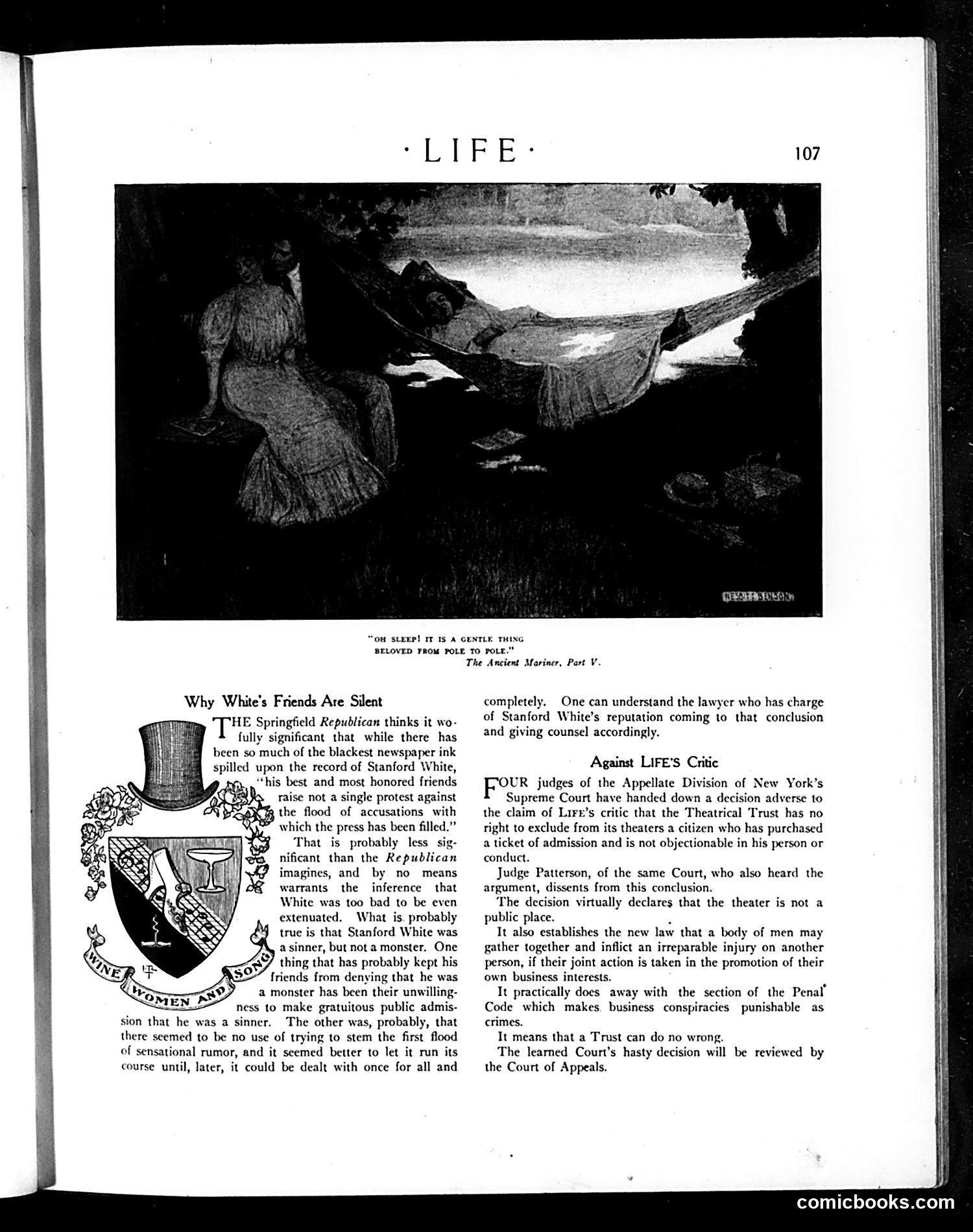
This page contains two distinct articles addressing prominent scandals of the era. **"Why White's Friends Are Silent"** discusses **Stanford White**, the famous architect accused of serious misconduct. The piece defends White's prominent friends' public silence, arguing it reflects strategic restraint rather than admission of guilt—they couldn't deny he was "a sinner" without making damaging public confessions, so they waited for legal resolution instead. **"Against LIFE's Critic"** attacks a recent New York court decision favoring the **Theatrical Trust** (a monopolistic theater consortium) against a paying customer they'd excluded. Life's editors denounce the ruling as establishing dangerous precedent: that theaters aren't public spaces, that business conspiracies can cause harm without legal consequence, and that trusts face no accountability. They announce the decision will be appealed. The **decorative image** at top (captioned from *The Ancient Mariner*) appears unrelated—likely a standard literary illustration typical of Life's design aesthetic.
📄 Transcribed text from this page (OCR, searchable)
Machine-transcribed from the original scan — historical spelling and the odd misread are preserved.
*LIFE- 107 “OM SLEEP! IT IS A GENTLE BELOVED FROM POLE TO POL! Why White's Friends Are Silent THE Springfield Republican thinks it wo- fully significant that while there has been so much of the blackest newspaper ink spilled upon the record of Stanford White, “this best and most honored friends raise not a single protest against the flood of accusations with which the press has been filled.” That is probably less sig- nificant than the Republican imagines, and by no means warrants the inference that White was too bad to be even extenuated. What is. probably true is that Stanford White was a sinner, but not a monster. One thing that has probably kept his friends from denying that he was. a monster has been their unwilling- ness to make gratuitous public admis- sion that he was a sinner. The other was, probably, that there seemed to be no use of trying to stem the first flood of sensational rumor, and it seemed better to let it run its course until, later, it could be dealt with once for all and KES SOISGNY The Ancient Mariner, Part V. completely. One can understand the lawyer who has charge of Stanford White’s reputation coming to that conclusion and giving counsel accordingly. Against LIFE'S Critic Foes judges of the Appellate Division of New York’s Supreme Court have handed down a decision adverse to the claim of Lire’s critic that the Theatrical Trust has no right to exclude from its theaters a citizen who has purchased a ticket of admission and is not objectionable in his person or conduct. Judge Patterson, of the same Court, who also heard the argument, dissents from this conclusion. The decision virtually declares that the theater is not a public place. ‘ It also establishes the new law that a body of men may gather together and inflict an irreparable injury on another person, if their joint action is taken in the promotion of their own business interests. It practically docs away with the section of the Penal’ Code which makes. business conspiracies punishable as crimes. It means that a Trust can do no wrong. The learned Court’s hasty decision will be reviewed by the Court of Appeals. comicbooks.com