
A complete issue · 24 pages · 1906
Life — June 14, 1906
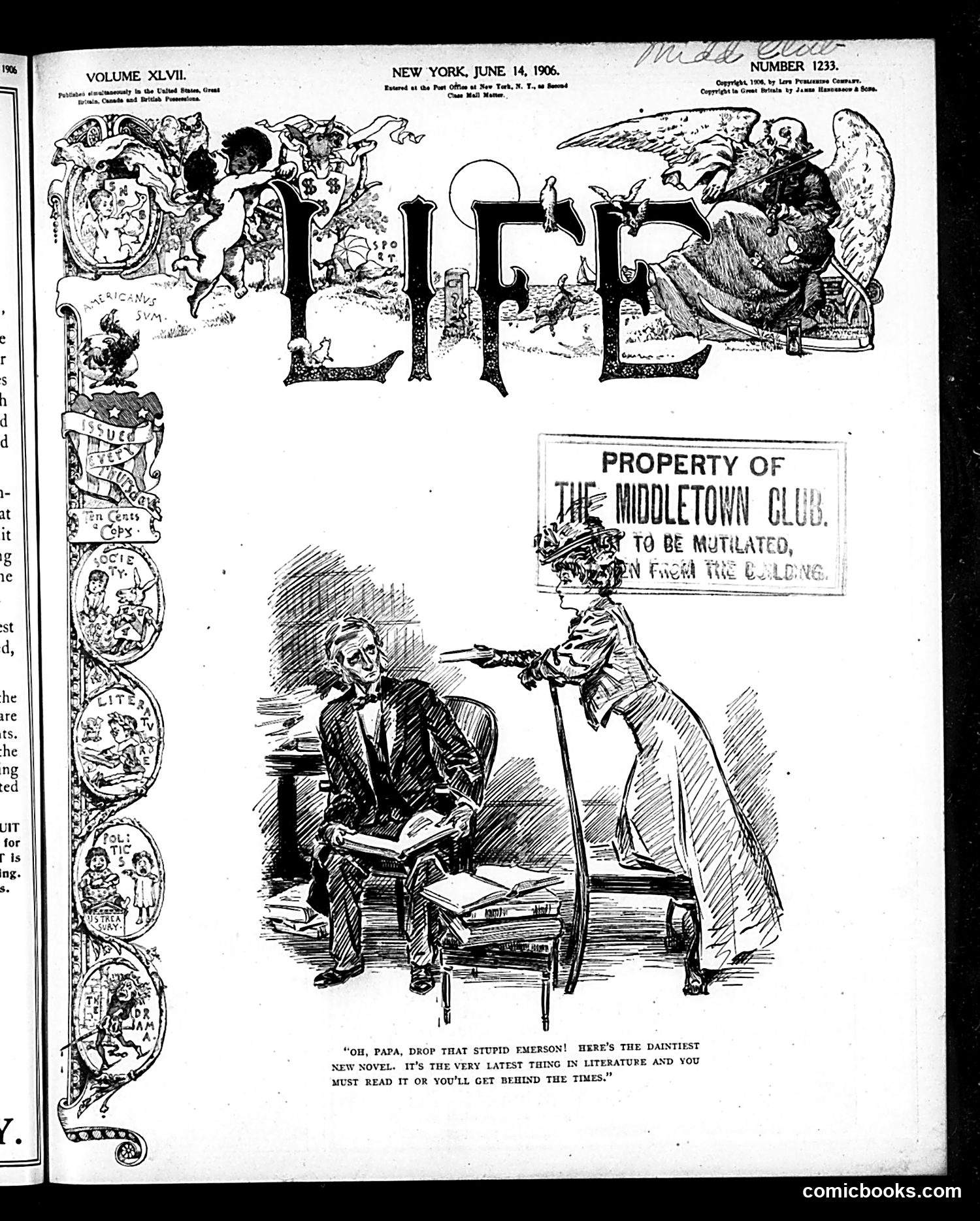
The main cartoon depicts a woman confronting a man seated with papers, holding a sign reading "Property of The Middletown Club - To Be Mutilated When Fired from the Building." The caption reads: "Oh, Papa, Drop That Stupid Emerson! Here's the Daintiest New Novel. It's the Very Latest Thing in Literature and You Must Read It or You'll Get Behind the Times." This satirizes literary trends and generational taste conflicts. The woman represents fashionable society pressuring an older gentleman (likely representing conservative taste) to abandon serious literature ("Emerson" — Ralph Waldo Emerson, the 19th-century philosopher) for frivolous contemporary novels. The "Middletown Club" stamp suggests institutional/social pressure to conform to modern literary fashions. The satire mocks both the superficiality of trendy reading and the social coercion to abandon intellectual substance for popularity.
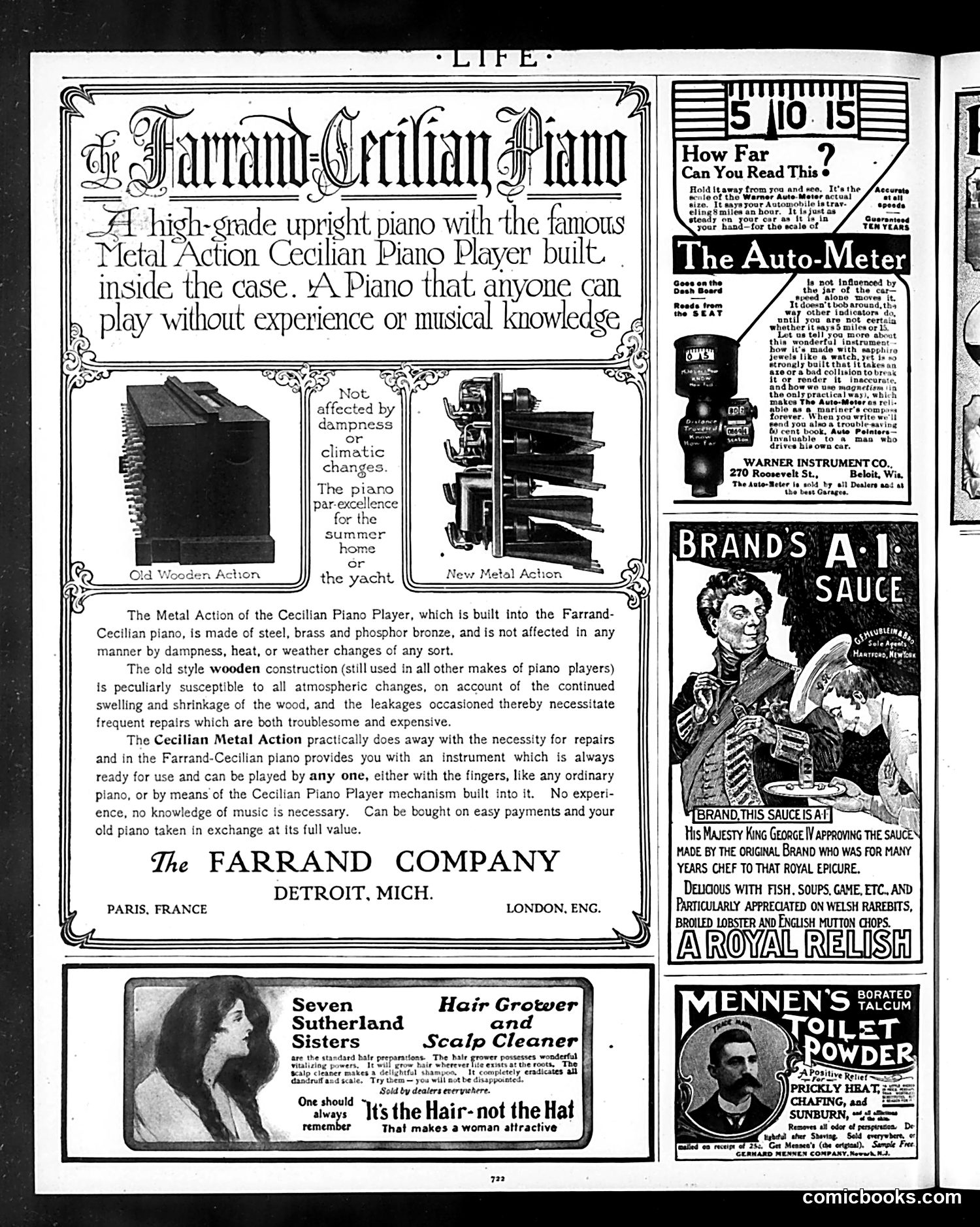
This page is **primarily advertising**, not satirical content. The main feature is a full-page advertisement for the Farrand-Cecilian Piano, a player piano with an automated mechanical action that allowed people to play music without musical training or experience. The ad emphasizes that the piano's metal action mechanism (unlike wooden mechanisms in competitors' pianos) resists damage from humidity and climate changes, making it reliable and durable. The right column contains additional product advertisements: The Auto-Meter (a car instrument), Brand's A.1. Sauce, hair-care products, and Mennen's talcum powder. There is **no political satire or social commentary** on this page—it represents typical early-20th-century commercial advertising in a lifestyle magazine.
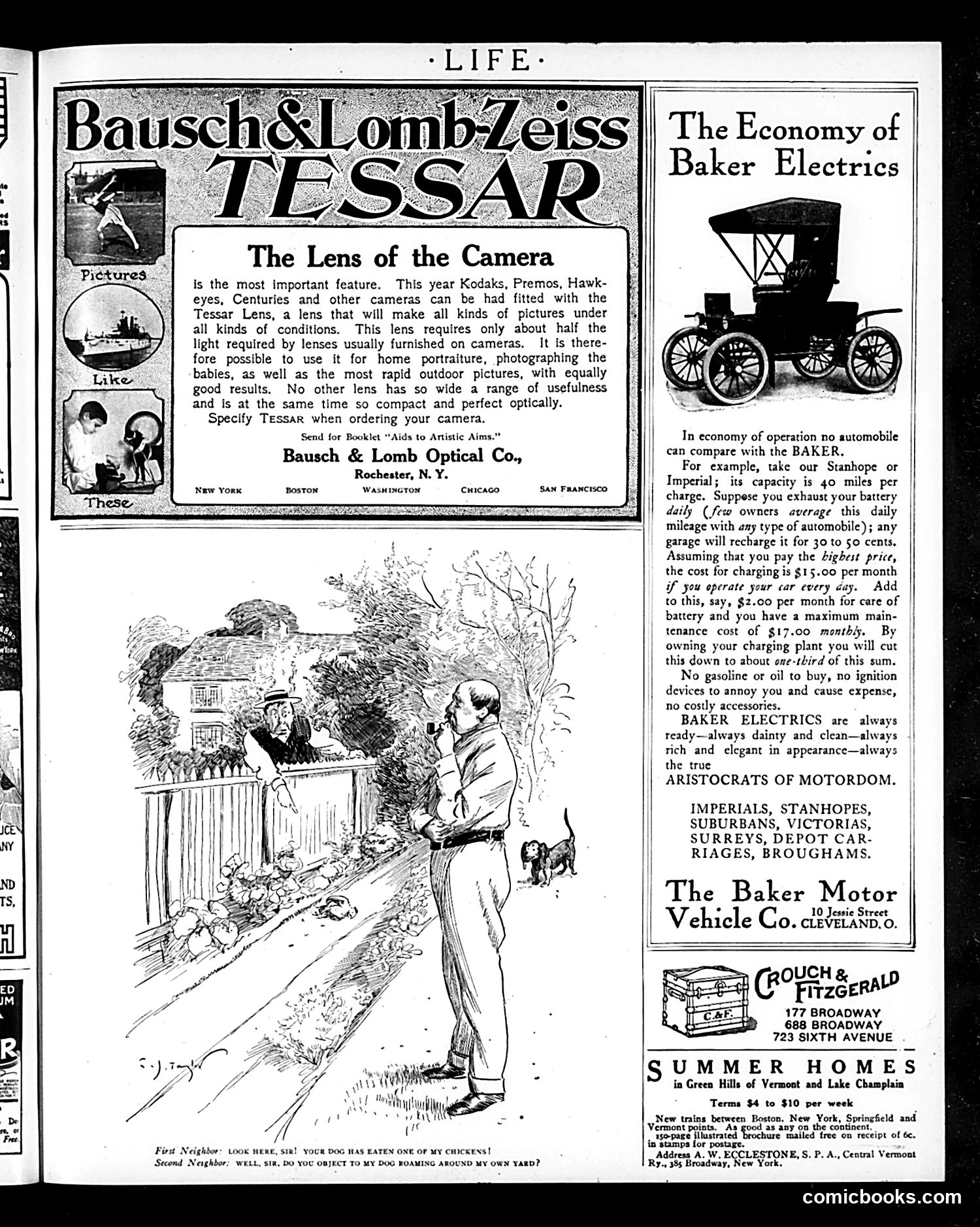
This page is primarily **advertising**, not political satire. The main content features ads for: 1. **Bausch & Lomb Zeiss Tessar lens** — promoting camera equipment, emphasizing the lens's superiority for various photography conditions 2. **Baker Electric automobiles** — highlighting economic advantages of electric cars over gasoline vehicles (cheaper operation, no fuel needed, low maintenance) 3. **Crouch & Fitzgerald** luggage and **Summer Homes** rentals The cartoon at bottom-left appears to be a humorous domestic scene about a neighbor's dog, unrelated to the advertisements. There is **no significant political or social satire** on this page—it's a straightforward commercial publication typical of early 20th-century Life magazine's mixed advertising and light humor format.
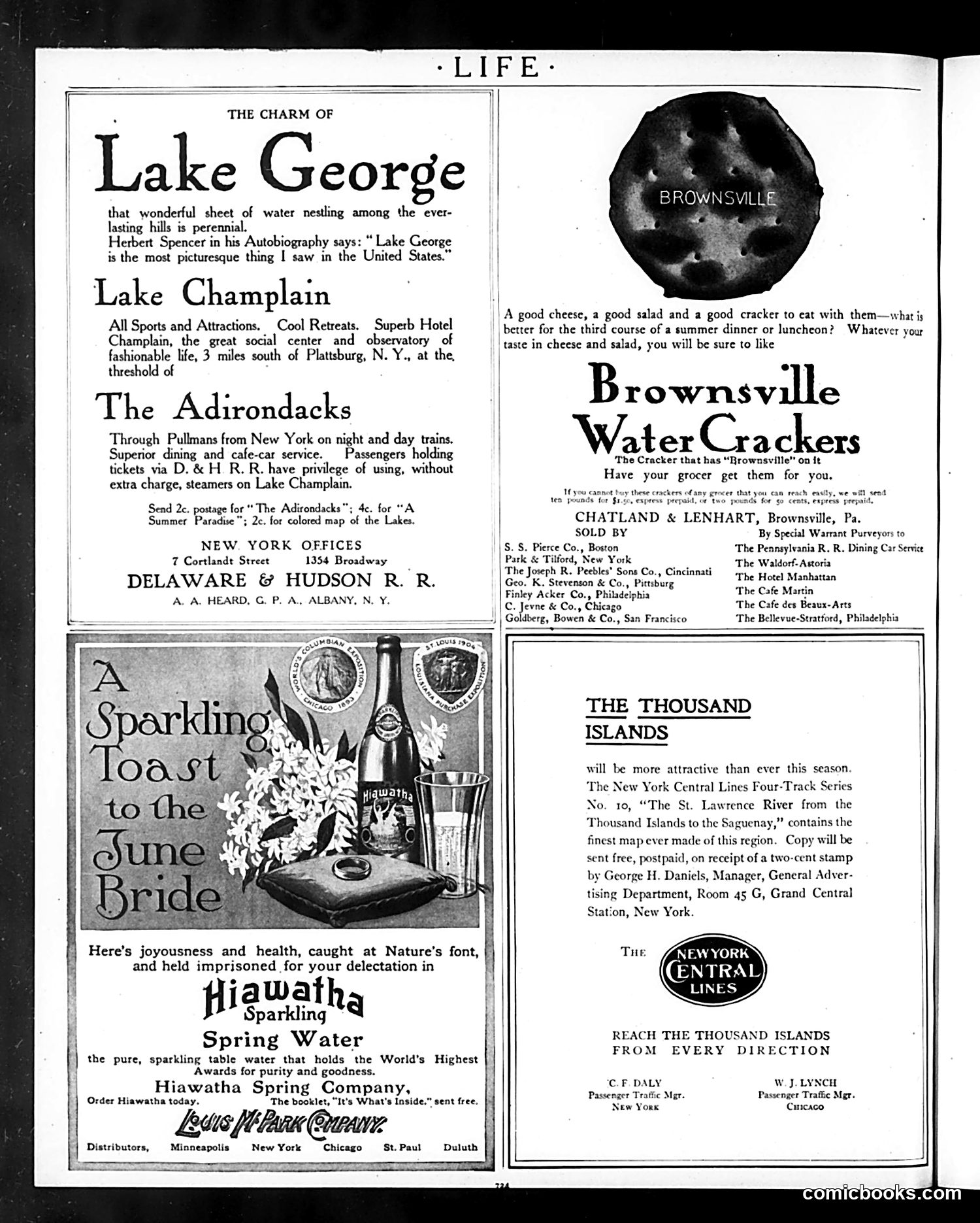
This page from *Life* magazine is primarily **advertising content** rather than satirical cartoons. It features: 1. **Tourism ads** promoting northeastern U.S. destinations (Lake George, Lake Champlain, the Adirondacks, and the Thousand Islands), emphasizing natural beauty and accessible travel via railroad. 2. **Brownsville Water Crackers ad** - a food product advertisement. 3. **Hiawatha Sparkling Spring Water ad** - featuring an illustration of champagne and celebratory imagery tied to a "June Bride" theme, marketed as pure and award-winning. The page reflects early-20th-century American leisure culture, highlighting vacation destinations for affluent readers and consumer products. There is **no political satire** visible—this is a straightforward advertising section typical of *Life* magazine's revenue model during this period.
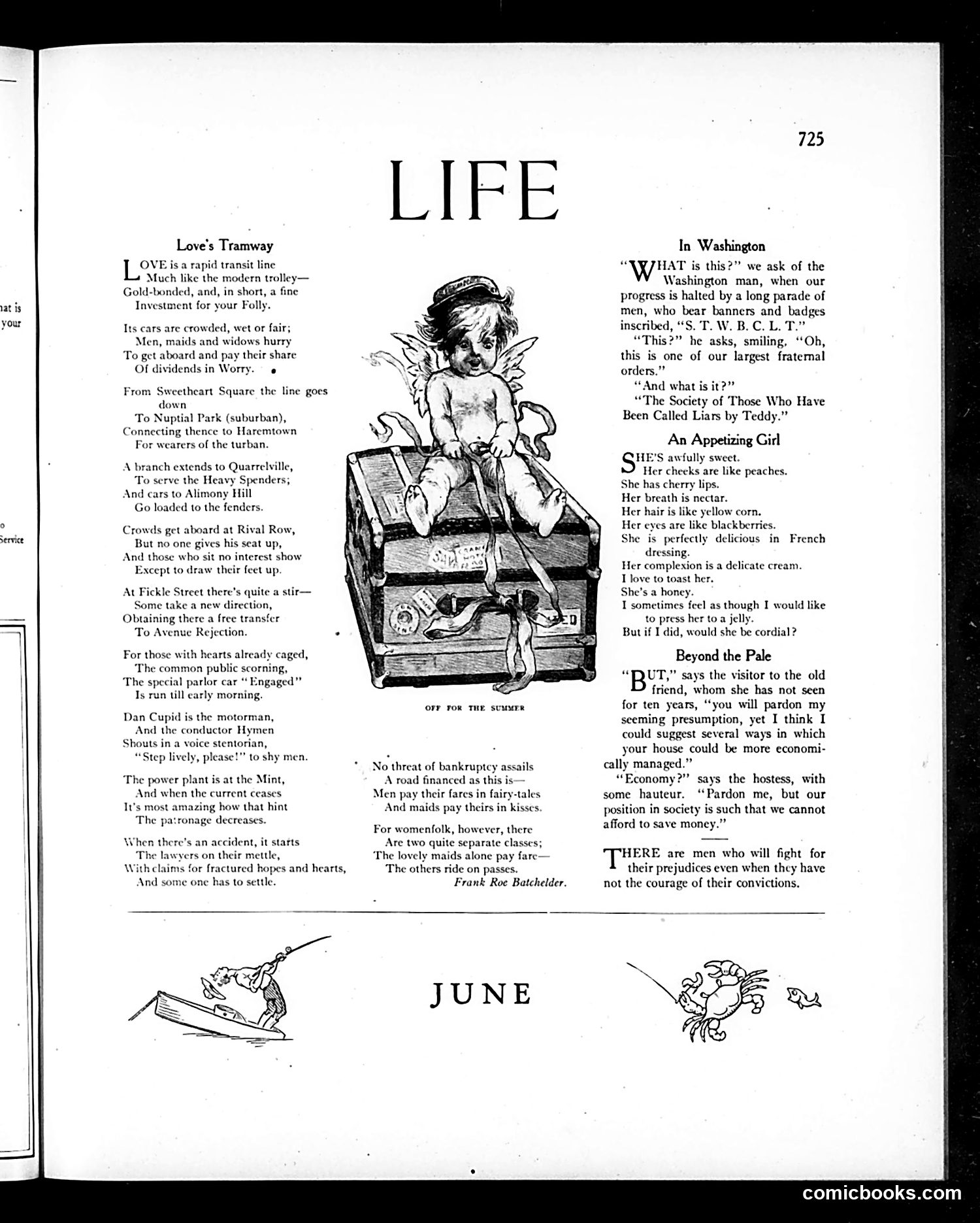
This page contains three satirical pieces about early 1900s urban life: **"Love's Tramway"** mocks romantic relationships as commercial transactions, comparing love to a rapid transit system where "Men, maids and widows hurry" and dividends are collected. **The central illustration** depicts Cupid as a streetcar conductor, visualizing the poem's metaphor of love as mechanized transit. **"In Washington"** satirizes fraternal organizations, specifically "The Society of Those Who Have Been Called Liars by Today"—mocking pretentious social clubs. **"An Appetizing Girl"** and **"Beyond the Pale"** offer lighter social commentary on feminine attractiveness and economic propriety among the upper classes. The overall tone is typical Life magazine satire: gentle mockery of modern social conventions, urban development, and bourgeois affectations, using humor to critique contemporary American society.
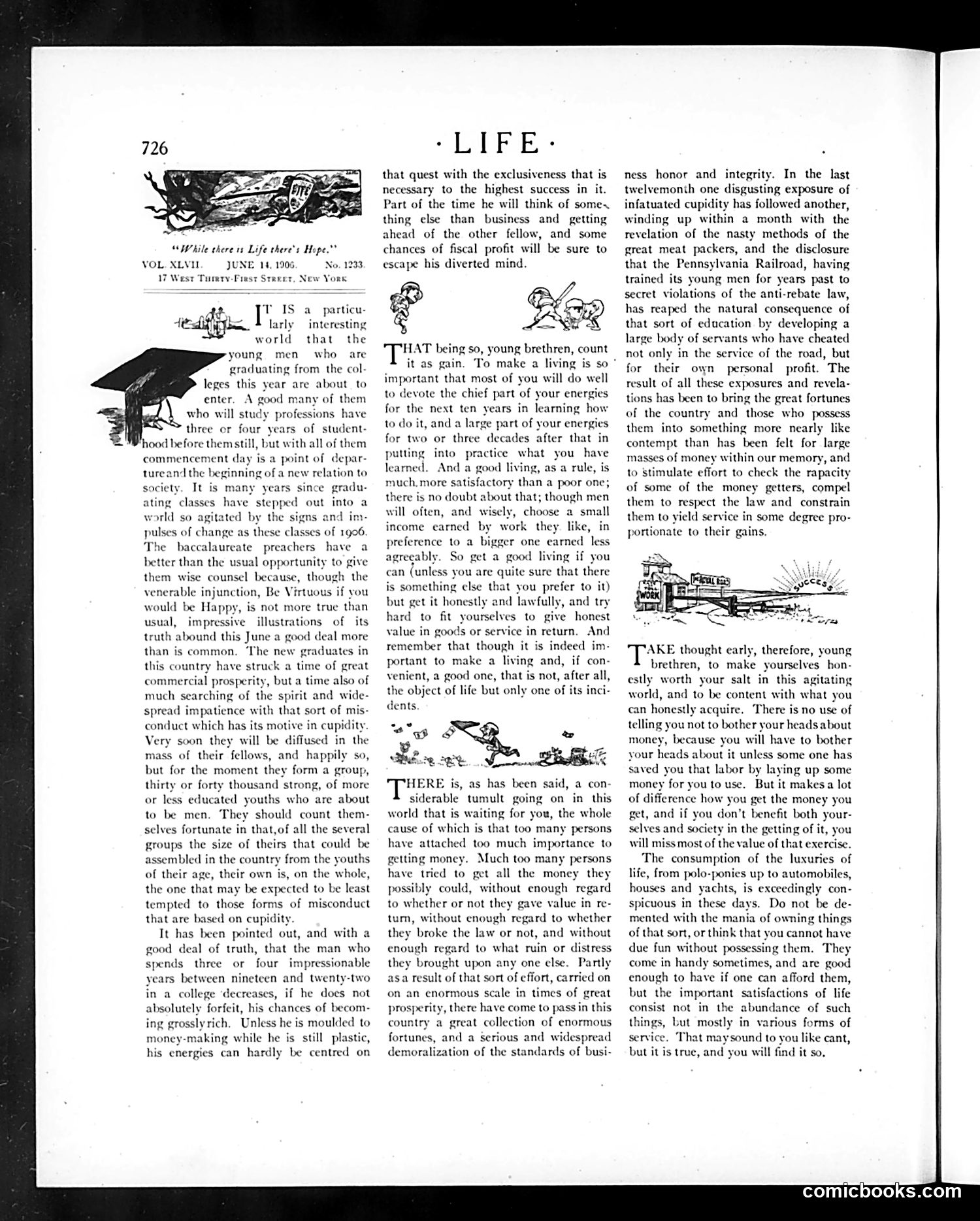
This page contains no political cartoons. It's an editorial essay titled "What Life's Liking," addressing young male college graduates entering the workforce around 1906 (based on the volume number). The small illustrations—a mortarboard, a graduate, and a train—are decorative vignettes supporting the text rather than satirical cartoons. They illustrate the article's theme about young men's career prospects. The essay warns graduates against pursuing wealth dishonestly or through misconduct. It references recent railroad industry scandals (the Pennsylvania Railroad disclosure mentioned in the text) and encourages honest work over rapid fortune-seeking. The tone is moralistic, cautioning against the era's widespread business corruption and suggesting that steady, ethical labor provides better long-term satisfaction than shortcuts to riches.
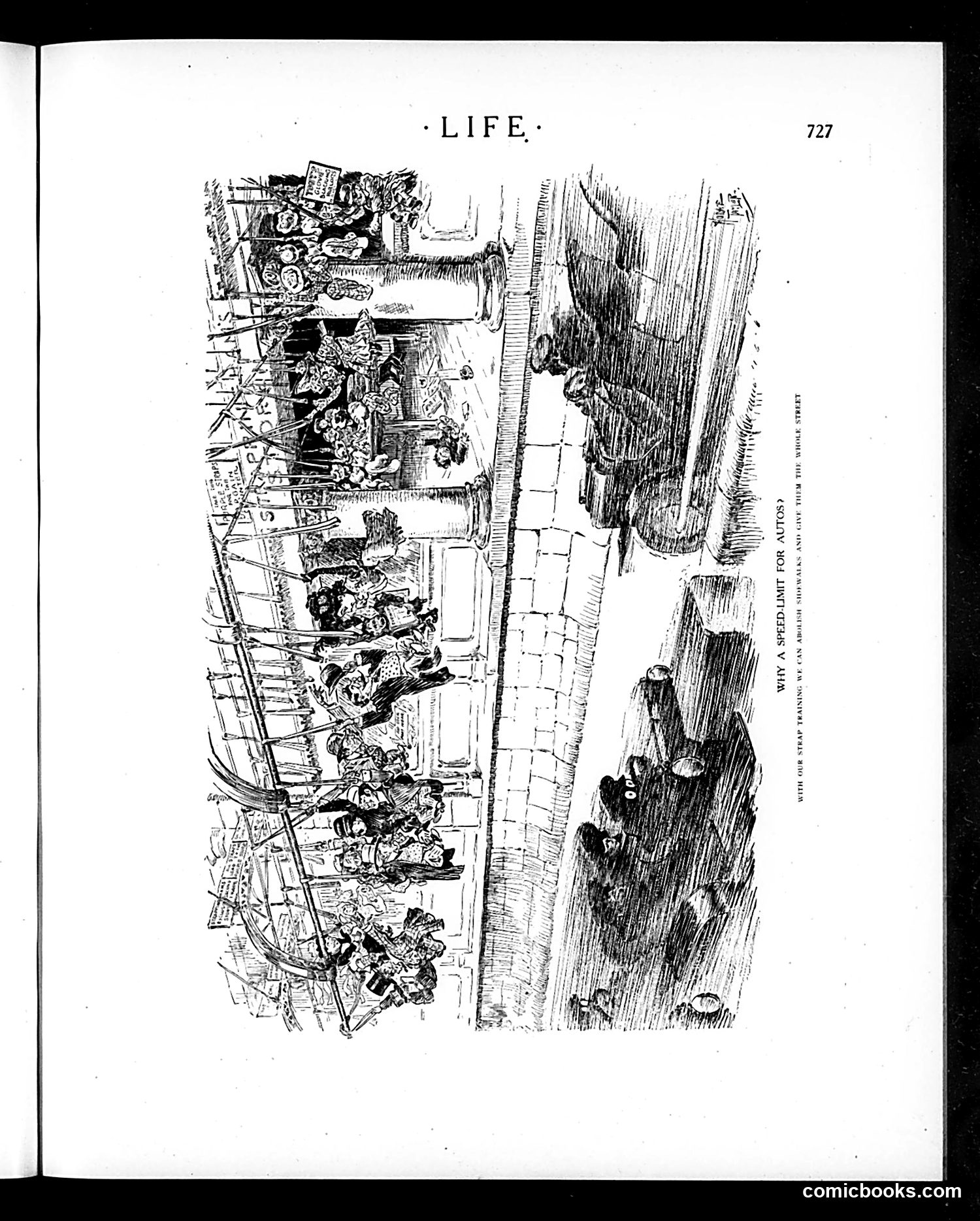
This page from *Life* magazine (page 727) contains a single illustration turned sideways, depicting what appears to be a crowded street scene with multiple figures and architectural elements. The caption reads "WHY A SEEDLING FOR AIRS" (or similar—OCR unclear). The image shows a vertical procession or gathering of people in period dress, with detailed architectural backgrounds including buildings and what appear to be shop fronts. The satirical intent seems to target social pretension or class affectation, suggested by the caption's reference to "airs" (pretentious behavior). However, without clearer text or identifying labels on the figures themselves, I cannot definitively identify specific individuals or political references being mocked. The exact social commentary remains unclear from this reproduction.
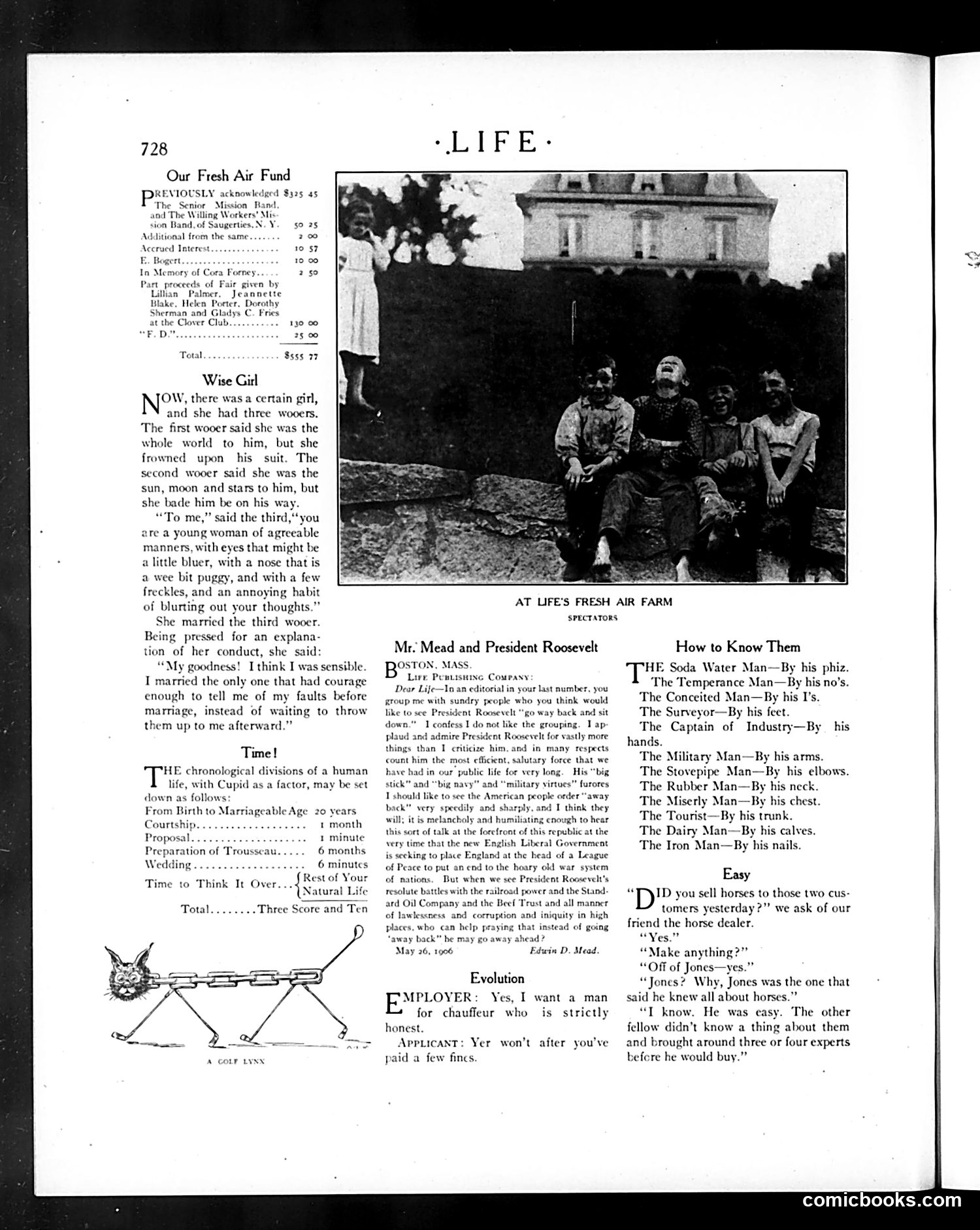
This page contains several unrelated satirical pieces typical of Life magazine's format: **"Wise Girl"** is a folk-tale style story about a woman choosing a suitor based on character assessment rather than flattery—a morality tale about feminine judgment. **"Mr. Mead and President Roosevelt"** appears to be an editorial praising Roosevelt's efficiency and criticizing those who doubt him, written during his presidency (the date visible is May 26, 1906). **"How to Know Them"** is a humorous list of character types identified by physical features (the Water Man by his ship, the Military Man by his arms, etc.)—light social satire. **"Easy"** and **"Evolution"** are brief comedic dialogues about horse-trading and dishonest job applicants—workplace humor. The page reflects early 20th-century American magazine humor: folk wisdom, political commentary favoring progressive leadership, and workplace satire.
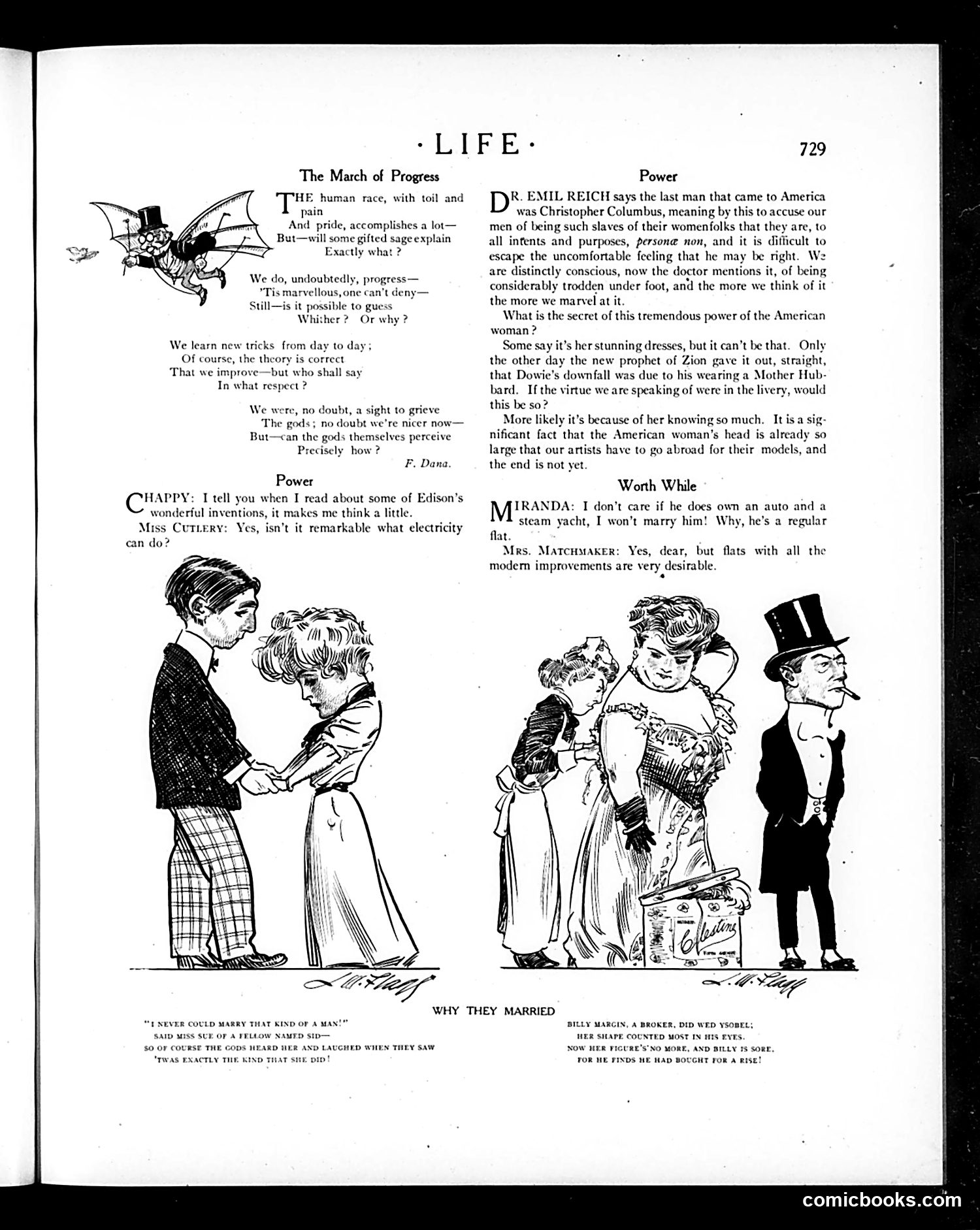
This page contains two distinct sections: **"The March of Progress"** (left): A poem celebrating human advancement, featuring a winged devil figure. The satire suggests that despite calling progress "inevitable," society remains uncertain whether improvements actually represent genuine advancement or mere change. **"Power"** (right): A dialogue about American women's influence and desirability. Dr. Emil Reich attributes women's power not to physical beauty or virtue, but to their knowledge and intellectual capacity. The piece satirizes contemporary assumptions about women, suggesting their real strength lies in education rather than superficial qualities. **"Why They Married"** (bottom): Two cartoon vignettes with captions contrasting marriages—one based on genuine affection, the other on mercenary motives (wealth). The satire critiques materialistic marriage motivations. The overall theme examines progress, female agency, and social values in early 20th-century America.
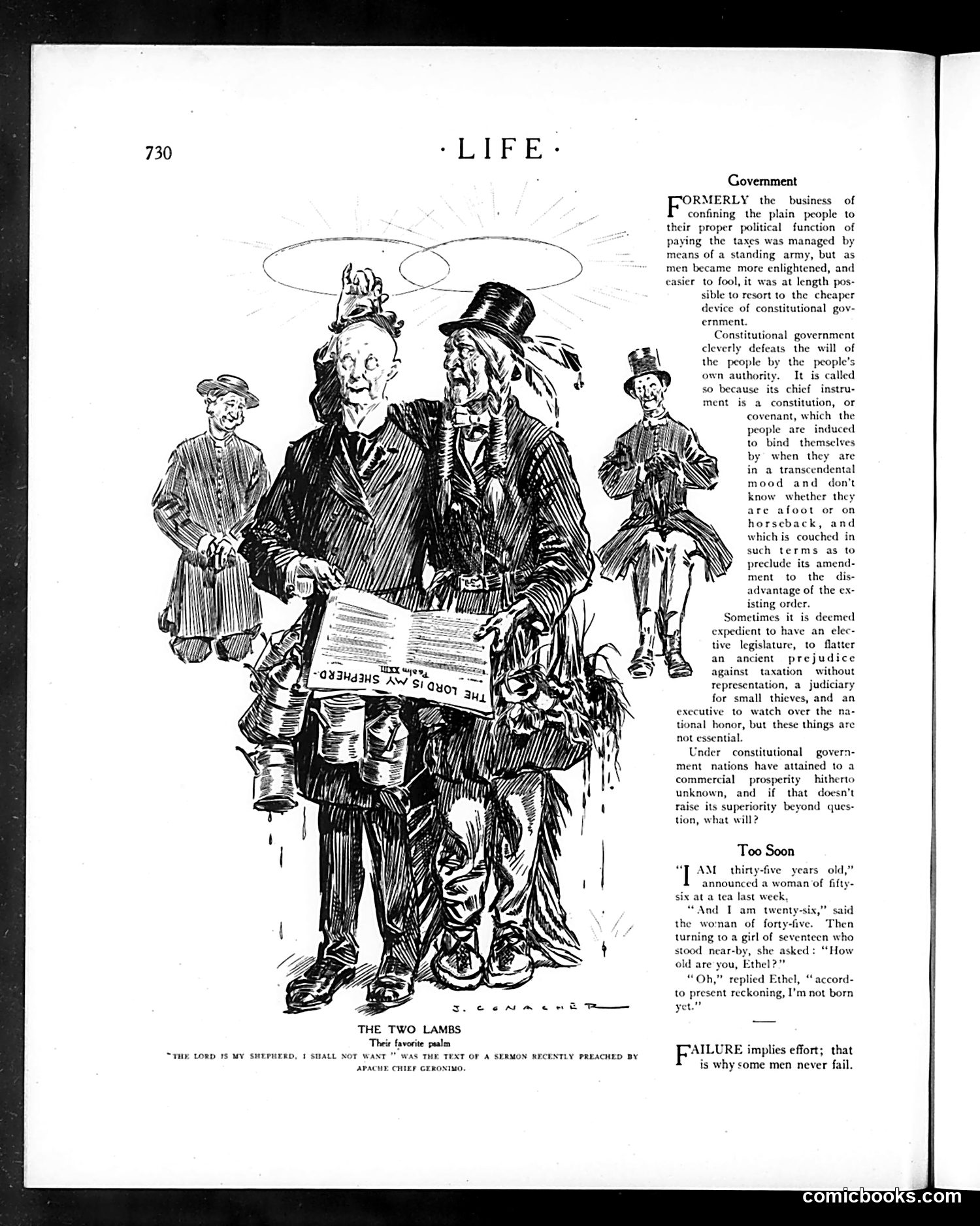
This cartoon satirizes government corruption and constitutional manipulation. The central figures appear to be wealthy or powerful men with halos (ironically suggesting false sanctity), examining what looks like a constitution or legal document. They're surrounded by smaller, lamb-like common citizens—the "two lambs" of the title. The satire suggests that despite constitutional protections, ordinary people are being deceived and fleeced by those in power. The halo imagery mocks the pretense of moral authority. The accompanying text discusses how constitutional government can be subverted through manipulation of public opinion and transcendental reasoning that obscures actual abuse. The overall message: constitutional safeguards mean little when leaders exploit them to control and exploit the populace.
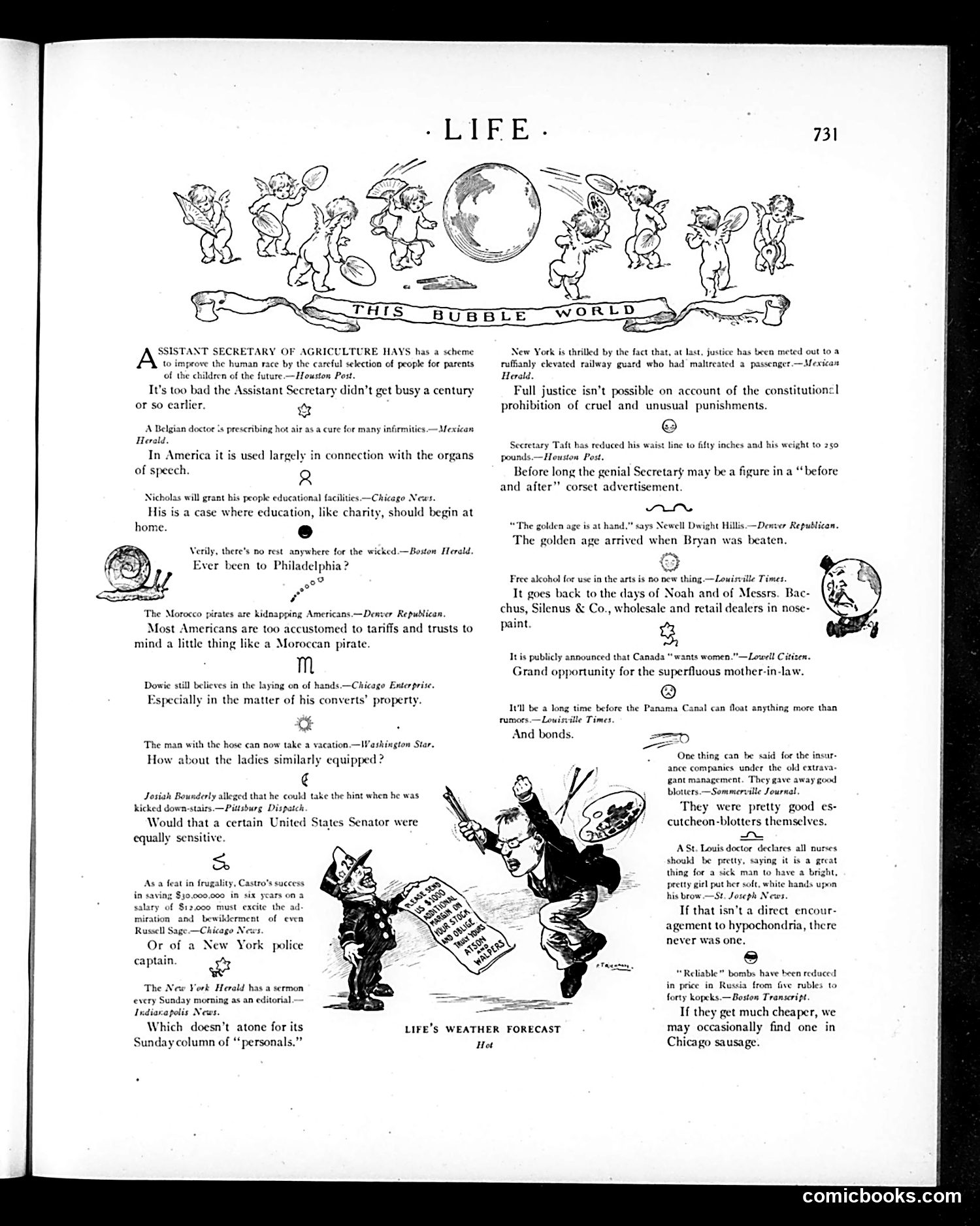
This page contains satirical commentary and jokes rather than political cartoons. The content mocks various contemporary figures and institutions: **Key references include:** - A jab at an Assistant Secretary of Agriculture for promoting selective breeding - Criticism of a Belgian doctor's unusual medical practice - A joke about a U.S. Senator's insensitivity (specific identity unclear) - Commentary on Roosevelt's handling of converts' property (likely Theodore Roosevelt) - A reference to Bryan being "beaten" (William Jennings Bryan, defeated presidential candidate) The illustrated cartoon shows two figures exchanging papers, likely satirizing bureaucratic or political incompetence. **Overall tone:** This is typical *Life* magazine satire—punching at government officials, absurd policies, and notable public figures through short, quip-based commentary rather than detailed visual narrative.
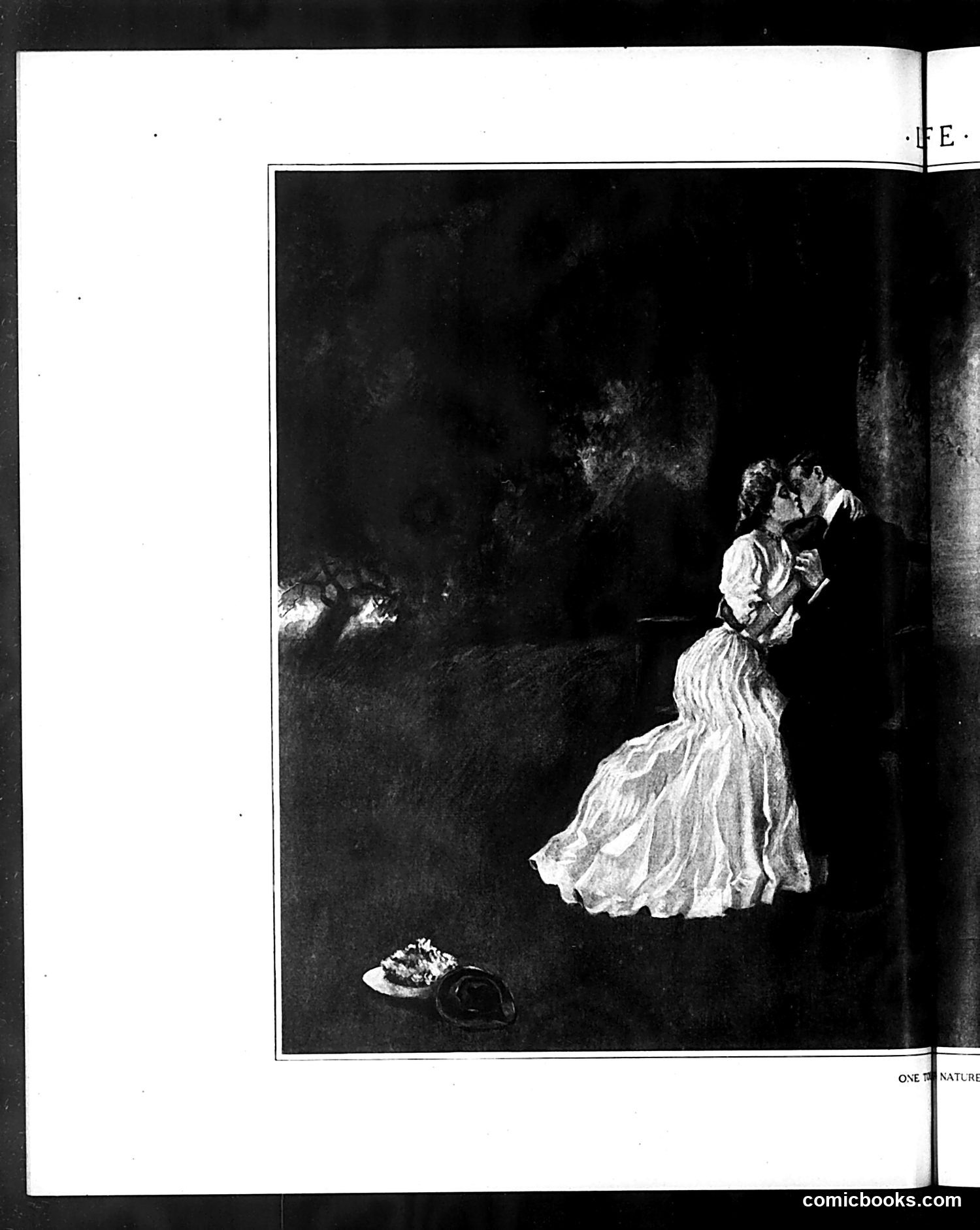
This appears to be an illustration from *Life* magazine showing a woman in an elaborate, flowing gown standing in a dramatic interior space. The text visible reads "ONE OF NATURE" (likely part of a larger caption or title that's cut off). Without the complete caption or surrounding context visible on this page, I cannot definitively identify the specific political or social satire intended. The image itself depicts what appears to be a fashionable woman in period dress, possibly from the early 20th century, but the satirical point—whether it comments on fashion, society, women's roles, or a specific public figure—remains unclear from the image alone. The dramatic lighting and composition suggest the illustration is meant to be humorous or critical of something, but stating exactly what would require speculation I cannot support from the visible evidence.
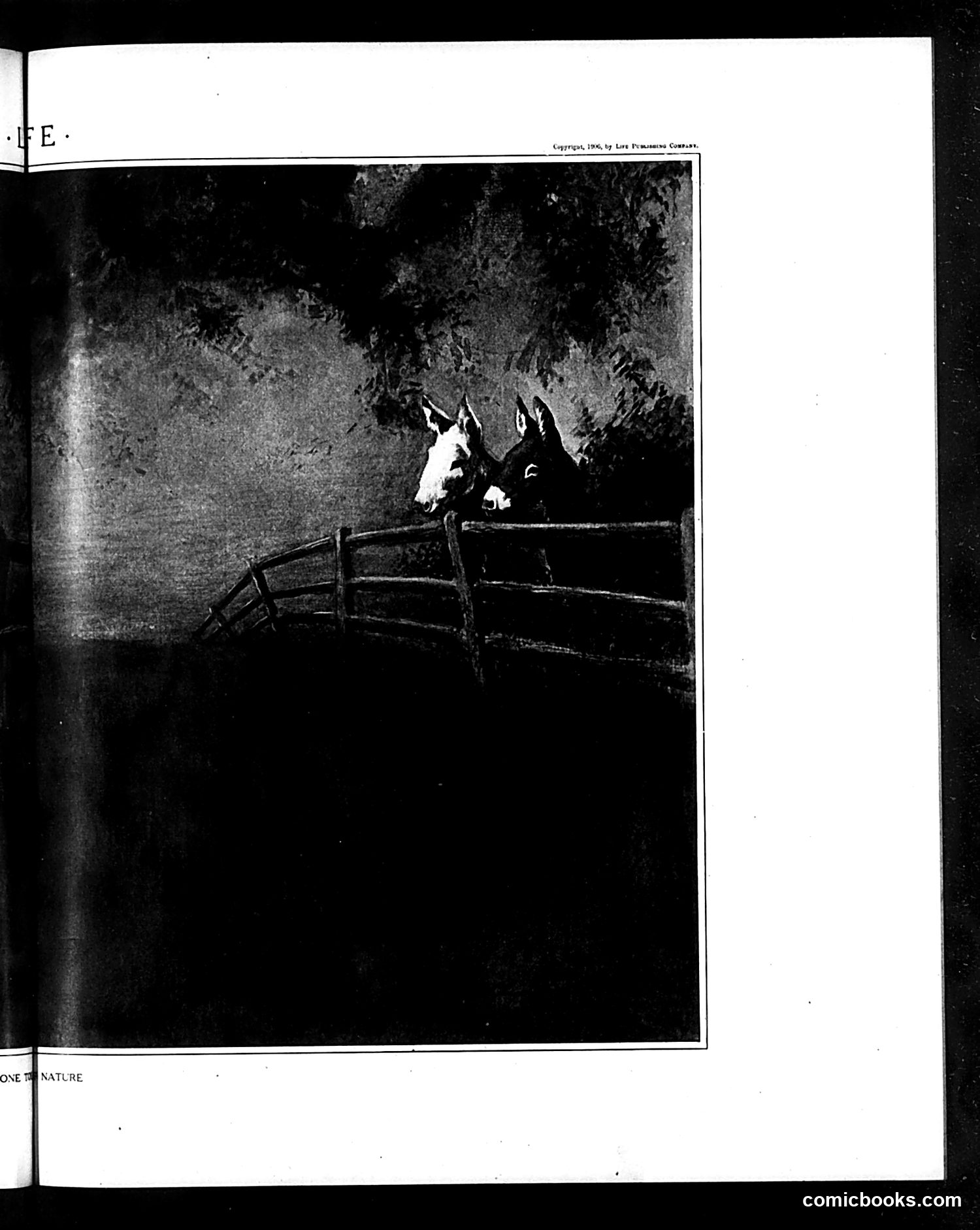
This black and white photograph shows two horses at a wooden fence beneath overhanging tree branches. The image appears to be labeled "ONE WITH NATURE" at the bottom left. Without additional caption text visible in the OCR, the specific satirical point is unclear. However, given Life magazine's satirical tradition, this likely uses the phrase "one with nature" ironically—perhaps commenting on domesticated animals in captivity, the relationship between humans and animals, or rural/pastoral nostalgia. The composition emphasizes the horses' confinement within the fence structure, which could suggest commentary on limitation or constraint despite the romantic notion of being "with nature." The photograph's documentary style and page placement suggest this was meant as social or environmental satire, though the exact target remains ambiguous from the visible material.
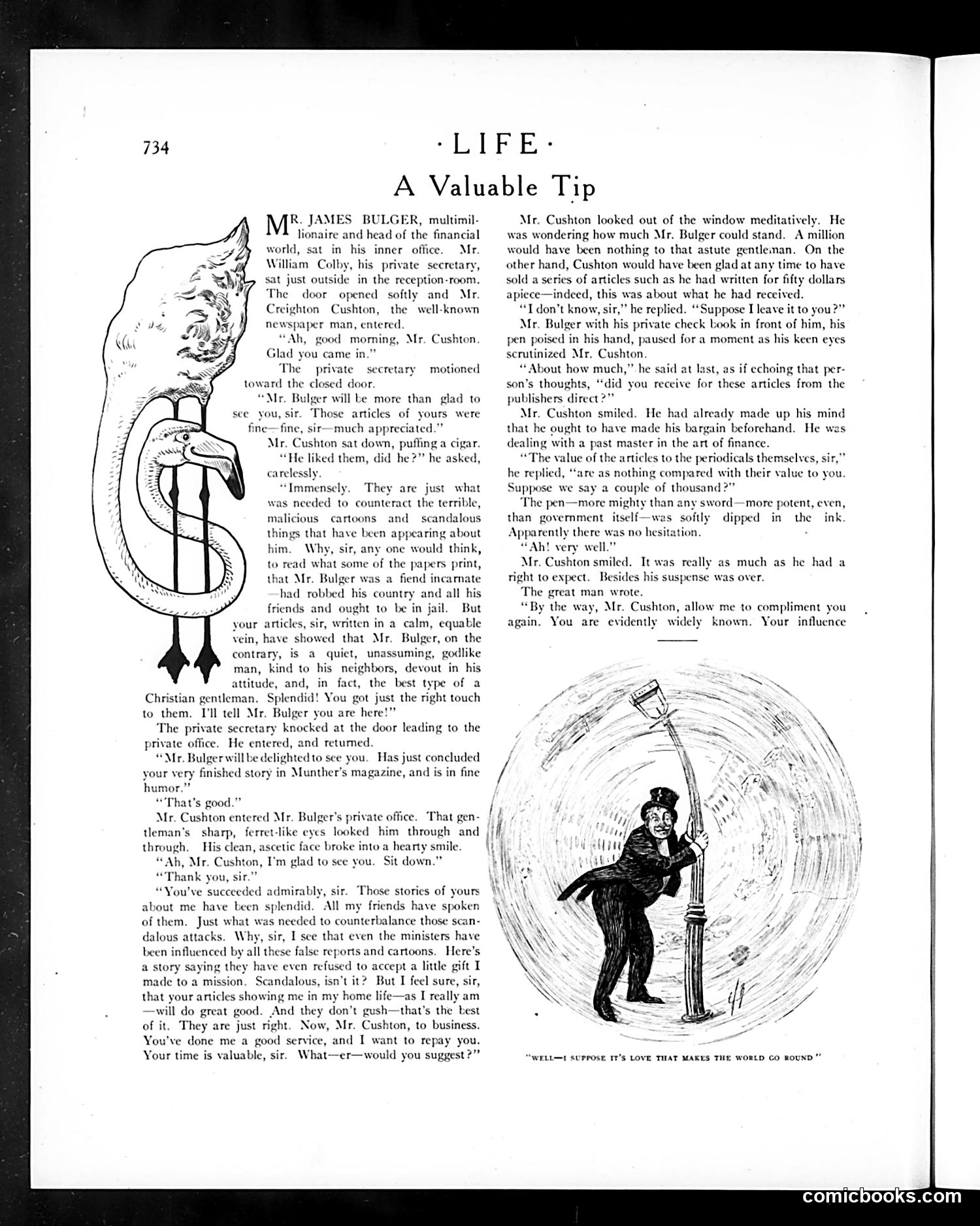
This story satirizes **corruption in journalism and PR manipulation**. A wealthy industrialist, James Bulger, has hired newspaper writer Creighton Cushton to write flattering articles countering "terrible, malicious cartoons and scandalous things" about him. The satire targets how money buys favorable press coverage: Cushton wrote articles for $50 per piece but, realizing Bulger's wealth and desperation for positive publicity, negotiates for $2,000—a massive markup. The accompanying cartoon (showing a figure wielding power) emphasizes money's corrupting influence. The joke is on both parties: Bulger naively thinks purchased favorable coverage erases his actual wrongdoing (refusing mission donations, robbing friends), while Cushton exploits the wealthy man's vulnerability to bad press. The satire exposes how journalism could be compromised by wealthy subjects seeking to rehabilitate their reputations through paid favorable coverage.
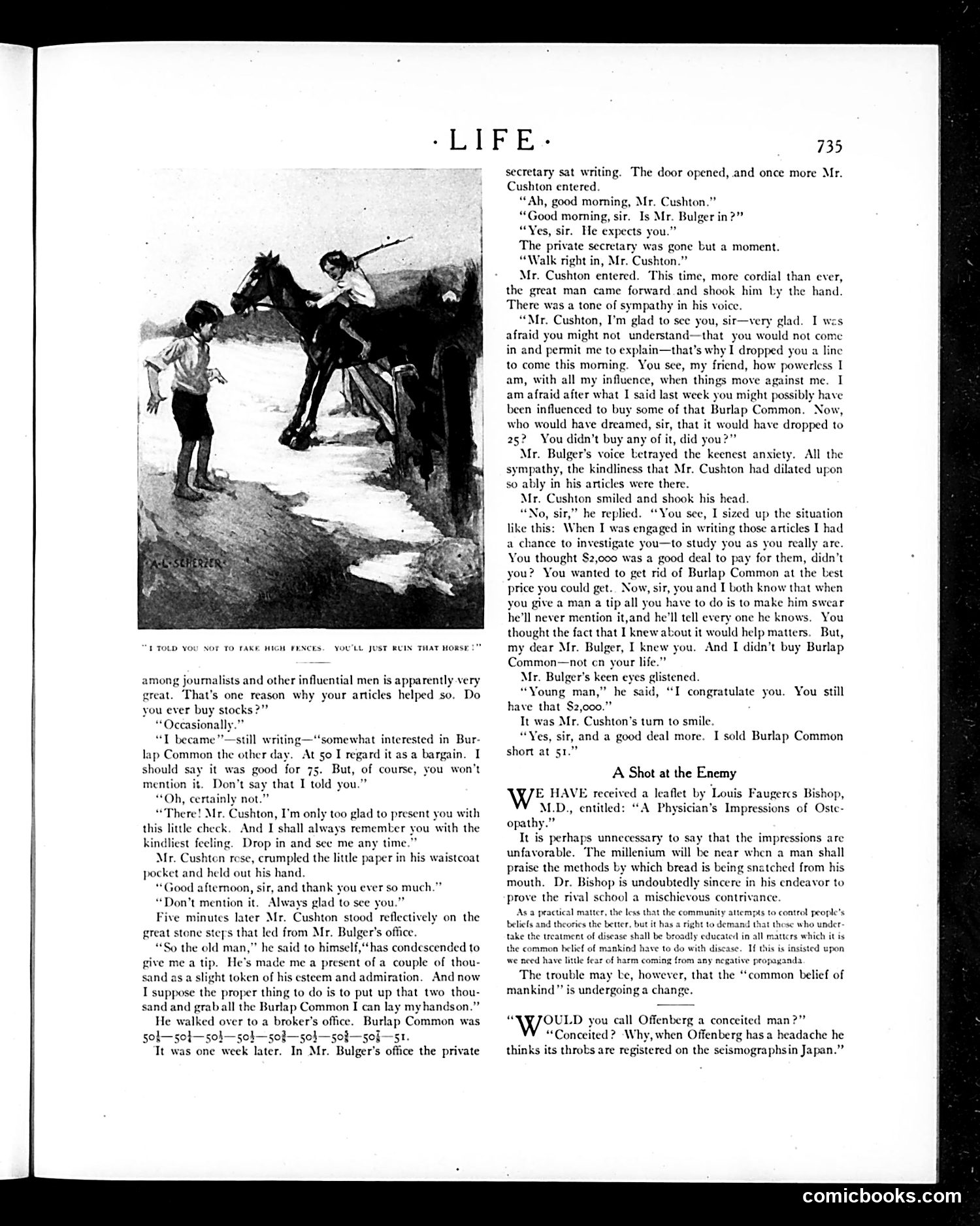
The illustration depicts a horseman taking a fence jump while someone warns from the ground—a visual metaphor for reckless risk-taking. This accompanies a satirical story about financial manipulation and journalistic corruption. The narrative describes Mr. Cushton, a journalist of apparent influence among business circles, who receives a $2,000 bribe and stock tip from the wealthy Mr. Bulger (hoping he'll buy Burlap Common stock). The satire exposes how Bulger attempts to manipulate Cushton into driving up the stock price through favorable articles. However, Cushton proves cleverer—he recognizes the scheme, refuses to buy, and instead sells the stock "short" (betting on its decline). When Bulger's scheme collapses and the stock drops, Cushton profits handsomely. The cartoon critiques early 20th-century financial corruption: wealthy businessmen bribing journalists to manipulate stock prices, and the vulnerability of markets to such schemes. The "high fences" represent dangerous financial risks taken without proper judgment.
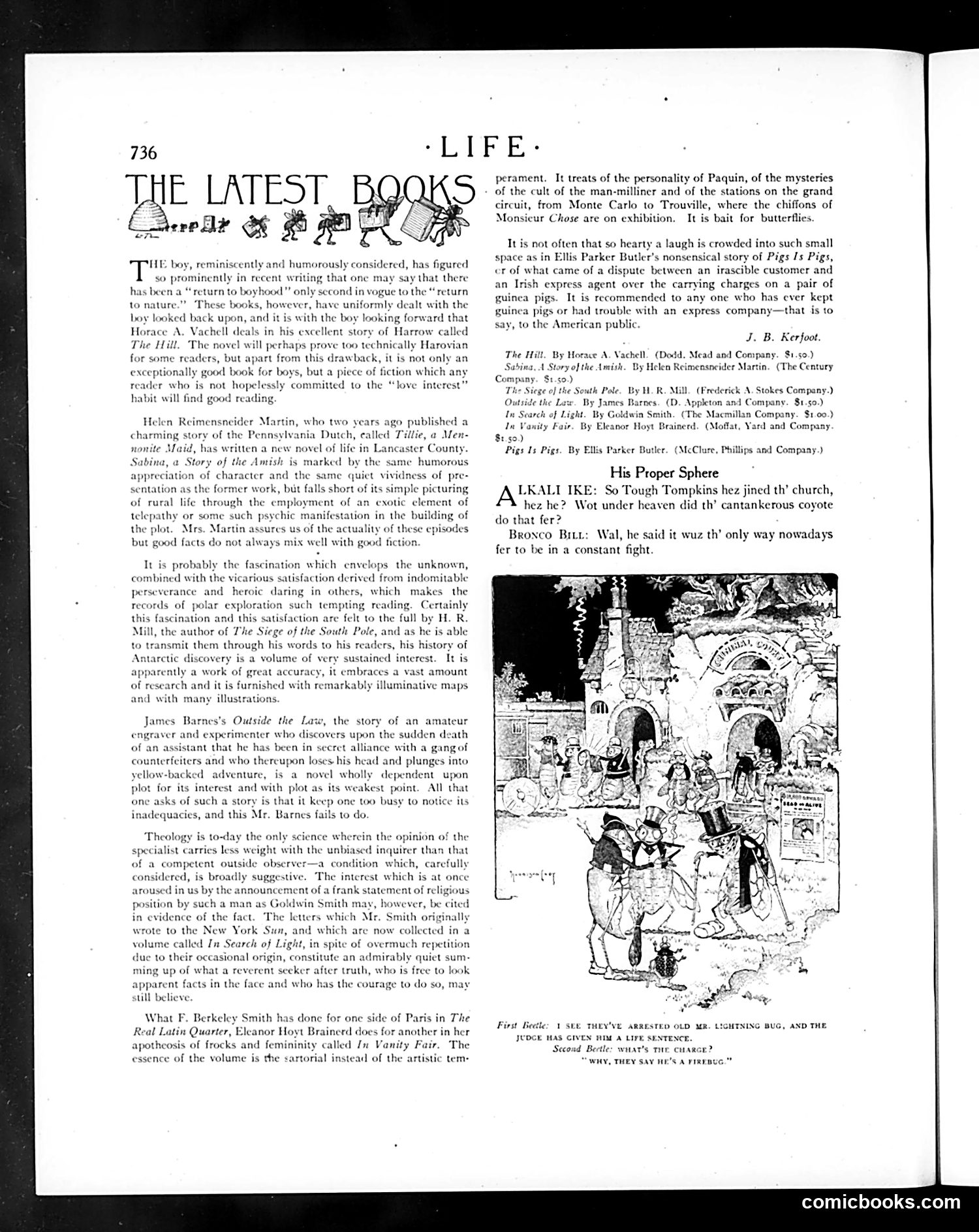
This page is primarily a **book review section** titled "The Latest Books," not a political cartoon. It discusses several contemporary novels including Horace Vachell's *The Hill* (about Harrow School), Helen Reimensneider Martin's *Sabina* (about Pennsylvania Dutch life), and works on polar exploration and Paris society. The only illustration is a **small cartoon** showing what appears to be a courtroom or legal scene. The captions reference "I see they've arrested old Mr. Lightning Bug, and the judge has given him a life sentence" and "What's the charge?" with a response about "vintage." This appears to be a **humorous society cartoon** making a pun about a "lightning bug" receiving a legal sentence, likely satirizing either minor legal proceedings or social pretension—typical of Life magazine's light satirical humor of the period. The page reflects early 20th-century literary culture and gentle domestic satire rather than hard political commentary.
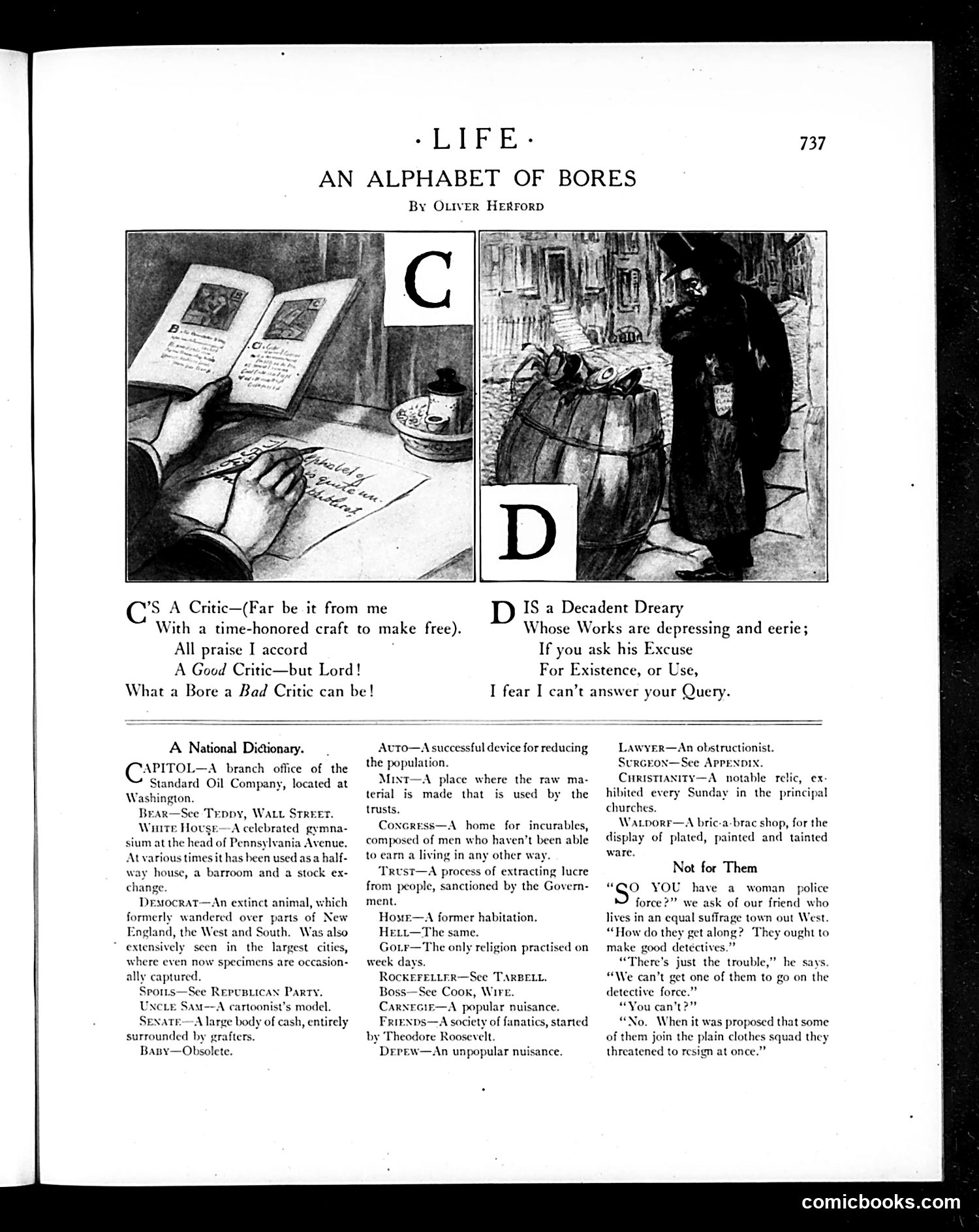
This satirical dictionary mocks early 1900s American institutions and figures through absurdist definitions. The two illustrated entries shown are: **C—A Critic**: The left image shows someone reading reviews, mocking both bad critics and the pretension of criticism itself. **D—A Decadent Dreary**: The right image depicts a gloomy figure, referencing the "Decadent" artistic movement popular in fin-de-siècle culture. The accompanying dictionary entries are biting political commentary: "Capitol" is a Standard Oil branch office (mocking corporate influence in government); "Democrat" is an "extinct animal" (suggesting the party's irrelevance); "Senate" is "a large body of cash, entirely surrounded by grafters"; and "Trust" is legalized extraction of money from people. These target corporate monopolies, political corruption, and the ineffectiveness of democratic institutions—hot-button Progressive Era issues. The final anecdote mocks women suffrage advocates as impractical idealists.
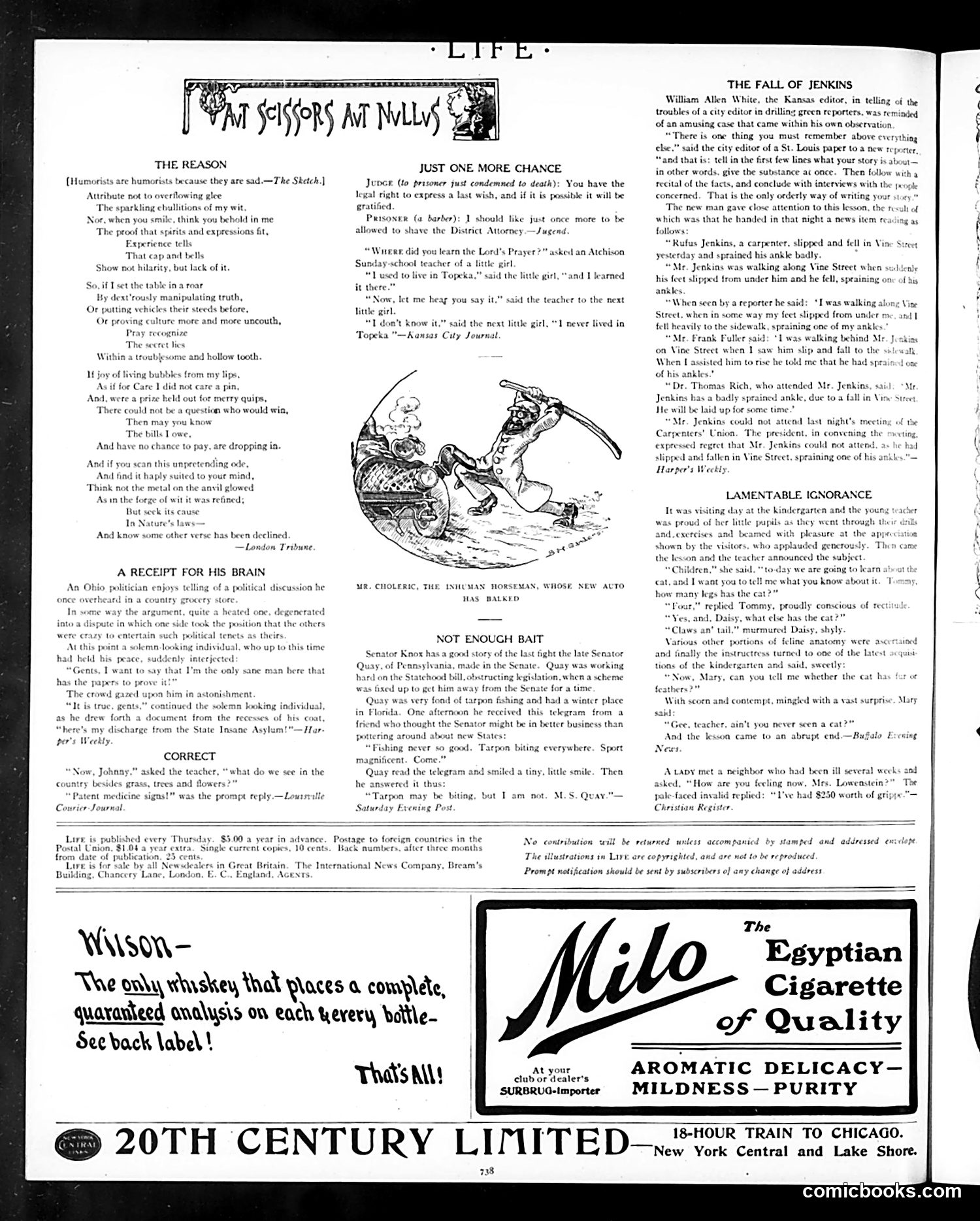
This page contains several short humorous pieces typical of early 20th-century satirical journalism: **"The Reason"** and **"A Receipt for His Brain"** are verse and prose pieces about the contradictions between outward cheerfulness and inner troubles—a humorist appears jolly but harbors debts and sorrows. **"Correct"** is a brief joke: when a teacher asks students what they see in nature, a child answers "Patent medicine signs"—satirizing the ubiquity of patent medicine advertising in the era. **"Just One More Chance"** shows a prisoner condemned to death requesting one final wish: to shave the District Attorney, suggesting the Attorney deserves execution instead. **"Not Enough Bait"** references Senator Quay of Pennsylvania, who prioritized legislative obstruction over relaxation, refusing to abandon work even for tarpon fishing—mocking his relentless political maneuvering. **"The Fall of Jenkins"** humorously illustrates a new reporter's overzealous application of journalism basics, burying the significant detail (the injury) beneath mundane narrative details. The page reflects turn-of-the-century American political satire and journalism culture.
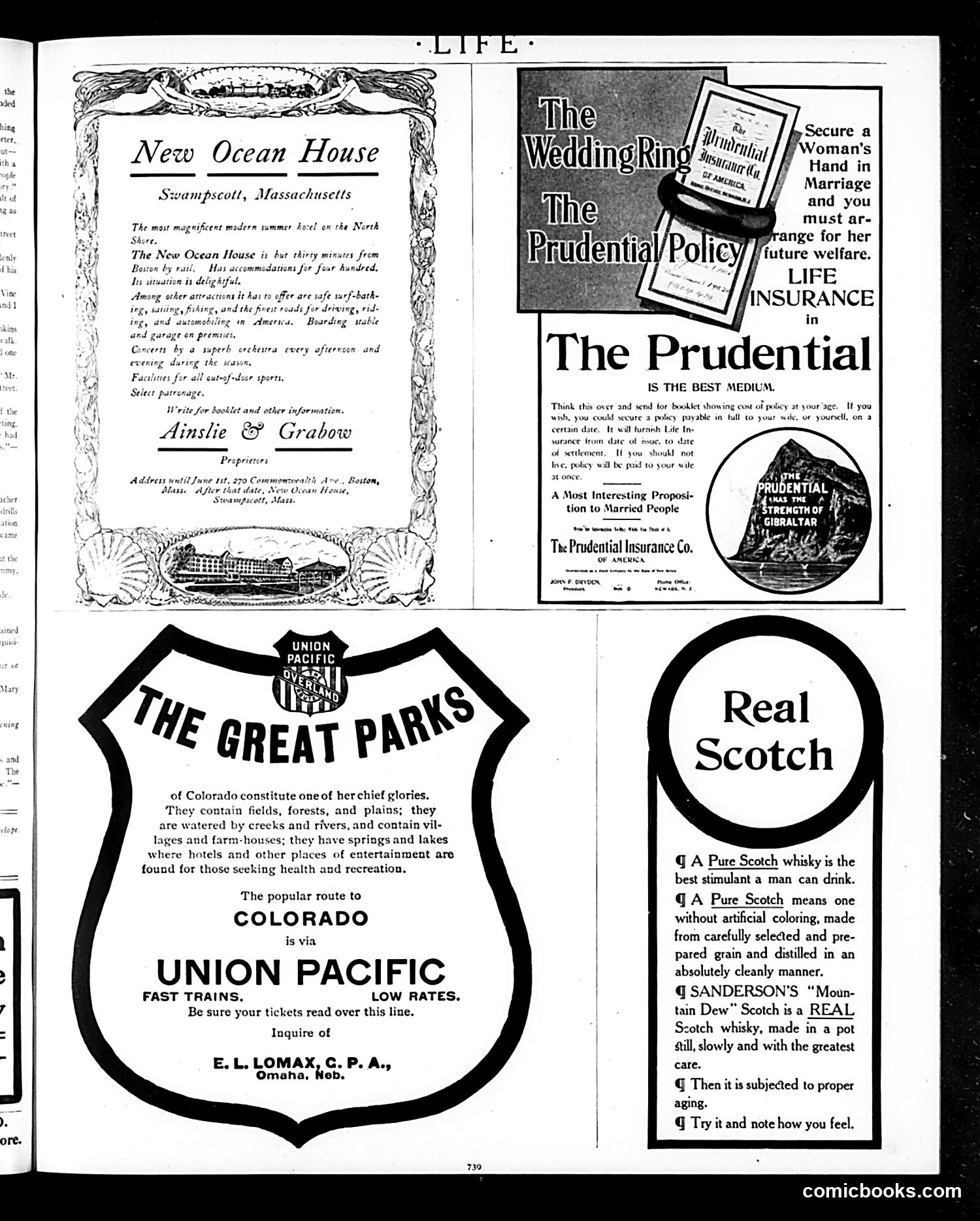
This is primarily a **advertisements page** from Life magazine, not a satirical cartoon. It contains four distinct ads: 1. **New Ocean House** (Swampscott, Massachusetts): A luxury resort advertisement targeting wealthy summer vacationers, emphasizing safety, amenities, and proximity to Boston. 2. **Prudential Insurance**: Targets married men, framing life insurance as securing a wife's financial future—reflecting early 20th-century assumptions about male breadwinners and female dependency. 3. **Union Pacific Railroad**: Promotes Colorado tourism and rail travel, emphasizing the scenic "Great Parks" and recreational opportunities. 4. **Sanderson's "Mountain Dew" Scotch Whisky**: Markets Scottish whisky by emphasizing purity and traditional production methods. The page reflects **Edwardian-era consumer culture**: leisure travel, life insurance as status/responsibility, and alcohol marketing. No political satire is evident—this represents straightforward period advertising targeting affluent readers.
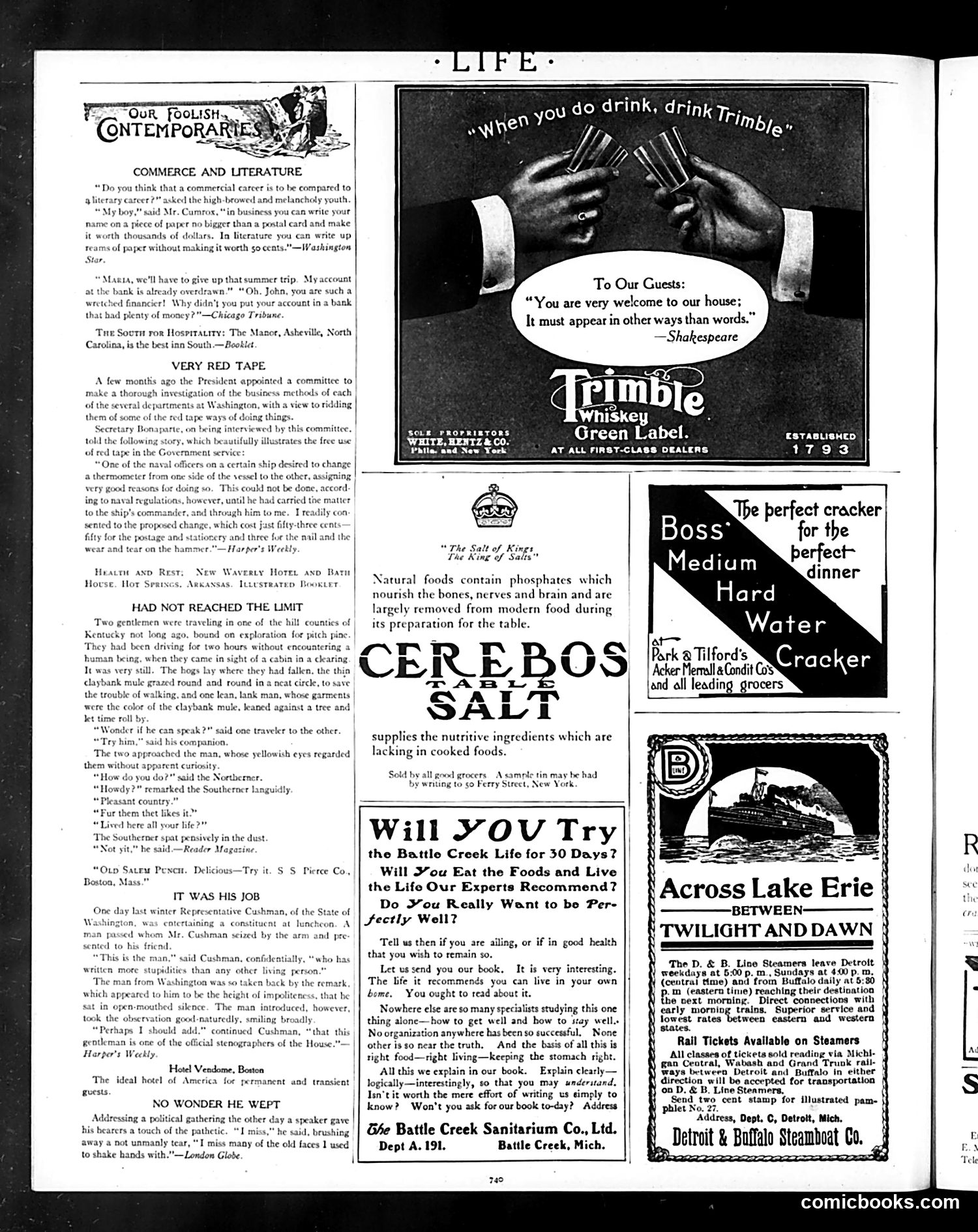
This page contains satirical commentary and period advertisements from an early 20th-century *Life* magazine issue. The cartoon section "Our Foolish Contemporaries" mocks everyday absurdities through brief anecdotes: a debate between commerce and literature (suggesting writing is financially worthless), a wife's illogical response to her husband's banking problems, and a lengthy rural dialogue where a taciturn Southern farmer provides minimal responses to Northern travelers' questions—satirizing regional stereotypes and rural reticence. Other sections lampoon bureaucratic "red tape" in government and a confused congressional stenographer. The page is dominated by **period advertisements** for luxury goods: Trimble Whiskey, Cerebos Salt (claiming nutritive phosphates), Boss crackers, Lake Erie steamship travel, and the Battle Creek Sanitarium promoting a health regimen. The satirical humor relies on recognizing contemporary frustrations (commercial vs. artistic value, government inefficiency, regional cultural differences) that would resonate with educated readers of the era. The advertisements reflect Progressive-era health consciousness and leisure travel marketing.
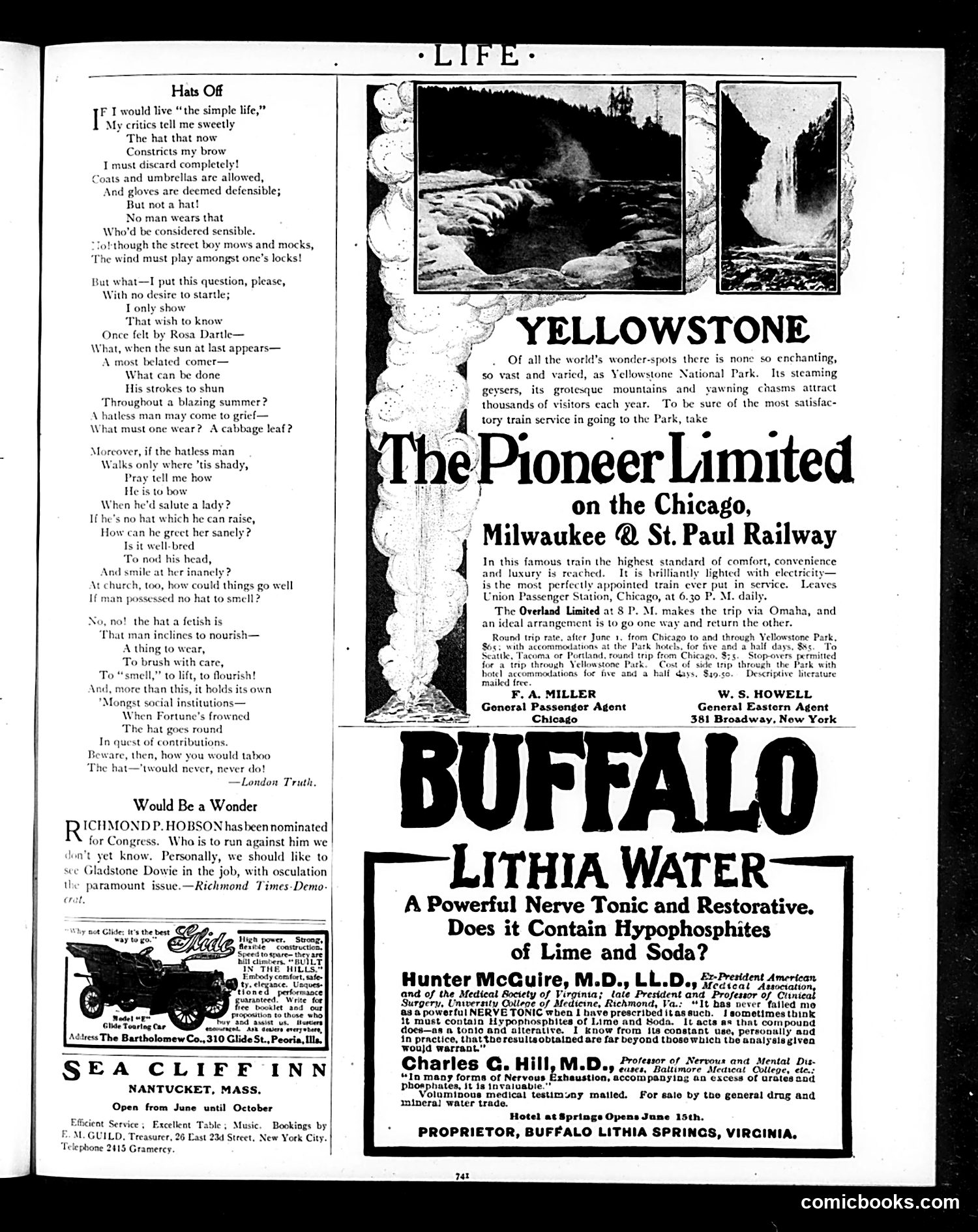
This page contains three distinct elements: a satirical poem, advertisements, and editorial commentary. **"Hats Off" Poem**: Lampooning the "simple life" movement, a early-20th-century trend where critics advocated rejecting social conventions, including hats. The satirist mocks this by listing absurd consequences: exposed hair in blazing sun, inability to tip one's hat to women (a fundamental courtesy gesture), and loss of the hat's role in charitable collections. The point: some social conventions exist for practical and social reasons. **"Would Be a Wonder"**: Brief commentary on Richmond P. Hobson's congressional nomination, joking that opponent "Gladstone Dowie" (appears to be a fabricated name) should campaign on "osculation" (kissing) as the paramount issue—apparently a humorous dig at someone. **Advertisements**: For Yellowstone travel, Buffalo Lithia Water (a purported nerve tonic), and other services. The water ads feature doctor testimonials claiming benefits for nervous ailments, typical of patent medicine marketing of the era.
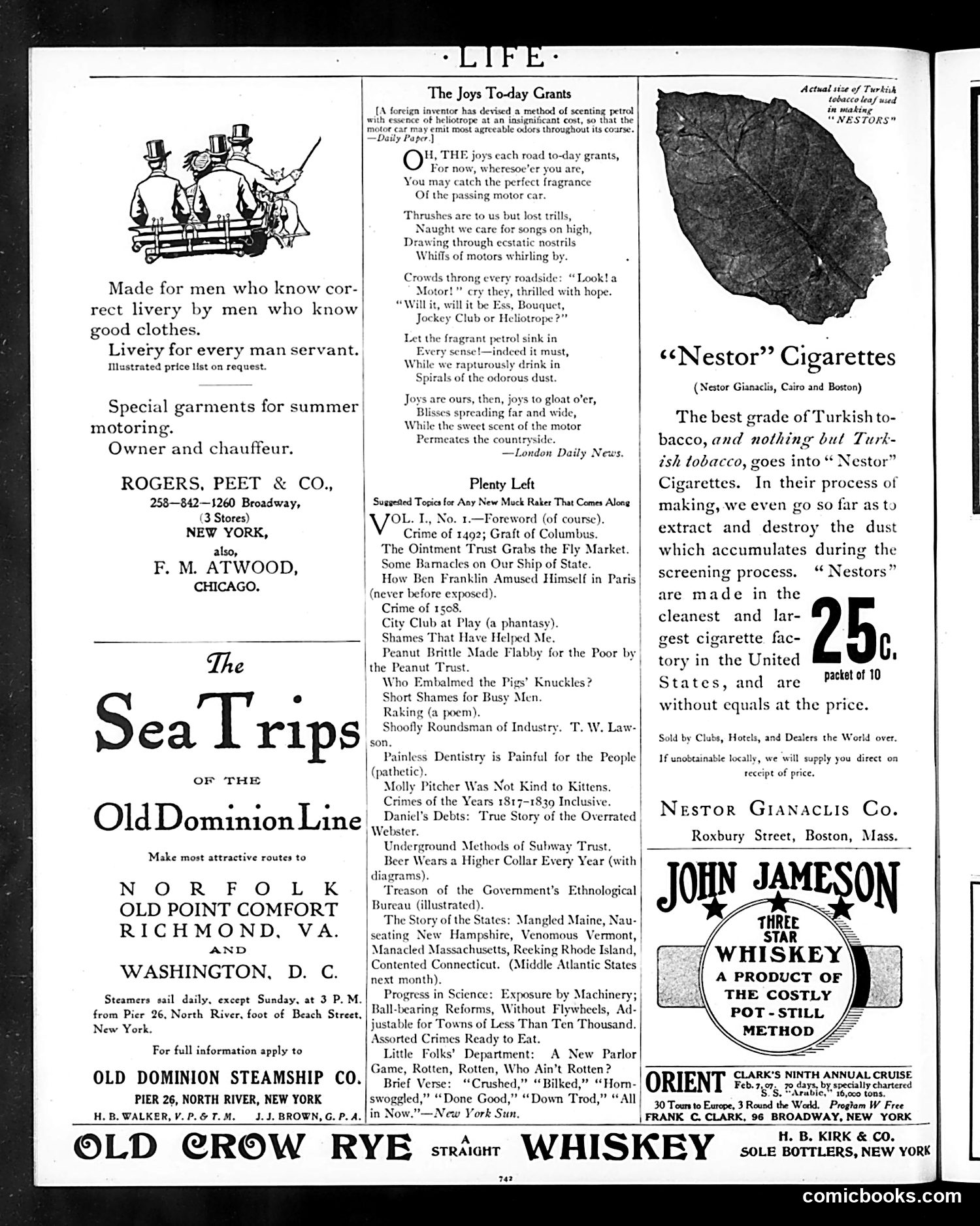
This page primarily consists of **advertisements and satirical content**, not political cartoons in the traditional sense. The main satire is a poem titled "The Joys To-day Grants," mocking the then-novel practice of scenting automobile fuel with perfume (heliotrope). The joke: motoring has become so ubiquitous that its exhaust fumes are now celebrated as a desirable fragrance, replacing natural pleasures like birdsong. It's gentle social satire about modern technology and changing urban sensibilities. The page is otherwise dominated by product advertisements (livery services, cigarettes, steamship lines, whiskey) and a "Plenty Left" section listing potential scandal topics for "muck-raker" exposés—likely referencing the Progressive Era's investigative journalism trend. These include satirical takes on historical "crimes" and contemporary institutional corruption (trusts, graft, bureaucratic abuse). The overall tone is satirical commentary on American progress, consumerism, and institutional failings typical of *Life* magazine's style during this period.
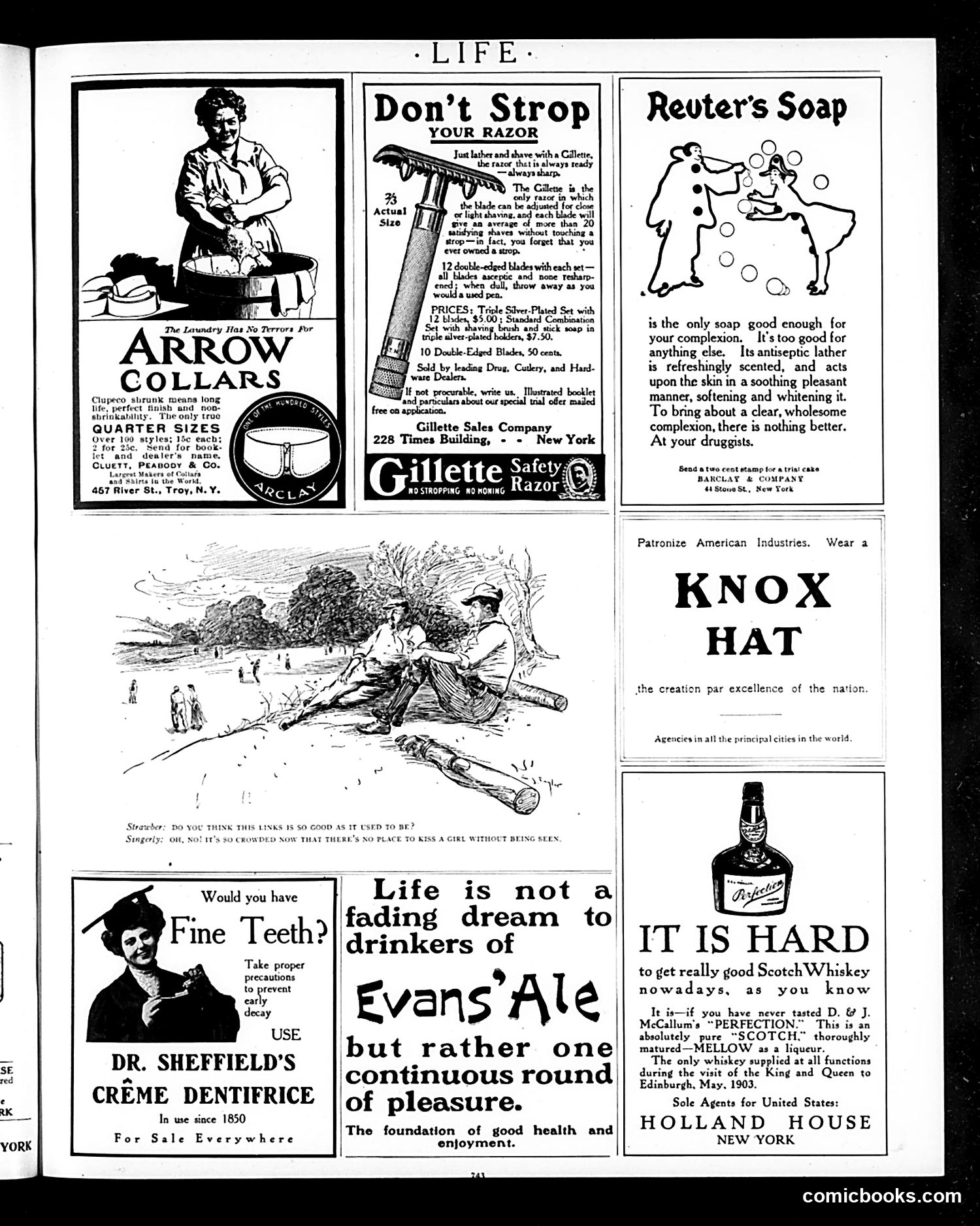
This is primarily a **commercial advertising page** rather than satirical content. It showcases early 20th-century consumer products through period-typical marketing approaches. The advertisements include: - **Arrow Collars** (laundry solutions for detachable collars, a common men's fashion item) - **Gillette Safety Razors** (promoting convenience over traditional stropping) - **Reuter's Soap** (emphasizing beauty benefits) - **Knox Hat** (patriotic "American Industries" branding) - **Dr. Sheffield's Crème Dentifrice** (tooth decay prevention) - **Evans's Ale** (health claims tied to pleasure) - **D&J McCallum Scotch Whisky** (emphasis on purity and prestige) The single **cartoon** (center-left) shows a couple at what appears to be a scenic overlook; the caption jokes that public spaces are now "too crowded" for private romantic moments—social commentary on urbanization rather than political satire. These ads reflect period assumptions: women's appearance as paramount concern, product claims without regulation, and alcohol marketed for health benefits—all practices modern readers would find notably unethical.
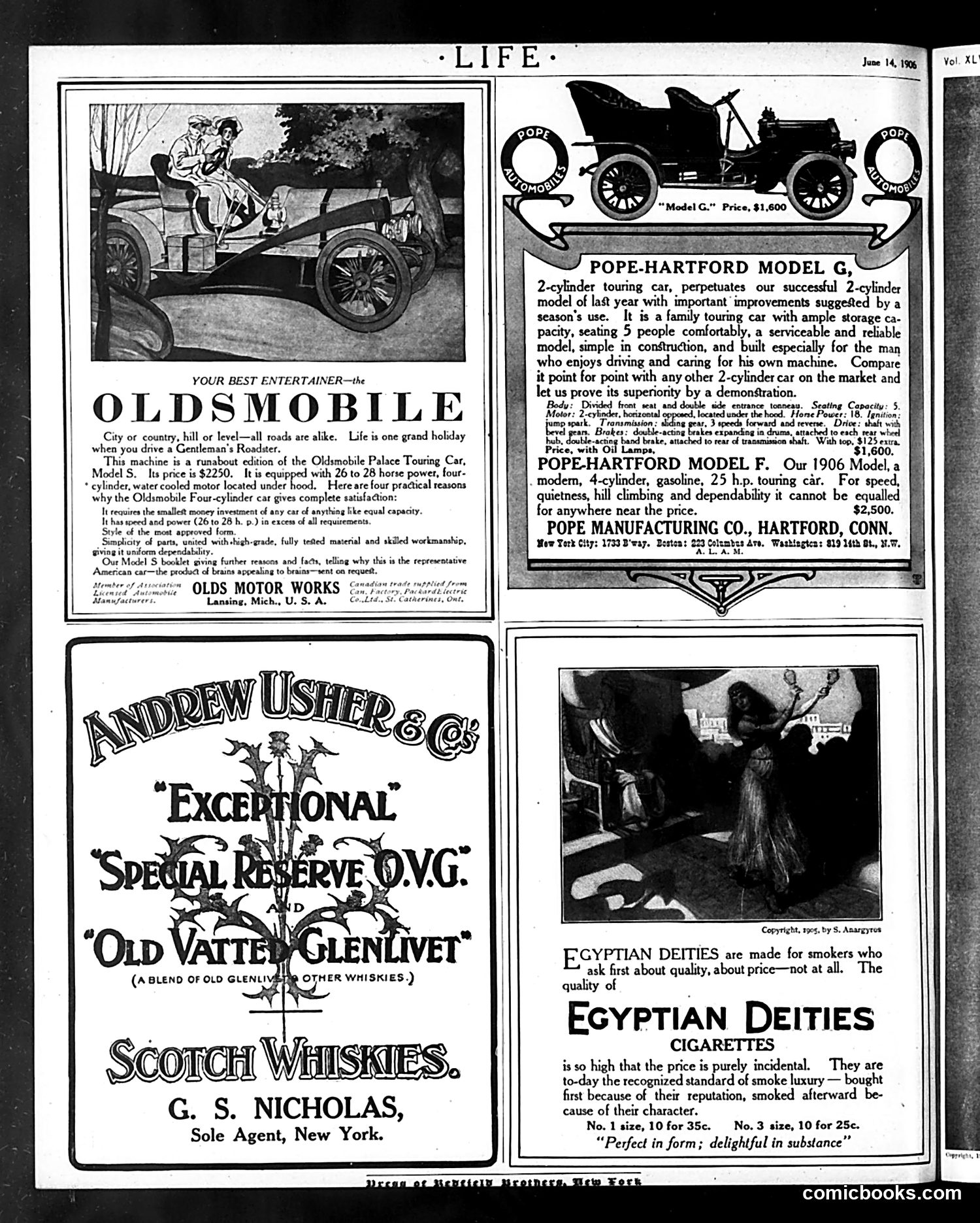
This is primarily an **advertising page**, not satirical content. It features four commercial advertisements typical of early 1900s publications: **Oldsmobile and Pope-Hartford**: Competing automobile manufacturers showcase touring cars, emphasizing reliability, horsepower, and affordability (prices $1,600-$2,500). The Oldsmobile ad uses leisure imagery—a couple enjoying countryside driving—to market automobiles as entertainment for the wealthy. **Andrew Usher & Co.**: A Scottish whisky advertisement listing premium blends. **Egyptian Deities Cigarettes**: A product advertisement claiming quality over price—a luxury cigarette brand positioned for discerning smokers. **Context for modern readers**: This represents the advertising ecosystem of a wealthy American publication circa 1906, targeting affluent readers interested in new automobiles, imported spirits, and premium tobacco. No political satire is present; this is straightforward commercial content reflecting the era's consumer culture and Life magazine's upscale readership.