
Life, 1906-06-14 · page 8 of 24
Life — June 14, 1906 — page 8: what you’re looking at
What you’re looking at
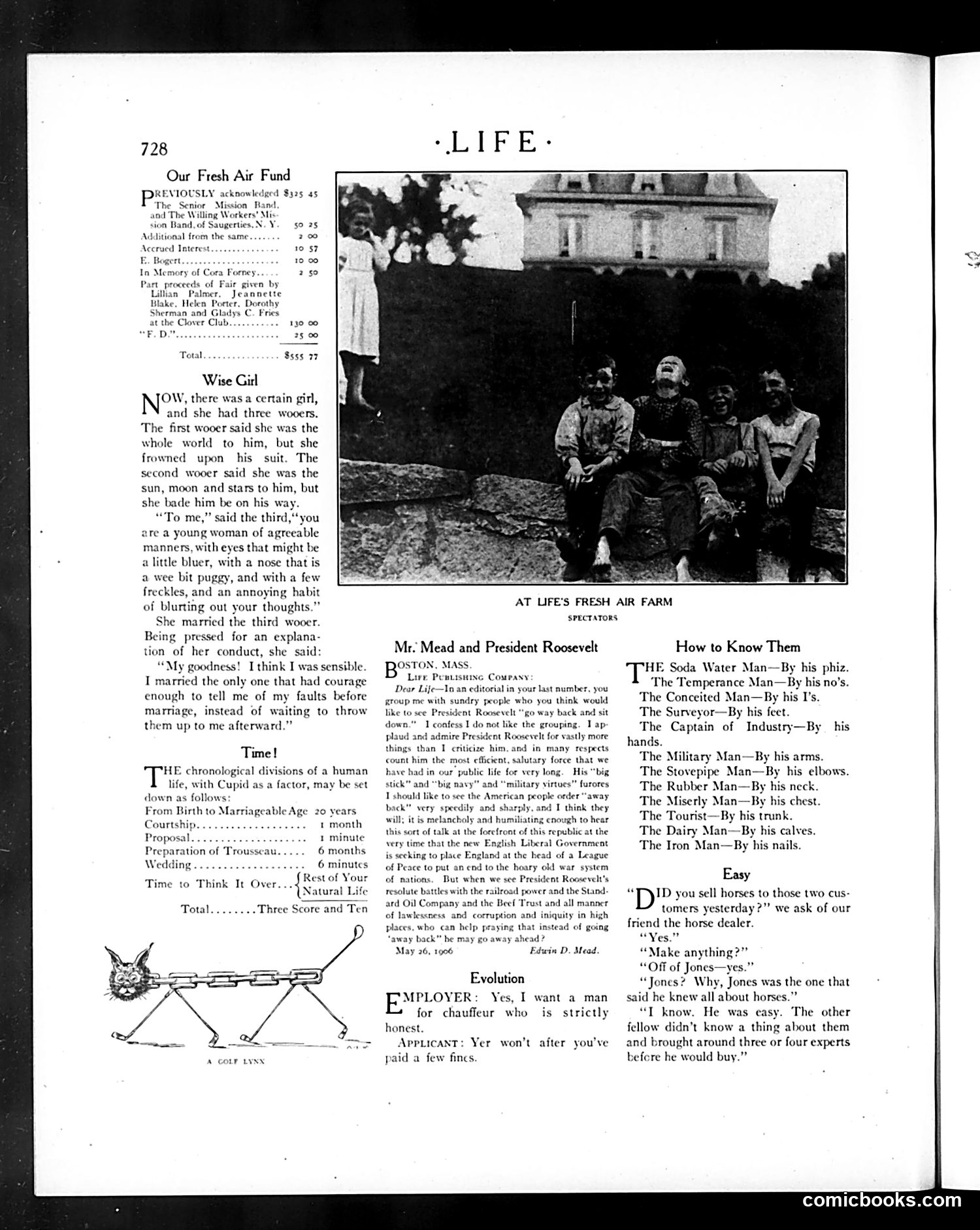
This page contains several unrelated satirical pieces typical of Life magazine's format: **"Wise Girl"** is a folk-tale style story about a woman choosing a suitor based on character assessment rather than flattery—a morality tale about feminine judgment. **"Mr. Mead and President Roosevelt"** appears to be an editorial praising Roosevelt's efficiency and criticizing those who doubt him, written during his presidency (the date visible is May 26, 1906). **"How to Know Them"** is a humorous list of character types identified by physical features (the Water Man by his ship, the Military Man by his arms, etc.)—light social satire. **"Easy"** and **"Evolution"** are brief comedic dialogues about horse-trading and dishonest job applicants—workplace humor. The page reflects early 20th-century American magazine humor: folk wisdom, political commentary favoring progressive leadership, and workplace satire.
📄 Transcribed text from this page (OCR, searchable)
Machine-transcribed from the original scan — historical spelling and the odd misread are preserved.
728 Our Fresh Air Fund REVIOUSLY acknowledged $325 The Senior Mission Rand. and The Willing Workers? Mis sion Band, of Saugerties. N.Y Additional from the same. Accrued Interest E. B : In Memory of Cora Forney Part proceeds of Fair given by Lillian Palmer. Jeannette Blake, Helen Porter. Dorothy Sherman and Gladys C. Fries at the Cl oF De Total $sss 77 Wise Girl OW, there was. certain girl, nd she had three wooers. The first wooer said she was the whole world to him, but she frowned upon his suit. The second wooer said she was the sun, moon and stars to him, but she bade him be on his way. “To me,” said the third,“‘you are a young woman of agreeable manners, with eyes that might be a little bluer, with a nose that is a wee bit puggy, and with a few freckles, and an annoying habit of blurting out your thoughts.” he married the third wooer. Being pressed for an explana- tion of her conduct, she said: “My goodness! I think I was sensible. I married the only one that had courage enough to tell me of my faults before marriage, instead of waiting to throw them up to me afterward.” Time! HE chronological divisions of a human life, with Cupid as a factor, may be set down as follows: From Birth to Marriageable Age 20 years Courtship. sees . onth Proposal i ation of Trousscau. . A COLT LYNN AT LIFE’S FRESH AIR FARM SPECTATORS Mr. Mead and President Roosevelt OSTON, MASS. Lire Pemutstinc Company Dear LiJe—In an editorial in your last number, you group me with sundry people who you think would sce President Roosevelt “go way back and sit I confess I do not like the grouping. I ap President Roosevelt for vastly more in I criticize him. and in many respects count him the most efficient, salutary force that we have had in our’ public life for very long. His “big stick” and “big navy" and“ ry virtues” furores 1 like to see the American people order “away back" very speedily and sharply, and I think they will; it is melancholy and humiliating cnough to hear this sort of talk at the forefront of this republic at the very time that the new English Liberal Government is secking to place England at the head of a League of Peace to put an end to the hoary old war system of nations. But when we see President Roosevelt's resolute battles with the railroad power and the Stand. ard Oil Company and the Beef Trust and all manner of lawlessness and ¢ places, who can help p ‘away back” be May 26, 1906 Edwin D. Mead. Evolution E IPLOYER: Yes, I want a man for chauffeur who is strictly honest. AppLicant: Yer won't after you've ida few fines. How to Know Them HE Soda Water Man—By his phiz. The Temperance Man—By his no’s. The Conceited Man—By his I's. The Surveyor—By his fect. The Captain of Industry—By his hands. The Military Man—By his The Stovepipe Man—By his elbows. The Rubber Man—By his neck. The Miserly Man—By his chest. The Tourist—By his trunk. The Dairy Man—By his calves. The Iron Man—By his nails. Easy “DID you sell horses to those two cus- tomers yesterday?” we ask of our friend the horse dealer. “Yes.” “Make anything?” “Off of Jones—yes.” “Jones? Why, Jones was the one that said he knew all about horses.” “T know. He was easy. The other fellow didn’t know a thing about them and brought around three or four experts fore he would buy.” comicbooks.com