
Life, 1906-06-14 · page 16 of 24
Life — June 14, 1906 — page 16: what you’re looking at
What you’re looking at
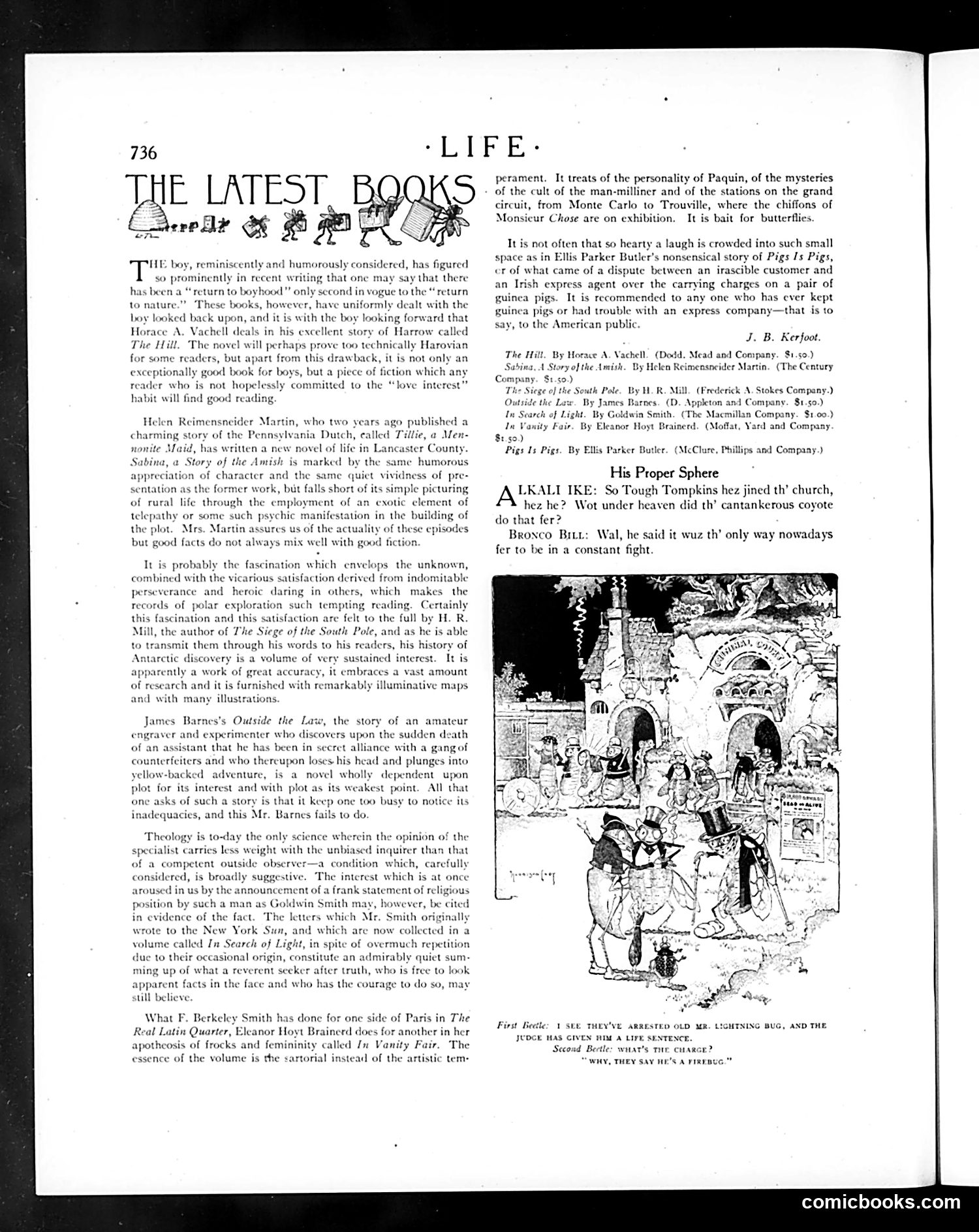
This page is primarily a **book review section** titled "The Latest Books," not a political cartoon. It discusses several contemporary novels including Horace Vachell's *The Hill* (about Harrow School), Helen Reimensneider Martin's *Sabina* (about Pennsylvania Dutch life), and works on polar exploration and Paris society. The only illustration is a **small cartoon** showing what appears to be a courtroom or legal scene. The captions reference "I see they've arrested old Mr. Lightning Bug, and the judge has given him a life sentence" and "What's the charge?" with a response about "vintage." This appears to be a **humorous society cartoon** making a pun about a "lightning bug" receiving a legal sentence, likely satirizing either minor legal proceedings or social pretension—typical of Life magazine's light satirical humor of the period. The page reflects early 20th-century literary culture and gentle domestic satire rather than hard political commentary.
📄 Transcribed text from this page (OCR, searchable)
Machine-transcribed from the original scan — historical spelling and the odd misread are preserved.
736 IE boy, reminiscently and humorously considered, has figured so prominently in recent writing that one may say that there has been a “return to boyhood” only second in vogue to the “return to nature.” These books, however, have uniformly dealt with the Loy looked back upon, and it is with the boy looking forward that Horace A. Vachell de s excellent story of Harrow called The Hill. The novel will perhaps prove too technically Harovian for some readcrs, but apart from this drawback, it is not only an iction which tionally good book for boys, but a piece o ‘ “love interest” reader who is not hopelessly committed to the habit will find good reading. Helen Reimensneider Martin, who two years ago published a charming story of the Pennsylvania Dutch, called Tillie, a Men- id, has written a new novel of life in Lancaster County. Sabina, a Stor noni of the Amish is marked by the same humorous appreciation of character and the same quiet vividness of pre- former work, but falls short of its simple picturing of rural life through the employment of an exotic clement of telepathy or some such psychic manifestation in the building of the plot. Mrs. Martin assures us of the actuality of these episodes but good facts do not always mix well with good fiction sentation as It is probably the fascination which envelops the unknown, combined with the vicarious satisfaction derived from indomitable daring in others, which makes the records of polar exploration such tempting reading. Certainly this fascination and this satisfaction are felt to the full by H.R. Mill, the author of The Siege of the South Pole, and as he is able to transmit them through his words to his readers, his history of Antarctic discovery is a volume of very sustained interest. It is apparently a work of great accuracy, it embraces a vast amount of research and it is furnished with remarkably illuminative maps and with many illustrations perseverance and heroic James Barnes's Outside the Law, the story of an amateur aver and experimenter who discovers upon the sudden death of an assistant that he has been in secret alliance with a gang of counterfeiters and who thereupon loses his head and plunges into yellow-backed novel wholly plot for its interest and with plot as its weakest: point adventure, is a dependent upon All that one asks of such a story is that it keep one too busy to notice its inadequacies, and this Mr. Barnes fails to do Theology is to-day the only science wherein the opinion of the specialist carries less weight with the unbiased inquirer than that of a competent outside observer—a condition which, carefully considered, is broadly suggestive. The interest which is at once aroused in us by the announcement of a frank statement of religious an as Goldwin Smith may, however, be cited ‘The letters which Mr. Smith originally , and which are now collected in a overmuch repetition due to their occasional origin, constitute an admirably quiet sum- ming up of what a reverent seeker after truth, who is free to look apparent facts in the face and who has the courage to do so, may Lill believe position by such a in evidence of the fact wrote to the New York volume called In Search of Light, in spite o What F. Berkeley Smith has done for one side of Paris in The Real Latin Quarter, Elcanor Hoyt Brainerd does for another in her The tem: apotheosis of frocks and femininity called Jn Vanity Fai essence of the volume is the sartorial instead of the artist -LIFE- perament. It treats of the personality of Paquin, of the mysteries of the cult of the man-milliner and of the stations on the grand circuit, from Monte Carlo to Trouville, where the chiffons of Monsieur Chose are on exhibition. It is bait for butterflies. It is not often that so hearty a laugh is crowded into such small space as in Ellis Parker Butler’s nonsensical story of Pigs 1s Pigs, cr of what came of a dispute between an irascible customer and an Irish express agent over the carrying charges on a pair of guinea pigs. It is recommended to any one who has ever kept guinea pigs or had trouble with an express company—that is to say, to the American public. J. B. Kerfoot. The Hilt. By Horace A. Vachell. (Dodd. Mead and Company. $1.59.) Sabina, A Story of the Amish. By Helen Reimensneider Martin. (The Century Company 0.) The Siege of the South Pole. Outside the L In Search of Light. In Vanity Fair $t.50.) Pigs Is Pigs By H.R. Mill. (Frederick A. Stokes Company.) By James Barnes. (D. Appleton and Company. 81.30.) By Goldwin Smith. (The Macmillan Company. $1.00.) By Eleanor Hoyt Brainerd. (Moffat, Yard and Company By Ellis Parker Butler. (McClure, Phillips and Company.) His Proper Sphere ALI IKE: So Tough Tompkins hez jined th’ church, he? Wot under heaven did th’ cantankerous coyote do that fer? Broxco Bitz: Wal, he said it wuz th’ only way nowadays. fer to be in a constant fight. First Beetle: 1 Ske THEY'VE ARRESTED OLD MR. LIGHTNING BUG, AND THE JUDCE MAS GIVEN MIM A Lire SENTENCE, Secoad Bertle: wnar’s Tae cuar “WHY, THEY SAY HE'S A rinenuc.”* comicbooks.com