
Life, 1906-06-14 · page 15 of 24
Life — June 14, 1906 — page 15: what you’re looking at
What you’re looking at
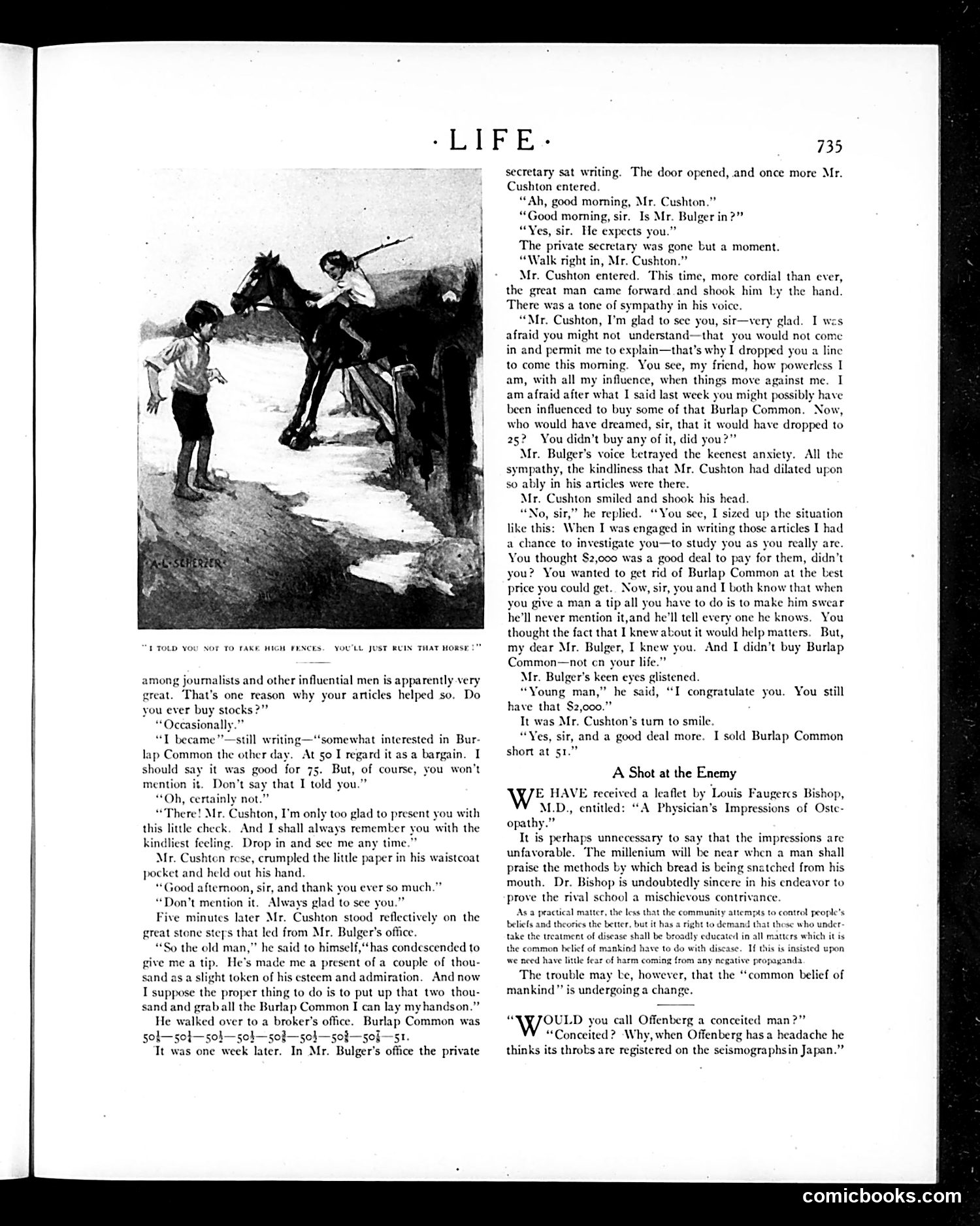
The illustration depicts a horseman taking a fence jump while someone warns from the ground—a visual metaphor for reckless risk-taking. This accompanies a satirical story about financial manipulation and journalistic corruption. The narrative describes Mr. Cushton, a journalist of apparent influence among business circles, who receives a $2,000 bribe and stock tip from the wealthy Mr. Bulger (hoping he'll buy Burlap Common stock). The satire exposes how Bulger attempts to manipulate Cushton into driving up the stock price through favorable articles. However, Cushton proves cleverer—he recognizes the scheme, refuses to buy, and instead sells the stock "short" (betting on its decline). When Bulger's scheme collapses and the stock drops, Cushton profits handsomely. The cartoon critiques early 20th-century financial corruption: wealthy businessmen bribing journalists to manipulate stock prices, and the vulnerability of markets to such schemes. The "high fences" represent dangerous financial risks taken without proper judgment.
📄 Transcribed text from this page (OCR, searchable)
Machine-transcribed from the original scan — historical spelling and the odd misread are preserved.
-LIFE.- 735 1 TOLD YOU NOT TO TAKE HIGH FENCES. YOU'LL JUST RUIN THAT HORSE!” among journalists and other influential men is apparently very great. That's one reason why your articles helped so. Do you ever buy stocks?” “Occasionally.” “T became’—still writing—“somewhat interested in Bur- lap Common the other day. At so I regard it as a bargain. I should say it was good for 75. But, of course, you won't mention it. Don’t say that I told you.” “Oh, certainly not.” There! Mr. Cushton, I'm only too glad to present you with this little chi And I shall always remember you with the kindliest feeling. Drop in and see me any time Mr. Cushton rese, crumpled the little paper in his waistcoat pocket and held out his hand. “Good afternoon, sir, and thank you ever so much.” “Don’t mention it. Always glad to sce you.” Five minutes later Mr. Cushton stood reflectively on the great stone steps that led from Mr. Bulger’s office. » the old man,” he said to himself,“‘has condescended to give me a tip. He’s made me a present of a couple of thou- sand asa slight token of his esteem and admiration. And now I suppose the proper thing to do is to put up that two thou- sand and graball the Burlap Common I can lay myhandson.” He walked over to a broker's office. Burlap Common was sok—so}—so}—sol—so§—so]—sof—sof—st. later. In Mr. Bulger’s office the private secretary sat writing. The door opened, and once more Mr. Cushton entered. “Ah, good moming, Mr. Cushton.” “Good moming, sir. Is Mr. Bulger in?” “Yes, sir. He expects “Walk right in, Mr. Cus Mr. Cushton entered. This time, more cordial than ever, the great man came forward and shook him by the hand. There was a tone of sympathy in his voice. “Mr. Cushton, I’m glad to see you, sir—ve afraid you might not understand—that you would not come in and permit me to explain—that’s why I dropped you a li to come this moming. You sce, my friend, how powerless I am, with all my influence, when things move against me. I am afraid after what I said last week you might possibly have been influenced to buy some of that Burlap Common. Now, who would have dreamed, sir, that it would have dropped to 25? You didn’t buy any of it, did you?” Mr. Bulger’s voice betrayed the keenest anxiety. All the sympathy, the kindliness that Mr. Cushton had dilated upon so ably in his articles were there. Mr. hton smiled and shook his head. “No, sir,” he replied. “You see, I sized up the situation like this: When I was engaged in writing those articles I had a chance to investigate you—to study you as you really are. You thought $2,000 was a good deal to pay for them, didn’t you? You wanted to get rid of Burlap Common at the best price you could get.. Now, sir, you and I both know that when you give a man a tip all you have to do is to make him swear he’ll never mention it,and he'll tell every one he knows. You thought the fact that I knew about it would help matters. But, my dear Mr. Bulger, I kne And I didn’t buy Burlap Common—not cn your lif Mr. Bulger’s keen eyes glistened. “Young man,” he said, “I congratulate you. You still have that $2,000.” Tt was Mr. Cushton’s tum to smile. “Yes, sir, and a good deal more. I sold Burlap Common short at 51.” A Shot at the Enemy E HAVE received a leaflet by Louis Faugercs Bishop, M.D., entitled: “A Ph ician’s Impressions of Oste- It is perhaps unnecessary to say that the impressions are unfavorable. The millenium will be near when a man shall praise the methods by which bread is being snatched from his mouth. Dr. Bishop is undoubtedly sincere in his endeavor to prove the rival school a mischievous contrivance. As a practical matter, the less that the community attempts to control people's beliefs and theories the better, but it has a right to demand that those who under take the treatment of disease shall be broadly educated in all matters which it is the common belief of mankind have to do with discase. If this is insisted upon we need have little fear of harm coming from any negative propaganda The trouble may be, however, that the “common belief of mankind” is undergoing a change. be OULD you call Offenberg a conceited man?” “Conceited? Why, when Offenberg has a headache he thinks its throbs are registered on the scismographsin Japan.” comicbooks.com