
A complete issue · 24 pages · 1906
Life — April 26, 1906
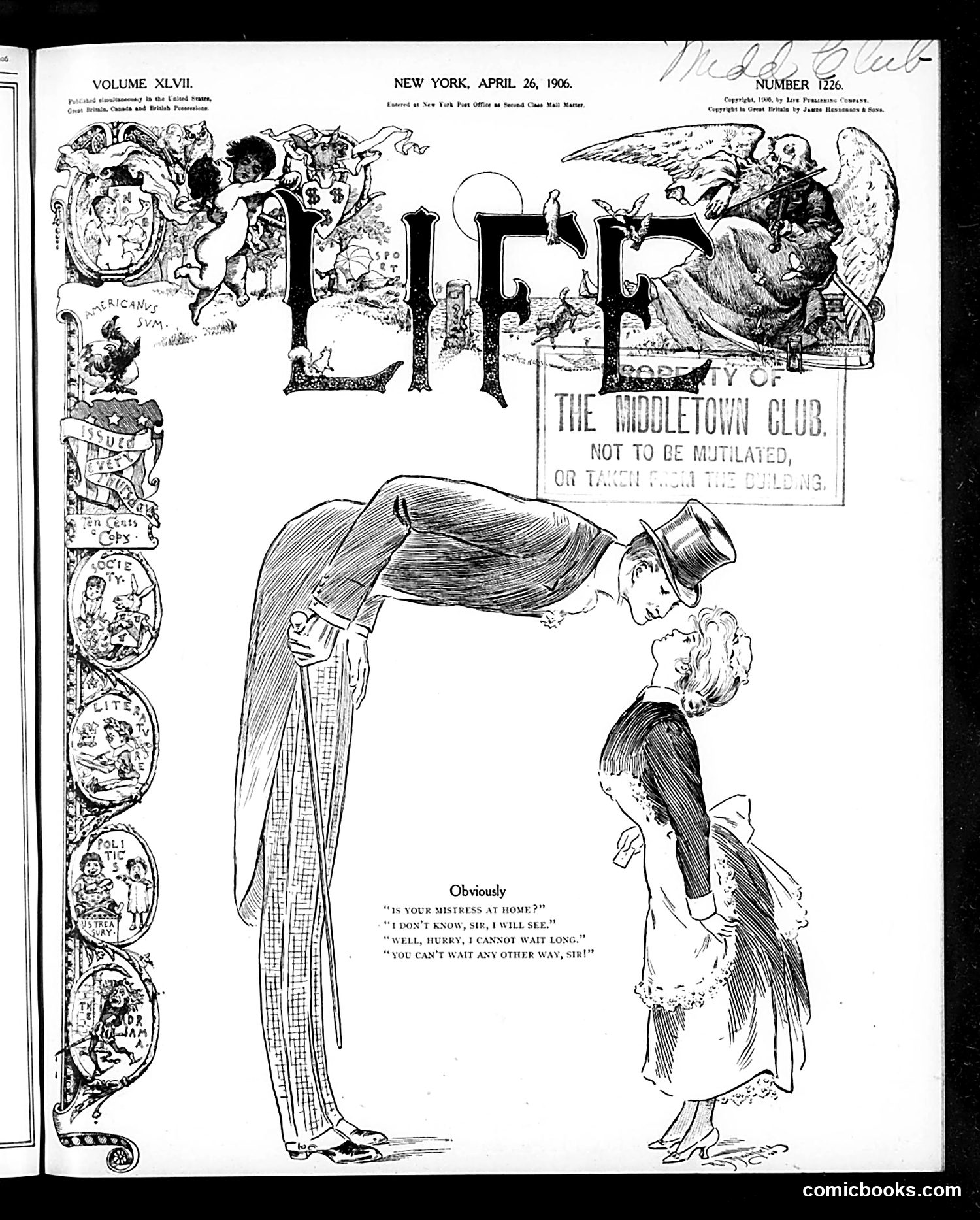
This satirical cartoon from *Life* magazine depicts a humorous domestic scene titled "The Middletown Club." A well-dressed man in a top hat bows deeply to a woman, with dialogue suggesting marital deception: **"Is your mistress at home?"** **"I don't know, sir, I will see."** **"Well, hurry, I cannot wait long."** **"You can't wait any other way, sir!"** The joke relies on the double meaning of "mistress"—the servant misinterprets the visitor's inquiry about the woman of the house as a reference to an affair. The punchline mocks the man's impatience and implies social commentary on infidelity among the wealthy "Middletown Club" set. The elaborate decorative borders and typography are typical of *Life*'s design aesthetic from this era.
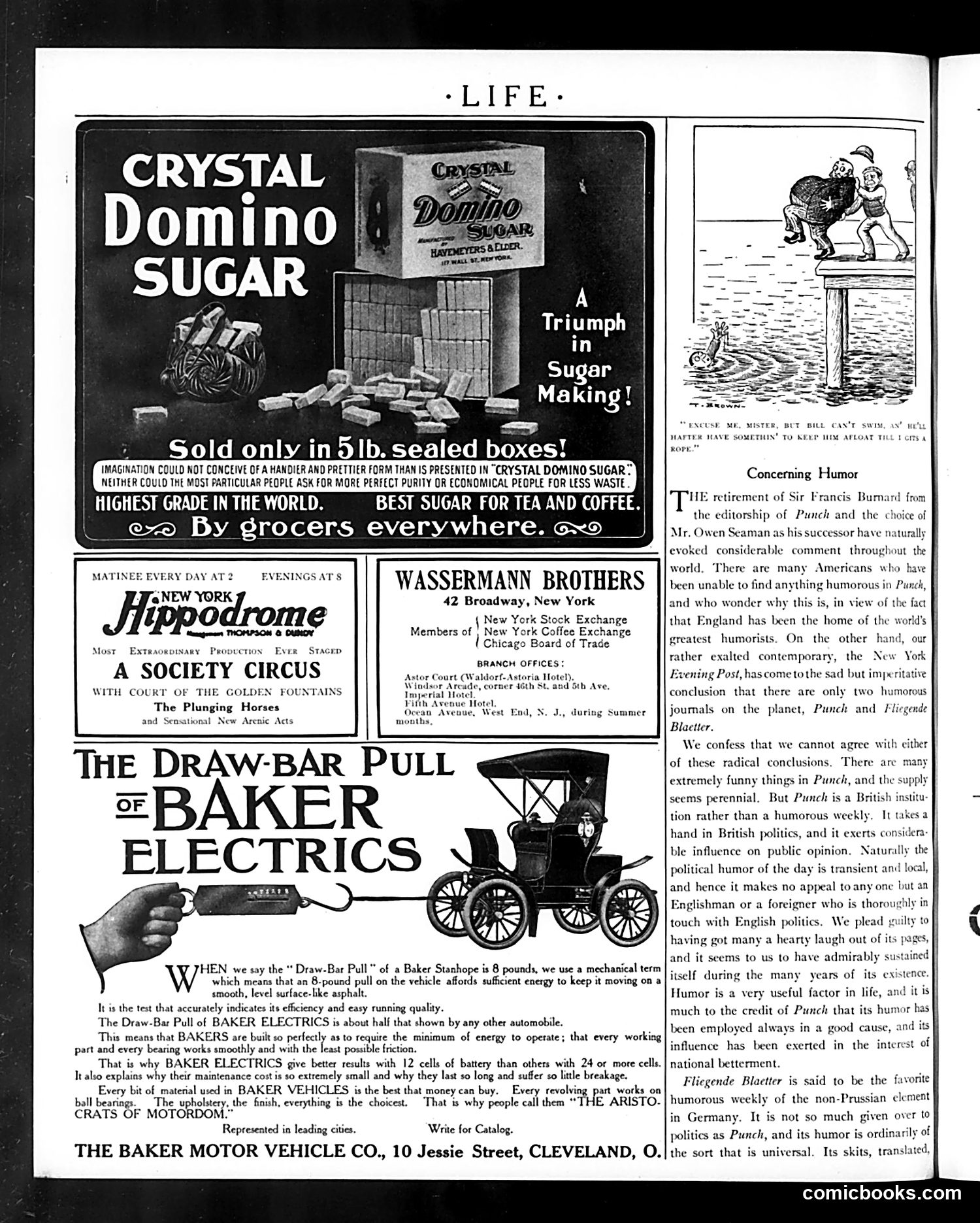
This page is primarily **advertising and editorial content** rather than political satire. The advertisements dominate: Crystal Domino Sugar, a New York Hippodrome circus show, Wassermann Brothers stockbrokers, and Baker Electrics vehicles. The only cartoon appears in the upper right—a simple beach scene showing children and what seems to be adults, with a caption about swimming and keeping an "afloat" (likely a pun). The substantial text block discusses **humor in journalism**, specifically comparing British *Punch* magazine with American publications. It argues *Punch* focuses on British politics rather than universal humor, making it less appealing to American readers. The author suggests *Fliegende Blätter* (a German humor magazine) has broader appeal because its satire transcends national politics. This is cultural commentary on international humor styles, not political satire itself.
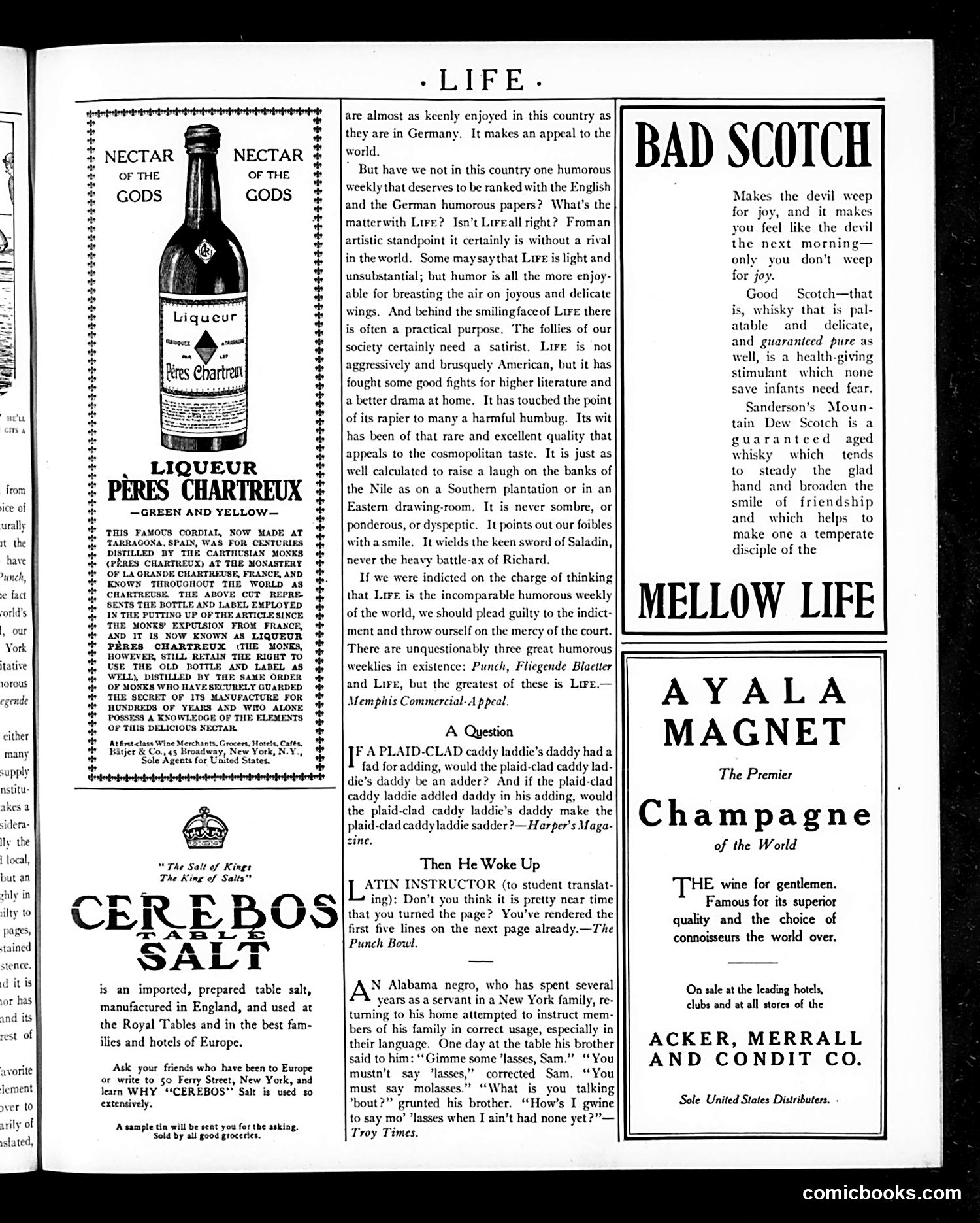
This page is primarily **advertisements** interspersed with brief humorous pieces, typical of Life magazine's format. The main content includes: - **"A Question"** and **"Then He Woke Up"**: Short jokes about wordplay and dialect humor - **"Bad Scotch" and "Mellow Life"** ads: Whiskey advertisements - **Liqueur and champagne ads**: Including Pères Chartreaux liquor and Ayala Magnet champagne The humor reflects early 20th-century sensibilities, including a racial dialect joke about an Alabama servant attempting to teach correct English usage to his family—material that would be considered offensive today. The page demonstrates how Life blended satirical content with commercial advertising, with products advertised using aspirational language about quality and sophistication for wealthy readers.
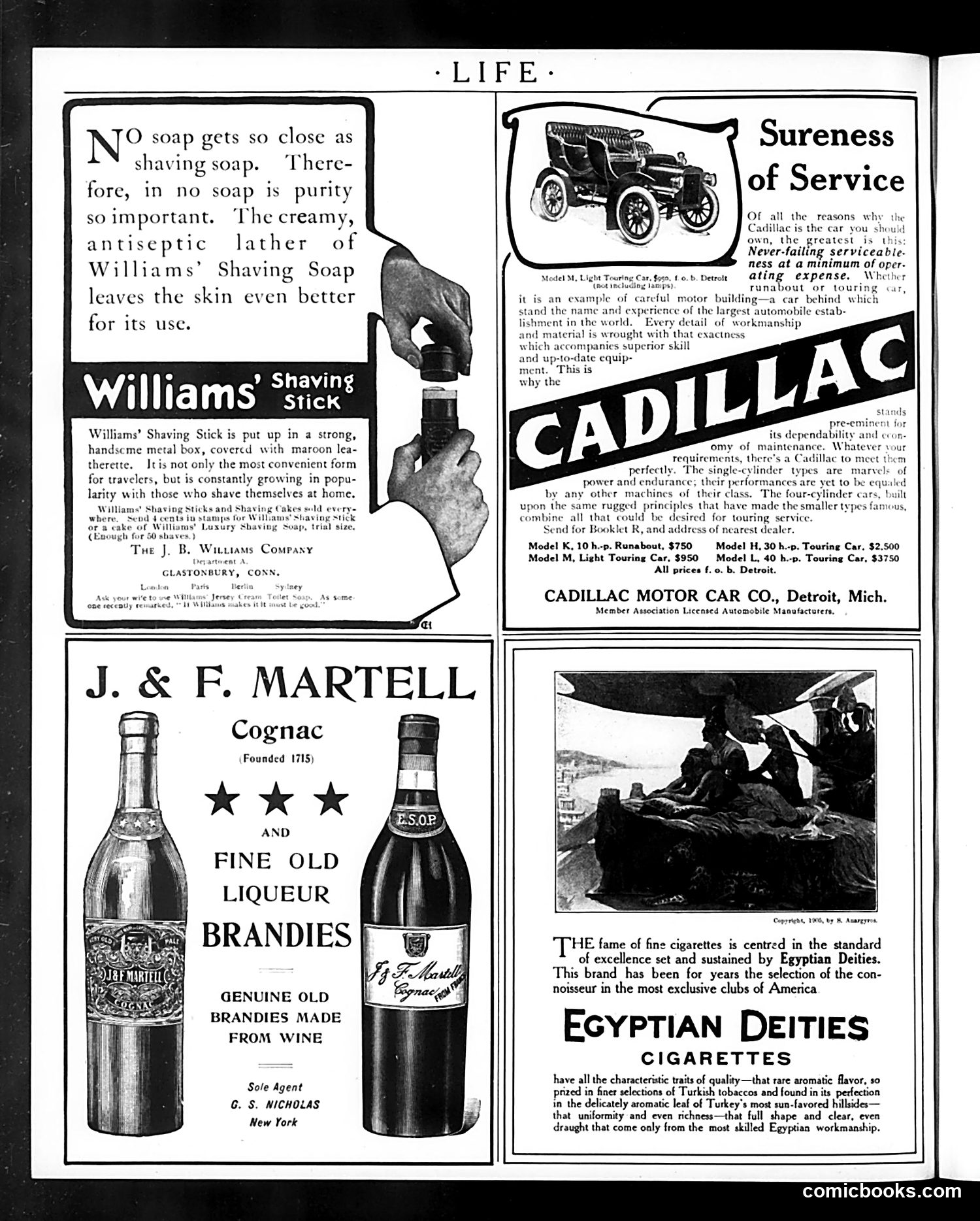
This page is **primarily advertising**, not political satire. It contains four commercial advertisements from what appears to be an early 20th-century issue of Life magazine: 1. **Williams' Shaving Stick** — promotes a grooming product with antiseptic properties 2. **Cadillac Motor Cars** — advertises various automobile models, emphasizing manufacturing quality and service reliability 3. **J. & F. Martell Cognac** — displays brandy bottles, highlighting the product's 1715 founding and authenticity 4. **Egyptian Deities Cigarettes** — markets cigarettes using exotic branding, claiming superior Turkish tobacco quality There is **no political cartoon or social satire present**. The page serves solely as paid advertising space, which was common in early Life magazine issues. The ads reflect consumer products and luxury goods available to affluent readers of that era.
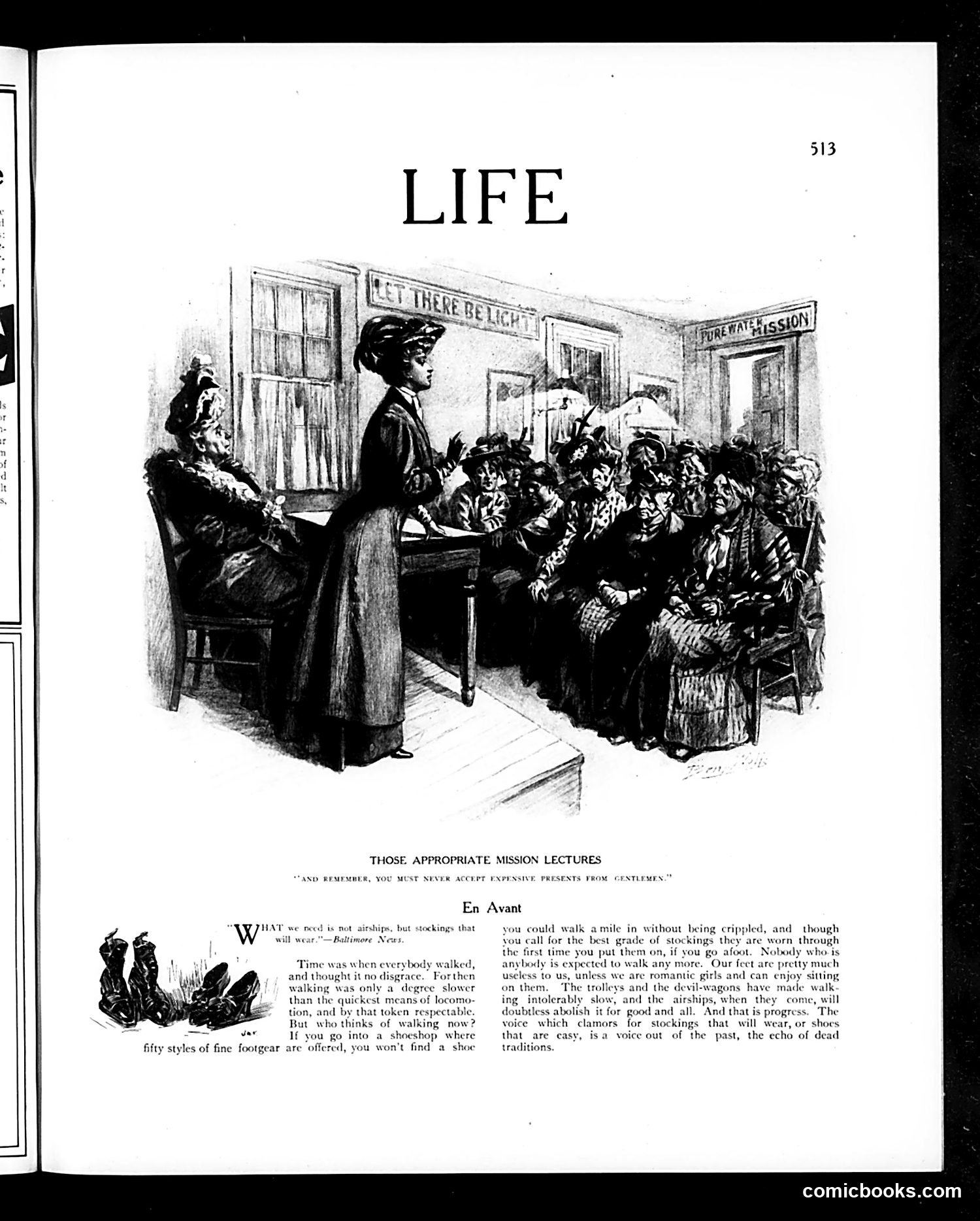
This satirical piece critiques the wealthy's patronage of charitable missions. The illustration shows a woman lecturing to a group of poor people in what appears to be a mission house (note signs reading "LET THERE BE LIGHT" and "PURE MISSION"). The title "Those Appropriate Mission Lectures" and the subtitle's quote—"And remember, you must never accept expensive presents from gentlemen"—suggest irony. The satire targets wealthy benefactors who impose moral lectures on the poor while themselves living luxuriously. The "En Avant" commentary mocks how the wealthy preach virtue and self-denial to those in poverty, while the rich enjoy comfort and excess. The joke: the hypocrisy of lecturing the disadvantaged about rejecting material goods when the lecturer represents an affluent class that benefits from inequality.
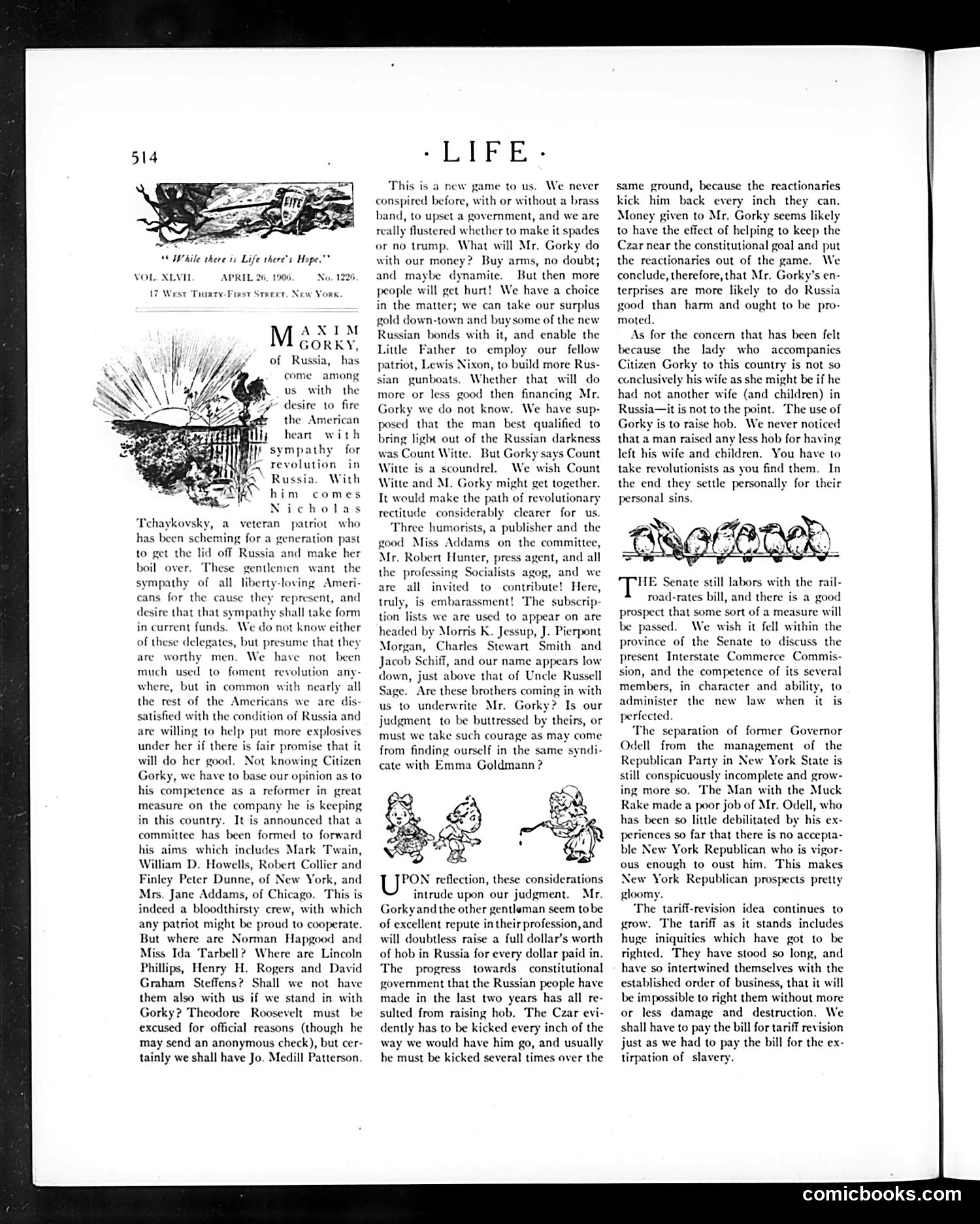
This page discusses Russian revolutionary Maxim Gorky's visit to America. The text reveals controversy: Gorky came seeking funds to support Russian revolution, but American donors withdrew support after learning he was living with a woman who wasn't his wife—a major scandal in 1906. The cartoon (upper left) appears to caricature Gorky, likely mocking this domestic situation. The text names prominent Americans on a committee supposedly backing him, including Mark Twain and Jane Addams, suggesting they faced embarrassment. The satire critiques American hypocrisy: wealthy patrons eager to fund Russian revolution but scandalized by Gorky's personal life, ultimately prioritizing moral propriety over political support. The piece questions whether such "revolutionaries" deserve backing.
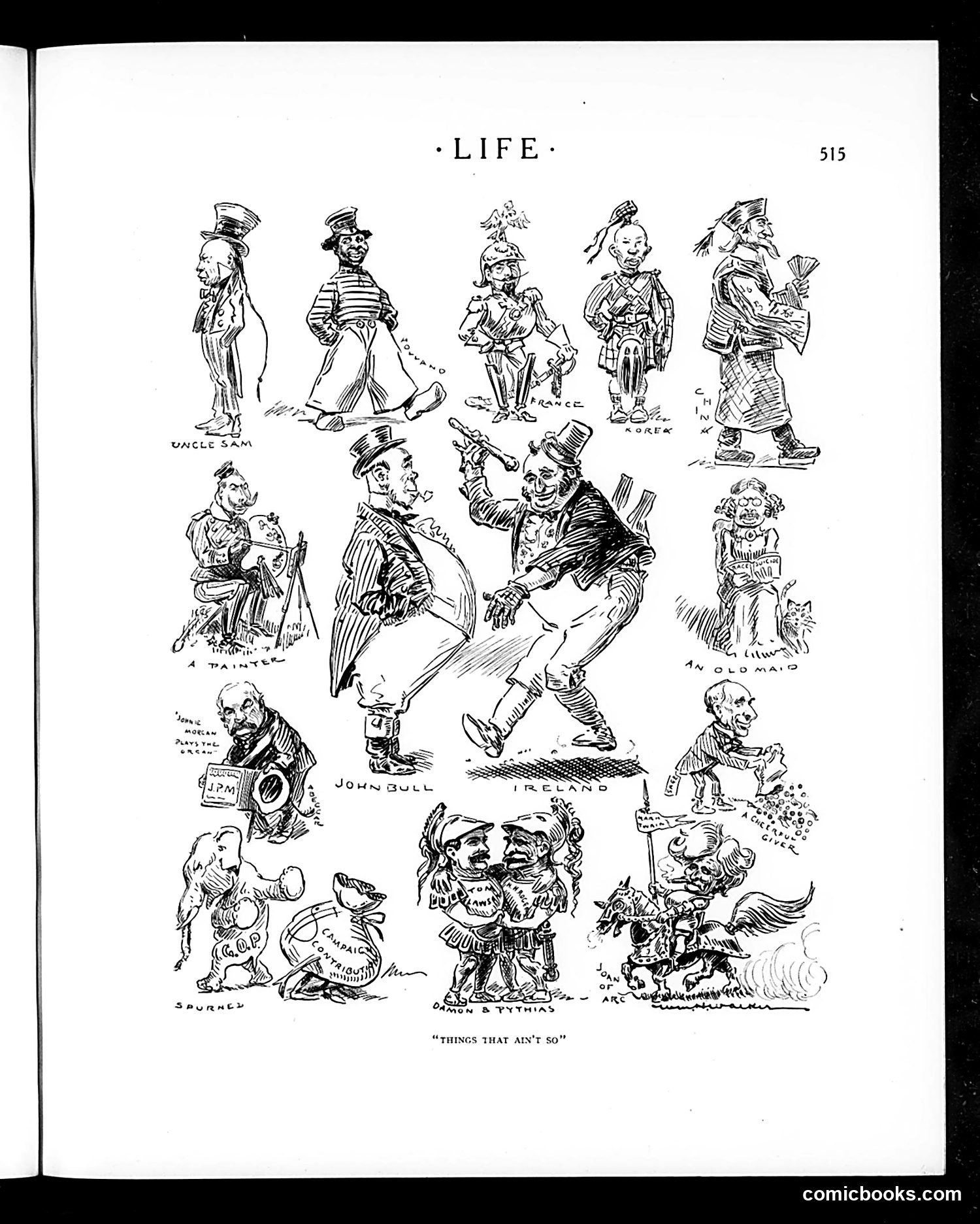
This page presents political caricatures labeled with national personifications—figures representing countries or political entities. The top row shows "Uncle Sam" (United States), a military figure (appears to be Britain), "France," "Korea," and "China." The middle and lower sections include additional caricatures labeled "John Bull" (Britain), "Ireland," and "Domon & Pythias" (likely a classical reference). The title "Things That Ain't So" suggests satire debunking common misconceptions about international relations or contemporary politics. The exaggerated facial features and poses are typical of early 20th-century satirical cartooning. Without specific dating, the exact historical moment referenced remains unclear, though the inclusion of Korea and China suggests post-colonial or early modern geopolitical tensions.
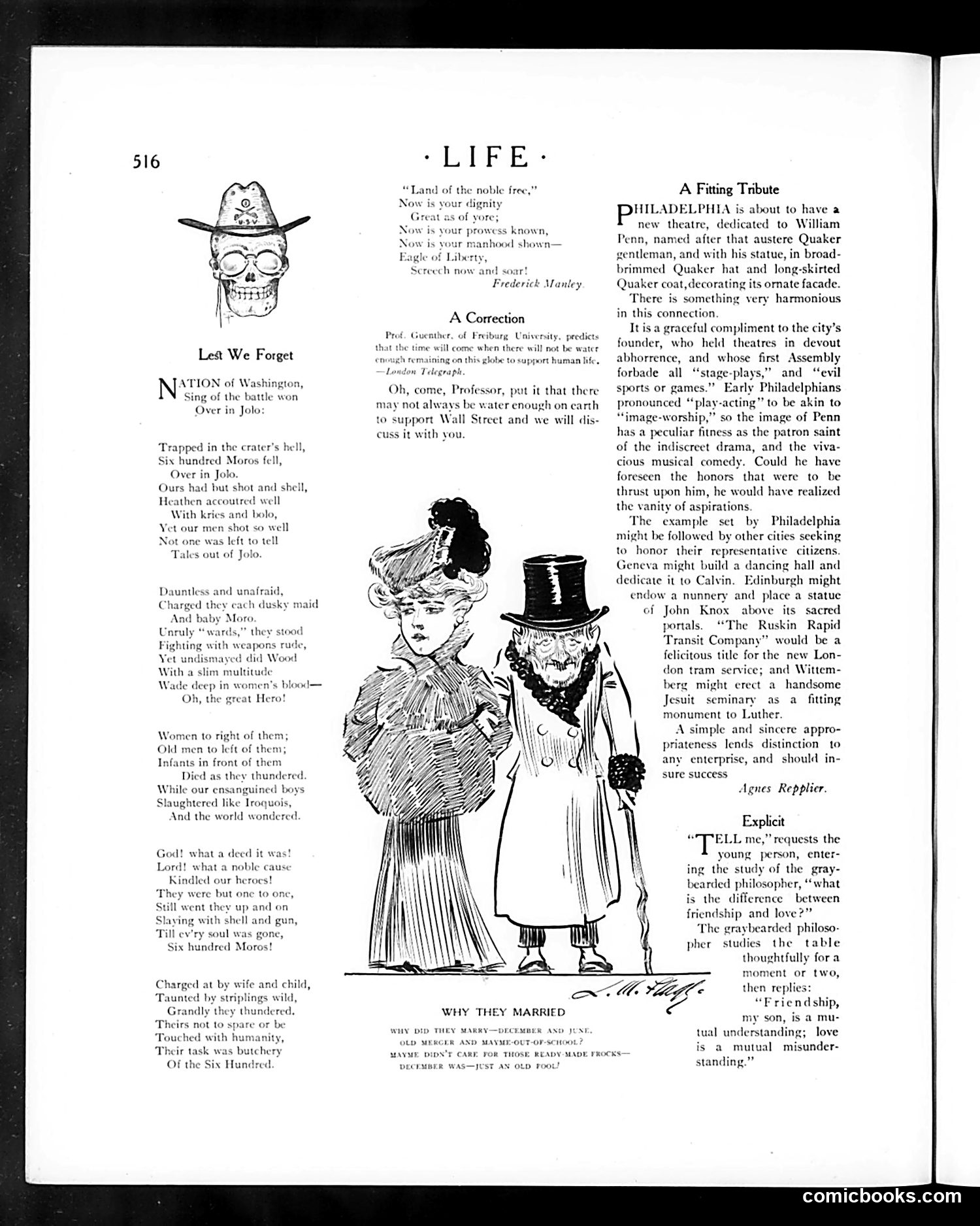
This page contains several distinct pieces: **"Lest We Forget"** — A patriotic poem commemorating American soldiers ("Nation of Washington," battle casualties, the "Six Hundred Moros"). The accompanying skull illustration wearing a cowboy hat likely references the Philippine-American War and frontier imagery. **"Why They Married"** — A satirical cartoon showing an elderly couple. The caption poses comic questions about their motivations: "Why did they marry—December and June, old merger and mash-out of school? Maybe didn't care for those ready-made frocks—December was just an old fool?" This mocks December-May romances and suggests the absurdity of marrying across age differences. **"A Fitting Tribute"** and **"Explicit"** — Articles praising Philadelphia's proposed William Penn Theater and discussing philosophy, respectively. The overall tone is satirical and patriotic, typical of Life's early-20th-century sensibility.
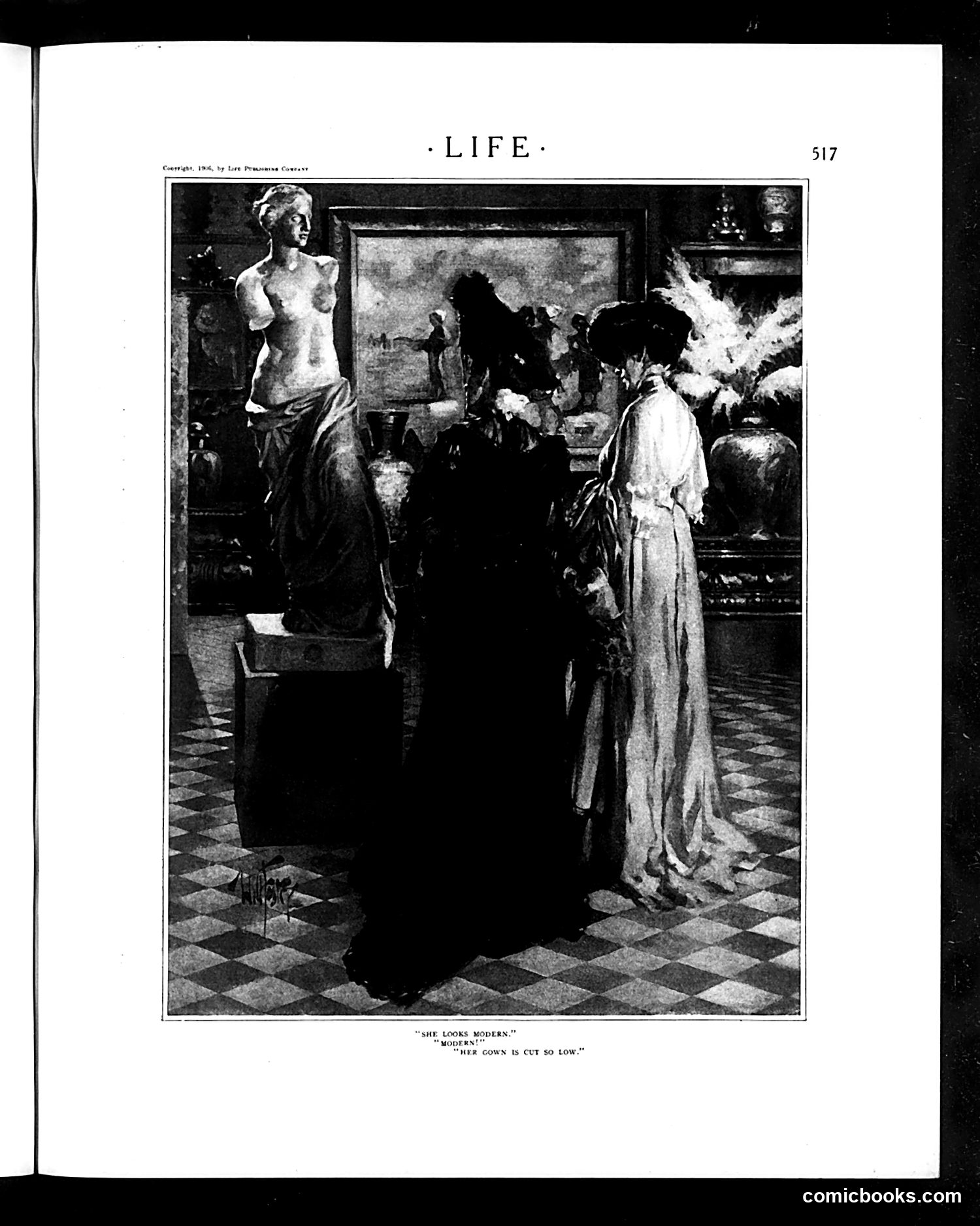
This appears to be a satirical illustration from Life magazine (copyright 1904 by Life Publishing Company) depicting an art world scene. The caption reads: "She looks modern." / "Modern?" / "Her gown is cut so low." The satire mocks both modern artistic pretension and changing women's fashion standards of the early 1900s. A nearly-nude classical statue stands prominently on display in what appears to be an artist's studio or salon, surrounded by visitors. The joke hinges on the irony that a woman's fashionably low-cut contemporary gown is considered "modern" and scandalous, while she stands beside an explicitly nude classical artwork—suggesting hypocrisy about what society deems appropriate or artistic. The illustration critiques both evolving fashion standards and the contradictory attitudes toward the female form in art versus public life.
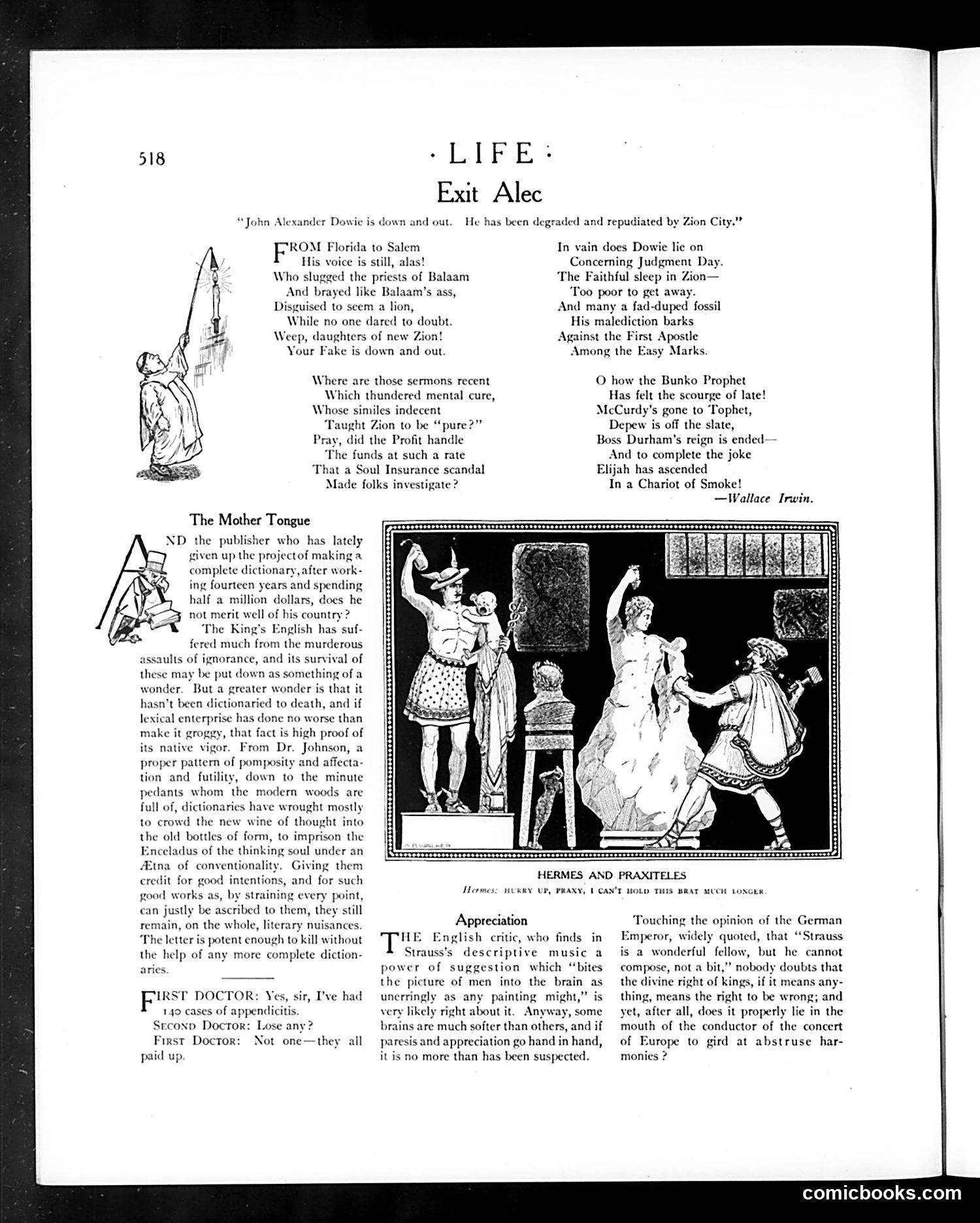
This page contains satirical commentary on John Alexander Dowie, a religious figure who "has been degraded and repudiated by Zion City." The poem mocks Dowie's downfall, referencing his failed prophecies, fraudulent financial schemes ("Soul Insurance scandal"), and discredited religious teachings. "The Mother Tongue" section praises a dictionary publisher's achievement while humorously noting that English has "suffered much from murderous assaults of ignorance." The classical illustration labeled "Hermes and Praxiteles" appears decorative. "Appreciation" discusses Richard Strauss's descriptive music, debating whether composers properly understand human nature—a lighthearted intellectual critique. The page primarily targets religious fraud and celebrates intellectual/cultural achievement through satirical commentary.
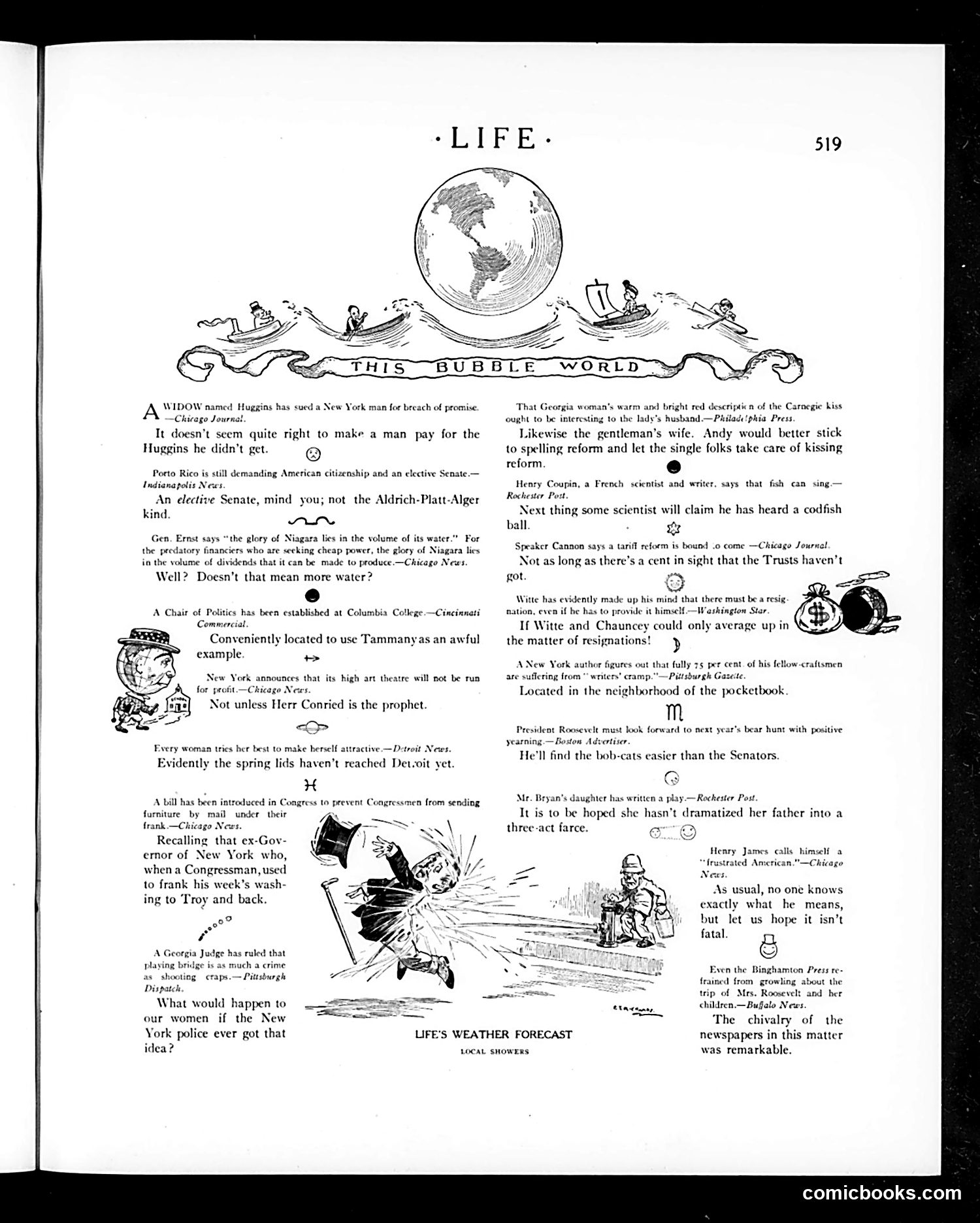
This satirical page combines brief humorous news items with a central cartoon titled "Life's Weather Forecast: Local Showers." The main cartoon depicts a man being violently ejected from what appears to be a building or institution, with the caption suggesting inevitable consequences—likely satirizing political or social upheaval of the era. The surrounding text snippets mock various contemporary figures and institutions: a widow suing a man for breach of promise, senators and trust monopolies, debates about spelling reform, and Mrs. Roosevelt's upcoming travels. The items ridicule political incompetence, business malfeasance, and social pretension. The "bubble world" header suggests these are all temporary, fragile situations destined to burst—a common early-20th-century satirical theme about economic and political instability.
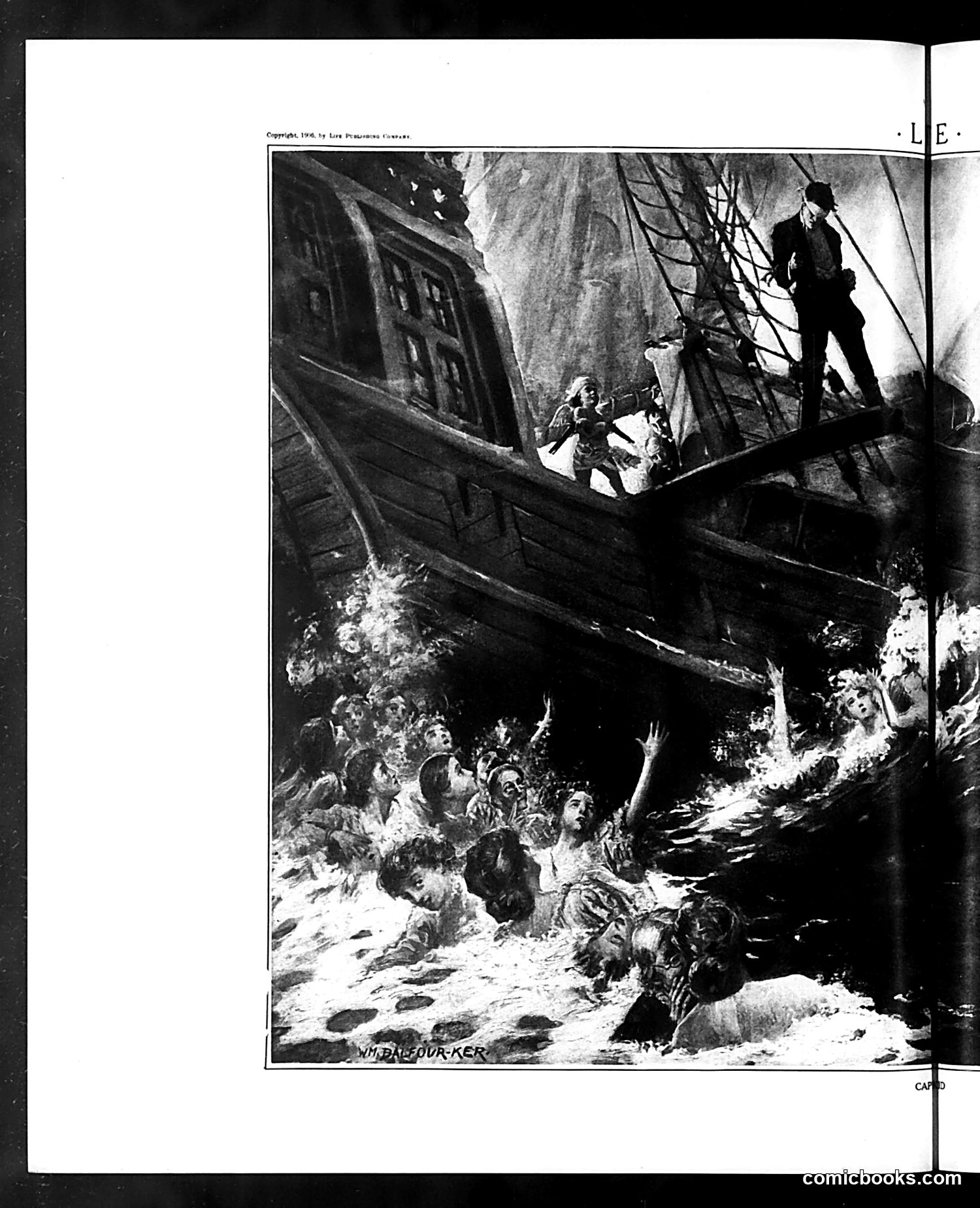
This appears to be an illustration by William Balfour Ker titled "Wreck of Our Ker" (based on visible signature). The image depicts a dramatic maritime disaster scene: a burning ship with crew members on deck and rigging, while a large crowd of people struggles in the water below, reaching upward in desperation. The satirical point likely critiques a contemporary political or social "wreck"—the shipwreck serves as metaphor for institutional failure, policy disaster, or leadership collapse. The contrast between those in control (crew aloft) and those suffering (drowning masses below) emphasizes class division or inequality in crisis. Without specific dating or additional context from the magazine, the exact political target remains unclear, though the imagery suggests commentary on mismanagement affecting vulnerable populations.
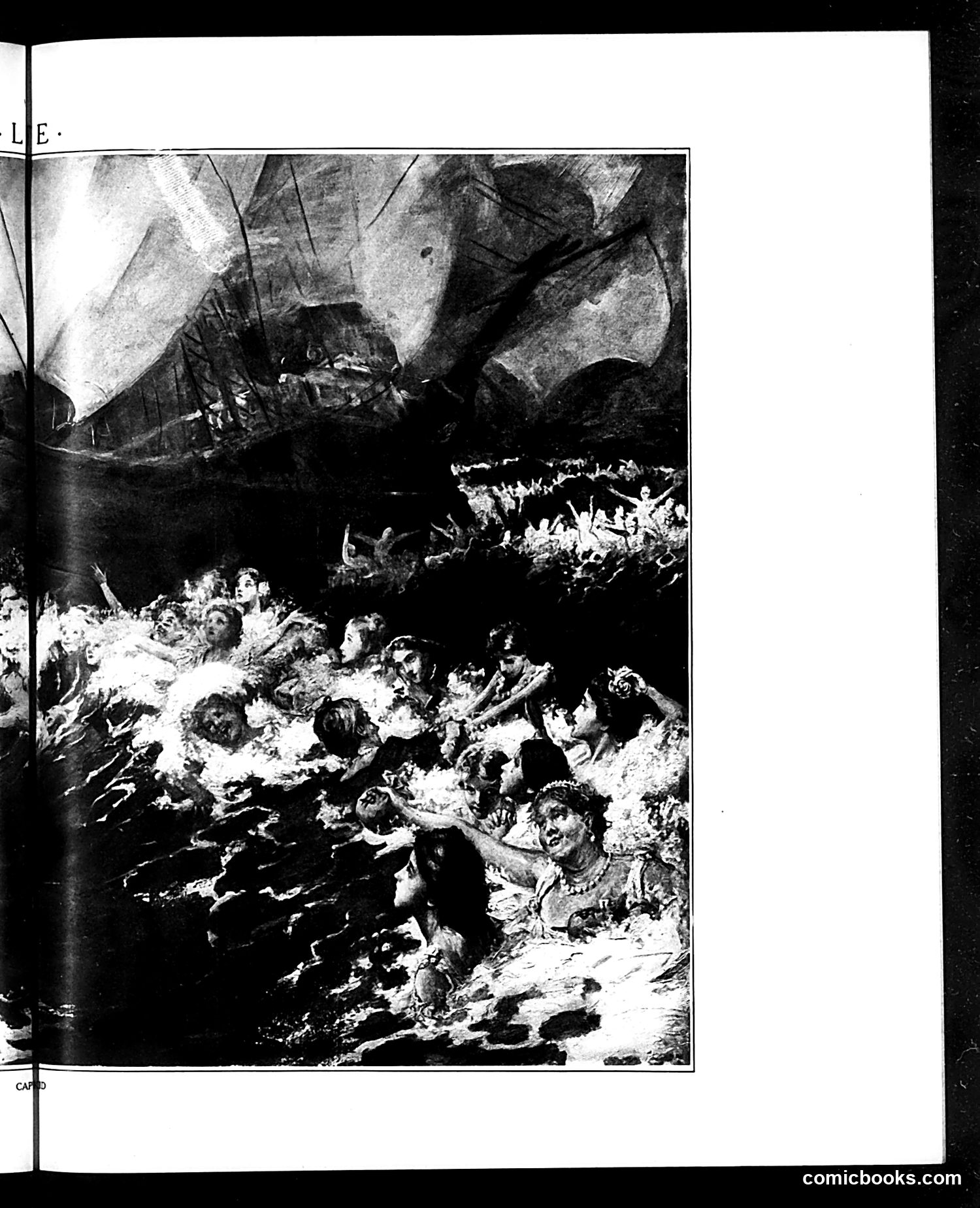
I can see this is a dramatic black and white illustration showing multiple figures in what appears to be a chaotic underwater or cave scene with surreal, grotesque imagery. The style is expressionistic with heavy contrast and distorted forms. However, I cannot reliably read the OCR text provided, and without legible captions, labels, or headlines visible in the image itself, I cannot definitively identify the specific figures, political references, or satirical intent of this cartoon. The artistic style suggests early-to-mid 20th century satirical work, but without clear textual context, I cannot accurately explain what specific events, people, or social commentary this illustration represents. To provide accurate historical analysis, I would need either clearer visible text on the page or additional contextual information about the specific Life magazine issue.
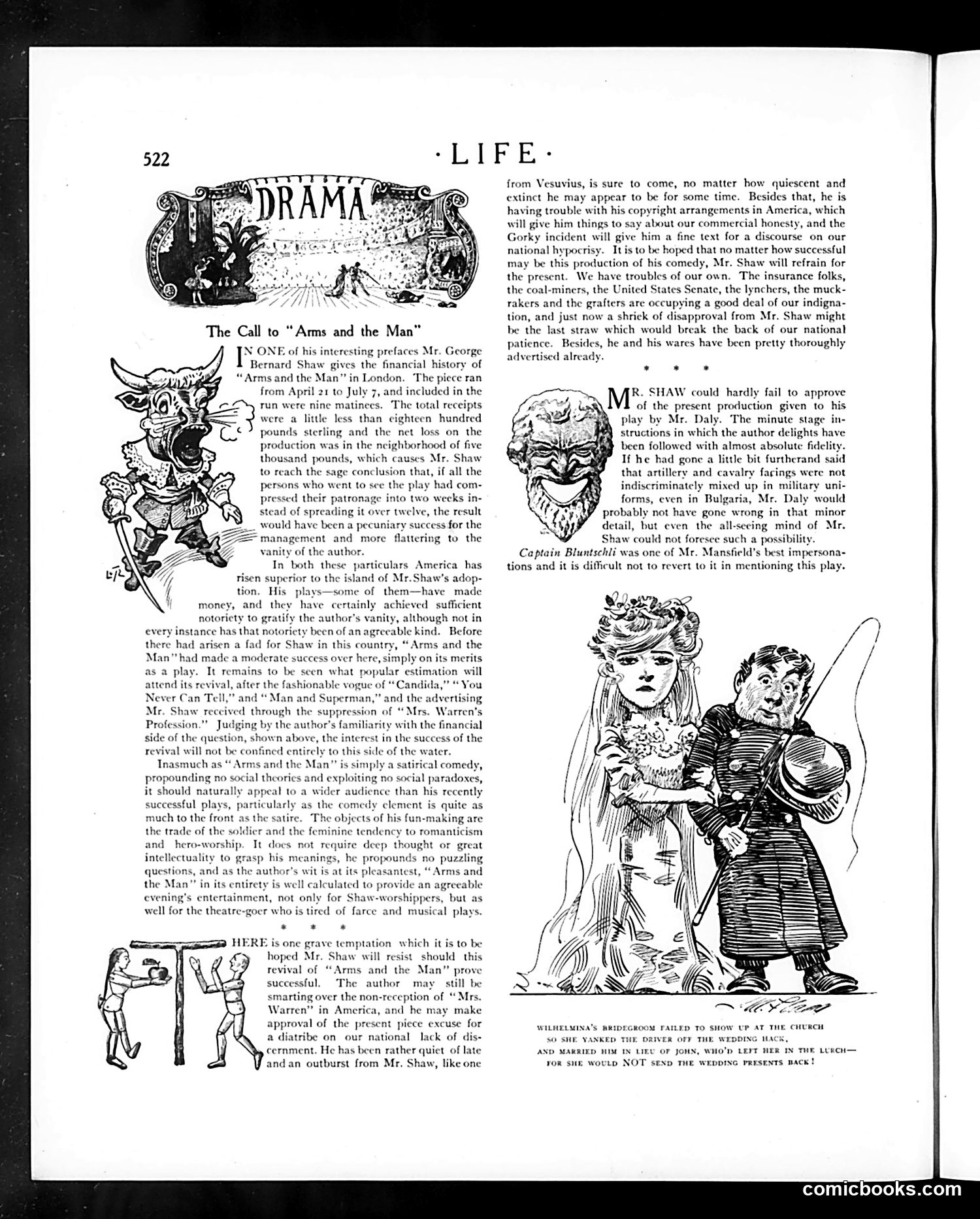
This page discusses George Bernard Shaw's play "Arms and the Man" and its American revival production by theatrical producer Daly. The text explains that Shaw's original London run (April-July, dates unclear) lost money despite decent attendance, but the play had already found moderate American success on its merits. The satire here targets Shaw himself—a famously opinionated social critic. The article warns that if this revival succeeds, Shaw might be tempted to publicly attack America's perceived shortcomings (copyright disputes, "Mrs. Warren's Profession" censorship, the Maxim Gorky affair). The author pleads with Shaw to stay silent, arguing Americans are already overwhelmed by real domestic crises: insurance fraud, coal strikes, Senate corruption, lynching, and muckraking scandals. The joke: Shaw's complaints would be just one complaint too many for the nation's patience.
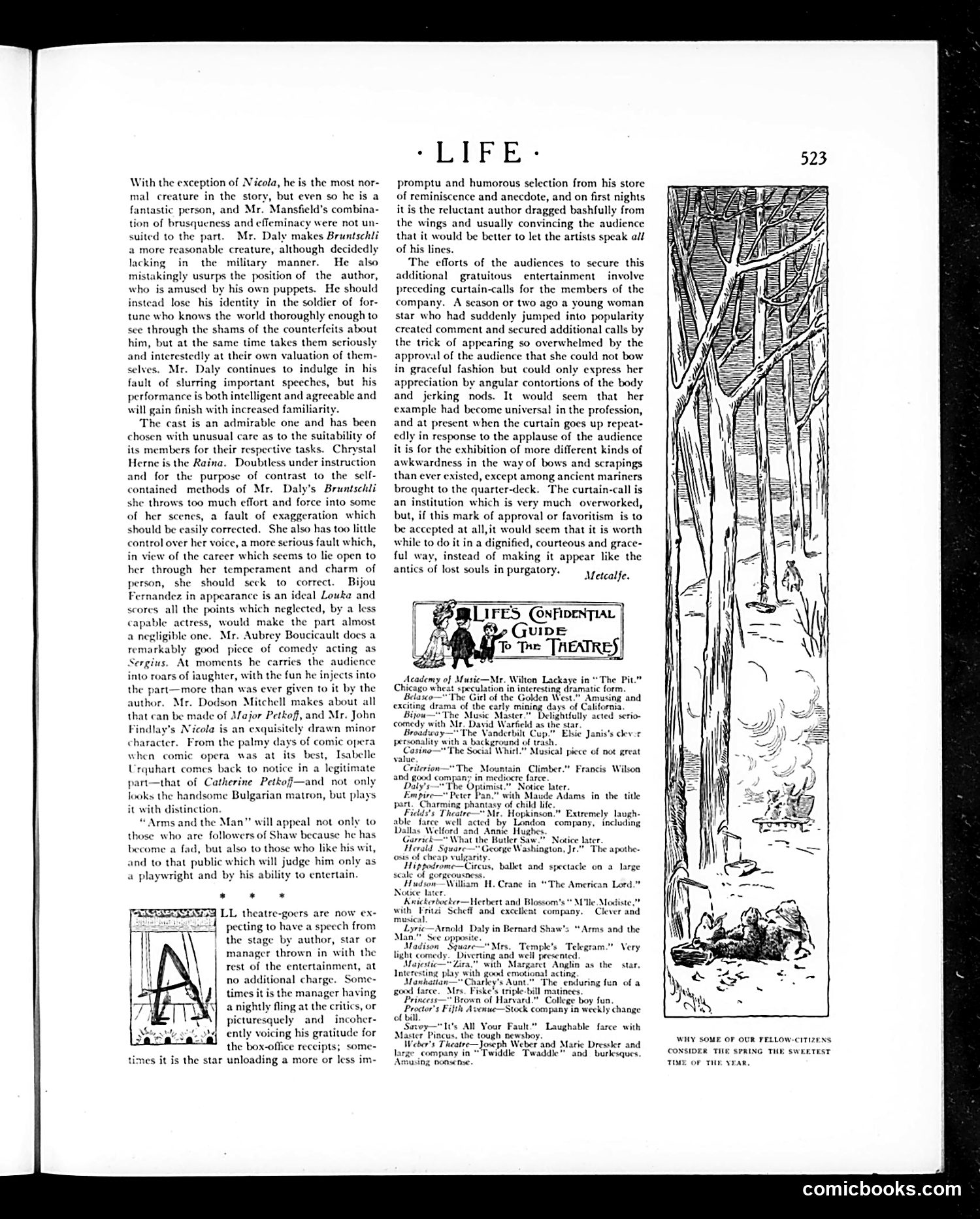
This page is primarily a **theater review** of Shaw's "Arms and the Man," with commentary on contemporary stage practices. The main text critiques the cast's performances—particularly praising Bijou Fernandez and John Findlay while noting Chrystal Herne's excessive effort and voice control issues. The review discusses how the lead actor (Daly) plays Bluntschli with excessive "identity," when he should disappear into the role. The **sidebar cartoon** (lower left) satirizes a modern theater convention: actors giving impromptu speeches from the stage. The text mocks how managers deliver "nightly flings at the critics," how reluctant authors are "dragged bashfully from the wings," and how actors manufacture gratitude by appearing "overwhelmed" to secure additional curtain calls. The satire targets **theatrical affectation and the blurring of performance boundaries**—the expectation that entertainment now includes unscripted ego-stroking rather than pure artistic merit. This reflects early 1900s concerns about professionalism deteriorating through manufactured sentiment.
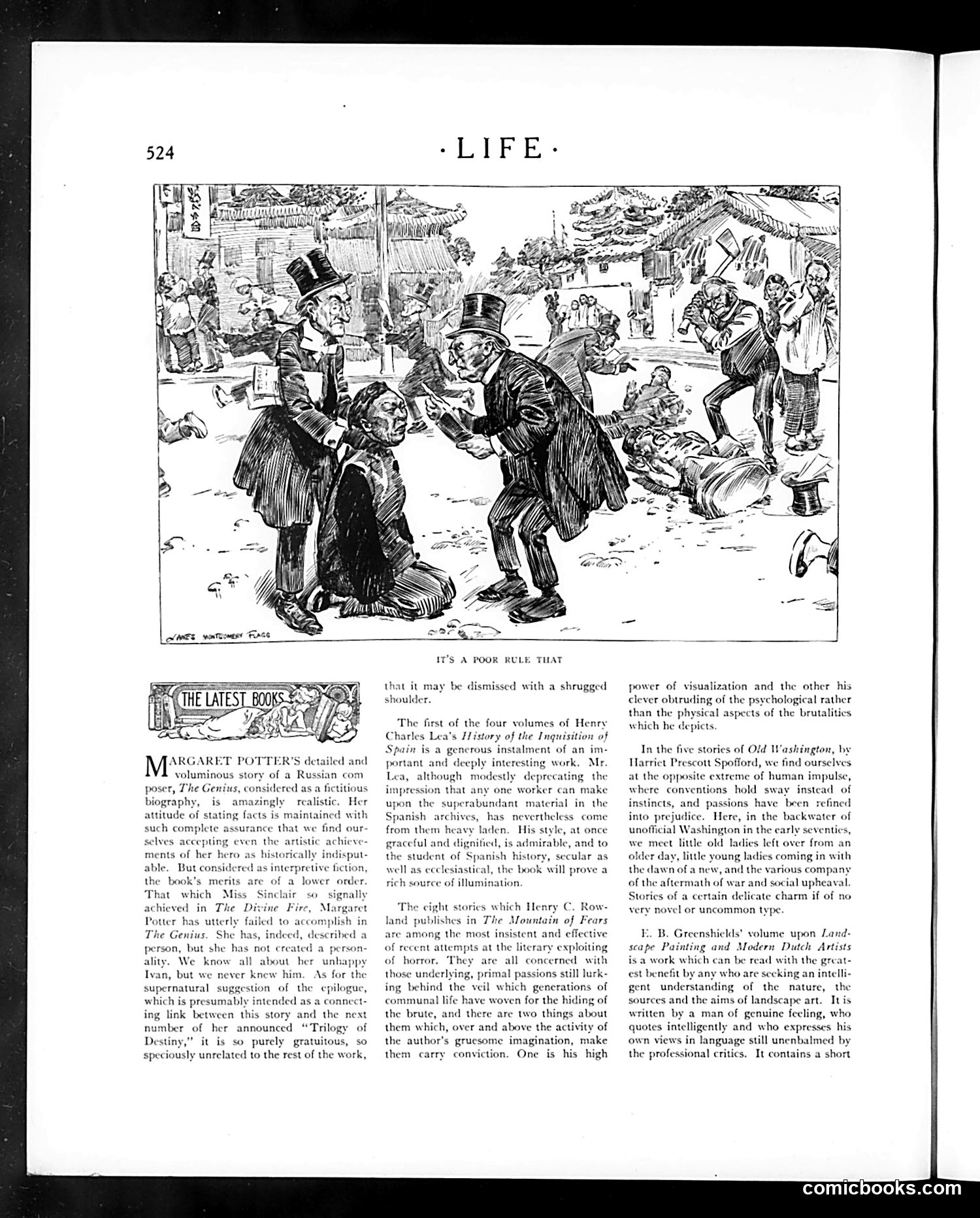
The top cartoon, titled "It's a Poor Rule That," depicts what appears to be a street scene where two well-dressed men in top hats are interacting with a kneeling child or beggar in ragged clothes, while various onlookers observe in an Asian or foreign setting (suggested by the pagoda architecture). The satire criticizes hypocrisy regarding poverty and charity—the title suggests an ironic "rule" that applies unequally. The well-dressed figures likely represent wealthy or powerful individuals, while their interaction with the destitute child illustrates how moral principles are selectively applied depending on circumstance or social standing. The page's lower half reviews recent books, including works on the Spanish Inquisition, psychological horror stories, and landscape painting, providing cultural context for the magazine's educated readership. The cartoon's exact political target remains unclear without additional historical dating information.
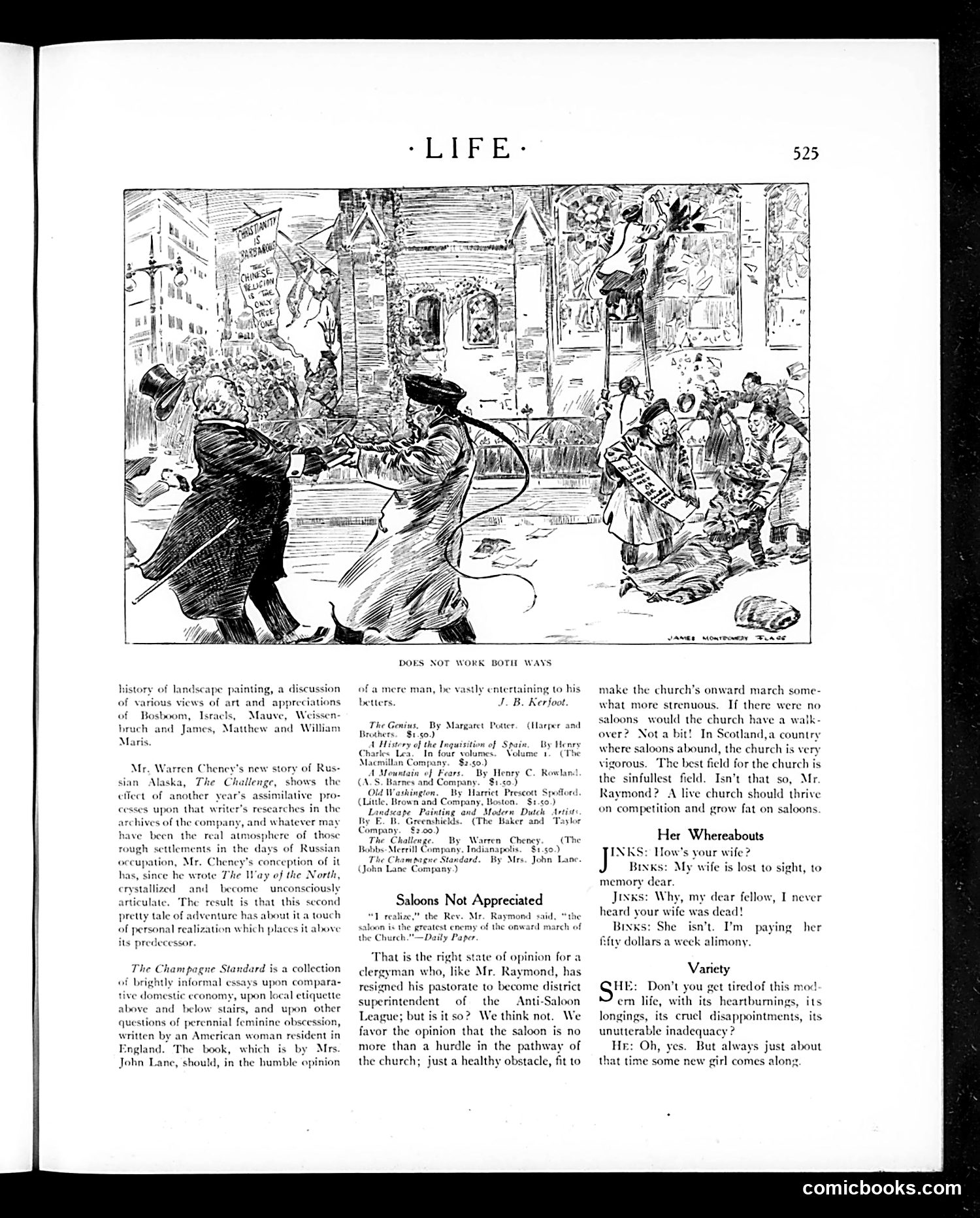
This page contains book reviews, brief humorous dialogues, and a cartoon about street conflict. **Main Cartoon ("Does Not Work Both Ways"):** The illustration depicts two men fighting with canes in a city street while onlookers—including children and women—watch from the sidewalk and storefront. The title suggests ironic commentary on a situation where one party's tactics fail when reversed. **"Saloons Not Appreciated":** A commentary on Rev. Raymond's anti-saloon advocacy. Life sarcastically argues that saloons actually *strengthen* the church by providing moral opposition—that churches need competition and temptation to remain vigorous. The piece mocks the idea that eliminating saloons would improve society, claiming this worked poorly in Scotland where saloons flourish yet the church remains strong. **Comic Dialogues:** Brief jokes about marriage and infidelity, typical of Life's humor section—one about a wife "lost to sight" due to alimony payments, another about romantic variety. The page reflects early 20th-century debates over Prohibition and moral reform, while maintaining Life's satirical stance against reform movements.
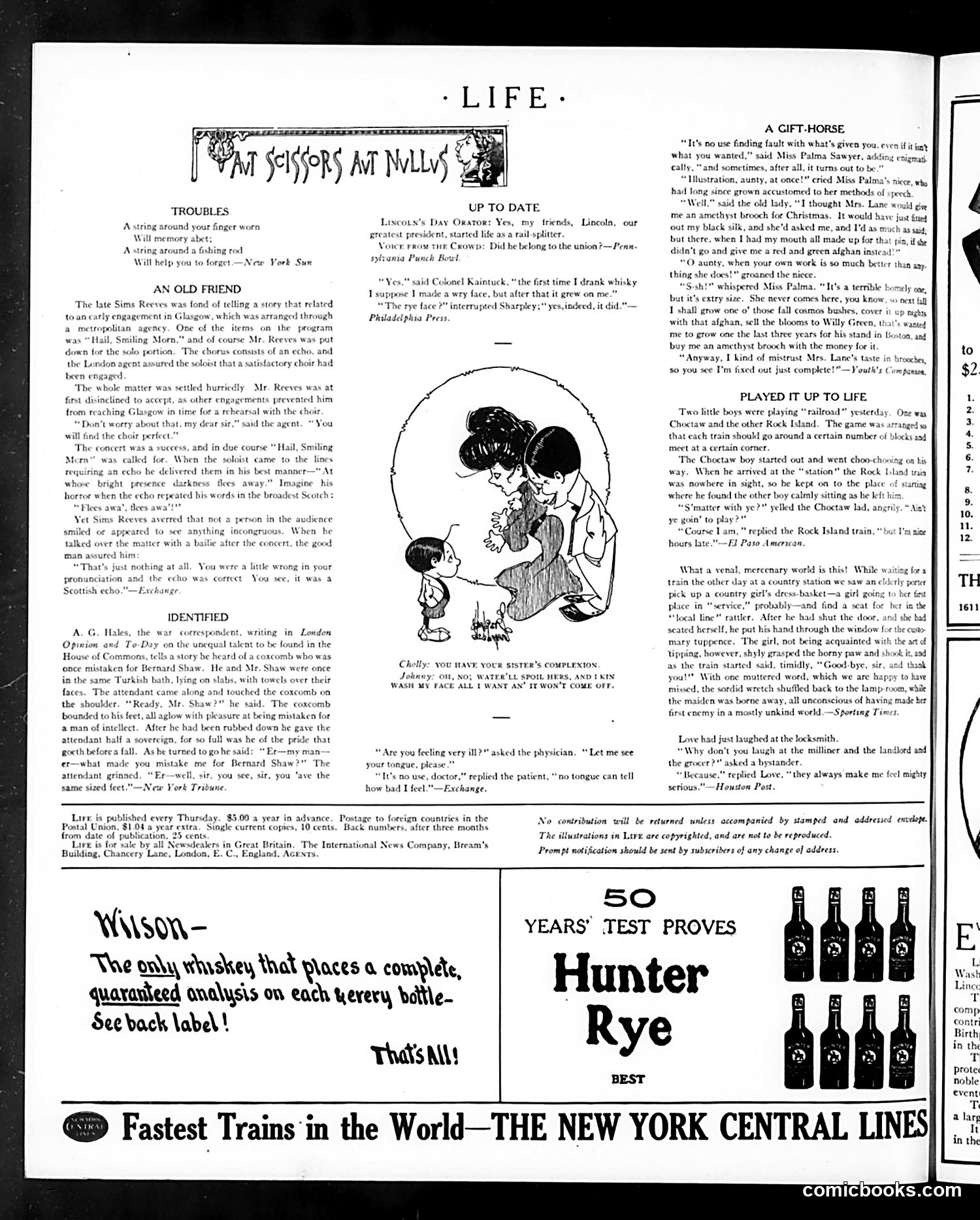
This page collects short humorous anecdotes satirizing human nature and social pretense. Key pieces: **"An Old Friend"** mocks a Victorian singer (Sims Reeves) who performs with an echo that unexpectedly delivers his lines in Scottish dialect—yet the audience pretends not to notice the absurdity. The satire targets polite society's willingness to ignore obvious incongruities. **"Identified"** jokes about mistaken identity: a war correspondent resembles Bernard Shaw so closely that a bathhouse attendant serves him by mistake. The humor lies in shallow physical similarity being enough for confusion among people of supposed intellect. **"Up to Date"** satirizes labor unions through a Lincoln's Day speaker—someone interrupts to ask if Lincoln belonged to "the union," treating 19th-century rail-splitting as if it required modern union membership. The joke mocks applying contemporary labor politics anachronistically. The remaining pieces target similar targets: pretension, vanity, and the gap between people's stated beliefs and actual behavior. Overall, the page reflects *Life*'s satirical mission of poking fun at American social hypocrisy.
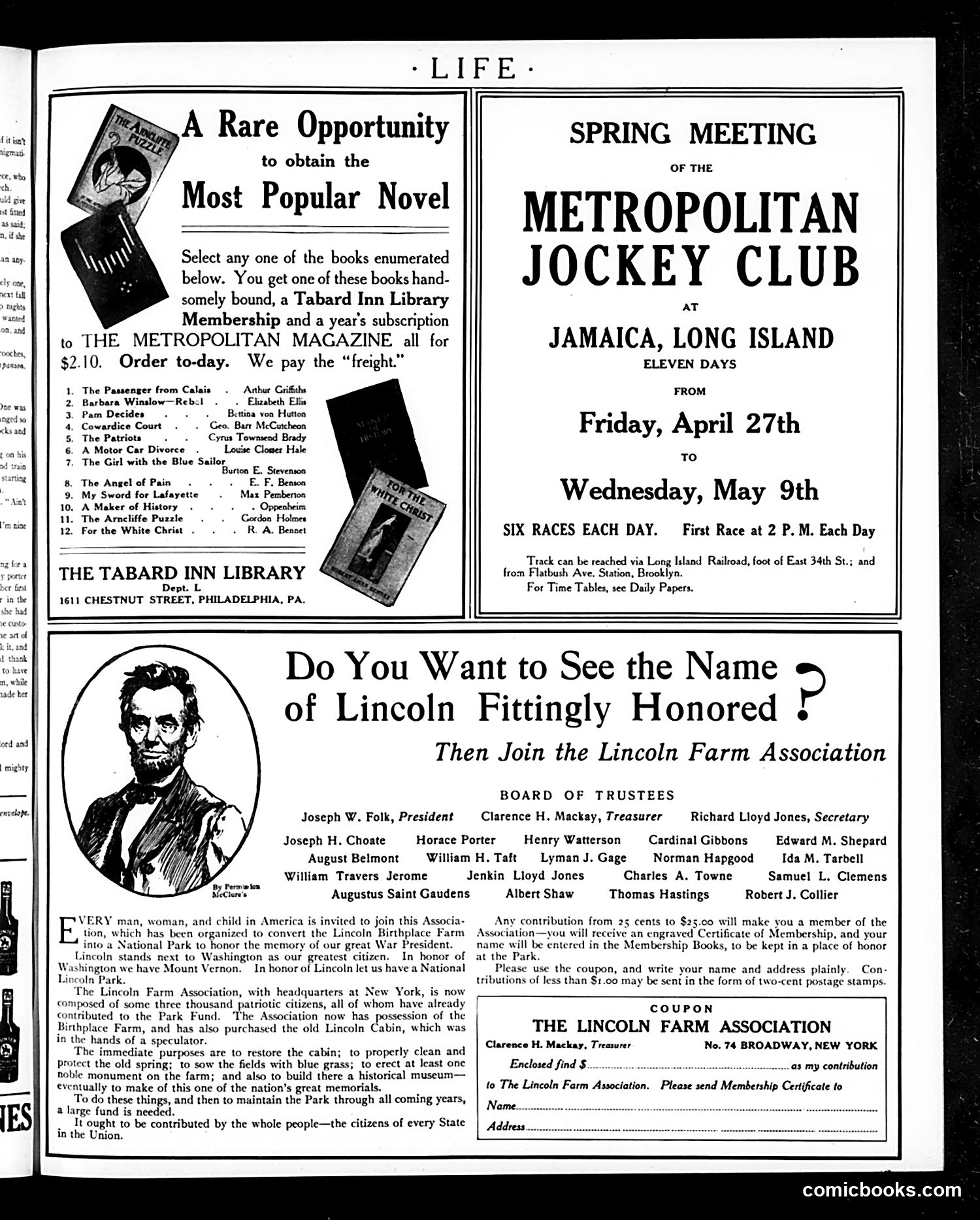
This page is primarily **advertising and fundraising**, not satire. It contains three distinct appeals: 1. **Top left**: A book club offer from Tabard Inn Library—membership plus a popular novel subscription for $2.10. 2. **Top right**: Advertisement for the Metropolitan Jockey Club's spring racing meet in Jamaica, Long Island (April 27–May 9). 3. **Bottom**: A fundraising campaign for the Lincoln Farm Association, seeking donations to convert Abraham Lincoln's birthplace into a national park. The board lists prominent figures (William H. Taft, Cardinal Gibbons, Mark Twain, etc.), legitimizing the cause. The association aims to restore the cabin, protect the spring, and build a historical museum. The Lincoln appeal emphasizes patriotic duty, comparing it to Mount Vernon's role in honoring Washington. No satire is evident—this reflects genuine early-20th-century efforts to preserve historical sites through public contribution.
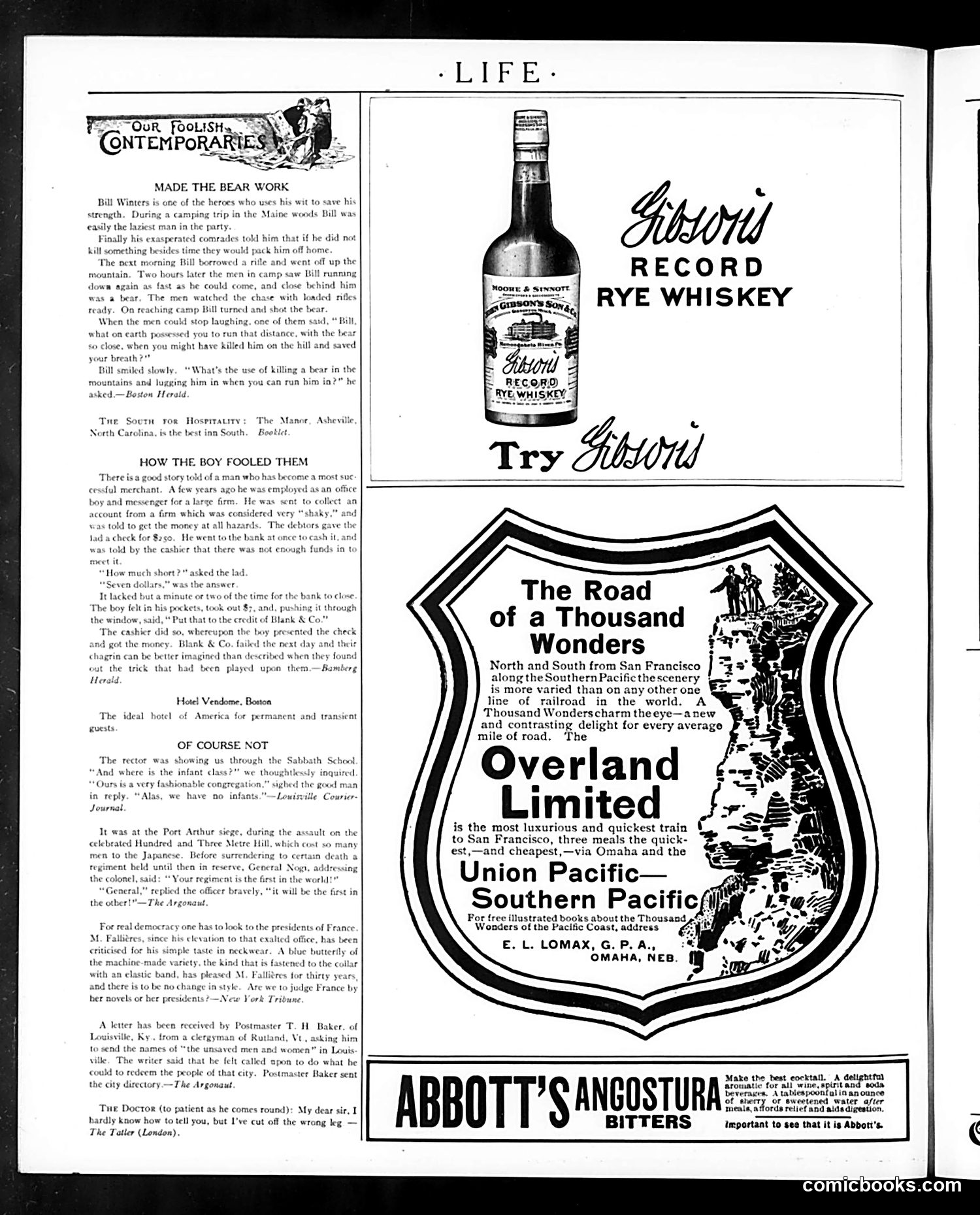
This page contains humorous anecdotes and advertisements typical of early 20th-century Life magazine. The main content includes three short satirical stories: **"Made the Bear Work"** mocks a lazy camper who, when finally pressured to hunt, encounters a bear and runs back to camp at remarkable speed—the irony being that laziness suddenly produces industriousness. **"How the Boy Fooled Them"** tells of a young messenger who deposits a single penny in a bank to make a large check appear legitimate, fooling both the bank and a shaky firm—satirizing business naïveté. **"Of Course Not"** jokes about a fashionable church congregation lacking "influence"—social satire about upper-class pretension. The page also features period advertisements for Osborn's Rye Whiskey, the Overland Limited train to San Francisco, and Abbott's Angostura Bitters. These ads reflect early 20th-century consumer culture and leisure travel. The humor throughout relies on irony and social observation rather than political commentary.
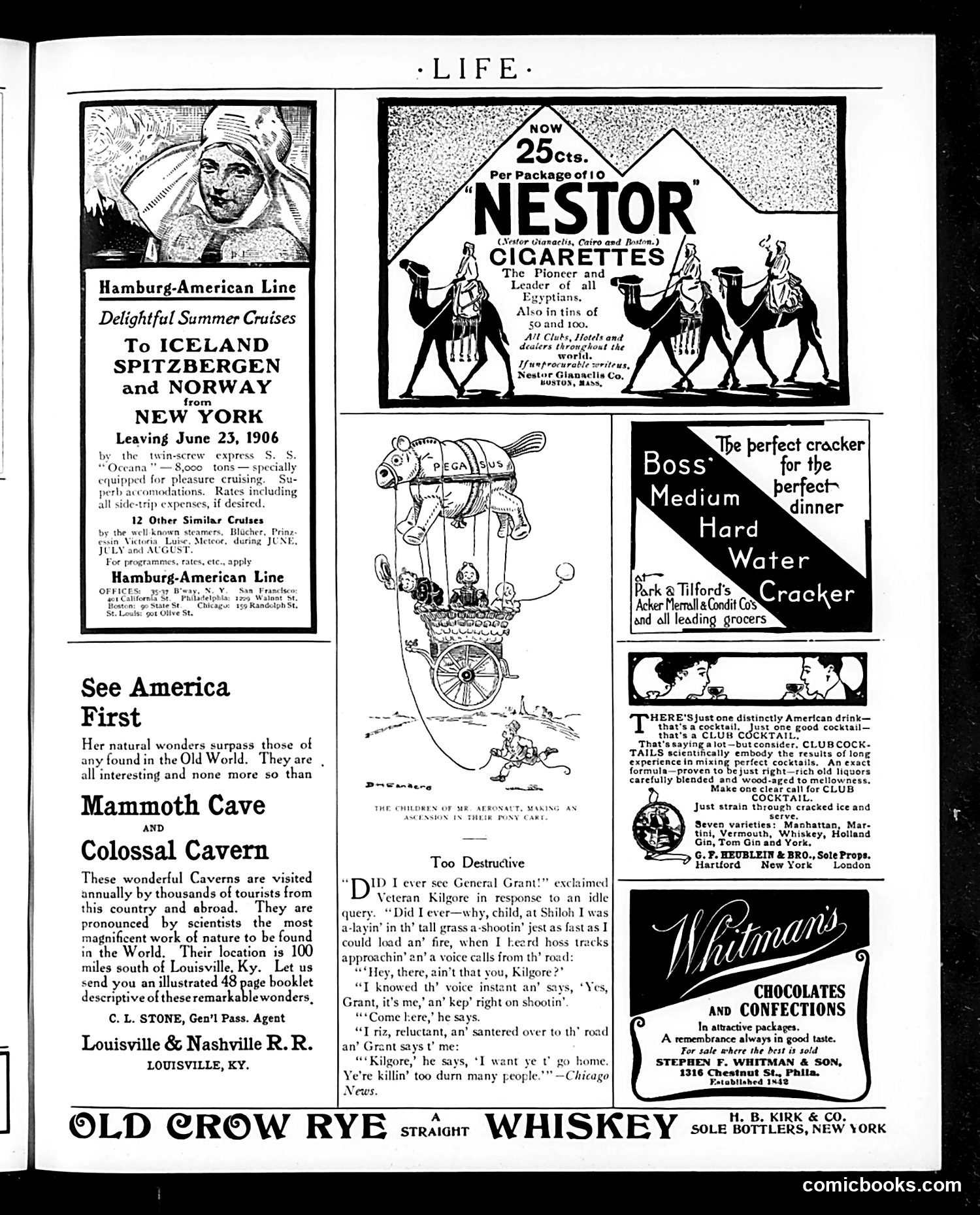
This is primarily an **advertising page** from Life magazine (circa 1906), with one embedded satirical cartoon. The main cartoon, titled "Too Destructive," depicts a Civil War anecdote about **General Grant** addressing a soldier named Kilgore during the Battle of Shiloh. The joke is a dry critique of indiscriminate warfare: Grant supposedly tells the overzealous soldier to stop shooting because he's "killin' too durn many people"—implying Grant finds the casualty rate excessive even by combat standards. The humor relies on Grant's matter-of-fact tone and the absurdity of the complaint during active battle. The surrounding advertisements promote luxury cruises, cigarettes, whiskey, chocolates, and tourist attractions—typical of early-1900s Life magazine content. The "See America First" campaign encourages domestic tourism to natural wonders like Mammoth Cave. The page reflects Edwardian-era commercial culture and nostalgic Civil War attitudes common to the period.
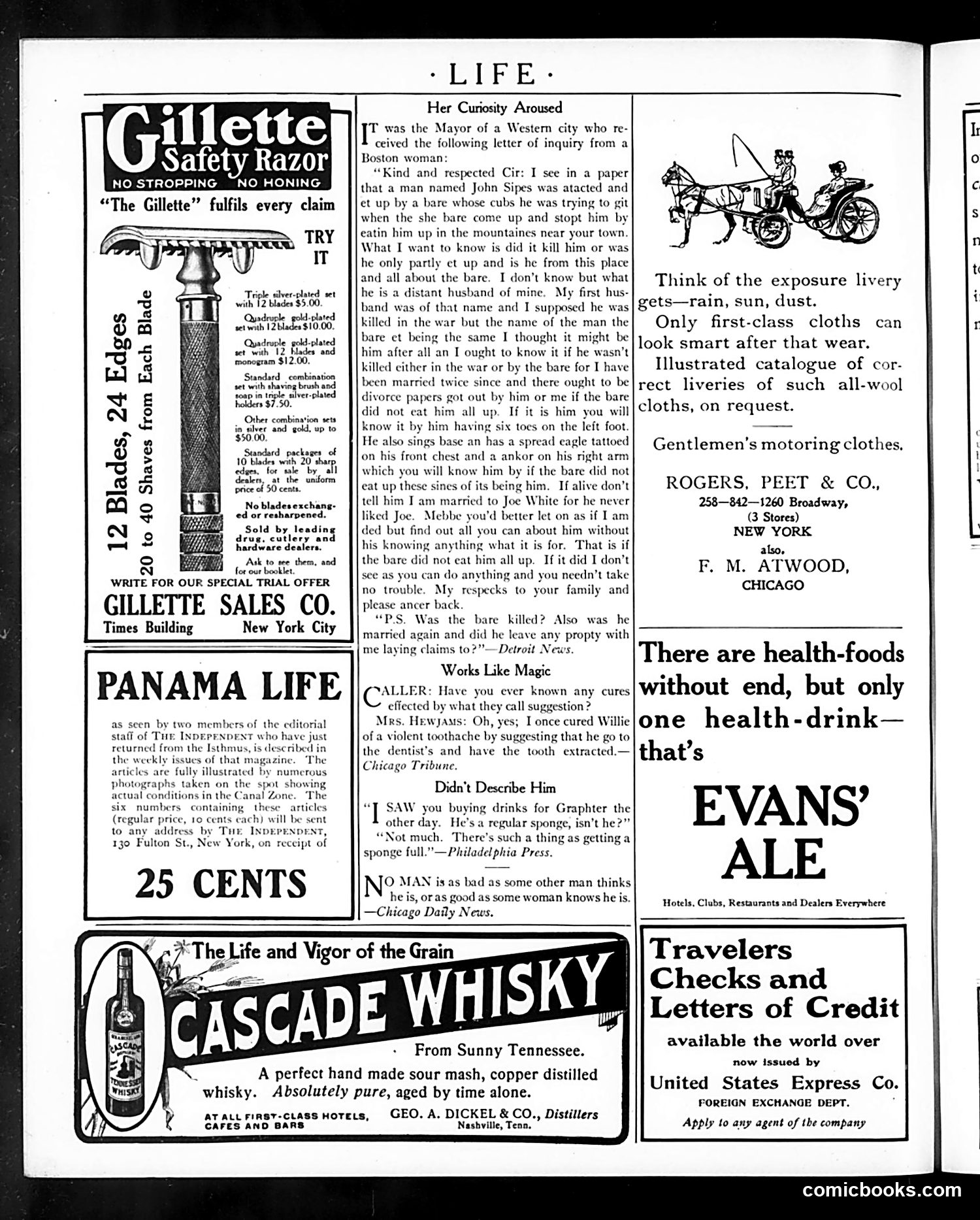
This page is primarily **advertising with humorous anecdotes**, not political cartoons. The main content includes: **"Her Curiosity Aroused"**: A comedic letter from a Boston woman to a Western mayor inquiring whether a man named John Sipes—possibly her estranged first husband—was killed by a bear. She seeks confirmation via identifying marks (six toes, eagle tattoo, anchor). The satire mocks both verbose letter-writing conventions and the absurdity of domestic entanglement. **"Works Like Magic" and other brief jokes**: Short humor pieces poking fun at suggestion/psychology and male behavior. **The advertisements** dominate: Gillette Safety Razors, Panama Life magazine, Evans' Ale, Cascade Whisky, and travel services. These reflect early 20th-century consumer goods marketed to middle-class men. The page reflects *Life*'s format as a satirical magazine blending humor columns with commercial advertising—typical of American periodicals from this era.
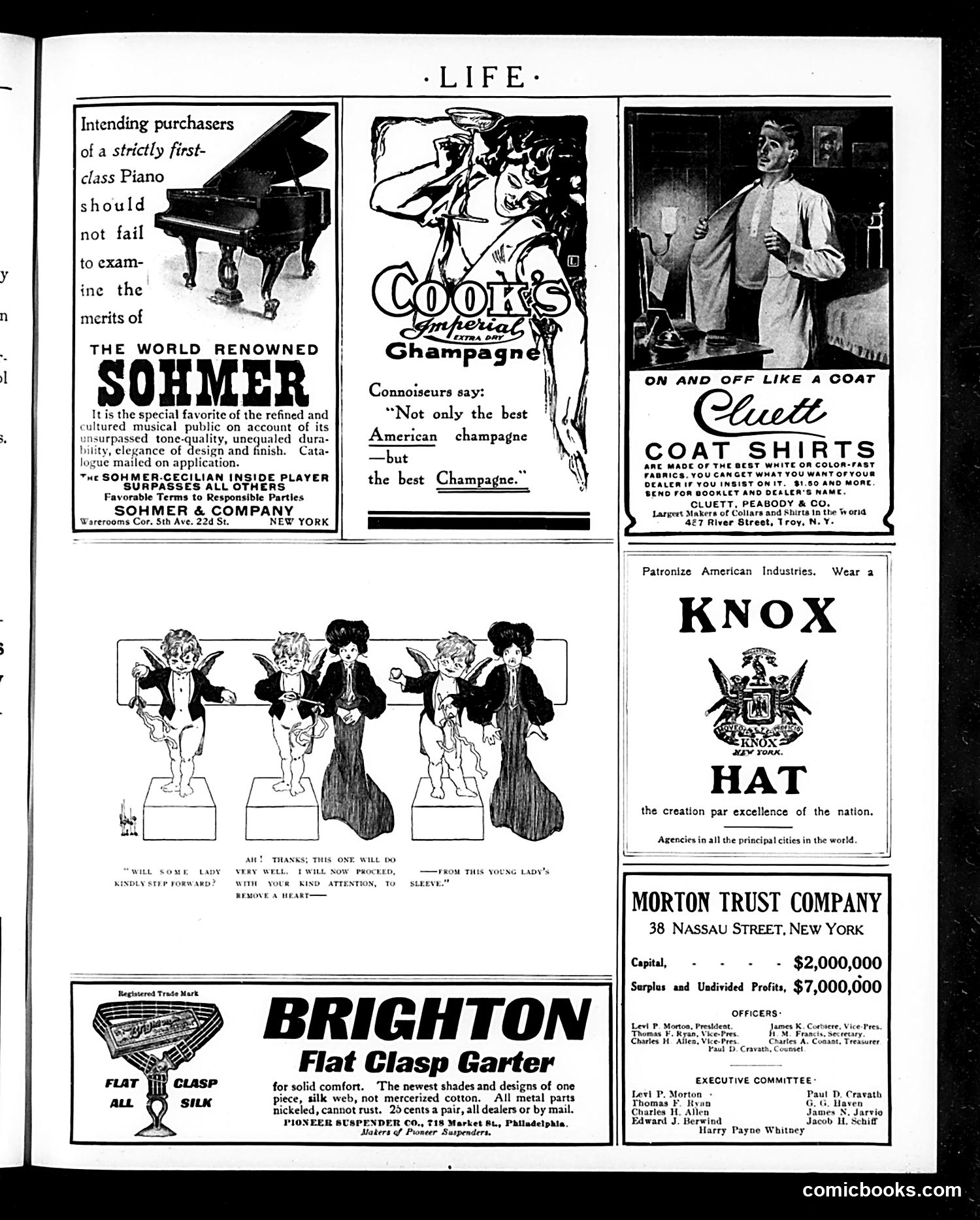
This page is primarily **advertising**, typical of early 20th-century magazines. The one cartoon—a small illustration near the bottom—depicts cherubs or putti (classical baby figures) in formal dress being presented or paraded, with dialogue suggesting someone is selecting or approving one to "become a heart." The humor appears to be gentle and whimsical rather than satirical. The advertisements promote luxury goods: pianos (Sohmer), champagne (Cook's), dress shirts (Cluett), hats (Knox), garters (Brighton), and financial services (Morton Trust Company). The phrase "Patronize American Industries" reflects early 20th-century protectionist sentiment. The cartoon's meaning is unclear without fuller context—it may be satirizing courtship rituals, social selection processes, or sentimental Victorian culture, but the image alone doesn't definitively establish the target of satire.
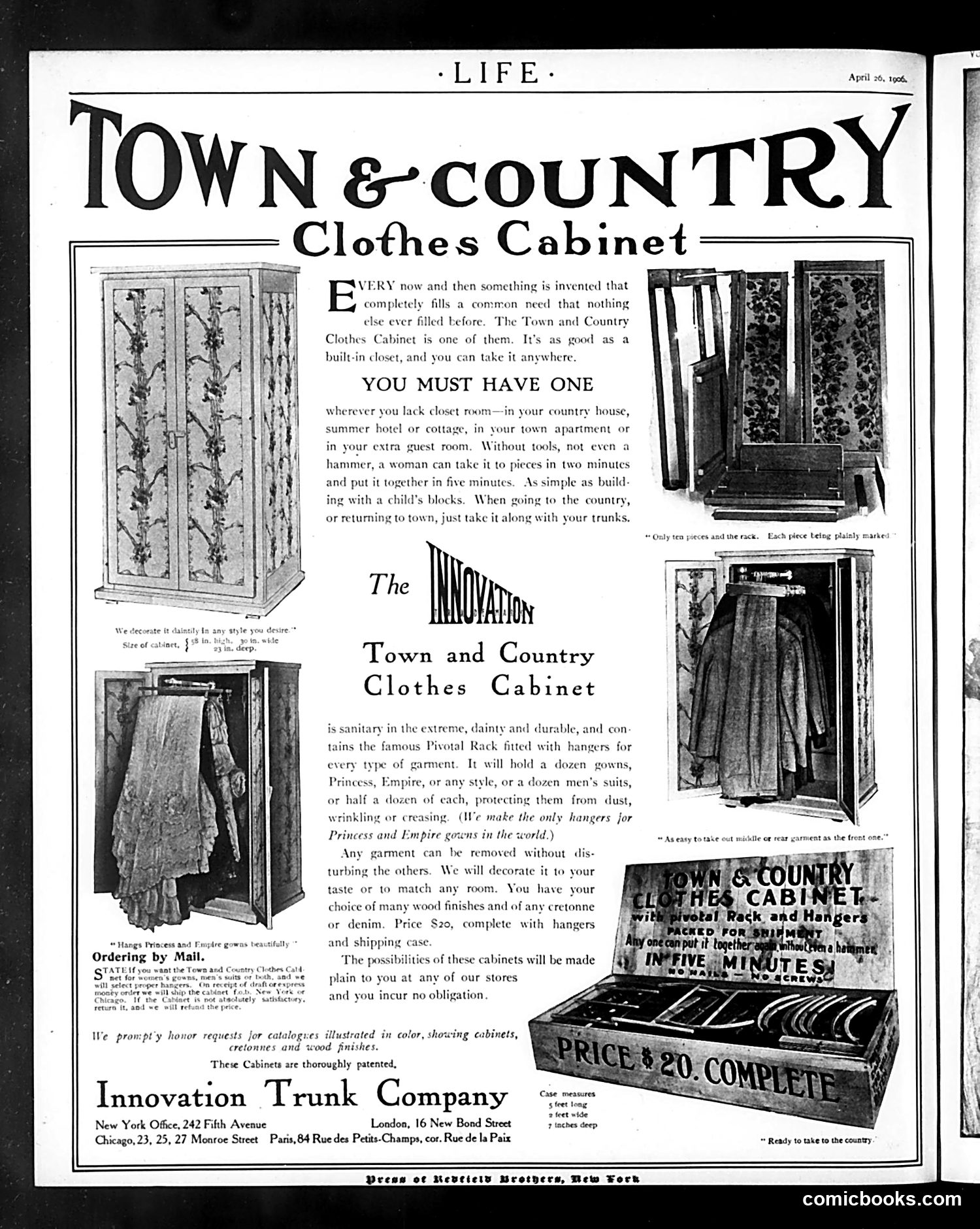
This page is **not a cartoon or satire** — it is a straightforward **advertisement** for the "Town and Country Clothes Cabinet," a portable wardrobe storage unit manufactured by the Innovation Trunk Company. The ad targets affluent women of the early 1900s who maintained multiple residences (country houses, town apartments, summer cottages). The cabinet's selling points are its portability, easy assembly ("as simple as building with a child's blocks"), and capacity to hold numerous garments while protecting them from dust and wrinkles. Key features highlighted include a patented "Pivotal Rack" and proprietary hangers for fashionable "Princess and Empire" gowns (period dress styles). The $20 price point (substantial for 1906) and multi-city offices (New York, Chicago, Paris, London) suggest this was a luxury product for the wealthy. The multiple photographs demonstrate the cabinet's appearance and open/closed configurations.