
Life, 1906-04-26 · page 6 of 24
Life — April 26, 1906 — page 6: what you’re looking at
What you’re looking at
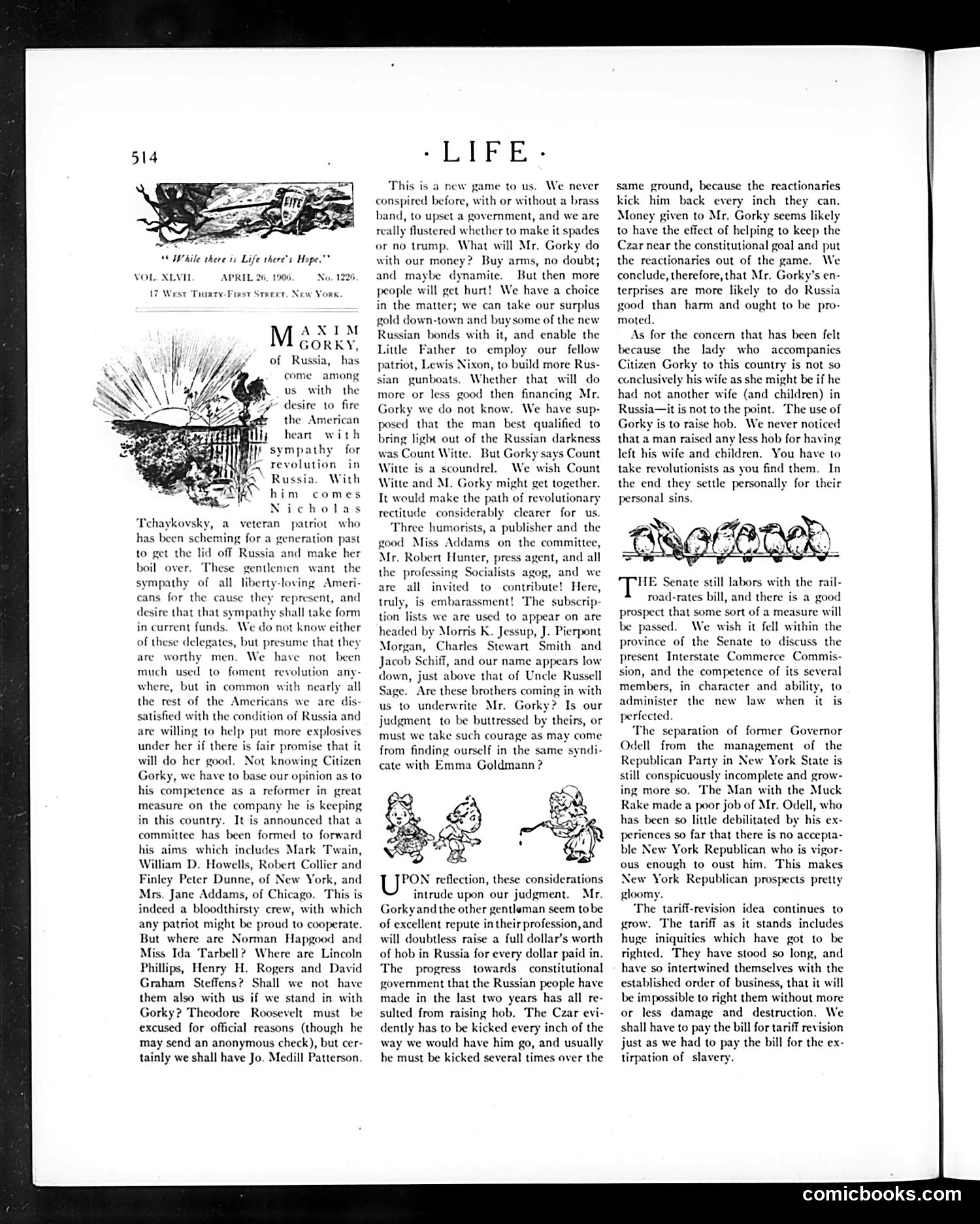
This page discusses Russian revolutionary Maxim Gorky's visit to America. The text reveals controversy: Gorky came seeking funds to support Russian revolution, but American donors withdrew support after learning he was living with a woman who wasn't his wife—a major scandal in 1906. The cartoon (upper left) appears to caricature Gorky, likely mocking this domestic situation. The text names prominent Americans on a committee supposedly backing him, including Mark Twain and Jane Addams, suggesting they faced embarrassment. The satire critiques American hypocrisy: wealthy patrons eager to fund Russian revolution but scandalized by Gorky's personal life, ultimately prioritizing moral propriety over political support. The piece questions whether such "revolutionaries" deserve backing.
📄 Transcribed text from this page (OCR, searchable)
Machine-transcribed from the original scan — historical spelling and the odd misread are preserved.
“While there is Life there's Ho VOL. XLVIL APRIL 26, 1908, No. 17 West Taary-Fiast Starner, New Yors. AXIM GORKY, of Russia, come among us with the desire to fire the American heart with sympathy for revolution in Russia. With him comes Nicholas ‘Tchaykovsky, a veteran patriot who has been scheming for a generation past to get the lid off Russia and make her boil over. These gentlemen want the sympathy of all liberty-loving Ameri- cans for the cause they represent, and desire that that sympathy shall take form in current funds. We do not know either of these delegates, but presume that they are worthy men. We have not been much used to foment revolution any- where, but in common with nearly all the rest of the Americans we are dis- satisfied with the condition of Russi: are willing to help put more explosi under her if there is fair promise that it will do her good. Not knowing Citizen Gorky, we have to base our opinion as to his competence as a reformer in great measure on the company he is keeping in this country. It is announced that a committee has been formed to forward his aims which includes Mark Twain, William D. Howells, Robert Collier and Finley Peter Dunne, of New York, and Mrs. Jane Addams, of Chicago. This is indeed a bloodthirsty crew, with which any patriot might be proud to cooperate. But where are Norman Hapgood and Miss Ida Tarbell? Where are Lincoln Phillips, Henry H. Ro; and David Graham Steffens? Shall we not have them also with us if we stand in with Gorky? Theodore Roosevelt must be excused for official reasons (though he may send an anonymous check), but cer- tainly we shall have Jo. Medill Patterson. has. -LIFE.- This is a new game to us. We never conspired before, with or without a brass band, to upset a government, and we are really flustered whether to make it spades, or no trump. What will Mr. Gorky do with our money? Buy arms, no doubt; and maybe dynamite. But then more people will get hurt! We have a choice in the matter; we can take our surplus gold down-town and buy some of the new Russian bonds with it, and enable the Little Father to employ our fellow patriot, Lewis Nixon, to build more Rus- sian gunboats, Whether that will do more or less good then financing Mr. Gorky we do not know. We have sup- posed that the man best quali bring light out of the Ru: was Count Witte. But Gorky says Witte is a scoundrel. We wish Count Witte and M. Gorky might get together. It would make the path of revolutionary rectitude considerably clearer for us. Three humorists, a publisher and the good N Addams on the committee, Mr. Robert Hunter, py agent, and all the professing Socialists agog, and we are all invited to contribute! Here, truly, is embarassment! The subscrip- tion lists we are used to appear on are headed by Morris K. Jessup, J. Pierpont Morgan, Charles Stewart Smith and Jacob Schiff, and our name appears low down, just above that of Uncle Russell Sage. Are these brothers coming in with us to underwrite Mr. Gorky? Is our judgment to be buttressed by theirs, or must we take such courage as may come from finding ourself in the same syndi- cate with Emma Goldmann ? PON reflection, these considerations intrude upon our judgment. Mr. Gorky and the other gentleman seem tobe of excellent repute in their profession, and will doubtless raise a full dollar’s worth of hob in Russia for every dollar paid in. The progress towards constitutional government that the Russian people have made in the last two years has all re- sulted from raising hob, The Czar evi- dently has to be kicked every inch of the way we would have him go, and usually he must be kicked several times over the same ground, because the reactionaries kick him back every inch they Money given to Mr. Gorky seems likely to have the effect of helping to keep the Czar near the constitutional goal and put the reactionaries out of the game. We conclude, therefore, that Mr. Gorky’s en- terprises are more likely to do Russia good than harm and ought to be pro- moted. As for the concern that has been felt because the lady who accompanies Citizen Gorky to this country is not so conclusively his wife as she might be if he had not another wife (and children) in Russia—it is not to the point. ‘The use of Gorky is to raise hob. We never noticed that a man raised any less hob for having left his wife and children. You have to take revolutionists as you find them. In the end they settle personally for their personal sins. HE Senate still labors with the rail- road-rates bill, and there is a good prospect that some sort of a measure will be passed. We wish it fell within the province of the Senate to discuss the present Interstate Commerce Commis- sion, and the competence of its several members, in character and ability, to administer the new law when it is perfected. The separation of former Governor Odell from the management of the Republican Party in New York State is ill conspicuously incomplete and grow- ing more so. The Man with the Muck ke made a poor job of Mr. Odell, who has been so little debilitated by his ex- periences so far that there is no accepta- ble New York Republican who is vigor- ous enough to oust him. This makes New York Republican prospects pretty gloomy. The tariff-re' . The tariff ion idea continues to s it stands includes iniquil which have got to be righted. They have stood so long, and have so intertwined themselves with the established order of business, that it will be impossible to right them without more or less damage and destruction. We shall have to pay the bill for tariff revi just as we had to pay the bill for the ex- tirpation of slavery. comicbooks.com