
Life, 1906-04-26 · page 15 of 24
Life — April 26, 1906 — page 15: what you’re looking at
What you’re looking at
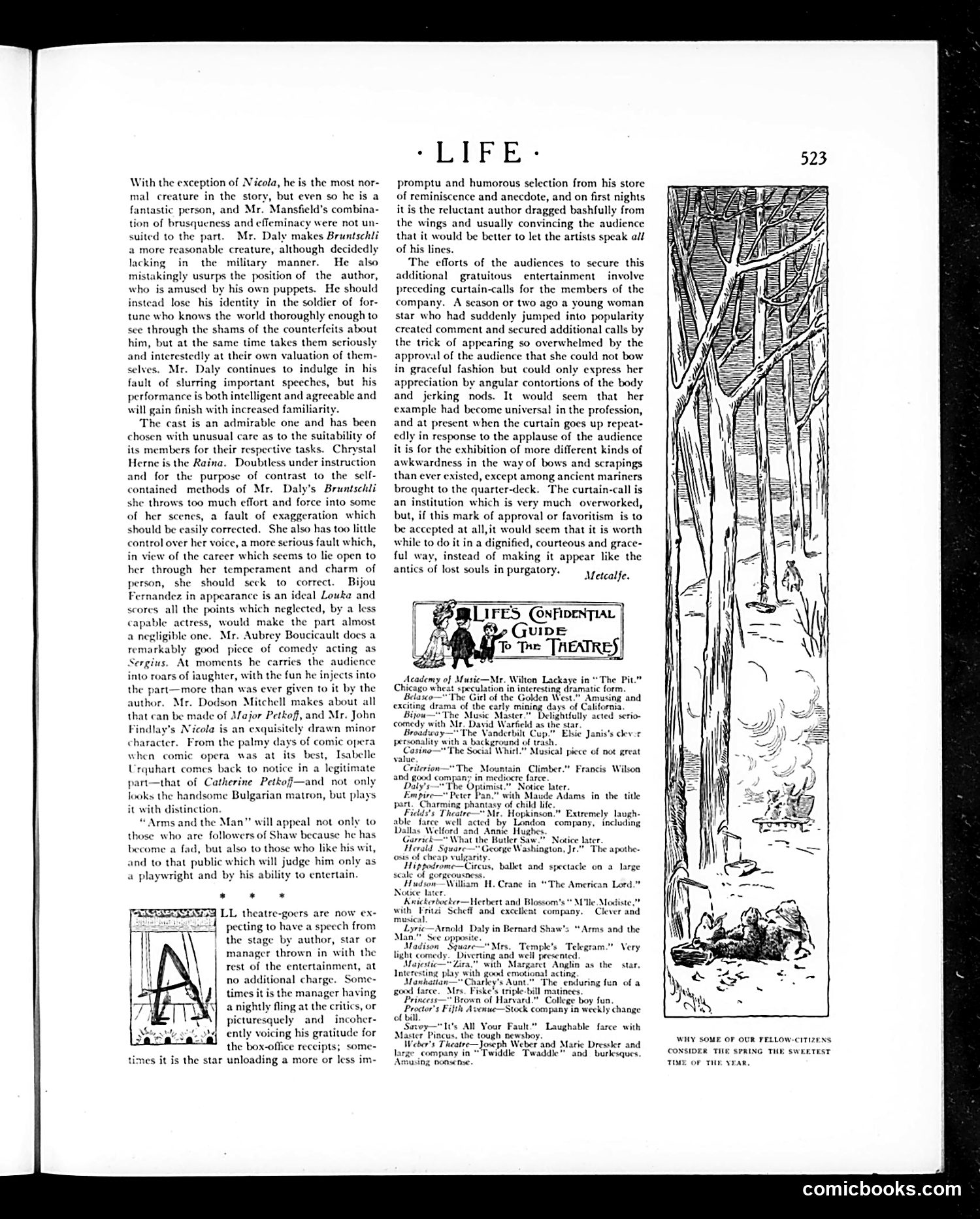
This page is primarily a **theater review** of Shaw's "Arms and the Man," with commentary on contemporary stage practices. The main text critiques the cast's performances—particularly praising Bijou Fernandez and John Findlay while noting Chrystal Herne's excessive effort and voice control issues. The review discusses how the lead actor (Daly) plays Bluntschli with excessive "identity," when he should disappear into the role. The **sidebar cartoon** (lower left) satirizes a modern theater convention: actors giving impromptu speeches from the stage. The text mocks how managers deliver "nightly flings at the critics," how reluctant authors are "dragged bashfully from the wings," and how actors manufacture gratitude by appearing "overwhelmed" to secure additional curtain calls. The satire targets **theatrical affectation and the blurring of performance boundaries**—the expectation that entertainment now includes unscripted ego-stroking rather than pure artistic merit. This reflects early 1900s concerns about professionalism deteriorating through manufactured sentiment.
📄 Transcribed text from this page (OCR, searchable)
Machine-transcribed from the original scan — historical spelling and the odd misread are preserved.
With the exception of Nicola, he is the most nor- mal creature in the story, but even so he is a fantastic person, and Mr. Mansfield’s combina- tion of brusqueness and effeminacy were not un- suited to the part. Mr. Daly makes Bruntschli a more reasonable creature, although decidedly lacking in the military manner. He also mistakingly usurps the position of the author, who is amused by his own puppets. He should instead lose his identity in the soldier of for- tune who knows the world thoroughly enough to see through the shams of the counterfeits about him, but at the same time takes them seriously and interestedly at their own valuation of them- selves. Mr. Daly continues to indulge in his fault of slurring important speeches, but his performance is both intelligent and agreeable and will gain finish with increased familiarity. ‘The cast is an admirable one and has been chosen with unusual care as to the suitability of its members for their respective ta: Chrystal Herne is the Raina. Doubtless under instruction and for the purpose of contrast to the self- contained methods of Mr. Daly’s Bruntschli she throws too much effort and force into some of her scenes, a fault of exaggeration which should be easily corrected. She also has too little control over her voice, a more serious fault which, in view of the career which seems to lie open to her through her temperament and charm of person, she should scck to correct. Bijou Fernandez in appearance is an ideal Louka and scores all the points which neglected, by a less capable actress, would make the part almost a negligible one. Mr. Aubrey Boucicault docs a remarkably good piece of comedy acting as Sergius. At moments he carries the audience into roars of iaughter, with the fun he injects into the part—more than was ever given to it by the author. Mr. Dodson Mitchell makes about all that can be made of Major Petkof, and Mr. John Findlay’s Nicola is an exquisitely drawn minor character. From the palmy days of comic opera when comic opera was at its best, Isabelle Urquhart comes back to notice in a legitimate part—that of Catherine Petkofi—and not only looks the handsome Bulgarian matron, but plays it with distinction. “Arms and the Man” will appeal not only to those who are followers of Shaw because he has become a fad, but also to those who like his wit, and to that public which will judge him only as a playwright and by his ability to entertain * 8 * ALM LL theatre-gocrs are now ex- scents pecting to have a speech from the stage by author, star or manager thrown in with the rest of the entertainment, at no additional charge. So times it is the manager having a nightly fling at the critics, or picturesquely and incoher- ently voicing his gratitude for the box-office receipts; some- s it is the star unloading a more or less im- ‘LUPE: promptu and humorous selection from his store of reminiscence and anecdote, and on first nights it is the reluctant author dragged bashfully from the wings and usually convincing the audience that it would be better to let the artists speak all of his lines. he efforts of the audiences to secure this additional gratuitous entertainment _ involve preceding curtain-calls for the members of the company. A scason or two ago a young woman star who had suddenly jumped into popularity created comment and secured additional calls by the trick of appearing so overwhelmed by the approval of the audience that she could not bow in graceful fashion but could only express her appreciation by angular contortions of the body and jerking nods. It would seem that her example had become universal in the profession, and at present when the curtain goes up repeat- edly in response to the applause of the audience it is for the exhibition of more different kinds of awkwardness in the way of bows and scrapings than ever existed, except among ancient mariners brought to the quarter-deck. The curtain-call is an institution which is very much overworked, but, if this mark of approval or favoritism is to be accepted at all,it would seem that it is worth while to do it in a dignified, courteous and grace- ful way, instead of making it appear like the antics of lost souls in purgatory. Metcalfe. FES (NFpenqiAL GuipE ‘P Tie THEATRES _leademy of Music—Mr. Wilton Lackaye in “The Pit.” Chicago wheat speculation in interesting dramatic form. Belaxo—" The Girl of the Golden West.” Amusing and exciting drama of the carly mining days Bijon—"'The Music Master.” Delightfully acted.» comedy with Mr. Day star Broadway — p.” Elsie Janis's deve Musical piece of not great Criterion and good ¢c Daly's “The Mountain Climber." Francis Wilson 1." Notice later. Em pire— Peter with Maude Adams in the title ming phantasy of child life Fieds's Theatre— Mr. Hopkinson.” Extremely laugh able farce well acted by London company, including Dallas Welford and Annie Hughes Garrick—" What the Butler Saw.” Notice later. Herald Square—" George Washington, Jr.” The apothe- oxis of cheap vulgarity. Hippodrome—Circus, ballet and spectacle on a large seale of gorgeousness. Hudson—William H. Crane in “The American Lord.” Notice later Anickerbocker—Herbert and Blossom's* Mlle. Modiste with Fritzi Scheff and excellent company. Clever and musical Lyric— Arnold Daly in Bernard Shaw": Man." Sce opposite Madison Square—* Mrs. Temp! light comedy. Diverting and well presente Mayestic—" Zita.” Margaret Ang! Interesting play. with 1 acting. Manhattan—"Ch The enduring fun of a good farce. Mrs. Fiske’s triple-bill matinces Princess—" Brown of Harvard.” College boy fun. a Linctor + Filth Avenue—Stock company in weekly change Savoy—"It's AN Your Fault.” Laughable farce with Master Pincus. the tough newsboy. Weber's Theatre—Joseph Weber and Marie Dressler and large company in “Twiddle Twaddle” and burlesques. Amusing nonsense. “Arms and the Felegram.” Very as the star, WHY SOME OF OU CONSIDER THE SPR UME OF THE yrAR, TELLOW-CITIZENS, t SWEETEST comicbooks.com