
A complete issue · 28 pages · 1906
Life — April 19, 1906
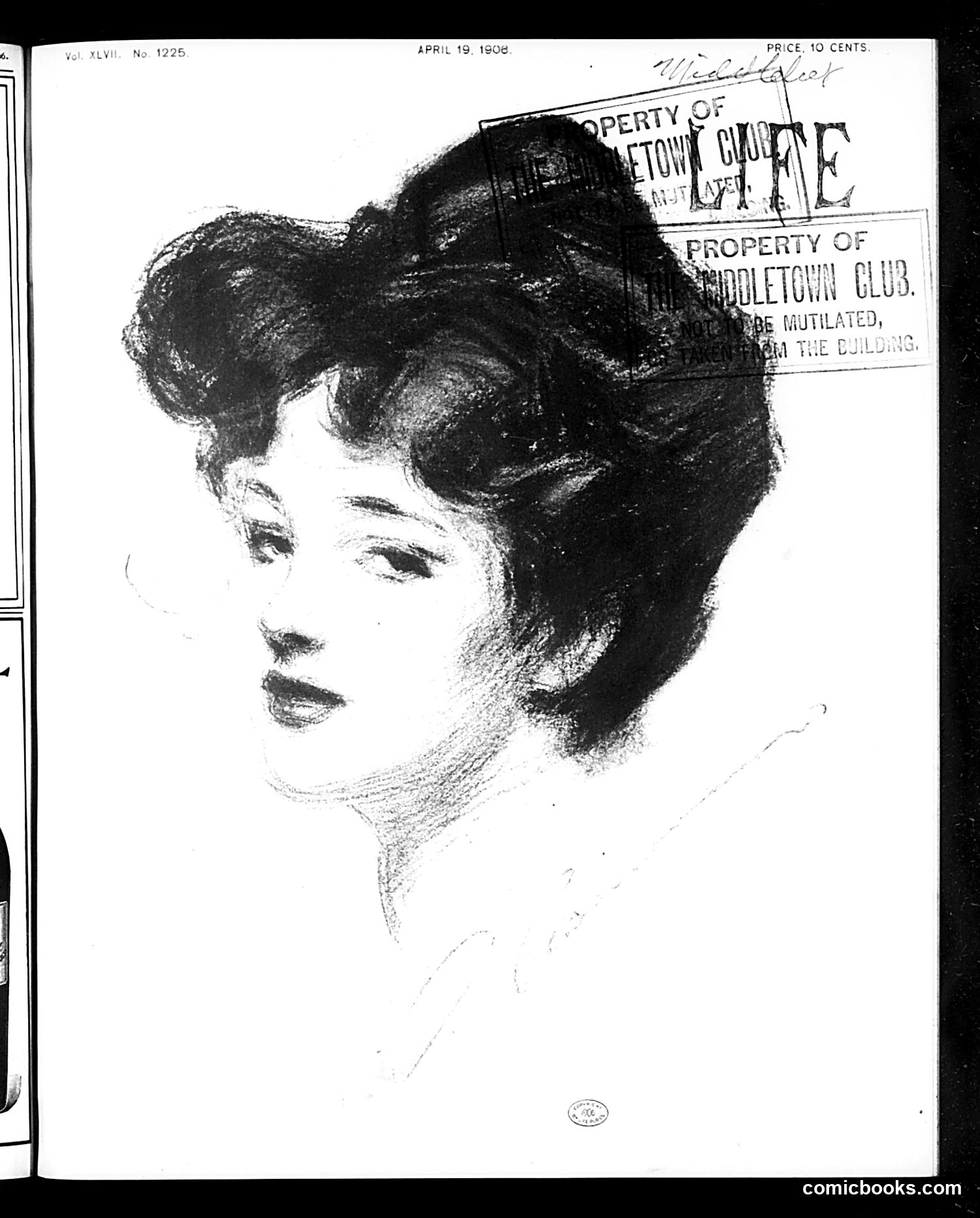
This page features a sketched portrait of a woman in profile, drawn in the early 1900s style. The image itself appears to be a straightforward portrait illustration rather than political satire or cartoon. The stamps visible on the page indicate this was property of the Middletown Club library, suggesting it was preserved as part of institutional archives. The date—April 19, 1906—places this just days after the San Francisco earthquake (April 18), though the portrait's subject and relevance to current events remains unclear from the visible content. Without additional context about who this woman is or what Life's accompanying article discussed, I cannot determine the satirical intent or social commentary this page may have contained.
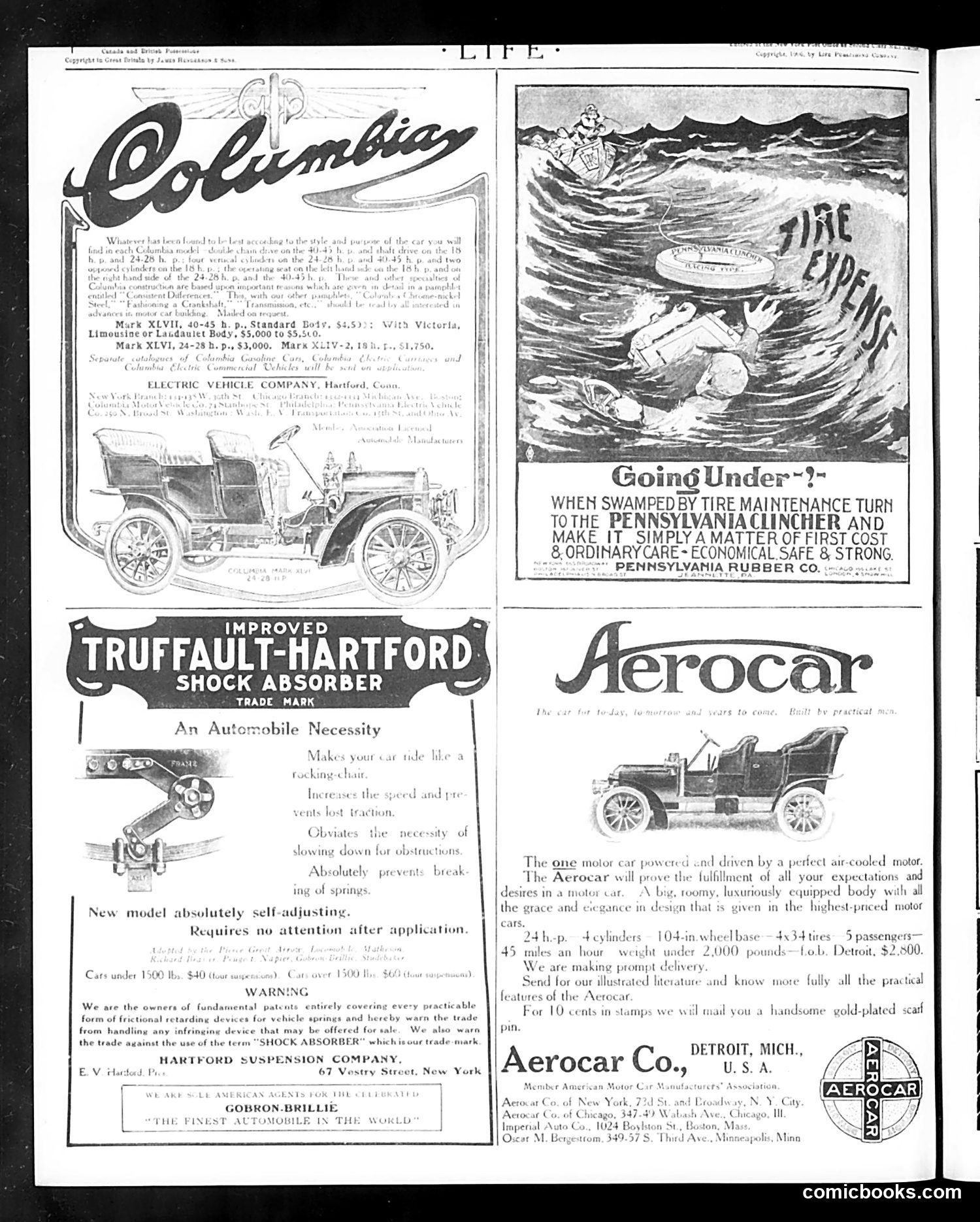
This page is predominantly **advertising** rather than editorial content or political cartoons. The left side features ads for the **Colombiar** automobile and the **Truffault-Hartford Shock Absorber** (a car suspension component). The right side contains ads for the **Pennsylvania Rubber Company** (tire maintenance) and the **Aerocar** (an automobile manufactured in Detroit). The only visual "narrative" appears in the Pennsylvania Rubber ad, which shows a humorous scene of someone being swept away by waves, captioned "Going Under?" The joke presents tire maintenance as protection against automotive failure—using drowning as metaphor for car trouble. The page reflects early-20th-century automotive industry competition, with multiple manufacturers advertising mechanical innovations to consumers.
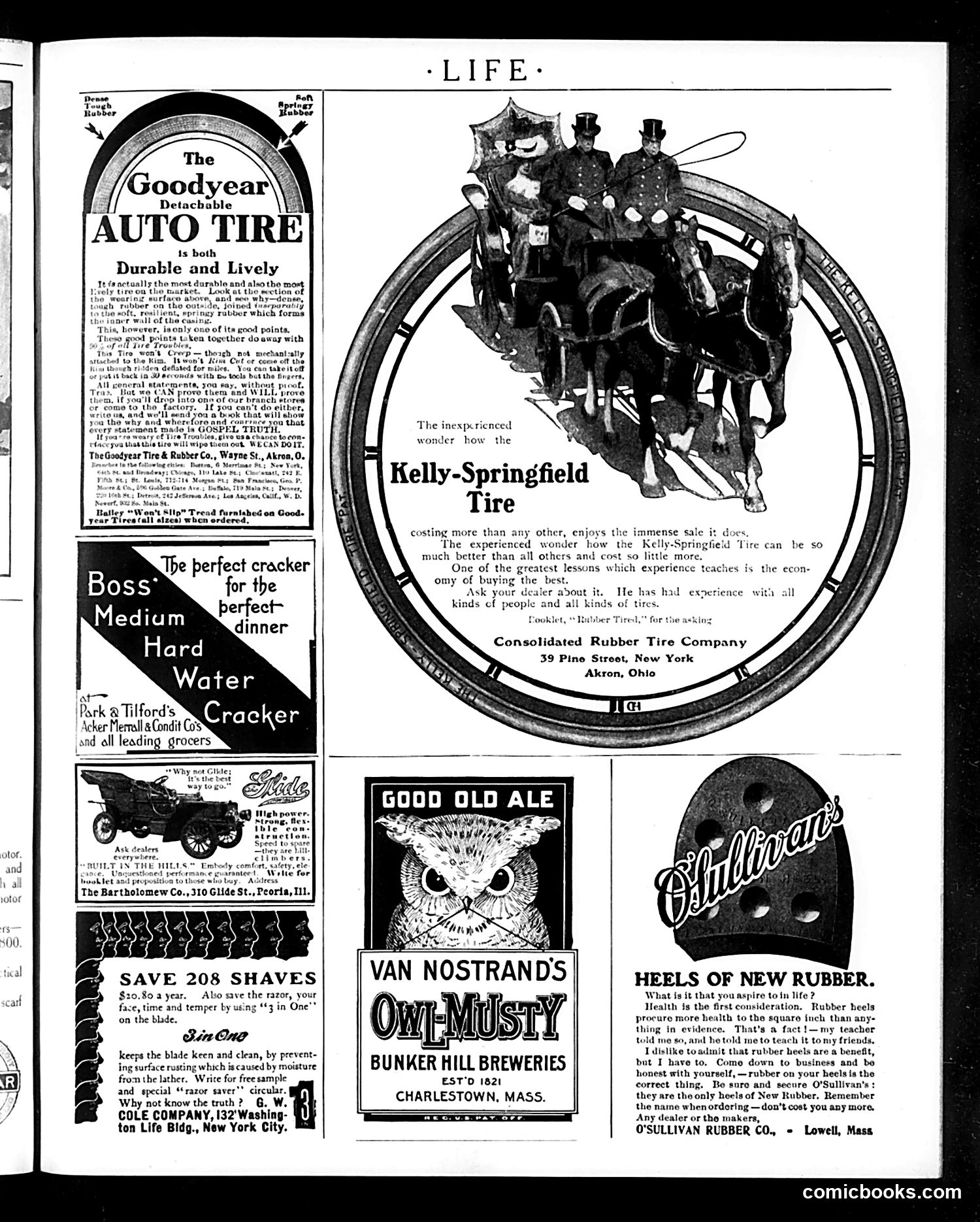
This page is **primarily advertising**, not political satire. The main content features four product advertisements typical of early 20th-century Life magazine: 1. **Goodyear Auto Tire** (upper left) — emphasizes durability and resilience 2. **Kelly-Springfield Tire** (large center image) — the central illustration shows well-dressed figures riding *inside* an enormous tire, humorously depicting the tire's quality and size 3. **Various minor ads** including Boss crackers, an automobile, and shaving products 4. **Alcohol ads** (Good Old Ale, Owl-Musty beer, O'Sullivan rubber heels) The Kelly-Springfield illustration is the page's only potentially humorous element — the absurd image of passengers traveling within the tire itself serves as visual advertising hyperbole rather than political commentary. No political figures or satirical content is evident here.
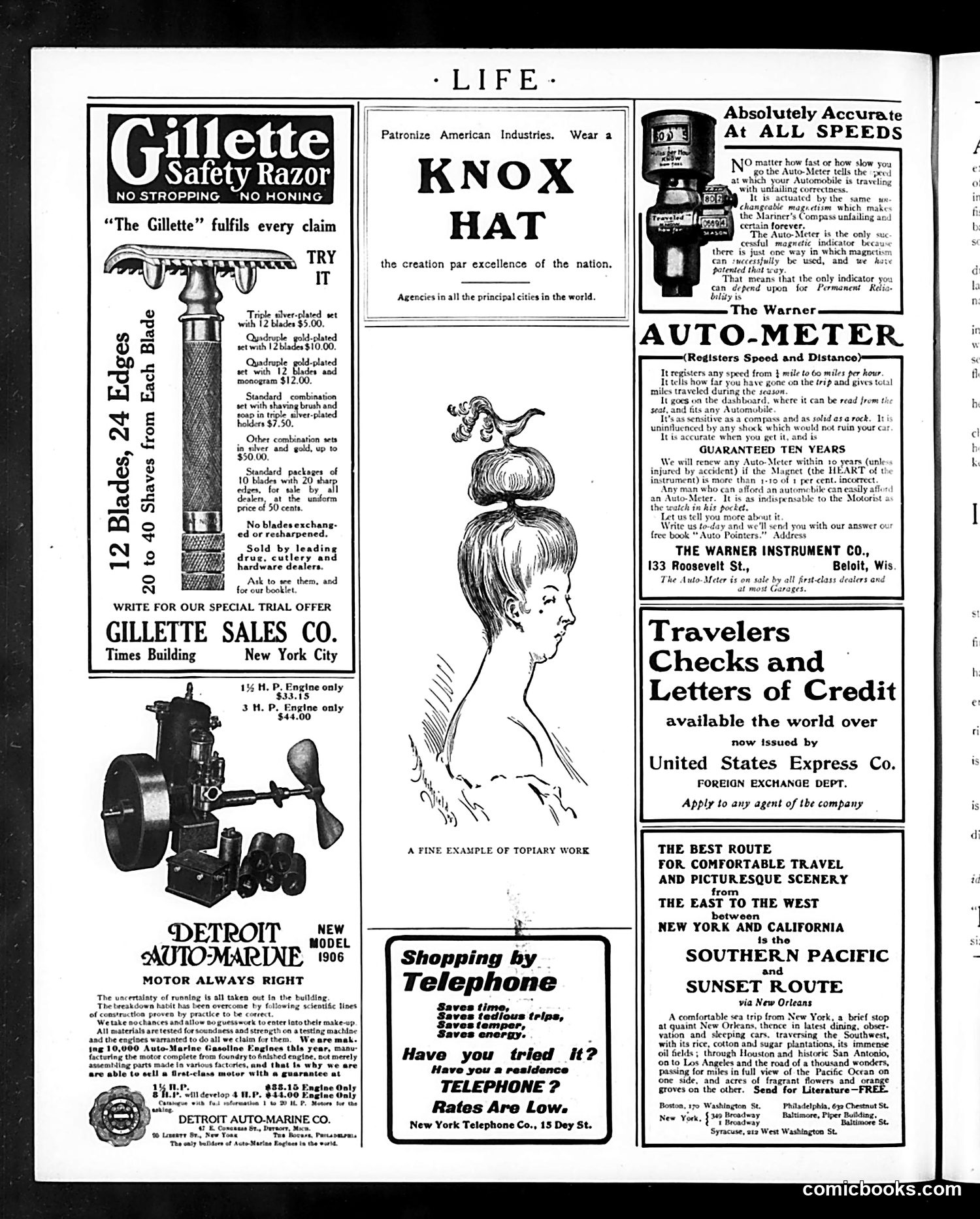
This page is **primarily advertising** rather than satirical content. It features commercial ads for consumer products popular in the early 1900s: Gillette Safety Razors, Knox Hats, Auto-Meter speedometers, Detroit Auto-Marine motors, United States Express traveler's checks, and telephone service. The only illustration with potential satirical intent is labeled "A Fine Example of Topiary Work"—a sketch of an elaborately styled woman's head/hair. This appears to mock exaggerated women's hairstyling fashions of the era, suggesting the coiffure is as artificially shaped and impractical as ornamental garden topiary. However, without additional context, the specific target remains unclear—it may simply be commenting on absurdly complex beauty standards rather than referencing a particular political or social event.
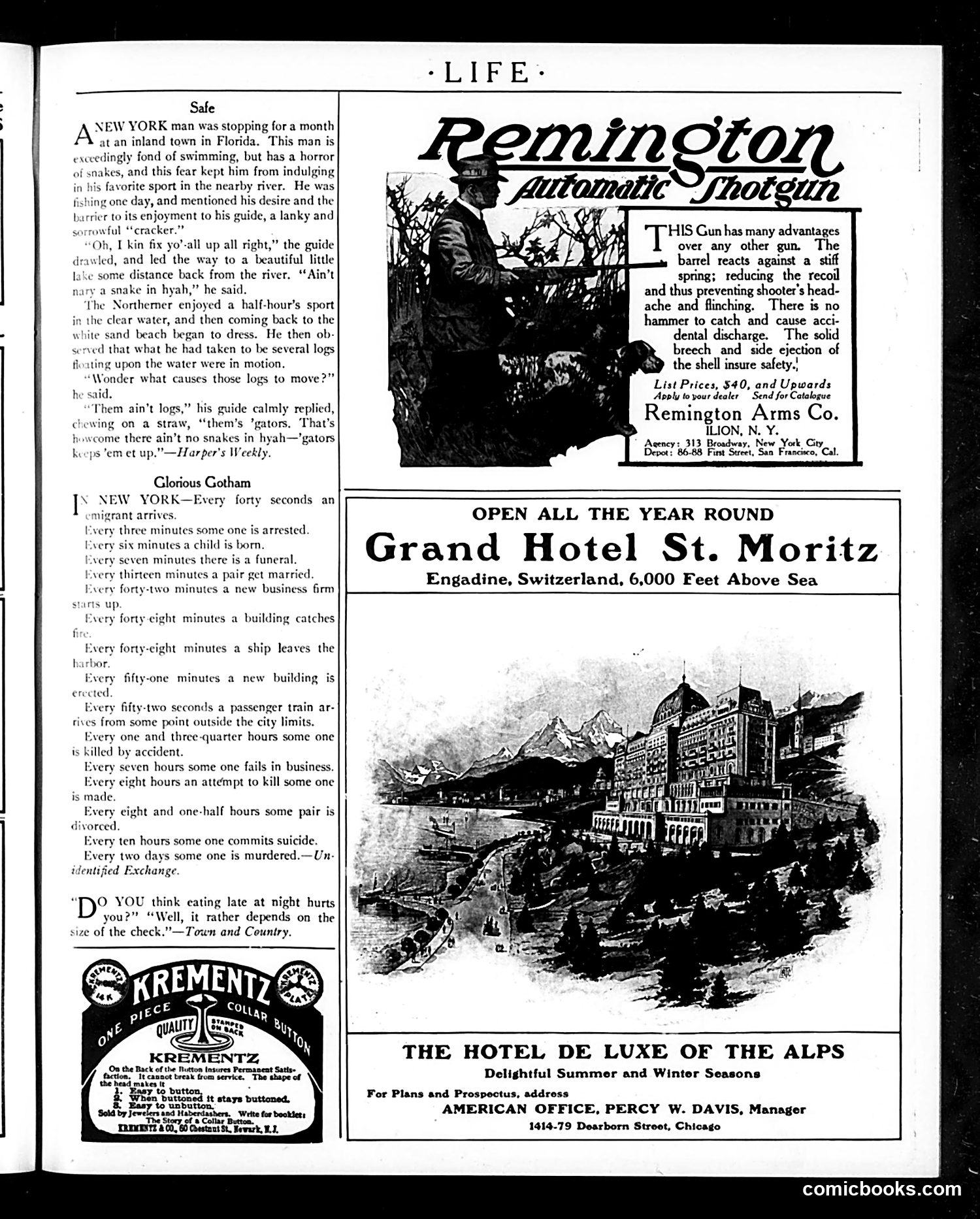
This page is primarily **advertising and miscellaneous content** rather than political satire or editorial cartooning. The left column contains anecdotal "Life" humor pieces about a New York man in Florida encountering snakes, and statistics about New York ("Glorious Gotham") listing rapid-fire facts about births, arrests, deaths, and accidents—typical of early 20th-century magazine filler meant to be humorous through sheer volume and absurdity. The right side features product advertisements: a Remington automatic shotgun and the Grand Hotel St. Moritz in Switzerland. A small Krementz jewelry ad appears at bottom left. **No discernible political cartoon or sustained satire is present.** The page reflects the magazine's mixed editorial-and-advertising format typical of the era.
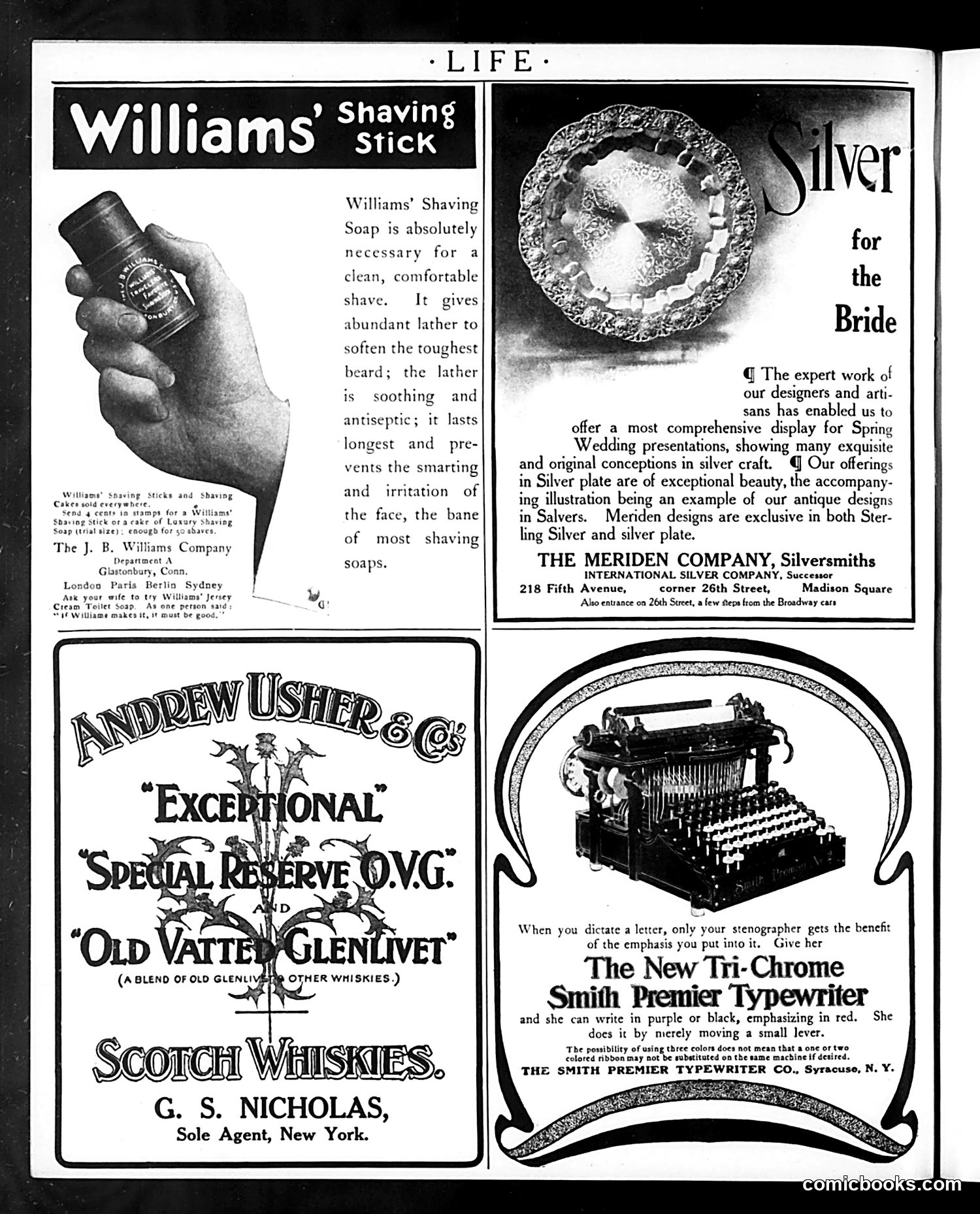
This page contains **four advertisements, not political cartoons or satire**. It appears to be from Life magazine's advertising section. The ads are: 1. **Williams' Shaving Stick** — promoting soap for comfortable shaving 2. **Meriden Company Silver** — advertising wedding gifts and silver plate items 3. **Andrew Usher & Co. Scotch Whiskies** — selling various whisky brands 4. **Smith Premier Typewriter** — promoting a tri-chrome typewriter that can write in multiple colors There is no satirical content or political commentary on this page. These are straightforward product advertisements typical of early-20th-century magazines, aimed at middle and upper-class consumers seeking luxury goods for personal grooming, home decoration, spirits, and office equipment.
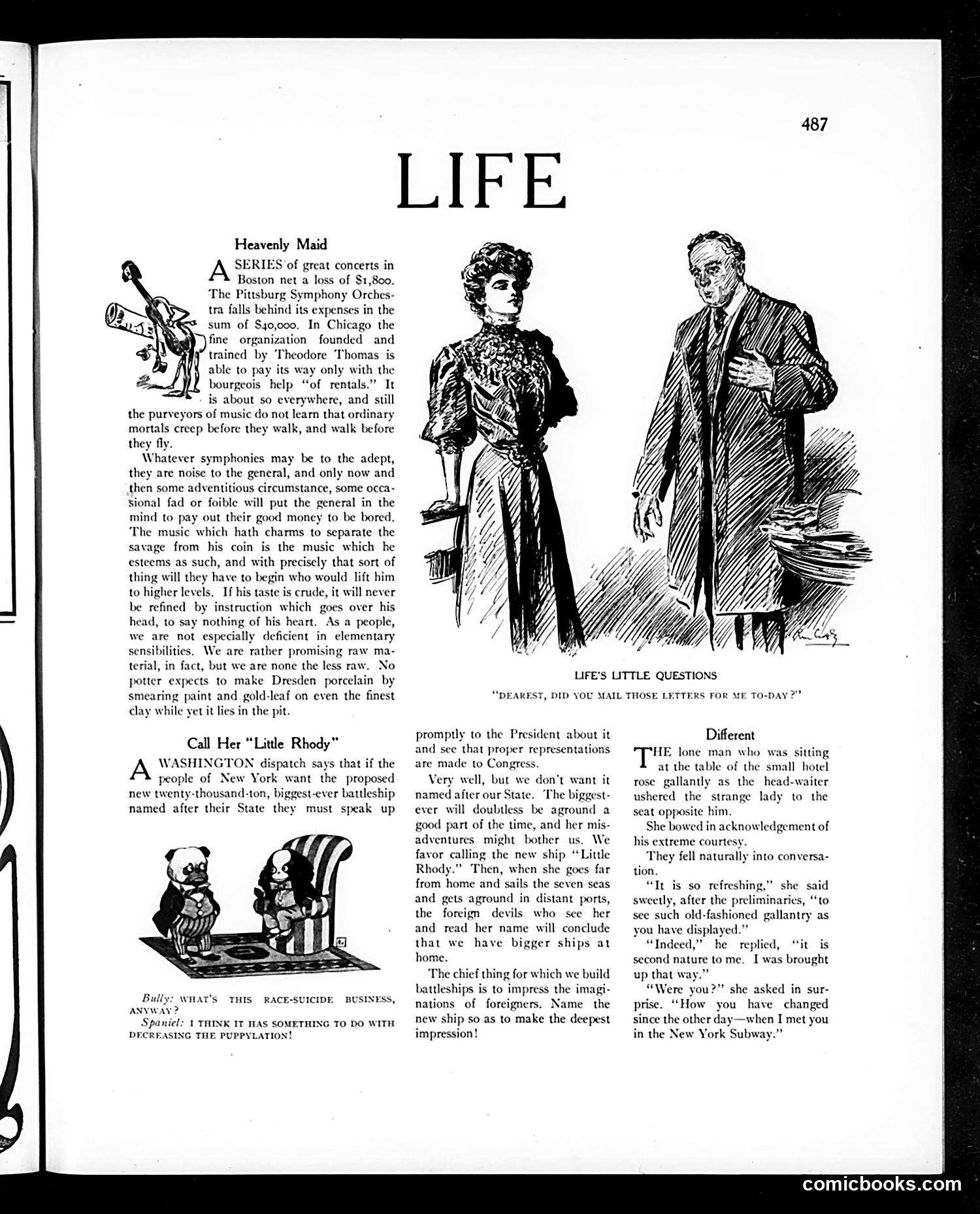
This page contains three separate humor pieces: 1. **"Heavenly Maid"** (top): A satirical essay criticizing orchestral concerts as culturally pretentious but financially necessary for cities. The author argues symphonies bore general audiences yet remain status symbols. 2. **"Call Her 'Little Rhody'"** (middle): A political cartoon about a proposed Navy battleship named after Rhode Island. The accompanying dialogue jokes about the ship's name impressing foreign powers and representing American naval strength. 3. **"Different"** (bottom right): A brief comedic vignette where a man compliments a woman's changed demeanor, attributing it to her recent New York subway experience—satirizing the transformative (or corrupting) effect of urban life. The cartoons employ typical early-20th-century Life magazine humor: social commentary mixed with light domestic comedy.
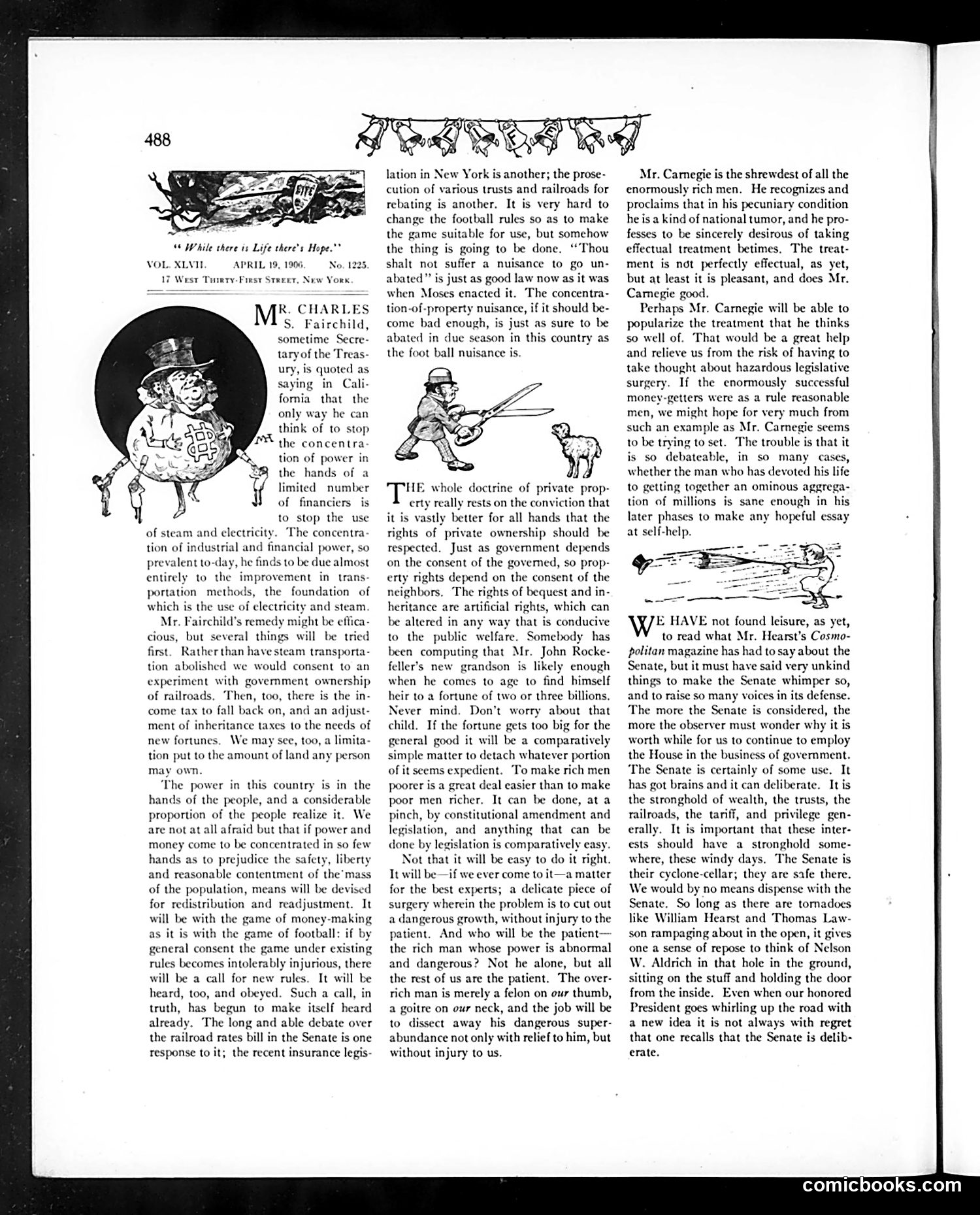
This Life magazine page (April 19, 1906) contains editorial commentary on wealth concentration and monopolies. The main illustration depicts **Mr. Charles Fairchild**, identified in the text as "sometime Secretary of the Treasury," shown as a figure manipulating industrial/financial power symbols. The article critiques the concentration of wealth in few hands, specifically discussing **John D. Rockefeller** and **Andrew Carnegie**. The satire targets these industrialists' vast fortunes and questions whether their philanthropic efforts (Carnegie's treatment of workers) adequately address the systemic inequality they've created. The piece also comments on **Senate debates over railroad regulation and tariffs**, suggesting the Senate's deliberations appear ineffective against entrenched monopolistic power—comparing it to weak responses to dangerous situations.
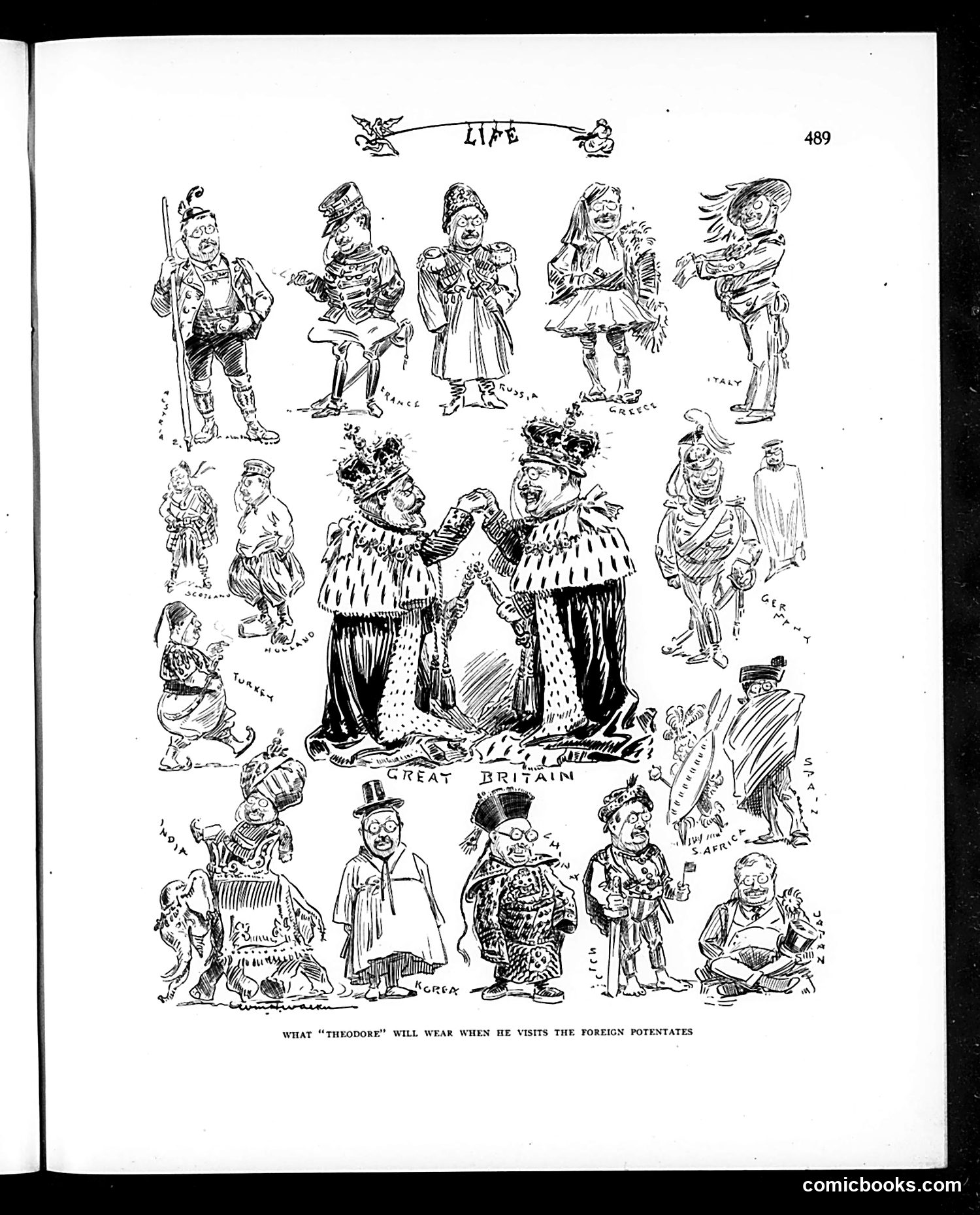
This satirical cartoon titled "What 'Theodore' Will Wear When He Visits the Foreign Potentates" depicts a central figure labeled "Great Britain" surrounded by various national personifications in elaborate costumes and regalia. The cartoon appears to mock diplomatic protocol and ceremonial dress, showing how a representative (likely President Theodore Roosevelt, referenced as "Theodore") would need to adopt different formal attire when visiting various foreign powers. The surrounding figures are labeled with country names (Italy, Greece, Turkey, France, Germany, and others visible in the sketch), each drawn in exaggerated period costume and caricatured style typical of early 20th-century satirical illustration. The humor derives from the absurdity of constantly changing formal dress codes during international diplomatic visits.
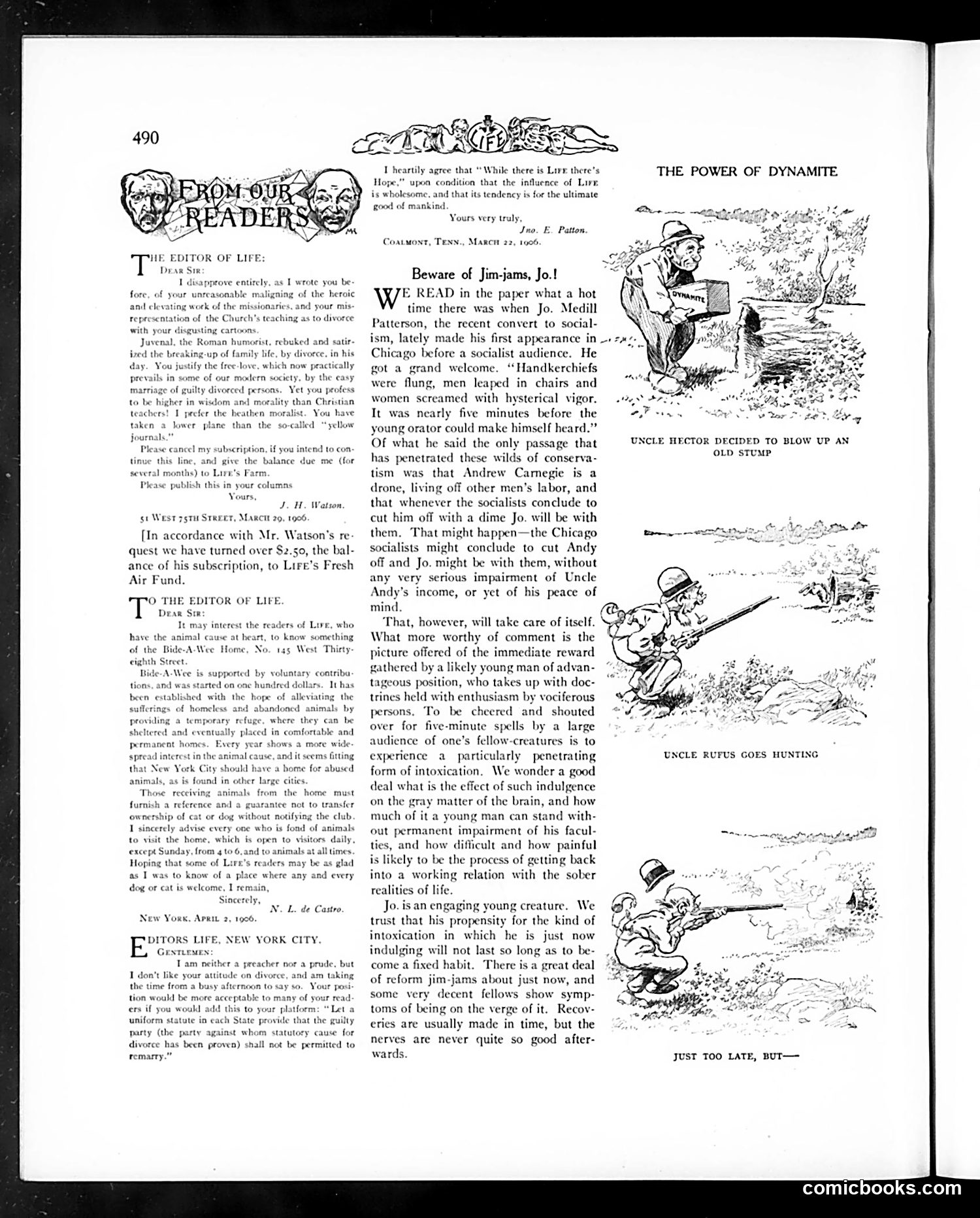
This page features a satirical story and illustrations titled "The Power of Dynamite," depicting "Uncle Hector" attempting to destroy an old tree stump using explosives. The cartoons show the humorous misadventures of this character as his plan backfires. The left column contains readers' letters responding to previous Life content, including commentary on socialism and Jo. Medill Brown, described as a recent convert to socialism who spoke to Chicago audiences. One letter criticizes the "jim-jams" (nervous effects) of such radical ideology. The cartoons appear to use the stump-blasting scenario as light satirical commentary on radical movements and their uncertain consequences, typical of Life's political humor from this era.
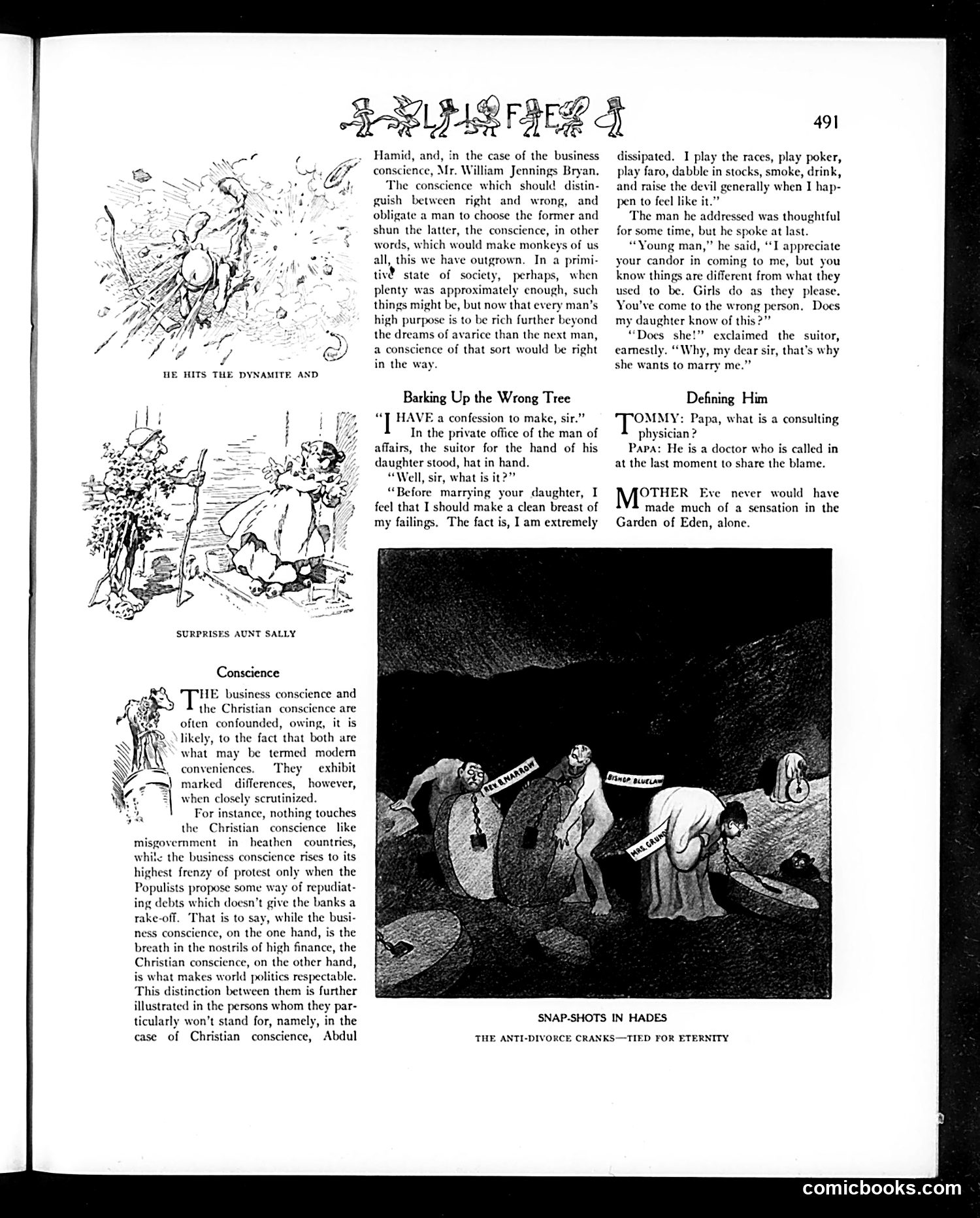
This page contains satirical commentary on morality and conscience rather than a specific political cartoon. The visible illustration labeled "SNAP-SHOTS IN HADES: THE ANTI-DIVORCE CRANKS—TIED FOR ETERNITY" depicts figures in the underworld bound together, apparently satirizing anti-divorce advocates. The text sections discuss business conscience versus Christian conscience, using the example of a suitor confessing his failures to a prospective father-in-law. Other brief pieces ("Young Man," "Tommy: Papa, what is a consulting physician?") appear to be humorous dialogue snippets. The overall theme critiques hypocrisy: those who preach strict moral positions (like opposing divorce) while engaging in questionable behavior themselves. The underworld imagery suggests divine judgment on such inconsistency.
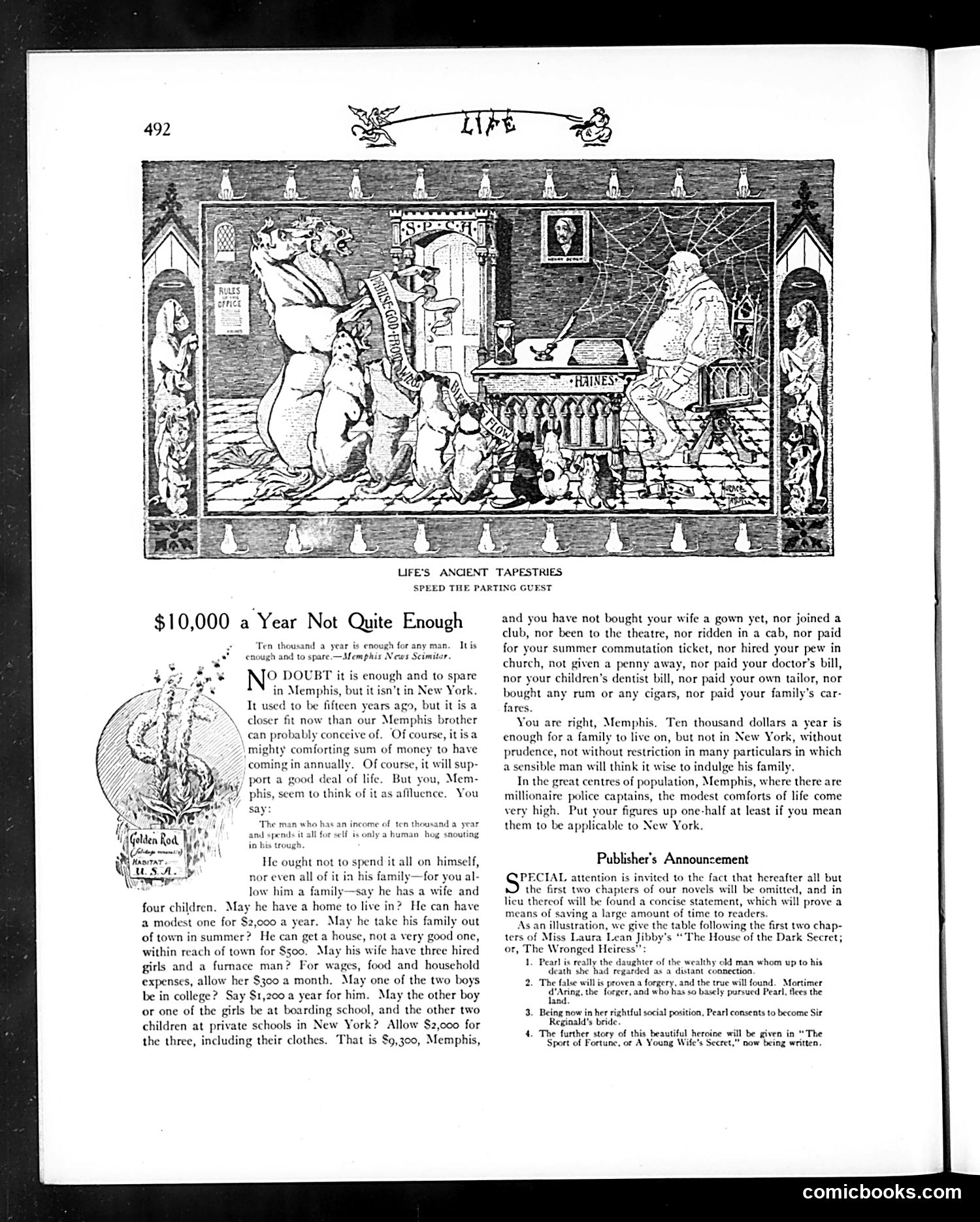
**The Tapestry Image:** This medieval-style woodcut depicts "Life's Ancient Tapestries: Speed the Parting Guest"—a humorous historical reference showing anthropomorphic animals (rats, possibly) being ushered out of a castle, likely satirizing formal farewells or overstaying visitors. **Main Article:** "$10,000 a Year Not Quite Enough" discusses whether this income is adequate for a family in New York. The article mocks Memphis residents' claim that $10,000 annually suffices, arguing that New York's costs—housing, children's education, entertainment, transportation—make this insufficient in the metropolis, even if livable elsewhere. **Publisher's Announcement:** Notes forthcoming concise plot summaries for serialized fiction, to save readers' time. The overall page satirizes regional economic differences and urban versus provincial living costs.
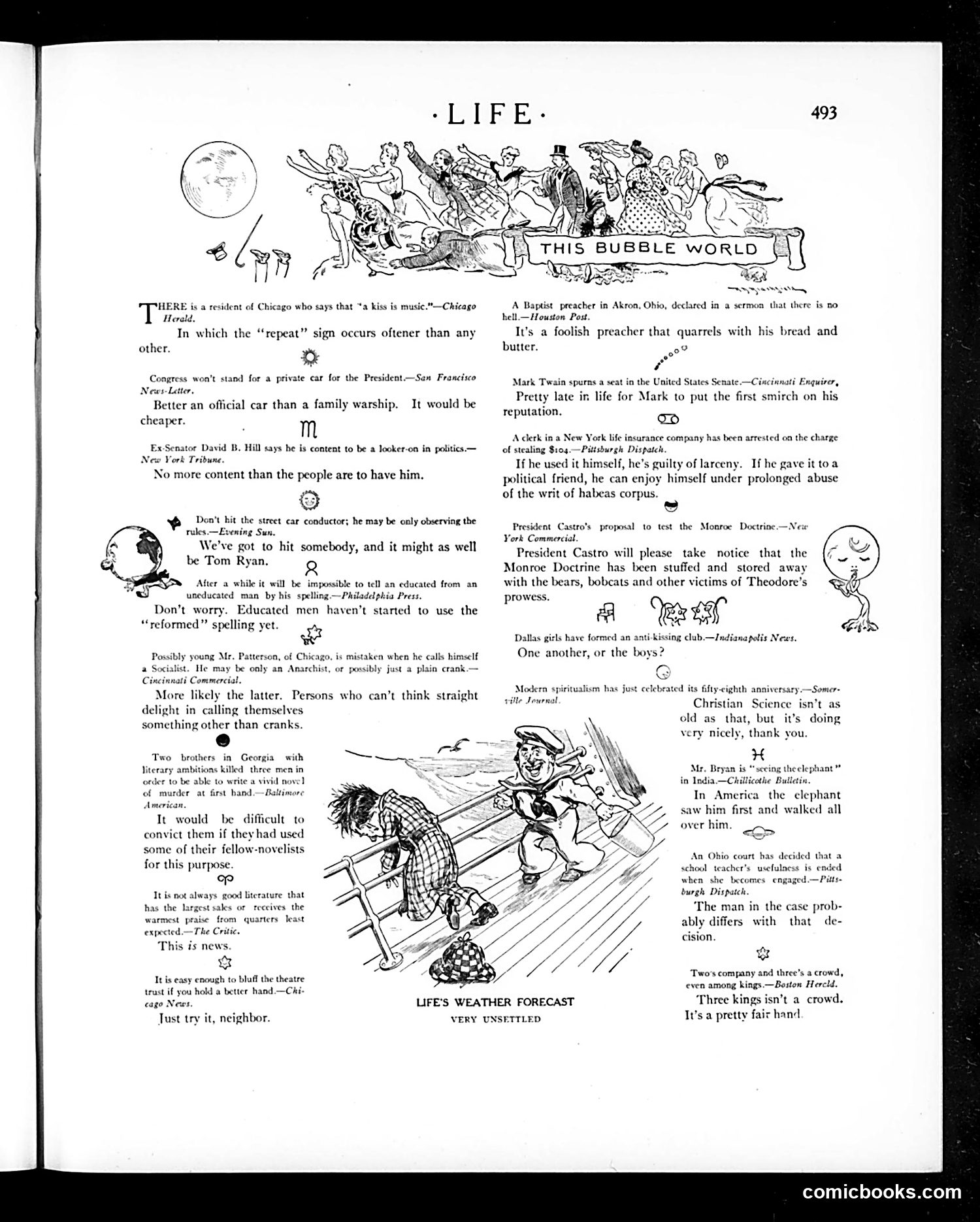
This page features satirical commentary and a central cartoon labeled "Life's Weather Forecast: Very Unsettled." The main illustration depicts figures being blown about chaotically, suggesting political or social turbulence of the era. The text snippets mock various contemporary figures and situations: a Chicago resident's claim that "a kiss is music," concerns about presidential transportation, Senator David B. Hill's political positioning, and references to Mark Twain, President Castro, and the Monroe Doctrine. The scattered quips target politicians' hypocrisy, public figures' pretensions, and social absurdities. The "unsettled weather" metaphor appears to comment on the unstable political climate, with the swirling composition visually reinforcing this sense of chaos and unpredictability in American public life.
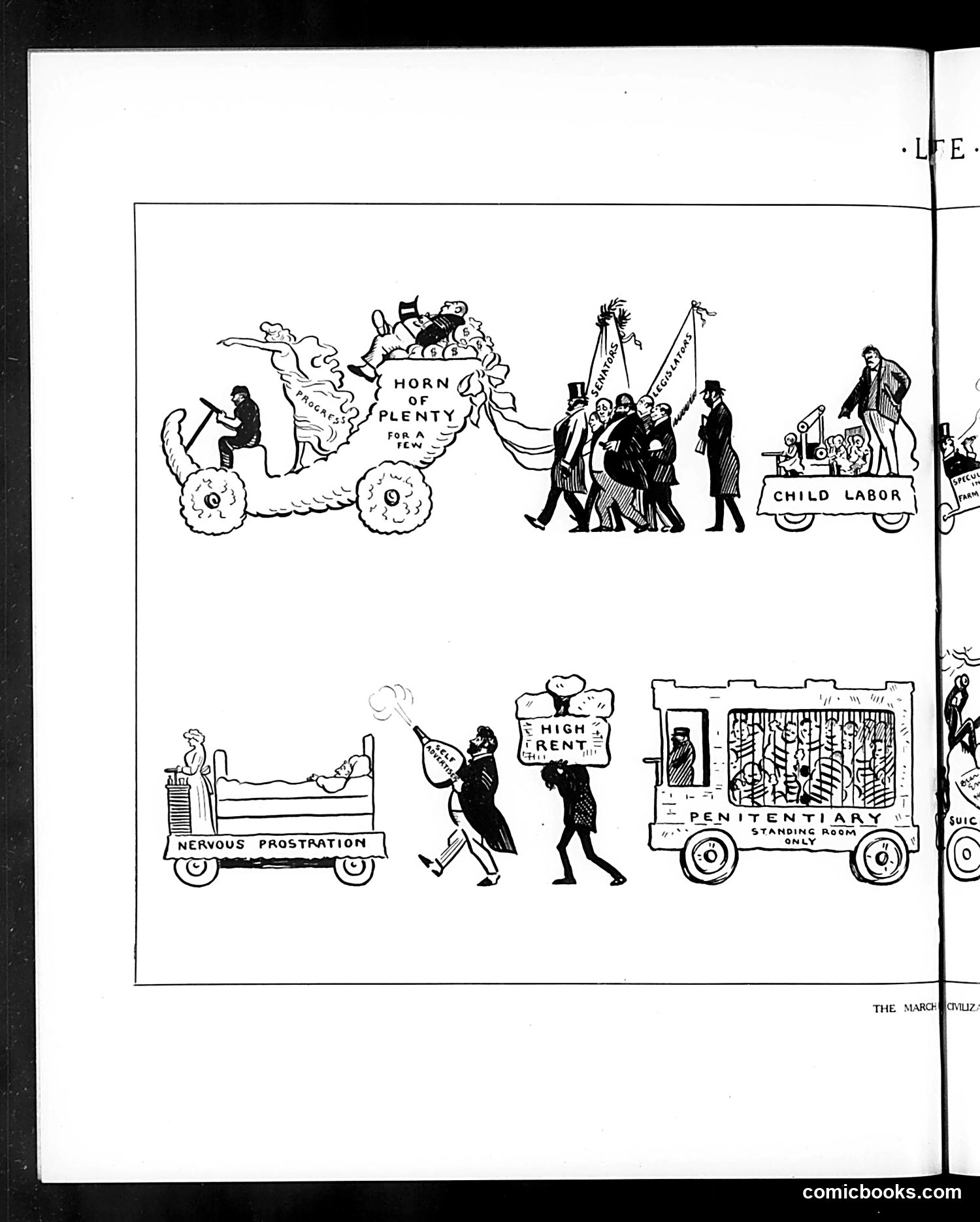
This appears to be a satirical parade or procession cartoon showing various social ills as carnival floats. The visible labeled entries include: - **"Horn of Plenty"** — depicting prosperity or wealth distribution - **"Child Labor"** — workers pulling a cart with children - **"Nervous Prostration"** — a person in bed on wheels - **"High Rent"** — figures struggling with housing costs - **"Penitentiary"** — a prison wagon The cartoon critiques Progressive Era social problems through the metaphor of a parade, suggesting these issues are paraded through society as accepted spectacles rather than addressed seriously. The OCR text "March Civilization" (partially visible) reinforces the ironic title—this is mock progress. The satire targets the gap between claimed American prosperity and the actual suffering of workers, the poor, and imprisoned individuals visible in industrial society.
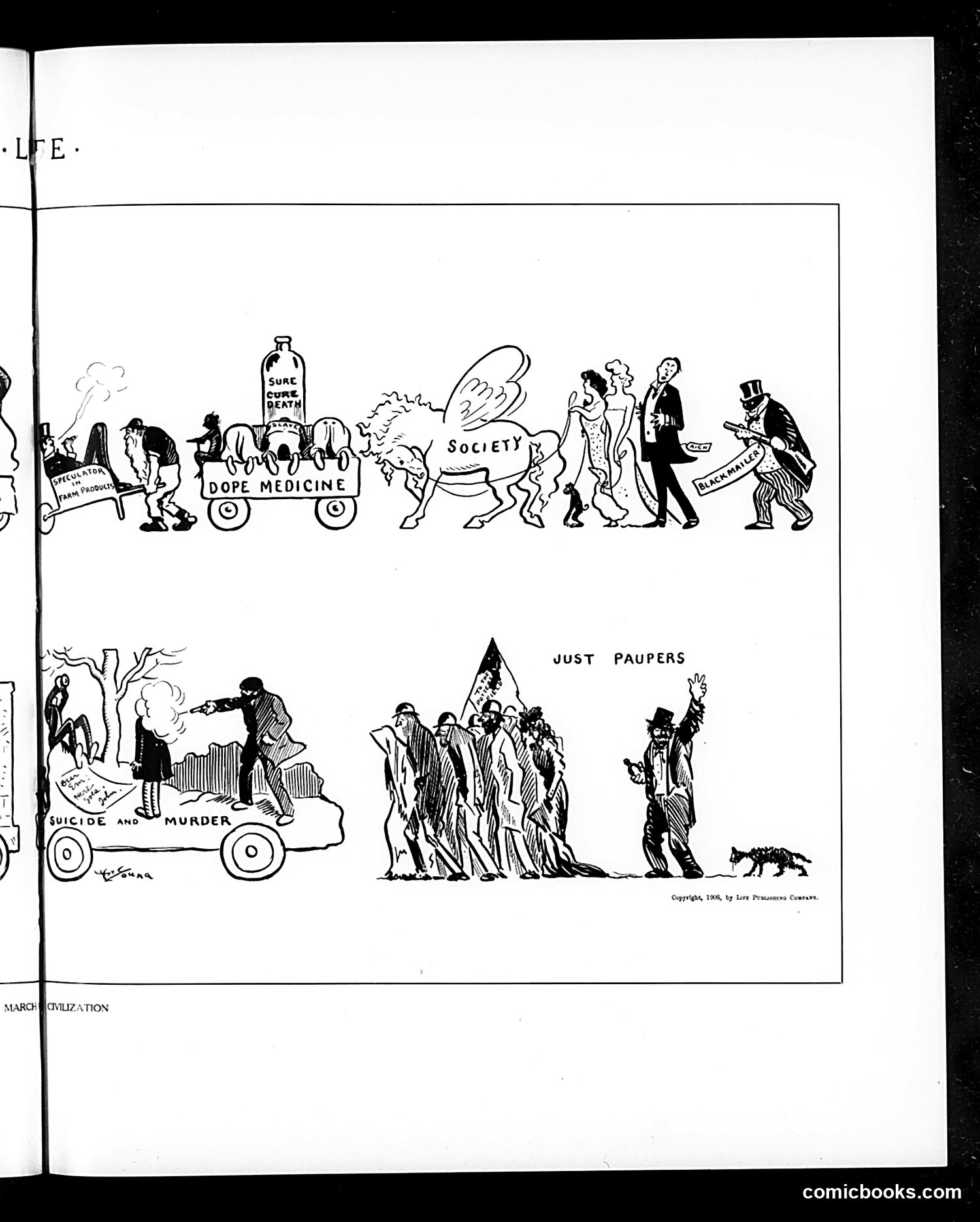
This satirical cartoon depicts a procession labeled "Society" as a grotesque parade of social ills. The top panel shows "Dope Medicine" and "Society" being pulled by what appears to be a donkey, followed by figures representing various vices—likely including blackmail and other corruptions. The bottom panels are more explicit: "Suicide and Murder" travels in its own cart, while "Just Paupers" depicts impoverished masses gathered beneath a flag. A skeletal figure with a rat appears to represent death or despair. The overall message critiques early 20th-century American "civilization" as fundamentally corrupt, driven by drug trafficking, crime, wealth inequality, and moral decay rather than genuine progress. The cartoon sardonically suggests society's proclaimed advancement masks systemic social pathology and human suffering.
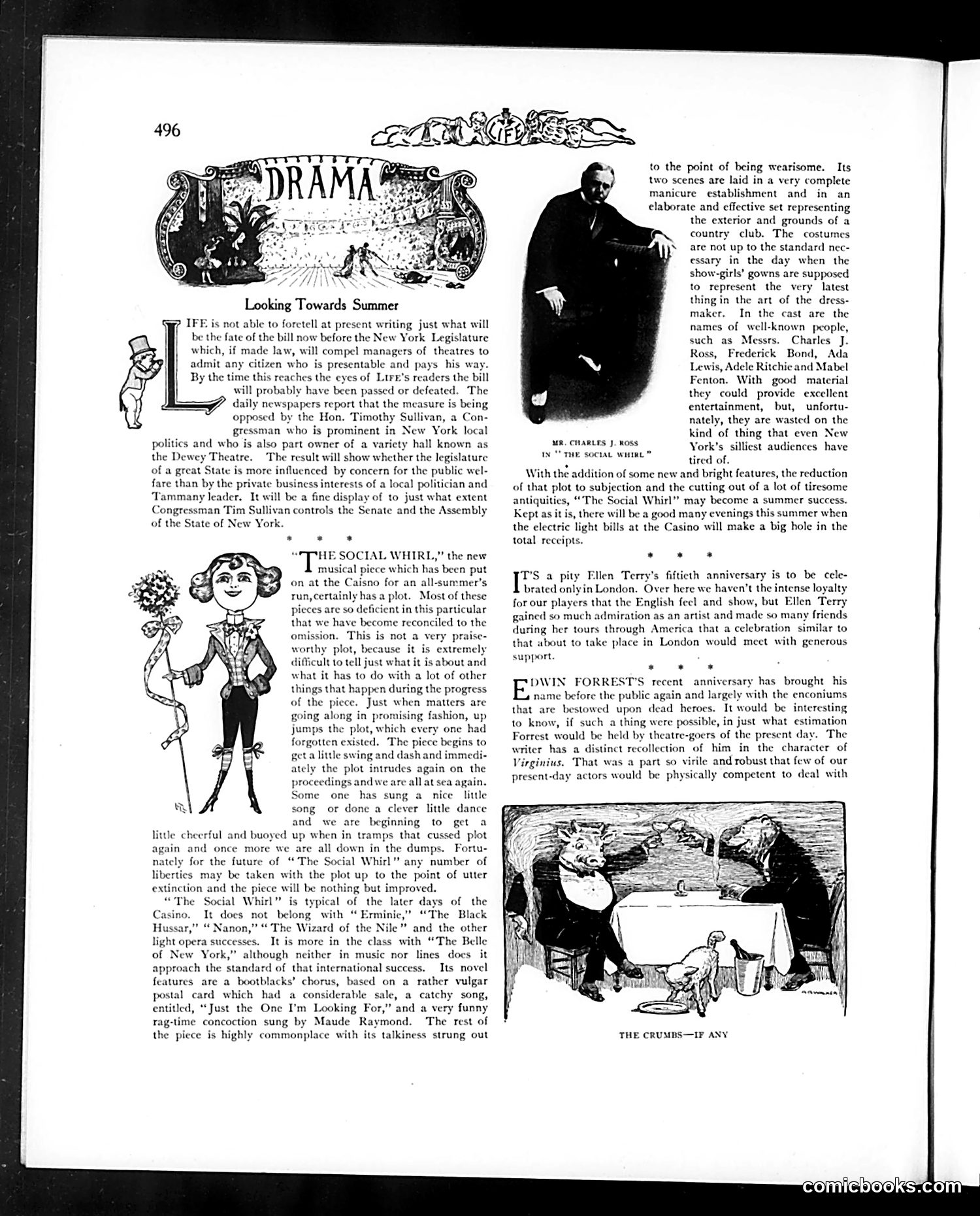
This page discusses two theatrical topics of early 1900s New York. **"Looking Towards Summer"** addresses a bill before the New York Legislature requiring theaters to admit any "presentable" paying citizen. The piece uses this to critique Congressman Tim Sullivan, who owns the Dewey Theatre and opposes the measure—testing whether state legislators serve public welfare or private business interests of Tammany Hall politicians. **"The Social Whirl"** reviews a new musical at the Casino theater, criticizing it as typical of the venue's decline. The plot is described as confusing and intrusive, repeatedly interrupting musical numbers. The review notes the cast includes respected performers (Charles J. Ross, Frederick Bond, Adele Ritchie, Mabel Fenton) but complains they're wasted on mediocre material, inferior to the Casino's earlier successes. The satire suggests even New York's "silliest audiences" have tired of such productions.
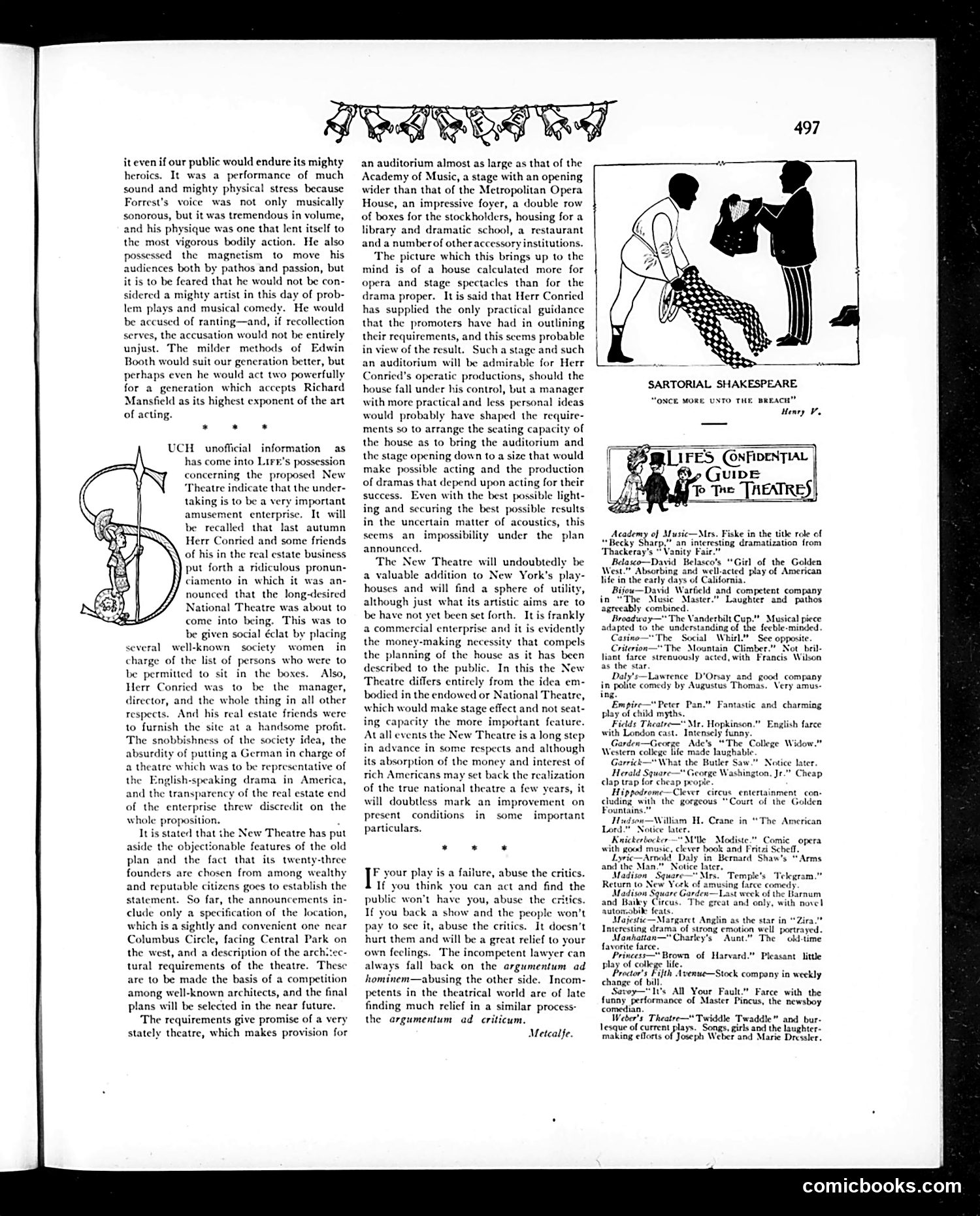
This cartoon satirizes a contemporary theatrical scandal. The image shows a man in exaggerated checkered pants being corrected by a woman—likely depicting criticism of an actor's inappropriate costume choices for a Shakespeare production ("once more unto the breach," from *Henry V*). The accompanying text discusses the proposed **New Theatre** in New York—an ambitious national theatre project. The satire targets its original plan, which the author mocks as absurdly managed by a German (Herr Conried) to represent English-speaking drama, with society women controlling box seating for snobbish reasons. The revised proposal, while improved, still seems designed more for opera spectacle than genuine drama. The cartoon likely ridicules either an actual production's costume disaster or theatrical pretension generally—emphasizing that legitimate Shakespeare performance requires more than visual spectacle or society patronage.
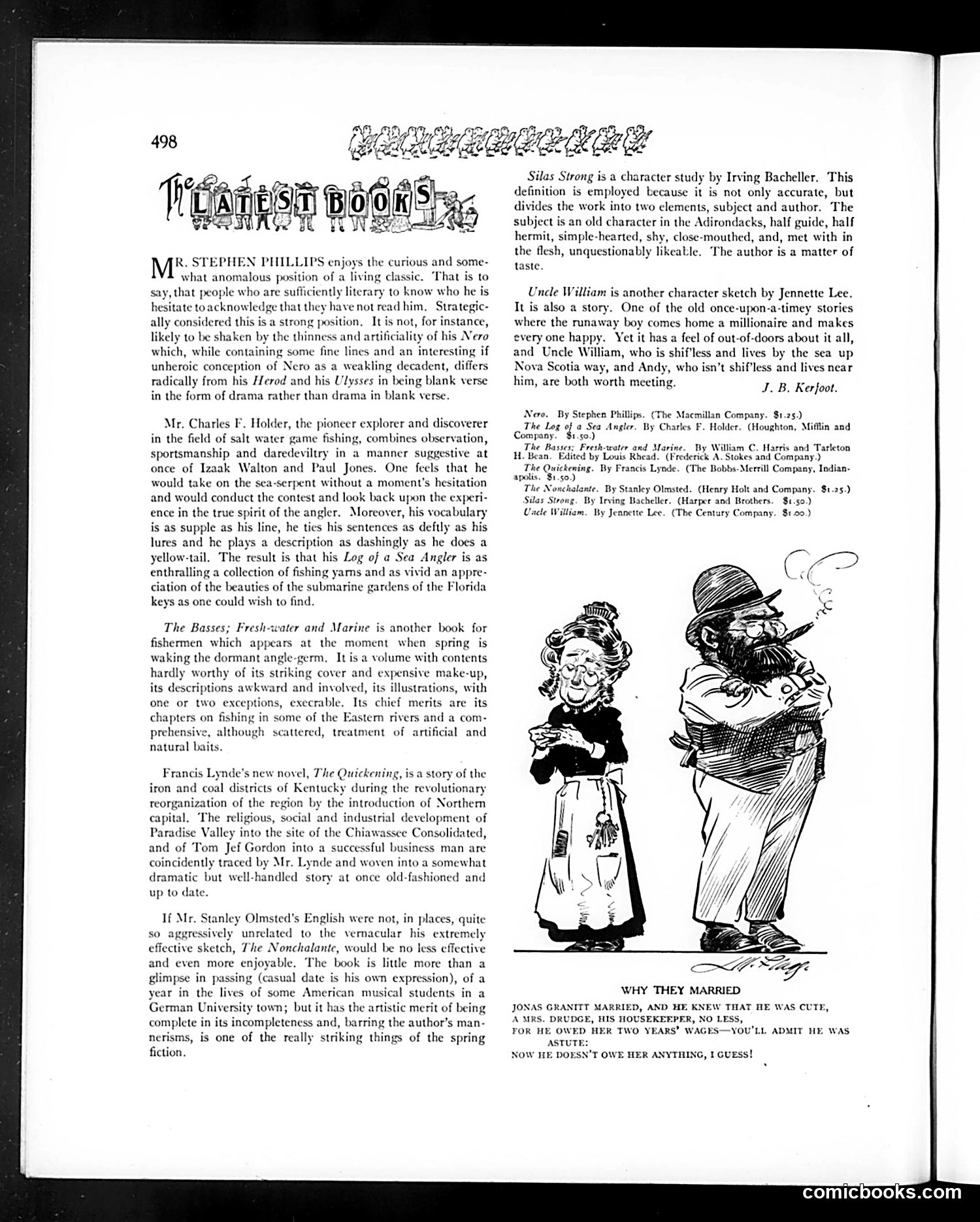
This page from *Life* magazine is primarily a **book review section**, not political satire. It discusses several newly published novels and non-fiction works, including titles about fishing (*Log of a Sea Angler*), Kentucky industrial development (*The Quickening*), and character studies (*Silas Strong*, *Uncle William*). The single illustration—labeled "WHY THEY MARRIED"—is a humorous cartoon showing two elderly people (a woman and man in old-fashioned dress). The caption explains the joke: she was cute and he owed her two years' wages, so he couldn't refuse; now he "doesn't owe her anything, I guess!" **The satire here is domestic/social**, not political: it mocks the financial desperation and transactional nature of marriage, particularly how a man might marry a woman primarily due to debt obligation. The cartoon reflects early 20th-century attitudes about gender, class, and marriage as economic arrangement.
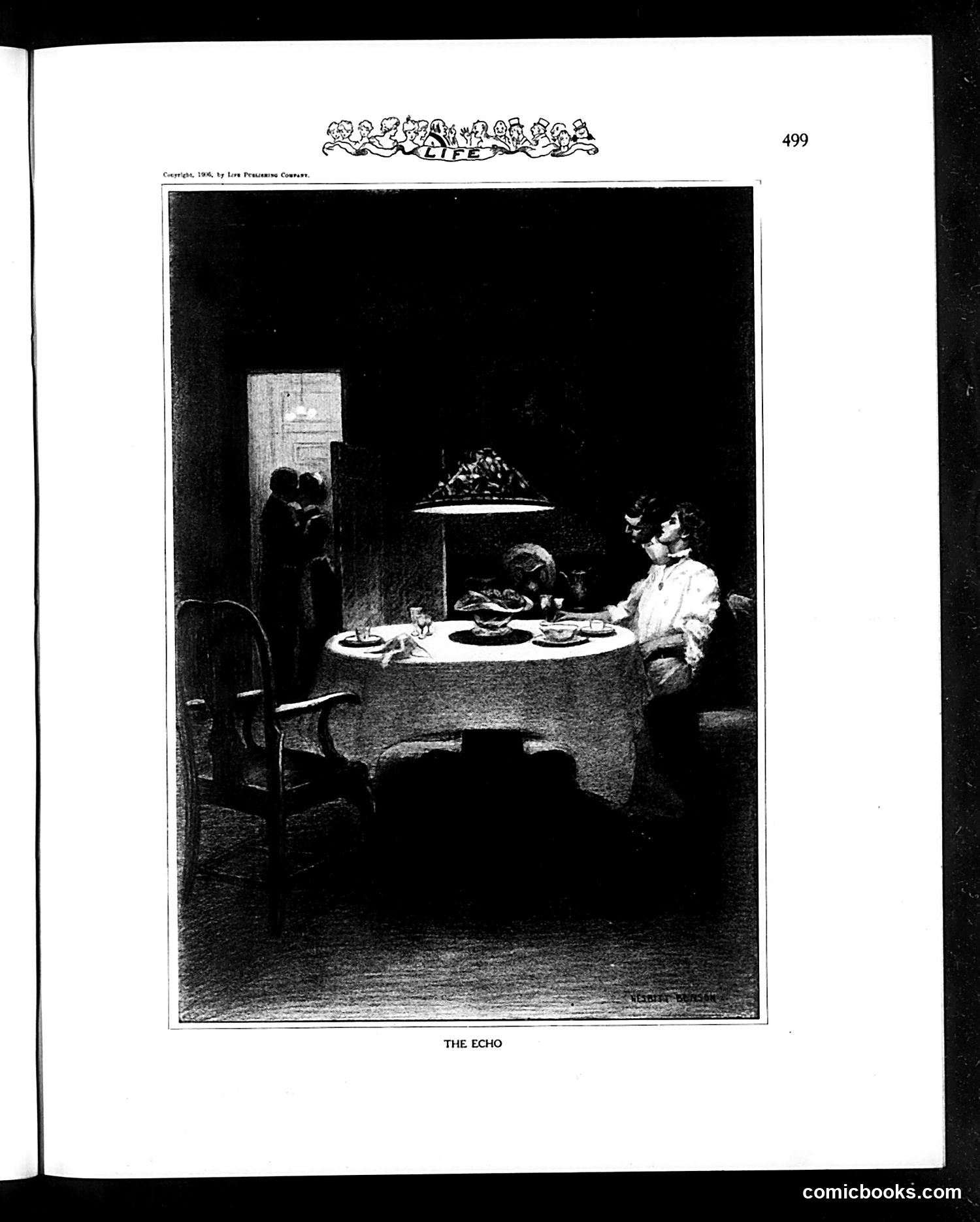
This appears to be a domestic scene satirizing social pretension or marital dynamics. A woman sits at a dining table while a man stands in a doorway in the background. The room is dimly lit and appears modest. The title "The Echo" suggests the cartoon's point: likely that the woman is merely echoing or parroting her husband's words, opinions, or behaviors—a common satirical trope about wives lacking independent thought in early 20th-century American humor. The formal dining setup and the woman's attentive posture toward the doorway reinforce this dynamic. Without additional context or the cartoonist's name clearly visible, the specific social commentary remains somewhat unclear, though it likely comments on gender roles and marital relationships typical of Life magazine's satire.
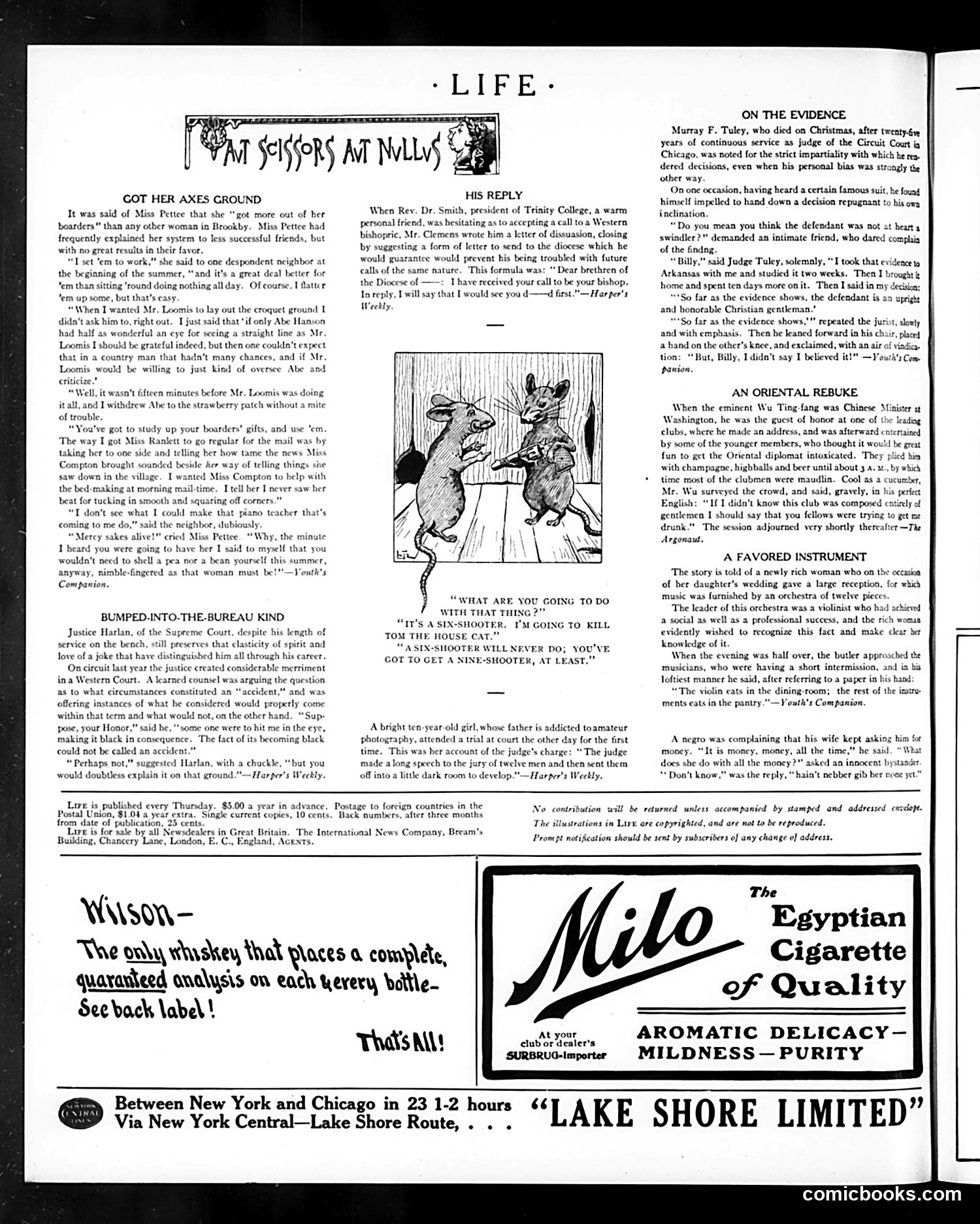
This page contains three satirical pieces typical of *Life* magazine's early 20th-century humor. **Main cartoon ("Scissors at Nully")**: Shows a woman manipulating boarders through reverse psychology—praising others' skills to provoke competitive action. Miss Pettee gets free labor (croquet layout, mail delivery, piano teaching) by flattering rivals instead of asking directly. The satire targets both her shrewd manipulation and the vanity of her marks who fall for transparent compliments. **"Bumped-Into-the-Bureau Kind"**: Anecdote about Justice Harlan's wit. A lawyer argues that a black eye from being hit isn't an "accident." Harlan jokes it would be an "accident" only in explanation—mocking the lawyer's circular reasoning about legal definitions. **Other sections**: Include brief anecdotes about Judge Tukey and Oriental diplomacy, plus advertisements (Wilson whiskey, Milo cigarettes, Lake Shore Limited train). The humor relies on American middle-class domestic scenarios and legal/political figures recognizable to period readers.
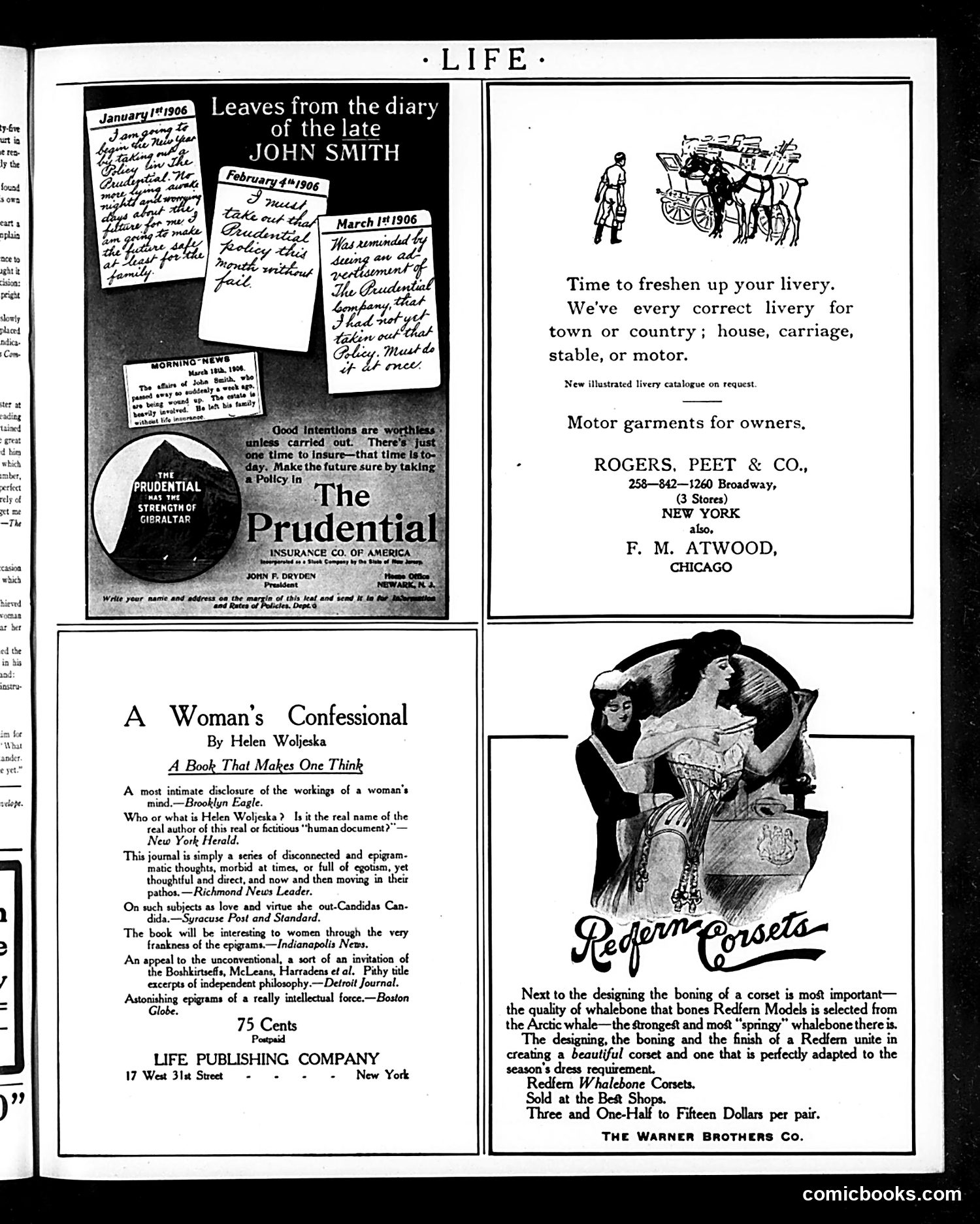
This page is primarily **advertising**, not political satire. The content includes: **Top left**: "Leaves from the diary of the late John Smith"—a humorous fake diary entry (dated January-March 1906) mocking mundane personal observations, paired with a **Prudential Insurance ad** emphasizing that good intentions require timely insurance. **Top right**: A livery service advertisement (Rogers, Peet & Co.) offering horses, carriages, and motor vehicles for urban/country use. **Bottom left**: A book advertisement for *A Woman's Confessional* by Helen Woljeska—presented as an intimate, philosophical work for women readers. **Bottom right**: A **Redfern Corsets advertisement** emphasizing whalebone quality and proper boning as essential to fashionable dress. The page reflects **early 1900s consumer culture**: insurance, transportation services, intellectual literature marketed to women, and fashion. The "John Smith" diary appears to be gentle satire of everyday life's trivialities.
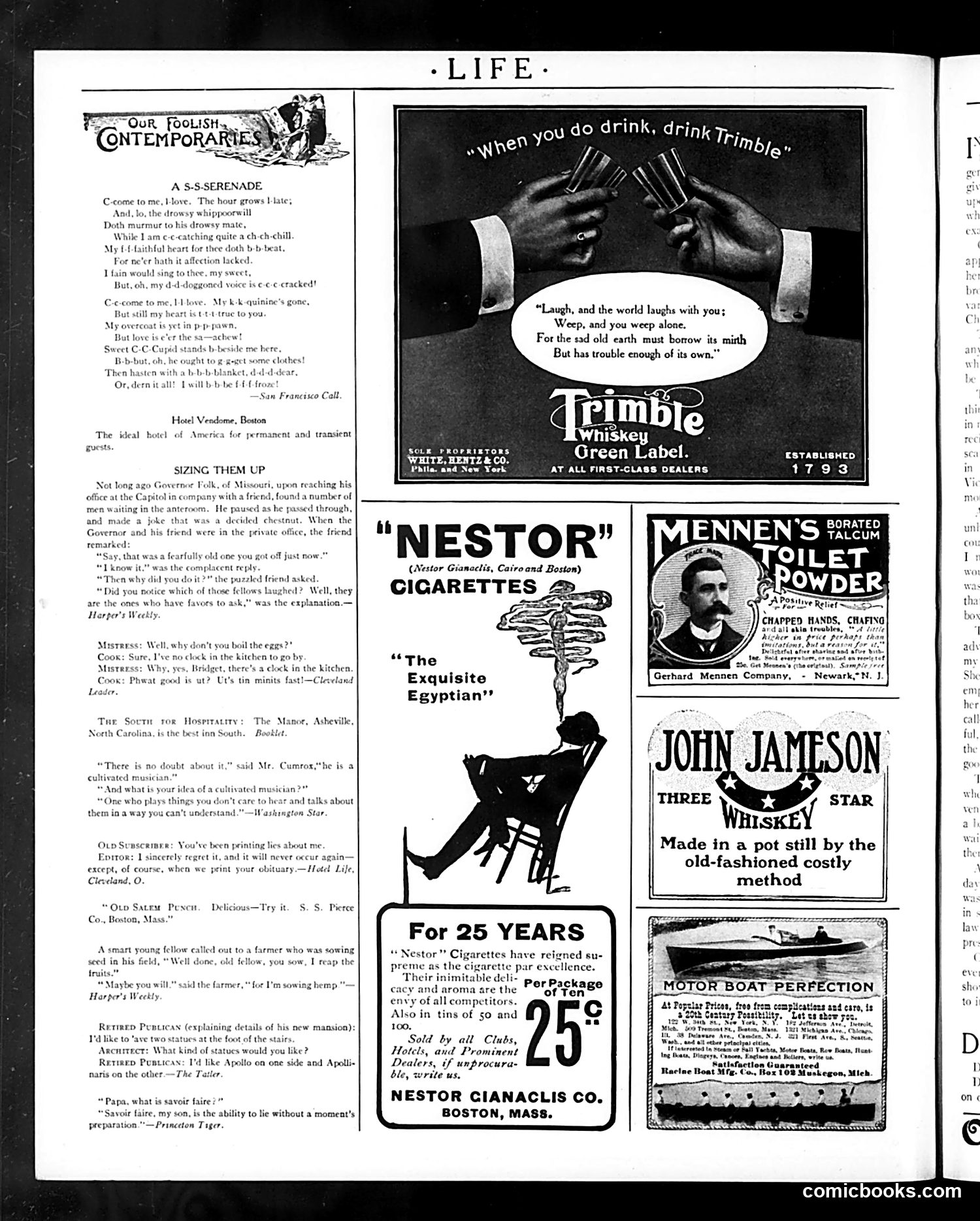
This page is primarily **advertising** mixed with short humorous sketches ("Our Foolish Contemporaries"). The cartoons and jokes are generic period humor rather than political satire. The sketches mock everyday situations: a man with a stammering voice trying to serenade someone, Governor Folk of Missouri being complimented on a stale joke, a cook's logic about boiling eggs, and a "nouveau riche" character wanting Apollo statues but mispronouncing "Apollinaris" (mineral water). The advertisements dominate—Trimble Whiskey (with a quote about laughing while the world suffers), Nestor Egyptian Cigarettes, Mennen's Talcum Powder, John Jameson Three Star Whiskey, and Motor Boat Perfection equipment. These ads are period pieces reflecting early 1900s consumer culture, with no satirical intent beyond typical advertising rhetoric. The page represents Life's dual nature: part satirical magazine, part high-end advertising vehicle for luxury goods.
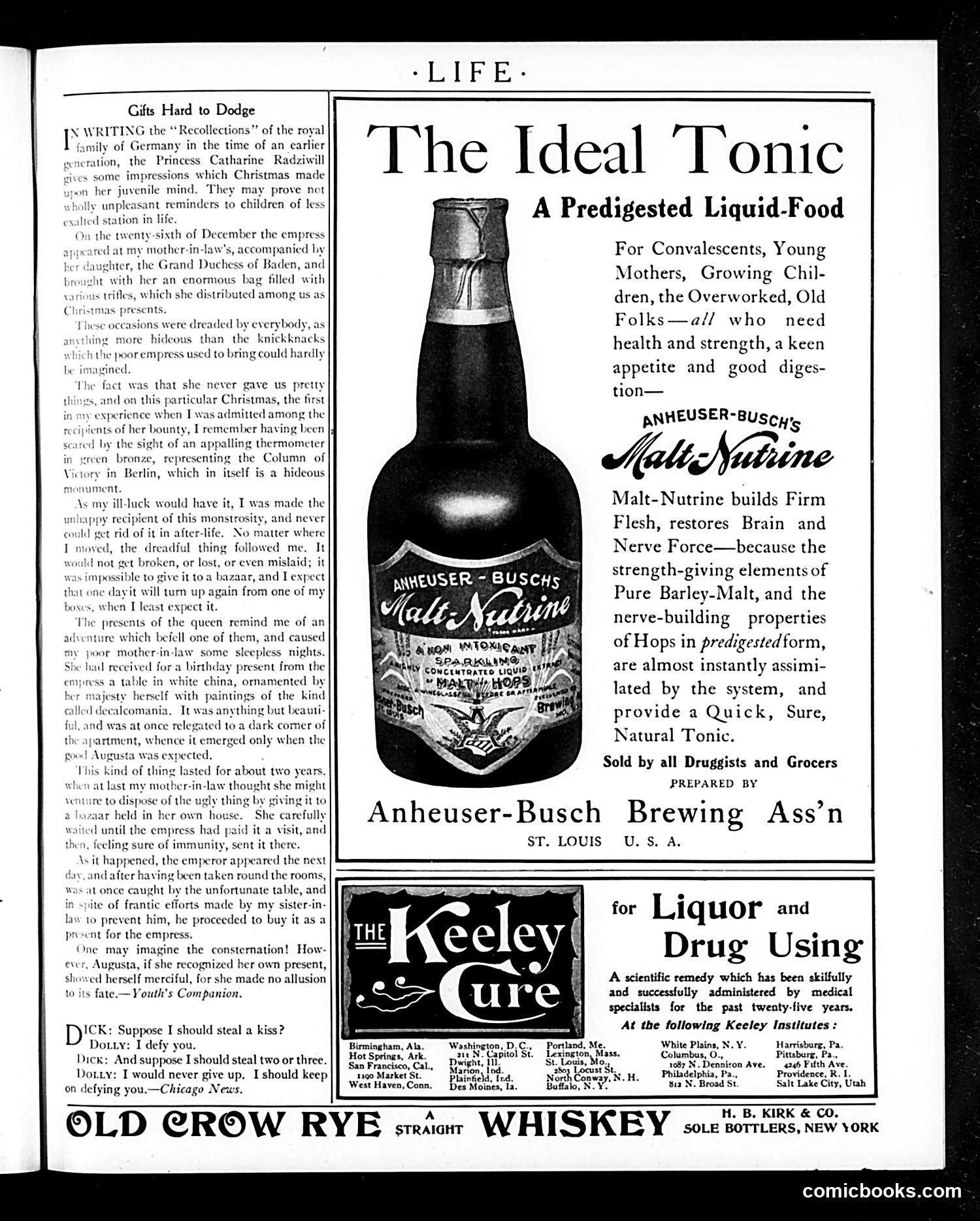
This page contains minimal cartooning. It's primarily a miscellany of advertisements and short humorous pieces from Life magazine. The main content is a serialized memoir excerpt titled "Gifts Hard to Dodge," where Princess Catharine Radziwill recounts receiving unwanted Christmas presents from German royalty—a hideous bronze thermometer and an ugly decorative table. The humor lies in the relatable frustration of receiving and being unable to dispose of genuinely unattractive gifts, compounded by the irony that when she finally donates the table to a charity bazaar, the Emperor purchases it as a gift for the Empress, forcing its return. This satirizes royal pretension and the awkwardness of gift-giving among the wealthy and privileged. Two brief jokes follow, including a flirtation dialogue ("Suppose I should steal a kiss?"). The page is dominated by period advertisements for Anheuser-Busch's Malt-Nutrine tonic, a Keeley Institute drug-treatment cure, and Old Crow whiskey—all presented as health remedies, reflecting early-20th-century patent medicine marketing common in magazines.
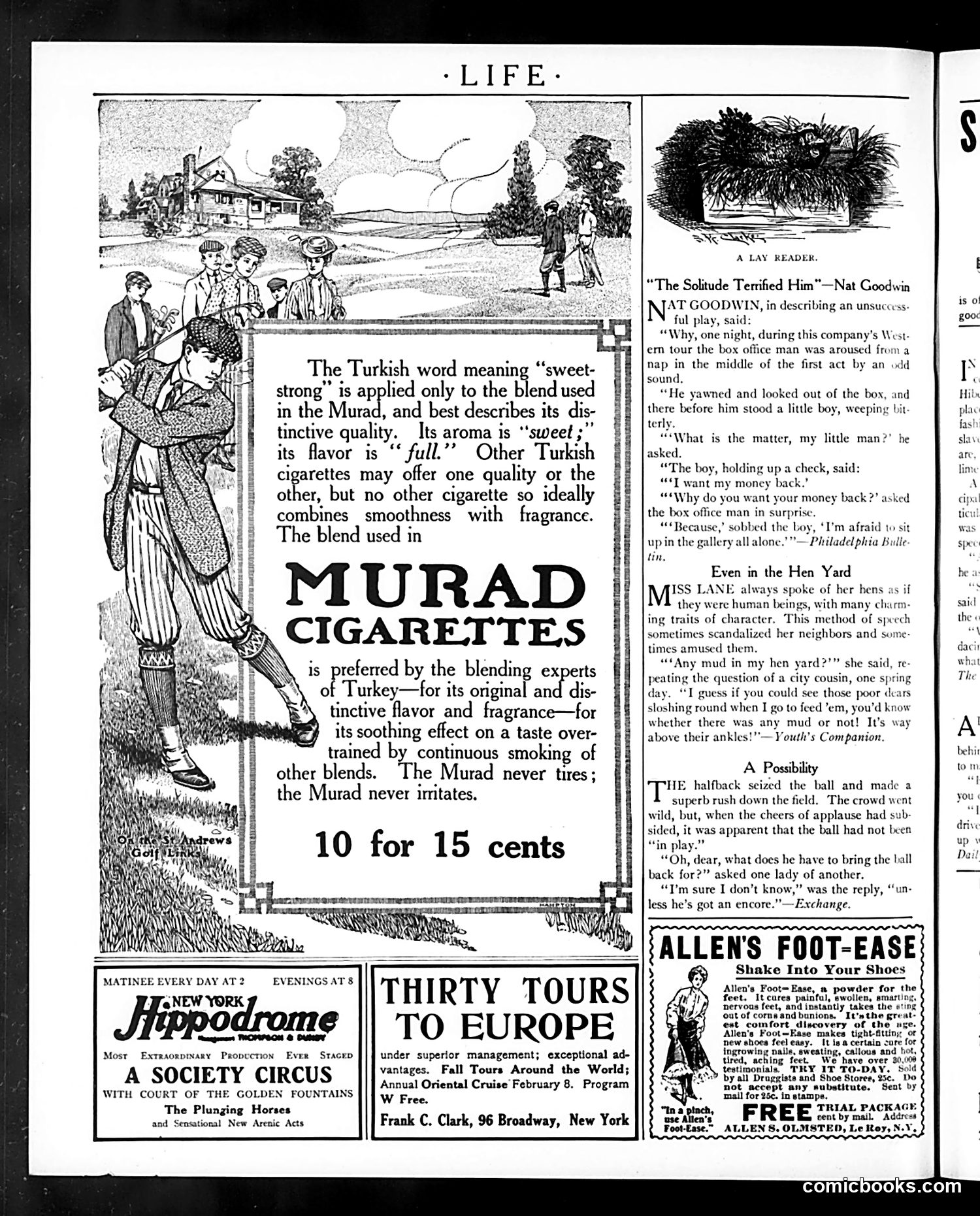
This page is primarily **advertising and humorous anecdotes**, not political satire. The main content includes: **Murad Cigarettes Ad** (center-left): A luxury cigarette advertisement emphasizing Turkish origin and quality blending. The decorative illustration shows fashionable figures in early 1900s dress, appealing to upscale consumers. The "10 for 15 cents" price suggests premium positioning. **"A Lay Reader"** (right): Three brief humorous stories—one about an actor whose play was so boring a child demanded a refund; one about a woman describing her muddy hen yard; one about spectators confused by football rules. These are gentle comedic anecdotes typical of *Life* magazine's humor section. **Other Ads**: Theater listings (Hippodrome circus), European tours, and Allen's Foot-Ease powder complete the page. **Historical Context**: This reflects early 1900s consumer culture, when cigarettes were marketed as sophisticated luxuries and magazines mixed high-end advertising with light humor for middle-class readers.
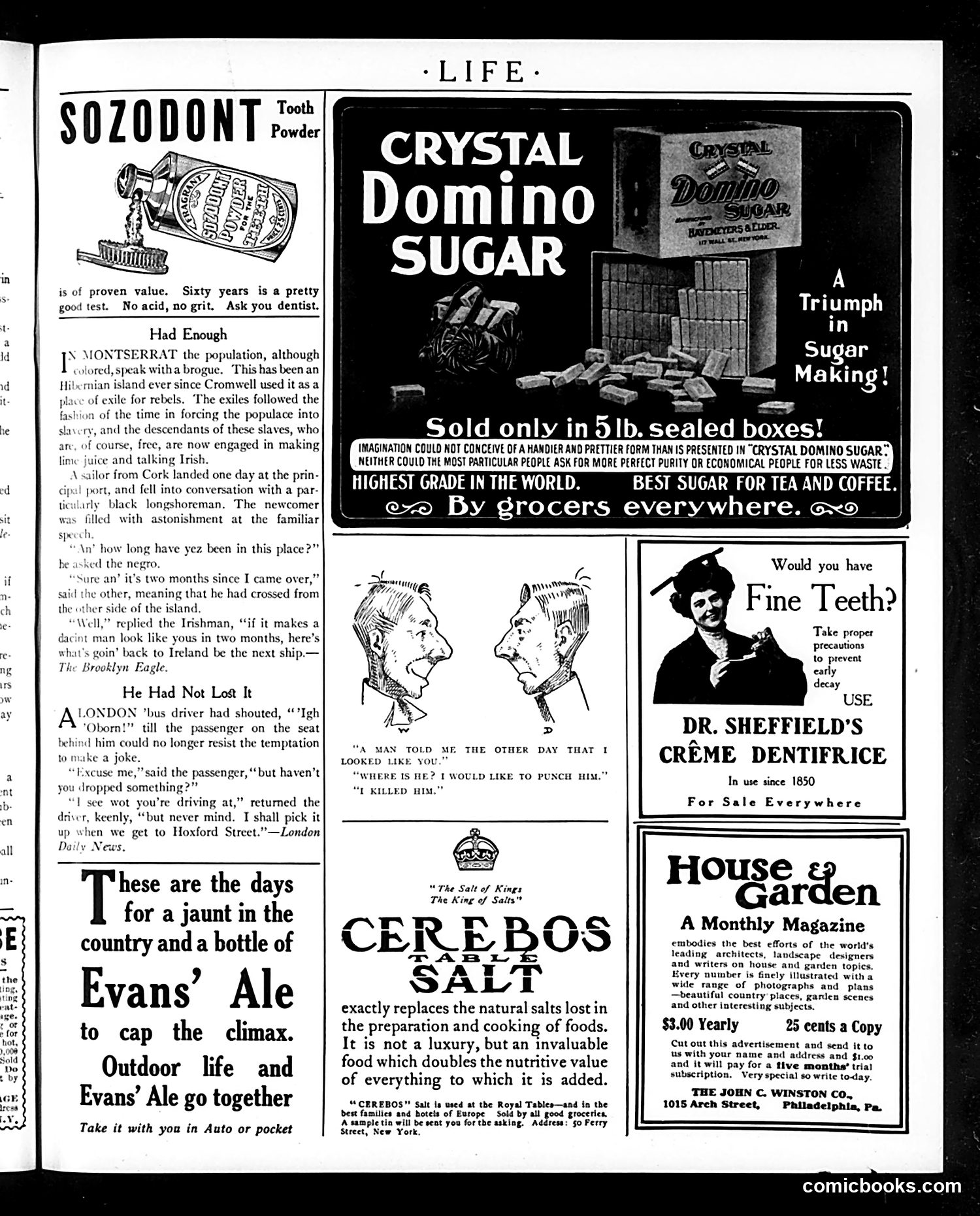
This page contains **three brief humorous anecdotes** (typical of Life's satirical humor), plus period advertisements. ## The Cartoons/Jokes: 1. **"Had Enough"**: An Irish sailor, newly arrived in Montserrat (a Caribbean island with an Irish population descended from Cromwell-era exiles), meets a Black longshoreman who's only been there two months. The sailor remarks that if two months in the Caribbean can make someone "look like" the longshoreman, he'd rather return to Ireland immediately. The joke relies on racial caricature and unflattering comparison. 2. **"He Had Not Lost It"**: A London bus driver shouts station names; a passenger makes a joke suggesting the driver has "lost" something. The driver's witty reply—that he'll retrieve it at Hoxford Street—implies the passenger has lost his wits, not a physical object. 3. **The cartoon with two profile faces**: A man says he was told he resembles someone else, then claims he killed that person. Dark humor based on insult and violence. The page is **primarily advertising** (Sozodont toothpowder, Crystal Domino Sugar, Evans' Ale, Cerebos Salt, Dr. Sheffield's Dentifrice, House & Garden magazine).
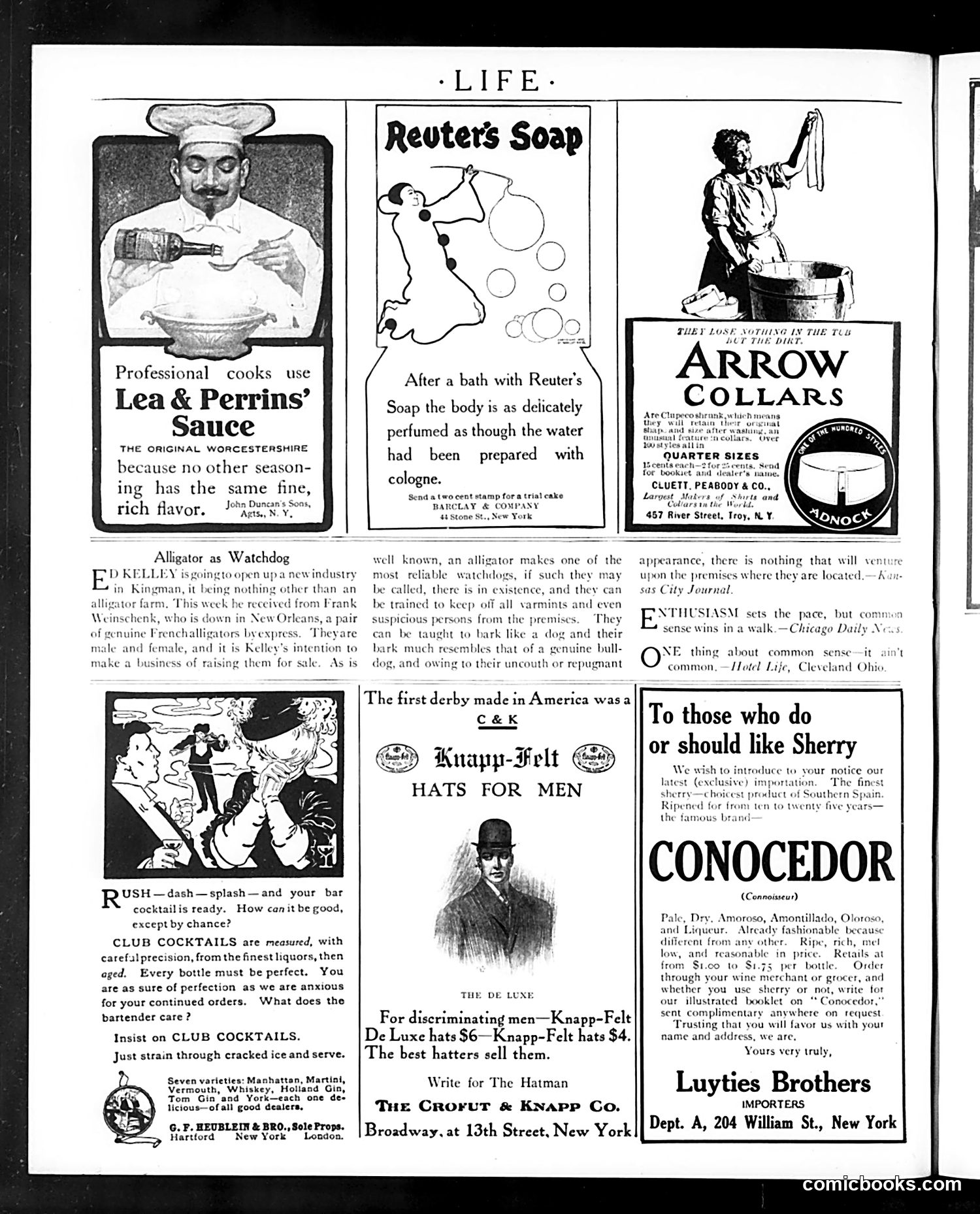
This is primarily an **advertising page** from an early 20th-century issue of Life magazine, with one notable satirical article. ## The Satire **"Alligator as Watchdog"** is the page's only editorial content—a humorous piece about a man named Kelley in Kingman who plans to breed alligators for sale as watchdogs. The joke mocks this impractical business scheme by earnestly describing alligators as "reliable watchdogs" that can be "trained to keep off varmints" and taught to "bark like a dog." The absurdity is the point: alligators are presented with deadpan seriousness as viable domestic security animals, which modern readers would immediately recognize as ridiculous. ## The Advertisements The page features period products: Lea & Perrins' Sauce, Reuter's Soap, Arrow Collars, Club Cocktails, Knapp-Felt Hats, Conocedor Sherry, and Luyties Brothers' imported goods. These reflect early 1900s consumer culture and marketing conventions. The layout and typography are typical of Life's satirical magazine format from this era.
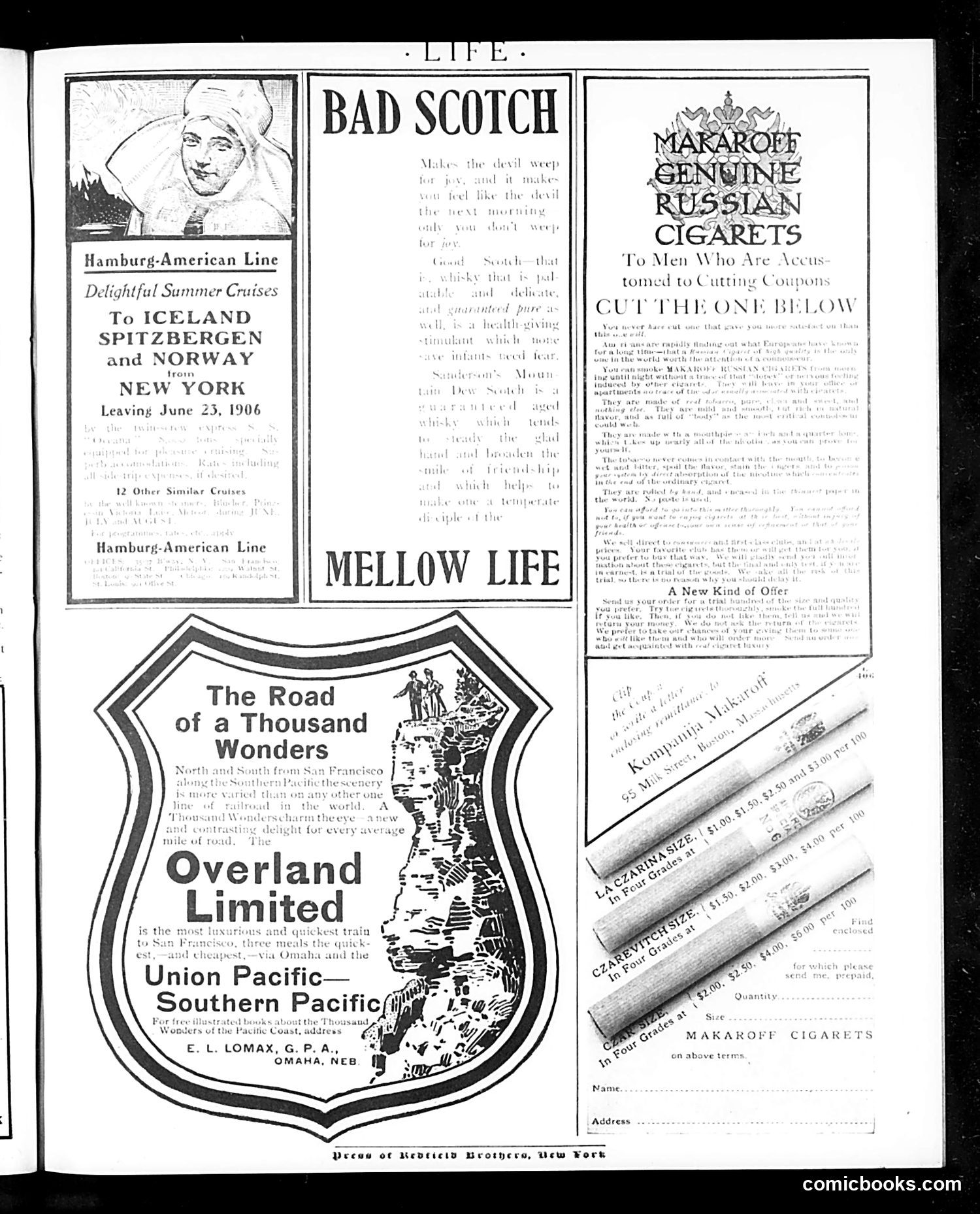
This page is primarily **advertisements** interspersed with a brief satirical piece titled "Bad Scotch" (center-left). The "Bad Scotch" cartoon mocks inferior Scotch whisky by personifying it as the devil—playing on the expression that bad Scotch "makes you feel like the devil the next morning." The joke relies on the stereotype of Scotch whisky's strength and quality; drinking poor-quality versions was supposedly worse than not drinking at all. The surrounding ads for cruise lines (Hamburg-American), trains (Overland Limited), and Russian cigars (Makaroff) are typical early-1900s luxury product advertisements. The page layout reflects Life magazine's characteristic format: mixing satirical humor with commercial advertising to reach wealthy, educated readers. The "Mellow Life" section appears to be a lifestyle column or advertisement section.
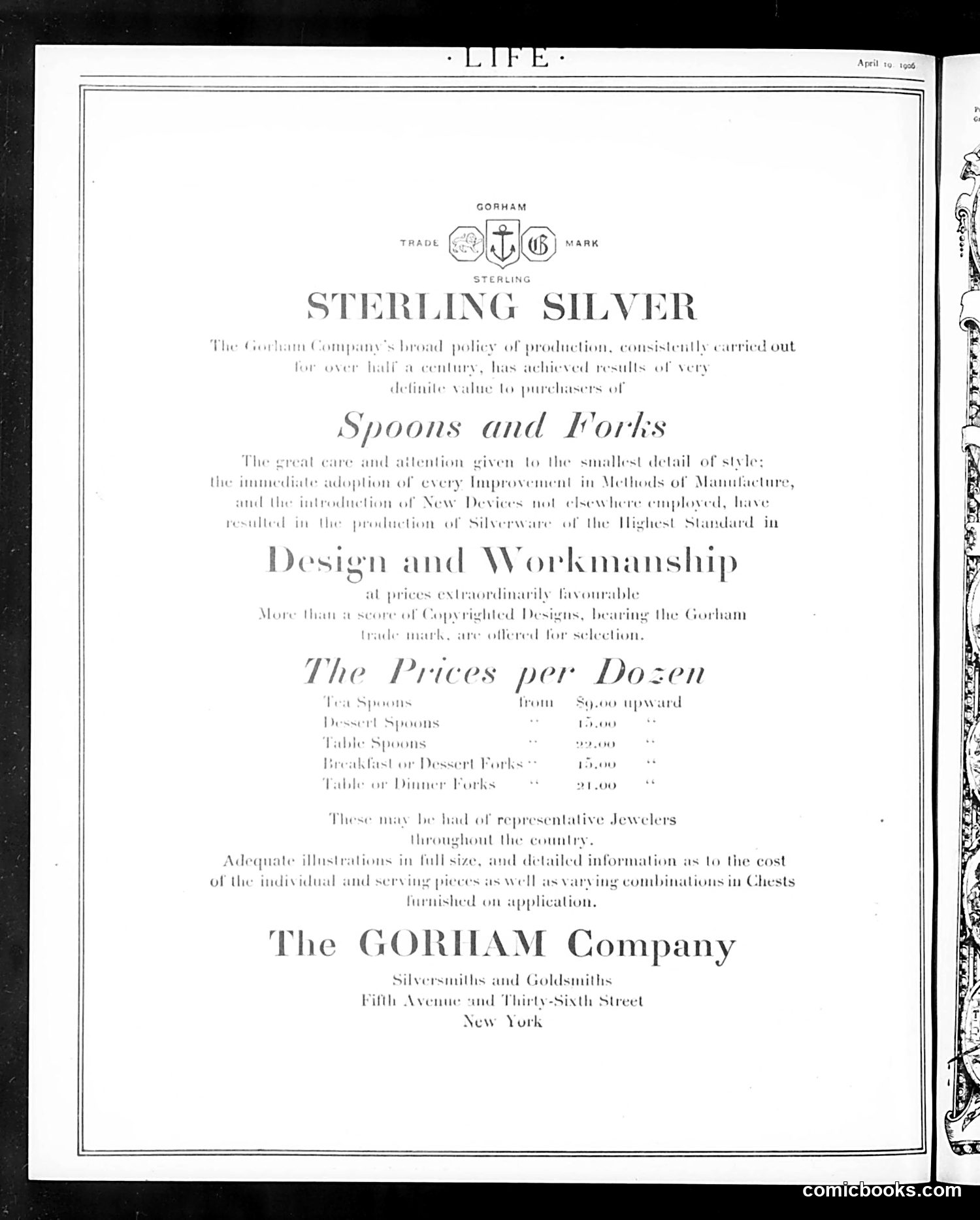
This is a full-page advertisement, not a cartoon or satirical content. It's a Gorham Company advertisement for sterling silver spoons and forks, published in *Life* magazine on April 12, 1906. The ad emphasizes Gorham's manufacturing excellence and design heritage (over half a century of production). It highlights their copyrighted designs and claims of superior craftsmanship, positioning their silverware as high-quality luxury goods. Pricing is listed per dozen—tea spoons starting at $9.00, with dinner forks at $21.00. The ad targets wealthy consumers through luxury magazine placement and appeals to refinement through detailed description of style and workmanship. There is no satire or political commentary on this page—it's straightforward commercial advertising typical of *Life*'s revenue model during this era.