
Life, 1906-04-19 · page 8 of 28
Life — April 19, 1906 — page 8: what you’re looking at
What you’re looking at
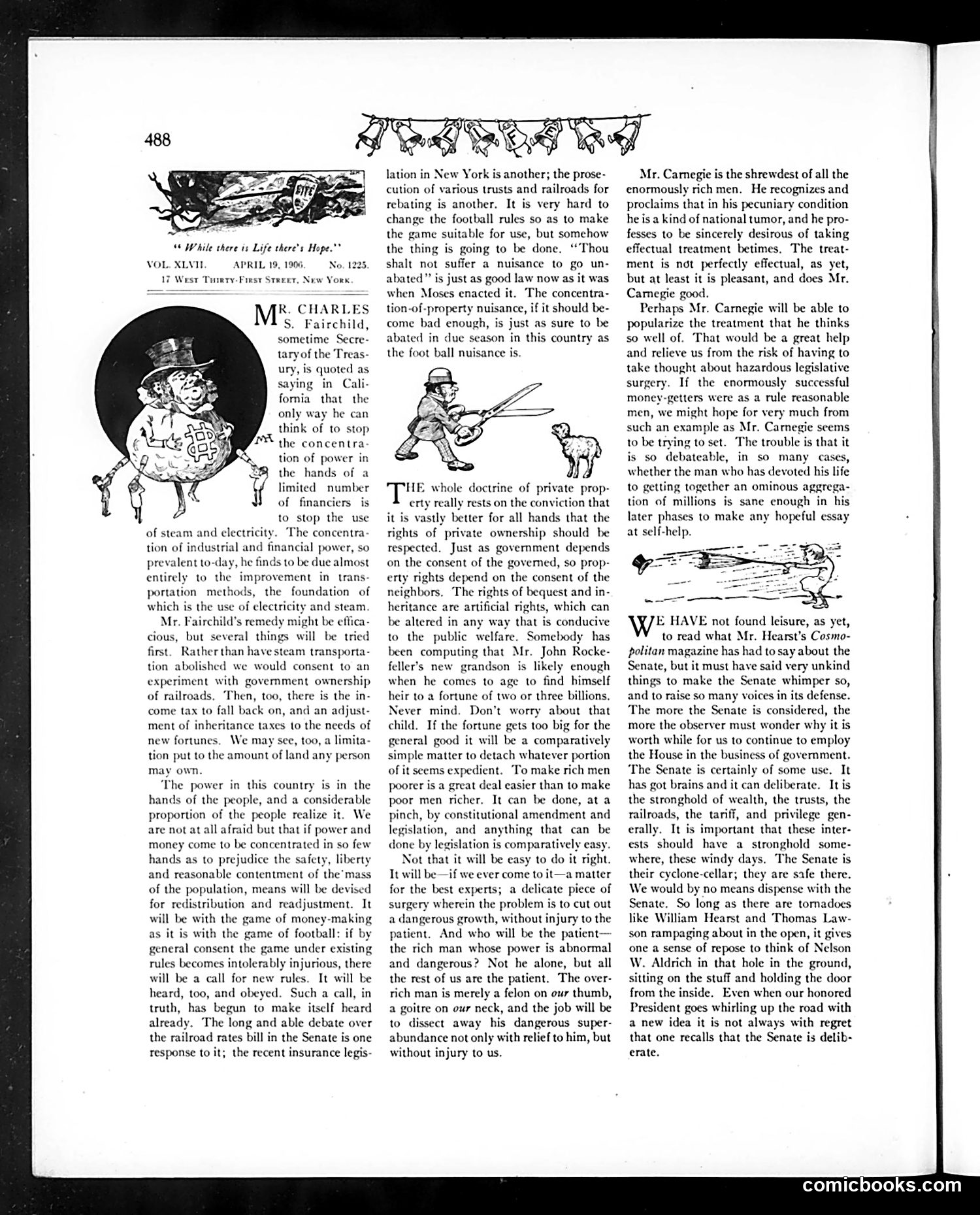
This Life magazine page (April 19, 1906) contains editorial commentary on wealth concentration and monopolies. The main illustration depicts **Mr. Charles Fairchild**, identified in the text as "sometime Secretary of the Treasury," shown as a figure manipulating industrial/financial power symbols. The article critiques the concentration of wealth in few hands, specifically discussing **John D. Rockefeller** and **Andrew Carnegie**. The satire targets these industrialists' vast fortunes and questions whether their philanthropic efforts (Carnegie's treatment of workers) adequately address the systemic inequality they've created. The piece also comments on **Senate debates over railroad regulation and tariffs**, suggesting the Senate's deliberations appear ineffective against entrenched monopolistic power—comparing it to weak responses to dangerous situations.
📄 Transcribed text from this page (OCR, searchable)
Machine-transcribed from the original scan — historical spelling and the odd misread are preserved.
“While there is Life there's Hope. VOL. XLVII APRIL 19, 1906, R. CHARLE . Fairchild, sometime Secre- taryof the Treas- ury, is quoted as saying in Cali- fornia that the only way he can think of to stop the concentra tion of power in the hands of a limited number of financiers is to stop the use . The concentra- tion of industrial and financial power, so prevalent to-day, he finds to be due almost to the improvement in trans. portation methods, the foundation of vhich is the use of electricity and steam. Mr. Fairchild’s remedy might be eftica- cious, but several things will be tried first. Ratherthan have steam transporta- tion abolished we would consent to an experiment with government ownership of railroads, Then, too, there is the in- come tax to fall back on, and an adjust- ment of inheritance taxes to the needs of new fortunes. We may see, too, a limita- tion put to the amount of land any person may own. The power in this country is in the hands of the people, and a considerable proportion of the people realize it. We are not at all afraid but that if power and money come to be concentrated in so few hands as to prejudice the safety, liberty and reasonable contentment of the’mass of the population, means will be devised for redistribution and readjustment. It will be with the game of money i as it is with the game of footbal , general consent the game under existing rules becomes intolerably injurious, there will be a call for new rules. It will be heard, too, and obeyed. Such a call, in truth, has begun to make itself heard already, The long and able debate over the railroad rates bill in the Senate is one response to it; the recent insurance legis- lation in New York is anothe cution of various trusts and railroads for rebating is another. It is very hard to change the football rules so as to make the game suitable for use, but somehow the thing is going to be done. “Thou shalt not suffer a nuisance to go un- abated” is just as good law now as it was when Moses enacted it. The concentra- tion-of-property nuisance, if it should be- come bad enough, is just as sure to be abated in due season in this country as the foot ball nuisance is. erty really rests on the conviction that it is vastly better for all hands that the rights of private ownership should be respected, Just as government depends on the consent of the govemed, so prop- erty rights depend on the consent of the neighbors, The rights of bequest and in- heritance are artificial rights, which can be altered in any way that is conducive to the public welfare. Somebody has been computing that Mr. John Rocke- feller’s new grandson is likely enough when he comes to age to find himself heir to a fortune of two or three billions. Never mind. Don’t worry about that child. If the fortune gets too big for the general good it will be a comparatively simple matter to detach whatever portion of it seems expedient. To make rich men poorer is a great deal easier than to make poor men richer. It can be done, at a pinch, by constitutional amendment and legislation, and anything that can be done by legislation is comparatively easy. Not that it will be easy to do it right. It will be—if we ever come to it—a matter for the best experts; a delicate piece of surgery wherein the problem is to cut out a dangerous growth, without injury to the patient. And who will be the patient— the rich man whose power is abnormal and dangerous? Not he alone, but all the rest of us are the patient. The over- rich man is merely a felon on our thumb, a goitre on our neck, and the job will be to dissect away his dangerous super- abundance not only with relief to him, but without injury to us. Mr. Camegie is the shrewdest of all the enormously rich men. He recognizes and proclaims that in his pecuniary condition he is a kind of national tumor, and he pro- fesses to be sincerely desirous of taking effectual treatment betimes, The treat- ment is not perfectly effectual, as yet, but at least it is pleasant, and does Mr. Carnegie good. Perhaps Mr. Carnegie will be able to popularize the treatment that he thinks so well of. That would be a great help and relieve us from the risk of having to take thought about hazardous legislative surgery. If the enormously successful money-getters were as a rule reasonable men, we might hope for very much from such an example as Mr. Carnegie seems to be trying to set. The trouble is that it is so debateable, in so many ¢ whether the man who has devoted his life to getting together an ominous aggrega- tion of millions is sane enough in his later phases to make any hopeful essay at self-help. E HAVE not found leisure, as y to read what Mr. Hearst’s Cosmo- politan magazine has had to say about the Senate, but it must have said very unkind things to make the Senate whimper so, and to raise so many voices in its defense. The more the Senate is considered, the more the observer must wonder why it is worth while for us to continue to employ the House in the business of government. ‘The Senate is certainly of some use. It has got brains and it can deliberate. It is the stronghold of wealth, the trusts, the railroads, the tariff, and privilege gen- erally. It is important that these inter- ests should have a stronghold som where, these windy days. The Senate is their cyclone-cellar; they are safe there. We would by no means dispense with the Senate. So long as there are tornadoes like William Hearst and Thomas Law son rampaging about in the open, it gives one a sense of repose to think of Nelson W. Aldrich in that hole in the ground, sitting on the stuff and holding the door from the inside. Even when our honored President goes whirling up the road with a new idea it is not always with regret that one recalls that the Senate is delib- erate. comicbooks.com