
Life, 1906-04-19 · page 18 of 28
Life — April 19, 1906 — page 18: what you’re looking at
What you’re looking at
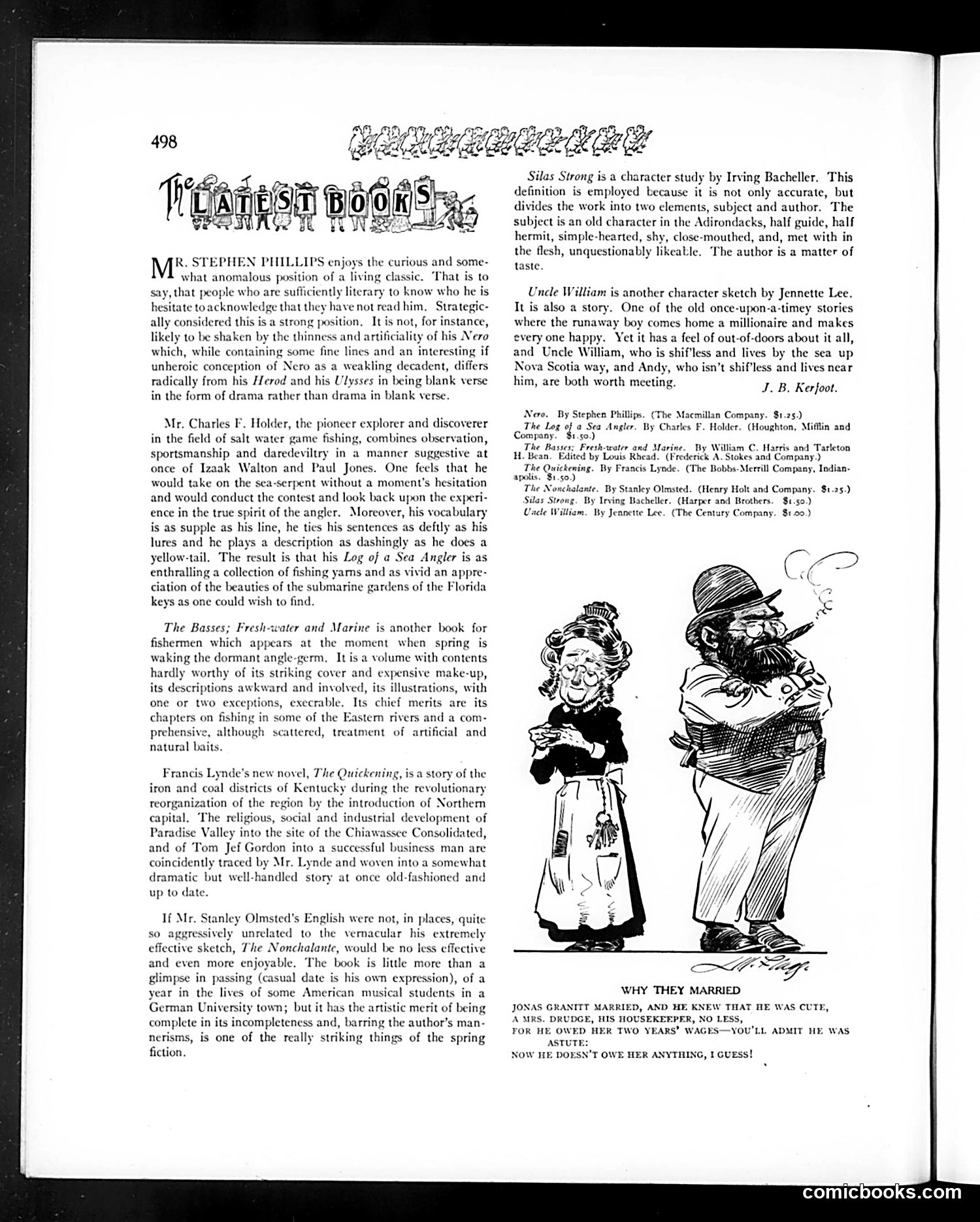
This page from *Life* magazine is primarily a **book review section**, not political satire. It discusses several newly published novels and non-fiction works, including titles about fishing (*Log of a Sea Angler*), Kentucky industrial development (*The Quickening*), and character studies (*Silas Strong*, *Uncle William*). The single illustration—labeled "WHY THEY MARRIED"—is a humorous cartoon showing two elderly people (a woman and man in old-fashioned dress). The caption explains the joke: she was cute and he owed her two years' wages, so he couldn't refuse; now he "doesn't owe her anything, I guess!" **The satire here is domestic/social**, not political: it mocks the financial desperation and transactional nature of marriage, particularly how a man might marry a woman primarily due to debt obligation. The cartoon reflects early 20th-century attitudes about gender, class, and marriage as economic arrangement.
📄 Transcribed text from this page (OCR, searchable)
Machine-transcribed from the original scan — historical spelling and the odd misread are preserved.
cs R. STEPHEN PHILLIPS enjoys the curious and some- what anomalous position of a living classic. That is to y, that people who are sufficiently literary to know who he is hesitate toacknowledge that they have not read him, Strategic- ally considered this is a strong position. It is not, for instance, likely to be shaken by the thinness and artificiality of his Nero which, while containing some fine lines and an interesting if unheroic conception of Nero as a weakling decadent, differs radically from his Herod and his Ulysses in being blank verse in the form of drama rather than drama in blank Mr. Charles F. Holder, the pioneer explorer and discoverer in the field of salt water game fishing, combines observation, sportsmanship and daredeviltry in a manner suggestive at once of Izaak Walton and ul Jones. One fe that he would take on the erpent without a moment's hesitation and would conduct the contest and look back upon the experi- ence in the true spirit of the angler. Moreover, his vocabulary is as supple as his line, he ties his sentences as deftly as his lures and he plays a description as dashingly as he does a yellow-tail. The result is that his Log of a Sea Angler is as enthralling a collection of fishing yams and as vivid an appre- ciation of the beauties of the submarine gardens of the Florida keys as one could wish to find. The Basses; Fresh-water and Marine is another book for fishermen which appears at the moment when spring is waking the dormant angle-germ, It is a volume with contents hardly worthy of its striking cover and expensive make-up, its descriptions awkward and involved, its illustrations, with one or two exceptions, execrable. Its chief merits are its chapters on fishing in some of the Eastern rivers and a com- prehensive, although scattered, treatment of artificial and natural baits. Francis Lynde’s new novel, The Quickening, is a story of the ricts of Kentucky during the revolutionary nization of the region by the introduction of Northem ‘The religious, social and industrial development of se Valley into the site of the Chiawassce Consolidated, and of Tom Jef Gordon into a successful business man are coincidently traced by Mr. Lynde and woven into a somewha dramatic but well-handled story at once old-fashioned and up to date. If Mr. Stanley Olmsted's English were not, in places, quite ggressively unrelated to the vernacular his extremely effective sketch, The Nonchalante, would be no less effective and even more enjoyable. The book is little more than a glimpse in passing (casual date is his own expression), of a year in the lives of some American musical students in a iversity town; but it has the artistic merit of being complete in its incompleteness and, barring the author’s man- nerisms, is one of the really striking things of the spring fiction. Silas Strong is a character study by Irving Bacheller. This definition is employed because it is not only accurate, but divides the work into two elements, subject and author. The subject is an old character in the Adirondacks, half guide, half hermit, simple-hearted, shy, close-mouthed, and, met with in the flesh, unquestionably likeable. The author is a matter of taste. Uncle William is another character sketch by Jennette Lee. It is also a story. One of the old once-upon-a-timey stories where the runaway boy comes home a millionaire and makes every one happy. Yet it has a feel of out-of-doors about it all, and Uncle William, who is shif'less and lives by the sea up No ‘otia way, and Andy, who isn’t shif’less and lives near him, are both worth meeting. J.B. Kerfoot. Nev. By Stephen Phillips. (The Macmillan Company. $t-25.) The Log of a Sea Angler. By Charles F. Holder. (Houghton, Mifflin and Company. $1.50.) The Basses: Fresh-woter and Marine. By William C. Harris and Tarleton H. Bean. Edited by Louis Rhead. (Frederick A. Stokes and Company.) The Quickening. By Francis Lynde. (The Bobbs- Merrill Company, Indian- apolis. $1.50.) The Nonchalante, By Stanley Olmsted. (Henry Holt and Company. $1.25.) Silas Strong. By Irving Bacheller. (Harper and Brothers. $1.52.) Uacte William. By Jennette Lee. (The Century Company. $1.09.) WHY THEY MARRIED JONAS GRANITT MARRIED, AND HE KNEW THAT HE WAS CUTE, A MRS. DRUDGE, HIS HOUSEKEEPER, N FOR HE OWED HER TWO YEARS’ WAG ASTUTE: NOW HE DOE: U'LL ADMIT HE WAS. ER ANYTHING, I GUESS! comicbooks.com