
Life, 1906-04-19 · page 17 of 28
Life — April 19, 1906 — page 17: what you’re looking at
What you’re looking at
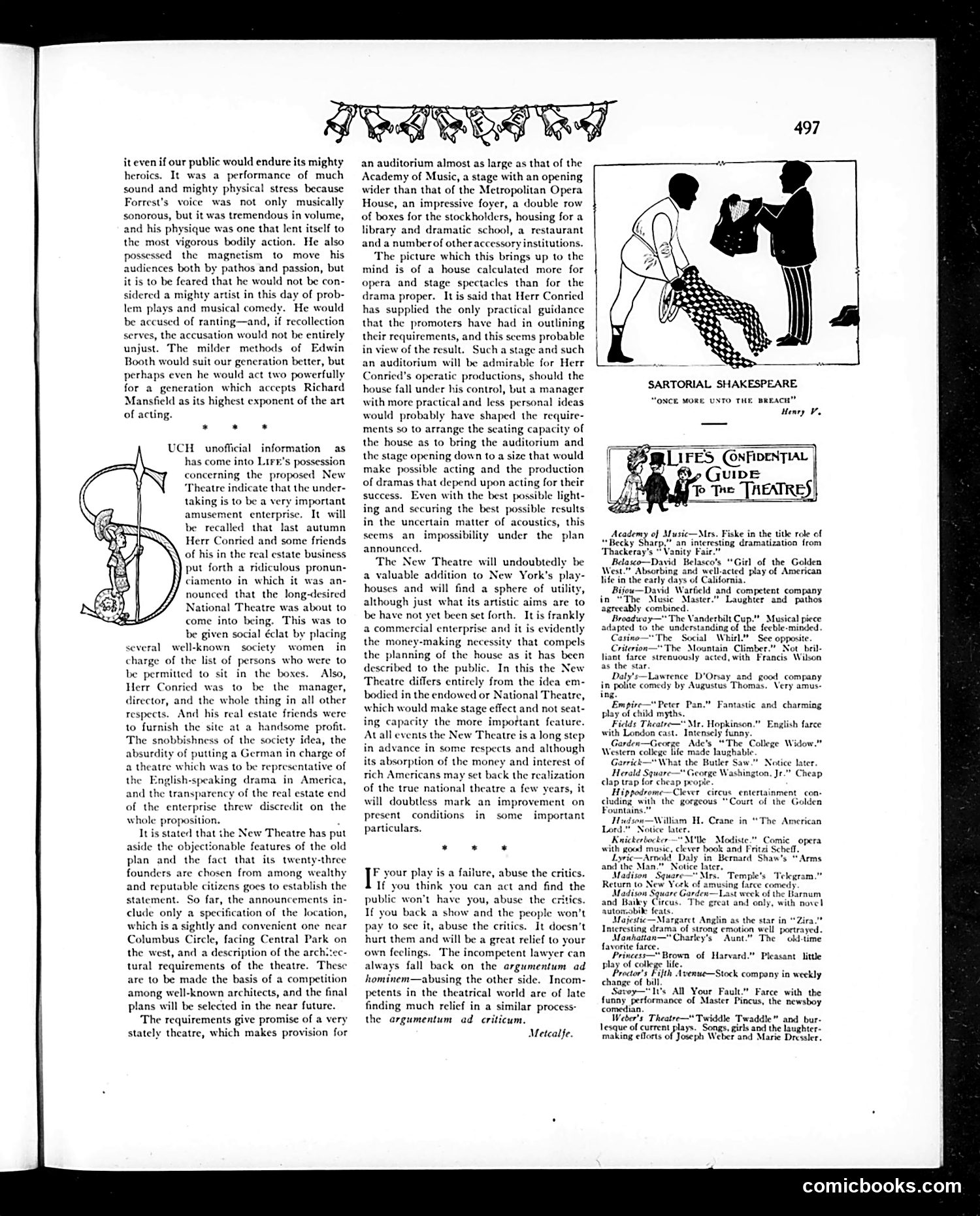
This cartoon satirizes a contemporary theatrical scandal. The image shows a man in exaggerated checkered pants being corrected by a woman—likely depicting criticism of an actor's inappropriate costume choices for a Shakespeare production ("once more unto the breach," from *Henry V*). The accompanying text discusses the proposed **New Theatre** in New York—an ambitious national theatre project. The satire targets its original plan, which the author mocks as absurdly managed by a German (Herr Conried) to represent English-speaking drama, with society women controlling box seating for snobbish reasons. The revised proposal, while improved, still seems designed more for opera spectacle than genuine drama. The cartoon likely ridicules either an actual production's costume disaster or theatrical pretension generally—emphasizing that legitimate Shakespeare performance requires more than visual spectacle or society patronage.
📄 Transcribed text from this page (OCR, searchable)
Machine-transcribed from the original scan — historical spelling and the odd misread are preserved.
it even if our public would endure its mighty heroics. It was a performance of much sound and mighty physical stress because Forrest's voice was not only musically sonorous, but it was tremendous in volume, and his physique was one that lent itself to the most vigorous bodily action. He also possessed the magnetism to move his audiences both by pathos and passion, but it is to be feared that he would not be con- sidered a mighty artist in this day of prob- lem plays and musical comedy. He would be accused of ranting—and, if recollection serves, the accusation would not be entirely unjust. The milder methods of Edwin Booth would suit our generation better, but perhaps even he would act two powerfully for a generation which accepts Richard Mansfield as its highest exponent of the art of acting. * * 8 UCH unofficial information as has come into Lire's possession concerning the proposed New ‘Theatre indicate that the under- taking is to be a very important amusement enterprise. It will be recalled that last autumn Herr Conried and some friends of his in the real estate business put forth a ridiculous pronun- ciamento in which it was an- nounced that the long-desired National Theatre was about to come into being. This was to be given social éclat by placing well-known society women in charge of the list of persons who were to be permitted to sit in the boxes. Also, Herr Conried was to be the manager, director, and the whole thing in all other respects. And his real estate friends were to furnish the site at a handsome profit. The snobbishness of the society idea, the absurdity of putting a German in charge of a theatre which was to be representative of the English-speaking drama in America, and the transparency of the real estate end of the enterprise threw discredit on the whole proposition. It is stated that < several ¢ New Theatre has put aside the objectionable features of the old plan and the fact that its twenty-thre founders are chosen from among wealthy and reputable citizens gocs to establish the statement. So far, the announcements in- clude only a specification of the location, which is a sightly and convenient one near Columbus Circle, facing Central Park on the west, and a description of the arch tural requirements of the theatre. Thes: are to be made the basis of a competition among well-known architects, and the final plans will be selected in the near future. The requirements give promise of a very stately theatre, which makes provision for an auditorium almost as large as that of the Academy of Music, a stage with an opening wider than that of the Metropolitan Opera House, an impressive foyer, a double row of boxes for the stockholders, housing for a library and dramatic school, a restaurant and a numberof other accessory institutions. ‘The picture which this brings up to the mind is of a house calculated more for opera and stage spectacles than for the drama proper. It is said that Herr Conried has supplied the only practical guidance that the promoters have had in outlining their requirements, and this scems probable in view of the result, Such a stage and such an auditorium will be admirable for Herr Conried’s operatic productions, should the house fall under his control, but a manager with more practical and less personal ideas would probably have shaped the require- ments so to arrange the seating capacity of the house as to bring the auditorium and the stage opening down to a size that would make possible acting and the production of dramas that depend upon acting for their success. Even with the best possible light- ing and securing the best possible results in the uncertain matter of acoustics, this seems an impossibility under the plan announced. The New Theatre will undoubtedly be a valuable addition to New York's play houses and will find a sphere of utility, although just what its artistic aims are to be have not yet been set forth. It is frankly a commercial enterprise and it is evidently the money-making necessity that compels the planning of the house as it has been described to the public. In this the New Theatre differs entirely from the idea em- bodied in the endowed or National Theatre, which would make stage effect and not seat- ing capacity the more impoftant feature. Atall events the New Theatre is a long step in advance in some respects and although its absorption of the money and interest of rich Americans may set back the realization of the true national theatre a few years, it will doubtless mark an improvement on present conditions in some important particulars. + 8 ¢ F your play is a failure, abuse the critics. If you think you can act and find the public won't have you, abuse the critics. If you back a show and the people won't pay to sce it, abuse the critics. It doesn’t hurt them and will be a great relief to your own feelings. ‘The incompetent lawyer can always fall back on the argumentum ad hominem—abusing the other side. Incom- petents in the theatrical world are of late finding much relief in a similar process: the argumentum ad criticum. Metcalfe. SARTORIAL SHAKESPEARE “once MoE UNTO THE mREACH” Henry Ve Academy of Music—Mrs. Fiske in the tile role of “Becky Sharp,” an interesting dramatization from ‘Thackeray's " Vanity Fair.” Belao—David Belasco’s “Girl of the Golden West.” Absorbing and well-acted play of American life in the eatly days of California. Bijou—David Warfeld and competent company in “The Music Master.” Laughter and pathos agreeably combined. Broadway—"* The Vanderbilt Cup." adapted to the understanding of the feeble-minded. Casino—"The Social Whirl.” See opposite. Criterion—"The Mountain Climber.” Not beil- Viant farce strenuowsly acted, with Francis: Wilbon as the st Daly's—Lawrence D'Orsay_and_ good, company in polite comedy by Augustus Thomas. Very amus- ing. Empire—" Peter Pan.” Fa play of child myths. Fidds Theatro—" Mr. Hopkinson.” English farce with London cast. Intensely funny Garden—George Ade’s “The College Widow.” Western college life made laughabl Garrick—" What the Butler Herald Square—" George Wash clap trap for cheap people Hippodrome—Clever circus en cluding with the gorgeous Fountains.” Heedson—William Hi. Crane in “The American Lord." Notice later. Knickerbocker ~"M'le_ Modiste." Comi with good music, clever book and Fritzi s Lyric—Arnokd Daly in Bernard Sha and the Man.” Notice later. Madison Square—" Return to New York of amusing farce com Madison Square G Last week of the Barnum and Bailey Circus. The great and only, with novel automobile feats. Majestic—Margaret Anglin as the star in “Zira."* Interesting drama of strong emotion well portrayed. Manhattan—"Charley's Aunt.” The” old-time favorite farce. Princess—" Brown of Harvard." Pleasant litle play of college ie; rrector’s Fijth Avenue—Stock company in weekly change of bill Satoy—"It’s All Your Fault.” Farce with the funny performance of Master Pincus, the newsboy comedian. Weber's Theatre—" Twiddle Twaddle” and bur- esque of current plays. Songs, girls and the Laughter- making efforts of Joseph Weber and Marie Dressler. Musical piece astic and charming ” Notice later. ington, Jr.” Cheap rlainment. con- Court of the Golden Temple's comicbooks.com