
A complete issue · 38 pages · 1906
Life — March 15, 1906
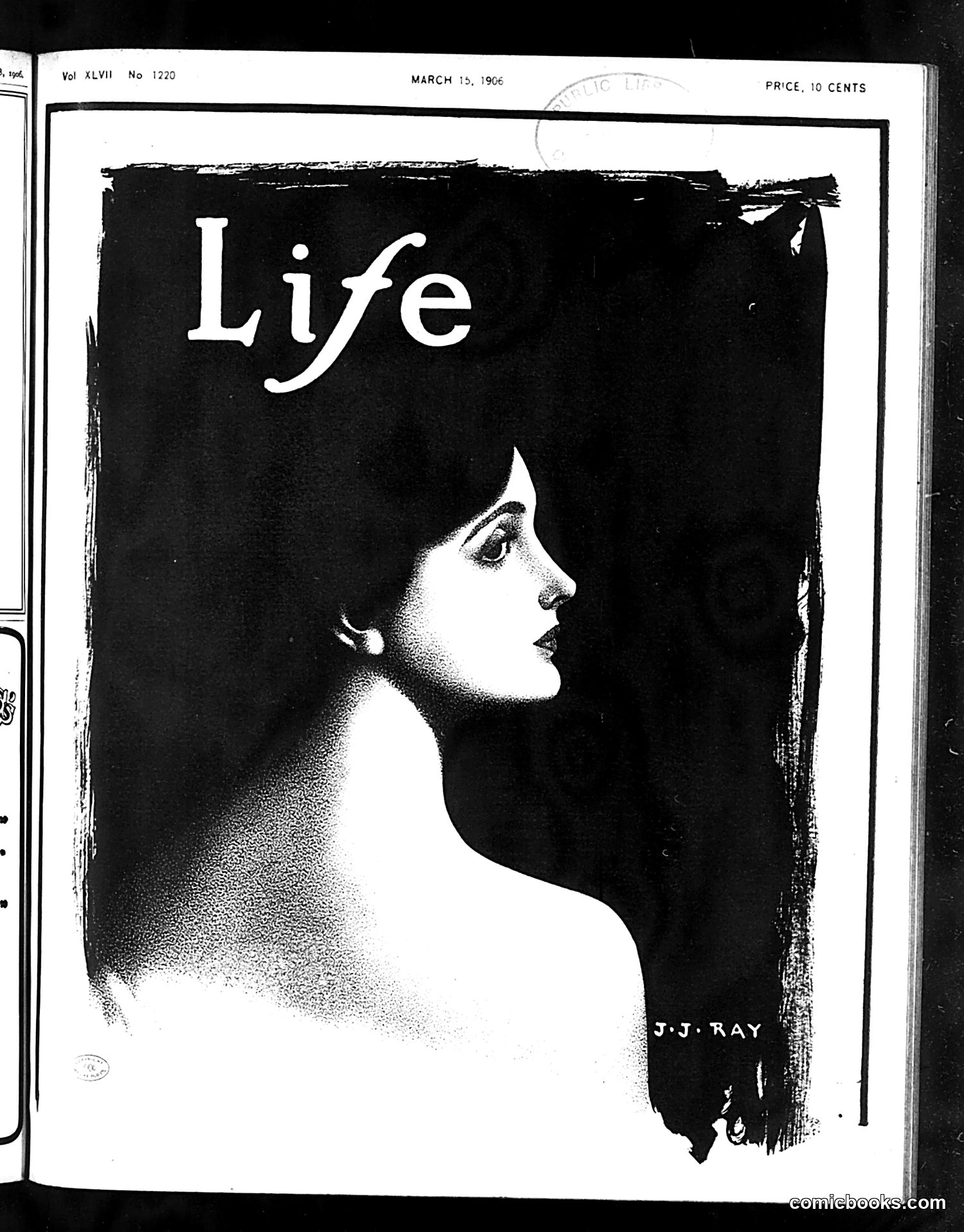
This is the cover of *Life* magazine from March 1906, featuring an illustration by J.J. Ray. It depicts a woman in profile against a dark background, with the word "Life" prominently displayed at the top. The image appears to be a stylized portrait rather than political satire. Without accompanying article text or captions visible on this cover page, the specific subject and intended commentary are unclear. The artistic style—a woman shown in elegant profile with careful shading—was typical of *Life*'s cover artwork during this era, often featuring society women, cultural commentary, or aesthetic studies. The price of 10 cents and volume information (Vol XLVII, No 1220) indicate this was a standard weekly issue of the satirical magazine.
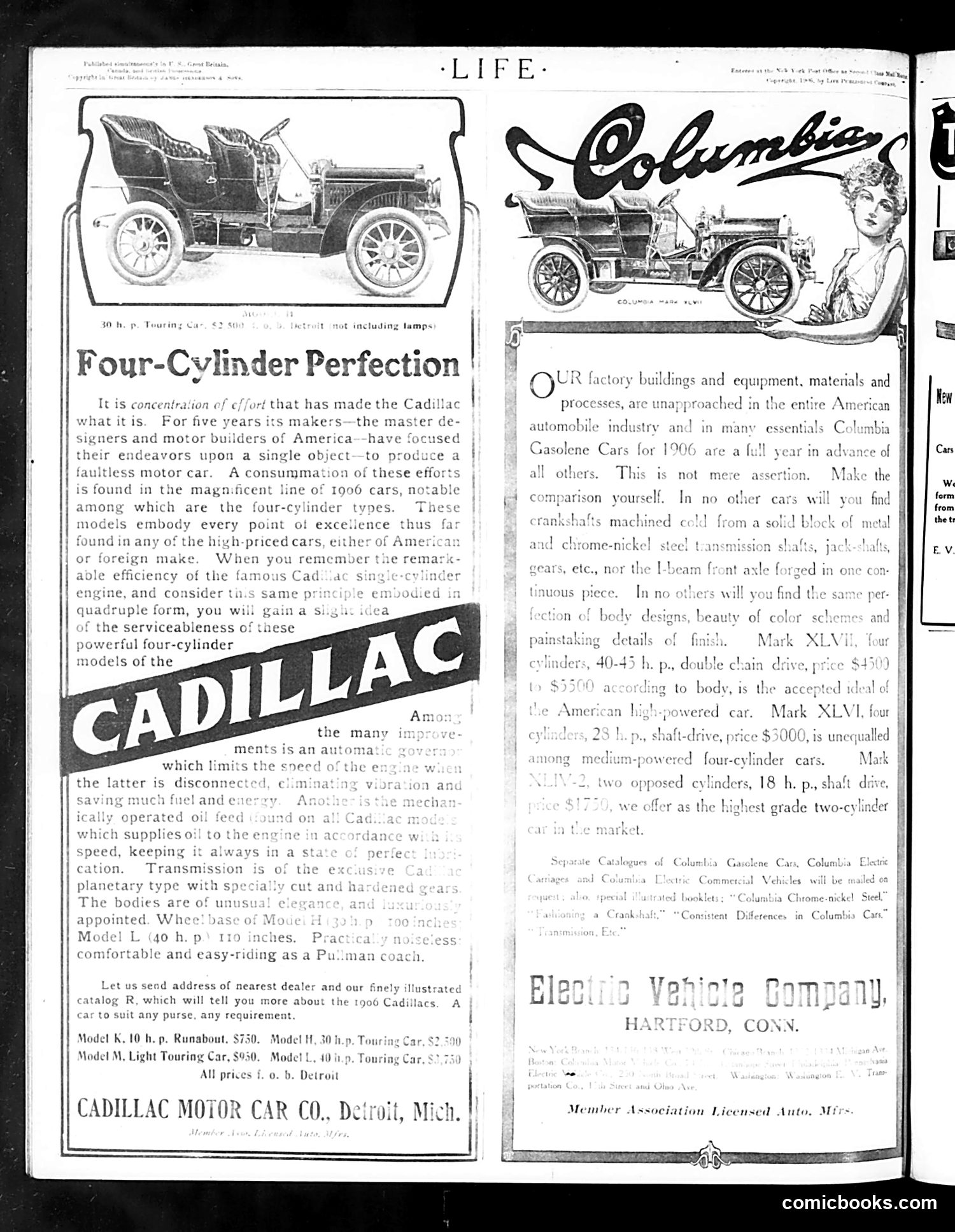
This page contains **no political cartoon or satire**—it is primarily **automobile advertising** from circa 1906. The left advertisement promotes **Cadillac Motor Car Co.** (Detroit), emphasizing their "Four-Cylinder Perfection" and highlighting technical specifications like transmission design and engine reliability. Models and prices are listed. The right advertisement is for **Columbia Gasoline Cars** and **Electric Vehicle Company** (Hartford, Connecticut), similarly marketing their automobiles' superior factory standards and engineering. Both ads feature period vehicle illustrations and employ the marketing language typical of early automotive competition. The page represents commercial content rather than satirical commentary—Life magazine's business model relied heavily on such paid advertisements to sustain publication.
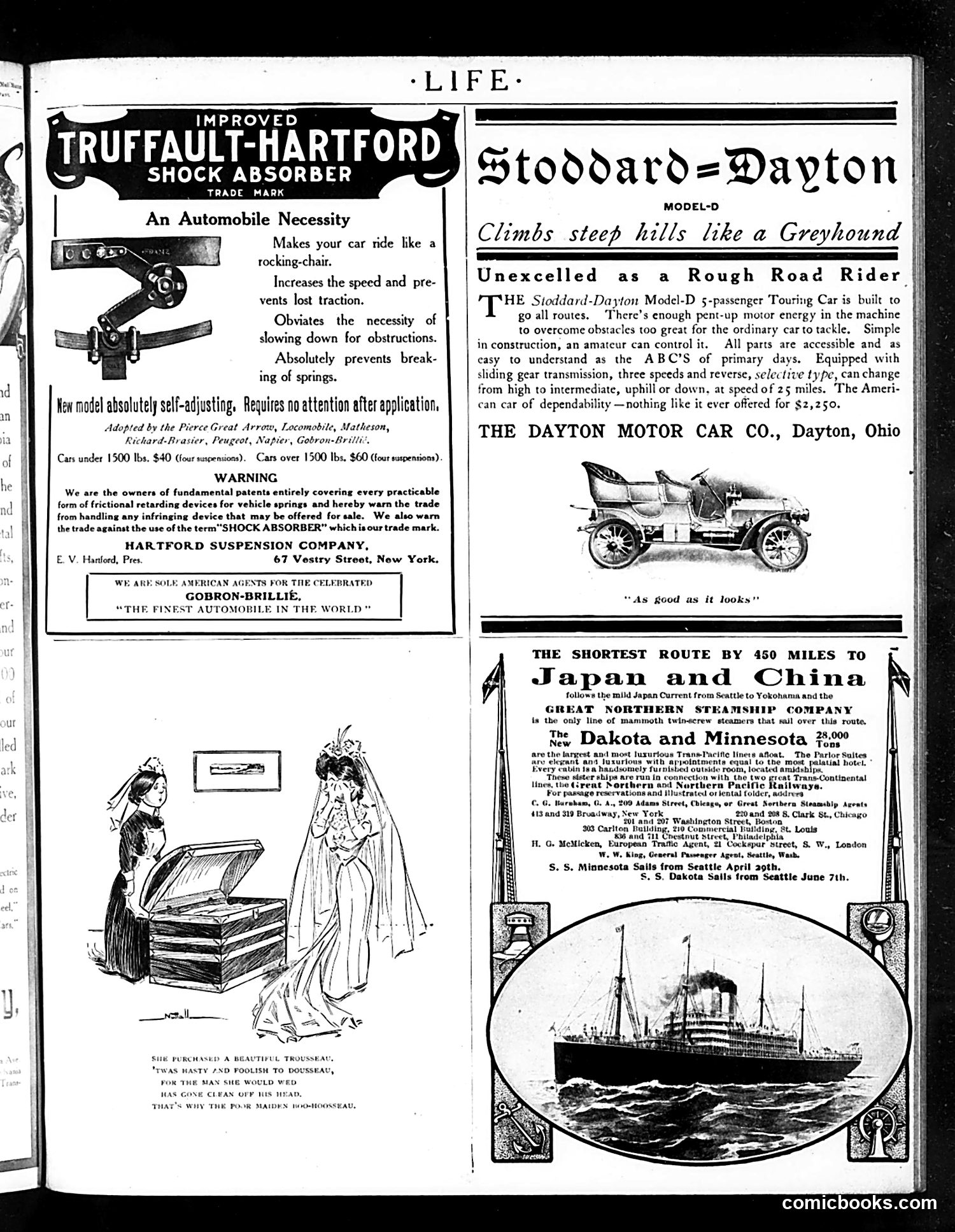
This page is primarily **advertising**, not political satire. The left side advertises the Truffault-Hartford shock absorber for automobiles, marketed as "An Automobile Necessity." The right side features a Stoddard-Dayton Model-D automobile advertisement. The only cartoon element is a small illustration (bottom left) showing a woman examining a trousseau (wedding clothes trunk). The accompanying verse suggests satirical commentary on marriage, with the caption implying the woman's husband has given her a "beautiful trousseau" but was "hasty and foolish" in doing so—likely a mild joke about marriage expenses or spousal financial decisions. The remainder consists of steamship travel advertisements to Japan and China.
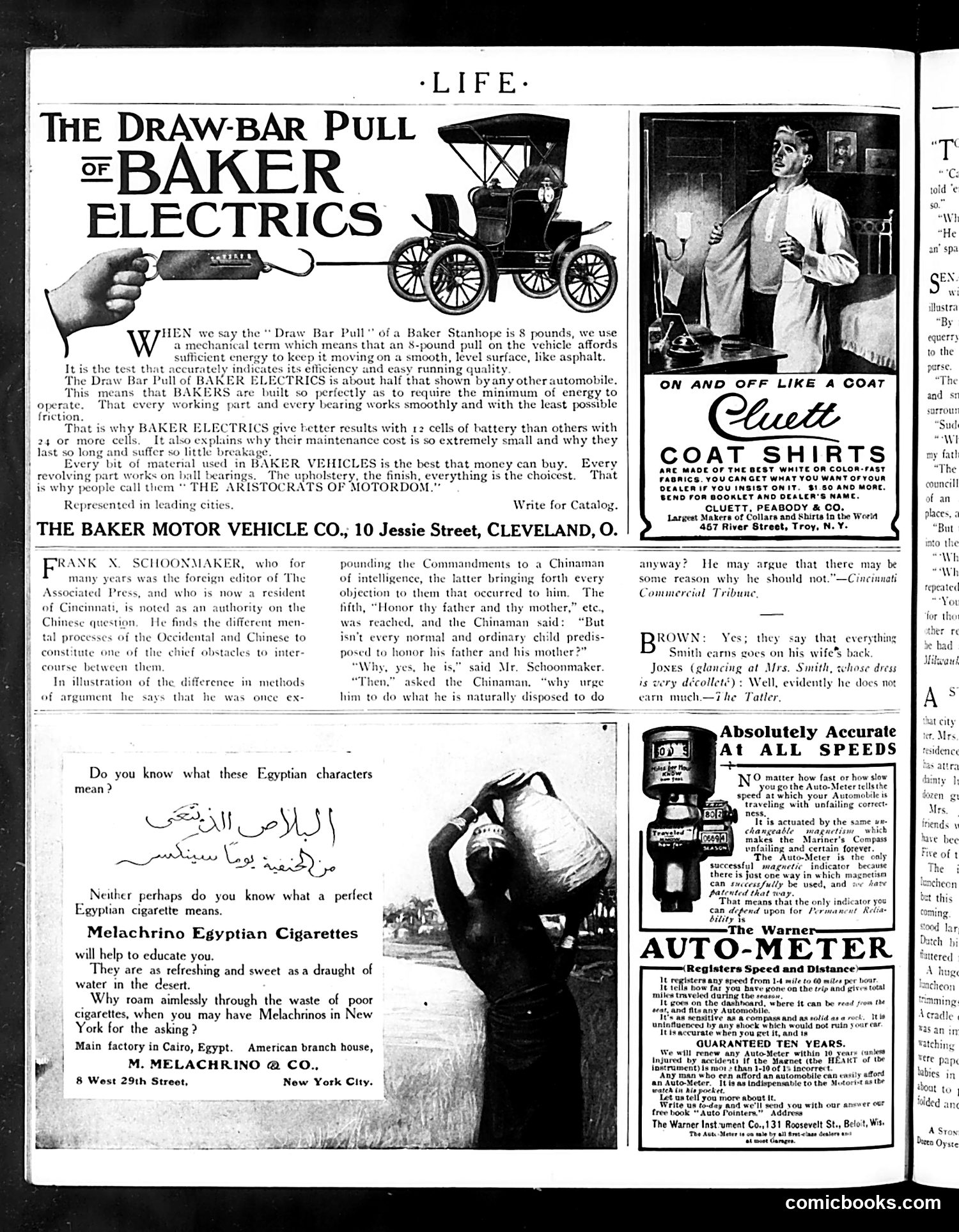
This page is **primarily advertising** interspersed with minor editorial content. The main advertisements promote: - **Baker Electrics** (electric automobiles), emphasizing efficiency and reliability - **Cluett Coat Shirts**, marketed as versatile clothing - **Melachrono Egyptian Cigarettes**, with an image of someone smoking - **Auto-Meter** (vehicle speedometer), guaranteed for ten years The editorial content includes a brief anecdote by Frank X. Schoonmaker about Chinese philosophy and a dialogue about wives' spending habits. There's also a reference to Egyptian hieroglyphics related to cigarette advertising. The satirical element is subtle—primarily the contrast between advertisements promoting modern technology (electric cars, speedometers) alongside traditional colonial-era cigarette marketing using Orientalist imagery. The page reflects early 20th-century consumer culture and advertising aesthetics rather than sharp political satire.
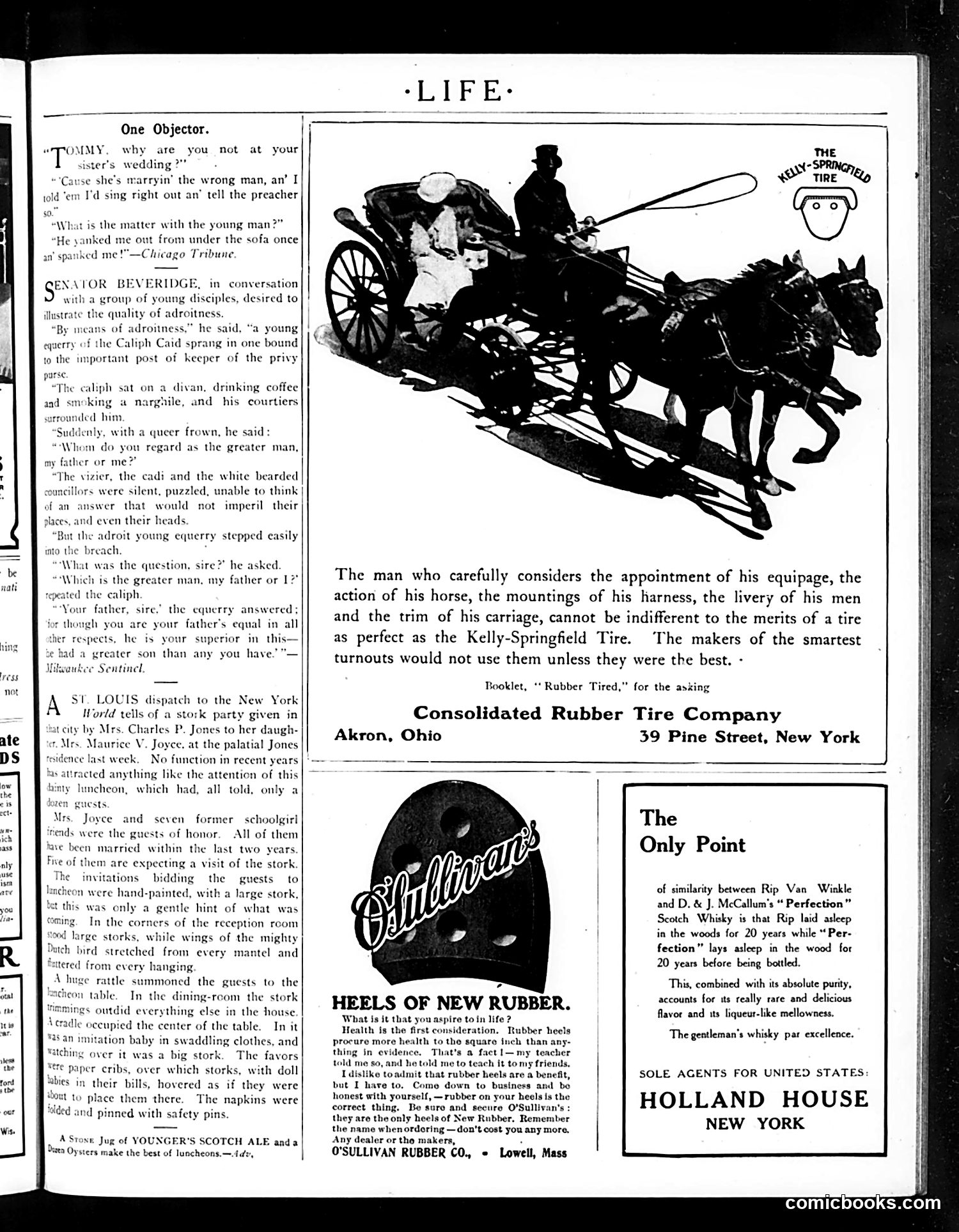
This page is primarily **advertising**, not political satire. The main content consists of four advertisements: 1. **Kelly-Springfield Tire** (top): Shows a horse-drawn carriage with passengers, arguing that careful attention to tire quality reflects good judgment about one's entire equipage. 2. **O'Sullivan Rubber Heels** (center-left): Promotes rubber heels as health-beneficial, claiming they reduce fatigue better than leather. 3. **D&J McCullum Scotch Whisky** (center-right): Compares favorably to Rip Van Winkle, emphasizing purity and quality. 4. **Holland House** (bottom-right): Advertises as sole U.S. agent for a Scotch whisky. The page's left column contains unrelated humorous anecdotes labeled "One Objector"—brief social comedy pieces typical of Life magazine's satirical content, but these are entirely separate from the advertisements.
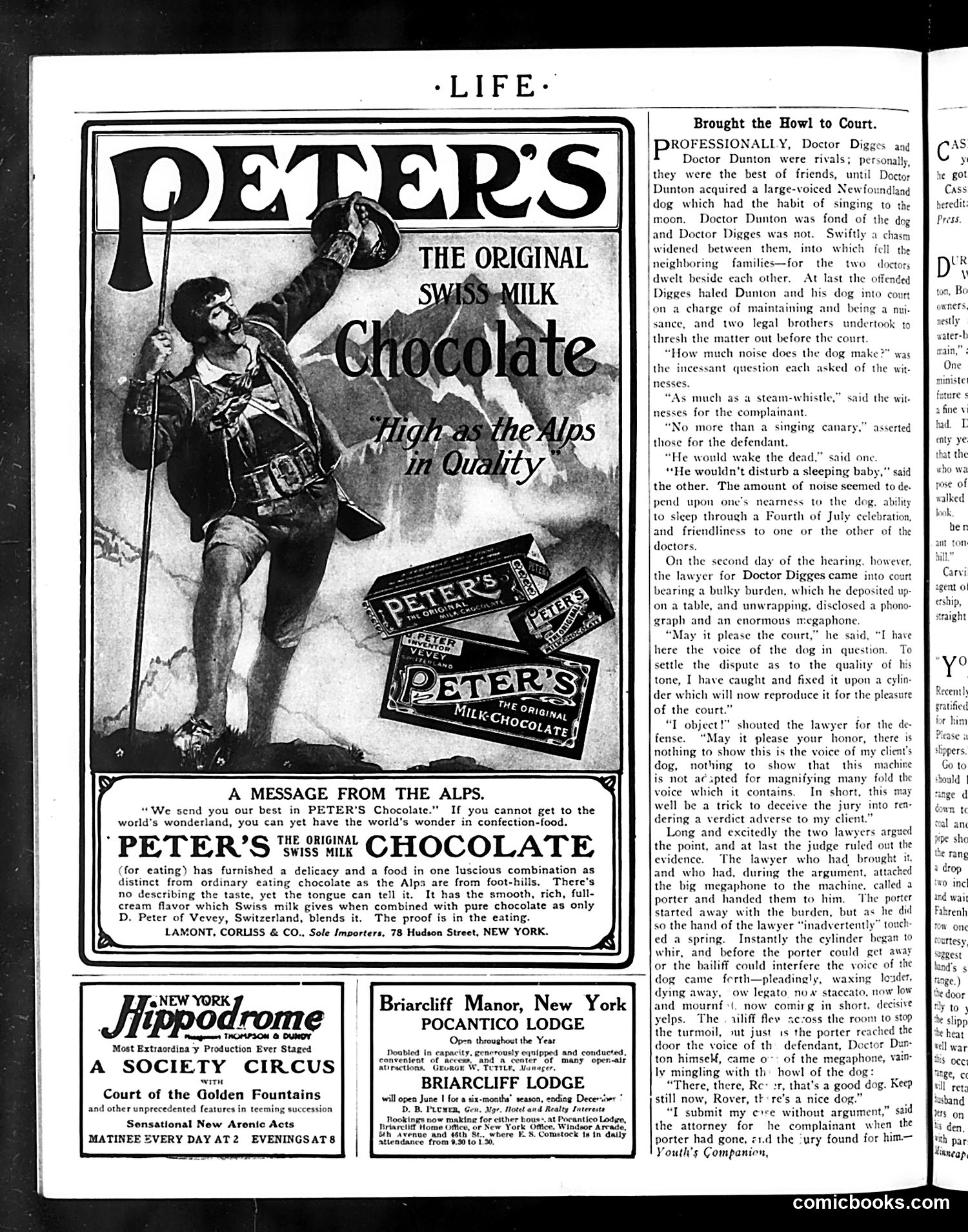
This page is primarily **advertising**, not satire or political commentary. The dominant content is a Peter's Chocolate advertisement featuring an Alpine mountaineer in traditional Swiss dress, promoting "The Original Swiss Milk Chocolate" with the slogan "high as the Alps in Quality." The accompanying article, "Brought the Howl to Court," describes a humorous legal dispute between two doctors, Dunton and Diggs, who argued about whether a Newfoundland dog's howling constituted a noise nuisance. The dispute was settled using an early recording device (a cylinder) to capture and reproduce the dog's actual howl for court evidence. This represents an early novelty use of sound-recording technology for legal purposes—the joke being that courtroom proceedings now included literal animal noise evidence.
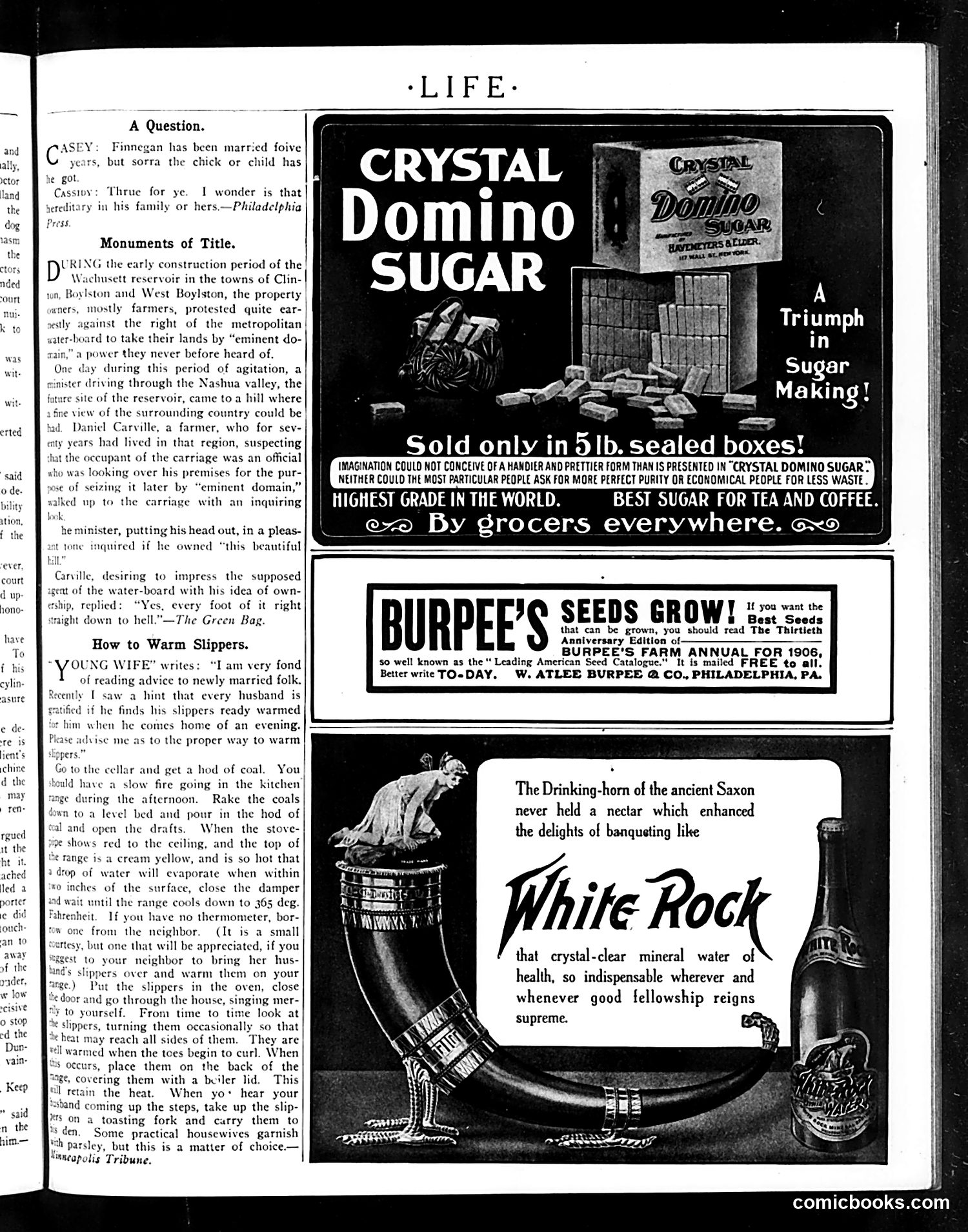
This page is primarily **advertising**, not satirical content. It features three commercial advertisements for early 20th-century products: 1. **Crystal Domino Sugar** — promotes refined sugar in sealed boxes, emphasizing purity and economy for households 2. **Burpee's Seeds** — advertises their farm annual catalog to gardeners 3. **White Rock Mineral Water** — markets "crystal-clear mineral water" as a health beverage, referencing the "drinking-horn of ancient Saxon" tradition to evoke sophistication and wellness The left column contains brief articles ("A Question," "Monuments of Title," "How to Warm Slippers") unrelated to the ads. There is **no political cartoon or satire** on this page. It represents typical Life magazine content from the early 1900s: a mix of editorial material and period advertisements targeting middle-class consumers concerned with domestic comfort, health, and household management.
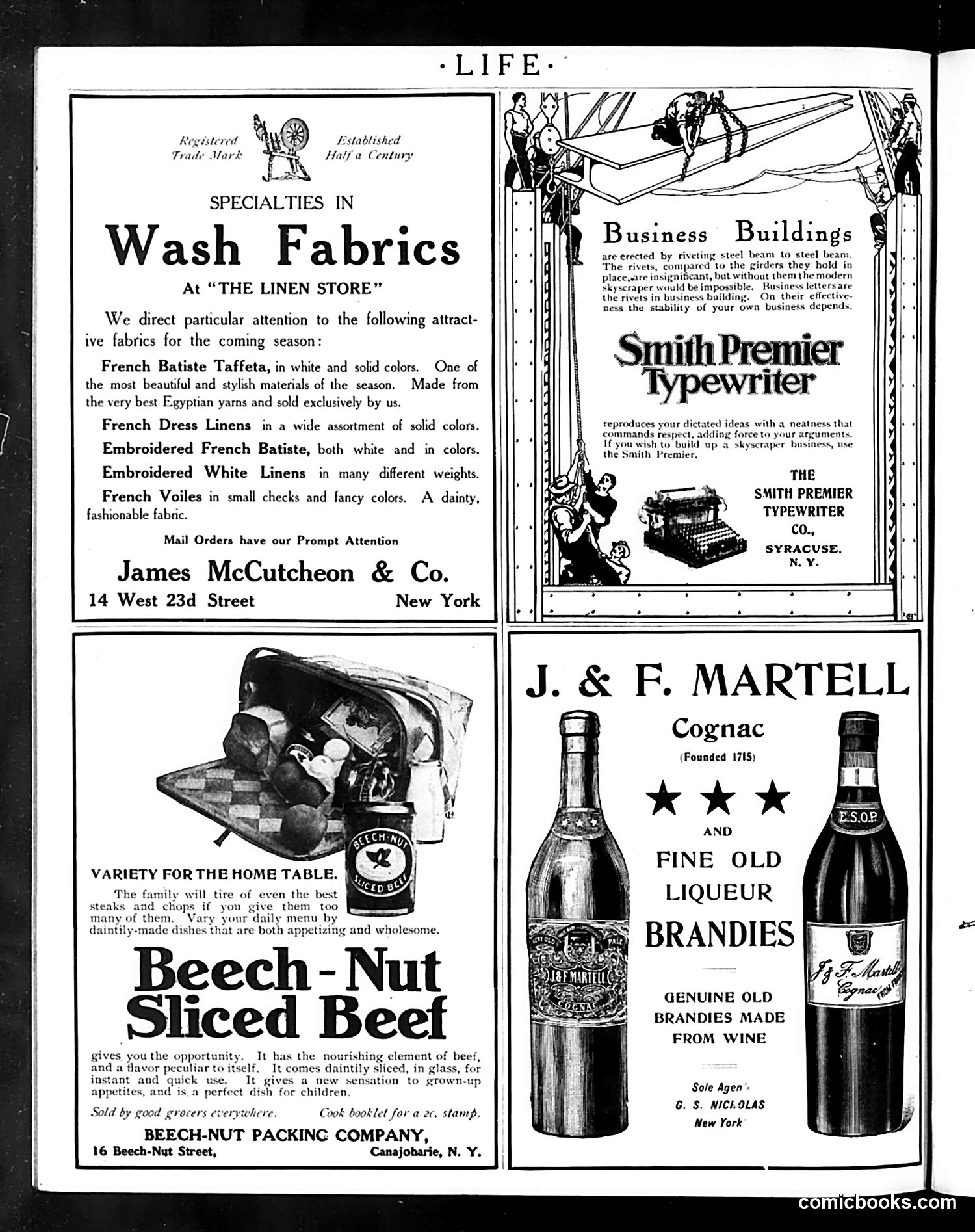
This page is primarily **advertising content**, not editorial satire. It contains four commercial advertisements from the early 20th century: 1. **James McCutcheon & Co.** - fabric merchant advertising washable linens 2. **Smith Premier Typewriter** - uses a metaphor comparing typewriter stability to steel-beam construction in skyscrapers 3. **Beech-Nut Sliced Beef** - packaged meat product emphasizing convenience and nutrition for families 4. **J. & F. Martell Cognac** - liquor advertisement highlighting French brandy quality The page reflects period consumer culture: ready-made fabrics, new office technology, packaged foods, and imported luxury goods. There is **no political cartoon or satire** visible—this is a straightforward commercial advertisement section from *Life* magazine's revenue-generating pages.
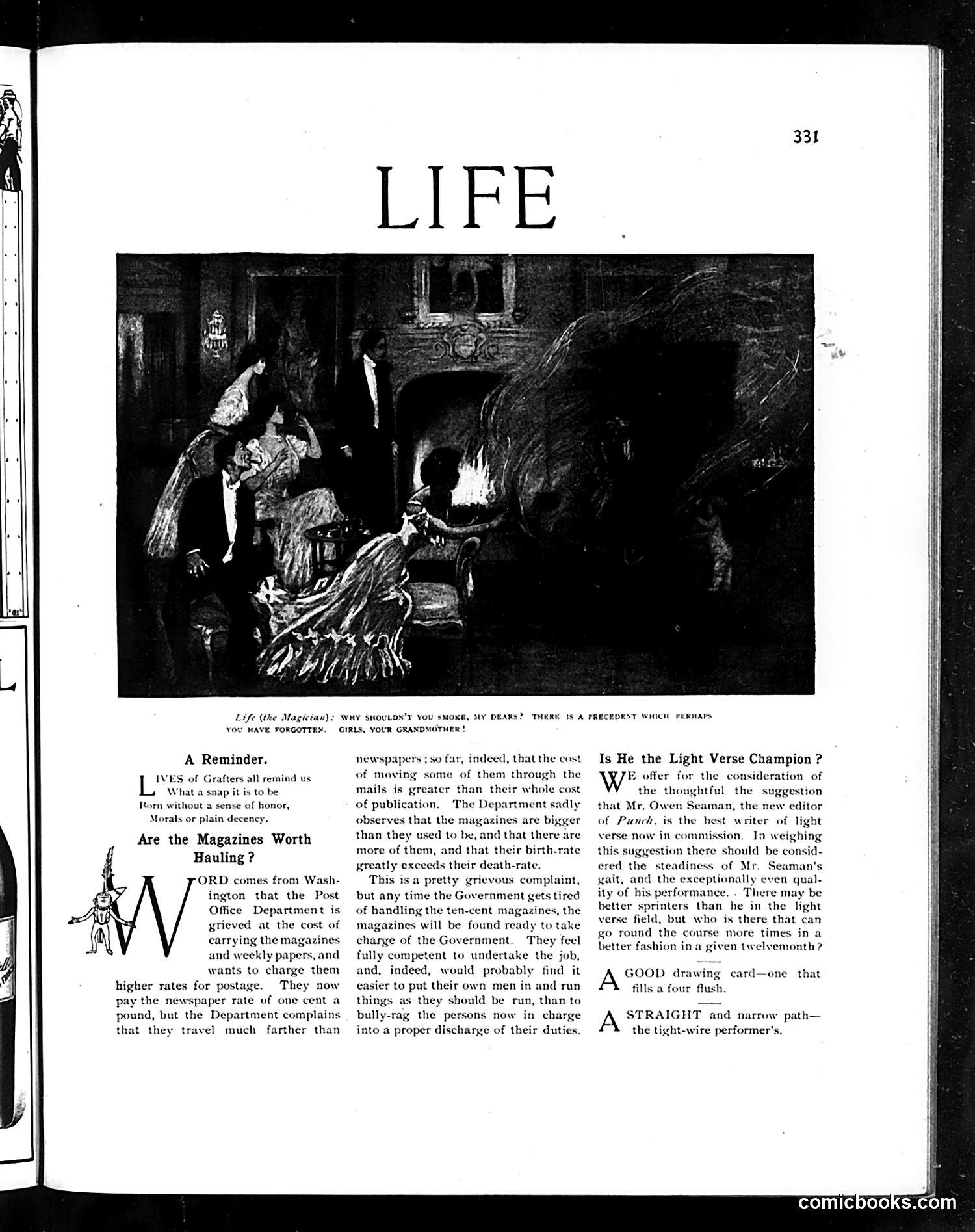
**The Main Cartoon (top):** The image shows an interior domestic scene with figures around a fireplace. The caption reads: "Life (the Magazines): Why shouldn't you smoke, my dears? There is a precedent which perhaps you have forgotten. Girls, your grandmother!" This is satirizing *Life* magazine's editorial stance on smoking by women—presenting it as old-fashioned moralizing. The joke suggests *Life* is lecturing readers about propriety while invoking outdated grandmother-like concerns. **The Articles Below:** These discuss practical postal/magazine distribution complaints and question whether *Life* magazine's light verse is superior to competitors' work. They appear to be editorial commentary on magazine industry issues and *Life's* own literary merit. The page critiques both *Life's* moralistic editorial voice and debates its cultural significance.
This page satirizes the academic and social pretensions of Harvard College through a debate between Colonel Henry Watterson (a prominent journalist and editor) and Mr. Jack London (the famous writer). The central joke concerns whether Harvard should elect London as president. Watterson argues Harvard's prestige demands an "ex-President" (suggesting Theodore Roosevelt), while London—described as "bored" and "intellectually morally originally sickened" by parlor society—rejects the offer. The satire mocks both figures: Watterson's reverence for institutional hierarchy and Roosevelt's influence, and London's affected disdain for upper-class conventions. The cartoon ridicules the era's obsession with social status and academic pedigree among America's intellectual elite. The humor depends on readers' familiarity with these public figures' actual personalities and reputations.
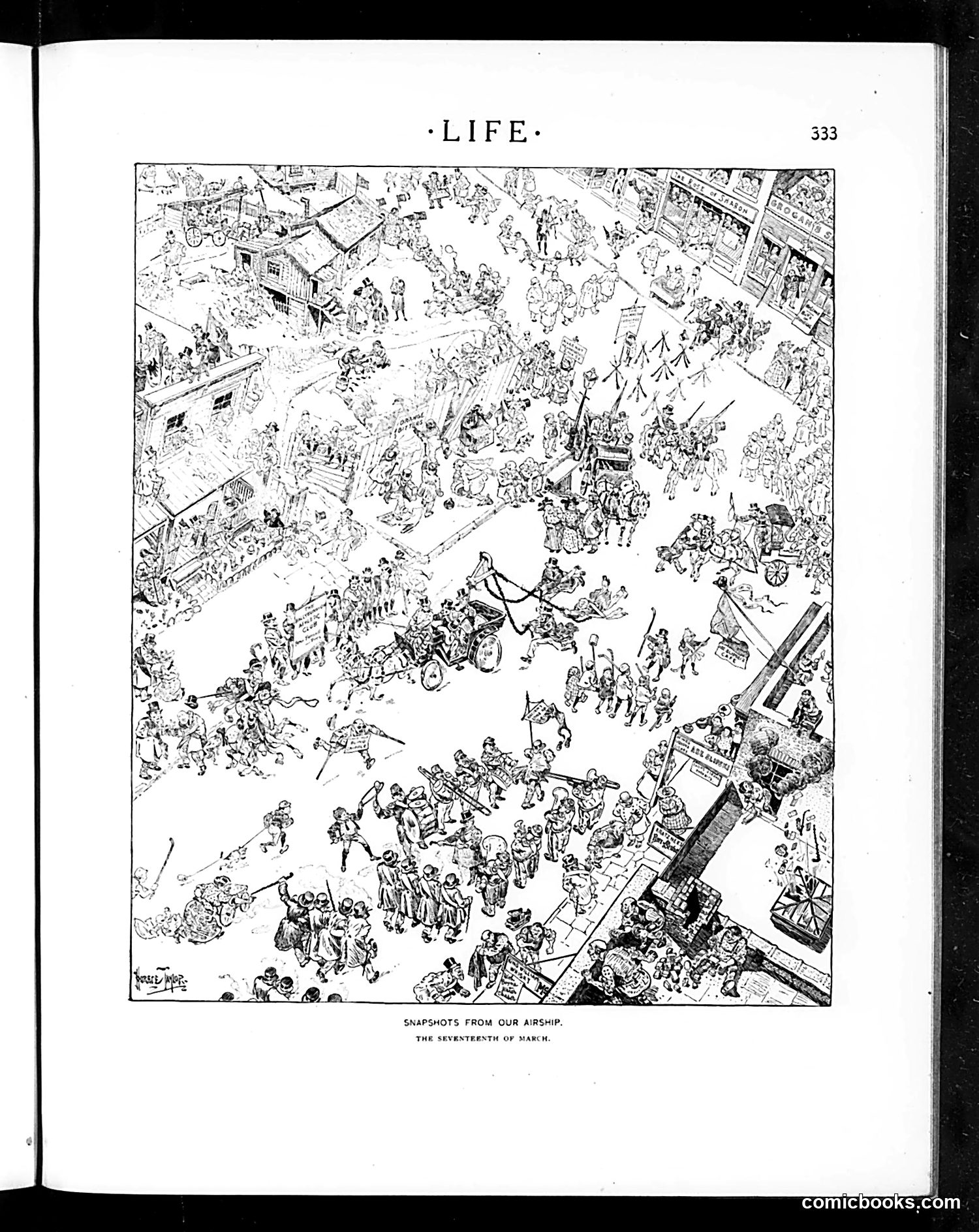
This page from *Life* magazine (page 333) presents an aerial illustration titled "Snapshots From Our Airship: The Seventeenth of March." The bird's-eye view depicts a crowded public gathering or parade, likely St. Patrick's Day festivities given the March 17th date reference. The intricate cartoon shows dense crowds of people, buildings, vehicles, and what appears to be parade formations or processions. The perspective mimics photography from an actual airship, a novel technology of the era that would have fascinated contemporary readers. The satire likely derives from observing the chaotic, teeming masses from above—a perspective that emphasizes human density and activity in humorous or critical ways typical of *Life* magazine's social commentary. The specific satirical point remains unclear without additional context about 1910s-era St. Patrick's Day culture.
This page contains several distinct sections rather than a unified cartoon: 1. **"Edwin Gilbert"** - An obituary praising a deceased benefactor who donated Fresh Air Farm at Branchville for poor children. 2. **"Pure Food"** - An editorial criticizing food legislation, arguing that public concern about food quality is exaggerated. 3. **"Too Many Sides"** - A piece mocking John P. Haines, president of the Society for Prevention of Cruelty to Animals, for hypocrisy—he prevents animal cruelty professionally while failing to accomplish it personally. 4. **Bottom illustration** - A small cartoon showing what appears to be a domestic scene with a figure and animals, captioned about breaking things. 5. **"Query"** - A brief philosophical dialogue between father and son about God's creation. The page represents typical Life magazine content: social commentary mixed with humor and moral observation.
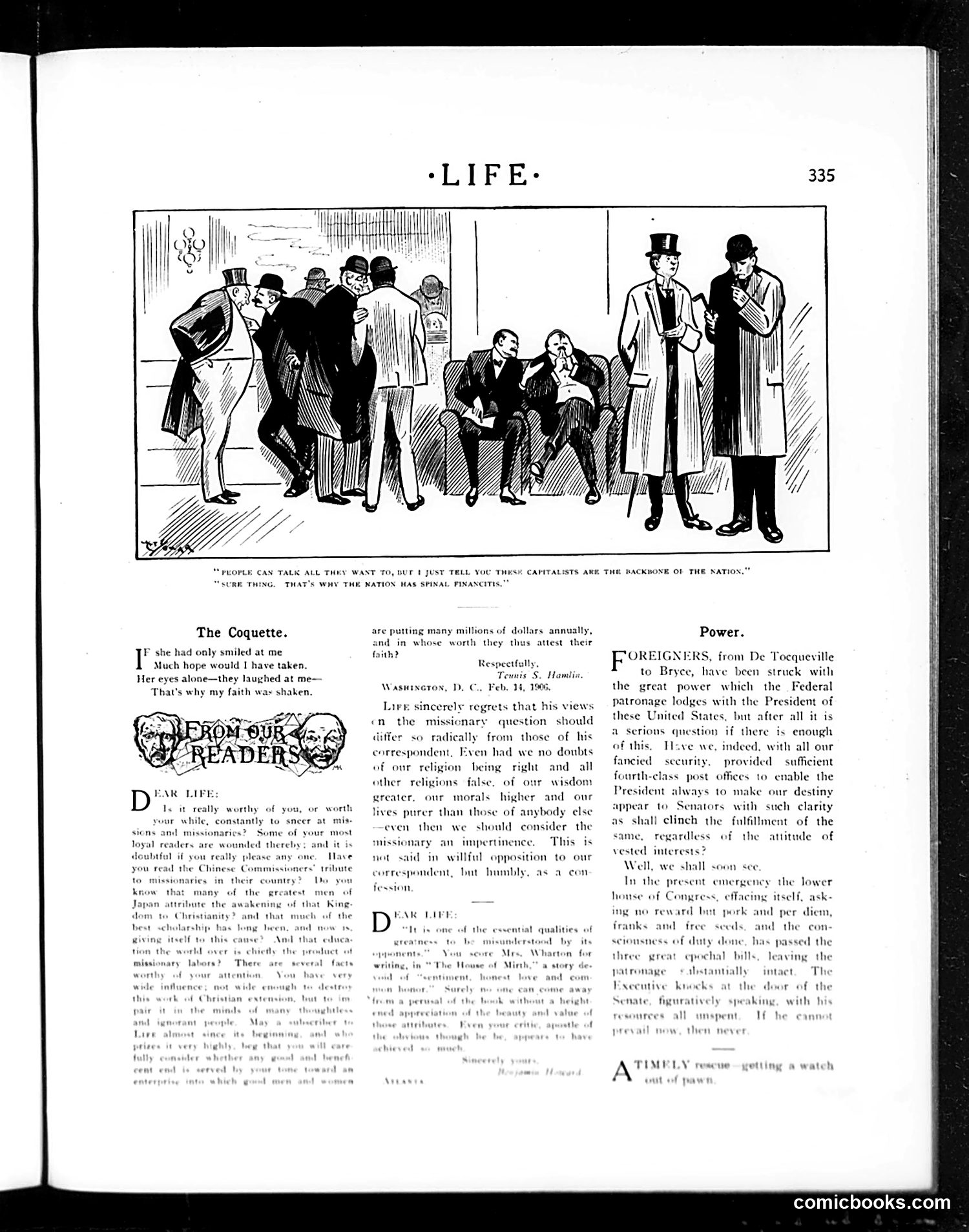
The top cartoon depicts well-dressed men in top hats discussing finances. The caption quotes someone stating "capitalists are the backbone of the nation" and references "spinal financitics"—a satirical coinage suggesting that financial dealings cause societal problems. Below, "The Coquette" poem and "Power" article discuss political/social issues. The "Power" section references De Tocqueville and Bryce's observations about Federal patronage, fourth-class post offices, and Congressional power struggles. It appears critical of executive overreach and suggests Congress needs stronger resources to resist presidential authority. The letters section ("From Our Readers") debates religion, missionary work, and Chinese education—typical early-1900s reform topics. The overall page satirizes both capitalist influence and political power dynamics of the era.
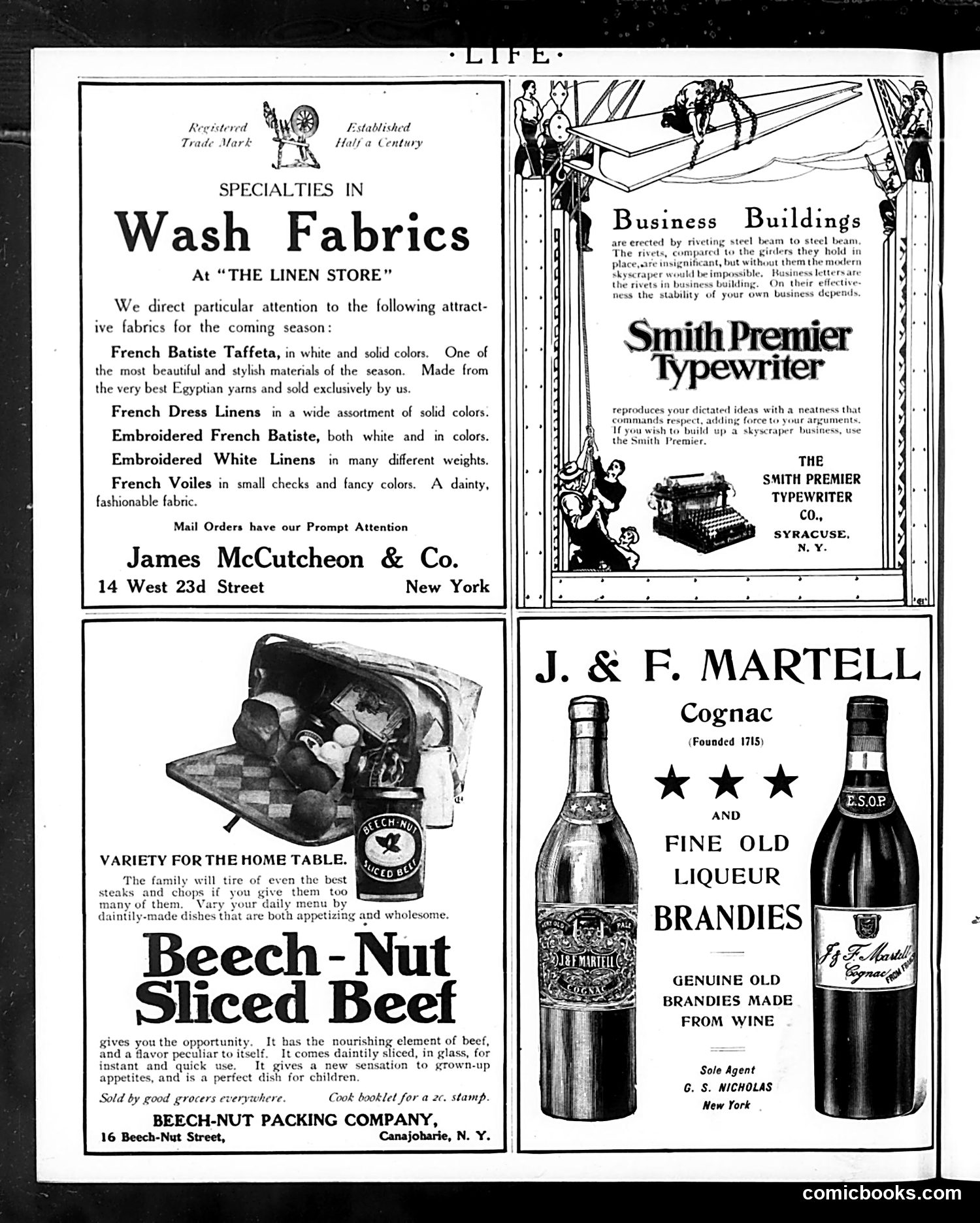
This is primarily an **advertising page**, not a satirical cartoon page. It contains four commercial advertisements from the early 20th century: 1. **James McCutcheon & Co.** — A New York linen store promoting French fabrics (batiste, linens, voiles) for the upcoming season. 2. **Smith Premier Typewriter** — Advertises business efficiency, showing workers on a steel beam, emphasizing the machine's role in modern office productivity. 3. **Beech-Nut Sliced Beef** — Canned meat product marketed as convenient, nutritious variety for family meals and children. 4. **J. & F. Martell Cognac** — French brandy (established 1715), sold through G.S. Nicholas in New York, emphasizing authenticity ("genuine old brandies made from wine"). The page reflects early-1900s consumer culture, targeting middle and upper-class readers with imported luxuries, modern office technology, and convenience foods. No political satire or caricature is present—this is straightforward period advertising.
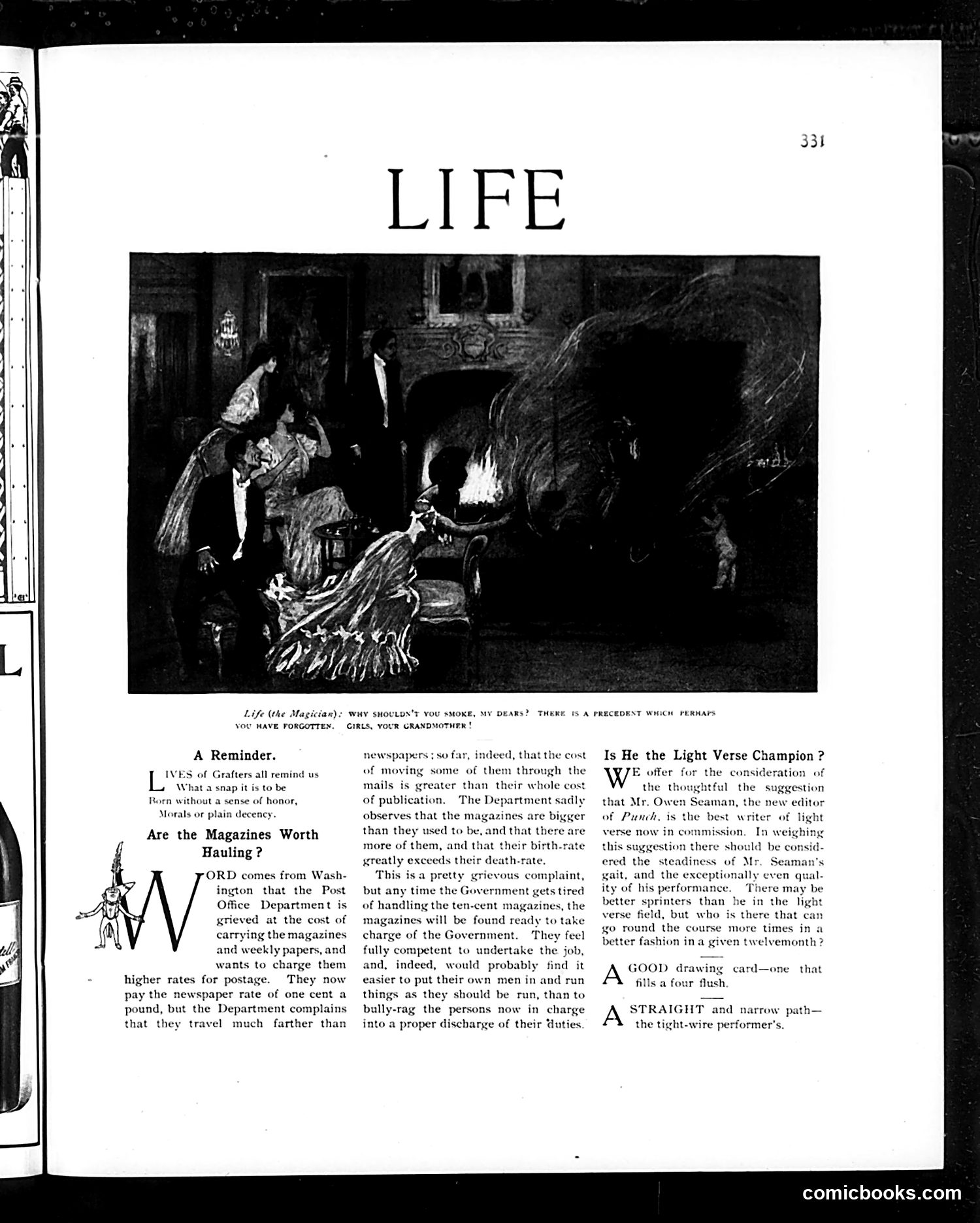
The page contains several satirical pieces targeting American institutions: **Main Cartoon**: "Life (the Magician)" depicts a society figure reminding guests that being "born without a sense of honor, morals or plain decency" is easy—likely satirizing the wealthy or political elite's ethical lapses. **"Are the Magazines Worth Hauling?"**: This piece mocks the Post Office Department's complaint that magazines cost too much to mail. Life sarcastically suggests magazines are so competent they could run the government better than current officials—a jab at government inefficiency and the power of the press. **"Is He the Light Verse Champion?"**: Life endorses Owen Seaman, new editor of *Punch* (a British satirical magazine), as the best light-verse writer, praising his consistency and skill. The page demonstrates Life's editorial voice: defending the magazine industry against government complaints while critiquing government competence and celebrating literary wit.
This page satirizes Colonel Henry Watterson's (editor of the Louisville Courier-Journal) suggestion that President Theodore Roosevelt should become President of Harvard College after leaving office. **The Setup:** Watterson proposes Harvard as an ideal "niche" for Roosevelt—where he could write books, preach ethics to students, and enjoy prestige for life. **Life's Rebuttal:** The magazine's response argues Roosevelt wouldn't actually want this "shelf" position. Five thousand ambitious Harvard students wouldn't revere him as "the greatest man on earth"—they'd debate whether he was a "gold brick" (fraud). More importantly, Roosevelt is a man of action who'd rather be "weighed" (tested in scales of power) than admired passively. **The Joke:** Watterson romanticizes the role, but Life suggests Roosevelt's temperament makes him unsuitable for academic life. The satirical thrust mocks both Watterson's naive proposal and implicitly questions whether Roosevelt—known for vigorous activism—could ever settle into scholarly retirement. The cartoon illustrations (visible but difficult to detail clearly) likely reinforce this contrast between contemplative academic life and Roosevelt's energetic personality.
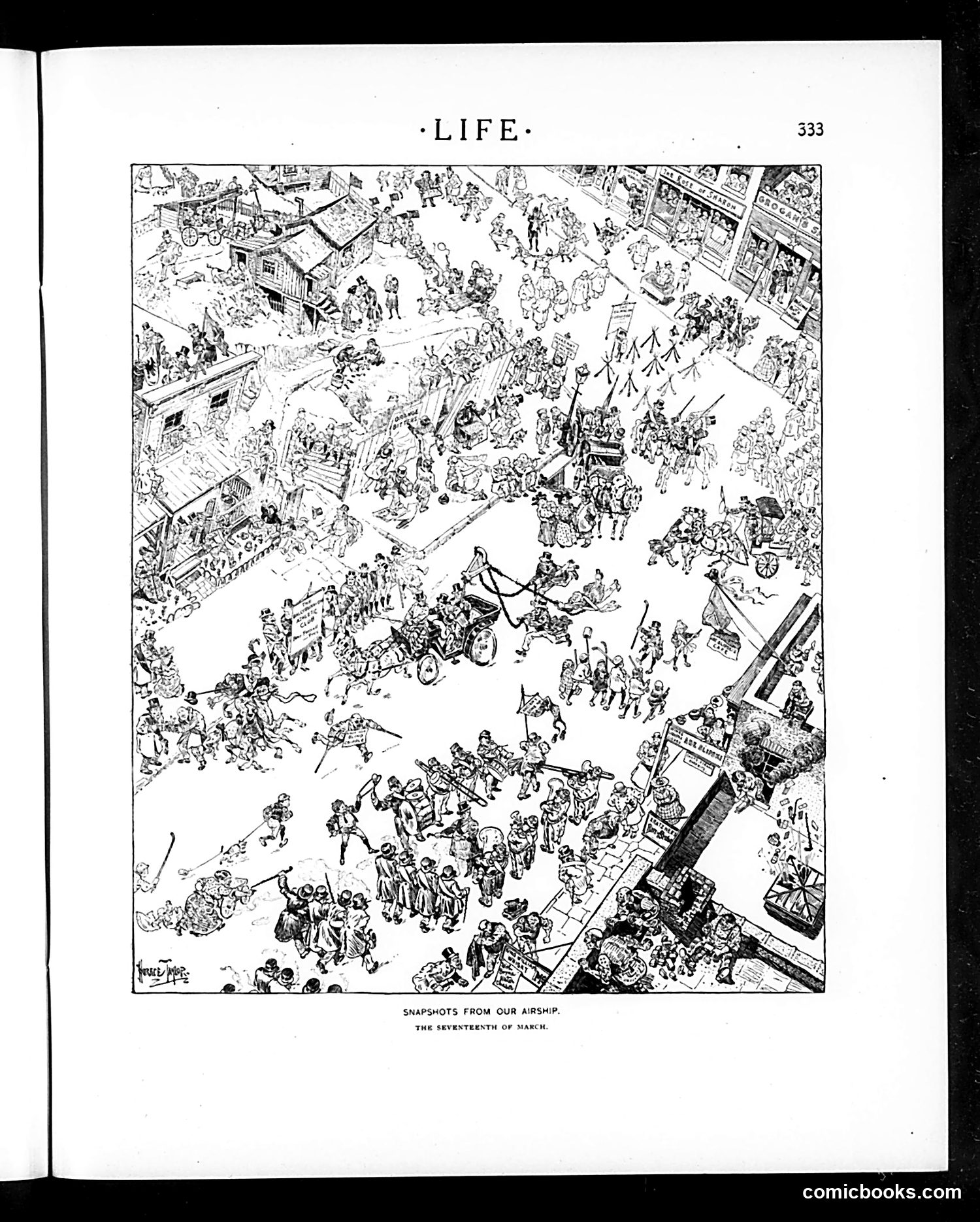
This is an aerial cartoon depicting a St. Patrick's Day celebration (March 17th) viewed from above, as if from an airship. The intricate bird's-eye view shows a crowded public square or street filled with hundreds of people, parade formations, horses, carriages, and festive gatherings. The satire appears to be commenting on the massive scale and chaos of Irish-American St. Patrick's Day celebrations—the sheer density of participants suggests both the holiday's popularity and perhaps gentle mockery of the revelry's intensity. The "airship" perspective is a modernist framing device popular in early 20th-century comics, offering a humorous vantage point on everyday American life. The detailed linework captures the democratic mixing of social classes and the commercial activity surrounding such public celebrations.
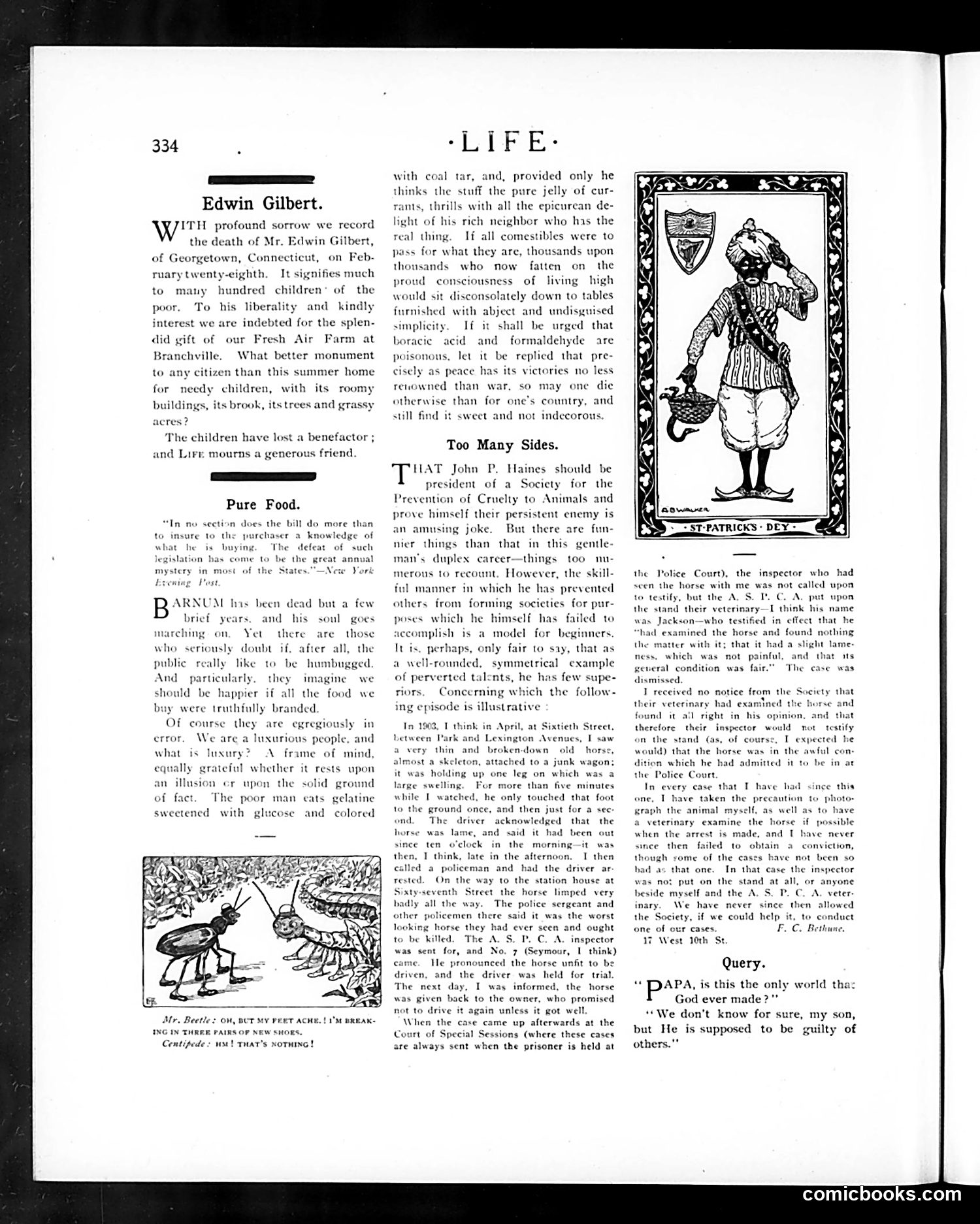
This page contains two distinct sections: **"Edwin Gilbert"** is an obituary praising a Connecticut philanthropist who donated a Fresh Air Farm for poor children—a common Progressive Era charity addressing urban poverty. **"Pure Food"** satirizes food safety and labeling. It references Barnum (the famous showman/huckster) to mock Americans' willingness to consume adulterated foods—items containing coal tar, formaldehyde, and boracic acid—if they're cheaper. The piece argues the poor eat "gelatine...sweetened with glucose" while the wealthy eat real food, yet both enjoy their meals equally. It's social commentary on class inequality and consumer deception in early 1900s food production. **"Too Many Sides"** criticizes John P. Haines, president of an animal welfare society, for hypocrisy. A detailed anecdote describes Haines witnessing a lame horse abused for hours but doing nothing—despite his organization's supposed mission. The satire exposes his moral inconsistency. The cartoons (Mr. Beetle and Centipede) appear unrelated comic relief about shoe-wearing.
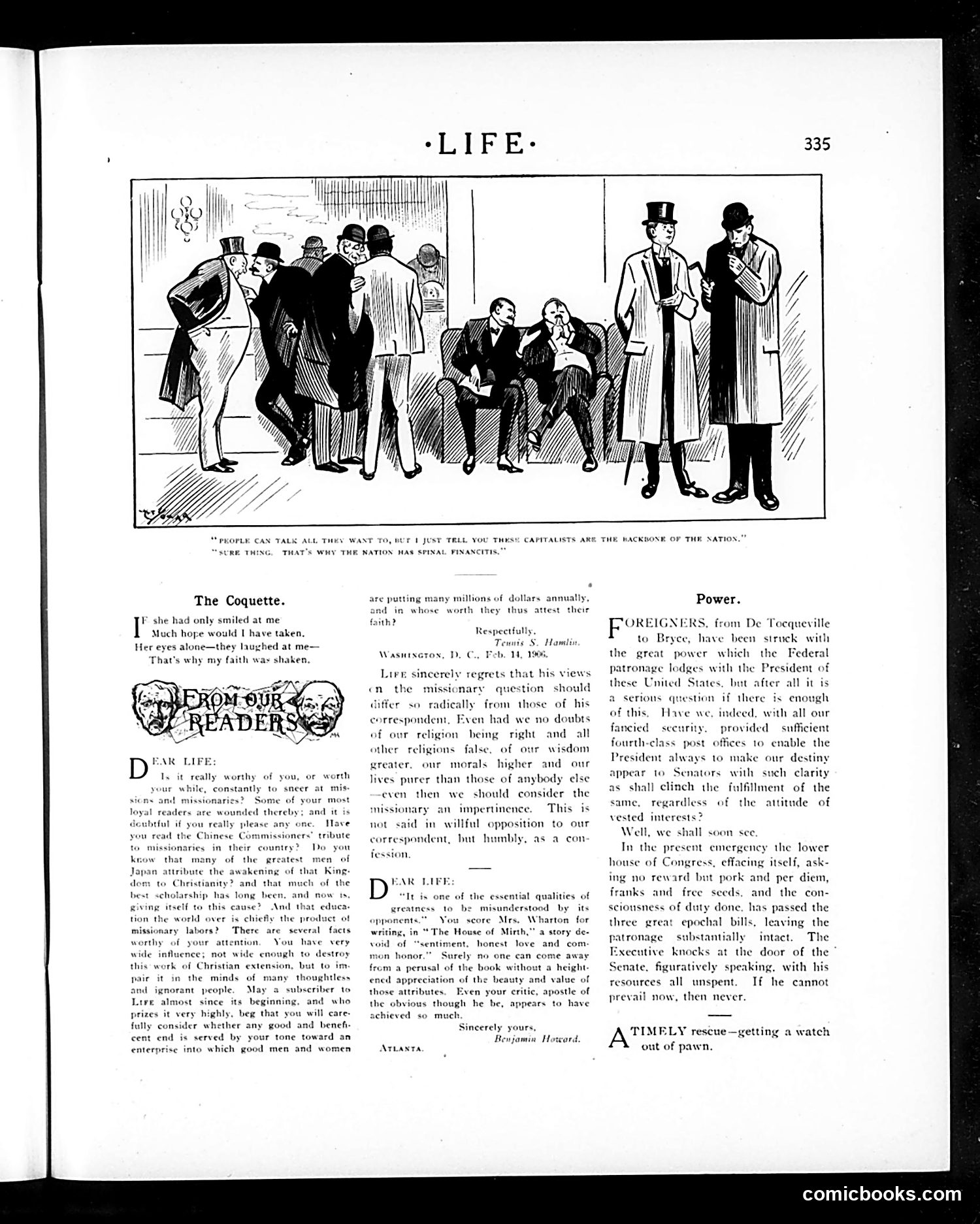
The top cartoon satirizes capitalist influence on government. A caption quotes someone claiming "capitalists are the backbone of the nation," while the visual shows well-dressed businessmen lounging comfortably while politicians and officials stand around them deferentially—suggesting capitalists control the nation's political apparatus rather than serving it. Below are three editorial sections responding to reader letters. One defends missionary work against accusations it's imperialistic. Another praises the novel *The House of Mirth* for its moral insights. The third, titled "Power," addresses concerns about whether the federal government has sufficient authority to advance national destiny independent of wealthy interests' influence. The page reflects Progressive Era anxieties (likely 1900s-1910s) about corporate power dominating democratic institutions and whether elected leaders could act in the public interest against entrenched financial interests.
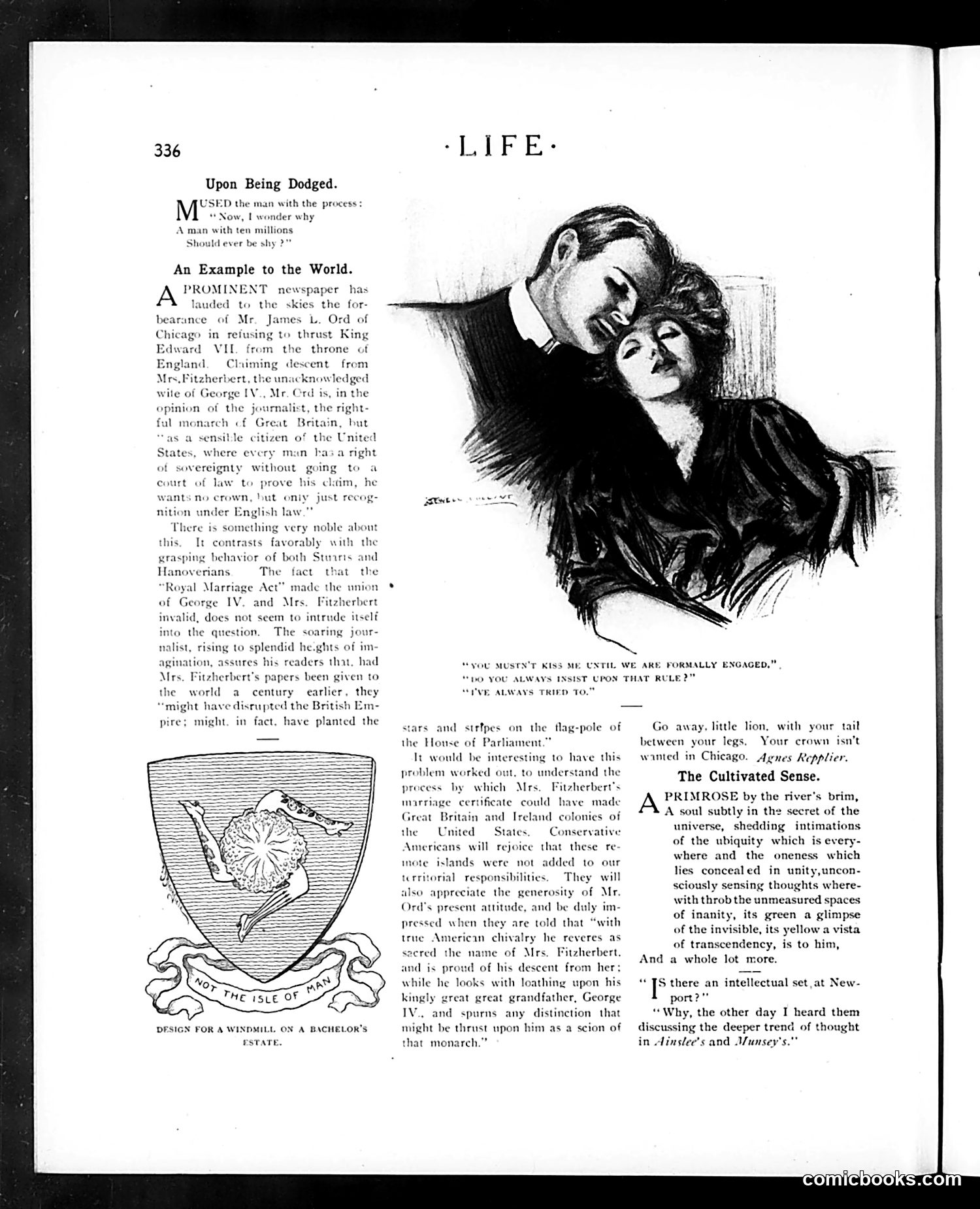
This page contains satirical commentary on James L. Ord of Chicago, who publicly refused to claim the British throne based on descent from Mrs. Fitzherbert (mistress of King George IV). The main article mocks Ord's rejection of a royal claim he never actually possessed, presenting it as false nobility. The satire suggests his refusal is performative virtue-signaling—claiming moral superiority for rejecting something that was never legitimately his to accept. The accompanying illustration shows a romantic couple, likely depicting the engagement etiquette being discussed in the caption dialogue about formal engagement protocols. A secondary item, "The Cultivated Sense," satirizes pretentious intellectualism—mocking Newport society for discussing "deeper trends of thought" in popular magazines (Munsey's), implying their intellectual sophistication is superficial posturing rather than genuine cultivation. Both pieces target American social pretension and false moral or intellectual authority.
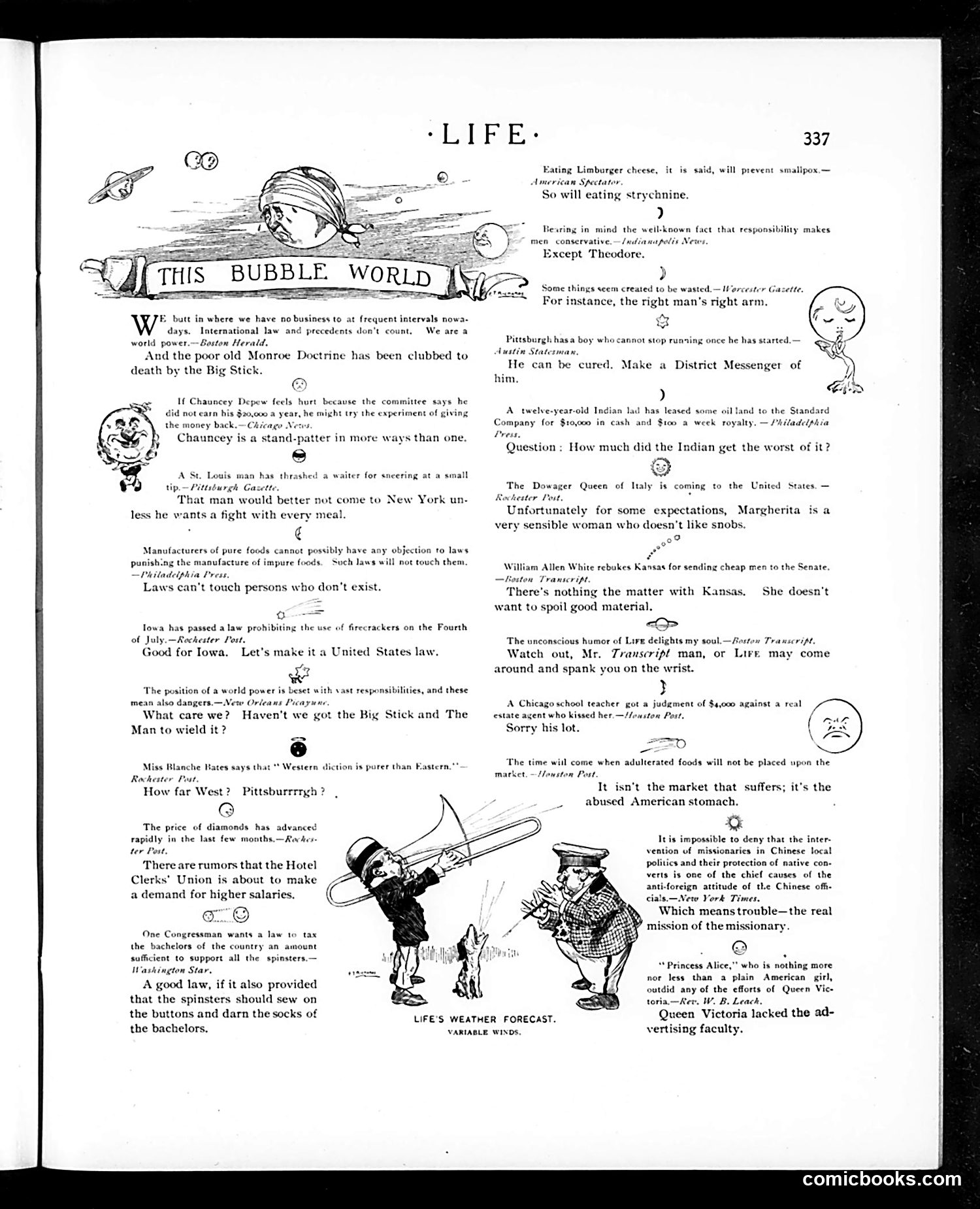
This page from *Life* magazine compiles brief satirical observations on contemporary American politics and society, likely from the early 1900s. Key references include: **"The Big Stick"** appears twice, referencing President Theodore Roosevelt's aggressive foreign policy—the satire mocks America's interventionist approach, noting the Monroe Doctrine has been "clubbed to death." **Political figures mentioned**: William Allen White (Kansas editor) and references to "Except Theodore," suggesting Roosevelt's inconsistency regarding conservative responsibility. **Social commentary** addresses: labor disputes (hotel clerks' unions), wealth inequality (the Indian oil-lease scam), food safety laws, gender relations, and missionary interference in Chinese politics. **The cartoon** at bottom ("Life's Weather Forecast") shows two figures—one wielding a club—depicting America's unpredictable, aggressive foreign policy as "variable winds." The overall tone criticizes American imperialism, corporate exploitation, and social hypocrisy through dry wit and irony typical of *Life*'s editorial approach.
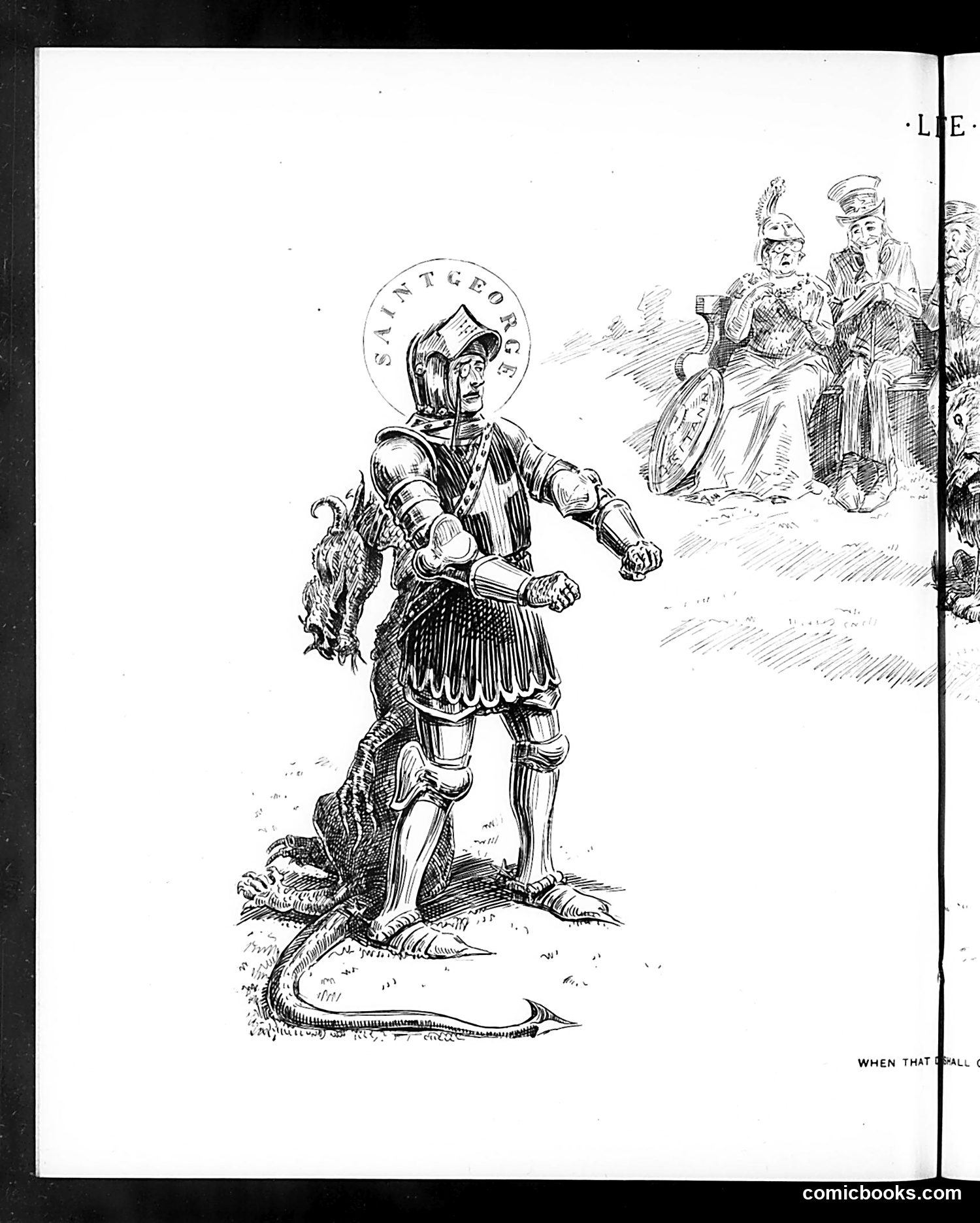
This page from *Life* magazine features a political cartoon depicting a figure labeled "SALTBURG" (visible in the halo/circle above the head). The character is dressed as a medieval knight in full armor, standing triumphantly with what appears to be a dead creature or trophy at their feet. A dragon or serpent lies defeated below. In the background, other figures observe the scene, suggesting this commemorates some notable event or achievement. The medieval knight imagery and the label suggest this satirizes a contemporary political or military figure, likely referencing the Salzburg region or a person/leader associated with it. The incomplete OCR text ("WHEN THAT SHALL...") prevents full interpretation, but the heroic-mock treatment typical of *Life*'s satire suggests ironic commentary on claimed victories or importance.
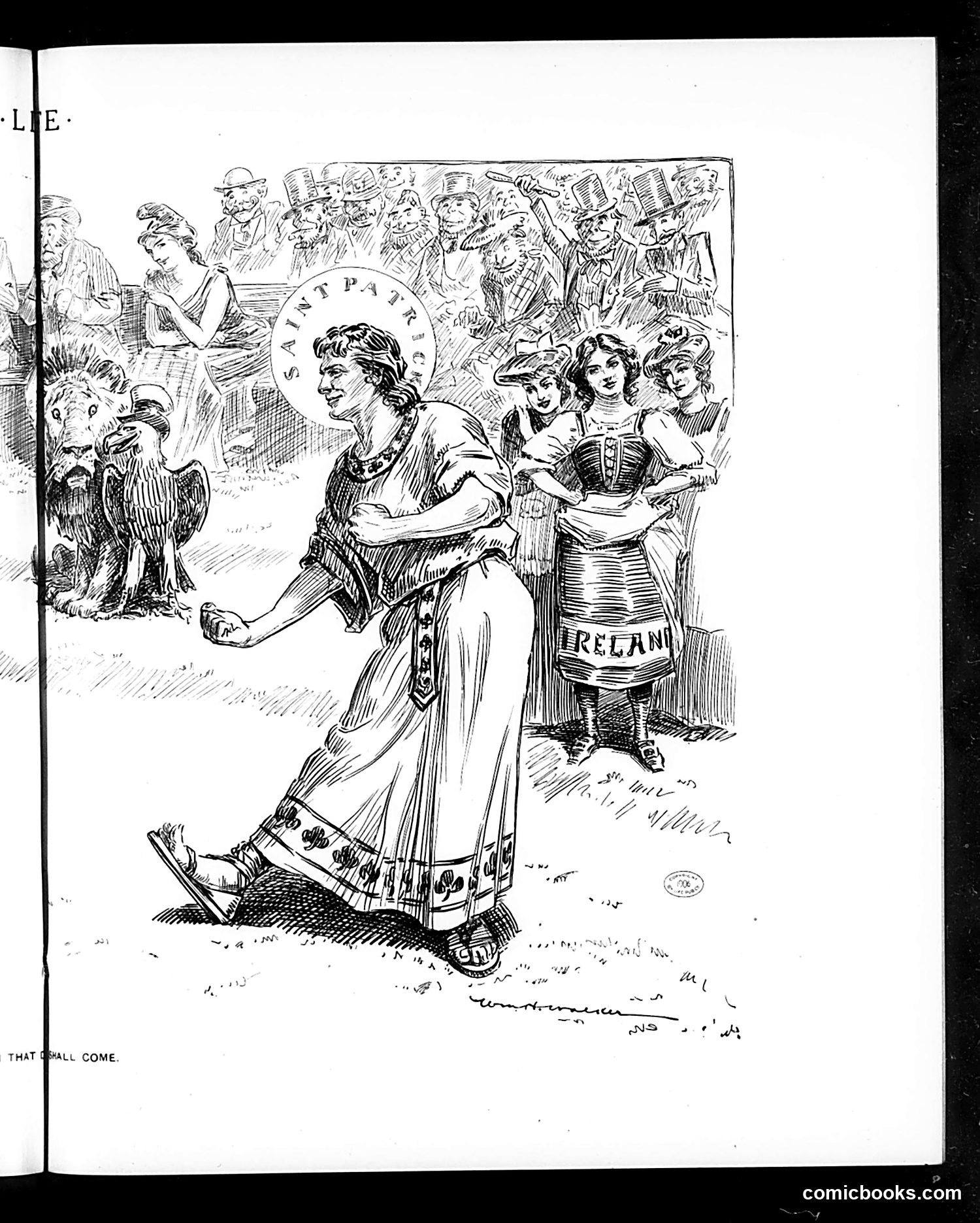
This appears to be a satirical cartoon from *Life* magazine depicting Ireland as a female figure (labeled "IRELAND" on her dress) being presented to an audience. She's positioned before what looks like a Shakespeare or theatrical backdrop (marked "SAINT PAUL'S"), with a lion on the left side and various onlookers in the background wearing period dress and top hats. The cartoon likely satirizes British political attitudes toward Ireland—possibly referencing Ireland's status or treatment within the British political system. The theatrical staging suggests Ireland is being "put on display" or presented as a spectacle. The caption fragment "THAT SHALL COME" is unclear without full context, but the overall image appears to mock how Ireland or Irish affairs were treated as entertainment or political theater by British audiences and policymakers.
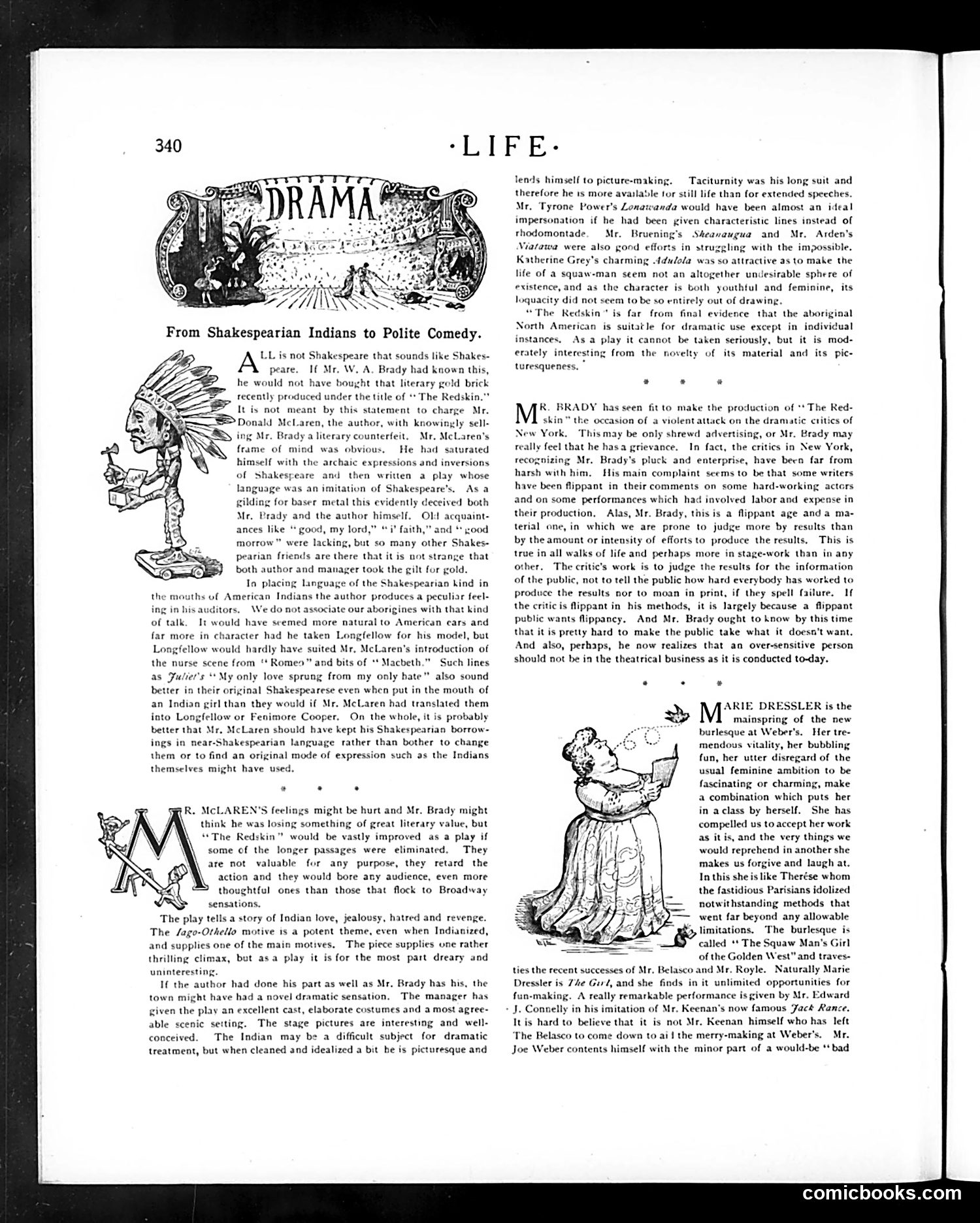
This is a drama criticism of a Broadway play called "The Redskin" by Donald McLaren, produced by W.A. Brady. The reviewer attacks the play's fundamental absurdity: it presents Native Americans speaking in Shakespearean language and style. The satire targets McLaren's pretentiousness—he saturated himself with archaic Shakespearean phrasing, then applied it to American Indian characters, creating an unnatural and laughable effect. The critic notes this sounds ridiculous; Indians would never speak this way. He suggests Longfellow or Fenimore Cooper would have been more appropriate models. The review acknowledges Brady's excellent production values (casting, costumes, sets) but argues the play itself is tedious and dreary, dragging with lengthy passages that bore audiences. The "Iago-Othello" jealousy plot shows promise, but poor execution undermines it. The underlying joke: pretentious literary imitation (fake "Shakespeare") fooled both author and producer, who mistook artificial language for genuine dramatic merit.
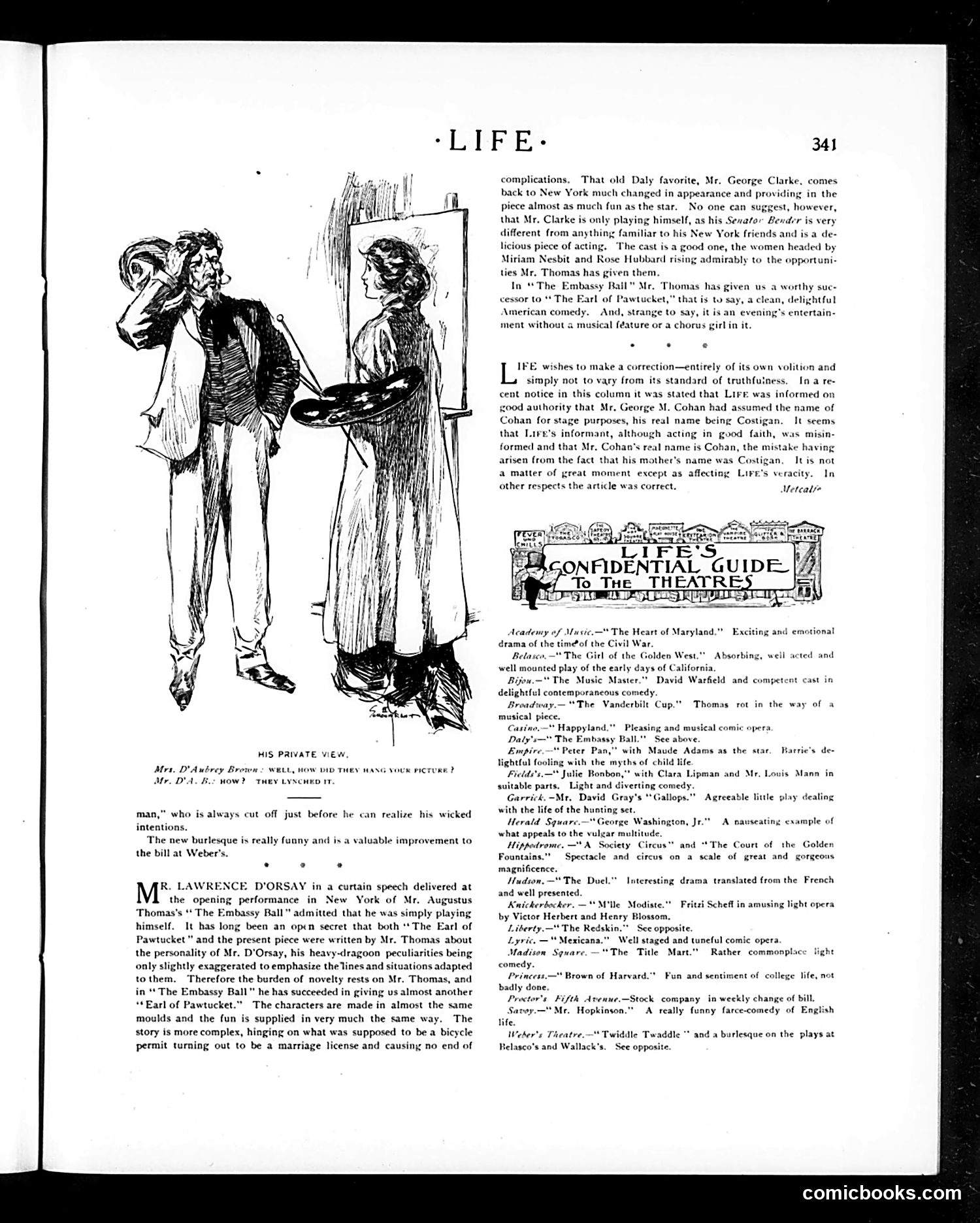
This page contains theatrical reviews and a satirical cartoon about an artist's portrait exhibition. **The Cartoon**: The sketch labeled "His Private View" shows two figures—a woman asking a man (identified as Mr. D'Aubrey Brown) how his picture was hung in an exhibition. His response uses a racial slur, making a joke about lynching. The humor relies on a dark double meaning: "hung" (displayed in a gallery) versus "hanged" (executed by lynching). This reflects the casual racist cruelty embedded in early-1900s American humor, where lynching was treated as acceptable subject matter for jokes in mainstream publications. **Context**: This appears in a theater review section, suggesting the cartoon may reference a theatrical personality or production, though the specific context isn't entirely clear from the visible text. The page primarily consists of reviews of Broadway productions and an editorial correction regarding actor George M. Cohan's real name.
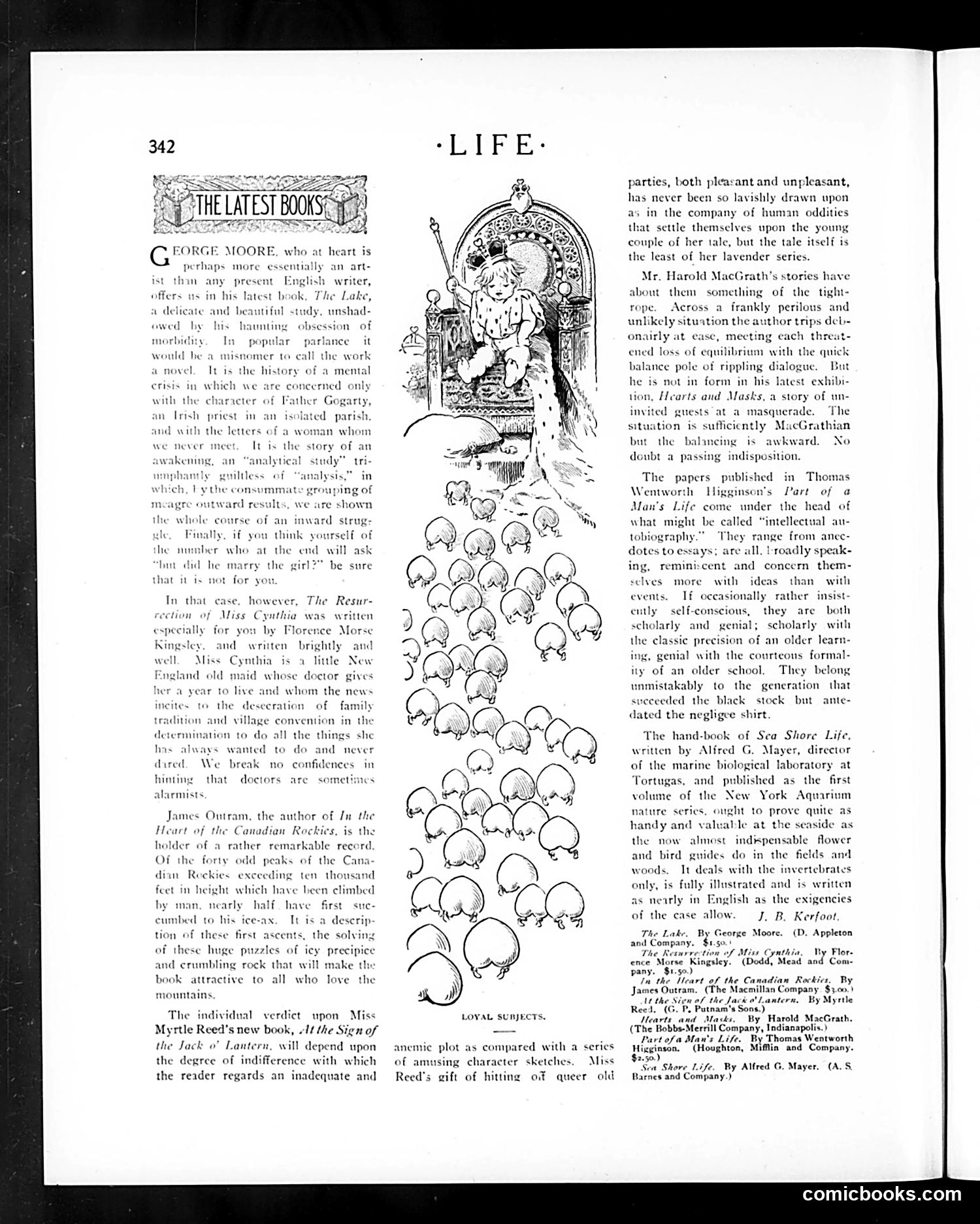
This page reviews recent books rather than presenting political cartoons. The central illustration depicts "Loyal Subjects"—a whimsical drawing of numerous small creatures (appearing as round, simplified figures) arranged in a pyramid formation, likely referencing a book discussed in the reviews. The page primarily contains literary criticism of contemporary works by authors including George Moore, Florence Morse Kingsley, James Outram, Myrtle Reed, and Harold MacGrath. The reviews discuss plot, character development, and writing style in the genteel, somewhat condescending tone typical of early 20th-century literary journalism. The illustration's meaning remains unclear from the visible text—it may be decorative, or relate to one of the reviewed books' content. Without identifying which specific book it accompanies, the satirical intent (if any) cannot be determined. This appears to be standard book review content rather than political satire.
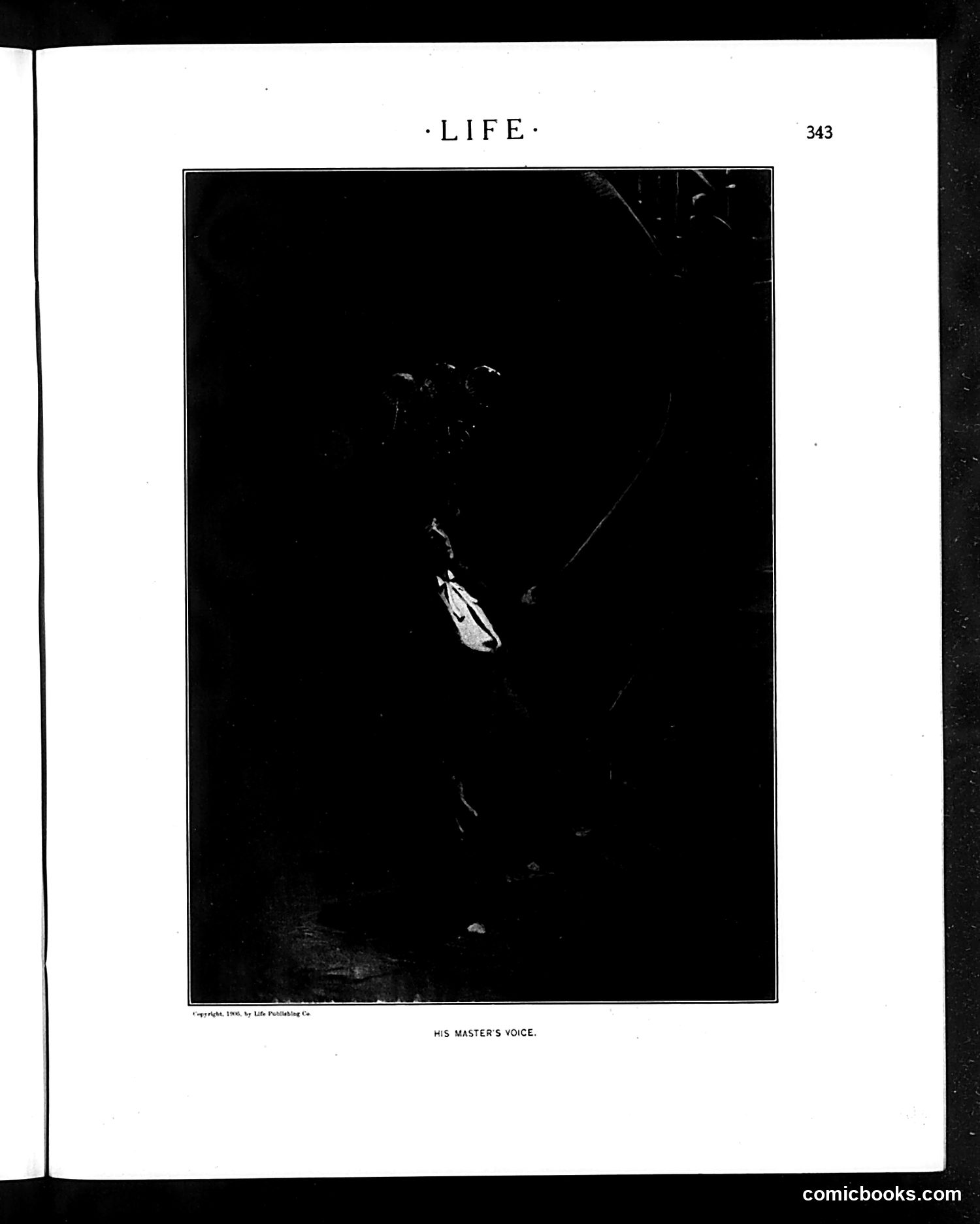
This page from *Life* magazine (page 343) reproduces a famous advertisement: the RCA Victor "His Master's Voice" image showing a dog listening to a gramophone/phonograph. The image is credited "Copyright 1906, by Life Publishing Co." The satirical caption repurposes the commercial image's title to make a political point—though the specific context isn't entirely clear from this page alone. The joke likely critiques someone or some group as slavishly obedient ("his master's voice"), either mocking political servility, corporate loyalty, or uncritical acceptance of authority. The iconic dog-and-gramophone image makes the insult pointed: the subject is being compared to a dog mechanically responding to commands. Without additional context from surrounding articles, the exact target remains unclear.
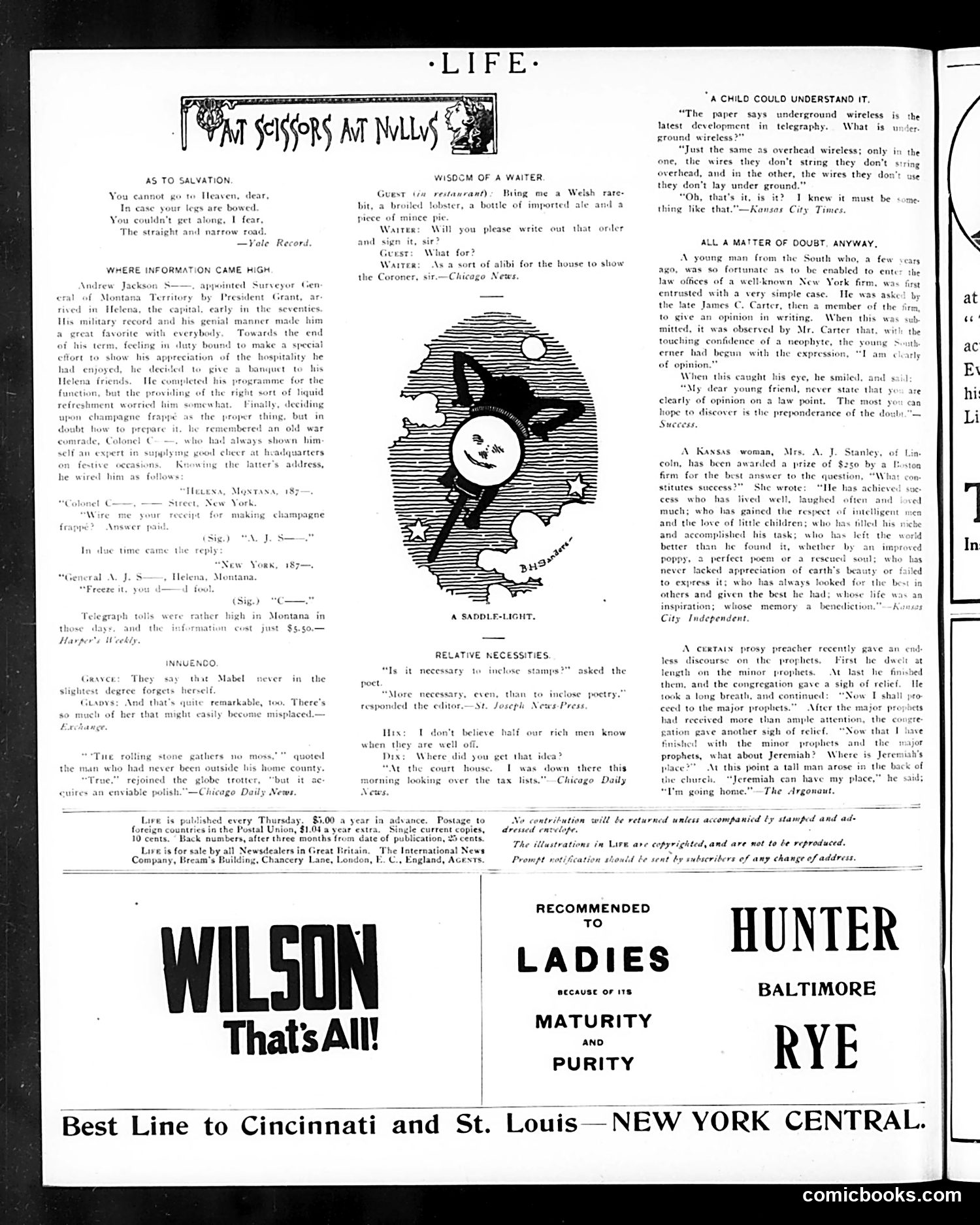
This is a miscellaneous humor page from *Life* magazine, primarily featuring short jokes and anecdotes rather than political cartoons. **Main Content:** The page contains several brief satirical pieces: 1. **"A Child Could Understand It"** — A joke mocking the confusing explanation of "underground wireless" (early radio/telegraph technology), where the distinction between overhead and underground systems is rendered absurdly circular. 2. **"Where Information Came High"** — An anecdote about a Montana surveyor who, preparing a banquet, sends an expensive telegraph asking for a champagne recipe—highlighting the absurdity of using costly communication for trivial purposes. 3. **"A Saddle-Light"** (illustration) — Appears to show a humorous visual gag, though details are unclear. 4. Various short jokes about human nature and social situations. **Purpose:** These are light, observational humor pieces typical of *Life*'s satirical approach—poking fun at emerging technology confusion, human vanity, and everyday absurdities rather than targeting specific political figures or events.
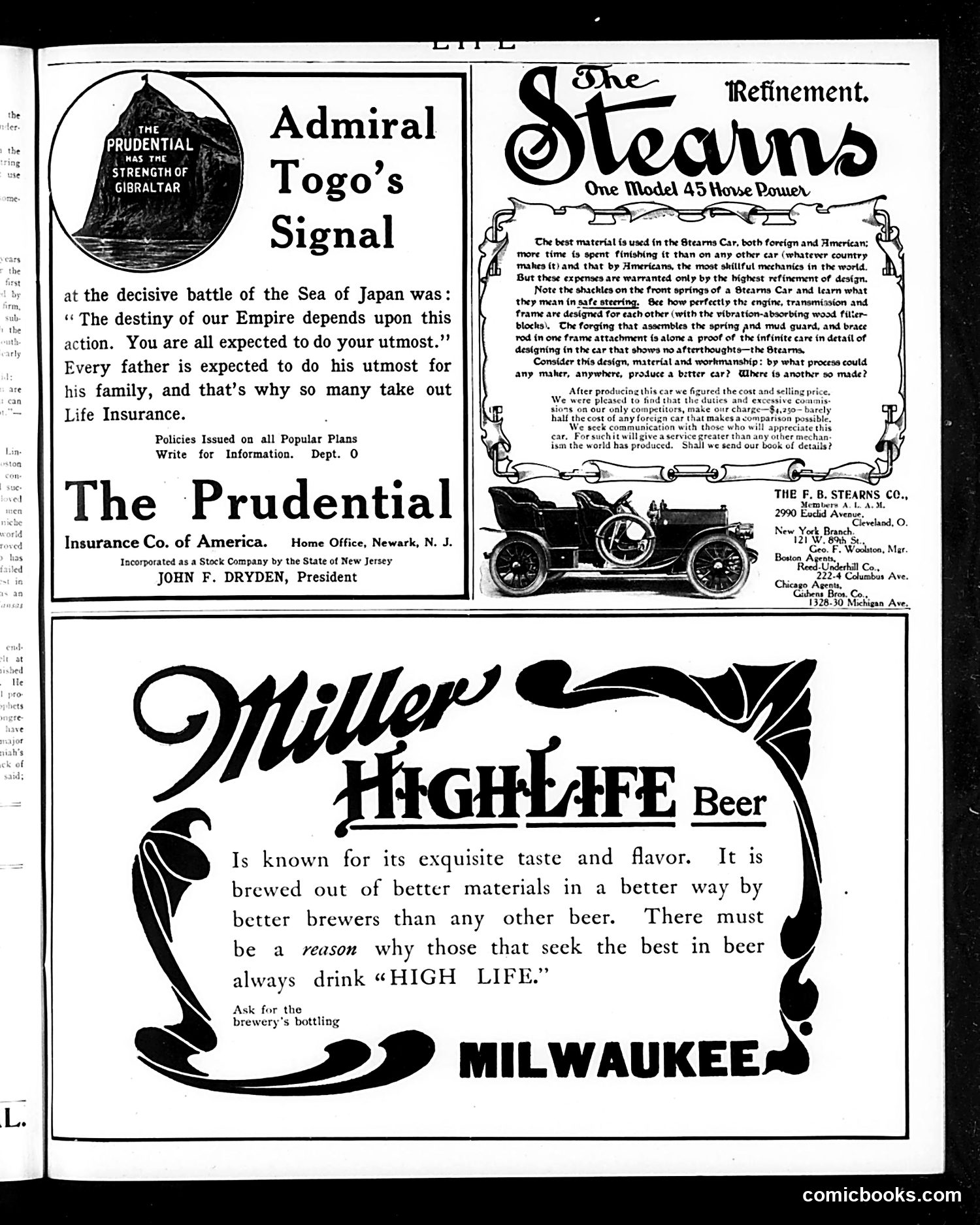
This page contains three distinct advertisements rather than editorial cartoons. **Top Left: Prudential Insurance** uses Admiral Togo's famous signal from the 1905 Russo-Japanese War Battle of the Sea of Japan ("The destiny of our Empire depends upon this action") as a patriotic appeal. The ad equates family duty with life insurance—just as soldiers must do their utmost for empire, fathers must protect their families financially. This leverages contemporary militaristic sentiment and nationalism to sell insurance. **Top Right: Stearns Automobile** promotes refinement and meticulous American manufacturing, emphasizing superior design and craftsmanship justify premium pricing. **Bottom: Miller High Life Beer** claims superiority through quality ingredients and brewing methods, asserting that discriminating consumers naturally choose "High Life." All three ads target middle-class male readers, appealing to duty, status, and aspirational consumption—typical of early 20th-century American advertising strategy.
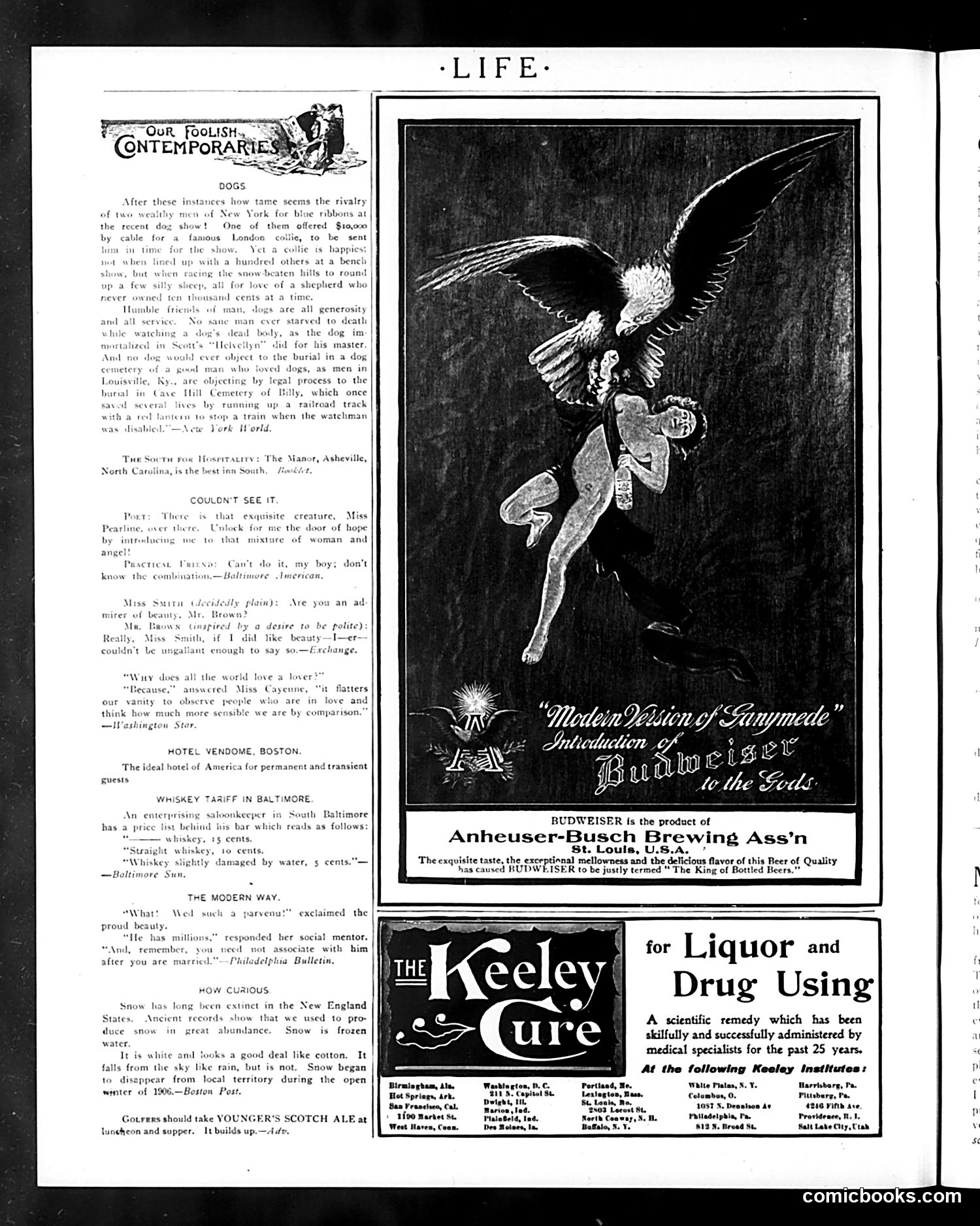
This page from *Life* magazine contains satirical commentary and period advertisements rather than a unified cartoon. **Main Content:** The "Our Foolish Contemporaries" column mocks wealthy New Yorkers' competitive dog-showing culture, contrasting their vanity with dogs' genuine loyalty. It includes anecdotes about a dog memorialized by Scott and references to Louisville cemetery disputes—satirizing human sentimentality toward pets while questioning the logic of expensive dog competitions. **Social Satire:** Brief jokes target gender relations ("I couldn't see it"), women's beauty standards, and Baltimore's whiskey tariffs—typical early 20th-century humor about contemporary foolishness. **Advertisements:** The page also features prominent ads for Budweiser beer and the "Keeley Cure"—a famous (now-infamous) treatment for alcohol and drug addiction, representing the era's pre-Prohibition attitudes toward drinking and the pseudo-scientific remedies marketed alongside alcohol sales. The juxtaposition is historically notable: *Life* simultaneously advertised alcohol while running ads for addiction treatment.
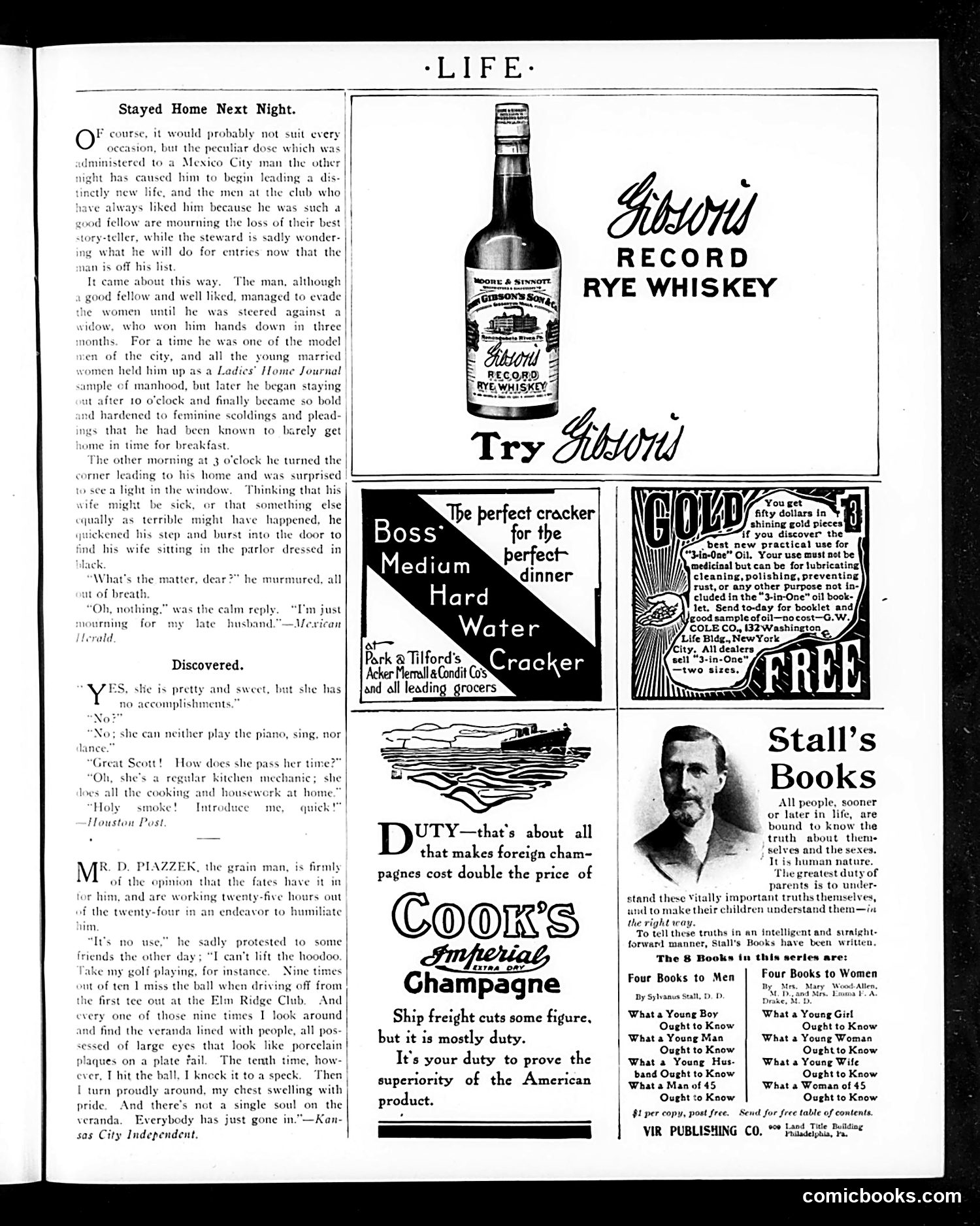
This page from Life magazine (a satirical publication) contains three humorous stories and several advertisements, typical of early 20th-century American humor. **"Stayed Home Next Night"** satirizes a man who, after receiving some unspecified "dose" in Mexico City, abandons his formerly respectable lifestyle. He transforms from a model citizen praised in women's magazines into a carouser staying out until 3 a.m. The joke hinges on his wife's calm response when he rushes home worried—she's merely mourning "her late husband," implying his behavioral death. **"Discovered"** mocks changing marital standards. A woman praised as "pretty and sweet" but "accomplishless" is revealed to actually be valuable because she's a "regular kitchen mechanic" who handles all domestic work—satirizing how women's worth was measured solely by domestic utility. **"Mr. D. Piazzek"** humorously describes a man blaming cosmic bad luck, particularly at golf, claiming he can only succeed when no one watches. It's absurdist humor about superstition and self-sabotage. The advertisements (Boss crackers, Cook's champagne, Stall's Books about sexual education) are period-typical but unrelated to the satirical content.
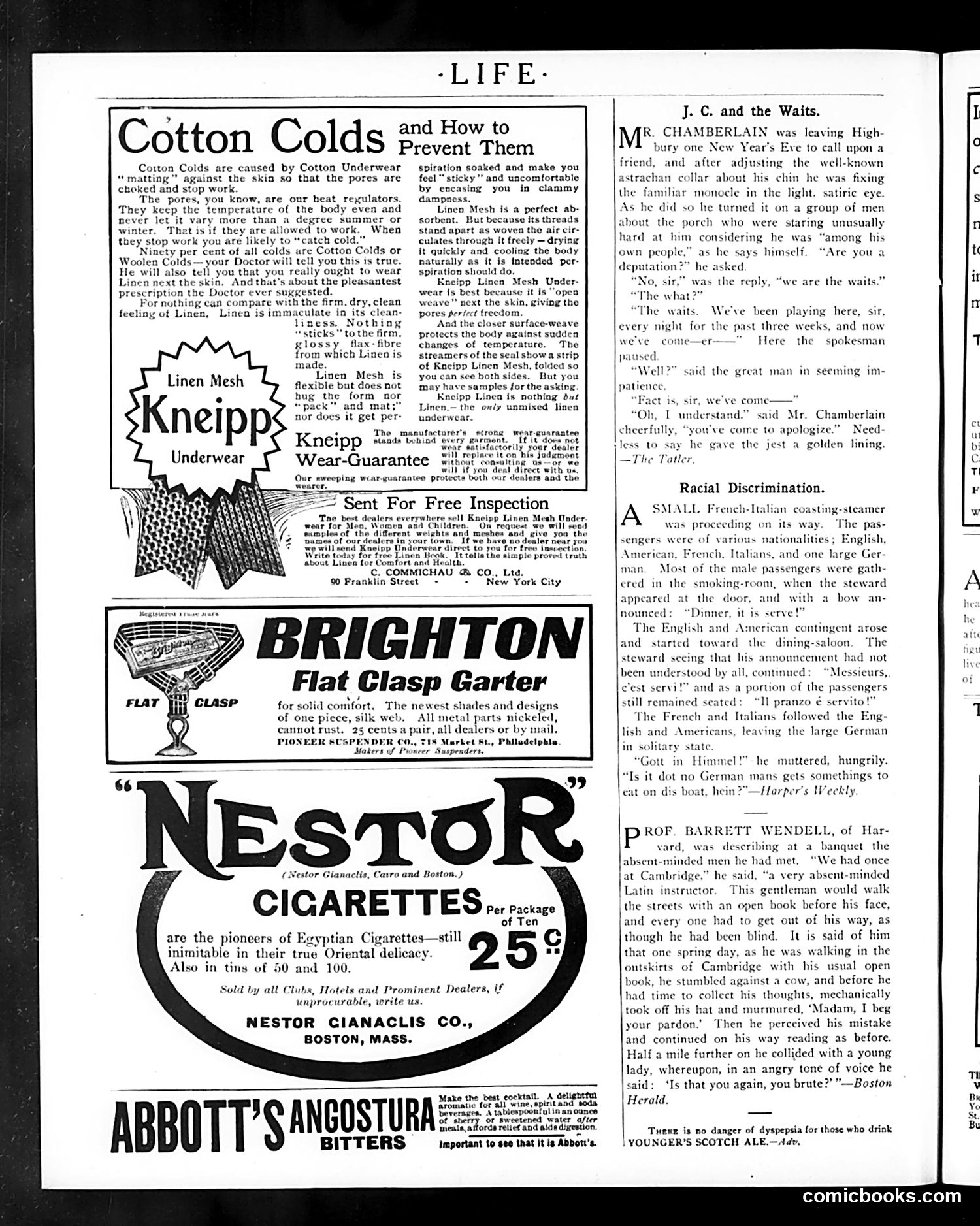
This page is primarily **advertisements** for consumer products (underwear, garters, cigarettes, bitters) interspersed with three short satirical pieces. The main satirical content includes: 1. **"J.C. and the Waits"** — A social satire about a wealthy man ("Mr. Chamberlain") encountering Christmas carolers ("waits") on New Year's Eve. The humor lies in his confusion about who they are and class assumptions about "his own people." 2. **"Racial Discrimination"** — A brief anecdote about a French-Italian steamship where the English/American passengers segregate from Continental Europeans in the dining room, with anti-German sentiment expressed ("God in Himmel!"). This satirizes ethnic and national prejudices of the era. 3. **"Prof. Barrett Wendell"** — A humorous story about an absent-minded Harvard Latin professor who walks through Cambridge reading a book, collides with a cow, and continues reading, oblivious. The joke plays on academic absentmindedness. The page reflects early 20th-century *Life* magazine's satirical focus on social pretension, class distinctions, and ethnic stereotypes typical of that period.
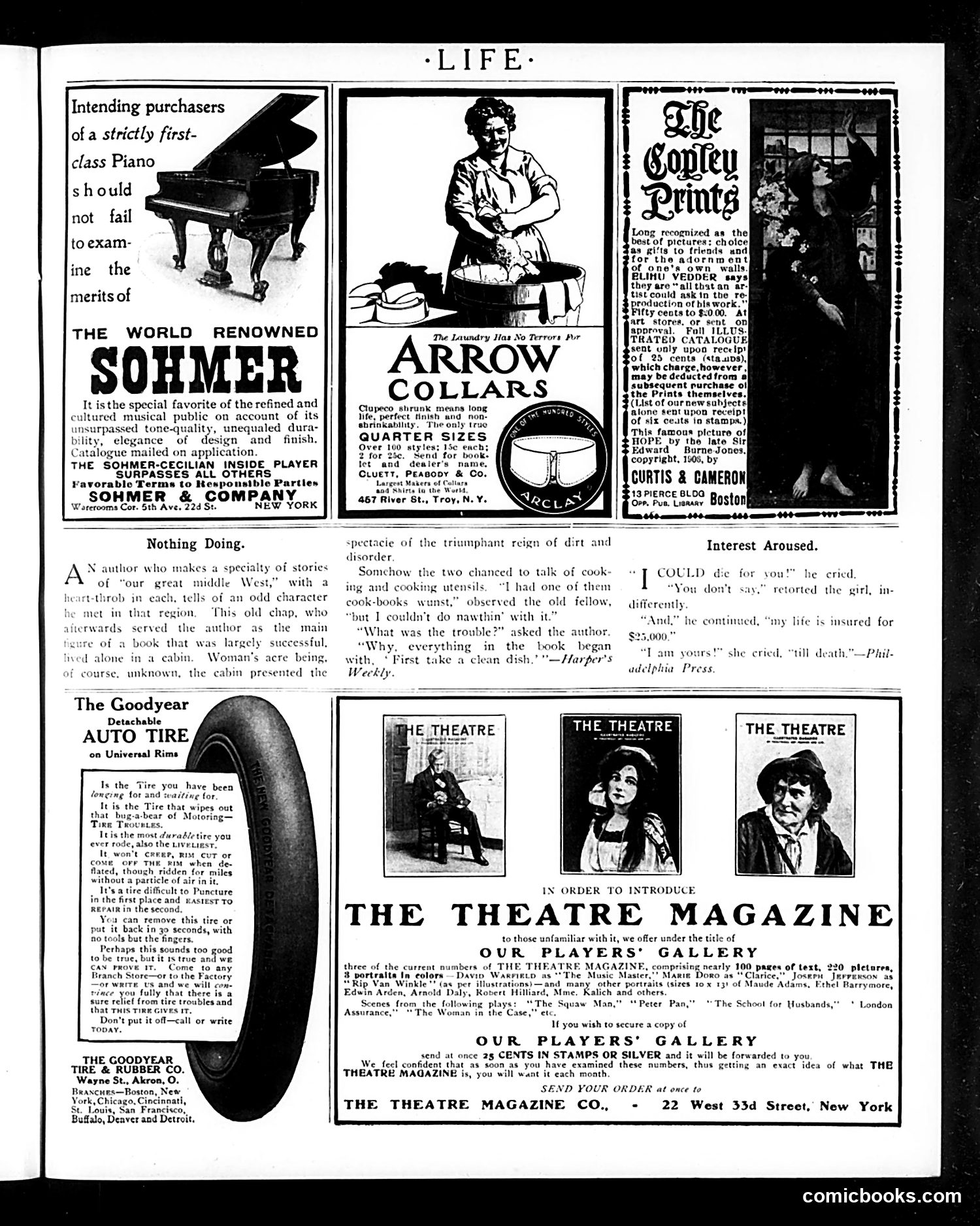
This page is primarily **advertising**, not satirical content. It contains product advertisements (Sohmer pianos, Arrow collars, Goodyear tires, Copley prints) interspersed with brief humorous anecdotes and Theatre Magazine promotions. The two notable text items are: 1. **"Nothing Doing"**: A short joke about a Midwestern cabin-dweller who owned a cookbook but found it useless because the first instruction—"First take a clean dish"—proved impossible in his disorder-filled home. The humor relies on rural/frontier stereotypes about slovenliness. 2. **"Interest Aroused"**: A brief romantic dialogue where a woman's enthusiastic declaration of love is undercut by the man's insurance policy mention, subverting romantic sentiment with practicality. Both anecdotes are mild, character-driven humor typical of early 20th-century magazines—no political satire or caricature is present. The page mainly serves to fill space between advertisements.
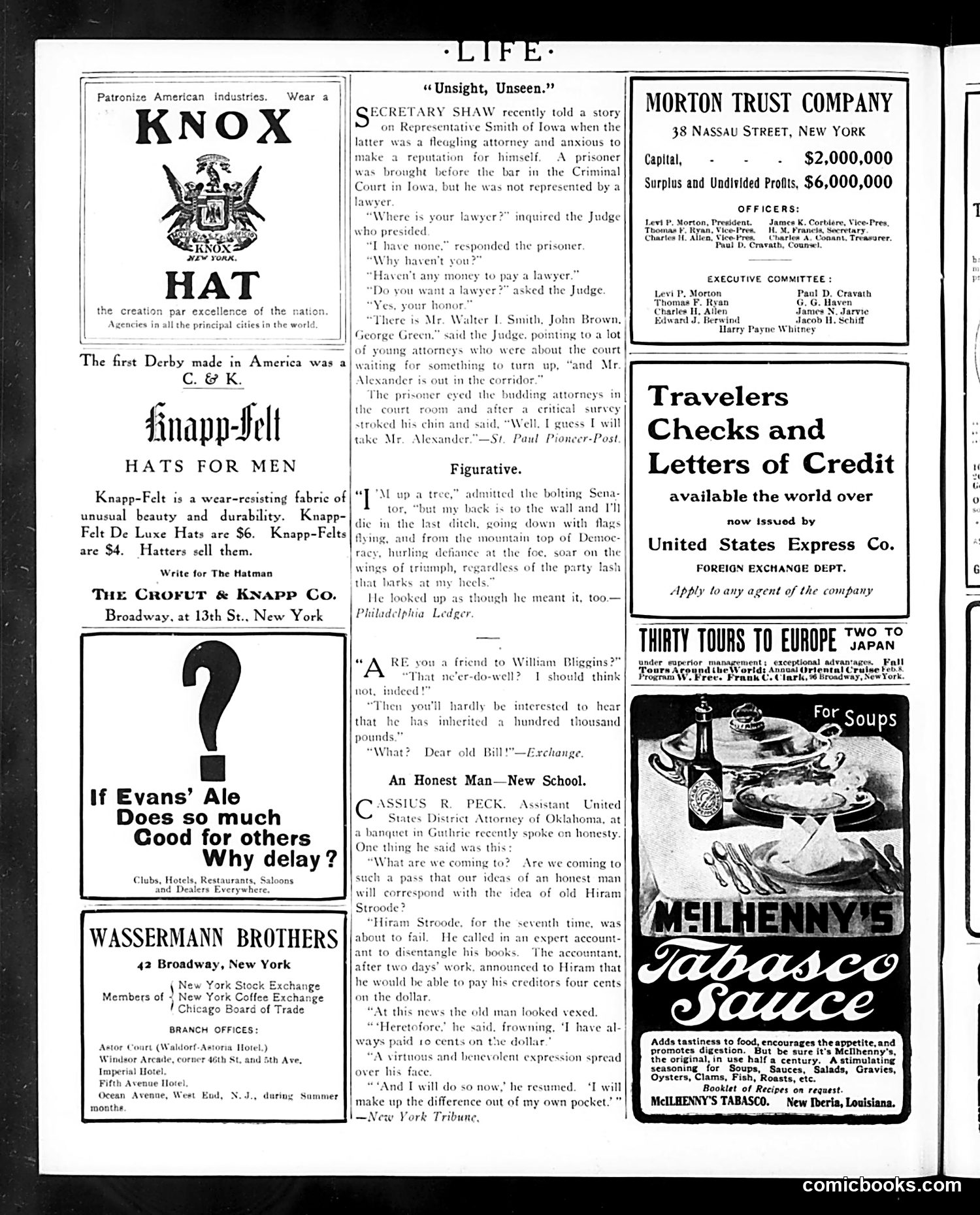
This page is primarily **advertising and humor anecdotes** rather than political cartoons. The main content includes: **Advertisements** dominate: Knox Hats, Knapp-Fell Hats, Evans' Ale, Wassermann Brothers (stock brokers), Morton Trust Company, United States Express travelers' checks, and McIlhenny's Tabasco Sauce. **Humor section** titled "Unsight, Unseen" contains several brief anecdotes: 1. A story about Representative Smith of Iowa involving a poor defendant unable to afford a lawyer—satirizing the legal system's treatment of the impoverished. 2. An exchange about William Bliggins inheriting money—a joke about unexpected wealth. 3. "An Honest Man—New School": A satirical anecdote about an Oklahoma District Attorney who discovers an accountant has reduced his creditor payments from 10 cents to 4 cents per dollar. The punchline mocks modern dishonesty: the man vows to maintain his old-fashioned virtue by paying 10 cents on the dollar—implying this is now considered generous rather than honest. The humor critiques contemporary moral and legal shortcuts.
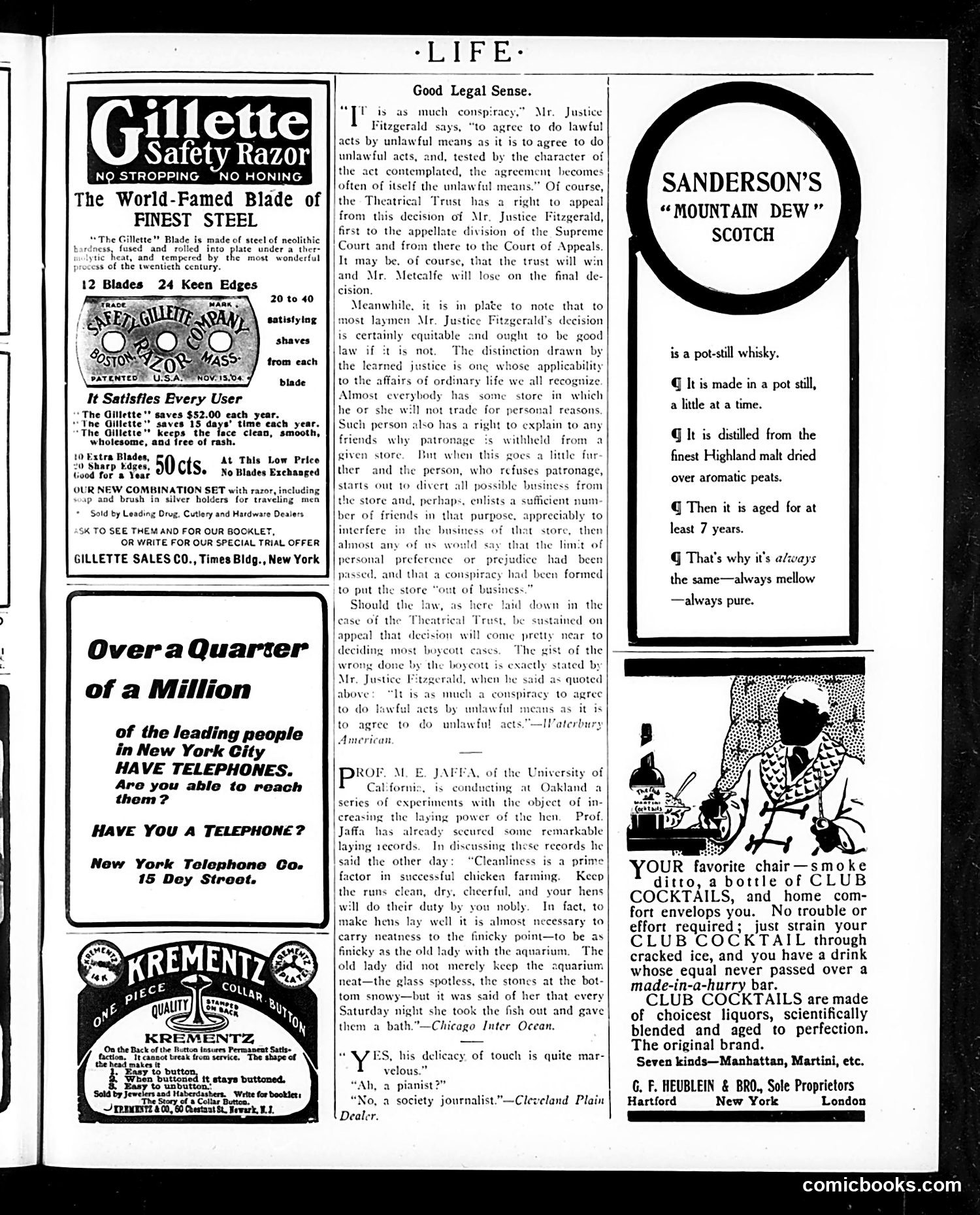
This page is primarily **advertisements** for consumer products (Gillette razors, telephones, collar buttons, Scotch whisky, cocktails) interspersed with two brief editorial pieces. The substantive content addresses: 1. **"Good Legal Sense"** — Commentary on a court decision by Mr. Justice Fitzgerald regarding the Theatrical Trust, discussing whether organizing boycotts constitutes illegal conspiracy. The piece distinguishes between personal preference (legal) and organized interference with a business (potentially illegal). This references real Progressive Era antitrust litigation against theater monopolies. 2. **Chicken farming notes** — Prof. M.E. Jaffa's experiments on improving hen productivity through cleanliness, discussed in mundane agricultural terms. Neither piece contains political satire or caricature. The page represents typical early 20th-century *Life* magazine format: commercial advertising dominant, with brief commentary on legal/scientific matters of contemporary interest to educated readers.
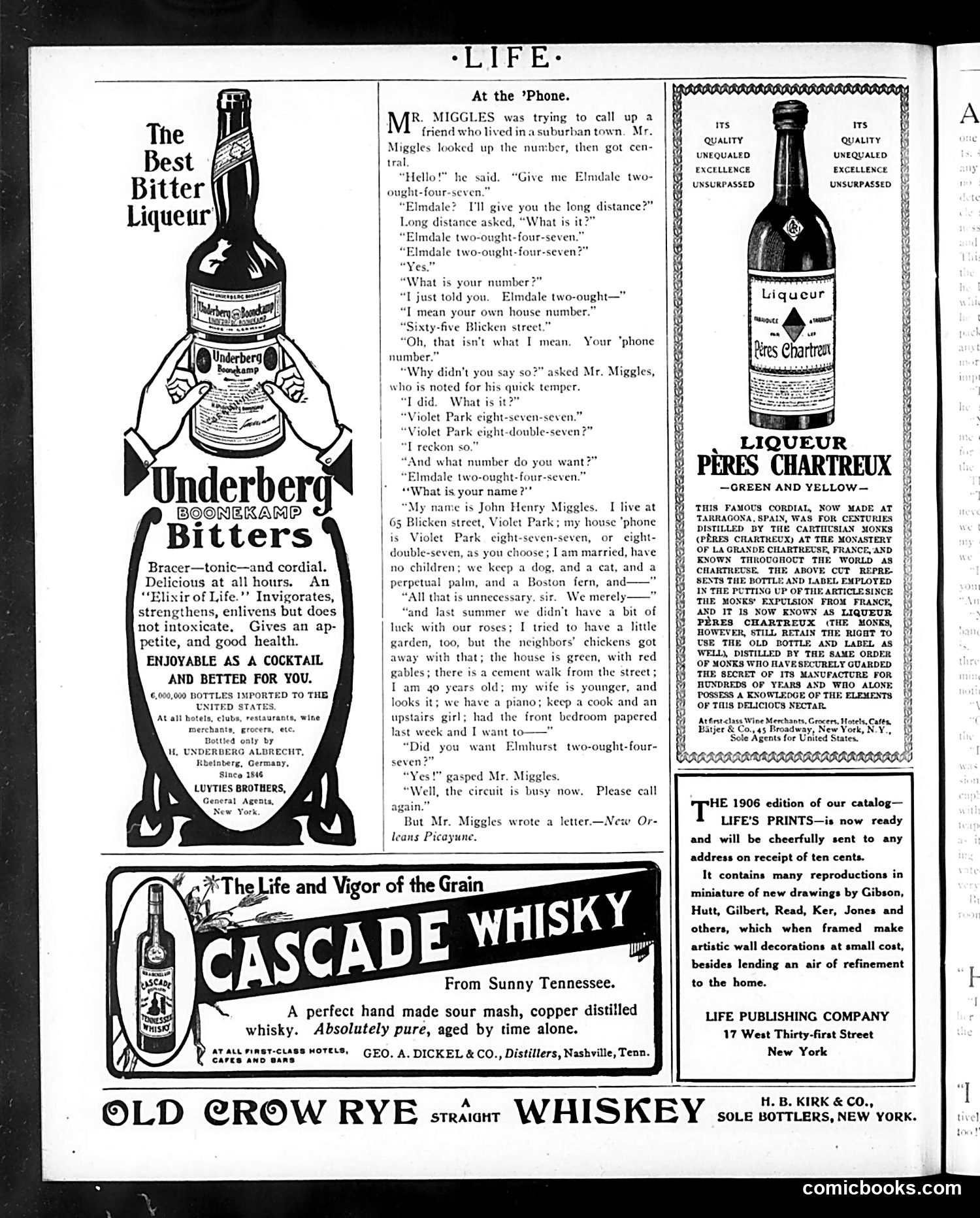
This humor piece satirizes the frustrations of early 1900s telephone technology and operators. Mr. Miggles attempts calling a friend, but encounters a central operator who repeatedly misunderstands his request. The comedy escalates as Miggles provides increasingly absurd personal details (his address, age, pets, home décor, rose garden failures) in exasperation, while the operator simply needs his phone number—which he's been stating all along. The satire targets both the telephone system's inefficiency and Miggles's own impatience and verbosity. The operator's confusion about "house number" versus "phone number" reflects the genuine confusion surrounding early telephone numbering systems. Miggles's escalating oversharing illustrates how frustration with new technology could reduce even reasonable people to absurdity. The joke ultimately lands on human nature rather than technology itself.
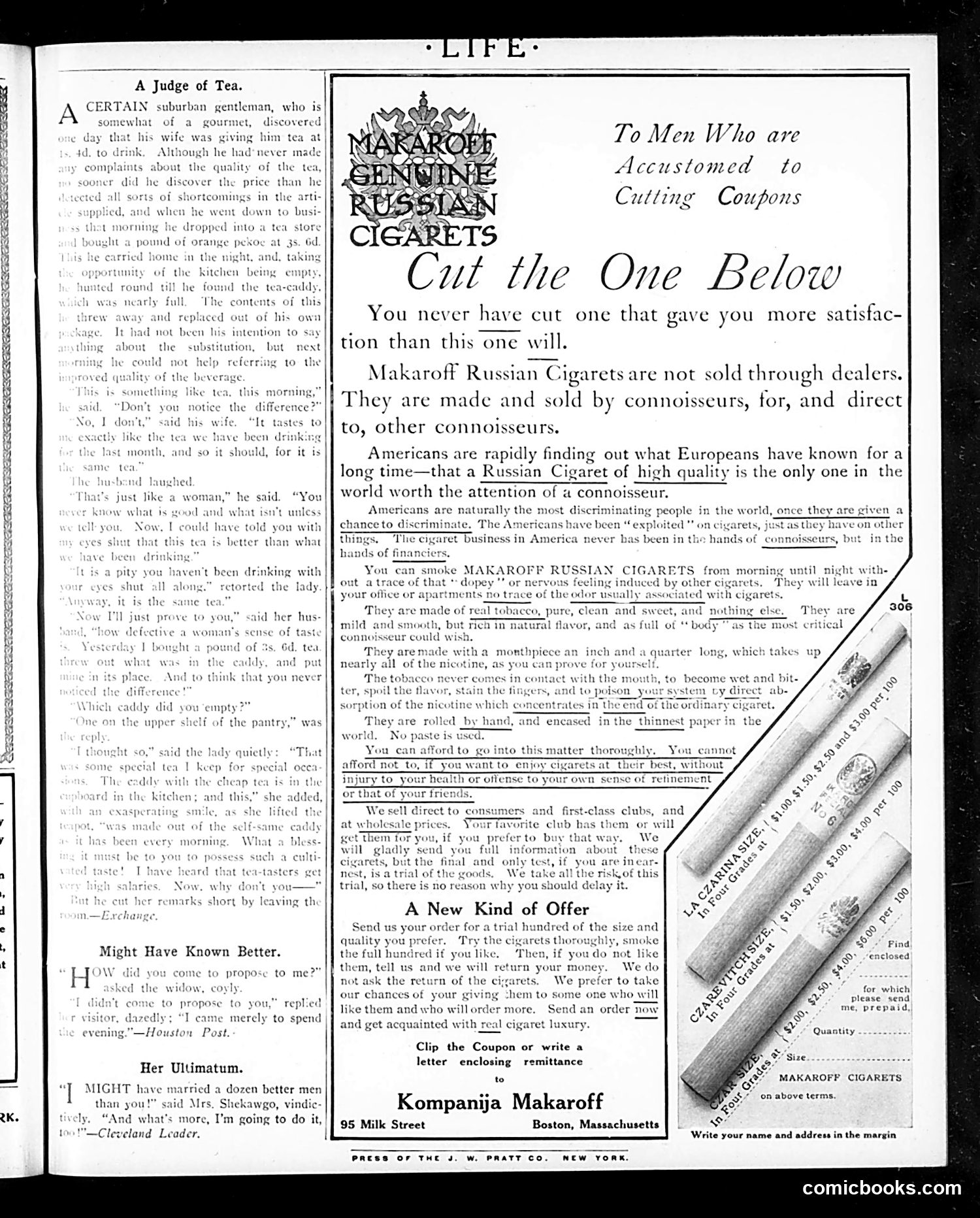
This page contains three distinct elements: **Left side - "A Judge of Tea" and related short humor pieces:** These are brief satirical anecdotes mocking domestic life and courtship. They poke fun at suburban husbands discovering their wives have been substituting cheap tea, and widows' pragmatic attitudes toward remarriage. The humor is gentle domestic satire typical of early 20th-century magazines. **Center and right - Makaroff Russian Cigarettes advertisement:** This is primarily a large cigarette advertisement disguised as editorial content, a common practice in early Life magazines. It targets wealthy men ("accustomed to cutting coupons"—investors), positioning Russian cigarettes as exclusive luxury goods sold only to "connoisseurs" rather than through ordinary dealers. The ad emphasizes European sophistication and exclusivity as selling points to aspirational American consumers. The page is essentially advertising masquerading as editorial content, a blurred line common in period magazines.
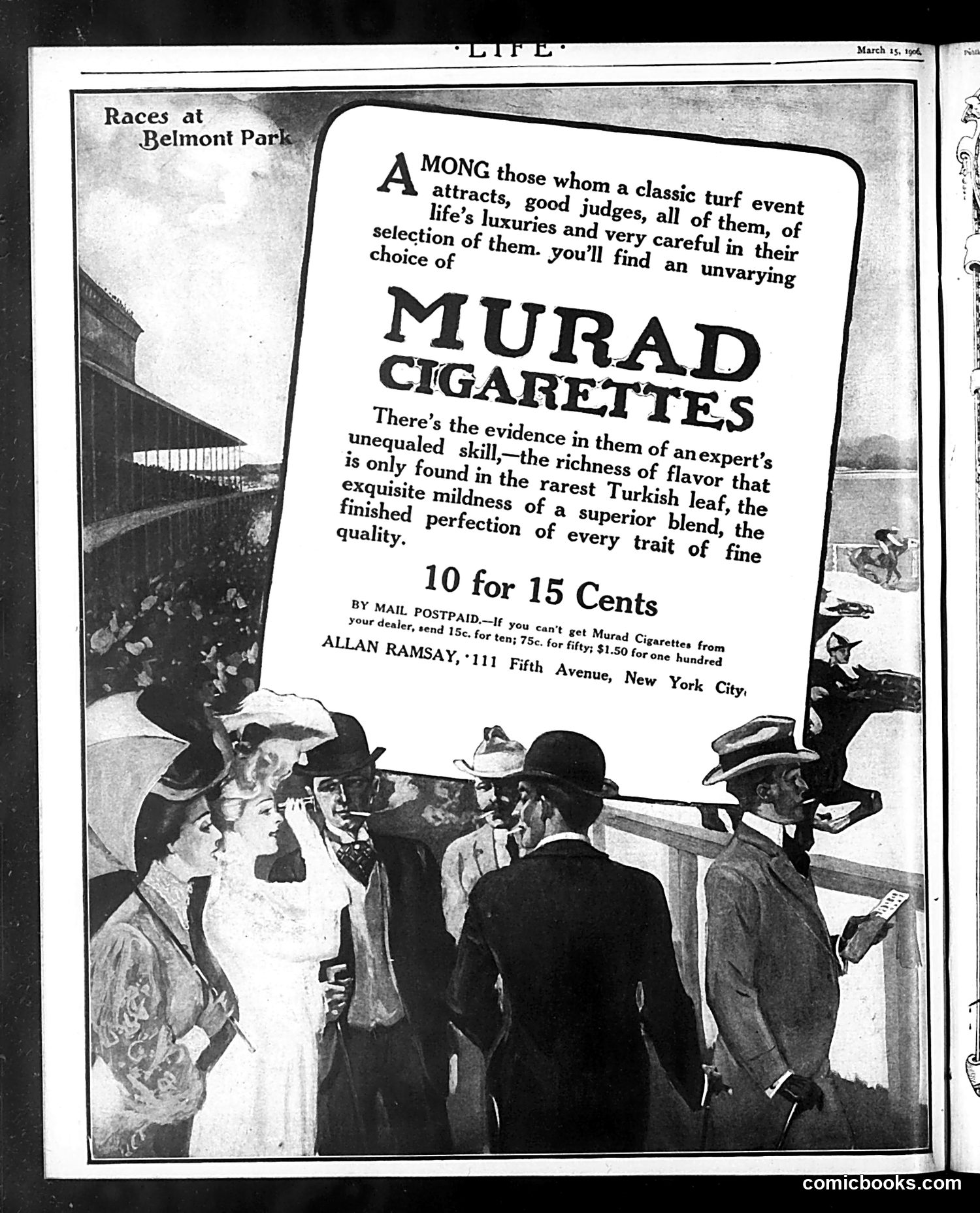
This page is primarily a **cigarette advertisement** for Murad brand, not political satire. It leverages the prestige of Belmont Park horse racing to market cigarettes to wealthy consumers. The advertisement features well-dressed attendees at Belmont Park (a famous racetrack), suggesting that discerning people of refined taste—those who appreciate "good judges" of "life's luxuries"—naturally choose Murad cigarettes. The copy claims the product contains "the richest of flavor" from "rarest Turkish leaf" and represents "perfection of every trait of fine quality." The pricing structure ("10 for 15 cents," "75¢ for fifty") indicates these were premium, mail-order cigarettes sold through Allan Ramsay in New York City. This reflects early-1900s advertising strategy: associating consumer products with upper-class social venues and aspirational lifestyles. There is **no political commentary** visible on this page—it's straightforward luxury goods marketing.