
Life, 1906-03-15 · page 10 of 38
Life — March 15, 1906 — page 10: what you’re looking at
What you’re looking at
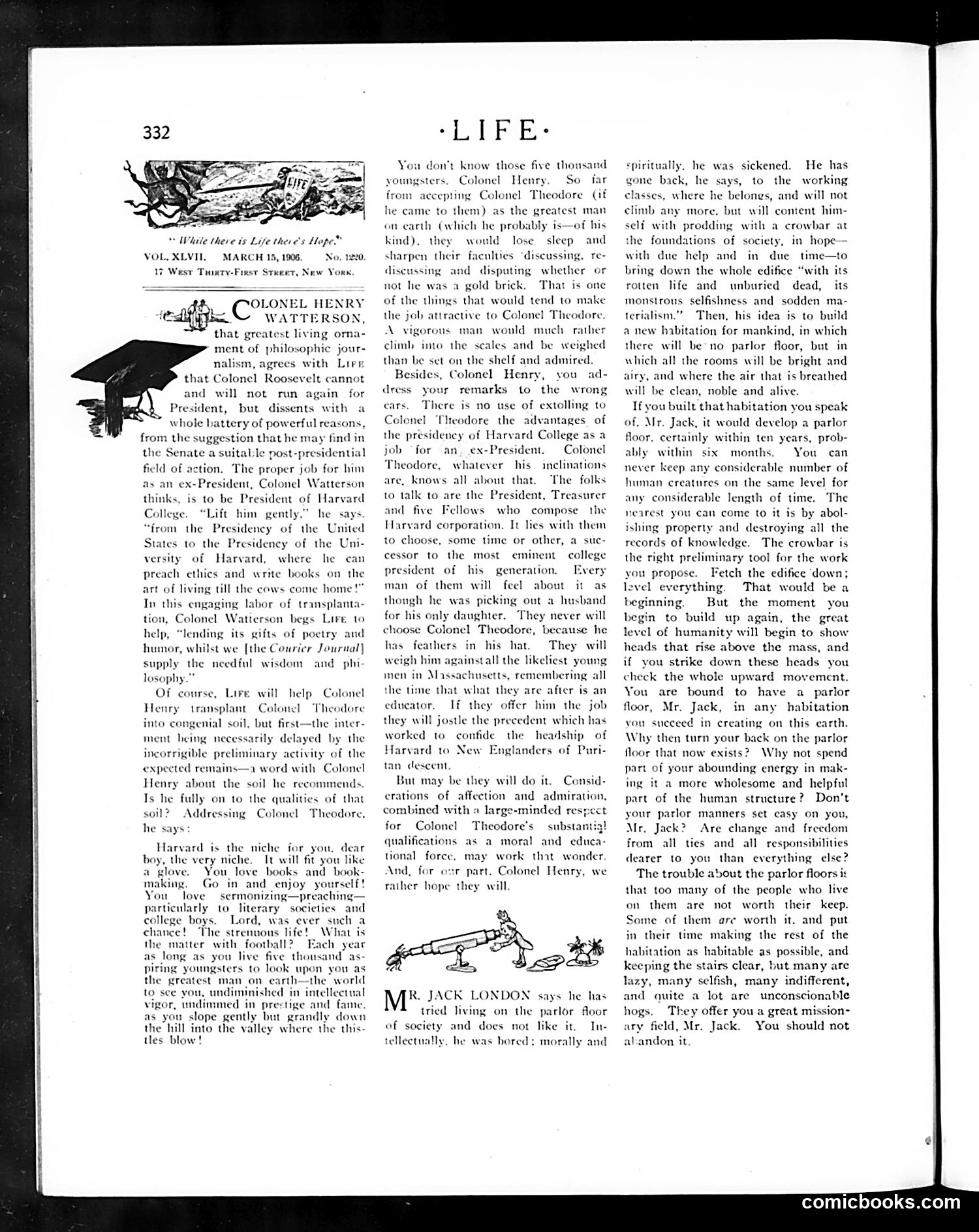
This page satirizes the academic and social pretensions of Harvard College through a debate between Colonel Henry Watterson (a prominent journalist and editor) and Mr. Jack London (the famous writer). The central joke concerns whether Harvard should elect London as president. Watterson argues Harvard's prestige demands an "ex-President" (suggesting Theodore Roosevelt), while London—described as "bored" and "intellectually morally originally sickened" by parlor society—rejects the offer. The satire mocks both figures: Watterson's reverence for institutional hierarchy and Roosevelt's influence, and London's affected disdain for upper-class conventions. The cartoon ridicules the era's obsession with social status and academic pedigree among America's intellectual elite. The humor depends on readers' familiarity with these public figures' actual personalities and reputations.
📄 Transcribed text from this page (OCR, searchable)
Machine-transcribed from the original scan — historical spelling and the odd misread are preserved.
VOL. XLVI, MARCH 15, 1906. 7 West Tinety-Finst Stkeet, New Yorx, Afi WATTERSON, that greatest living orna- ment of philosophic jour- nalism, agrees with Livr that Colonel Roosevelt cannot and will not run again for President, but dissents with a ” whole battery of powerful reasons, from the suggestion that he may find in the Senate a suitable post-presidential field of action. The proper job for him as an ex-President, Colonel Watterson thinks, is to be President of 1 c. “Lift him gently.” he says. from the Presidency of the United States to the Presidency of the Uni- Harvard, preach ethics and write books on the art of living till the cows come hom In this engaging labor of transplanta- tion, Colonel Watierson begs Lire to help, “lending its gifts of poetry and humor, whilst we [the Courier Journal] supply the needful wisdom versity of where he can and. phi losophy.” Of course, Lire will help Colonel Henry transplant Colonel Theodore into congenial soil, but first—the inter- ment heing necessarily delayed by the incorrigible preliminary activity of the expected remains—a word with Colonel Henry about the soil he recommends Is he fully on to the qualities of that Addressing Colonel Theodor he says: Harvard is the niche for you, dear boy, the very niche. [t will fit you like a glove. You love books and book making. Go in and enjoy yourself! You love sermonizing—preaching— particularly to. literary societies and college boys. Lord, was ever such a chance! ‘The strentious life! What is the matter with football? Each year s long as you live five thousand as- piring youngsters to look upon you as the greatest man_on earth—the world to sce you, undiminished in intellect vigor, undimmed in prestige and. fame. as you slope gently but grandly down the hill into the valley where the this- tles blow! SL ESE + You don't know those five thousand Colonel Henry, So far from accepting Colonel Theodore (if he came to them) as the greatest man of his and youngsters. on earth (which he probably is kind). sleep sharpen their faculties “discussing, re- discussing and disputing whether or not he was a gold brick, That is one of the things that would tend to make they would lose the job attractive to Colonel Theodore. much rather climb into the scales and be weighed A vigorous man would than be set on the shelf and admired. Besides, Colonel Henry, you your remarks to the cars. There is no use of extolling to Colonel ‘Theodore the advantages of the presidency of Harvard College as a job ‘for an. ex-President. Colonel Theodore, whatever his inclinations are, knows all about that. The folks to talk to are the President, Treasurer and five Fellows who compose the Harvard corporation. It lies with them to choose, some time or other, a suc- cessor to the most eminent college president of his generation. Every man of them will feel about it as though he was picking out a husband for his only daughter. They never will choose Colonel Theodore, because he hat. They will weigh him againstall the likeliest. young men in Massa ad- dress wrong has feathers in his usetts, remembering all the time that what they are after is an educator. If they offer him the job they will jostle the precedent which has worked to confide the headship of Harvard to New Englanders of Puri- tan descent But may be they will do it. Consid- erations of affection and admiration, combined with a large-minded respect for Colonel Theodore’s 1 qualifications as a moral and educa- tional foree, may work that wonder. And, for osr part. Colonel Henry, we rather hope th substar ap as R. JACK LONDON s: Ne has tried living on the parlor floor of society and does not like it. In- tellectually, he was bored; morally and spiritually, he was sickened. He has gone back, he says, to the working sses, Where he belongs, and will not climb any more. but will content him- self. with prodding with a crowbar at ¢ foundations of society, in hope— with due help and in due time—to bring down the whole edifice “with its rotten life and unburied dead, its monstrous selfishness and sodden ma- Then, his idea is to build a new habitation for mankind, in which there will be-no parlor floor, but. in which all the rooms will be bright and airy, and where the air that is breathed will be clean, noble and alive. If you built that habitation you speak of, Mr. Jack, it would develop a parlor floor. certainly within ten years, prob- ably within six months. You can never keep any considerable number of human creatures on the same level for any considerable length of time. The an come to it is by abol- ishing property and destroying all the records of knowledge. The crowbar is the right preliminary tool for the work you propose. Fetch the edifice down; level everything. That would be a beginning. But the moment you begin to build up again, the great level of humanity will begin to show heads that rise above the mass, and if you strike down these heads you check the whole upward movement. You are bound to have a parlor floor, Mr. Jack, in any habitation you succeed in creating on this earth. Why then turn your back on the parlor floor that now exists? Why not spend part of your abounding energy in mak- ing it a more wholesome and helpful part of the human structure? Don’t your parlor manners set casy on you, Mr. Jack? Are change and freedom from all ties and all responsibilities dearer to you than everything else? The trouble about the parlor floors it that too many of the people who live on them are not worth their keep. Some of them are worth it, and put in their time making the rest of the habitation as habitable as possible, and keeping the stairs clear, but many are lazy, many selfish, many indifferent, and quite a lot are unconscionable hogs. They offer you a great mission- ary field, Mr. Jack. You should not abandon it terialism.”” nearest you comicbooks.com