
Life, 1906-03-15 · page 24 of 38
Life — March 15, 1906 — page 24: what you’re looking at
What you’re looking at
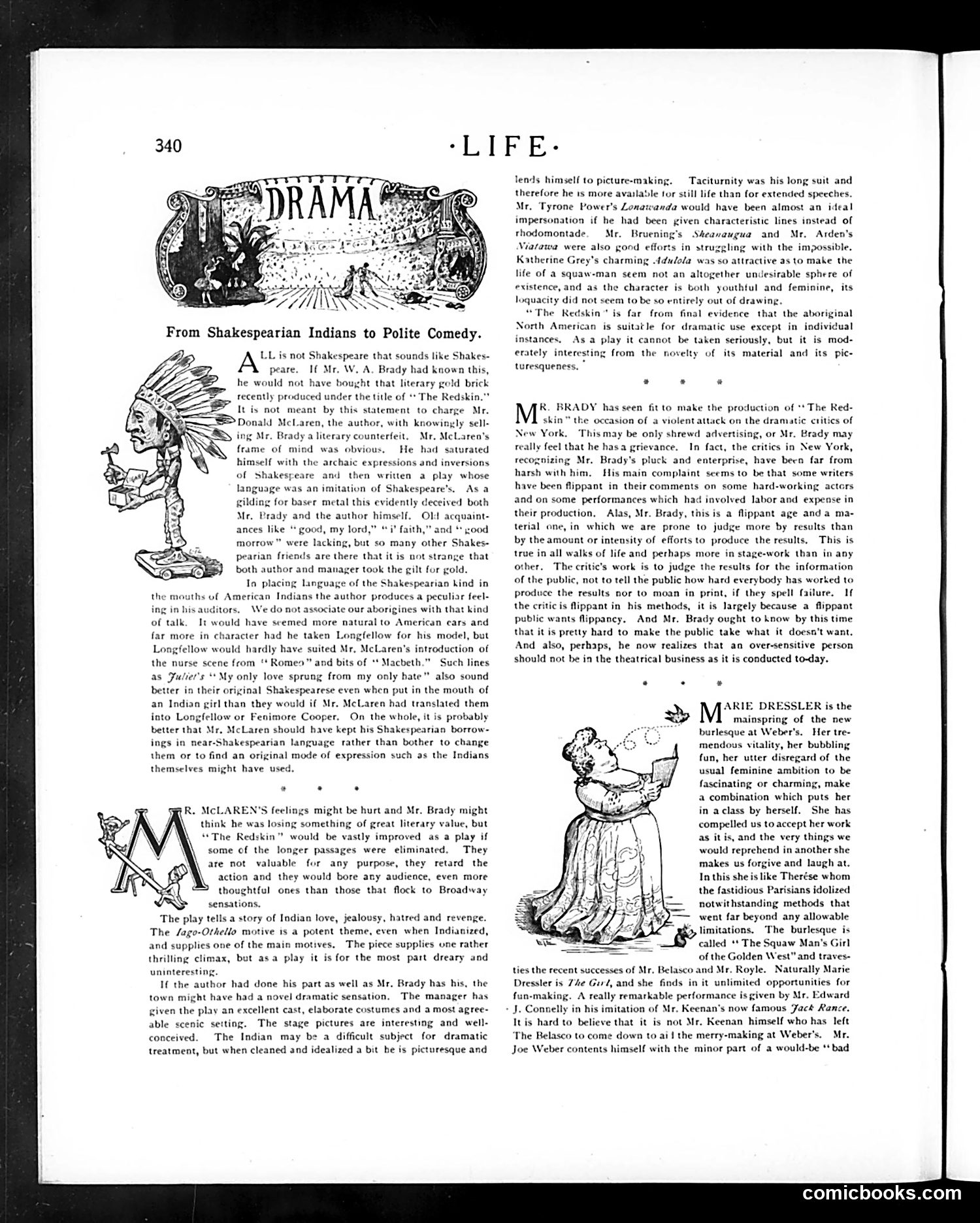
This is a drama criticism of a Broadway play called "The Redskin" by Donald McLaren, produced by W.A. Brady. The reviewer attacks the play's fundamental absurdity: it presents Native Americans speaking in Shakespearean language and style. The satire targets McLaren's pretentiousness—he saturated himself with archaic Shakespearean phrasing, then applied it to American Indian characters, creating an unnatural and laughable effect. The critic notes this sounds ridiculous; Indians would never speak this way. He suggests Longfellow or Fenimore Cooper would have been more appropriate models. The review acknowledges Brady's excellent production values (casting, costumes, sets) but argues the play itself is tedious and dreary, dragging with lengthy passages that bore audiences. The "Iago-Othello" jealousy plot shows promise, but poor execution undermines it. The underlying joke: pretentious literary imitation (fake "Shakespeare") fooled both author and producer, who mistook artificial language for genuine dramatic merit.
📄 Transcribed text from this page (OCR, searchable)
Machine-transcribed from the original scan — historical spelling and the odd misread are preserved.
*LIFE:- LL is not Shakespeare that sounds like Shakes- peare. If Mr. W, A. Brady had known this, he would not have bought that literary gold brick recently produced under the title of * The Redskin.” It is not meant by this statement to charge Mr. Donald Mclaren, the author, with knowingly sell- Mr. McLaren's He had saturated ing Mr. Brady a literary counterfeit, frame of mind was obvious, himself with the archaic expressions and inversions of Shakespeare and then written a play whose language was an imitation of Shakespeare's. As a gilding for baser metal this evidently deceived both Mr. Brady and the author himself. Old acquaint- ances like ‘ morrow” * good, my lord,” “i? faith,” and * pood were lacking, but so many other Shakes- pearian friends are there that it is not strange that both author and manager took the gilt for gold. In placing Language of the Shakespearian kind in the mouths uf American Indians the author produces a peculiar feel- gin his auditors. We do not associate our aborigines with that kind of talk. It would have seemed more natural to American ears and far more in character had he taken Longfellow for his model, but Longfellow would hardly have suited Mr, McLaren's introduction of the nurse scene from ‘ Romeo” and bits of * Macbeth.” Such lines as Julier’s * My only love sprung from my only hate” also sound better in their original Shakespearese even when put in the mouth of an Indian girl than they would if Mr. McLaren had translated them into Longfellow or Fenimore Cooper. On the whole, it is probably better that Mr, McLaren should have kept his Shakespearian borrow~ ings in near-Shakespearian language rather than bother to change them or to find an original mode of expression such as the Indians themselves might have used, MCLAREN'S feelings might be hurt and Mr. Brady might think he was losing something of great literary value, but “The Redskin” would be vastly improved as a play if some of the longer passages were eliminated. They ate not valuable for any purpose, they retard the \. action and they would bore any audience, even more thoughtful ones than those that flock to Broadway sensations, The play tells a story of Indian love, jealousy, The /ago-Othello motive is a potent theme, even when Indianized, and supplies one of the main motives, The piece supplies one rather thrilling climax, but asa play it is for the most part dreary and atred and revenge. uninteresting. If the author had done his part as well as Mr. Brady has his, the town might have had a novel dramatic sensation. The manager has given the play an excellent cast, elaborate costumes and a most agree- able scenic setting. The stage pictures are interesting and well- conceived. The Indian may be a difficult subject for dramatic treatment, but when cleaned and idealized a bit he is picturesque and lends himself to picture-making. Taciturnity was his long suit and therefore he 1s more available for still life than for extended speeches. Mr, Tyrone Power's Lonawanda would have been almost an ideal impersonation if he had been given characteristic lines instead of rhodomontade. Mr. Bruening’s Skeavaugua and Mr, Arden’s Viatawa were also good efforts in struggling with the impossible. Katherine Grey's charming Adulola was so attractive as to make the life of a squaw-man seem not an altogether undesirable sphere of existence, and as the character is both youthful and feminine, its loquacity did not seem to be so entirely out of drawing, “The Redskin" is far from North American is suitatle for dramatic use except in individual instances, Asa play it cannot be taken seriously, but it is mod- erately interesting from the novelty of its material and its pic- turesqueness, * al evidence that the aboriginal * . « R. BRADY has seen fit to make the production of The Red- skin” the occasion of a violent attack on the dramatic critics of New York, ‘Thismay be only shrewd advertising, or Mr, Brady may really feel that he hasa grievance. In fact, the critics in New York, recognizing Mr. Brady's pluck and enterprise, have been far from harsh with him, His main complaint seems to be that some writers have been flippant in their comments on some hard-working actors and on some performances which had involved labor and expense in their production, Alas, Mr. Brady, this is a flippant age and a ma- terial one, in which we are prone to judge more by results than by the amount or intensity of efforts to produce the results, This is true in all walks of life and perhaps more in stage-work than in any other, The critic's work is to judge the results for the information of the public, not to tell the public how hard everybody has worked to produce the results nor to moan in print, if they spell failure. If the critic is flippant in his methods, it is largely because a flippant public wants flippancy. And Mr. Brady ought to know by this time that it is pretty hard to make the public take what it doeso't want, And also, perhaps, he now realizes that an over-sensitive person should not be in the theatrical business as it is conducted to-day. . . * Man DRESSLER is the xy mainspring of the new burlesque at Weber's. Her tre- mendous vitality, her bubbl fun, her utter disregard of the usual feminine ambition to be fascinating or charming, make a combination which puts her in aclass by herself. She has compelled us to accept her work as it is, and the very things we would reprehend in another she makes us forgive and laugh at. In this she is like Therése whom the fastidious Parisians idolized notwithstanding methods that went far beyond any allowable “& itations. The burlesque is called ** The Squaw Man's Girl of the Golden West and traves- ties the recent successes of Mr. Belasco and Mr. Royle. Naturally Marie Dressler is Zhe Gert, and she finds in it unlimited opportunities for fun-making. A really remarkable performance is given by Mr. Edward J. Connelly in his imitation of Mr. Keenan's now famous Jack Rance, It is hard to believe that it is not Mr. Keenan himself who has left The Belasco to come down to ail the merry-making at Weber's. Mr. Joe Weber contents himself with the minor part of a would-be “bad comicbooks.com