
Life, 1906-03-15 · page 20 of 38
Life — March 15, 1906 — page 20: what you’re looking at
What you’re looking at
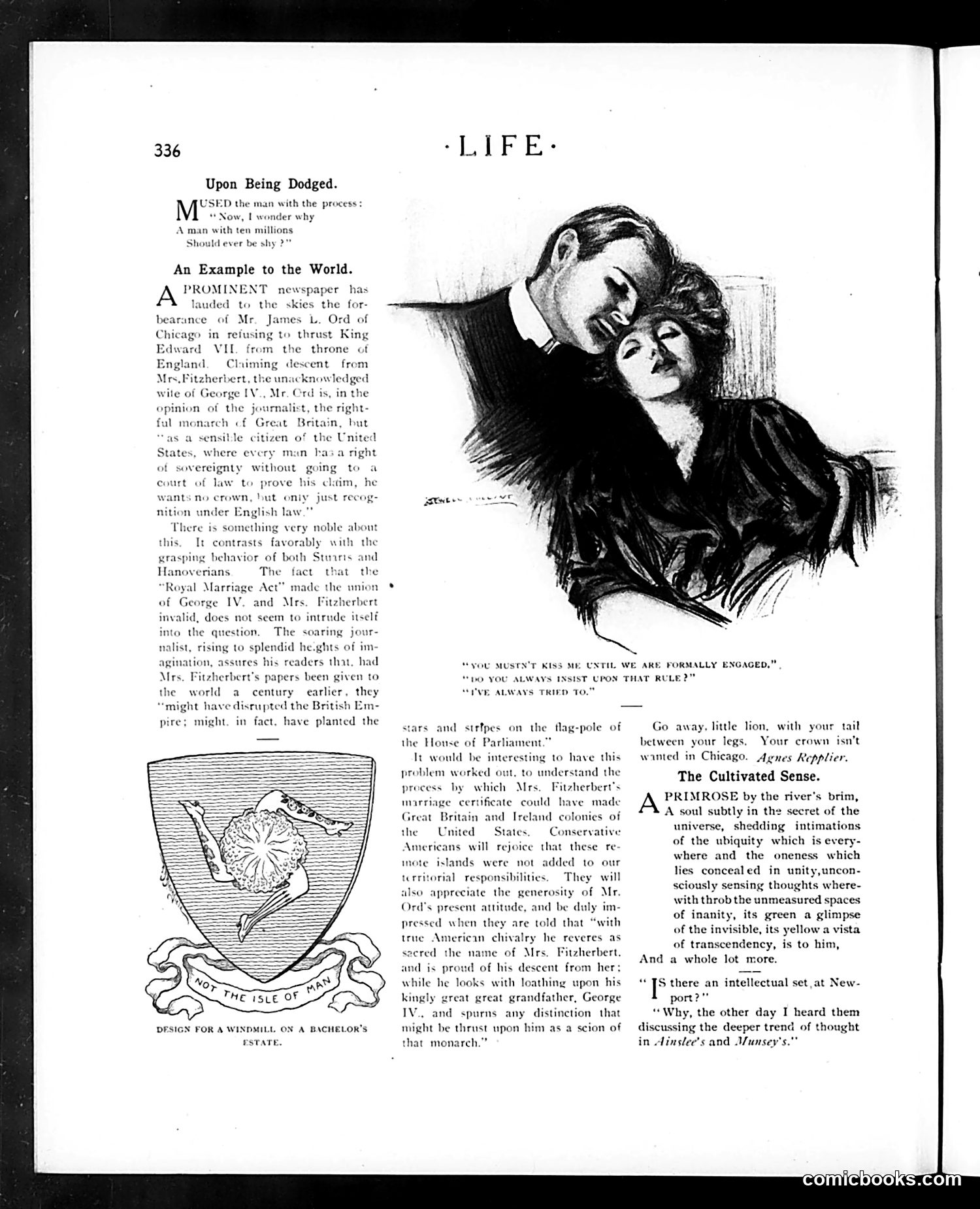
This page contains satirical commentary on James L. Ord of Chicago, who publicly refused to claim the British throne based on descent from Mrs. Fitzherbert (mistress of King George IV). The main article mocks Ord's rejection of a royal claim he never actually possessed, presenting it as false nobility. The satire suggests his refusal is performative virtue-signaling—claiming moral superiority for rejecting something that was never legitimately his to accept. The accompanying illustration shows a romantic couple, likely depicting the engagement etiquette being discussed in the caption dialogue about formal engagement protocols. A secondary item, "The Cultivated Sense," satirizes pretentious intellectualism—mocking Newport society for discussing "deeper trends of thought" in popular magazines (Munsey's), implying their intellectual sophistication is superficial posturing rather than genuine cultivation. Both pieces target American social pretension and false moral or intellectual authority.
📄 Transcribed text from this page (OCR, searchable)
Machine-transcribed from the original scan — historical spelling and the odd misread are preserved.
Upon Being Dodged. USED the “Now, A man with ten million: Should ever be shy 2” An Example to the World. PROMI lauded to t ies the for- of Mr mes L. Ord of go in refusing to thrust King Edward VII the throne of ngland. Cl descent from Mrs.Fitzherbert, the unacknowledged newspaper has from ning wite of deorge IV., Mr. Ord is, int opinion of the jc t, the right- ful monarch t Britain, but “as a sen: r citizen of the Unite States, where every man has a right ereignty without going to a t of law to ove wants no crown, but only nition under English law.’ s che he just recog re is something very noble about the nd the this, It contrasts favorably with grasping behavior of both Stuarts Hanoverians The fact that “Royal Marriage Act” made the union IV. and Mrs. Fitzherber: ing to splendid he.ghts of im- ders that, had apers been given to world a century earlier, they “might have disrupted the British Em- pire; might. in fact, have planted the . Fitzherbert’s DESIGN FOR A WINDMILL ON A BACHELOR'S STATE. “YOU MUSTN'T KISS ME UNTIL WE ARE FORMALLY ENGAGE! “bO YOU ALWAYS INSIST UPON THAT RULE?" “TVE ALWAYS TRIED TO." stars and strfpes on the flag-pole of the Honse It would be interesting to have this problem worked out, to understand the which Mrs. Fitzherbert’s marriage certificate could have made Great Britain and Ireland colonies of United States. Conservative Americans will rejoice that these re islands territorial responsibilities. vf Parliament.” process by the added to our They will ppreciate the generosity of Mr. Ord’s present attitude, and be duly im- pressed when they are told that “with true American chivalry he reveres as secred the name of Mrs. Fitzherbert. of his descent from her: while he looks with loathing upon his mot were not also and is. pre kingly great great grandfather, George IV., and spums any distinction that might be thrust upon him as a scion of that monarch.” Go away, little lion, with your tail between your legs. Your crown isn't wanted in Chicago. Agnes Kepplier. The Cultivated Sense. PRIMROSE by the river's brim, A soul subtly in the secret of the universe, shedding intimations of the ubiquity which is every where and the oneness which lies concealed in unity,uncon- sciously sensing thoughts where- with throb the unmeasured spac of inanity, its green a glimpse of the invisible, its yellow a vista of transcendency, is to him, And a whole lot more. “JS there an intellectual set at New- port?" “Why, the other day I heard them discussing the deeper trend of thought in Hinslee’s and Munsey's.”