
A complete issue · 24 pages · 1906
Life — February 22, 1906
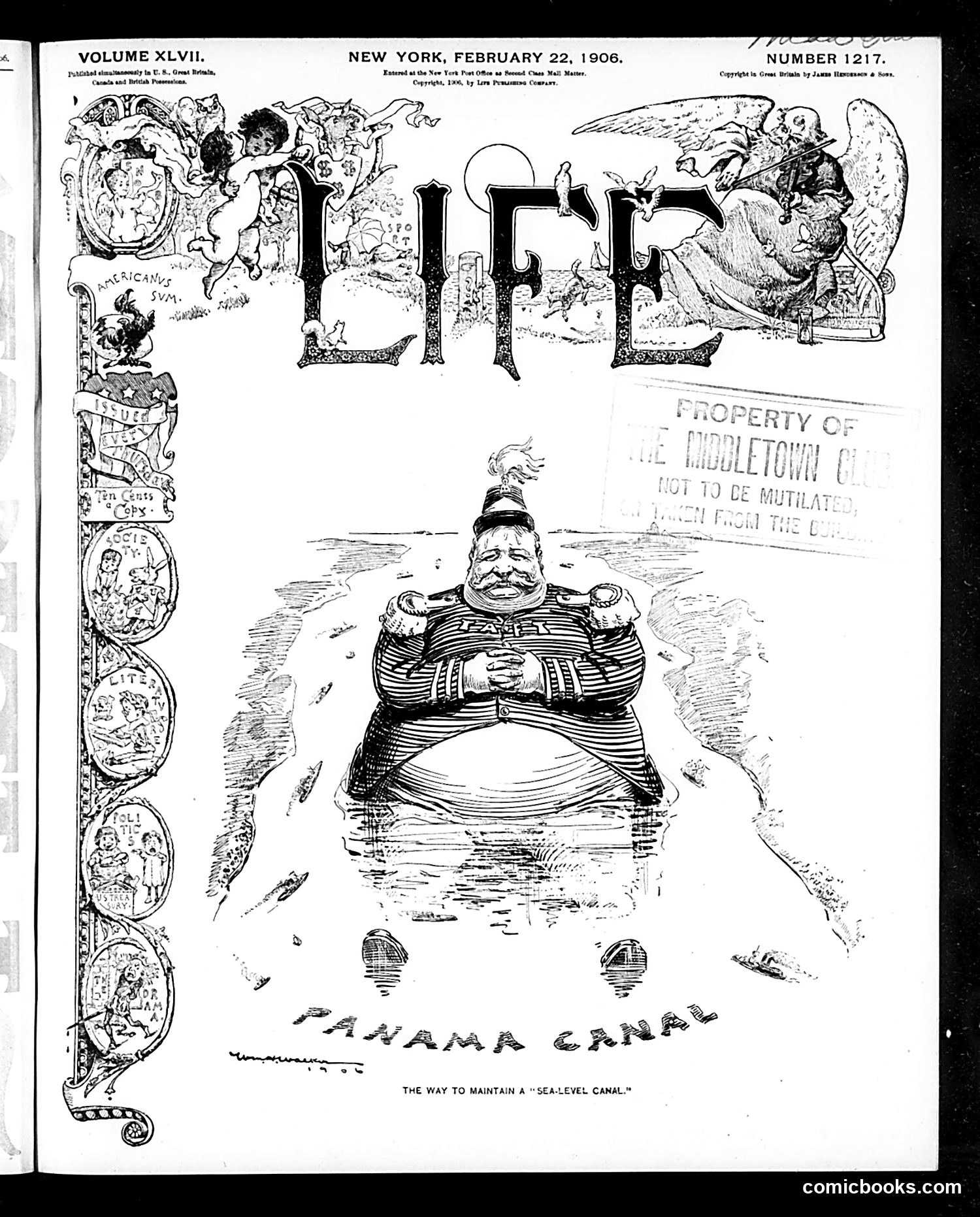
This **Life** magazine cover from February 22, 1906 satirizes debates over the Panama Canal's construction. The central figure is a corpulent military officer (likely representing Theodore Roosevelt or Panama Canal Commission leadership) sitting in water labeled "PANAMA CANAL," surrounded by small boats. The caption "THE WAY TO MAINTAIN A 'SEA-LEVEL CANAL'" is sarcastic. The cartoon mocks proposals for a sea-level canal versus a lock-based system. By depicting an enormous official literally occupying the canal waters, the cartoonist suggests that maintaining a sea-level canal would require filling it with absurdly large obstacles—satirizing the engineering and political challenges the project faced. The ornate decorative border containing classical scenes adds to the satirical tone.
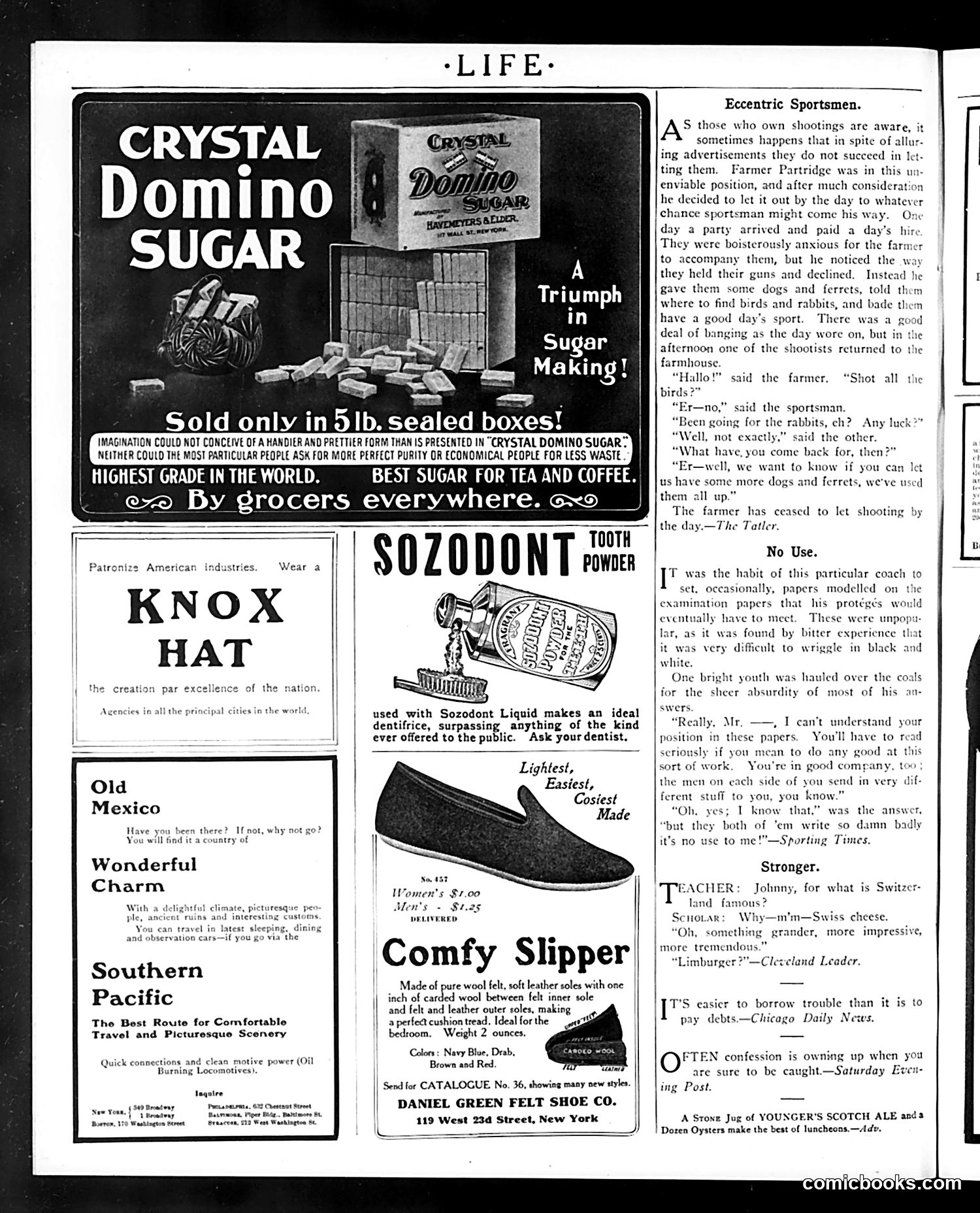
This page is primarily **advertising** rather than satirical content. The dominant advertisements include: - **Crystal Domino Sugar**: Emphasizes purity and economical use - **Knox Hat**: Appeals to patriotism ("patronize American industries") - **Sozodont Tooth Powder**: Claims superiority as a dentifrice - **Comfy Slipper**: Wool felt shoes marketed for comfort - **Old Mexico/Southern Pacific**: Travel promotions The right side contains brief **humorous anecdotes** (labeled "Eccentric Sportsmen," "No Use," "Stronger") presenting comedic situations—a farmer annoyed by hunters, a coach frustrated with examination papers, and a teacher's joke about Switzerland. These are light satirical vignettes poking fun at social types rather than political commentary. The overall page reflects early 20th-century consumer culture and genteel humor typical of Life magazine's format during this era.
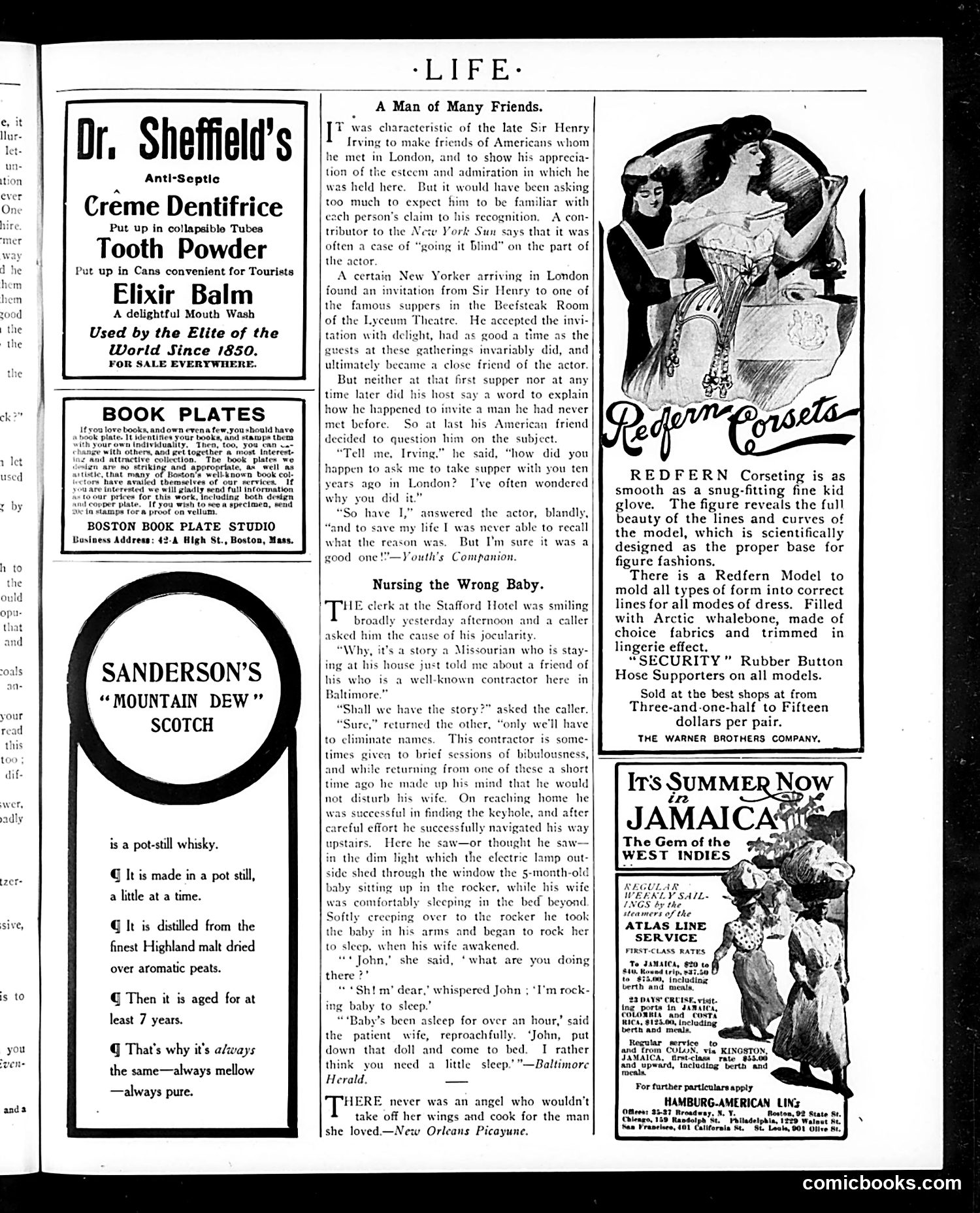
This page is primarily **advertising and lifestyle content** rather than political satire. The main articles are social vignettes: "A Man of Many Friends" describes Sir Henry Irving (a famous actor) befriending American visitors in London; "Nursing the Wrong Baby" is a humorous anecdote about a man mistakenly rocking someone else's infant. The advertisements include Dr. Sheffield's dental products, Sanderson's "Mountain Dew" Scotch whisky, Redfern Corsets (with an illustration of an idealized female figure), and travel promotions to Jamaica and via the Hamburg-American Line. The page reflects early 20th-century consumer culture and leisure interests rather than containing political commentary or satirical cartoons.
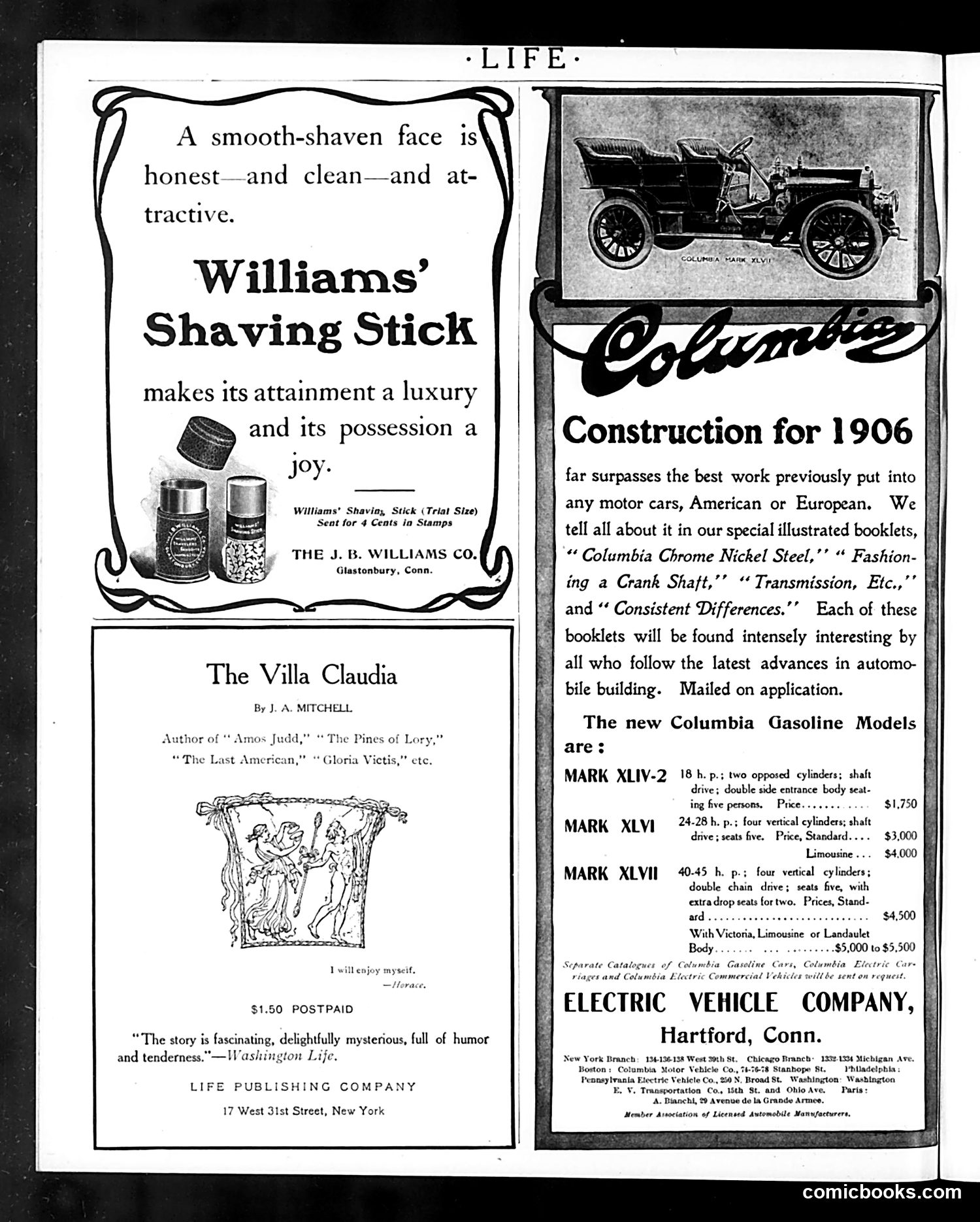
This page contains **no political cartoon or satire**. Instead, it features three advertisements typical of early 1900s Life magazine: 1. **Williams' Shaving Stick** (top left): A grooming product ad claiming a smooth-shaven face is "honest—and clean—and attractive." 2. **"The Villa Claudia"** (bottom left): A book advertisement for J.A. Mitchell's novel, priced at $1.50 postpaid. 3. **Columbia automobiles** (right): The dominant ad showcasing 1906 gasoline-powered car models with specifications and prices ($1,750–$5,500), manufactured by the Electric Vehicle Company in Hartford, Connecticut. The page represents standard commercial content that subsidized Life's publication, rather than satirical editorial material.
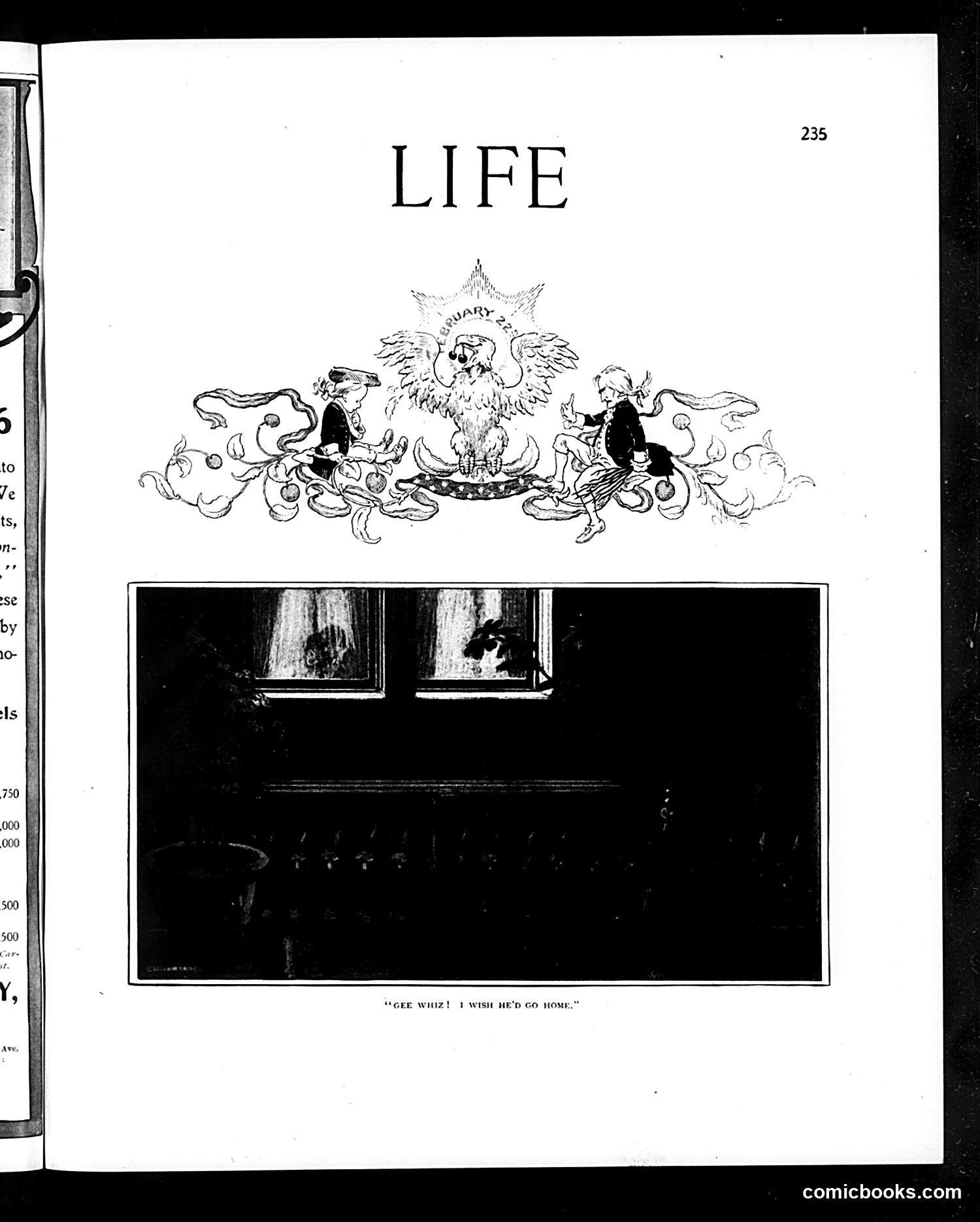
This page presents a satirical illustration titled "GEE WHIZ! I WISH HE'D GO HOME." The decorative header features two figures (appearing to be caricatured political or social characters) flanking an eagle with a banner labeled "LIBRARY," surrounded by ornamental flourishes. The main illustration below depicts a darkened interior scene with two figures visible through windows at the top, while silhouettes of what appear to be audience members are seated below, suggesting a theater or public gathering setting. The caption's sentiment—wishing someone would leave—combined with the "Library" eagle emblem, suggests this critiques a particular public figure or speaker whose presence was unwelcome to observers. Without additional context about the specific issue date, identifying the exact target remains unclear.
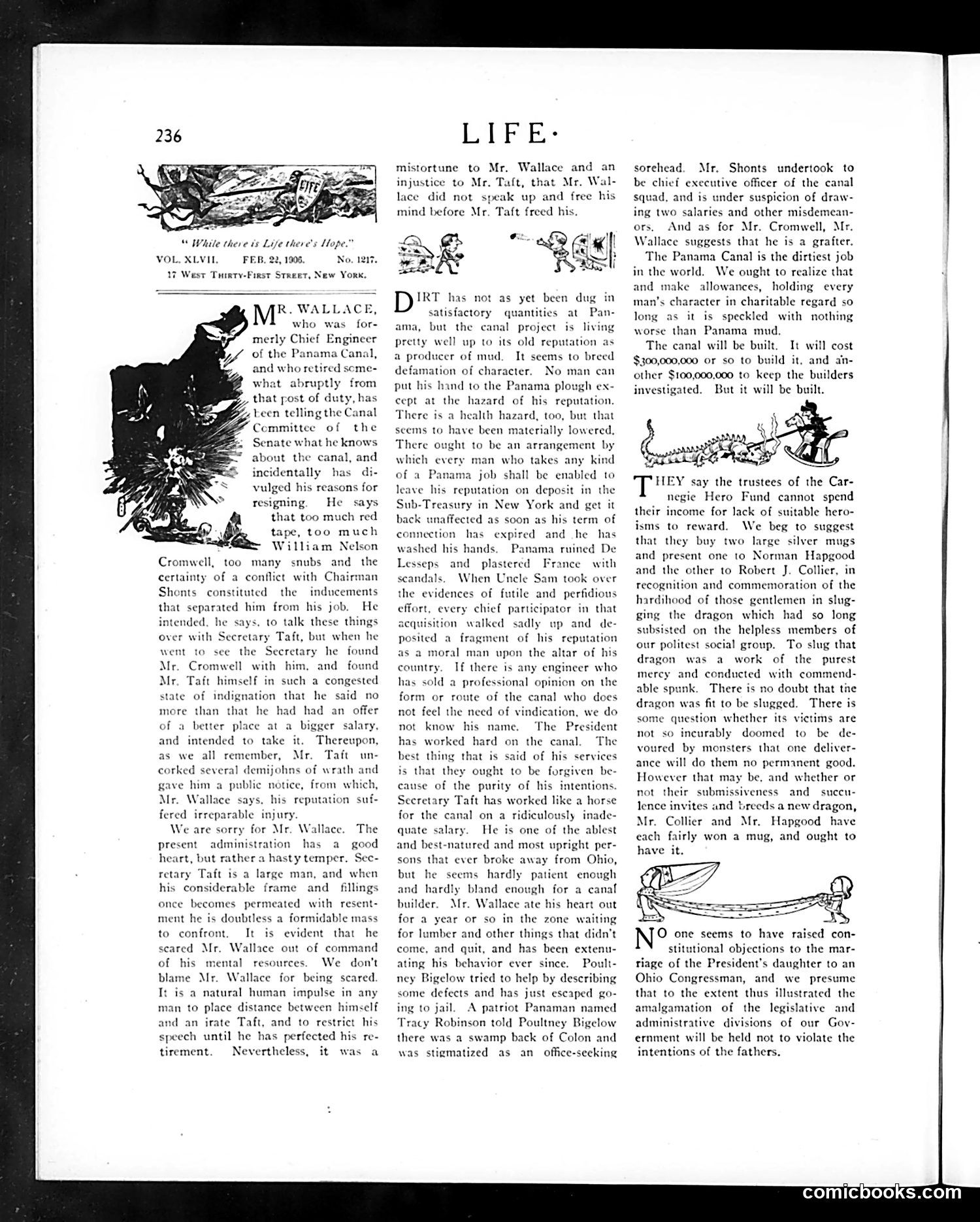
This page satirizes the Panama Canal construction and its administrators. The article criticizes Mr. Wallace, the former Chief Engineer, for resigning due to character attacks and health concerns. The text reveals internal conflict: Secretary Taft allegedly pressured Wallace to resign, while other officials like Mr. Cromwell and Chairman Shonts faced suspicion regarding financial dealings and mismanagement. The cartoon illustrations (though small) appear to support the written critique of canal project corruption and incompetence. The article concludes with a jab at President Roosevelt's daughter's rumored engagement to an Ohio Congressman, suggesting political motives behind the union—satirizing how government administrative positions became entangled with political marriages and favoritism during this era.
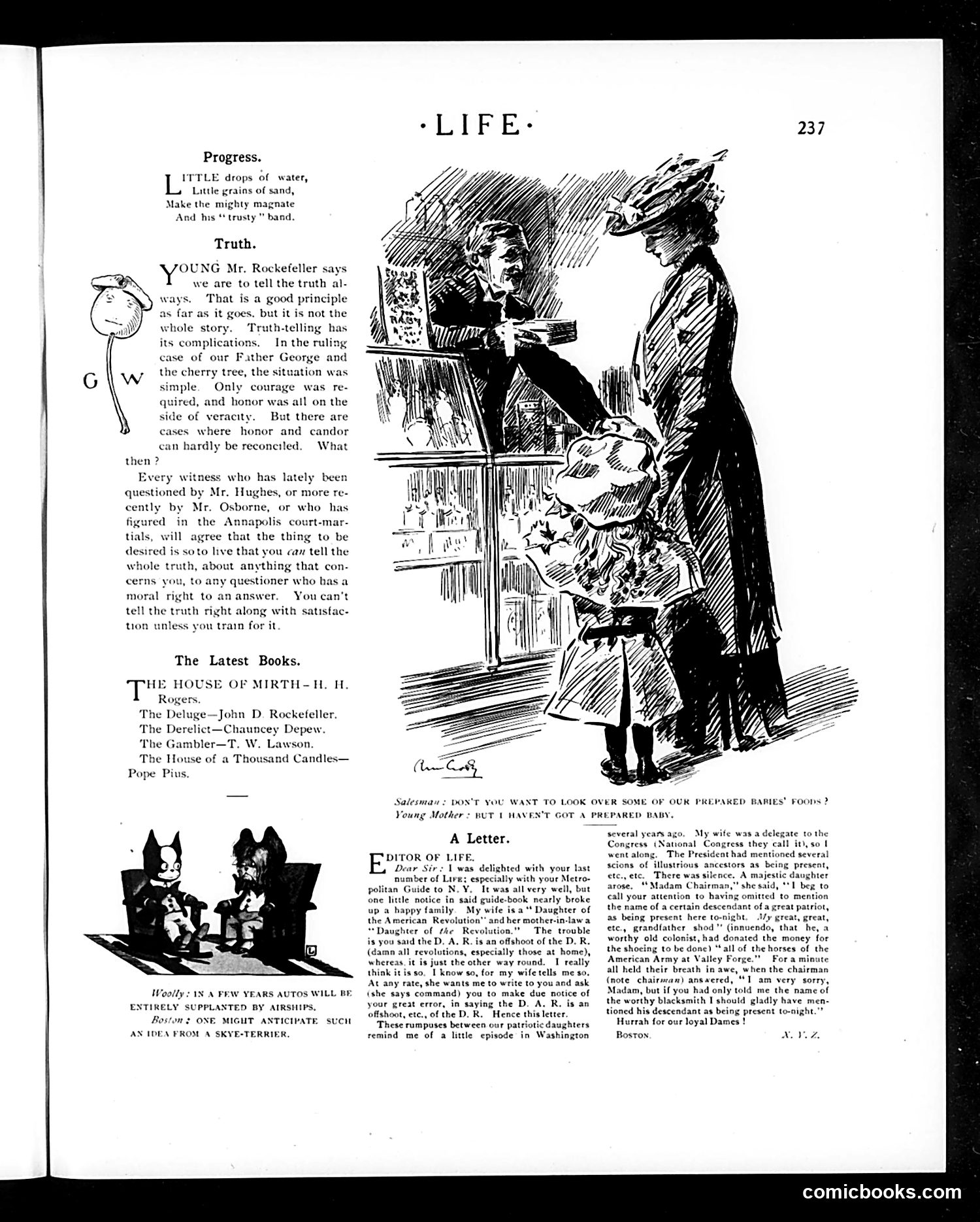
This page contains satirical commentary and illustrations typical of Life magazine's editorial content. The main cartoon depicts a social encounter between two women at what appears to be a shop or counter, with the caption "DON'T YOU WANT TO LOOK OVER SOME OF OUR PREPARED BABIES' FOODS?" and the response "BUT I HAVEN'T GOT A PREPARED BABY." The satire mocks commercialization of motherhood and the emerging market for packaged baby foods—a relatively new consumer product at the time. It suggests absurdity in the presumption that all mothers would want such modern conveniences, poking fun at aggressive marketing tactics and changing domestic practices. The page also includes book reviews and a letter to the editor addressing historical genealogy claims, reflecting Life's mix of humor, social critique, and reader correspondence.
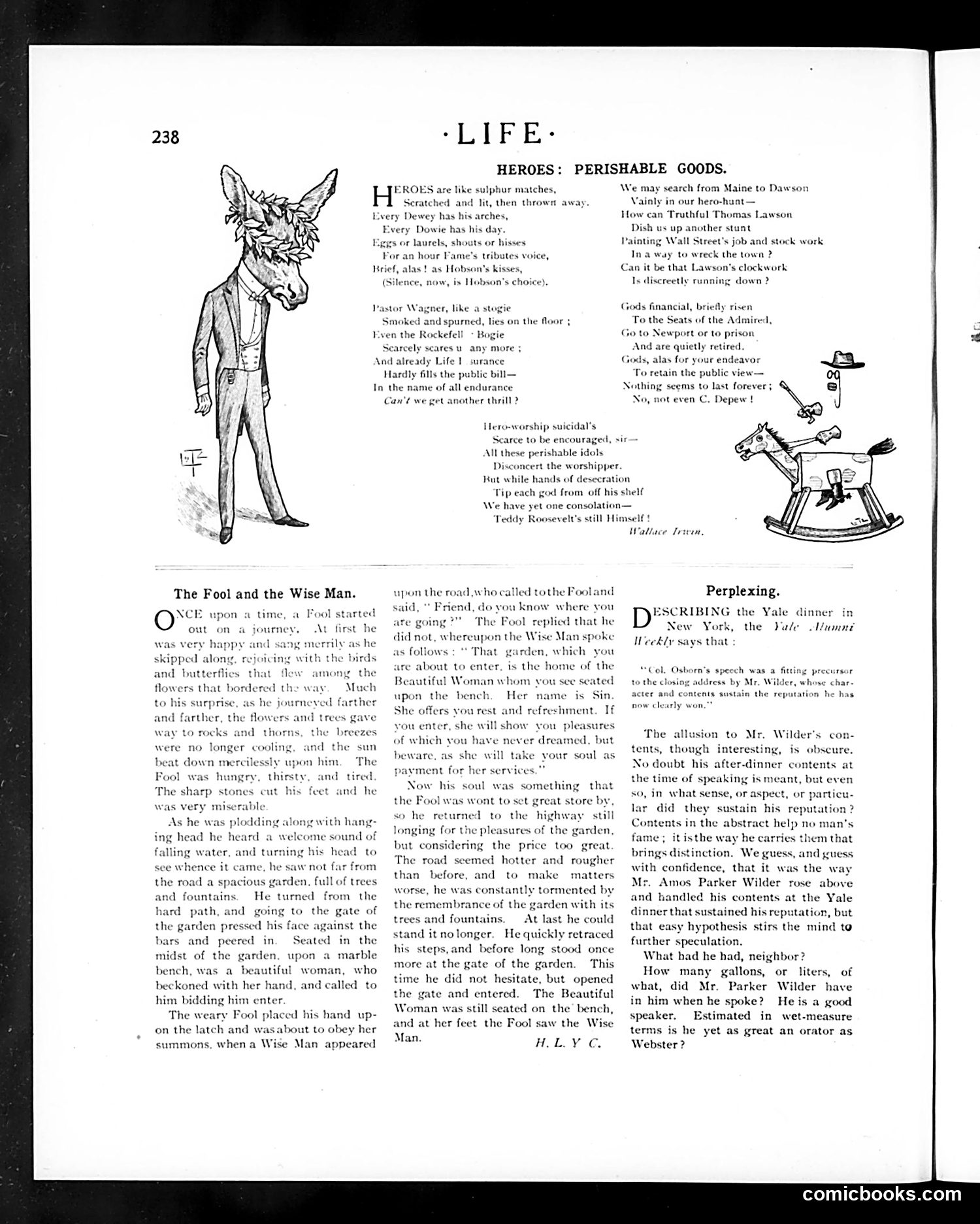
The top section, "Heroes: Perishable Goods," is political satire mocking American public figures as temporary celebrities. The donkey-headed caricature on the left represents political or cultural "heroes" who are discarded after brief fame. The text references specific figures: Pastor Wagner (described as "smoked and spurned"), the Rockefeller name, and "Teddy Roosevelt's still Himself!"—suggesting Roosevelt's enduring popularity contrasts with others' faded relevance. The lower sections contain two unrelated pieces: "The Fool and the Wise Man" (a fable), and "Perplexing" (a note about Yale Alumni Weekly's reference to Parker Wilder's speaking abilities). The satire's point: American heroes are consumed and discarded like disposable goods, subject to public whim.
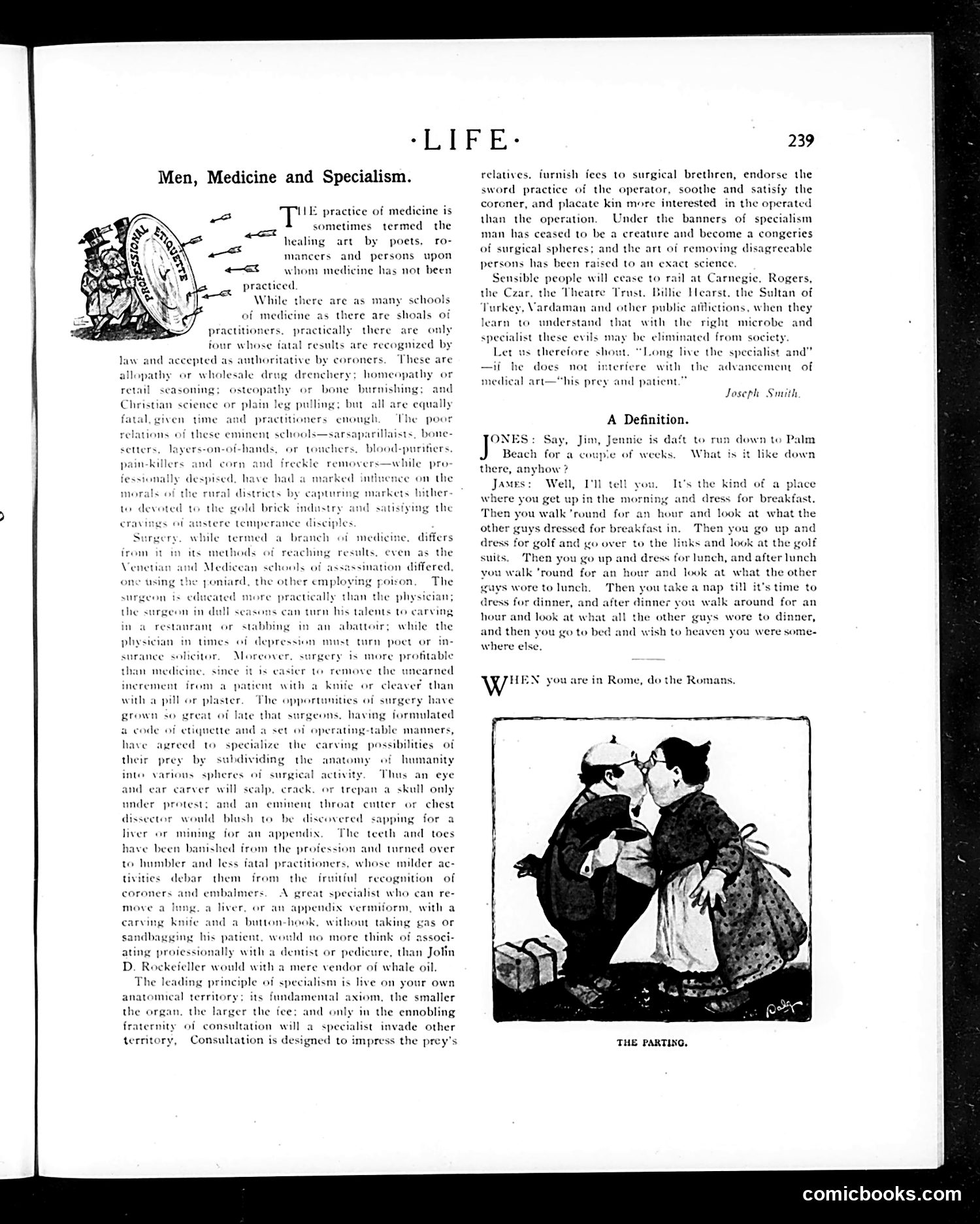
This illustration depicts two working-class figures—a man in a cap and a woman in modest dress—embracing emotionally at what appears to be a departure. The caption "WHEN you are in Rome, do the Romans" suggests a cynical commentary on social mobility and romantic relationships. The accompanying text criticizes medical specialists and practitioners who abandon their humble origins upon achieving success, becoming "congeneres of surgical spheres." The cartoon appears to parallel this professional betrayal: the couple represents the ordinary people left behind when ambitious individuals climb the social ladder, presumably to more "refined" circles—the working-class sweetheart abandoned for wealthier romantic prospects, much as doctors abandon their ethical roots for prestige and profit.
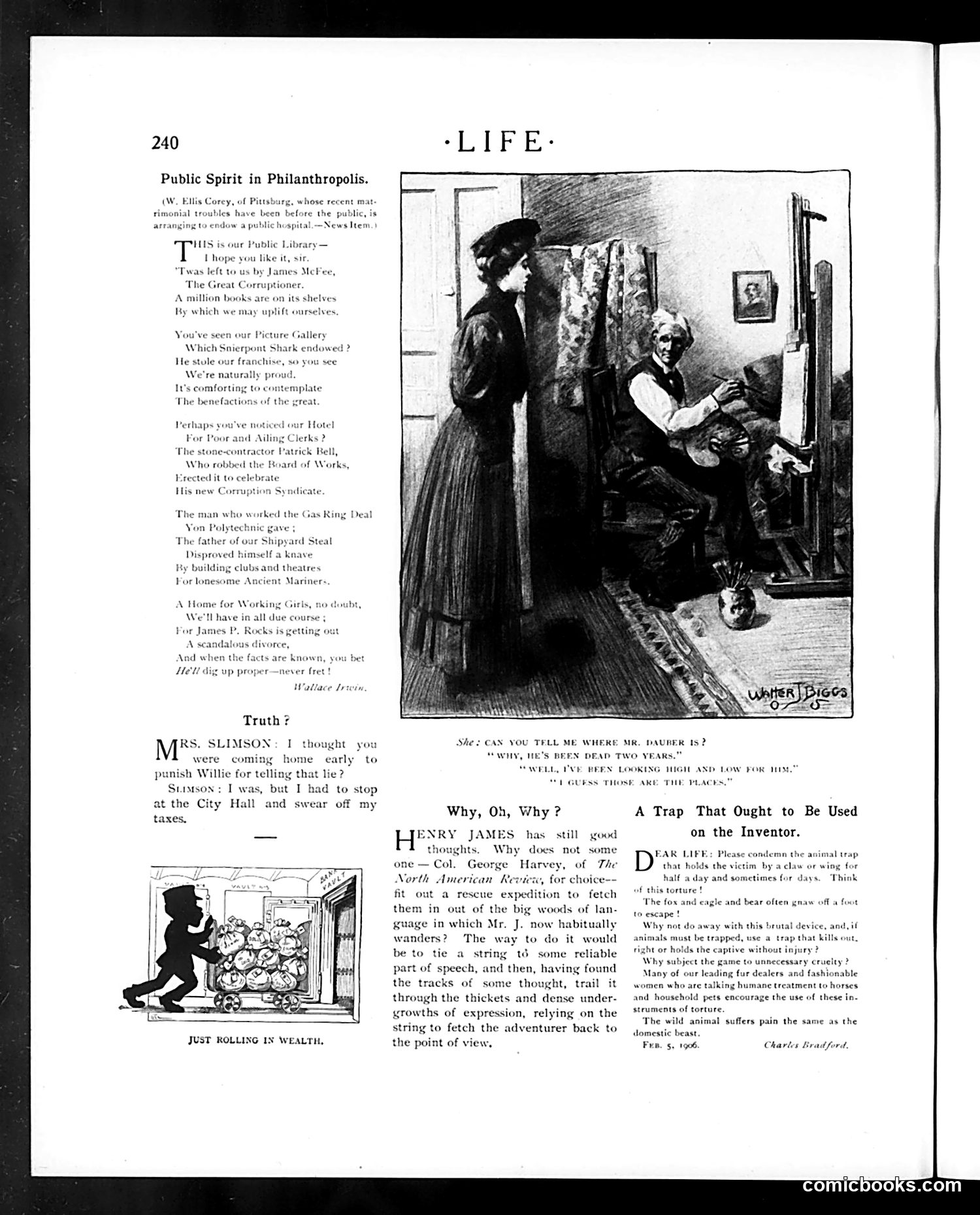
This page contains **social satire** rather than political cartoons. The main illustrated piece shows a woman visiting what appears to be an art gallery or museum, with the caption "She can you tell me where Mr. Dauber is? 'Why, he's been dead two years.' 'Well, I've been looking high and low for him.' 'I guess those are the places.'" The joke mocks pretentious art appreciation—the woman seeks a living artist by name while viewing his work, not realizing he's deceased. The accompanying text satirizes Philadelphia's philanthropic institutions and urban corruption. The smaller cartoon titled "Just Rolling Is Wealth" appears to reference financial speculation or dubious wealth accumulation (unclear without more context). The overall page critiques class pretension and institutional hypocrisy in early 20th-century American cities.
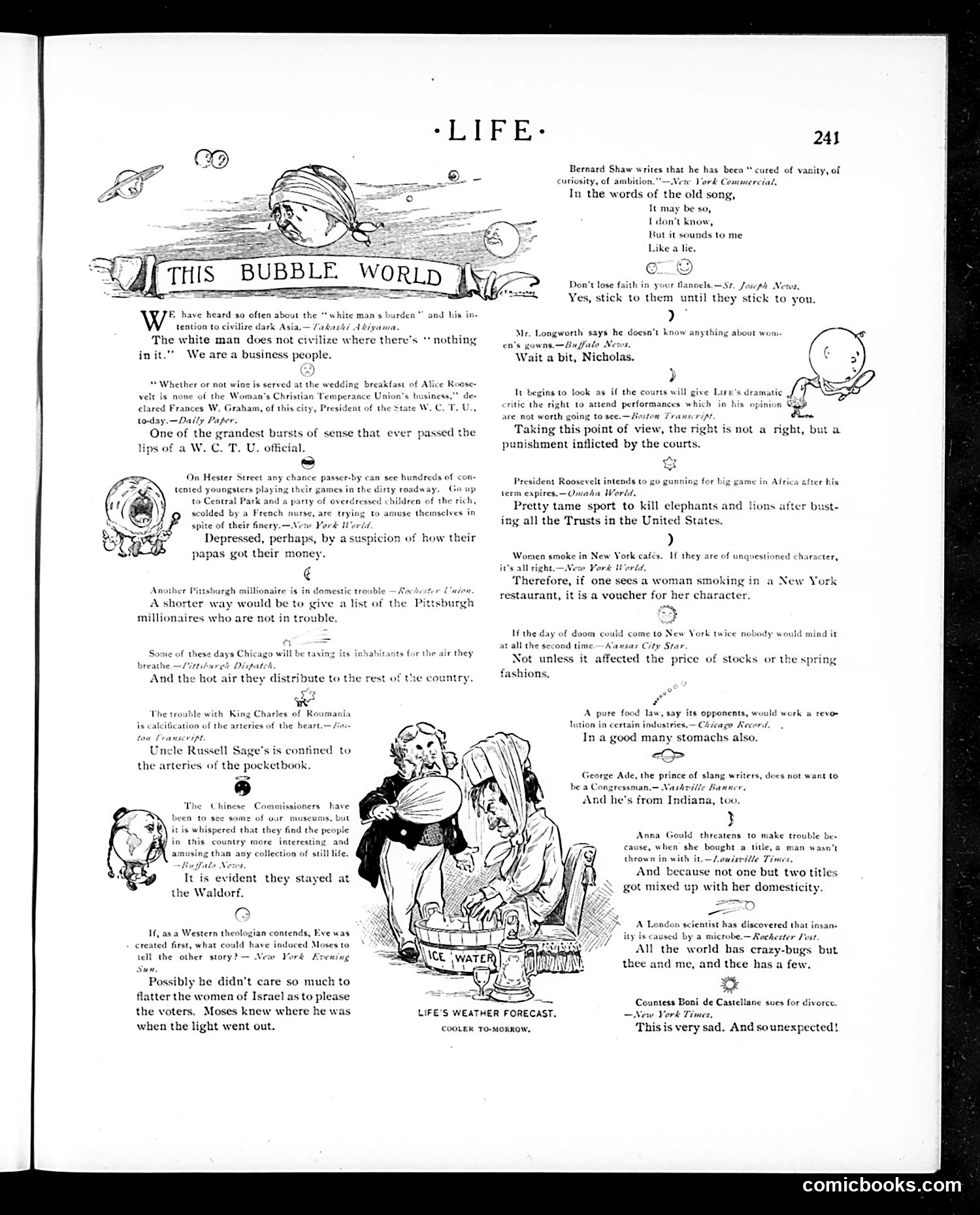
This page features "This Bubble World," a satirical column commenting on contemporary social absurdities. The illustrations mock various figures and situations: one cartoon shows what appears to be wealthy people in frivolous pursuits (referenced humorously as "bubbles"), while another depicts "Life's Weather Forecast" with figures around ice water, likely satirizing social pretension. The text references specific scandals and figures—including Bernard Shaw, Roosevelt's hunting plans, and Chicago's air quality issues—with biting commentary on hypocrisy. The satire targets the wealthy and powerful, critiquing their self-serving behaviors while claiming moral authority. The "bubble" metaphor suggests these people live in an artificial, disconnected reality divorced from ordinary concerns. The overall tone is one of social criticism through humor.
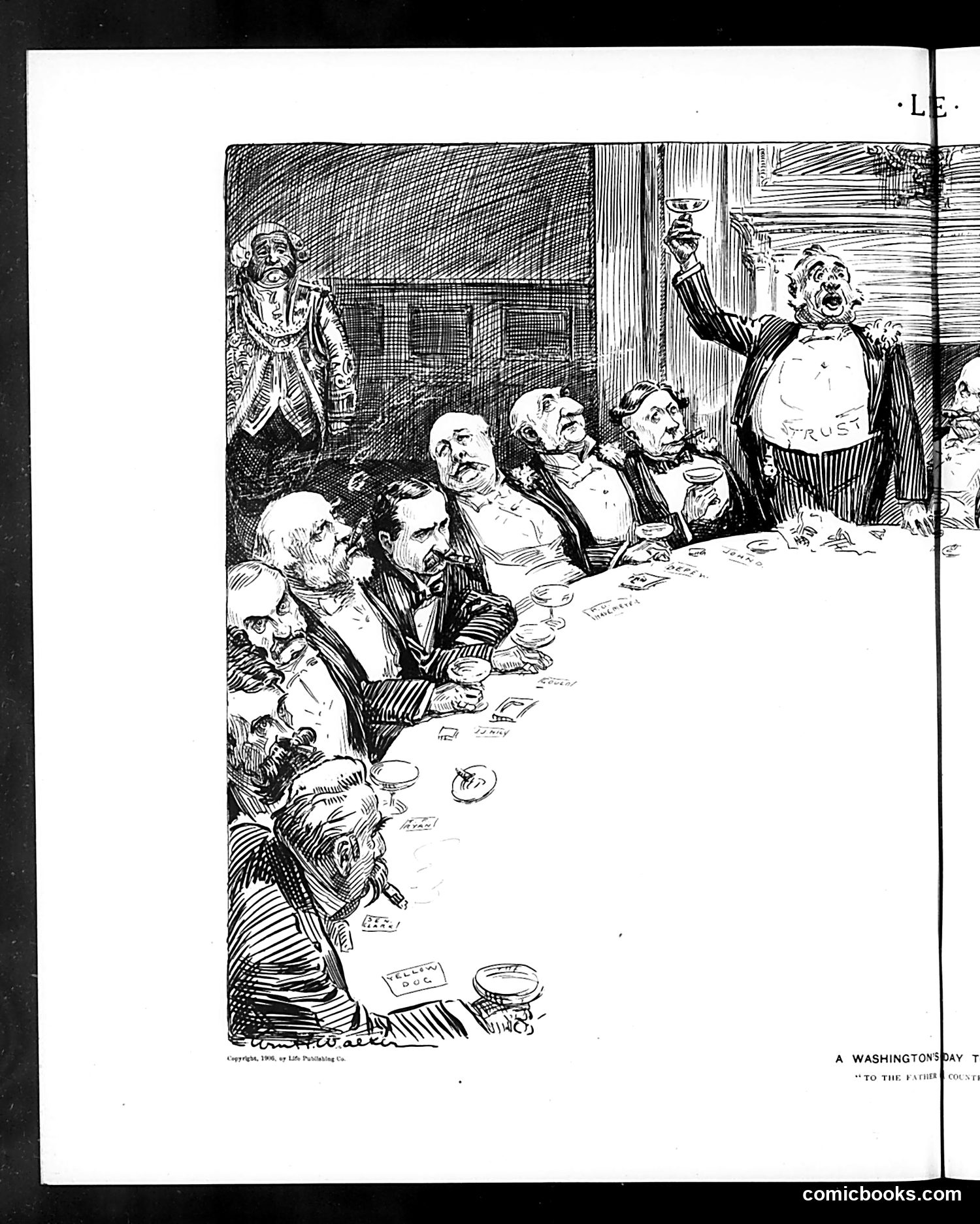
This political cartoon depicts a formal dinner or banquet scene satirizing corruption and corporate influence in American politics. A rotund figure labeled "TRUST" stands prominently, addressing seated politicians and businessmen around a dining table. The composition suggests that wealthy industrialists or monopoly interests ("trusts") literally control political proceedings—they dine with and direct elected officials. The cartoon appears to critique the Gilded Age problem of corporate trusts exerting undue influence over government. The seated figures' passive postures and attention to the standing "Trust" figure emphasizes how political power has been captured by moneyed interests rather than serving the public. This reflects Progressive Era anxieties about corporate monopolies controlling American democracy.
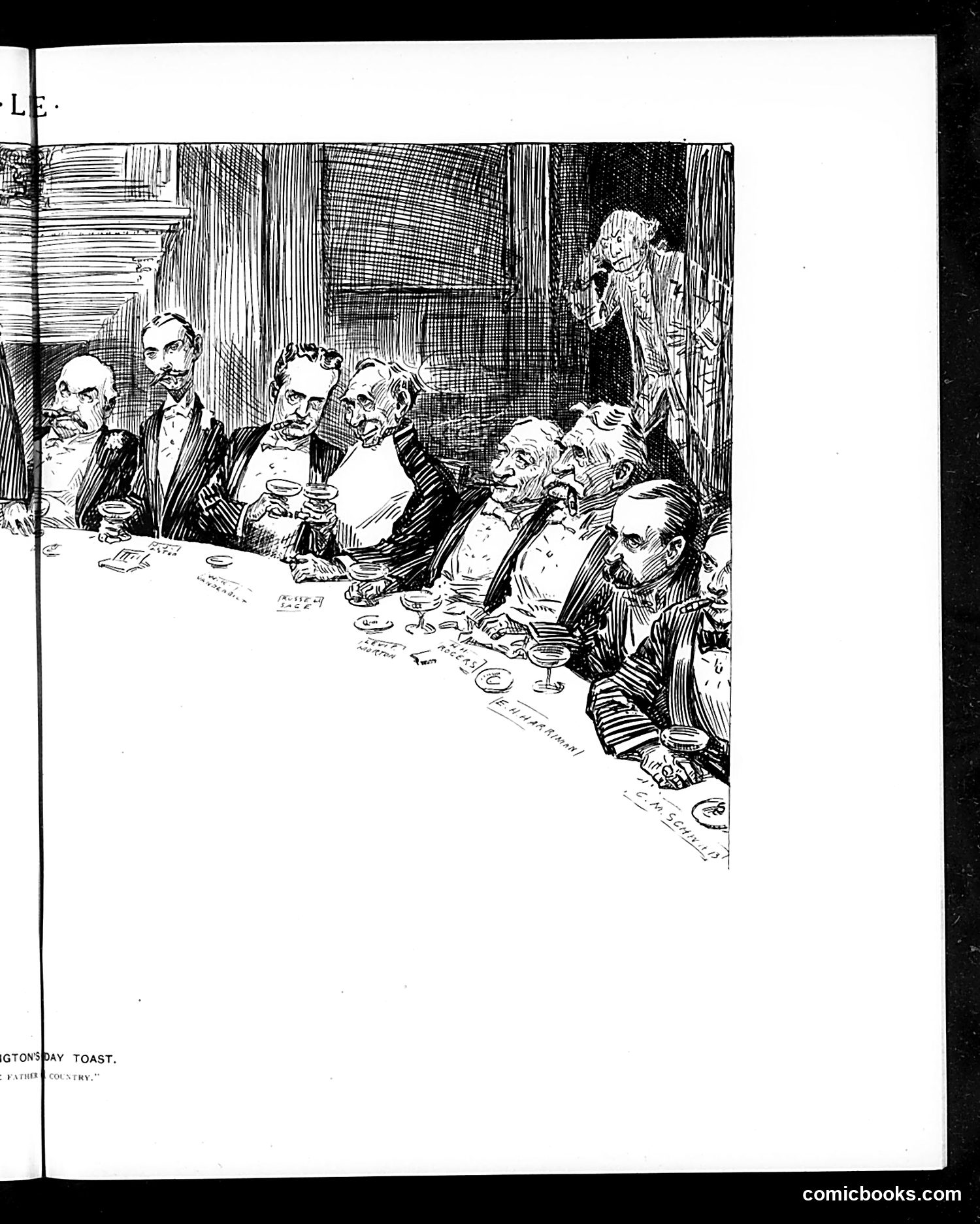
This political cartoon depicts a formal dinner scene with well-dressed gentlemen seated around a table, raising glasses in a toast. The caption references "Washington's Day Toast" and appears to invoke patriotic sentiment with a phrase about "country." The illustration shows multiple caricatured figures in formal 19th-century attire, suggesting this depicts prominent political or social figures of the era toasting on a significant occasion. One figure stands apart, possibly delivering remarks. However, without clearer visibility of specific identifying labels or dates on the page, I cannot definitively identify which particular Washington's Day celebration this represents or name the specific individuals caricatured. The satirical intent likely comments on political hypocrisy or ceremonial formality, but the precise targets remain unclear from this image alone.
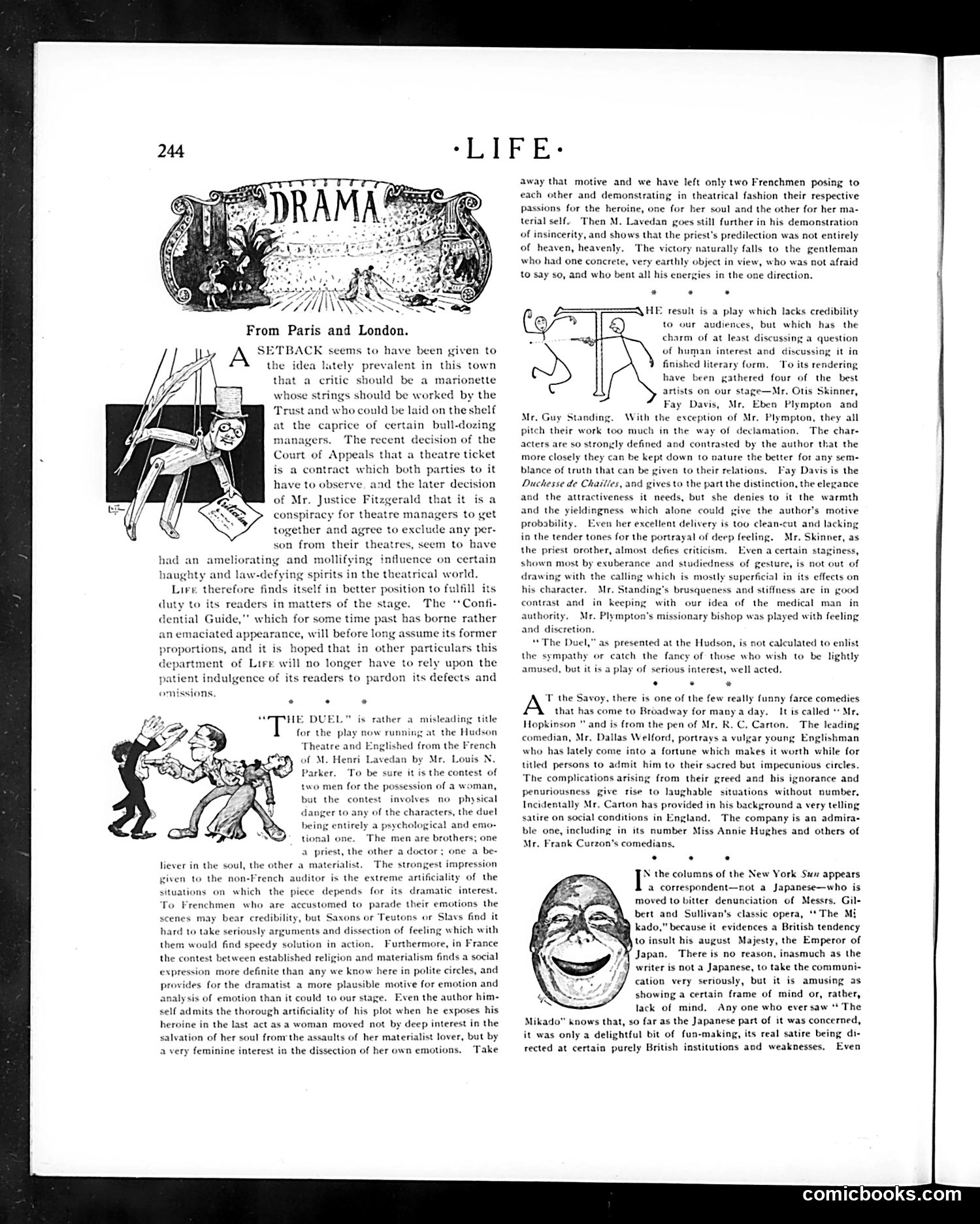
This page reviews recent Broadway productions, focusing on theatrical management and artistic merit. The upper cartoons satirize theater critics and managers, referencing a recent court decision that established theater tickets as binding contracts and made it illegal for managers to collectively exclude patrons—a victory for press freedom against theatrical monopolies. The main reviews critique two plays: "The Duel" (adapted from French playwright Henri Lavedan) and "Mr. Hopkinson" (starring comedian Dallas Welford). The critic argues "The Duel" lacks credibility for American/Saxon audiences because its psychological, emotionally-dissective conflict feels artificially theatrical—Frenchmen parade emotions while English/German/Slavic audiences expect action over philosophical debate. The review praises the cast (Otis Skinner, Fay Davis, Eben Plympton) but faults their over-declamatory style. "Mr. Hopkinson" is praised as lighter social satire with comic merit despite its vulgar protagonist.
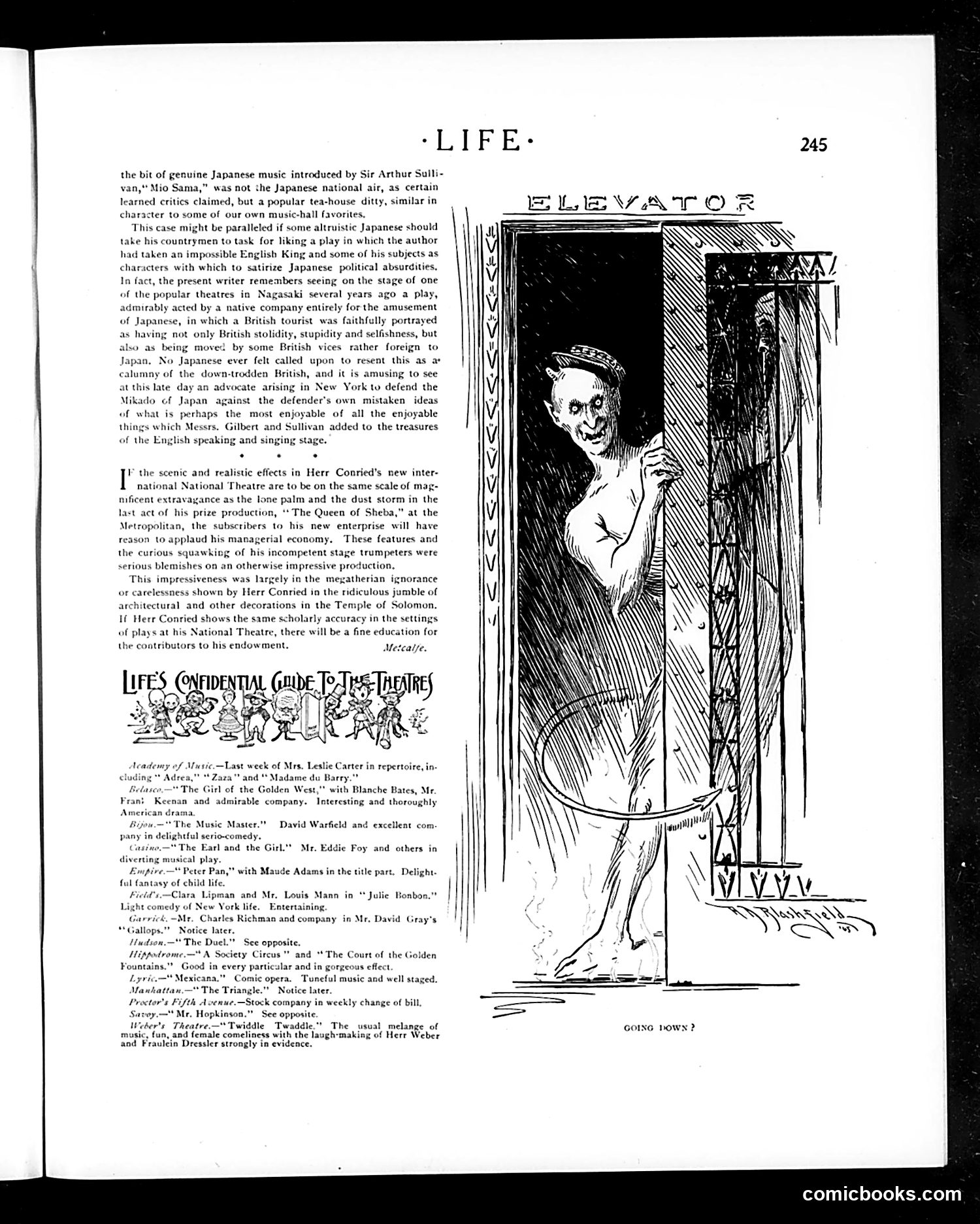
This page critiques the controversy over Gilbert and Sullivan's *The Mikado*, a satirical operetta featuring a fictional Japanese setting and characters. The text defends the work against critics who claimed it misrepresented Japanese culture. The main argument: a Japanese theater once performed a play mocking British tourists with exaggerated stereotypes—yet no one objected. Therefore, it's hypocritical for New York critics to attack *The Mikado* for satirizing Japanese politics. The author argues both are legitimate theatrical satire. The page also criticizes theater producer Herr Conried's production design for his National Theatre, particularly his confused and historically inaccurate Temple of Solomon set for *The Queen of Sheba*. The illustration titled "ELEVATOR" and captioned "GOING DOWN?" appears to be a separate satirical cartoon, though its specific target isn't clear from this context. The remainder is theatrical listings for various New York productions.
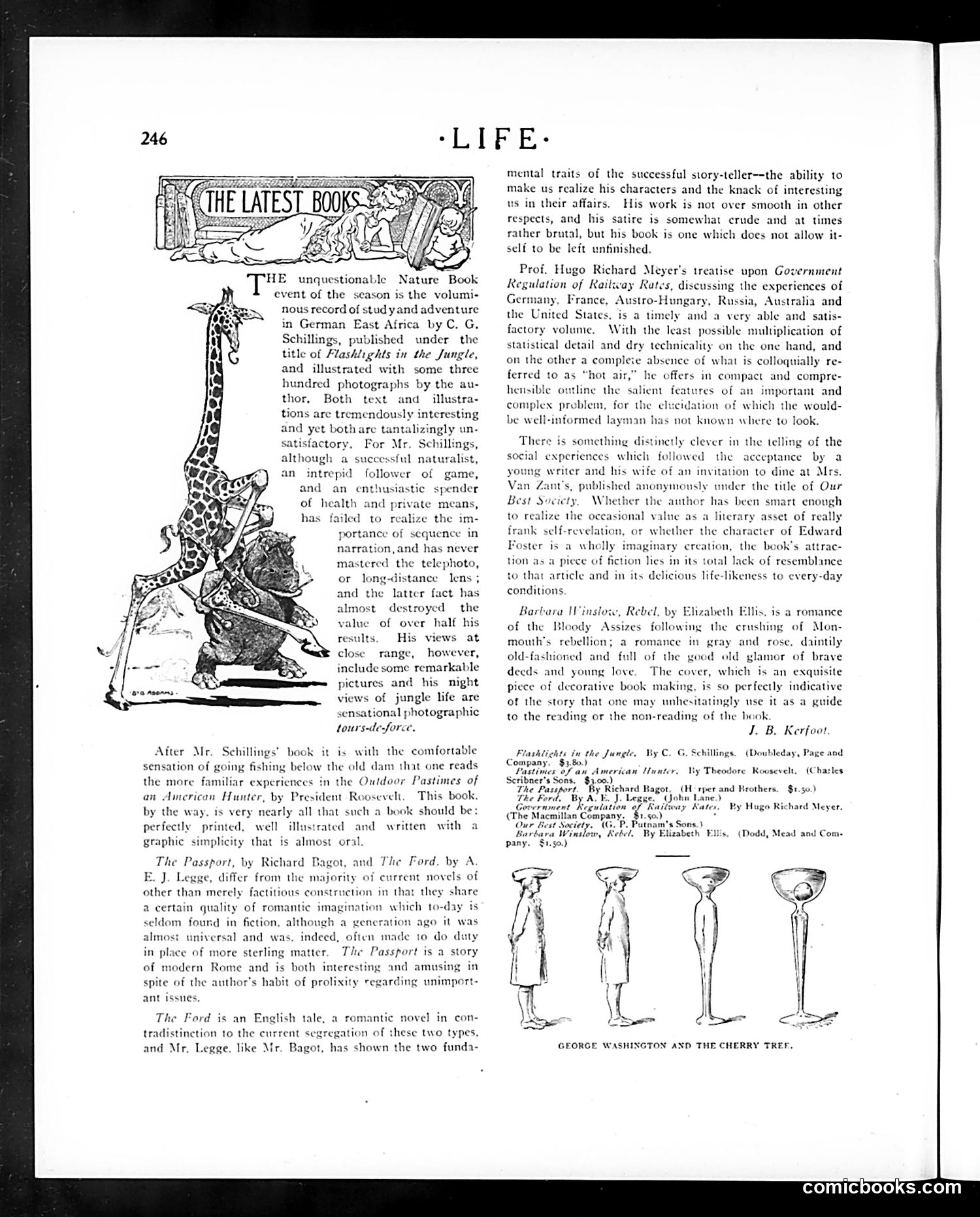
This is a straightforward book review section, not political satire. The page discusses recent publications, prominently featuring C.G. Schillings' *Flashlights in the Jungle*, a nature photography book about German East Africa. The main illustration—a giraffe with a hunter—visually supports the review's discussion of Schillings' work. The reviewer praises his photographic adventures but criticizes his poor mastery of telephoto lens technology, which undermined half his results. The page also reviews President Roosevelt's *Outdoor Pastimes of an American Hunter*, calling it exactly what such a book should be. Other books discussed include *The Passport* and *The Ford* (romantic novels), Meyer's *Government Regulation of Railway Rates*, and *Barbara Winslow, Rebel*. The small illustrations at bottom showing drinking glasses relate to "George Washington and the Cherry Tree"—likely advertising or decorative filler unrelated to the book reviews above.
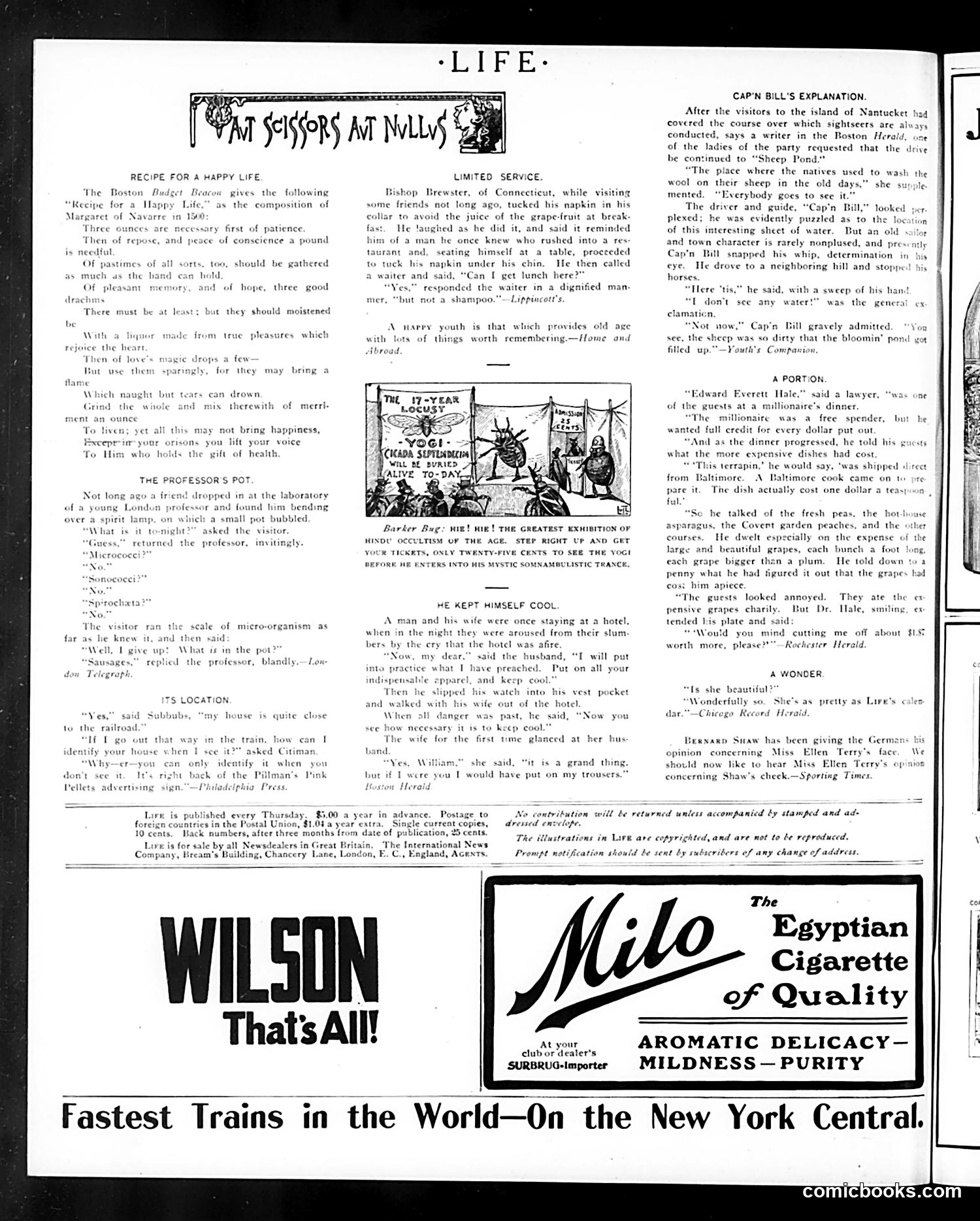
This page from *Life* magazine consists primarily of humorous anecdotes and brief jokes typical of early 20th-century American humor, interspersed with advertisements. The cartoons/jokes include: - **"At Scissors at Nulls"**: A small illustrated anecdote about a London professor's mysterious pot (appears to be a microorganism experiment joke) - **"Cap'n Bill's Explanation"**: A Nantucket tour guide humorously explains why "Sheep Pond" contains no water—the sheep were so dirty they filled it in - **"He Kept Himself Cool"**: A man calmly removes his watch during a hotel fire, prioritizing composure over panic These represent gentle, wholesome satire aimed at: - Academic pretension (the professor sketch) - Rural/folk wisdom and Yankee character types (Cap'n Bill) - Marital dynamics and masculine composure The advertisements at bottom promote Wilson brand products, Milo Egyptian cigarettes, and New York Central trains—standard commercial content of the era.
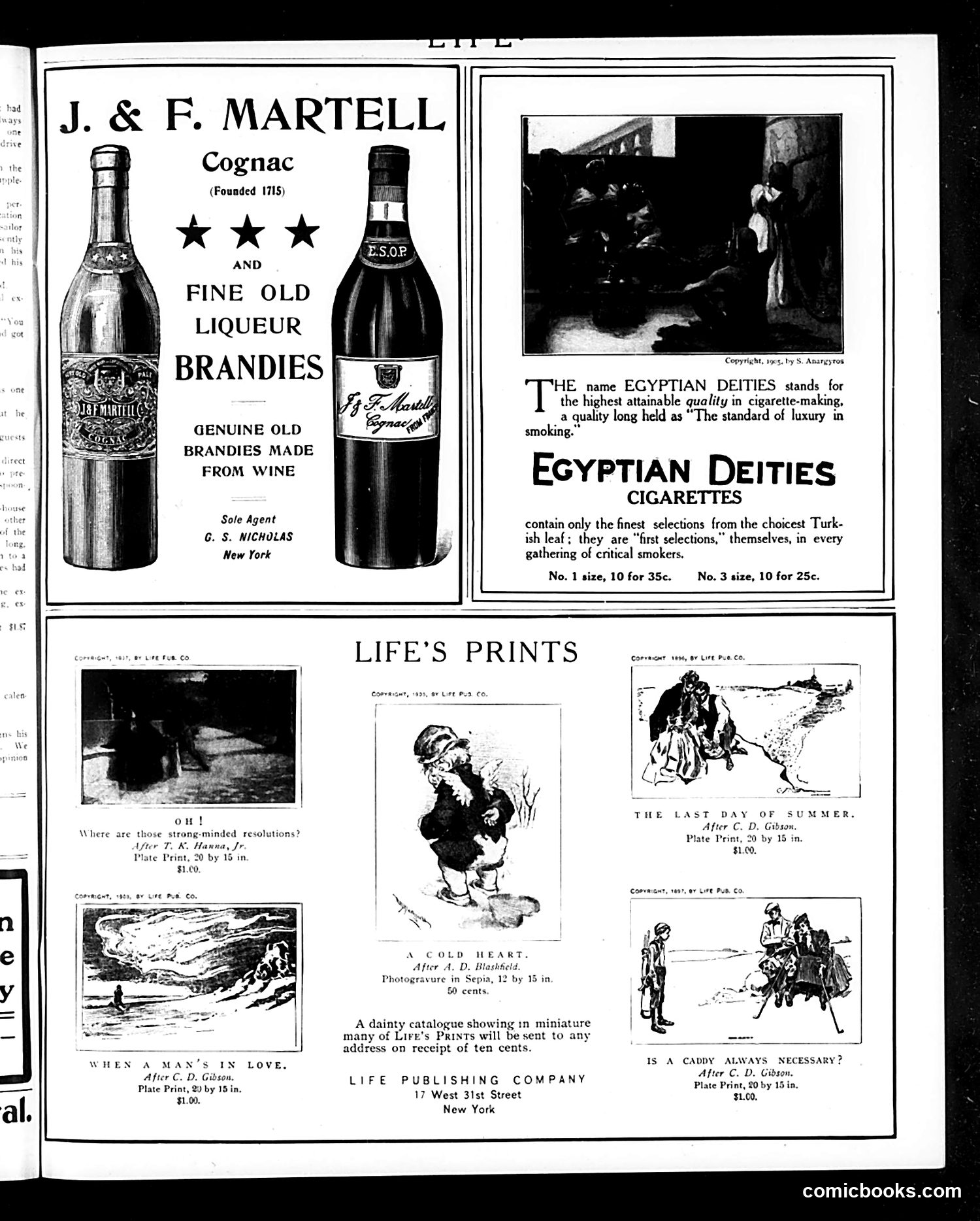
This page is primarily **advertising and merchandise**, not political satire. It contains three distinct advertisements: 1. **J. & F. Martell Cognac** — a luxury brandy ad emphasizing the brand's founding in 1715 and quality, with a New York distributor listed. 2. **Egyptian Deities Cigarettes** — promoting Turkish tobacco cigarettes as "the standard of luxury in smoking," available in two sizes at different prices. 3. **Life's Prints** — the publishing company advertising fine art reproductions, including works by artists A. D. Blashfield and C. D. Gibson. The prints shown appear to be sentimental or genre scenes ("A Cold Heart," "The Last Day of Summer," "Is a Caddy Always Necessary?"), priced from 50 cents to $1.00. The page reflects early 20th-century consumer culture, showcasing luxury goods marketed to affluent readers. There is no apparent political commentary or social satire on this particular page.
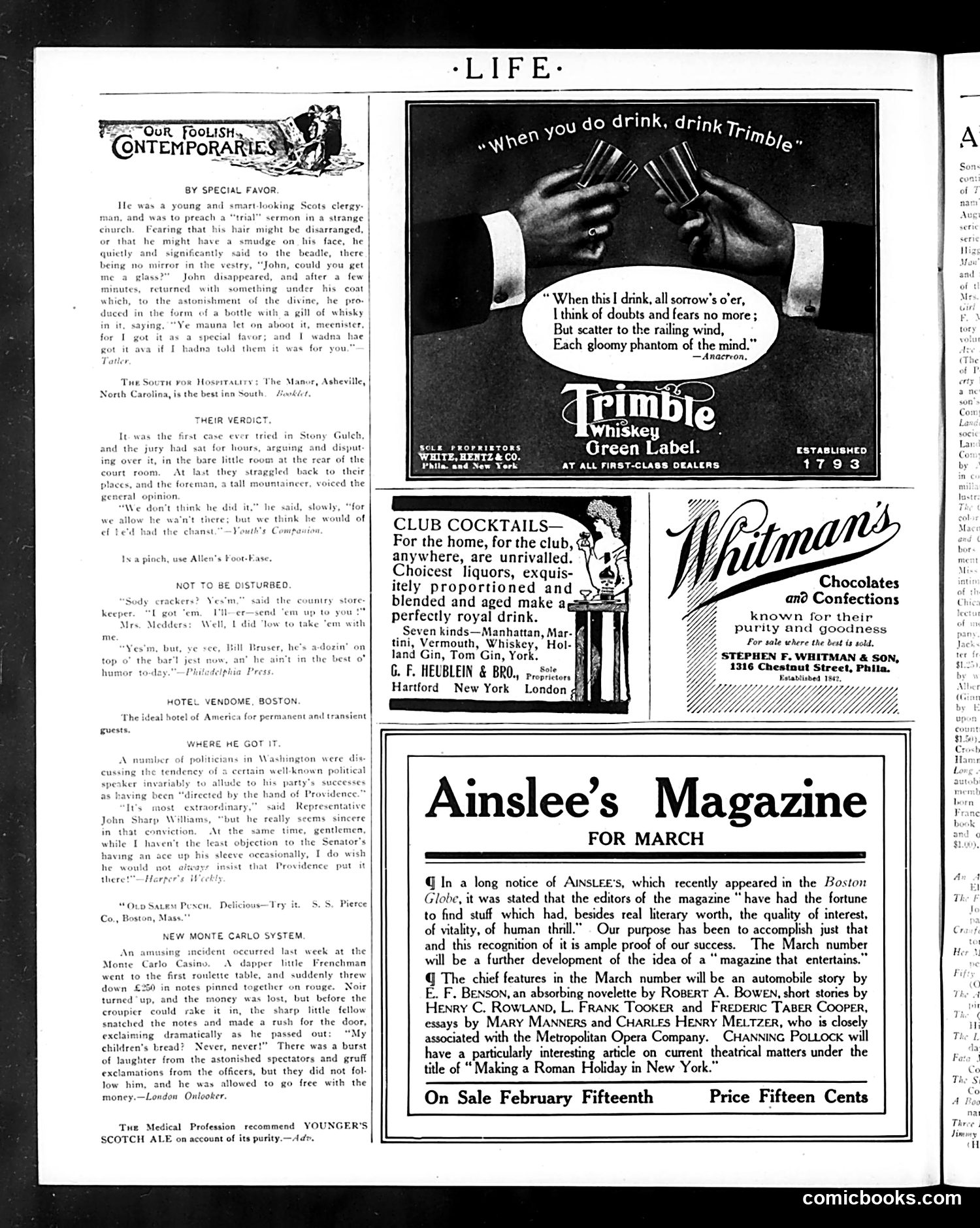
This page is primarily **advertising and promotion** rather than political satire. The main content includes: **"Our Foolish Contemporaries"** (top left): A brief humorous anecdote about a Scottish clergyman who secretly obtained whisky from a church beadle, establishing a comic setup about human weakness and hypocrisy. **Trimble Whiskey Advertisement** (top right): Features a quote attributed to Anacreon (ancient Greek poet) endorsing whiskey as a cure for melancholy—using classical authority to legitimize alcohol consumption. **Additional advertisements**: Club cocktails, Whitman's chocolates, and Ainslee's Magazine promotion dominate the lower half. **The satire**, such as it is, gently mocks human nature—clergy sneaking alcohol, politicians guided by "Providence," and society's various pretenses. However, this page is **overwhelmingly commercial** rather than politically pointed. The humor is light, domestic, and designed to sell products rather than critique current events or figures.
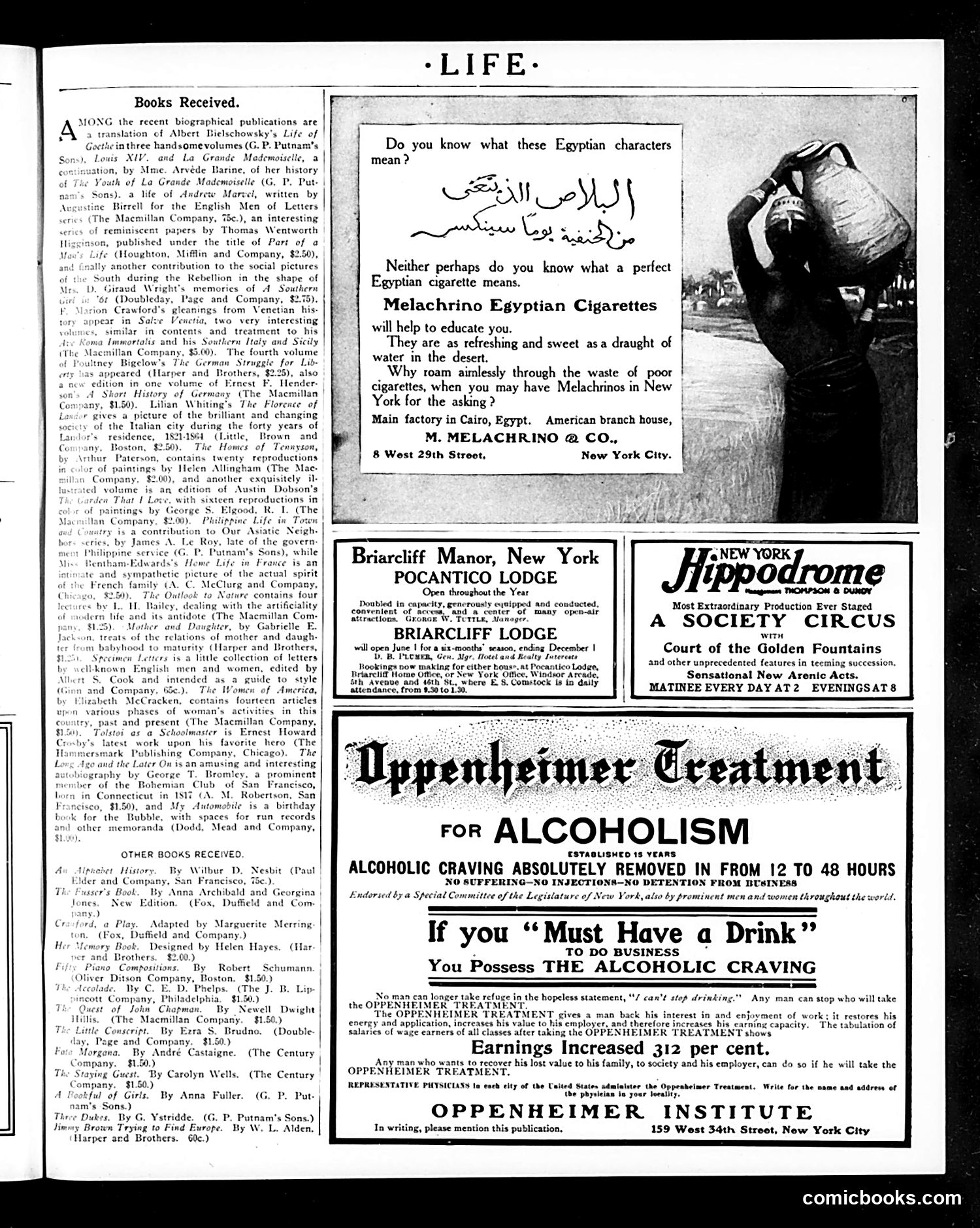
This page is primarily **advertising and book reviews**, not political satire. The dominant advertisement is for the **Oppenheimer Treatment for Alcoholism**—a dubious medical cure claiming to eliminate "alcoholic craving" in 12-48 hours with "earnings increased 312 per cent." This reflects early 20th-century snake-oil medicine and the contemporary temperance movement's anxieties about drinking. Secondary ads promote **Melachrino Egyptian Cigarettes** (with Egyptian script), **Hippodrome's Society Circus**, and **Briarcliff Manor lodge**—typical period luxury goods marketing. The left column lists recent book publications, mostly biographies and historical works of limited satirical interest. **Modern relevance**: The alcoholism "cure" advertisement is historically significant as an example of unregulated medical fraud common before FDA regulations—promising miraculous results without evidence, targeting businessmen with false productivity claims.
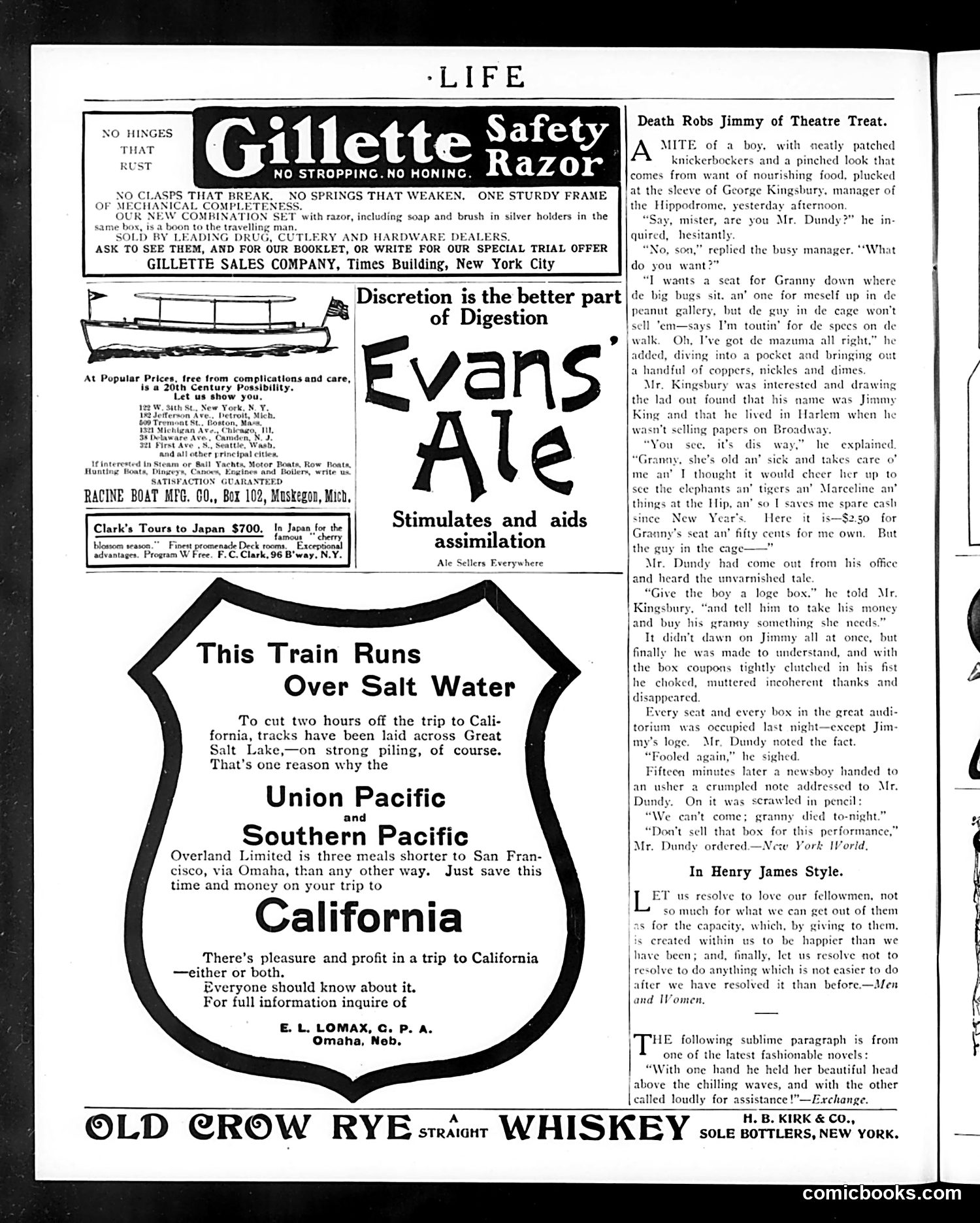
This page is primarily **advertising** with a small news story. The main content is a brief human-interest piece titled "Death Robs Jimmy of Theatre Treat," which tells of a poor newsboy from Harlem who scrapes together money (in nickels, dimes, and pennies) to buy theater seats for himself and his elderly grandmother at the Hippodrome. He approaches theater manager Mr. Dundy, who is moved by the boy's devotion and generously upgrades them to a loge box. Tragically, the story ends when Jimmy delivers a note saying his grandmother died that night—so the seats go unused. The satire here is gentle rather than sharp: it critiques **urban poverty and social class** while celebrating charitable impulse. The boy's dialect ("de big bugs," "mazuma") marks him as working-class, and his struggle to afford entertainment underscores economic inequality. Yet the story's sentimental resolution—the manager's kindness—suggests paternalistic benevolence rather than systemic reform. The surrounding advertisements (Gillette razors, Evans Ale, railroad travel) are typical period marketing, unrelated to the news story's social commentary.
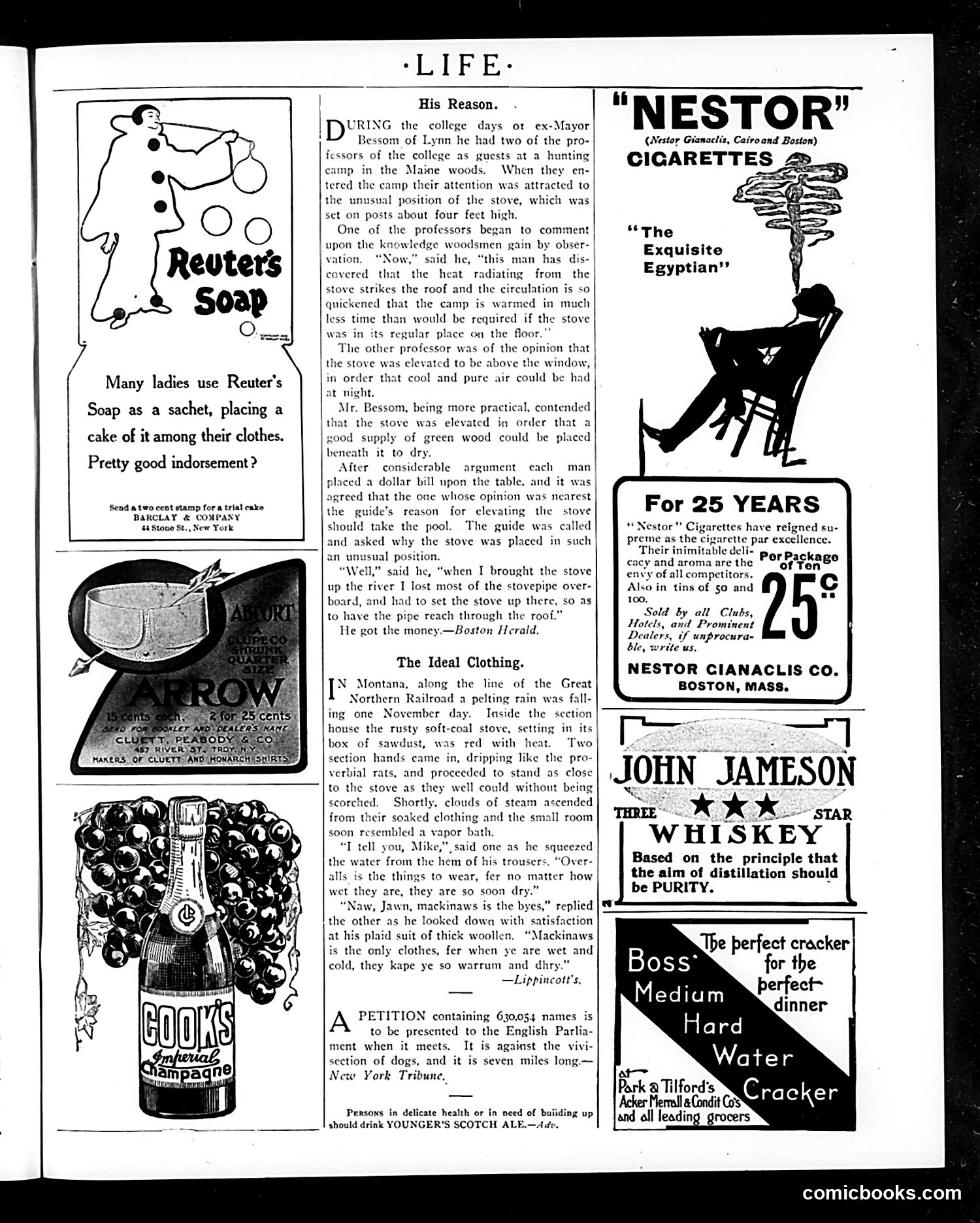
This page consists primarily of **humorous anecdotes and advertisements** rather than political cartoons. The two main stories are: 1. **"His Reason"**: A practical joke on academics. Ex-Mayor Bessom's college professor guests debate why a hunting camp stove sits elevated on posts—one theorizes about heat circulation, another about air quality. The guide's actual reason: his stovepipe fell overboard during transport, so he had to elevate it to reach the roof. The joke mocks professorial over-analysis versus common-sense practicality. 2. **"The Ideal Clothing"**: Two railroad workers debate wet-weather gear—one favors overalls for quick drying, the other mackinaws for warmth. It's gentle humor about working-class preferences with no deeper satire. The page is dominated by **period advertisements** for Reuter's Soap, Nestor Cigarettes, Cook's Champagne, John Jameson whiskey, and Boss crackers—typical of *Life* magazine's commercial content. The overall tone is lighthearted Americana, not social or political commentary.
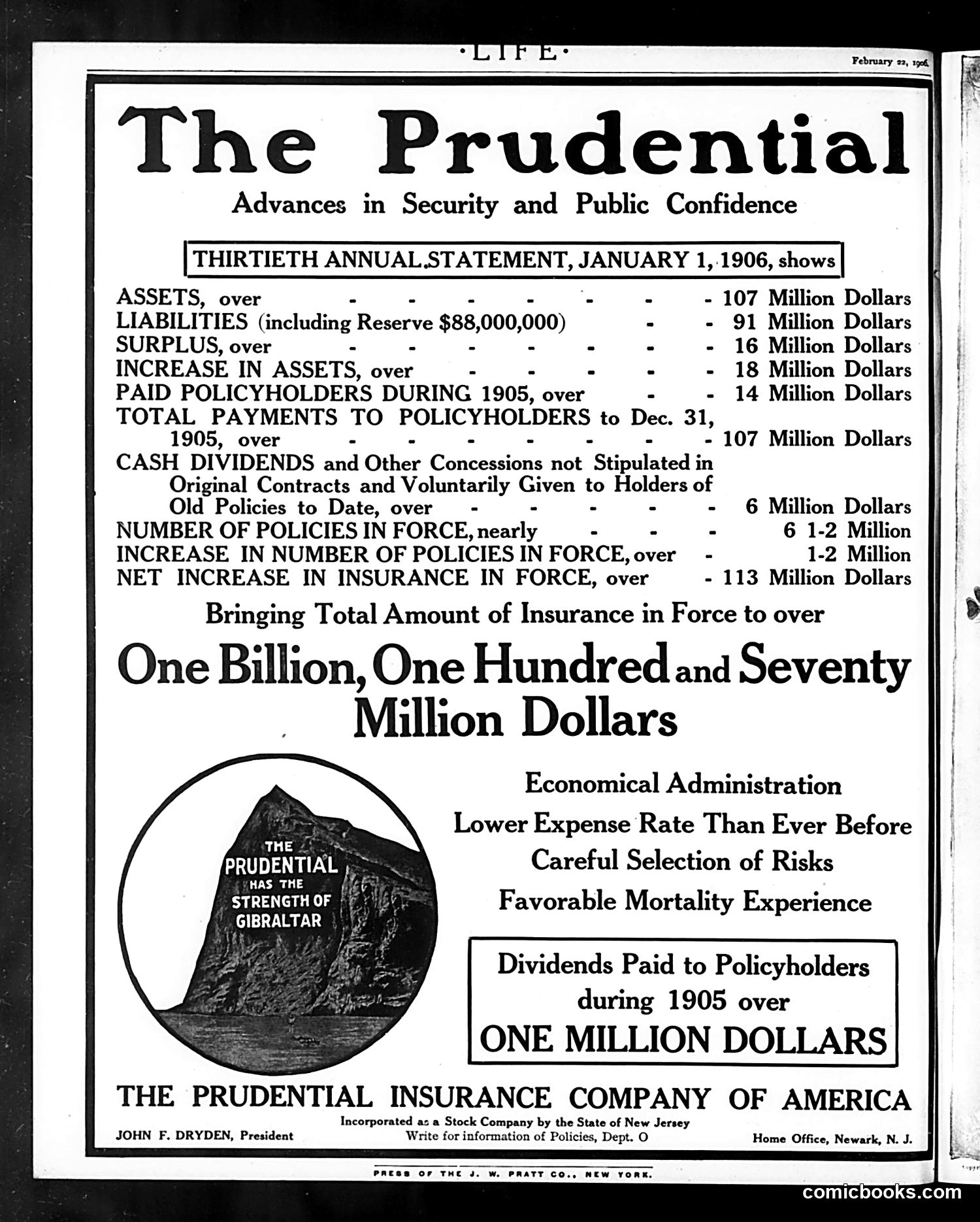
This is primarily a **full-page advertisement** for The Prudential Insurance Company, not satirical content. Published in *Life* magazine (February 29, 1906), it showcases the company's financial strength through its thirtieth annual statement. The only visual element is the **Rock of Gibraltar** logo—a symbol comparing Prudential's stability to the famous fortress. The tagline "THE PRUDENTIAL HAS THE STRENGTH OF GIBRALTAR" emphasizes reliability and permanence. The ad targets middle-class readers by highlighting concrete achievements: over $107 million in assets, $1 billion+ insurance in force, and $1 million paid to policyholders in 1905. It emphasizes "economical administration" and "favorable mortality experience"—reassuring language for life insurance buyers concerned about company solvency. John F. Dryden served as president. This advertisement reflects the early-1900s insurance industry's need to build public confidence in financial institutions.