
Life, 1906-02-22 · page 16 of 24
Life — February 22, 1906 — page 16: what you’re looking at
What you’re looking at
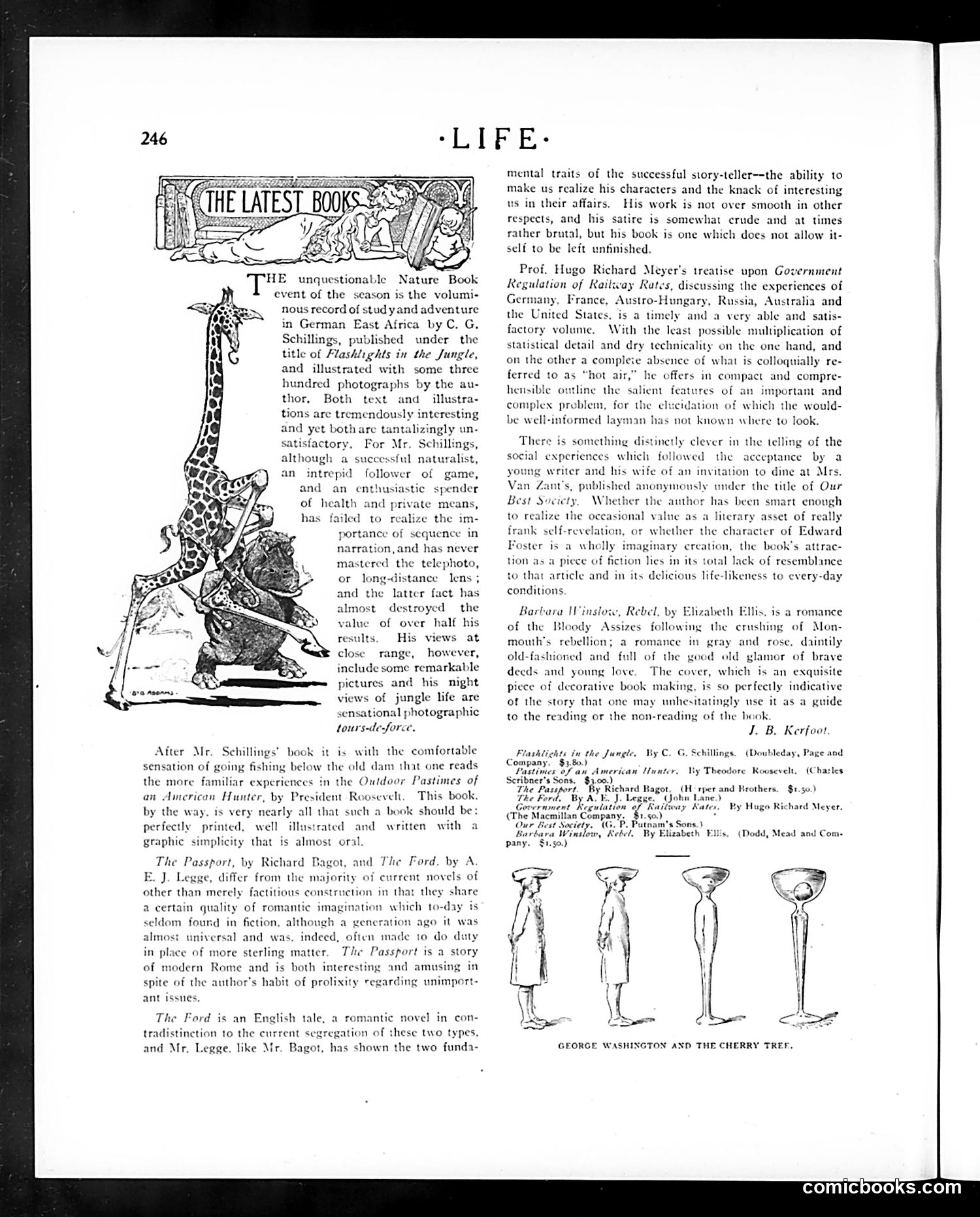
This is a straightforward book review section, not political satire. The page discusses recent publications, prominently featuring C.G. Schillings' *Flashlights in the Jungle*, a nature photography book about German East Africa. The main illustration—a giraffe with a hunter—visually supports the review's discussion of Schillings' work. The reviewer praises his photographic adventures but criticizes his poor mastery of telephoto lens technology, which undermined half his results. The page also reviews President Roosevelt's *Outdoor Pastimes of an American Hunter*, calling it exactly what such a book should be. Other books discussed include *The Passport* and *The Ford* (romantic novels), Meyer's *Government Regulation of Railway Rates*, and *Barbara Winslow, Rebel*. The small illustrations at bottom showing drinking glasses relate to "George Washington and the Cherry Tree"—likely advertising or decorative filler unrelated to the book reviews above.
📄 Transcribed text from this page (OCR, searchable)
Machine-transcribed from the original scan — historical spelling and the odd misread are preserved.
og HE unquestionable Nature Book event of the season is the volumi- nous record of stud yand adventure in German East Africa by C. G. Schillings, published under the title of Flashlights in the Jungle, and illustrated with some three hundred photographs by the au- thor, Both text and illustra- tions are tremendously interesting and yet both are tantalizingly un- satisfactory. For Mr. Schillings, although a successful naturalist, an intrepid follower of game, and an enthusiastic spender of health and private means, has failed to realize the im- portance of sequence in narration, and has never mastered the telephoto, or long-distance lens ; and the latter fact has almost destroyed the alue of over half his results. His views at close range, however, include some remarkable pictures and his night views of jungle life are sensational photographic tours-de-force. After Mr. Schillings’ book it is with the comfortable sensation of going fishing below the old dam that one reads the more familiar experiences in the Outdoor Pastimes of n American Hunter, by President Roosevelt. This book, by the way. is very nearly all that such a book should be: perfectly printed, well i ted and written with a graphic simplicity that is almost oral. The Passport, by Richard Bagot, and The Ford. by E. J. Legge, differ from the majority of ettrrent novels of other than merely factitious construction in that they share a certain quality of romantic ima which to-day is in fiction, although a gener and was. indeed, often made to do ¢ © of more sterling matter. The Passport is a story of modern Rome and is both interesting and amusing in spite of the author's habit of prolixity regarding unimport- ant issues. jon ago it was The Ford is an English tale, a romantic novel in con- tradistinction to the current segregation of these two types, and Mr. Legge. like Mr. Bagot, has shown the two funda- mental traits of the successful story-teller--the ability to make us realize his characters and the knack of interesting us in their affairs. His work is not over smooth in other respects, and his satire is somewhat crude and at times rather brutal, but his book is one which does not allow self to be left unfinished. Prof. Hugo Richard Meyer's treatise upon Government Regulation of Railway Rates, discussing the experiences of Germany, France, Austro-Hungary, Russia, Australia and the United States. is a timely and a very able and satis- factory volume, With the least possible multiplication of statistical detail and dry technicality on the one hand, and on the other a compleie absence of what is colloquially re- ferred to as “hot air,” he offers in compact and compre- hensible outline the salient features of an important and complex problem, the elicidation of which the would- be well-informed layman has not known where to look. There is something distinctly clever in the telling of the social experiences which followed the acceptance by a ng writer and his wife of an invitation to dine at Mrs. Zant’s, published anonymously under the title of Our Sveciety, Whether the author has been smart enough to realize the occasional value as a literary a frank self-revelation, or whether the character of Foster is a wholly imaginary creation, the beok’s attrac- tion as a picce of fiction lies in its total lack of resemblance to that article and in its delicious life-likeness to every-day conditions Barbara Winslow, Rebe of the Bloody mouth’s rebellion; a romance in gra old-fashioned and full of the good deeds and young love picce of decorative book making, is so perfectly indicative . by Elizabeth Ellis, is a romance the crushing of Mon- and rose, daintily d glamor of bray The cover, which is an exquisite Assizes following of the story that one may unhesitatingly use it as a guide to the reading or the non-reading of the hook J.B. Kerfoot Flashlights in the Jungle, Vy C. G. Schillings. (Doubleday, Page and Company. $3.80.) Pastimes of an American Hunter, Scribner's Sons, $3.00.) By Richard Bagot, (Hi rper and Brothers, $1.50.) The Ford. By &.¥. J. Legge, (Jobn Lane.) Government Rgutat By Hugo Ri (The Macmill: Our Best Society. (GP. s Winslow, Kebcl. By Elizabeth Ellis. (Dodd, Mead and Com- lty Theodore Koosevelt. (Chazles ard Meyer. > GEORGE WASHINGTON AND THE CHERRY TREF. comicbooks.com