
Life, 1906-02-22 · page 14 of 24
Life — February 22, 1906 — page 14: what you’re looking at
What you’re looking at
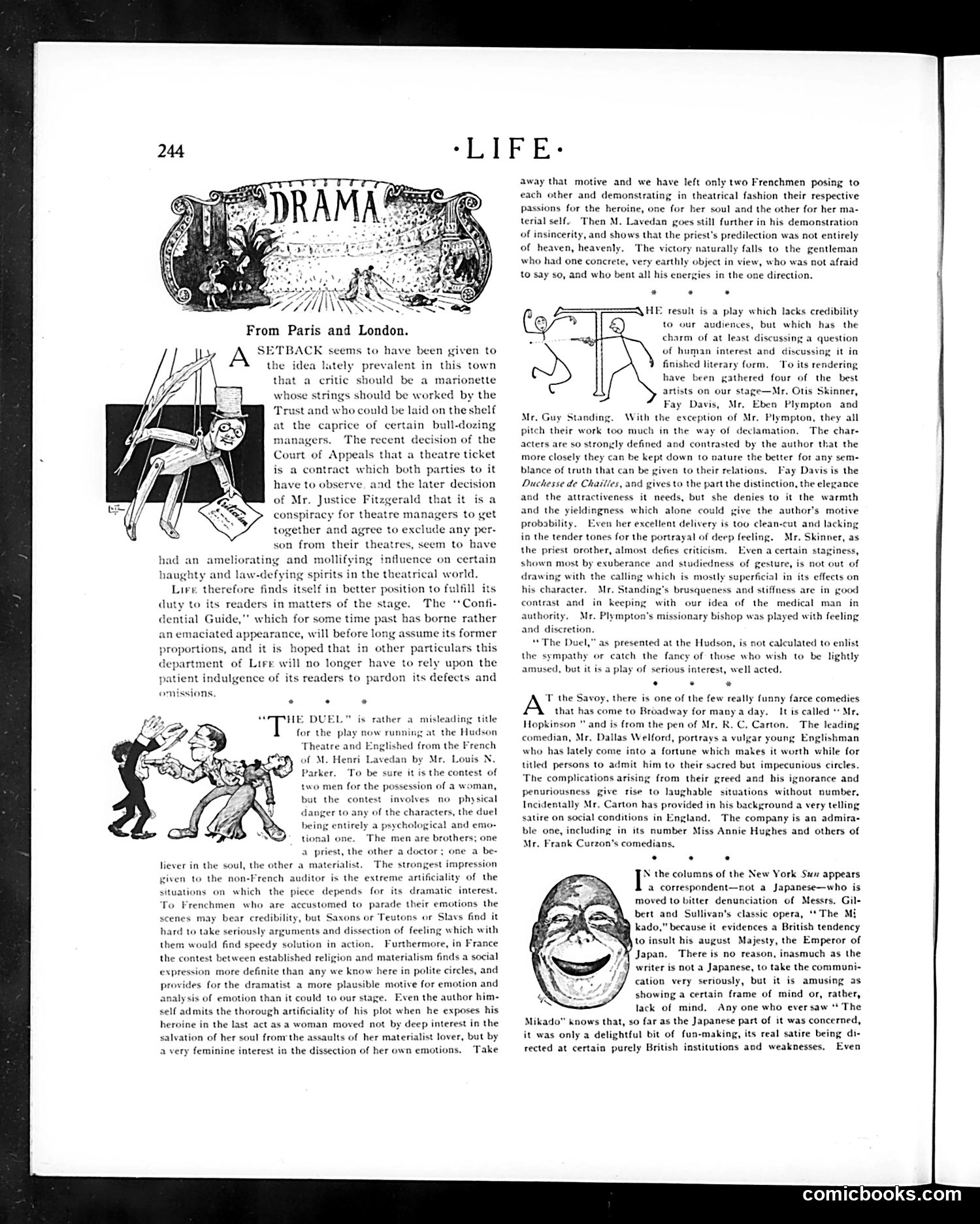
This page reviews recent Broadway productions, focusing on theatrical management and artistic merit. The upper cartoons satirize theater critics and managers, referencing a recent court decision that established theater tickets as binding contracts and made it illegal for managers to collectively exclude patrons—a victory for press freedom against theatrical monopolies. The main reviews critique two plays: "The Duel" (adapted from French playwright Henri Lavedan) and "Mr. Hopkinson" (starring comedian Dallas Welford). The critic argues "The Duel" lacks credibility for American/Saxon audiences because its psychological, emotionally-dissective conflict feels artificially theatrical—Frenchmen parade emotions while English/German/Slavic audiences expect action over philosophical debate. The review praises the cast (Otis Skinner, Fay Davis, Eben Plympton) but faults their over-declamatory style. "Mr. Hopkinson" is praised as lighter social satire with comic merit despite its vulgar protagonist.
📄 Transcribed text from this page (OCR, searchable)
Machine-transcribed from the original scan — historical spelling and the odd misread are preserved.
-LIFE* From Paris and London. 'TBACK seems to have been given to the idea lately prevalent in this town that a critic should be a marionette whose strings should be worked by the Trust and who could be laid on the shelf at the caprice of certain bull-dozing managers. The recent decision of the Court of Appeals that a theatre ticket is a contract which both parties to it have to observe, and the later decision of Mr. Justice Fitzgerald that it is a conspiracy for theatre managers to get together and agree to exclude any per- son from their theatres, seem to ve had an ameliorating and mollifying influence on certain efying spirits in the theatrical world. efore finds itself in better position to fulfill its The **Conti- which for some time past has borne rather haughty Lire t duty to its readers in matters of the stage. dential Guide," an emaciated appearance, will before long assume its former proportions, and it is hoped that in other particulars this department of Lire will no longer have to rely upon the patient indulgence of its readers to pardon its defects and omissions. . . . “HE DUEL for the play now runn Theatre and Englished from the French of M. Henri Lavedan by Mr. Louis } Parker, two men for the possession of a woman, is rather a misleading title at the Hudson To be sure it is the contest of but the contest involves no physical danger to any of the characters, the duel being entirely a psychological and emo- tional one. The men are brothers; one a priest, the other a doctor; one a be- ver in the soul, the other a materialist, The strongest impression given to the non-French auditor is the extreme artificiality of the situations on which the piece depends for its dramatic interest. To Frenchmen who are accustomed to parade their emotions the scenes may bear credibility, but Saxons or Teutons or Slavs find it hard to take seriously arguments and dissection of feeling which with Furthermore, in France and materialism finds a social them would find speedy solution in action. the contest between established reli expression more definite than any we know here in polite circles, and provides for the dramatist a more plausible motive for emotion and analysis of emotion than it could to our stage. Even the author him- self admits the thorough artificiality of his plot when he exposes his roine in the last act asa woman moved not by deep interest in the salvation of her soul fromm the assaults of her materialist lover, but by a very feminine interest in the dissection of her own emotions. Take away that motive and we have left only two Frenchmen posing to each other and demonstrating in theatrical fashion their respective passions for the heroine, one for her soul and the other for her ma- terial self. Then M. Lavedan goes still further in his demonstration of insincerity, and shows that the priest's predilection was not entirely of heaven, heavenly. The victory naturally falls to the gentleman who had one concrete, very earthly object in view, who was not afraid to say so, and who bent all his energies in the one direction. HE result is a play which lacks credibility to our audiences, but which has the charm of at least discussing a question (oF of human interest and discussing it in To its rendering have been gathered four of the best artists on our st Mr. Otis Skinner, Fay Davis, Mr, Eben Plympton and With the exception of Mr. Plympton, they all pitch their work too much in the way of declamation, The cha acters are so strongly defined and contrasted by the author that the more cl e better for any sem- blance of truth that can be given to their relations, Fay Davis is the Duchesse de Chaities, and gives to the part the distinction, the elegance and the attractiveness it needs, but she denies to it the warmth and the yieldingness which alone could ive the author's motive ven her excellent delivery is too clean-cut and lacking in the tender tones for the porte: Mr. Skinner, as the priest orother, almost defies criticism, Even a certain staginess, finished literary form. Mr. Guy Standing. ly they can be kept down to nature probability. 1 of deep feeling. shown most by exuberance and studiedness of gesture, is not out of drawing with the calling which is mostly superficial in its effects on his character. Mr. Standing’s brusqueness and stiffness are in good contrast and in keeping with our idea of the medical man in authority, Mr. Plympton’s missionary bishop was played with feeling and discretion. ," as presented at the Hudson, is not calculated to enlist the sympathy or catch the fancy of those who wish to be lightly amused, but it is a play of serious interest, well acted. . . « A the Savoy, there is one of the few really funny farce comedies that has come to Broadway for many a day. It is called ** Mr. Hopkinson " and is from the pen of Mr. R. C, Carton, The leading comedian, Mr. Dallas Welford, portrays a vulgar young Englishman who has lately come into a fortune which makes it worth while for titled persons to admit him to their sacred but impecunious circles. The complications arising from their greed and his ignorance and penuriousness give rise to laughable situations without number, Incidentally Mr. Carton has provided in his background a very telling satire on social conditions in England. The company is an admira- ble one, including in its number Miss Annie Hughes and others of Mr. Frank Curzon’s comedians. . . . I the columns of the New York Sux appears a correspondent—not a Japanese—who is moved to bitter denunciation of Messrs, Gil- bert and Sullivan's classic opera, ‘The Mi kado,” because it evidences a British tendency sult his august Majesty, the Emperor of Japan, There is no reason, inasmuch as the writer is not a Japanese, to take the communi: cation very seriously, but it is amusing as showing a certain frame of mind or, rather, lack of mind, Mikado” knows that, so far as the Japanese part of it was concerned, it was only a delightful bit of fun-making, its real satire being di- rected at certain purely British institutions aod weaknesses. Even Any one who ever saw “ The comicbooks.com