
A complete issue · 30 pages · 1905
Life — December 21, 1905
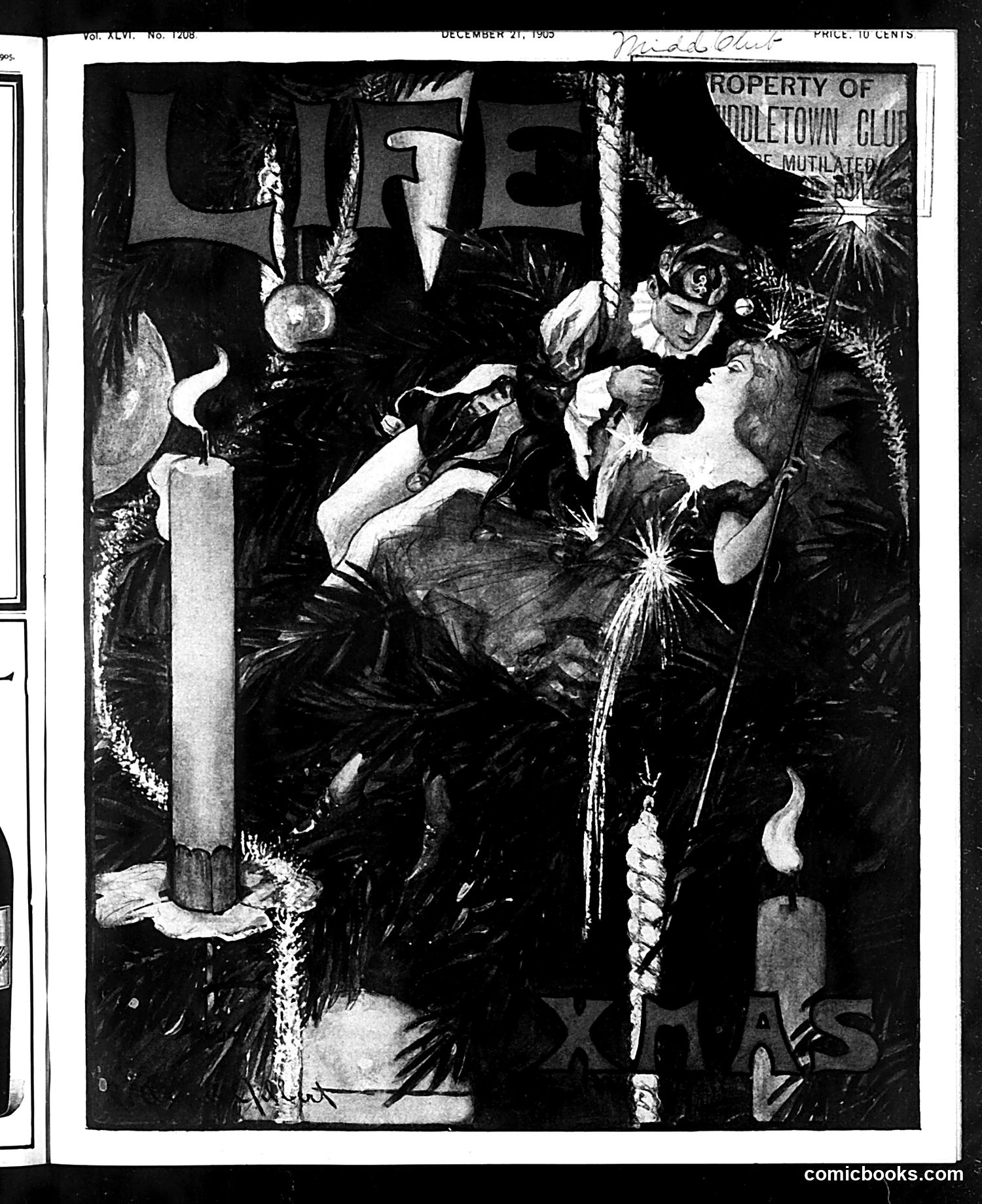
This appears to be a festive New Year's Eve or Christmas illustration titled "Life" (visible in large letters). The image depicts a masquerade or costume party scene with figures in formal evening wear and masks, surrounded by holiday decorations including garland, candles, and stars. The central figures appear to be women in black formal attire at what looks like an elegant celebration. The artistic style and masquerade theme suggest social satire about high society's holiday festivities. The "Property of Middletown Club" stamp indicates this copy belonged to a local organization. Without additional text context beyond the OCR fragments visible, the specific satirical target remains unclear, though the wealthy revelers and festive excess were common subjects for Life's social commentary of the Edwardian era.
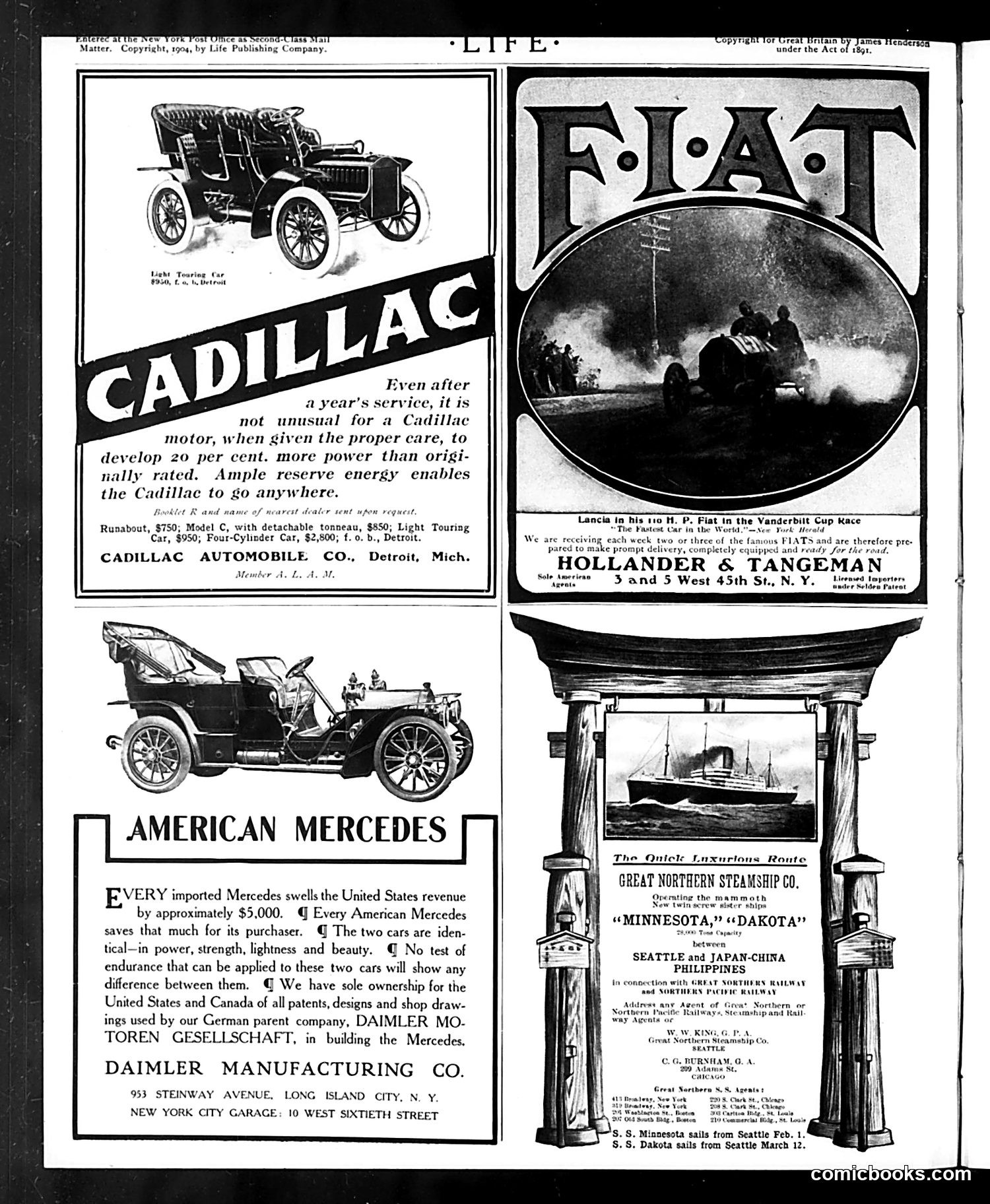
This page is **primarily advertising** rather than editorial content or satire. It contains four advertisements: 1. **Cadillac** (top left): Touts durability and power gains after a year of service 2. **Fiat** (top right): Features a racing car image, promoting Italian automobiles through Hollander & Tangeman 3. **American Mercedes** (bottom left): Emphasizes imported Mercedes cars' superiority, highlighting German engineering from parent company Daimler-Motoren 4. **Great Northern Steamship Co.** (bottom right): Advertises luxury steamship service between Seattle and Japan/China There is no political cartoon or satire evident on this page. The content reflects early 20th-century consumer advertising for luxury automobiles and international travel services.
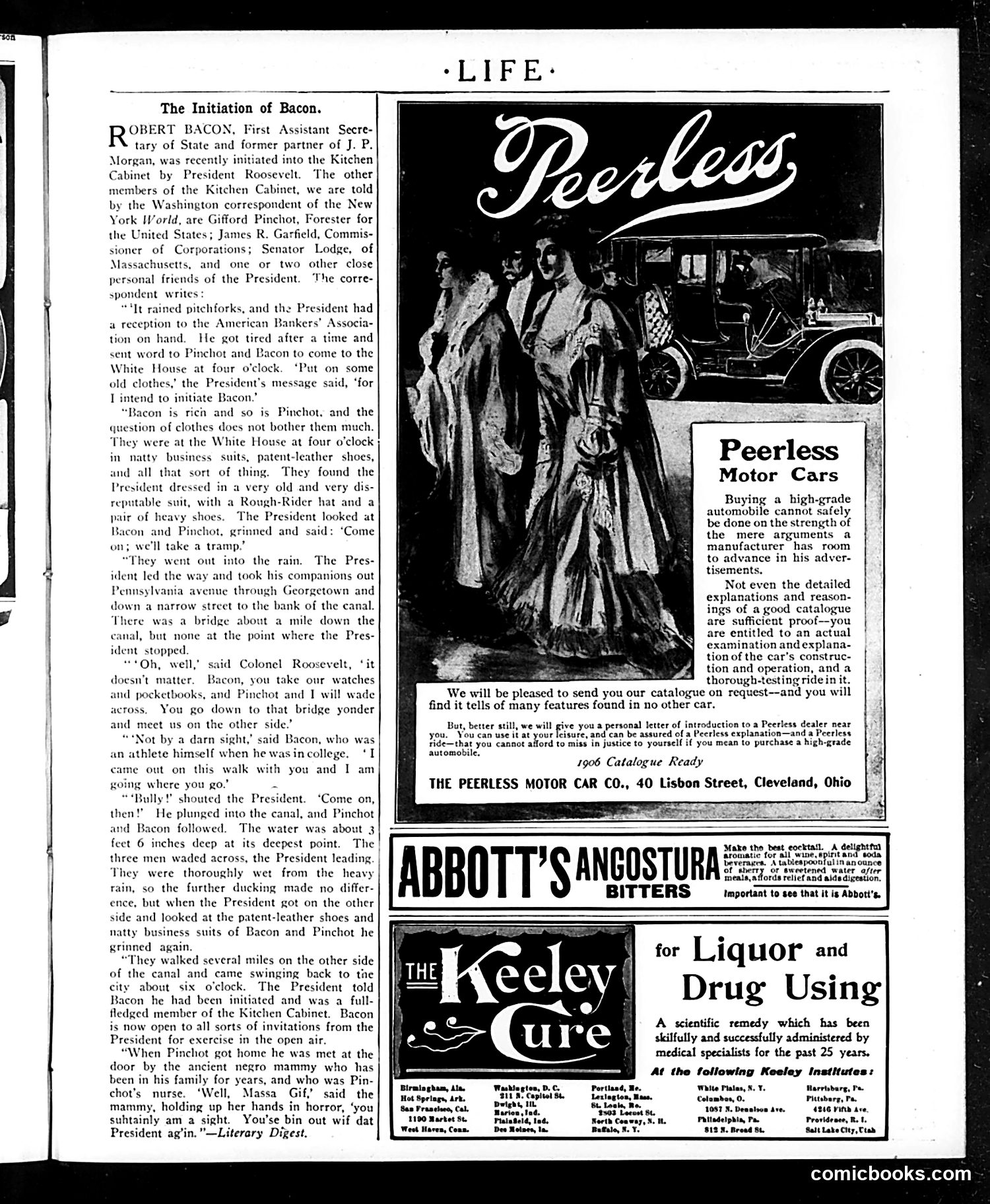
This page is primarily **advertisements** interspersed with a brief narrative article titled "The Initiation of Bacon." The article recounts President Roosevelt initiating Robert Bacon (First Assistant Secretary of State) into the "Kitchen Cabinet" by taking him on an impromptu adventure—wading through a canal in Georgetown during rain. The humor lies in Roosevelt's casual, vigorous personality: he impulsively decides to test Bacon's mettle by getting thoroughly soaked, treating it as a bonding ritual. The three large advertisements dominate the page: Peerless Motor Cars, Abbott's Angostura Bitters, and The Keeley Cure (a substance abuse treatment). The satire gently mocks Roosevelt's energetic, unconventional character and his informal governing style—suggesting he initiates subordinates through physical ordeals rather than traditional formality.
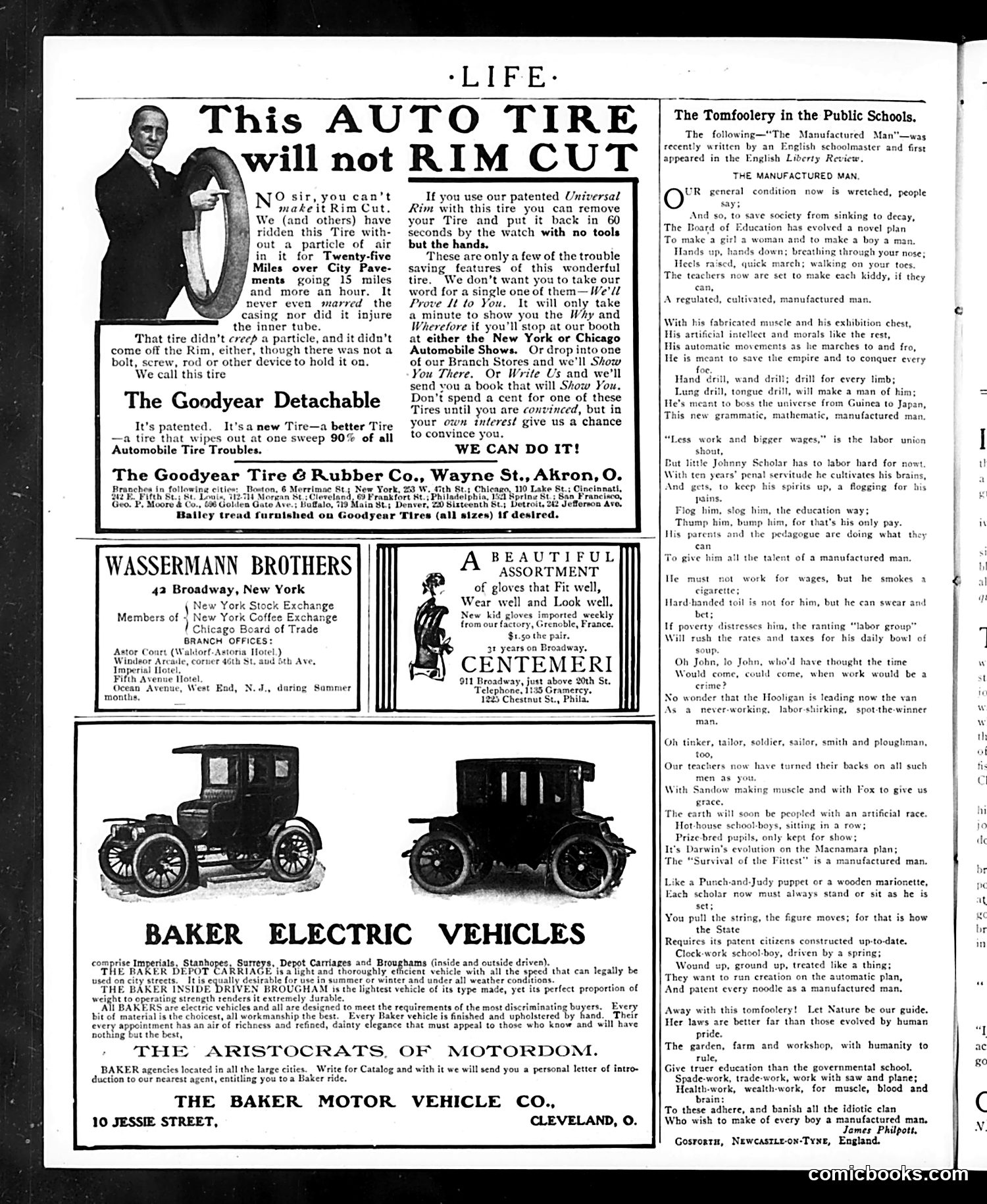
This page is primarily **advertising** rather than satirical content. The dominant features are commercial advertisements for: 1. **Goodyear Detachable Tires** - prominently featuring a man holding a tire, emphasizing that this tire won't rim-cut and can be removed without tools 2. **Baker Electric Vehicles** - showcasing early electric cars as luxury "aristocrats of motordom" 3. **Wassermann Brothers** and **Centmeri** (glove company) ads The right column contains "The Tomfoolery in the Public Schools," a satirical poem criticizing educational systems for creating "manufactured men" rather than developing individual character and practical skills. The satire targets education policy, not specific figures, arguing that schools produce conformity instead of fostering genuine human development and craftsmanship.
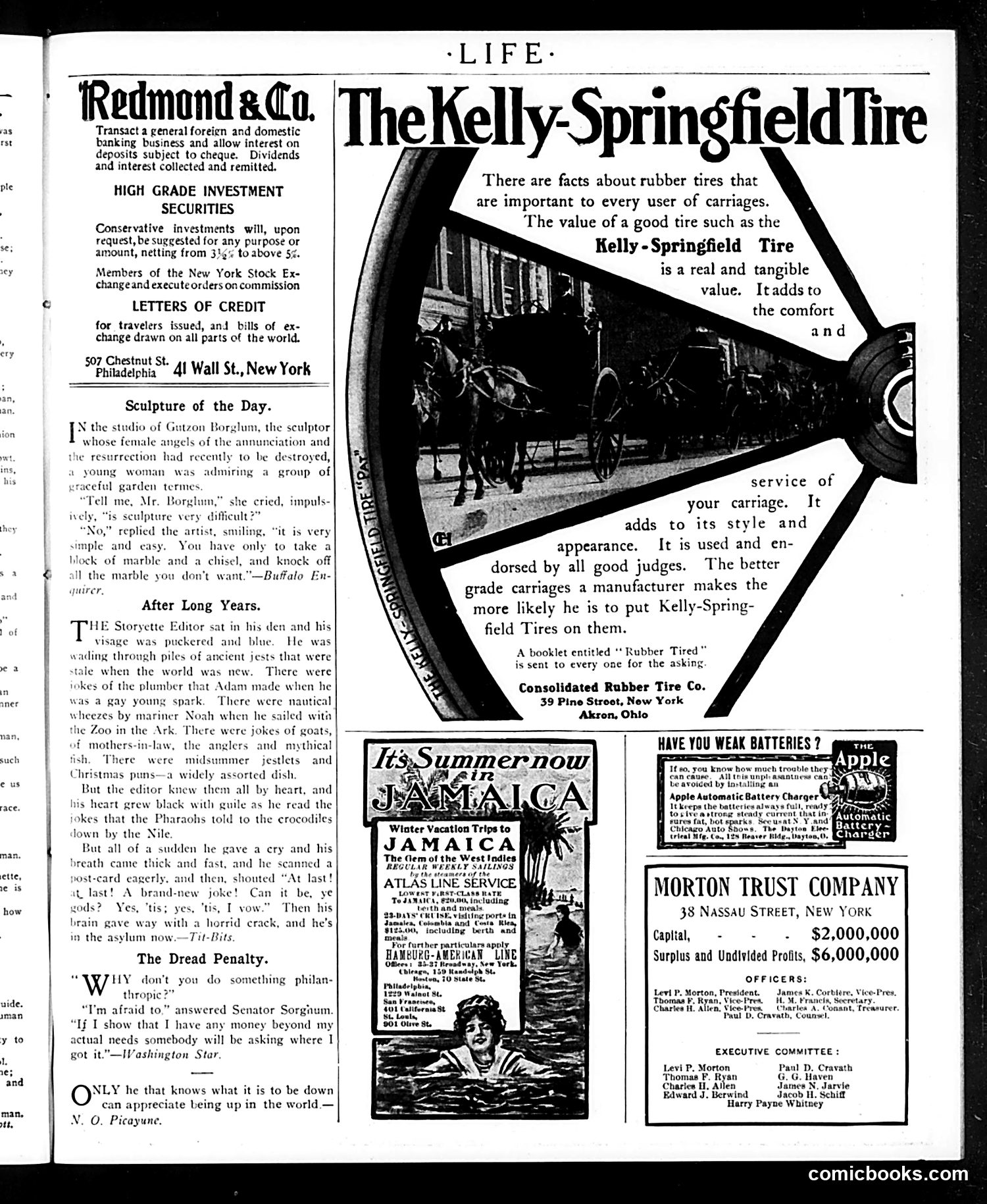
This page is primarily **advertising and editorial content** rather than political satire. The main content includes: 1. **"Sculpture of the Day"** - A humorous anecdote about sculptor Gutzon Borglum and a female artist discussing marble sculpture techniques. The joke appears to be about the simplicity of sculpting versus the artist's initial impression of difficulty. 2. **"After Long Years"** - A nostalgic piece where the Storyette Editor reflects on ancient world tests and oddities, culminating in a pun about crocodiles on the Nile. 3. **"The Dread Penalty"** - A brief satirical exchange about philanthropy, with Senator Sorghum expressing reluctance to give money. The remainder consists of period advertisements for tires, Jamaica travel, batteries, and financial services. There is no significant political cartoon content on this page.
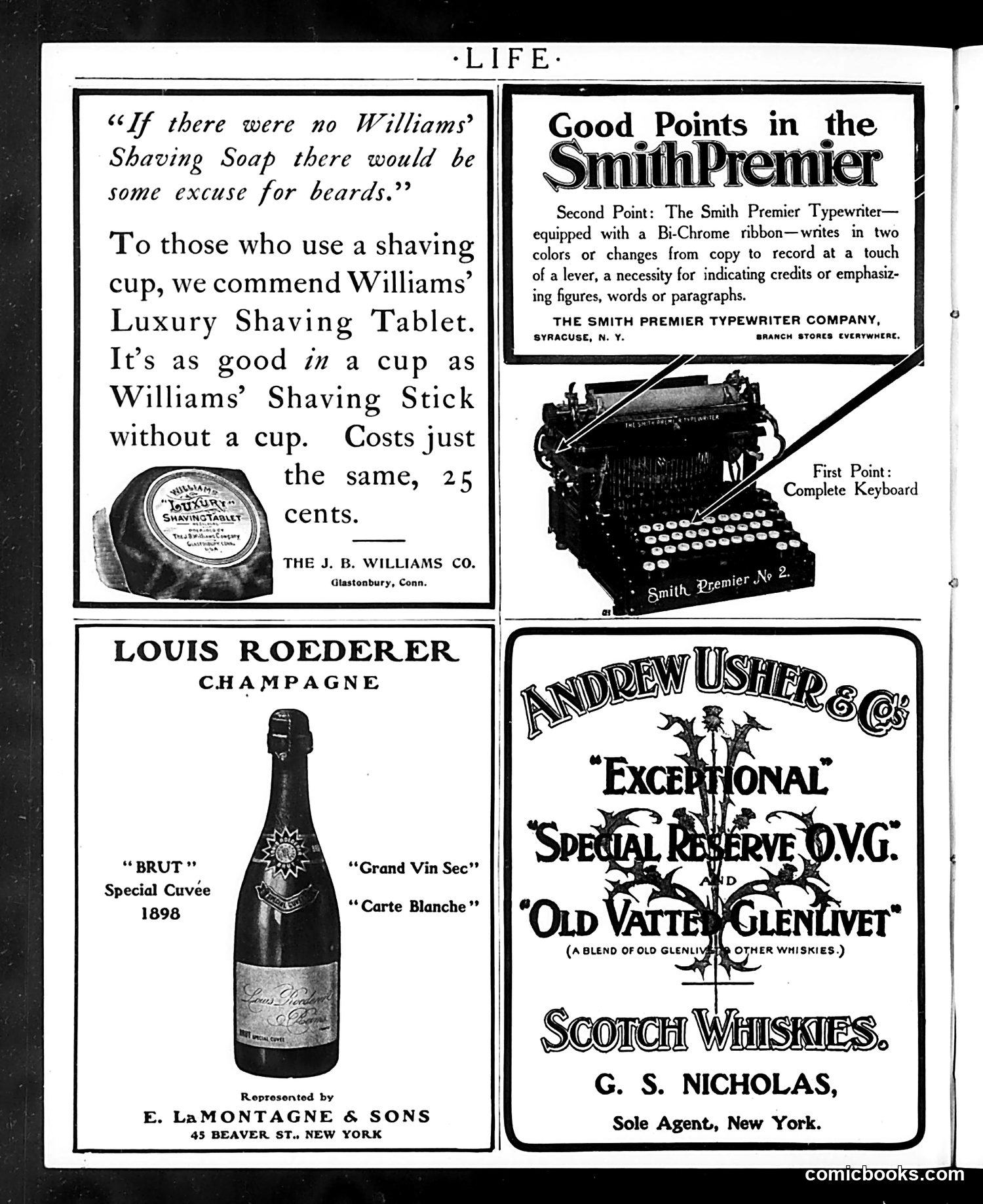
This page contains **four advertisements, not political cartoons or satire**. It's a commercial advertisement page from *Life* magazine. The ads promote: 1. **Williams' Shaving products** (soap tablet and stick) — positioning the tablet as an alternative to traditional shaving cups, both costing 25 cents. 2. **Smith Premier Typewriter** — highlighting two features: a complete keyboard and a bi-chrome ribbon for two-color typing. 3. **Louis Roederer Champagne** — advertising French champagne varieties from 1898. 4. **Andrew Usher & Co. Scotch Whiskies** — promoting blended whisky brands sold by G.S. Nicholas in New York. There is no satirical content or political commentary on this page. It represents typical early-1900s magazine advertising.
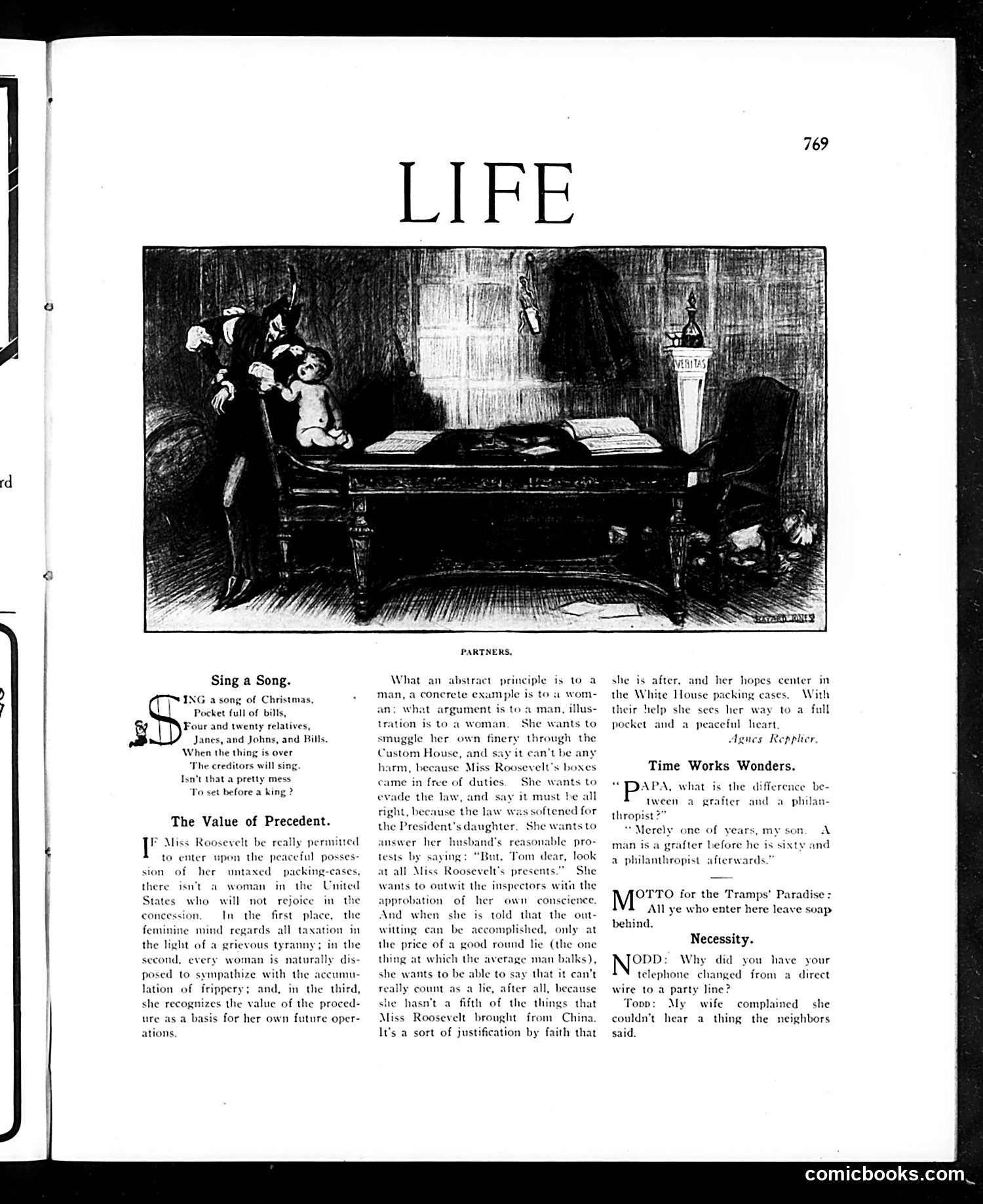
The illustration titled "Partners" depicts two figures seated at a desk in what appears to be an office setting, with papers and a lamp visible. Based on the accompanying text, this cartoon satirizes **Miss Roosevelt's tariff and taxation policies**. The piece critiques a woman (likely Eleanor Roosevelt, though not explicitly named) attempting to navigate customs duties and tax law. The satire suggests she wants to smuggle goods through customs while claiming they're duty-free, then outwit inspectors by invoking her own conscience. The joke targets the apparent hypocrisy of using privilege and personal moral authority to circumvent laws meant for ordinary citizens—a classic Progressive-era critique of political elites operating under different rules.
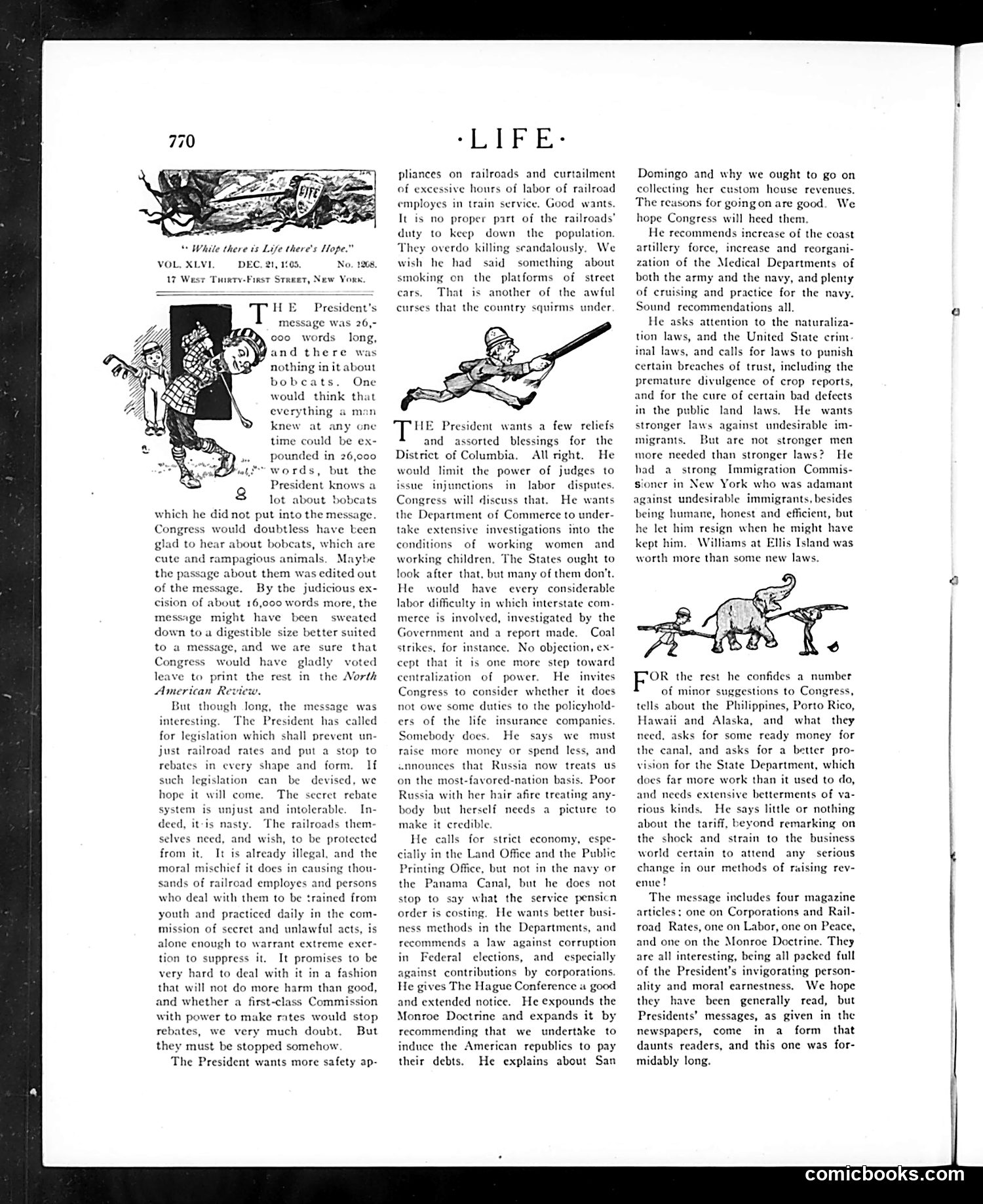
This page contains **satirical commentary on President Theodore Roosevelt's recent message to Congress**—the text discusses his various policy recommendations. The cartoons mock Roosevelt's prolific output of suggestions and reforms. The first cartoon shows a figure overwhelmed by the sheer volume of proposals ("26,000 words"), satirizing how Roosevelt wanted to address everything from railroad safety to labor disputes to immigration law. The second cartoon (bottom) depicts a donkey/mule being worked hard, likely representing **Congress itself**—overloaded with the President's ambitious agenda and expected to implement his many demands. The humor targets Roosevelt's aggressive, interventionist presidency and his tendency to micromanage through legislation rather than allowing Congress independence. This reflects contemporary political anxiety about executive overreach.
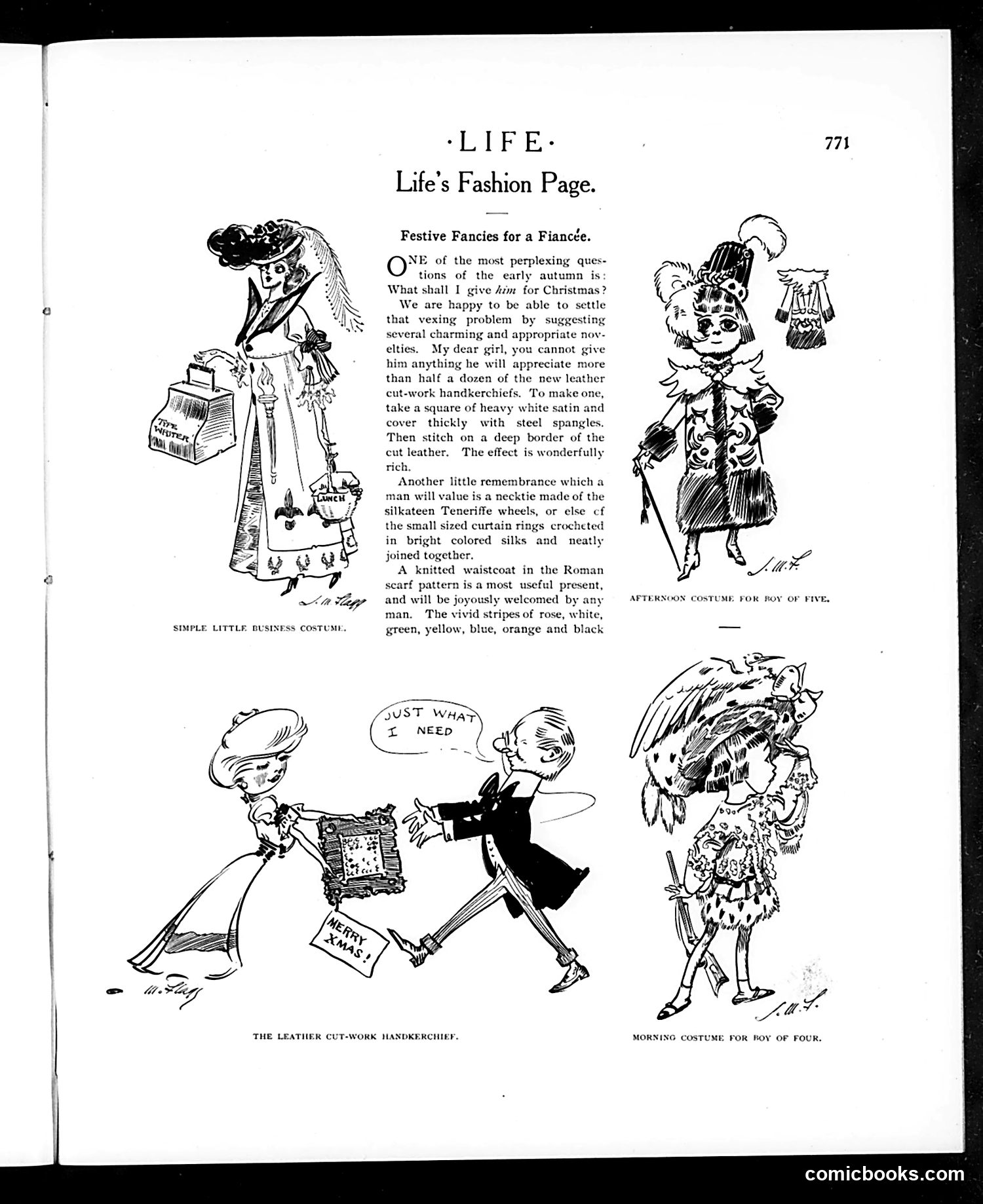
This is "Life's Fashion Page" from an early 20th-century issue (page 771), presenting satirical gift suggestions for Christmas, specifically "Festive Fancies for a Fiancée." The page mocks traditional gender roles and courtship customs through humorous illustrations. It suggests impractical or humorous gifts a man might give his fiancée: leather cut-work handkerchiefs, knitted waistcoats, and children's costumes labeled "Afternoon Costume for Boy of Five" and "Morning Costume for Boy of Four." The central cartoon shows a man presenting a handkerchief to a woman saying "Just What I Need"—satirizing the disconnect between what men think women want versus actual desires. The humor relies on the assumption that such utilitarian, unfashionable, or juvenile items are obviously unsuitable gifts, mocking both masculine gift-giving ignorance and period notions of feminine preferences.
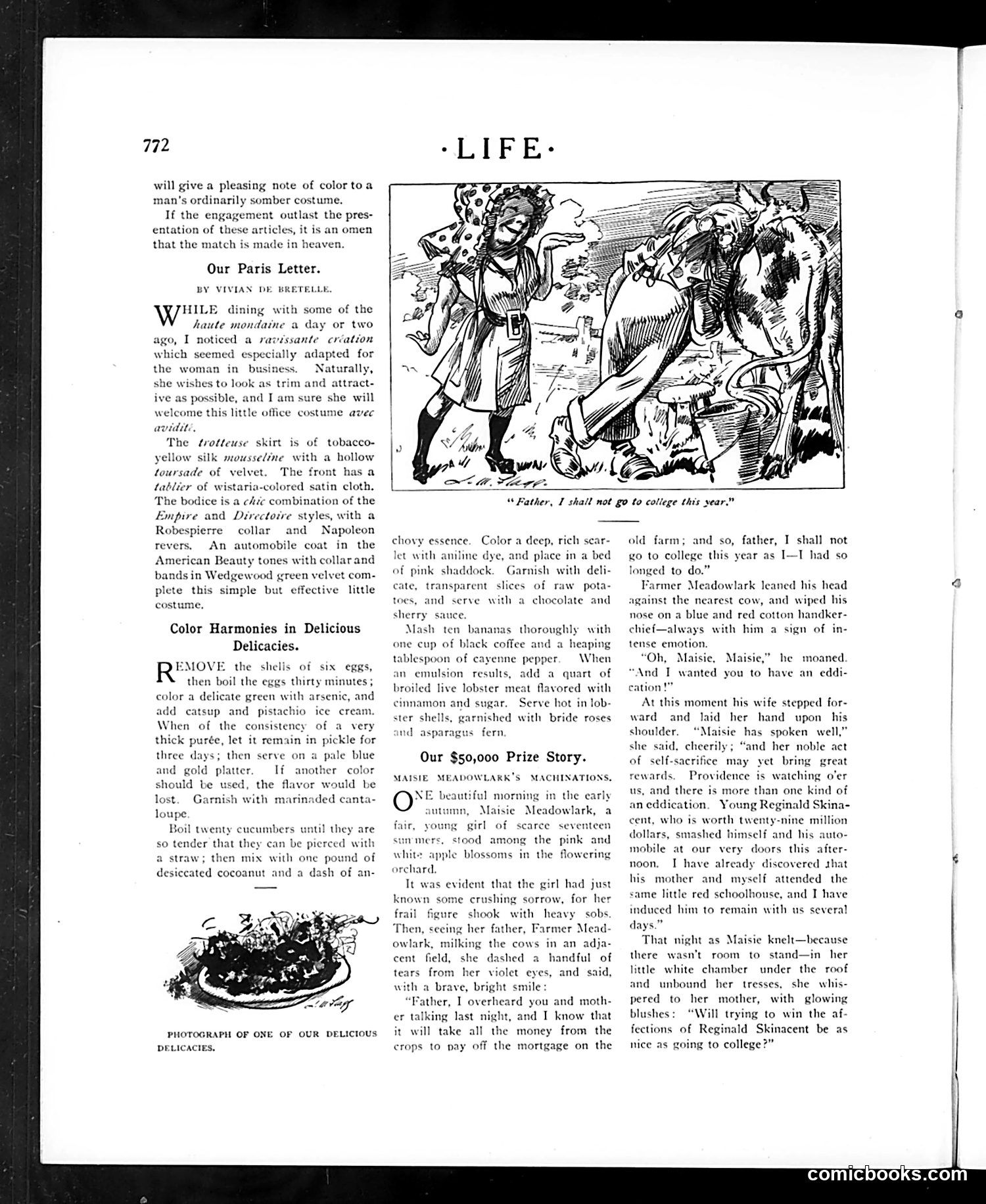
The page contains three distinct sections: 1. **"Our Paris Letter"** by Vivian de Bretelle describes fashionable women's clothing, focusing on a "ravissante creation" featuring a tobacco-yellow silk skirt with velvet trim and Empire-style bodice. This is straightforward fashion commentary, not satire. 2. **The cartoon** (captioned "Father, I shall not go to college this year") depicts a rural farmer and his daughter, illustrating a story about financial hardship—the family cannot afford college tuition due to mortgage payments on their farm. 3. **"Our $50,000 Prize Story"** begins a serialized fiction about Maisie Meadowlark, a young farm girl, apparently focusing on romance and social mobility. The page reflects early 20th-century concerns about rural poverty and limited educational access for farm families.
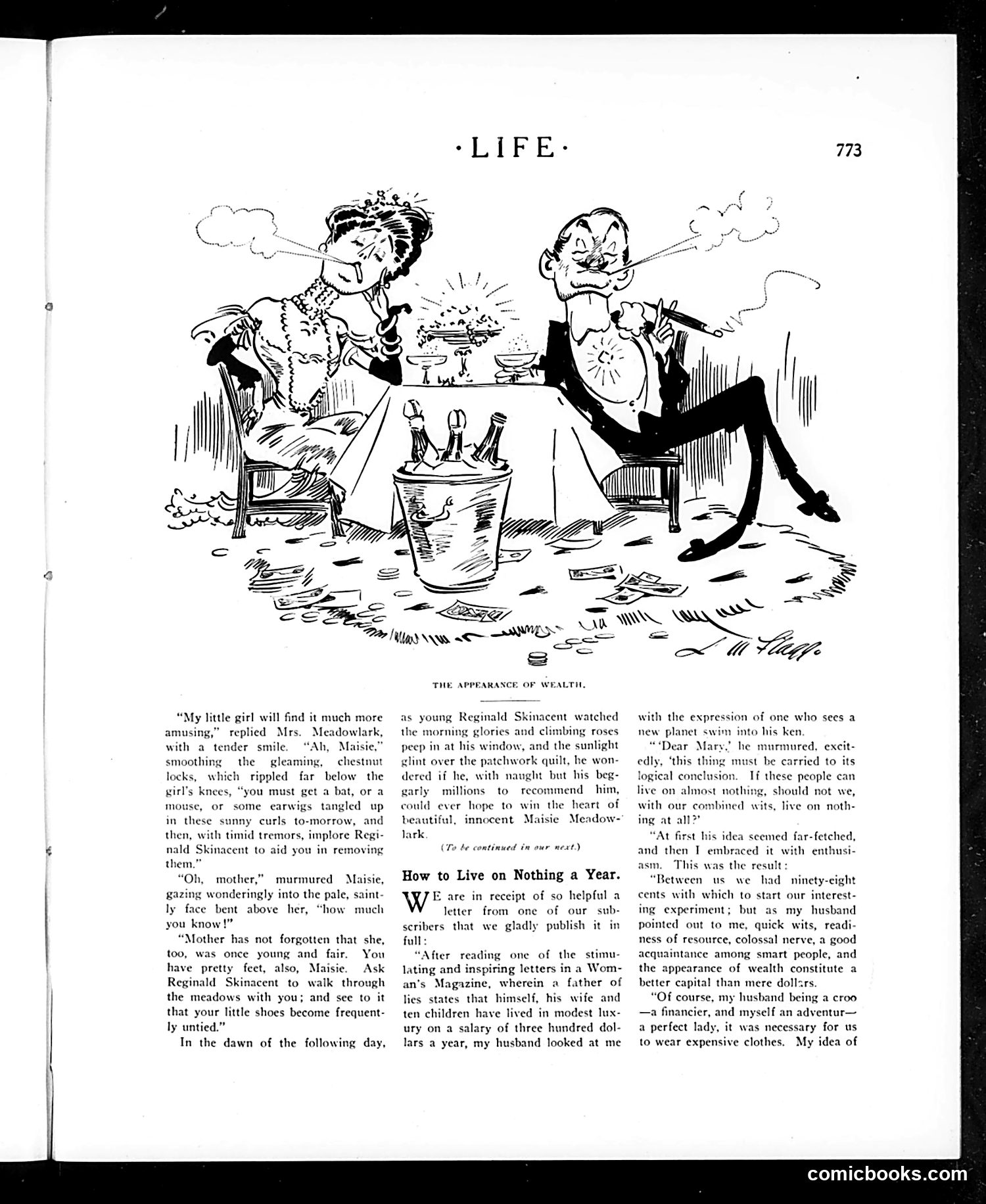
This cartoon satirizes the pressures of maintaining social appearances despite financial hardship. Two figures sit at a dining table with champagne, both exaggeratedly dressed and groomed—one in jewelry and fashionable dress, the other in formal evening wear. Money scattered on the ground suggests extravagant spending. The accompanying article, "How to Live on Nothing a Year," describes a family surviving on $300 annually while the husband "must wear expensive clothes" to maintain appearances. The satire targets the era's social expectation that respectable people must *appear* wealthy regardless of actual finances—a commentary on class pretension and the financial strain of maintaining status through conspicuous consumption.
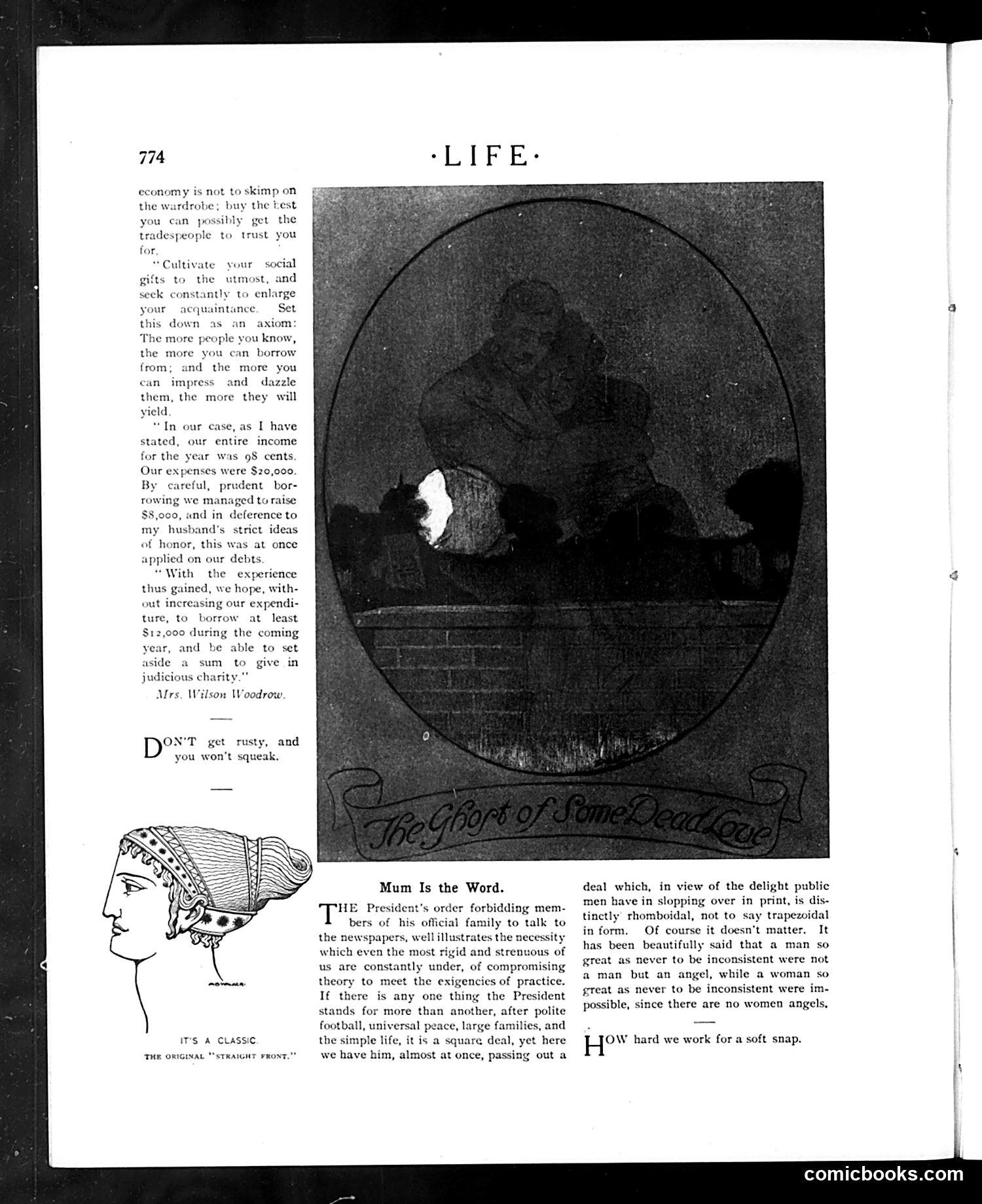
The large oval illustration titled "The Ghosts of Some Dead Gods" depicts silhouettes of what appear to be religious or mythological figures inside a circular frame—likely representing abandoned or obsolete belief systems. Below it, the section "Mum Is the Word" references a President's order forbidding his official family from speaking to newspapers. The text argues this demonstrates how even the "most rigid and strenuous" leaders must compromise principle for practical necessity. The commentary suggests the policy is ultimately futile, noting the inherent contradiction in expecting consistency from people. The small profile sketch labeled "A Classic" with caption "The Original 'Straight Front'" appears to be a humorous reference to classical beauty standards or physiognomy.
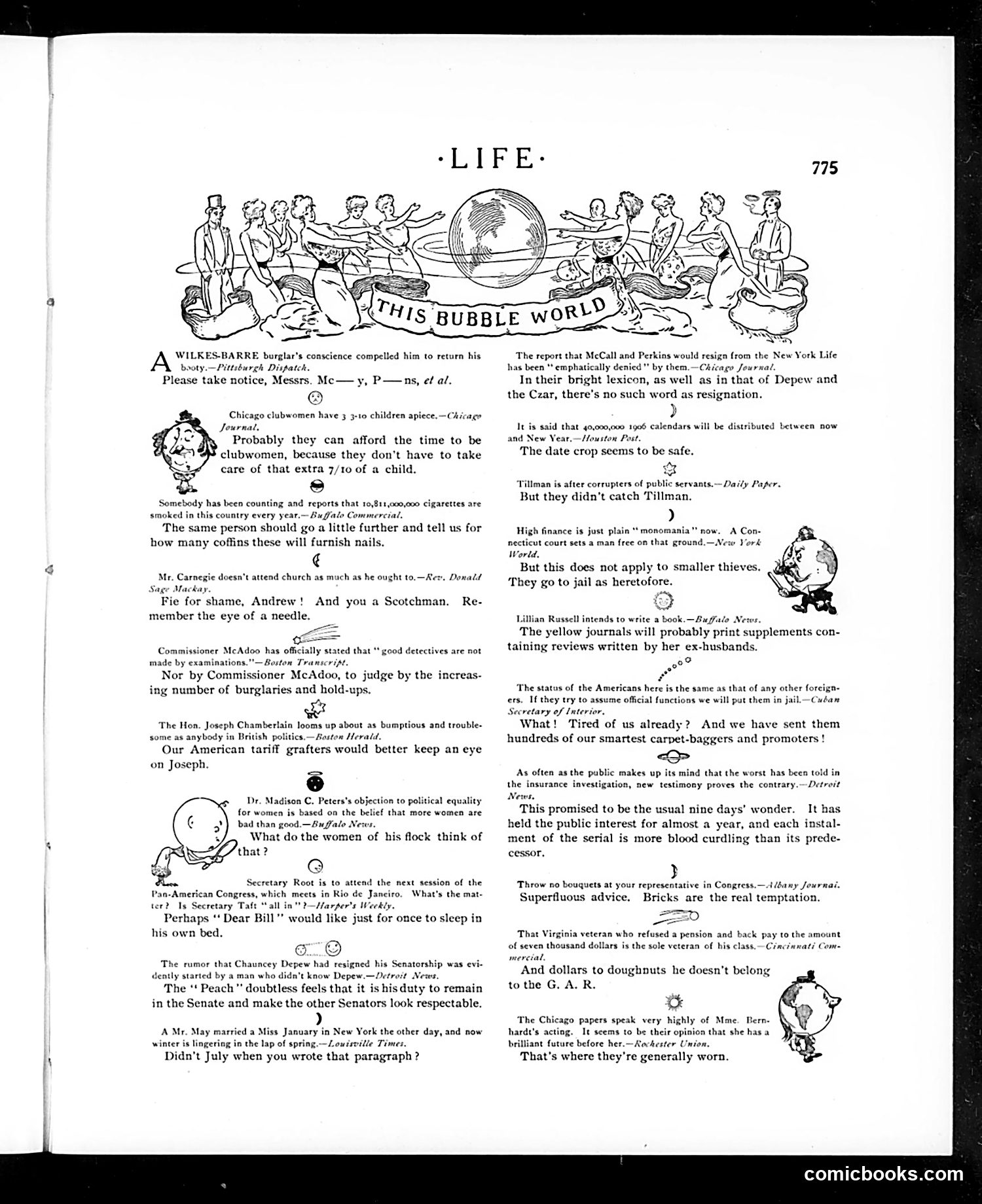
This page is a satirical news commentary section titled "This Bubble World," featuring short jokes and observations about contemporary politics and society. The content mocks various targets: Chicago clubwomen's leisure time, Mr. Carnegie's church attendance, Detective McAdoo's crime-fighting record, and politicians' behavior. One item jokes about a "Peach" (likely a political nickname) remaining in the Senate despite scandal. The cartoons feature simple caricatured faces illustrating specific jabs—one appears to critique women's political views, another mocks a representative receiving bribes ("bricks"). Without visible dates or clearer identification of specific figures, the exact political context remains somewhat opaque, but the page clearly satirizes corruption, gender politics, and institutional hypocrisy through brief, pointed commentaries typical of early 20th-century American satirical journalism.
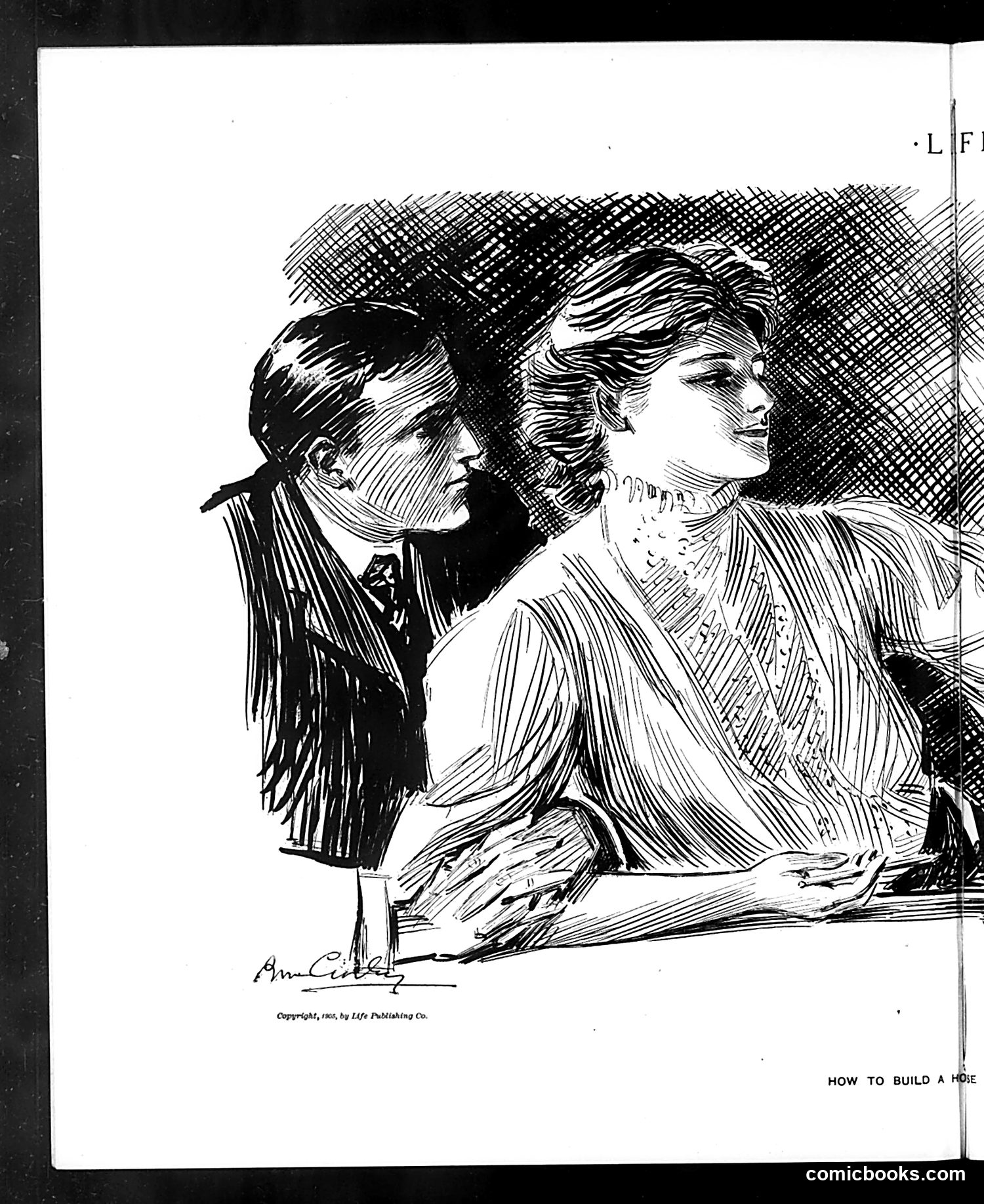
This is a pen-and-ink illustration from Life magazine (1908) showing two figures in profile—a man in formal dress leaning toward a woman in an elegant gown. The artwork style is characteristic of early 20th-century American satirical illustration. The page heading reads "HOW TO BUILD A HOLE" (likely "HOME"), suggesting this depicts domestic or romantic courtship. The intimate positioning and the woman's composed expression suggest social commentary on courtship rituals or marriage prospects of the Edwardian era. The OCR text is largely illegible, making specific satirical intent unclear. Without readable accompanying text, the precise social or political critique remains uncertain—though the formal illustration style and Life magazine's reputation for satirizing upper-class manners suggests this likely mocked contemporary romance conventions or social pretension.
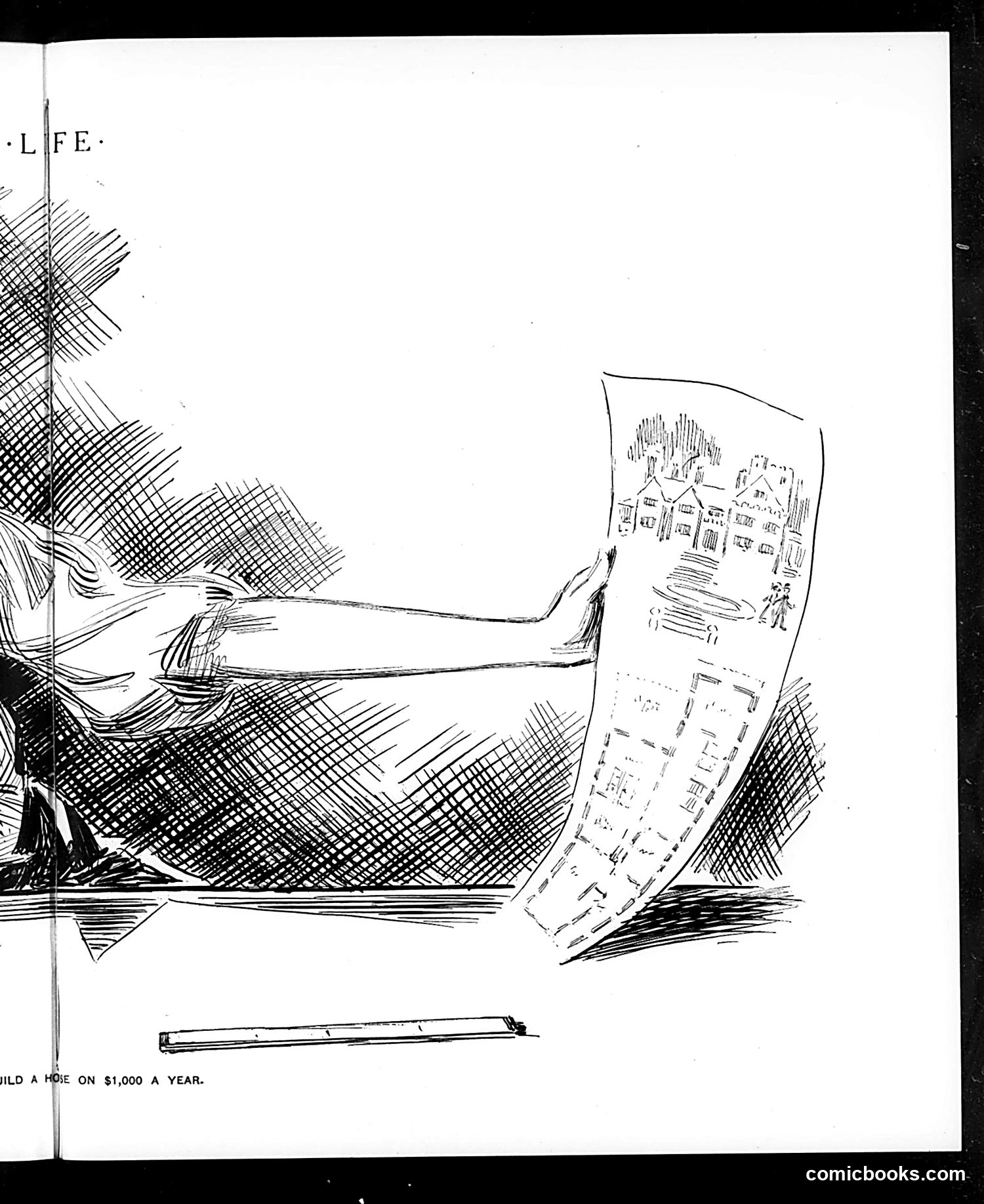
This appears to be a satirical cartoon about housing affordability. The image shows a giant hand holding a rolled-up blueprint or map of a house/neighborhood, depicted in miniature scale. The hand represents someone with significant resources or power, while the tiny buildings suggest the actual size or cost-effectiveness of housing that can be built. The caption "BUILD A HOSE ON $1,000 A YEAR" (likely "HOUSE" misspelled in OCR) appears to be ironic commentary on the impossibility or absurdity of constructing adequate housing on such a modest annual income. This satirizes the gap between wages and housing costs, suggesting that building a house on $1,000 yearly salary is as unrealistic as fitting an actual neighborhood into someone's hand. The cartoon critiques economic inequality and the housing crisis facing working-class Americans during Life magazine's era.
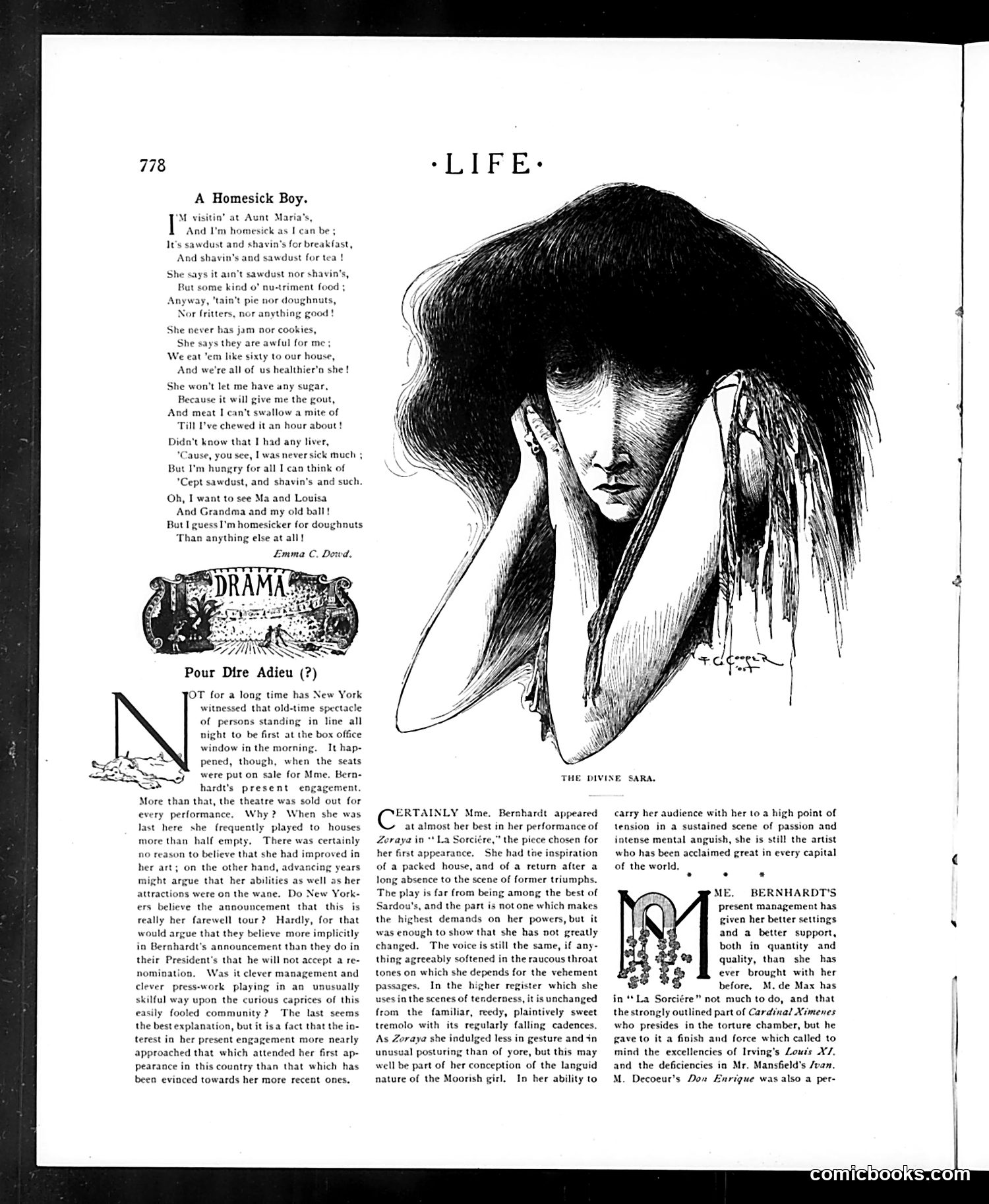
**"A Homesick Boy"** is a humorous poem about a child visiting Aunt Maria who resents her health-conscious cooking (sawdust-like food, no sugar, no fried items) compared to his mother's home cooking. The joke is that despite missing family, he's most homesick for doughnuts and treats—satirizing both restrictive Victorian health fads and children's priorities. **"Pour Dire Adieu (?)"** discusses Sarah Bernhardt's theatrical comeback to New York. The piece credits her full houses to "clever management and press-work" rather than genuine artistic improvement, noting audiences lined up despite her playing to half-empty theaters on her last visit. The question mark in the title suggests skepticism about her announced "farewell tour," implying New Yorkers don't truly believe it's her final performance—a cynical view of theatrical marketing and public gullibility.
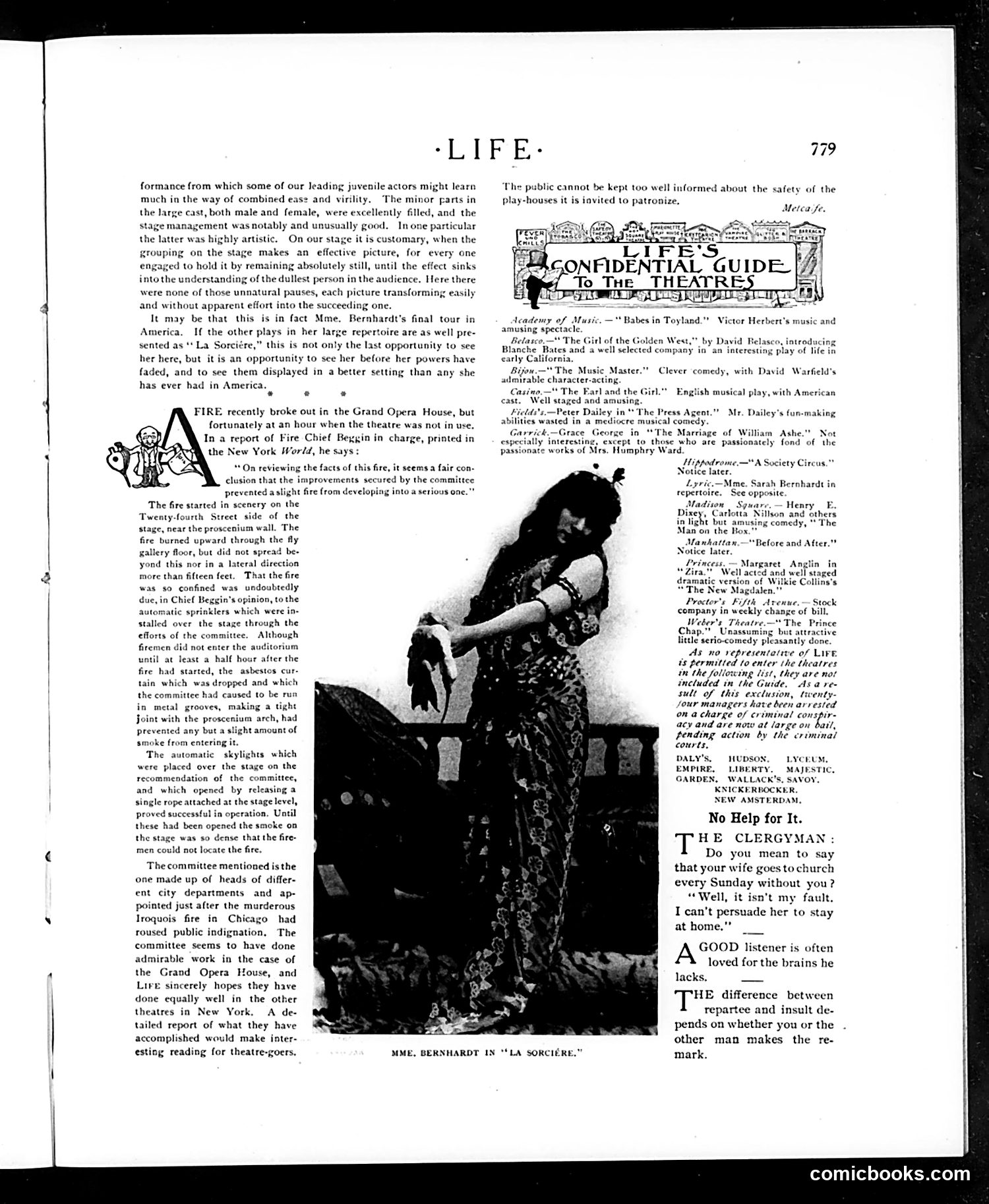
This page from *Life* magazine features theatrical reviews and safety commentary. The central photograph shows **Mme. Bernhardt in "La Sorcière"** (The Sorceress)—a dramatic scene of the famous French actress in costume, likely depicting a climactic moment. The accompanying text praises Bernhardt's performance and notes this is her final American tour, urging readers to see her before her "powers have faded." The article's major focus addresses a **recent fire at the Grand Opera House**. Rather than sensationalism, *Life* uses this incident to celebrate safety improvements: automatic sprinklers and asbestos curtains installed by a civic committee formed after Chicago's catastrophic **Iroquois Theatre fire** (1903). The piece advocates for public awareness of theatre safety—a serious social concern following that disaster. The right column contains a "Confidential Guide to the Theatres" listing current Broadway productions with brief reviews, positioning theater-going as a respectable cultural activity worthy of informed patronage.
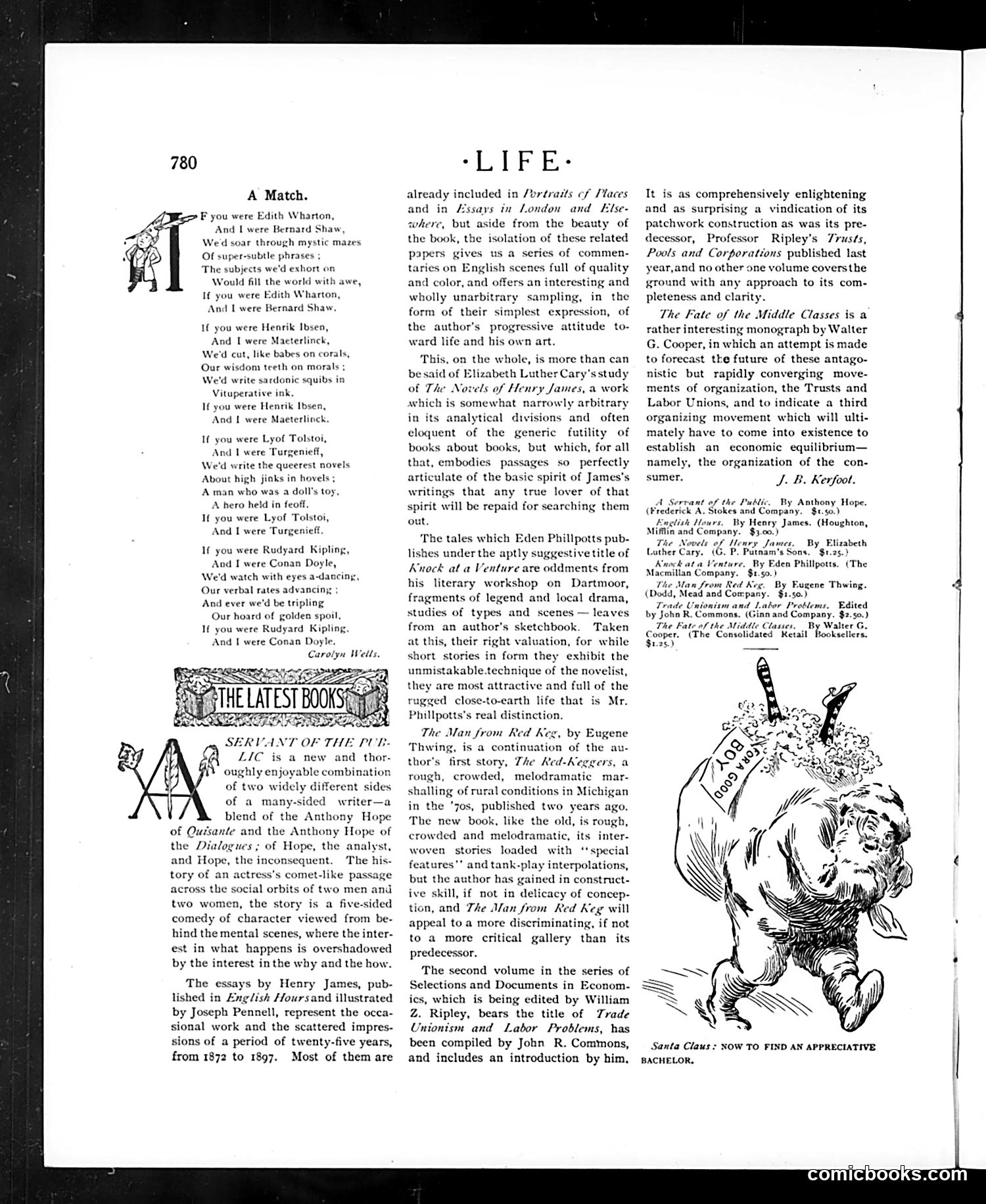
This poem by Carolyn Wells playfully imagines hypothetical pairings of celebrated late-19th-century writers and intellectuals. The joke lies in contrasting their reputations: pairing Henry James with Bernard Shaw, Ibsen with Maeterlinck, Tolstoy with Turgenev, and Kipling with Conan Doyle. The satire mocks the pretensions of "serious" literary figures (the philosophical, moralistic Europeans) against commercially successful popular writers. Wells suggests that if you combined a highbrow playwright like Shaw with a literary novelist like Wharton, you'd produce incomprehensibly abstract work; conversely, if adventure writers Kipling and Doyle joined forces, they'd merely accumulate wealth ("hoard of golden spoil"). The piece gently ridicules both literary snobbishness and popular success, suggesting these famous authors represent distinct—even contradictory—approaches to writing. It's a light-hearted commentary on the literary hierarchies and rivalries of the Edwardian era.
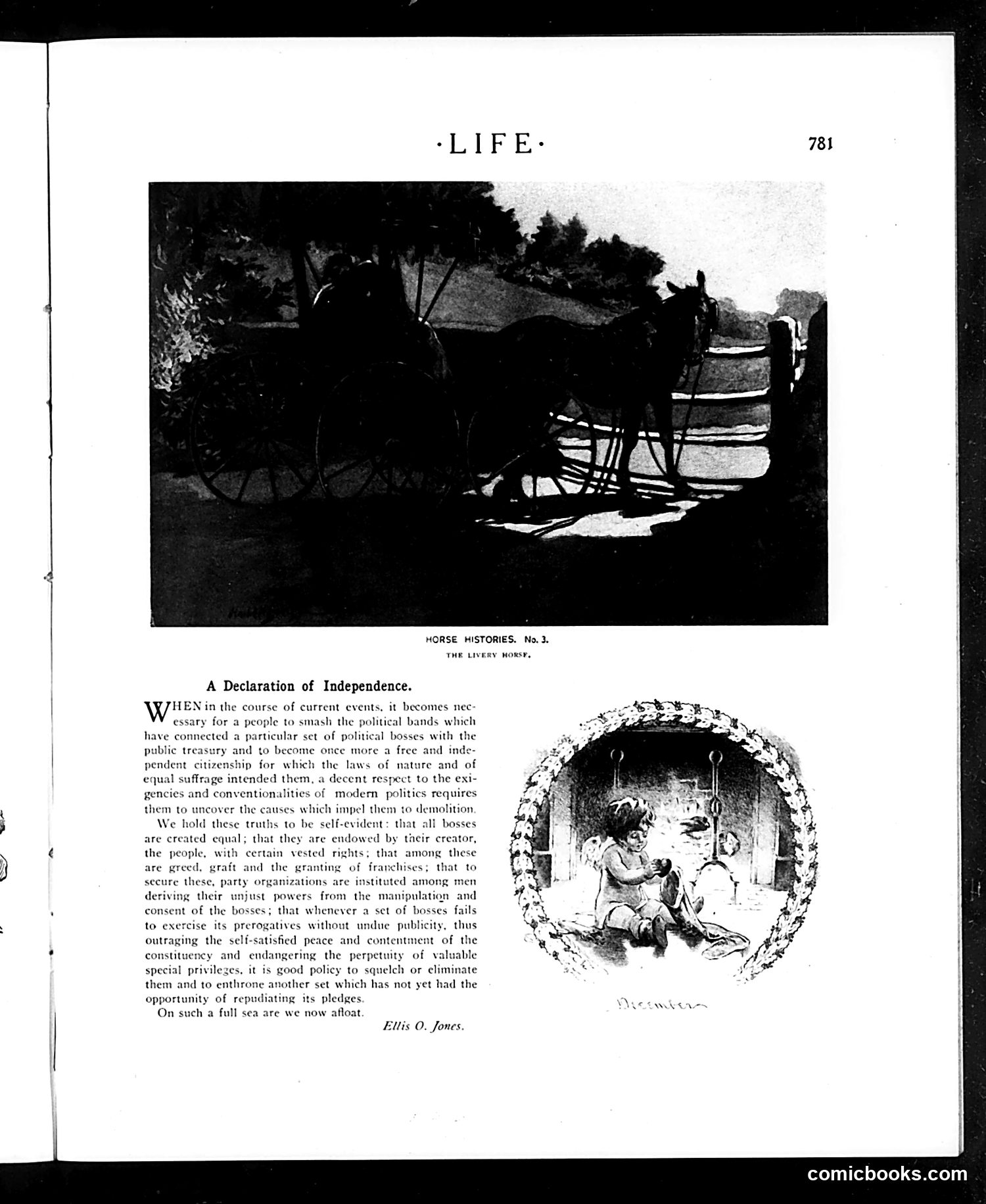
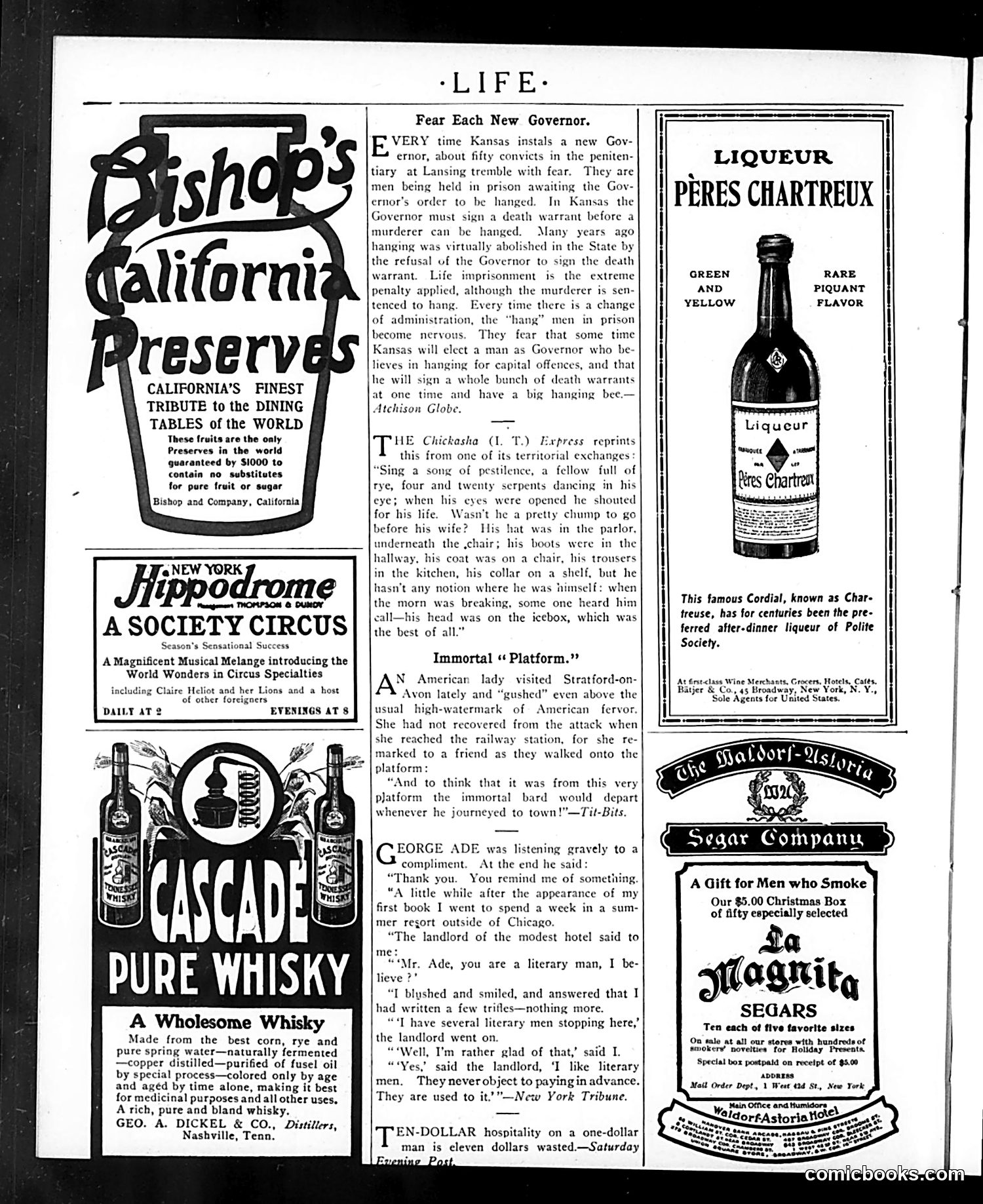
This is a satirical political piece mocking corrupt urban political machines. The text parodies the Declaration of Independence to critique "political bosses" who exploit public treasuries through graft, bribery ("franchises"), and manipulation. The top photograph shows a livery horse—a working animal rented to the public—establishing a metaphor: just as a livery horse serves multiple masters for profit, political bosses cynically serve whoever pays them. The circular illustration (by Ellis O. Jones) depicts a horse's head, reinforcing this analogy. The satire suggests that removing one corrupt political machine only replaces it with another equally corrupt one, since they all operate on the same principles of self-interest. The parodic "declaration" mocks the gap between democratic ideals and the actual venality of machine politics—bosses are "created equal" only in their shared dedication to "greed, graft." This reflects Progressive Era criticism of city political corruption, a major reform movement concern in early 20th-century America.
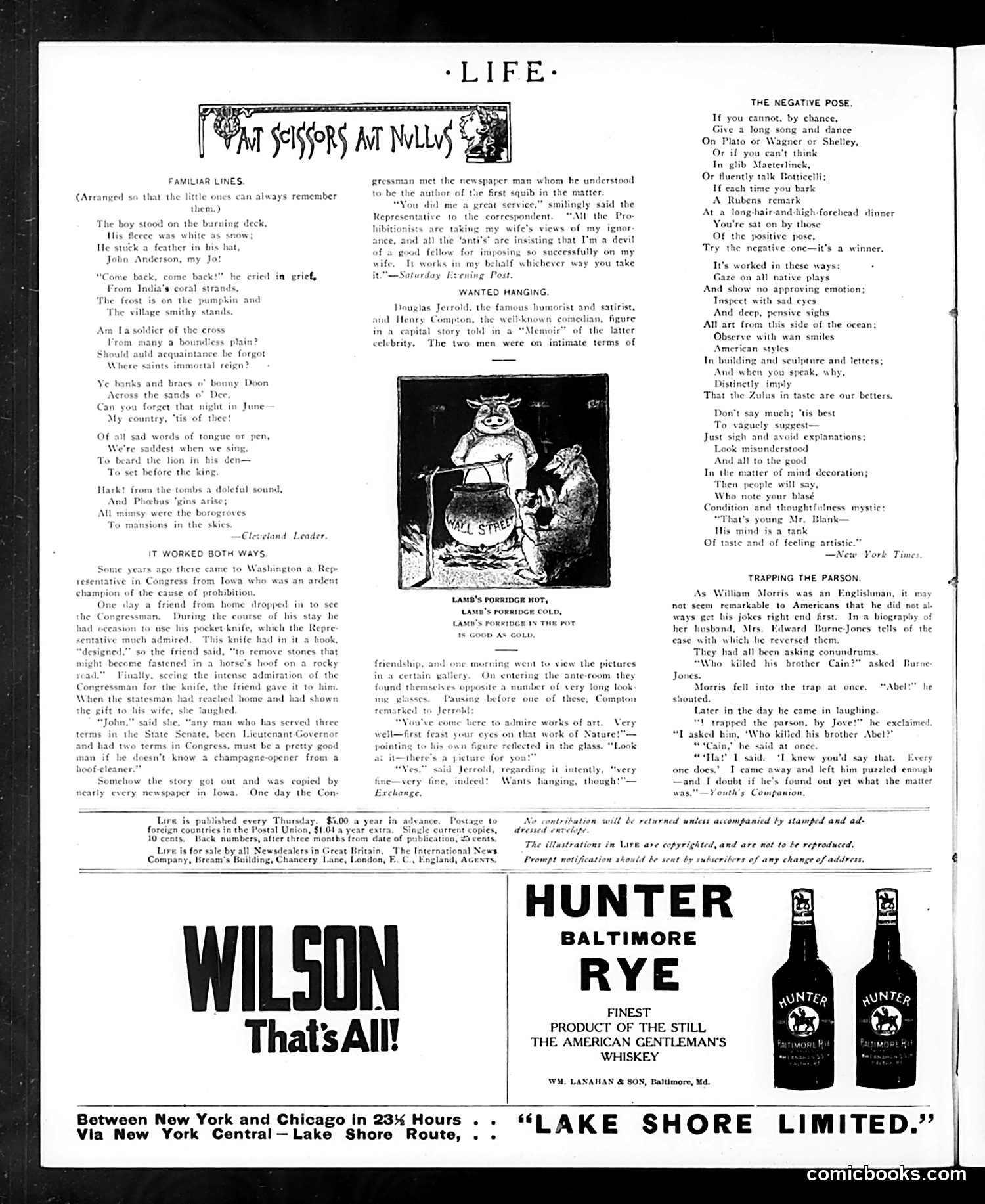
This page contains several humorous anecdotes and satirical pieces typical of Life magazine's content. **"It Worked Both Ways"** recounts a story about a Republican congressman from Iowa who championed prohibition. A friend gave him a fancy pocket knife; the congressman's wife sarcastically remarked that any man who served in the State Senate without knowing a champagne-opener from a corkscrew must be quite ignorant. The joke satirizes the congressman's hypocrisy—advocating prohibition while apparently enjoying the luxuries prohibition supposedly opposed. **"Wanted Hanging"** tells of humorist Douglas Jerrold and Henry Compton discussing a witty newspaper article. When Jerrold claims authorship, Compton demands the writer be hanged for such brilliance—a compliment delivered as mock outrage. **"The Negative Pose"** offers society satire about fashionable behavior: how to appear artistic and intellectual without genuine effort—sigh mysteriously, look misunderstood, avoid clear speech, and adopt a pose of world-weary sophistication. The page also features advertisements for Wilson whiskey and Hunter Baltimore Rye, reflecting the pre-Prohibition era.
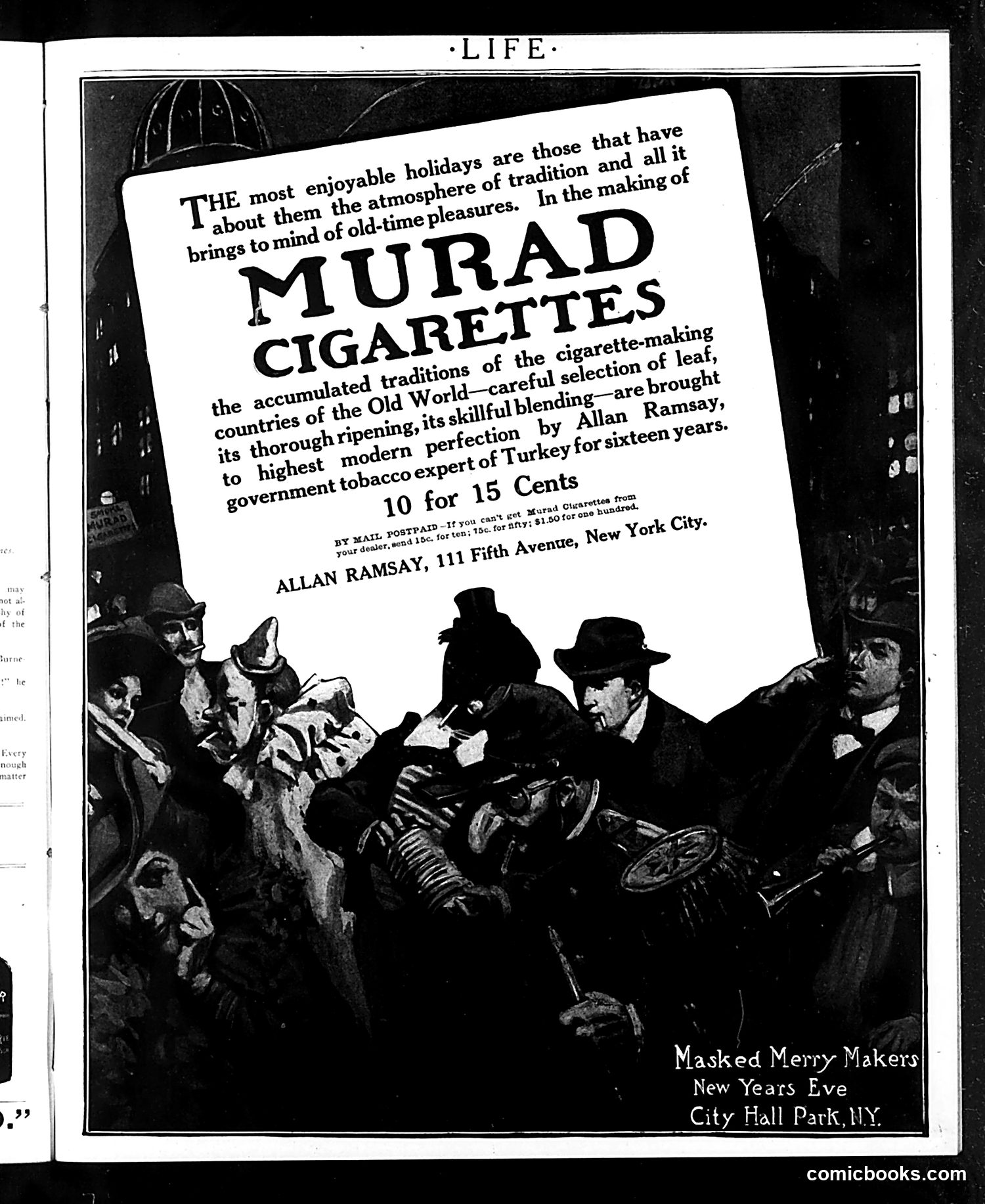
This is a **Murad Cigarettes advertisement** disguised as editorial content in *Life* magazine. The ad uses a New Year's Eve holiday theme to market cigarettes by associating them with "old-time pleasures" and "tradition." The illustration shows masked revelers celebrating in City Hall Park, New York—evoking festive holiday merriment. The ad claims Murad cigarettes represent "accumulated traditions" of Old World cigarette-making, with tobacco selected and blended by "Allan Ramsay, government tobacco expert of Turkey for sixty years." The pitch: "10 for 15 Cents," with mail-order availability. For modern readers, this reveals how openly cigarettes were advertised in early 20th-century magazines, marketed through lifestyle and tradition rather than health warnings—practices now illegal in most countries.
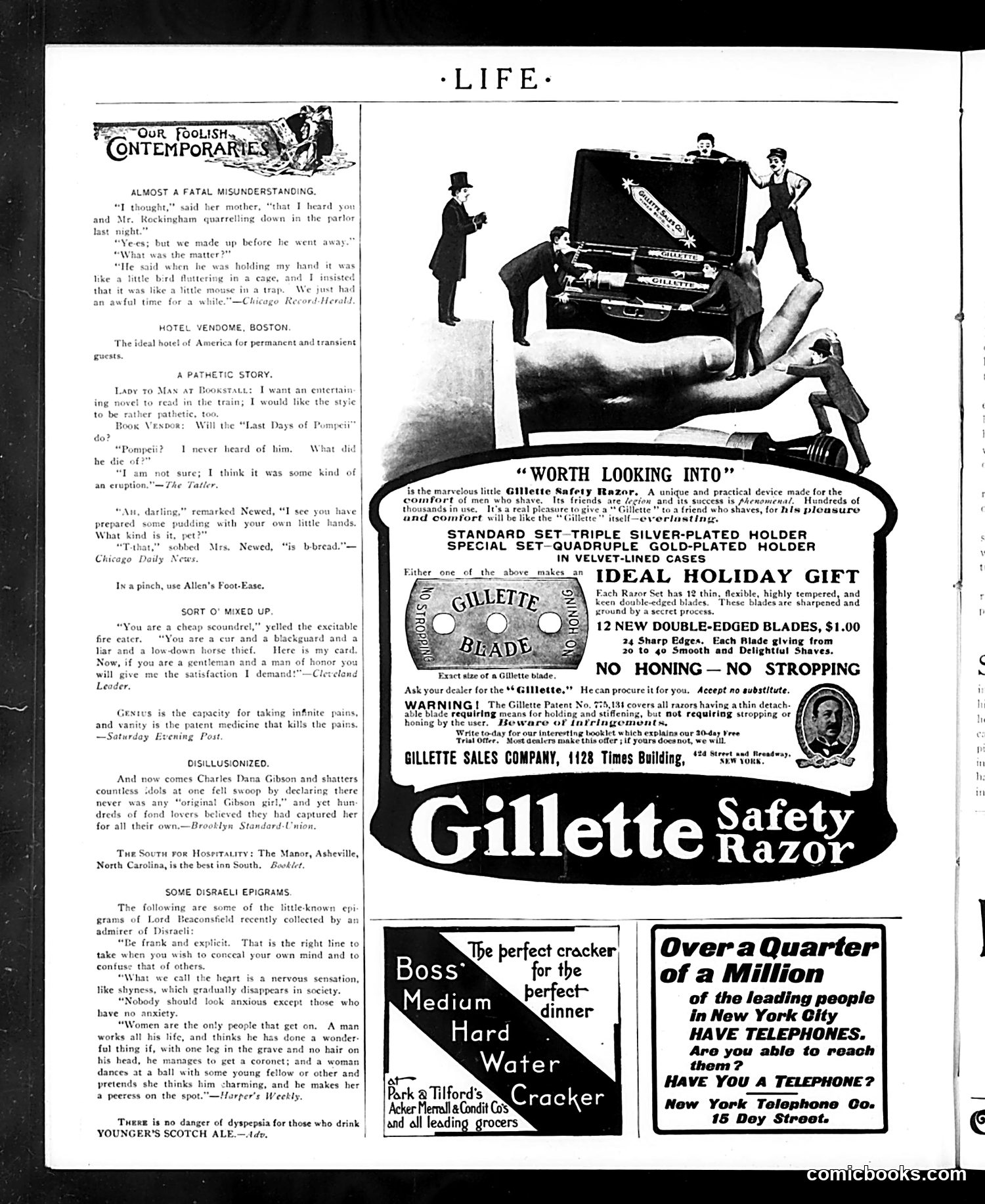
This page is primarily **advertising**, not political satire. The dominant content is a large Gillette Safety Razor advertisement featuring a humorous illustration of men examining the razor like it's a remarkable discovery. The small "Our Foolish Contemporaries" section at top left contains brief, unrelated anecdotes mocking social awkwardness—a woman mishearing a quarrel as a "mouse in a trap," confusion over bread-making. These are gentle domestic humor, not political commentary. The remaining left-side text includes literary quotes attributed to Disraeli and passages about Gibson Girls, offering cultural commentary but no clear satirical target. The page's real purpose is selling products: the Gillette razor (prominently), Boss crackers, and New York Telephone service. The Gillette ad emphasizes the razor's ease of use ("No Honing—No Stropping") as an ideal holiday gift—typical early-20th-century consumer marketing, not satire.
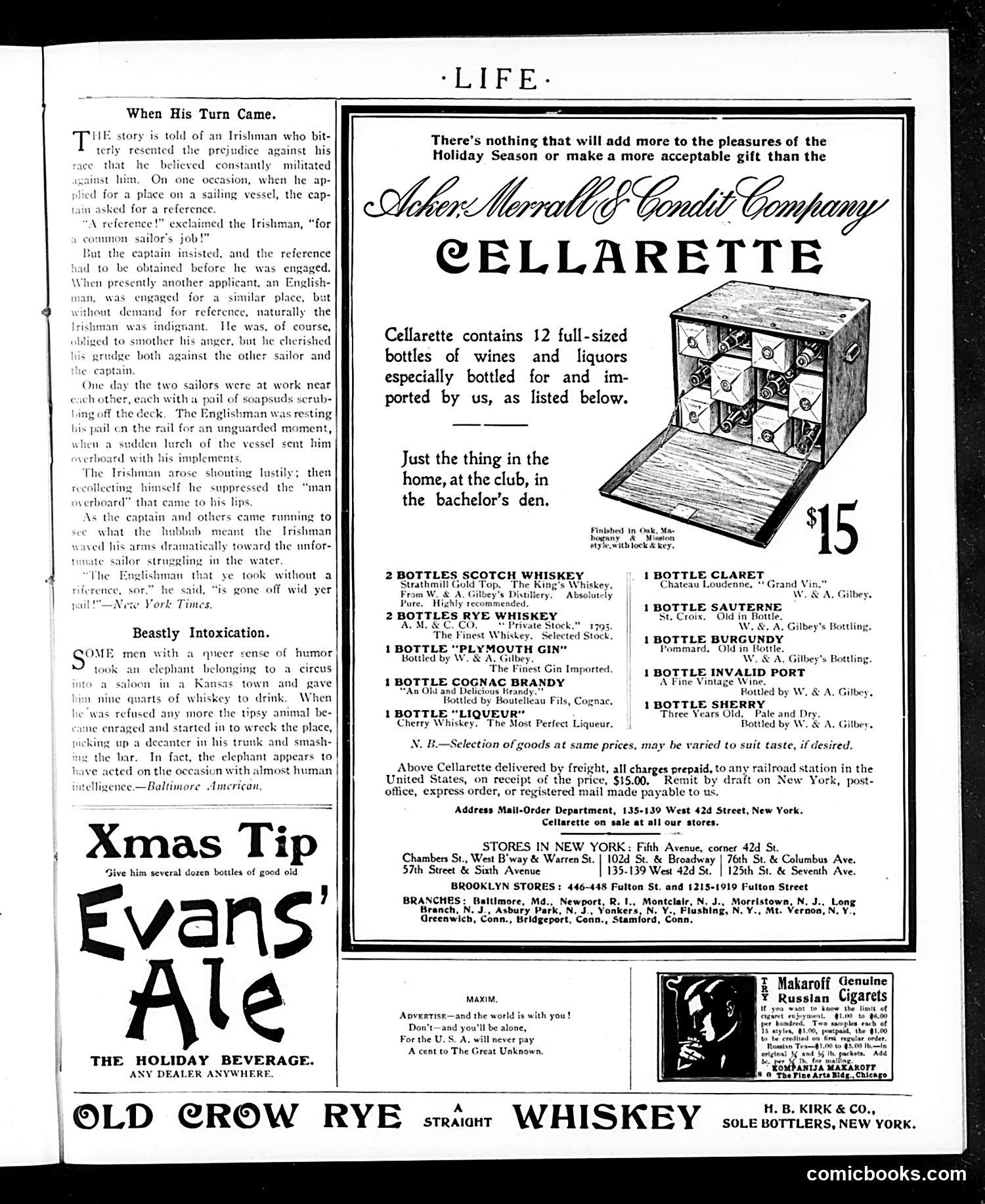
This page consists primarily of **advertisements and brief humorous anecdotes** rather than political satire. The main content includes: **"When His Turn Came"** — An Irish immigrant joke playing on ethnic stereotypes. An Irish sailor, denied a job reference due to prejudice while an Englishman is hired without one, gets revenge when the Englishman falls overboard. The Irishman alerts the captain by shouting "Ould Ireland forever!" — suggesting he'll let the man drown rather than help, though the punchline implies he may have meant something else. **"Beastly Intoxication"** — A humorous anecdote about a drunk circus elephant wrecking a bar, presented as an example of animal "intelligence." The page's dominant feature is a **Cellarette wine/liquor gift advertisement** ($15, mail-order) prominently displayed, alongside ads for **Evans' Ale** and **Old Crow Rye Whiskey**. The humor relies on period ethnic stereotyping and slapstick. This reflects early 20th-century Life magazine's blend of gentle satire, advertising, and light entertainment targeting middle-class readers.
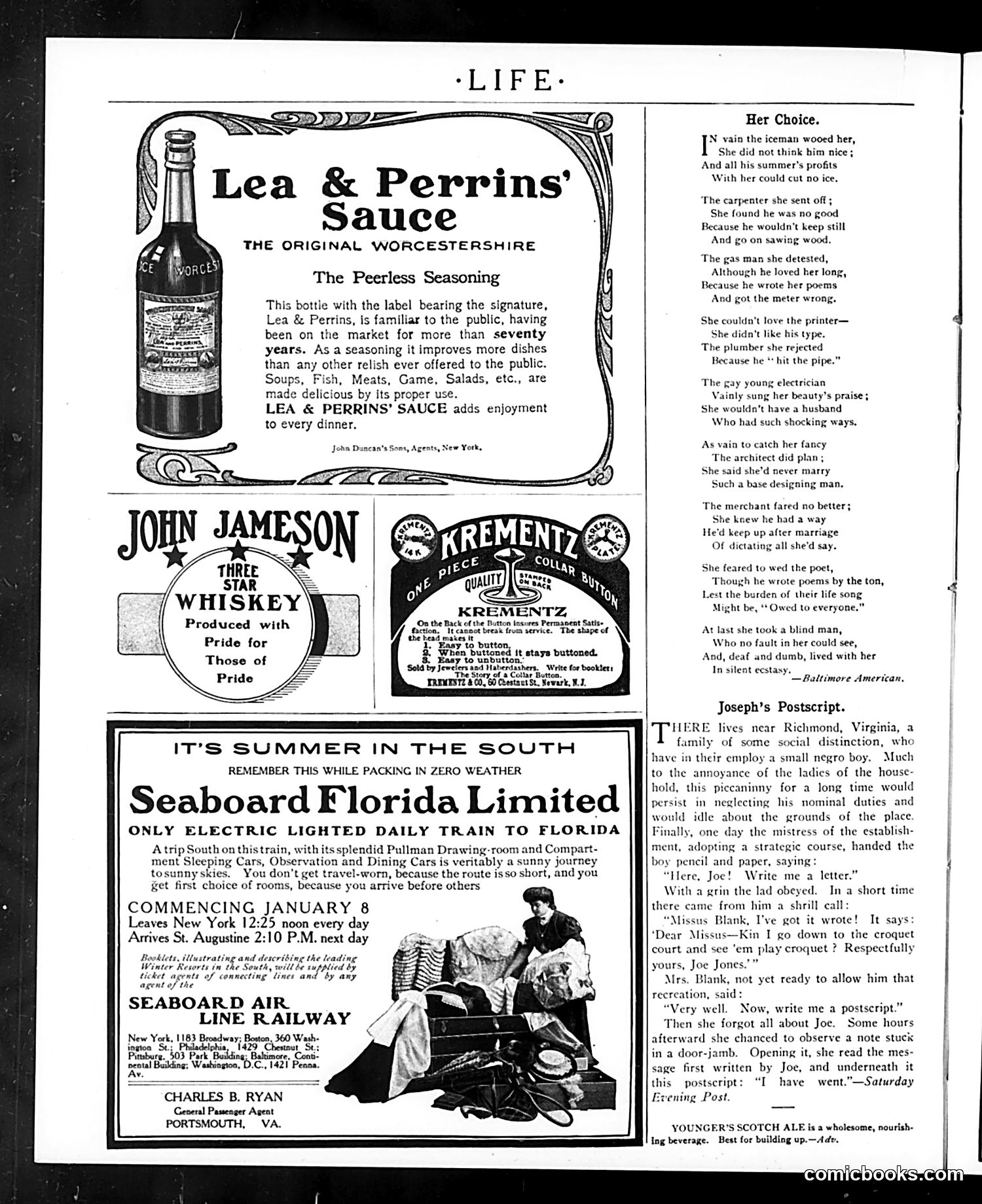
This is a **Life magazine page** (circa early 1900s) composed primarily of **advertisements** interspersed with two pieces of **satirical content**: ## Main Advertisements The page features product ads: Lea & Perrins Sauce, John Jameson Whiskey, Krementz collar buttons, and the Seaboard Florida Limited train line—typical commercial content. ## Satirical Content **"Her Choice"** (poem): A humorous verse listing a woman's rejections of various tradesmen (iceman, carpenter, gas man, printer, plumber, electrician, architect, merchant, poet) for absurd professional reasons—until she marries a blind man who "no fault in her could see." The satire mocks either women's pickiness or men's foolishness in courtship. **"Joseph's Postscript"**: A brief anecdote about a Black servant boy near Richmond who, when asked to write a letter, writes one requesting permission to watch croquet—demonstrating unexpected literacy or cleverness. The humor (from the era's perspective) likely derives from the servant exceeding expected capabilities. Both pieces reflect early-20th-century American humor conventions and social attitudes.
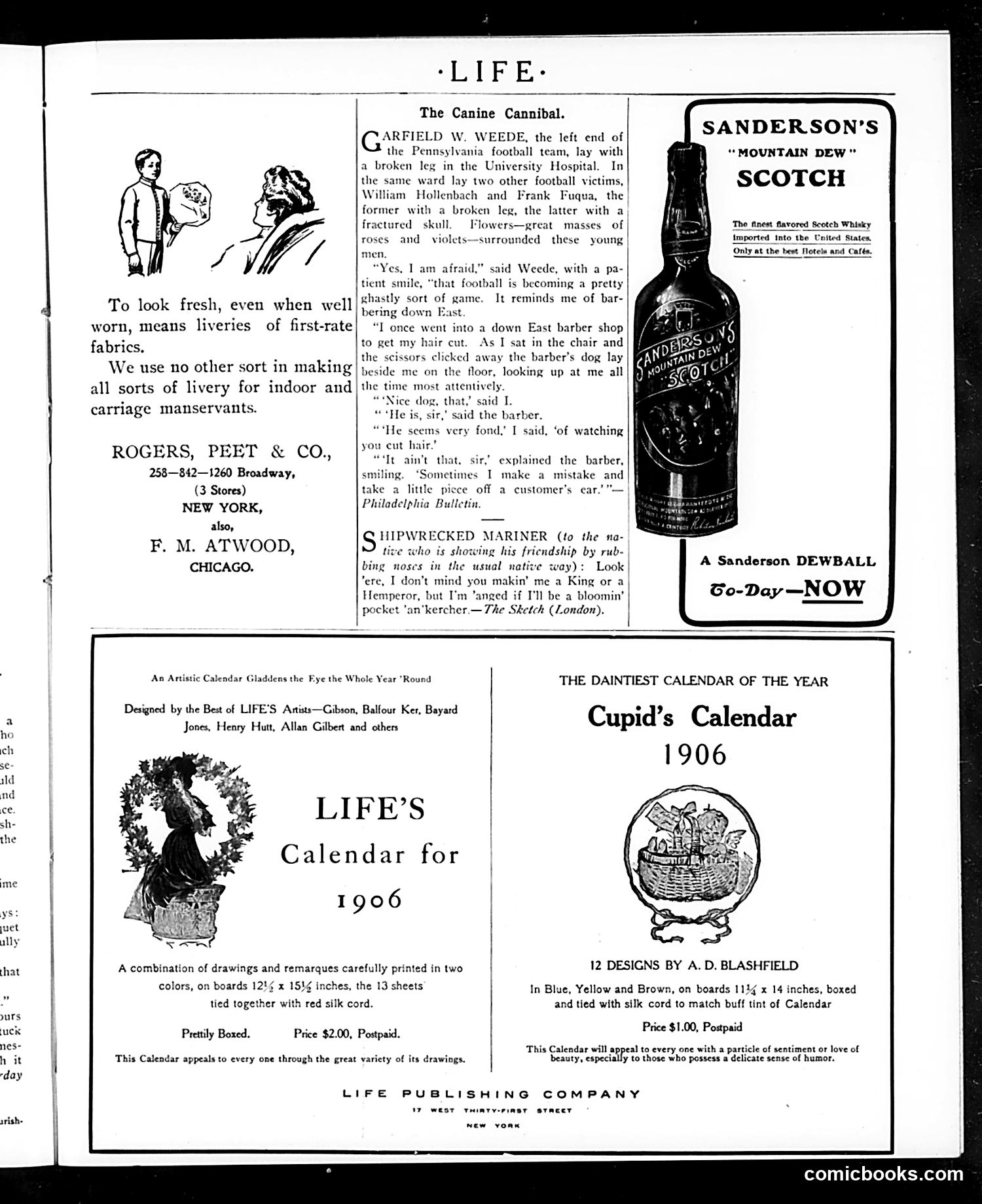
This page contains three humor pieces typical of early 1900s satirical journalism: **"The Canine Cannibal"** mocks football's brutality. It reports that Garfield Weede (Pennsylvania football player) lies hospitalized with a broken leg alongside teammates with fractured skulls. Weede jokes that football resembles a barbershop where a dog watches the barber—not from affection, but because the barber sometimes accidentally cuts off customers' ears. The dark humor equates football injuries to mutilation, criticizing the sport as increasingly violent and dangerous to players. **"Shipwrecked Mariner"** is a brief joke about a castaway who, when rubbed noses by natives in greeting, fears becoming a "bloomin' pocket handkerchief"—a crude reference to being consumed or disrespected. The page also advertises **Life's 1906 Calendar** (designed by prominent illustrators) and **Cupid's Calendar**, plus Rogers, Peet & Co. clothing and Sanderson's Scotch whisky. The satire reflects contemporary concerns about football's safety, which was genuinely dangerous in this era before modern rules.
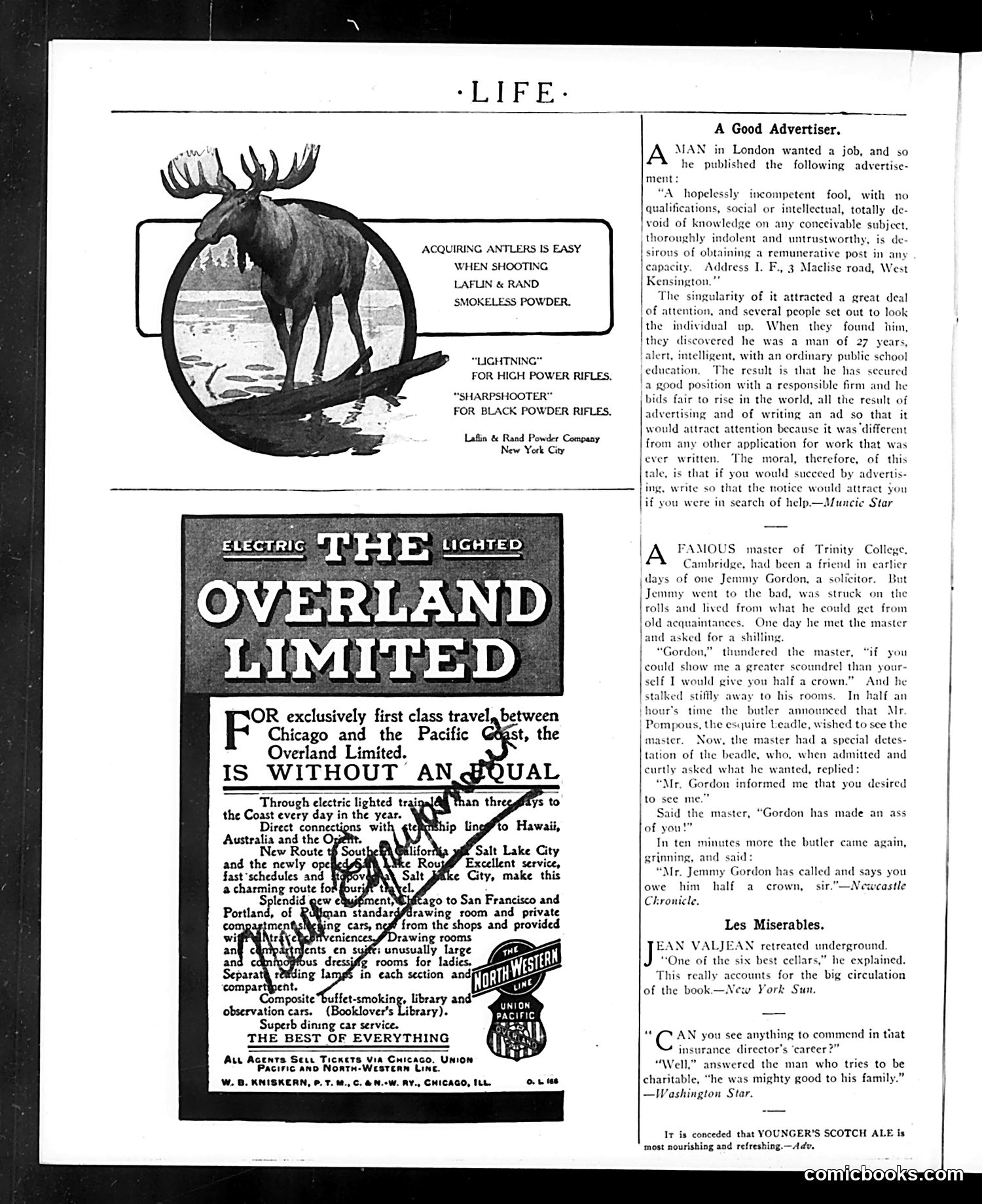
This page contains **primarily advertisements and humorous anecdotes** rather than political cartoons. The top features a **moose illustration advertising Laflin & Rand smokeless powder**—a straightforward product advertisement emphasizing the ammunition's effectiveness for hunting. The main content includes three **humorous short stories**: 1. "A Good Advertiser" praises a London man who secured employment by writing an unusually honest (self-deprecating) job advertisement that stood out through its novelty and candor. 2. A Cambridge anecdote mocks a Trinity College master and a disreputable character named Jemmy Gordon through a joke about mistaken identity. 3. "Les Miserables" offers a brief quip about Victor Hugo's novel's popularity. The **Overland Limited railway advertisement** dominates the lower left, promoting luxury transcontinental travel to the Pacific Coast. There is **no political satire or commentary** on this page—it represents typical early 20th-century Life magazine content mixing commercial advertisements with light social humor and wit.
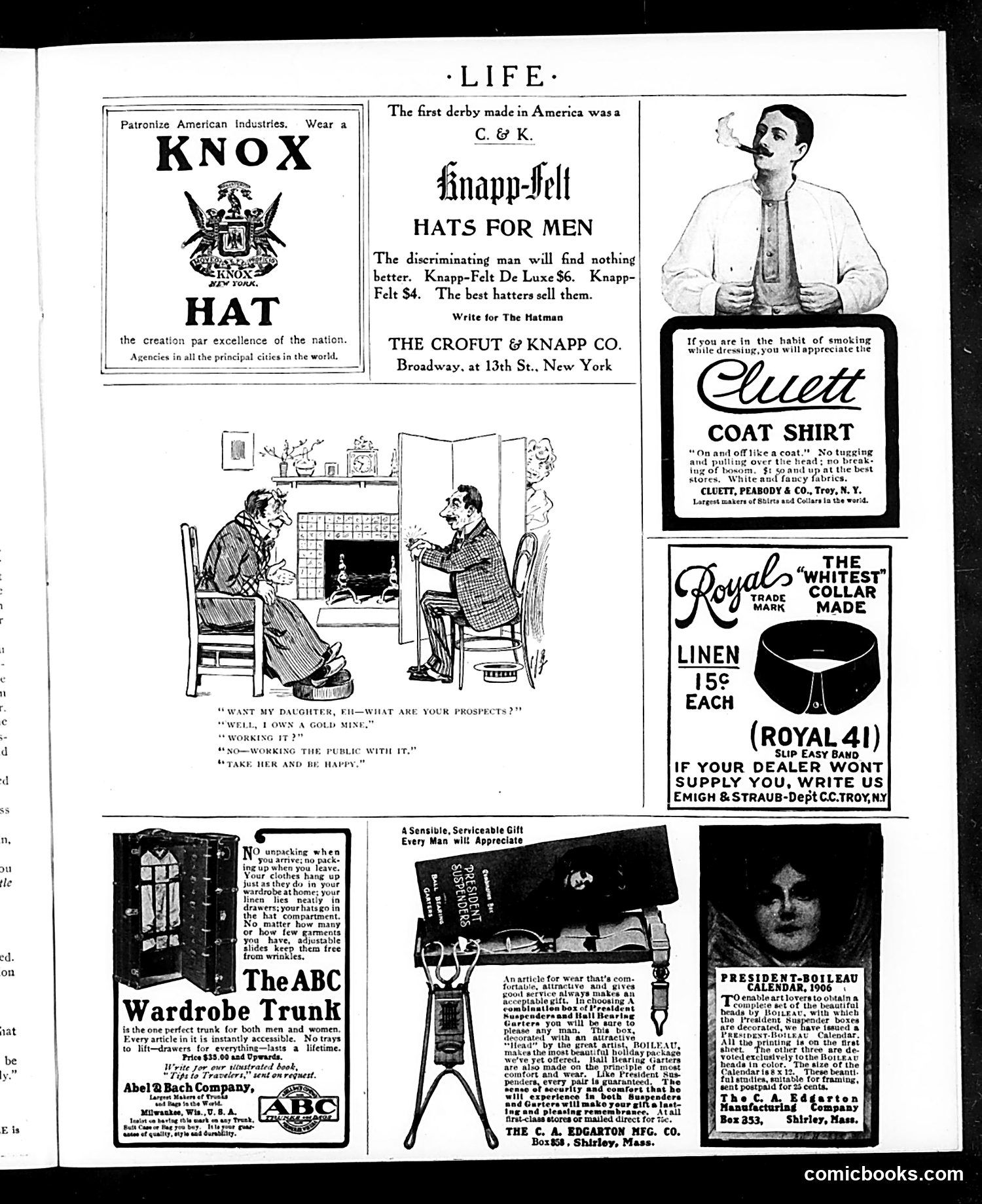
This page is primarily **advertising**, with one central cartoon joke. The main cartoon depicts a father-daughter conversation about her suitor's prospects. The man claims to "own a gold mine" but is actually "working the public with it"—a satire on get-rich-quick schemes and con artists prevalent in the early 1900s. The joke's punch line, "Take her and be happy," suggests the father is cynically offloading his daughter to a scoundrel, implying skepticism about both the suitor's integrity and marriage itself. The surrounding ads promote era-appropriate male fashion and travel goods (Knox hats, Cluett shirts, ABC wardrobe trunks, collars). One ad mentions "President Boileau Calendar, 1905," suggesting this page dates to that year. The advertisements reflect Edwardian-era consumer culture targeting professional men, while the cartoon mocks contemporary financial fraud and courtship customs.
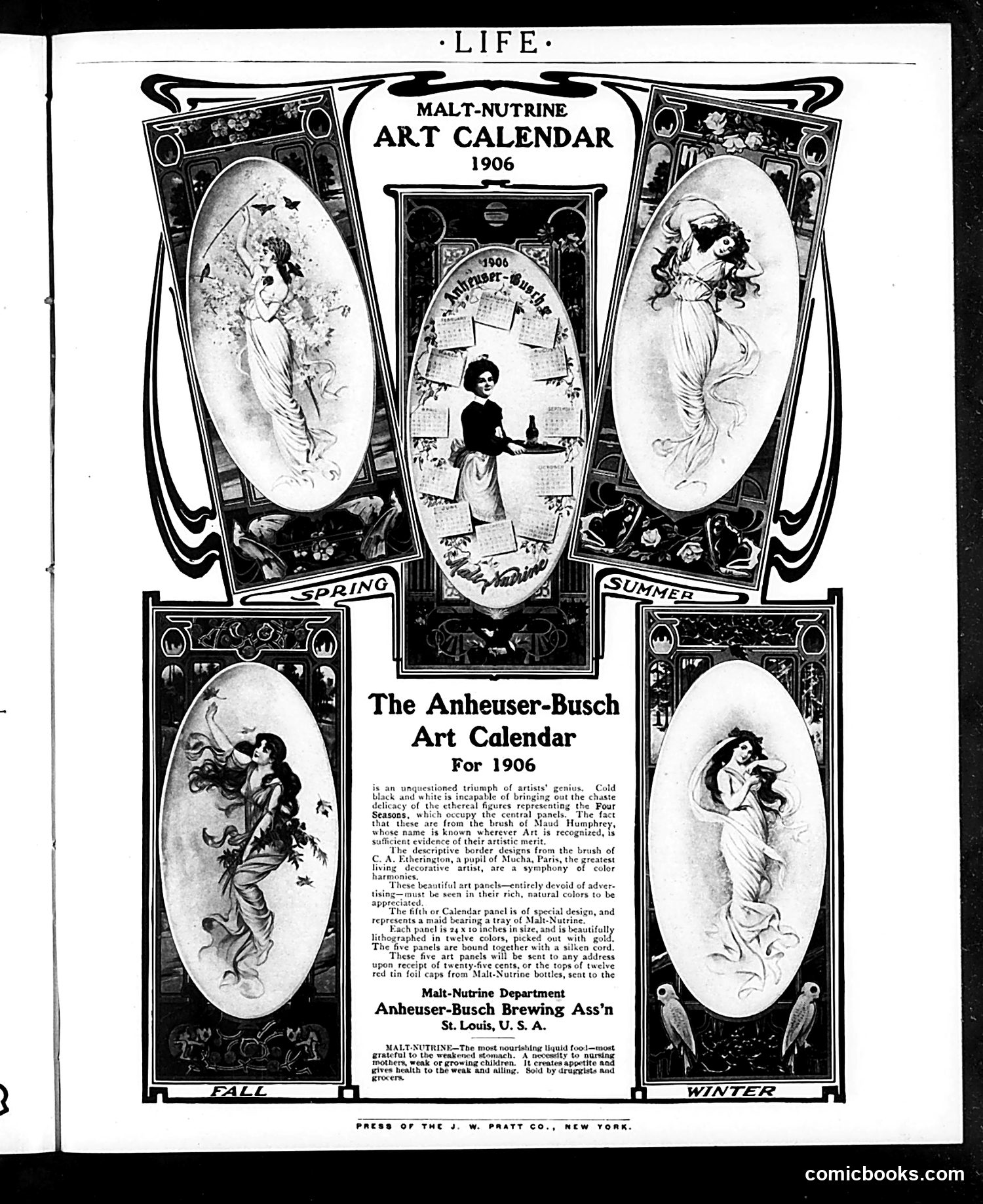
This is primarily **advertising**, not satire or political commentary. The page promotes Anheuser-Busch's "Malt-Nutrine" product through a 1906 art calendar. The layout features four oval-framed classical-style artistic panels representing the four seasons, arranged around a central calendar. Each panel depicts idealized female figures in allegorical poses—typical Art Nouveau aesthetic conventions of the era. The advertisement's pitch emphasizes that these "art panels" are "beautifully lithographed in twelve colors" and positions the product as cultured and refined. Readers could obtain the five-panel calendar by collecting tin foil caps from Malt-Nutrine bottles. **The strategy**: Marketing a nutritional tonic (containing malt, marketed to nursing mothers and "weak" children) by associating it with fine art and classical aesthetics. This was common early-1900s advertising—using artistic prestige to elevate a commercial product's status and appeal to middle-class consumers valuing culture and health. There is no political satire here; *Life* magazine is simply running a paid advertisement disguised as editorial content.
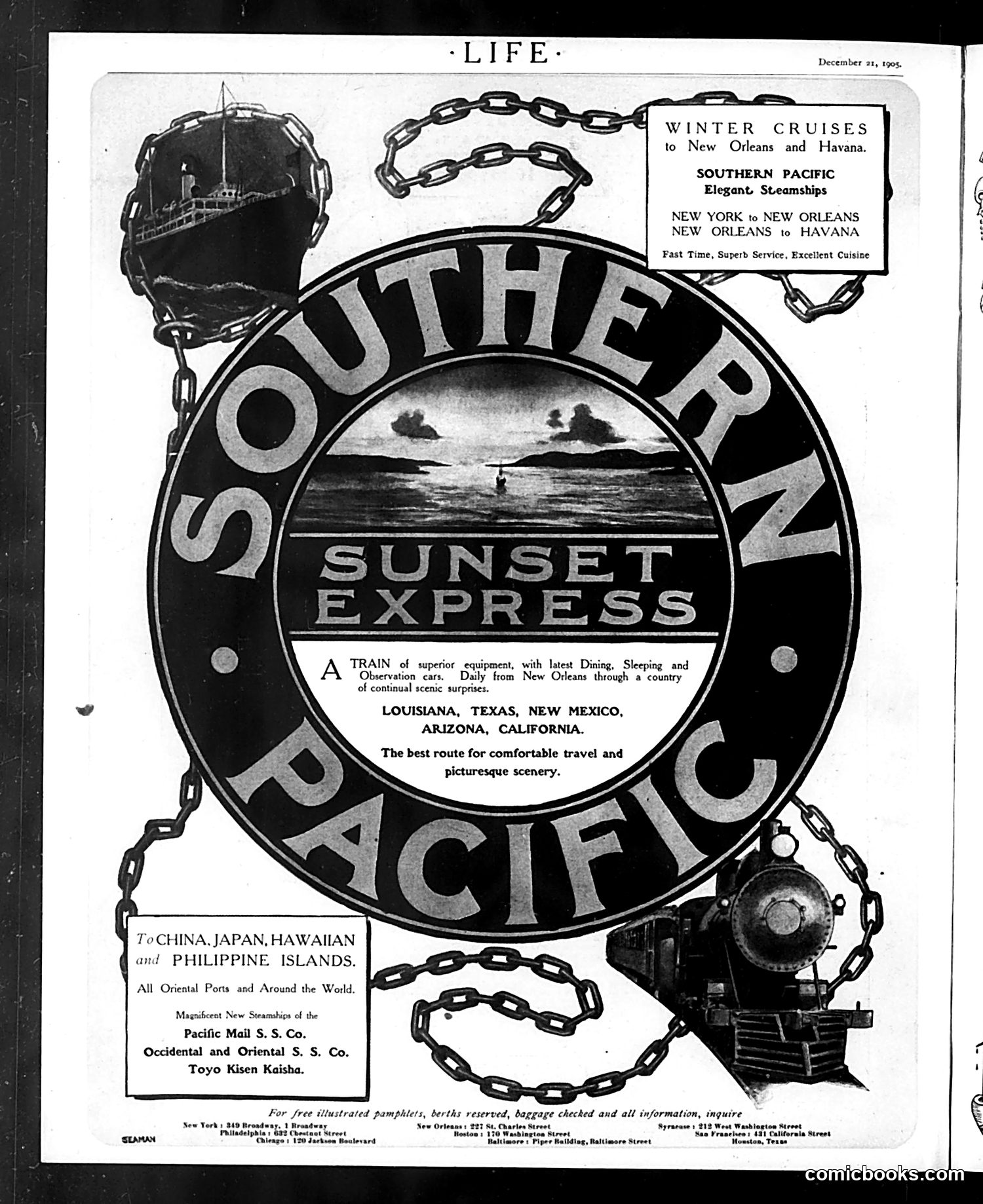
This page is primarily **transportation advertising**, not political satire. The central image features a large circular emblem for the "Southern Pacific" railroad's "Sunset Express" train, decorated with chain links and flanked by illustrations of a steamship (upper left) and locomotive (lower right). The advertisements promote three travel routes: Southern Pacific steamships from New York to New Orleans and Havana; the Sunset Express train through the American Southwest (Louisiana, Texas, New Mexico, Arizona, California); and Pacific Mail steamships to Asia and the Philippines. The chain imagery and ship/train illustrations are purely decorative, emphasizing connectivity and transportation links across America and to distant ports. This reflects the era's celebration of modern industrial travel and America's expanding commercial reach, particularly toward Asia and the Caribbean—regions of strategic interest following the Spanish-American War (1898).