
Life, 1905-12-21 · page 18 of 30
Life — December 21, 1905 — page 18: what you’re looking at
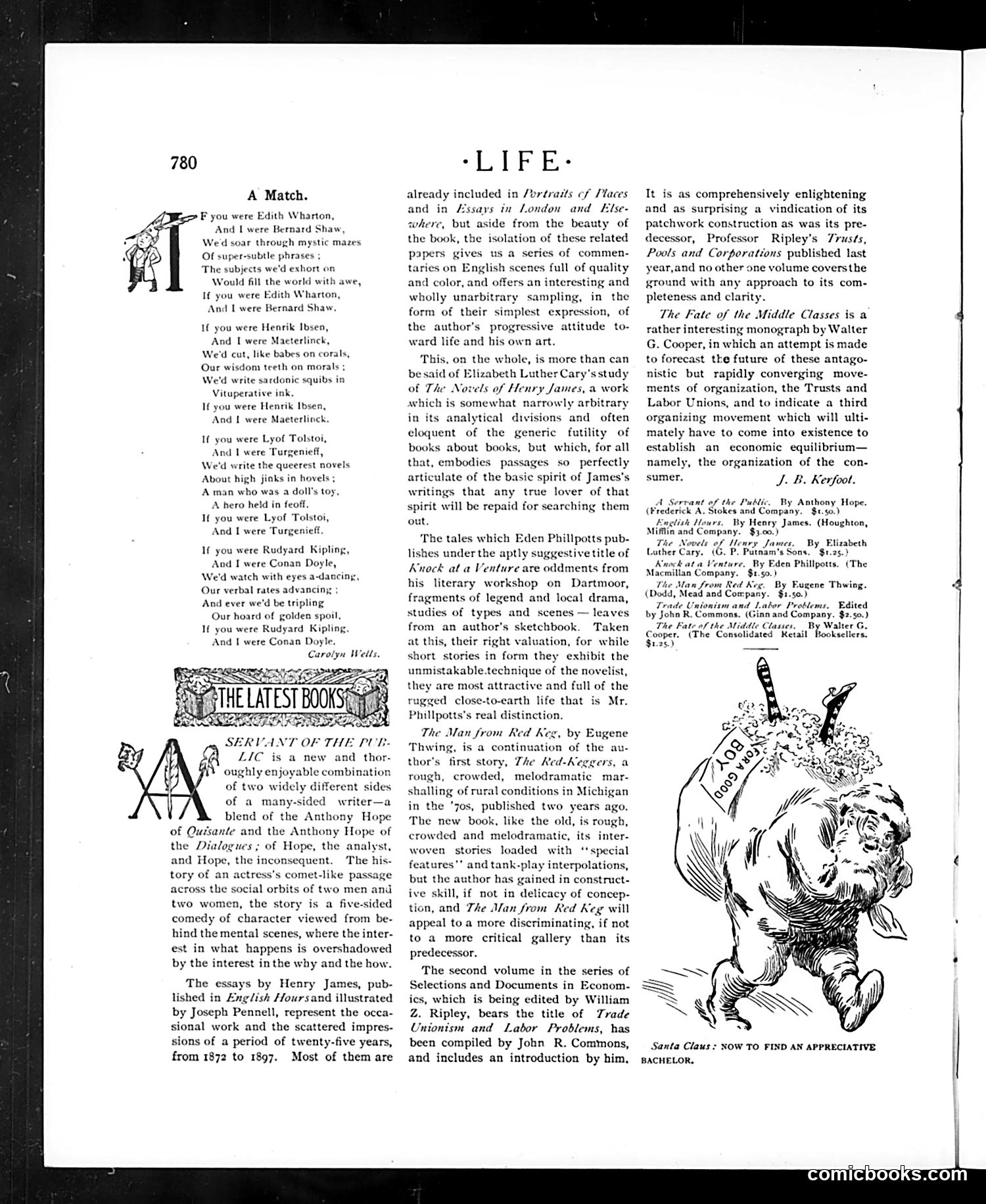
What you’re looking at
This poem by Carolyn Wells playfully imagines hypothetical pairings of celebrated late-19th-century writers and intellectuals. The joke lies in contrasting their reputations: pairing Henry James with Bernard Shaw, Ibsen with Maeterlinck, Tolstoy with Turgenev, and Kipling with Conan Doyle. The satire mocks the pretensions of "serious" literary figures (the philosophical, moralistic Europeans) against commercially successful popular writers. Wells suggests that if you combined a highbrow playwright like Shaw with a literary novelist like Wharton, you'd produce incomprehensibly abstract work; conversely, if adventure writers Kipling and Doyle joined forces, they'd merely accumulate wealth ("hoard of golden spoil"). The piece gently ridicules both literary snobbishness and popular success, suggesting these famous authors represent distinct—even contradictory—approaches to writing. It's a light-hearted commentary on the literary hierarchies and rivalries of the Edwardian era.
📄 Transcribed text from this page (OCR, searchable)
Machine-transcribed from the original scan — historical spelling and the odd misread are preserved.
A Match. F you were Edith Wharton, And I were Bernard Shaw, We'd soar through mystic mazes Of The subjects we Would fill the world with awe, If you were Edith Wharton, And I were Bernard Shaw, per-subtle phrases ; exhort on If you were Henrik Ibsen, And I were Maeterlinck, We'd cut, like babes on corals, Our wisdom teeth on morals ; We'd write sardonic squibs Vituperative ink. If you were Henrik Ibsen, And I were Maeterlinck. If you were Lyof Tolstoi, And I were Turgenieff, We'd write the queerest novels About high jinks in hovels ; A man who was a doll’s toy, A hero held in feoff, If you were Lyof Tolstoi, And I were Turgenieff. If you were Rudyard Kipling, Aod I were Conan Doyle, We'd watch with eyes a-dan Our verbal rates advancing, And ever we'd be tripling Our hoard of golden spoil, If you were Rudyard Kipling, And I were Conan Doyle. Carolyn Wells. ing, BERRIES IOS TELAT OS ae Pe ERIS OA SERVANT OF THE PU LIC is a new and the oughly enjoyable combination of two widely different sides of a many-sided writer blend of the Anthony Hope of Quisante and the Anthony Hope of the Dialogues ; of Hope, th : and Hope, the inconsequent tory of an across the s two women, the story is a five-sided comedy of character viewed from be- hind the mental scenes, where the inter- est in what happens is overshadowed by the interest inthe why and the how. The his- ctress’s comet-like passage ocial orbits of two men and The essays by Henry James, pub- lished in English Hoursand illustrated by Joseph Pennell, represent the occa- sional work and the scattered impres- sions of a period of twenty-five years, from 1872 to 1897. Most of them are *LIFE- already included in /vrérazts cf Places and in Fssays in London and EF, where, but aside from the beaut the book, the isolation of these related papers gives us a series of commen- taries on English scenes full of quality and color, and offers an interesting and wholly unarbit ampling, in the form of their simplest expression, of the author's progressive attitude to- ward life and his own art. This, on the whole, is more than can be said of Elizabeth Luther Cary's study of The Novels of Henry James, a work which is somewhat narrowly arbitrary in its analytical divisions and often eloquent of the generic futility of books about books, but which, for all that, embodies passages so perfectly articulate of the basic spirit of James's writings that any true lover of that spirit will be repaid for searching them out. ‘The tales which Eden Phillpotts pub- lishes under the aptly suggestive title of Knock at a Venture are oddments from his literary workshop on Dartmoor, fragments of legend and local drama, studies of types and scenes — leaves from an author's tchbook. Taken at this, their right valuation, for while short stories in form they exhibit the unmistakable.technique of the nov they are most attractive and full of the rugged close-to-earth life that is Mr. Phillpotts’s real distinction. The Man from Red Keg, by Eugene Thwing, is a continuation of the thor’s first story, The Red-Keggers, a rough, crowded, melodramatic mar- shalling of rural conditions in Michigan in the '7os, published two years ago. The new book, like the old, is rough, crowded and melodramatic, its inter- woven stories loaded with “special features’* and tank-play interpolations, but the author has gained in construct- ive skill, if not in delicacy of concep- tion, and The Man from Red Keg will appeal to a more discriminating, if not to a more critical gallery than its predecessor. st, The second volume in the series of Selections and Documents in Econom- ics, which is being edited by William Z. Ripley, bears the title of Trade Unionism and Labor Problems, has been compiled by John R. Commons, and includes an introduction by him, It is as comprehensively enlightening and as surprising a vindication of its patchwork construction as its pre- decessor, Professor Ripley’s Trusts, Pools and Corporations published last year,and no other one volume coversthe ground with any approach to its com- pleteness and clarity. The Fate of the Middle Classes is a rather interesting monograph by Walter G. Cooper, in which an attempt is made to forecast the future of these antago- nistic but rapidly converging move- ments of organization, the Trusts and Labor Unions, and to indicate a third organizing movement which will ulti- mately have to come into existence to establish an economic equilibrium— namely, the organization of the con- J. B. Kerfoot. sumer. 1 Servant of the Public. By Anthony Hope. (Frederick A. Stokes and Company. $1.50.) English Hours, By Henry James. (Houghton, Mifflin and Company. $3.00.) The Novels of Henry James, By Elizabeth Luther Cary. (G. P. Puitnam’s Sons. $1.25.) Knock at a Venture, By Eden Phillpotts. (The Macmillan Company. $1.59.) The Man from Red Keg. By Eugene Thwing. (Dodd, Mead and Company. $1.50.) Trade Unionitm and Labor Problems, Edited by John R. Commons. (Ginn and Company. $2.50.) The Fate of the Middte Classes. By Walter G. Cooper. “(The Consolidated Metall Booksellers 1.25.) Santa Claus ; NOW TO FIND AN APPRECIATIVE BACHELOR,