
Life, 1905-12-21 · page 8 of 30
Life — December 21, 1905 — page 8: what you’re looking at
What you’re looking at
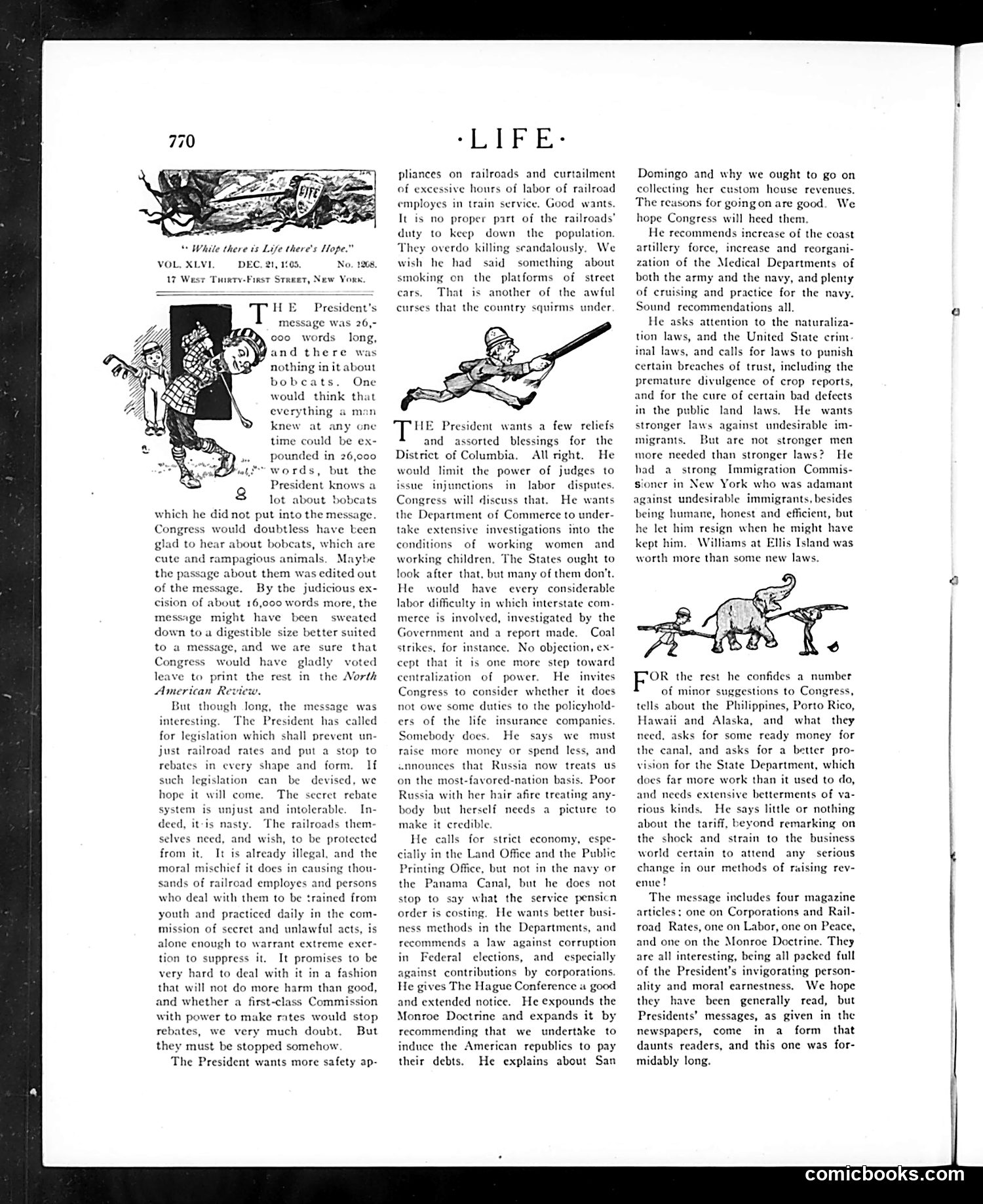
This page contains **satirical commentary on President Theodore Roosevelt's recent message to Congress**—the text discusses his various policy recommendations. The cartoons mock Roosevelt's prolific output of suggestions and reforms. The first cartoon shows a figure overwhelmed by the sheer volume of proposals ("26,000 words"), satirizing how Roosevelt wanted to address everything from railroad safety to labor disputes to immigration law. The second cartoon (bottom) depicts a donkey/mule being worked hard, likely representing **Congress itself**—overloaded with the President's ambitious agenda and expected to implement his many demands. The humor targets Roosevelt's aggressive, interventionist presidency and his tendency to micromanage through legislation rather than allowing Congress independence. This reflects contemporary political anxiety about executive overreach.
📄 Transcribed text from this page (OCR, searchable)
Machine-transcribed from the original scan — historical spelling and the odd misread are preserved.
“While there ts Life there's Hope.” VOL, XLVI, DEC. 21, 1:05, No. 1268. 17 West Triety-First Street, New Yor, HE President's message was 26,- coo words long, and there was nothing in it about bobcats. One would think that everything a man knew at any one time could be ex- pounded in 26,000 words, but the President knows a lot about bobcats which he did not put into the message. Congress would doubtless have been glad to hear about bobcats, which are mpagious animals. Maybe the passage about them was edited out of the message. By the judicious ex cision of about 16,000 words more, the message might have been sweated down to a digestible size better suited to a message, and we are sure that Congress would have gladly voted leave to print the rest in the North American Review. But though Jong, the message was interesting. The President has called for legislation which shall prevent un- just railroad rates and put a stop to rebates in every shape and form. If such legislation can be devised, we hope it will come. The secret rebate system is unjust and intolerable. In- deed, it-is nasty. The railroads them- |, and wish, to be protected from it, It is already illegal, and the moral mischief it does in causing thou- sands of railroad employes and persons who deal with them to be trained from selves n youth and practiced daily in the com- mission of secret and unlawful acts, is alone enough to warrant extreme ex tion to suppress it. It promises to be very hard to deal with it in a fashion that will not do more harm than good, and whether a first-class Commission with power to make rates would stop rebates, we very much doubt. But they must be stopped somehow The President wants more safety ap- *LIFE: pliances on railroads and curtailment of excessive hours of labor of railroad employes in train service. Good wants. It is no proper part of the railroads’ duty to keep down the population. They overdo killing scandalously. We wish he had said something about smoking on the platforms of street cars, That is another of the awful curses that the country squirms under. HE President wants a few reliefs and assorted blessings for the District of Columbia. All right. He would limit the power of judges to issue injunctions in labor disputes. Congress will discuss that. He wants the Department of Commerce to under- take extensive investigations into the conditions of working women and working children. The States ought to look after that, but many of them don't. He would have every considerable labor difficulty in which interstate com- merce is involved, investigated by the Government and a report made. Coal strikes, for instance. No objection, cept that it is one more step toward centralization of power. He invites Congress to consider whether it does not owe some duties to the policyhold- ers of the life insurance companies. Somebody docs. He says we must raise more money or spend less, and announces that Russia now treats us on the most-favored-nation basis. Poor Russia with her hair afire treating any- body but herself needs a picture to make it credible. He calls for strict economy, espe- cially in the Land Office and the Public Printing Office, but not in the navy or the Panama Canal, but he does not stop to say what the service pensicn order is costing. He wants better busi- ness methods in the Departments, and recommends a law against corruption in Federal elections, and especially against contributions by corporations. He gives The Hague Conference a good and extended notice. He expounds the Monroe Doctrine and expands it by recommending that we undertake to induce the American republics to pay their debts. He explains about San Domingo and why we ought to go on collecting her custom house revenues. The reasons for going on are good. We hope Congress will heed them. He recommends increase of the coast artillery force, increase and reorgani- zation of the Medical Departments of both the army and the navy, and plenty of cruising and practice for the navy. ound recommendations all, He S$ attention to the naturali tion laws, and the United State crim inal laws, and calls for laws to punish certain breaches of trust, including the premature divulgence of crop reports, and for the cure of certain bad defects in the public land laws. He wants stronger laws against undesirable im- migrants. But are not stronger men more needed than stronger laws? He had a strong Immigration Commis- sioner in New York who was adamant against undesirable immigrants, besides being humane, honest and efficient, but he let him resign when he might have kept him. Williams at Ellis Island was. worth more than some new laws. OR the rest he confides a number of minor suggestions to Congress, tells about the Philippines, Porto Rico, Hawaii and Alaska, and what they need, asks for some ready money for the canal, and asks for a better pro- for the State Department, which does more work than it used to do, and needs extensive betterments of va- rious kinds, He says little or nothing about the tariff, beyond remarking on the shock and strain to the business world certain to attend any serious change in our methods of raising rev- enue! The message includes four magazine articles; one on Corporations and Rail- road Rates, one on Labor, one on Peace, and one on the Monroe Doctrine. They are all interesting, being all packed full of the President’s invigorating person- ality and moral earnestness. We hope they have been generally read, but Presidents’ messages, as given in the newspapers, come in a form that. daunts readers, and this one was for- midably long. visi a comicbooks.com