
A complete issue · 24 pages · 1905
Life — September 28, 1905
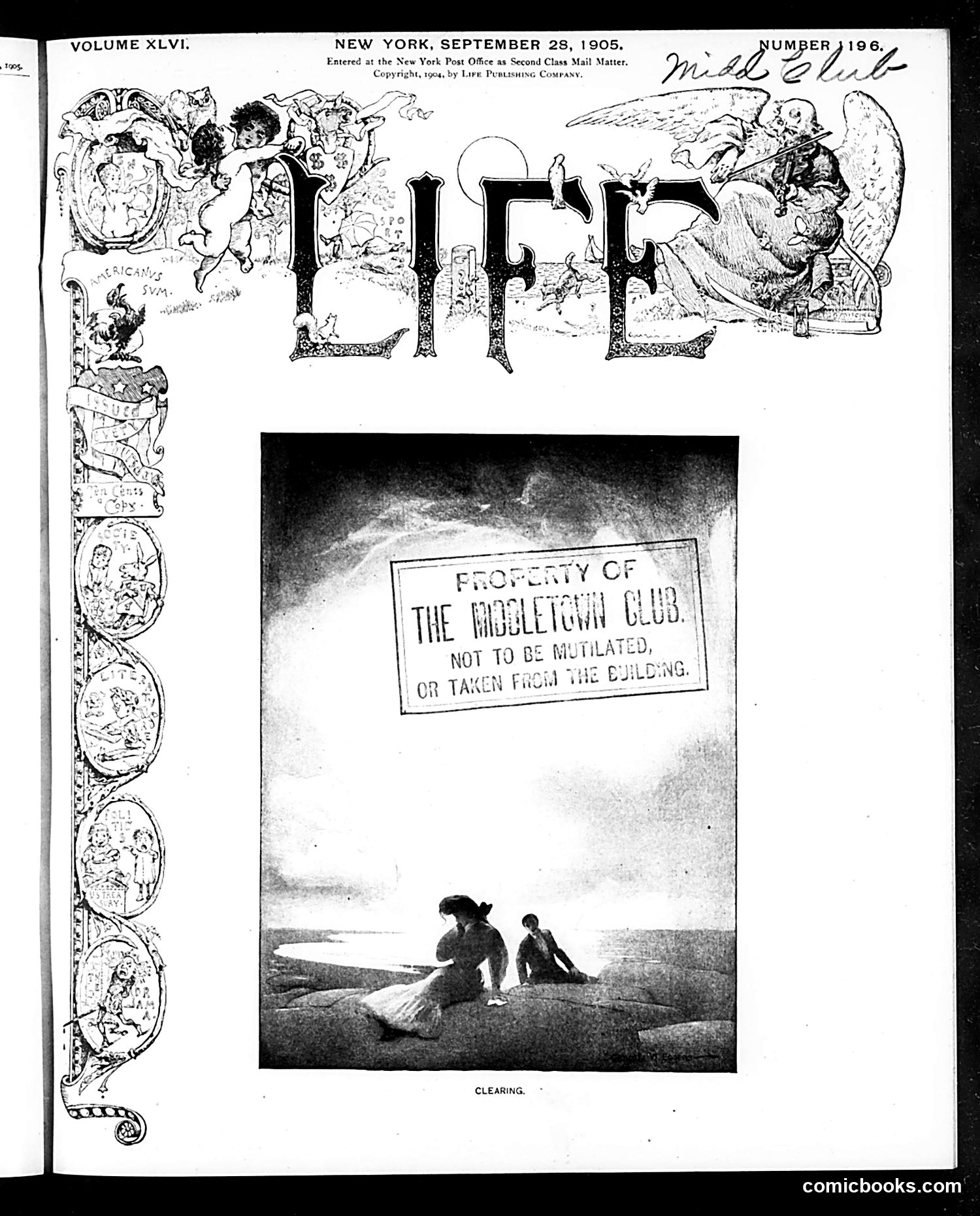
This page features a satirical illustration titled "CLEARING" showing two figures clearing land beneath a large sign reading "PROPERTY OF THE MUDLETOWN CLUB. NOT TO BE MUTILATED, OR TAKEN FROM THE BUILDING." The cartoon appears to satirize the contrast between property claims and actual land use. The "Mudletown Club" seems to be a fictional or real establishment asserting ownership while the landscape depicted looks barren or undeveloped. The figures actively clearing the land suggest tension between official property designation and practical utilization or unauthorized use. The ornate decorative border on the left contains classical vignettes, typical of Life's design aesthetic. Without additional context, the specific Mudletown Club reference is unclear, but the cartoon mocks bureaucratic property ownership versus ground-level reality.
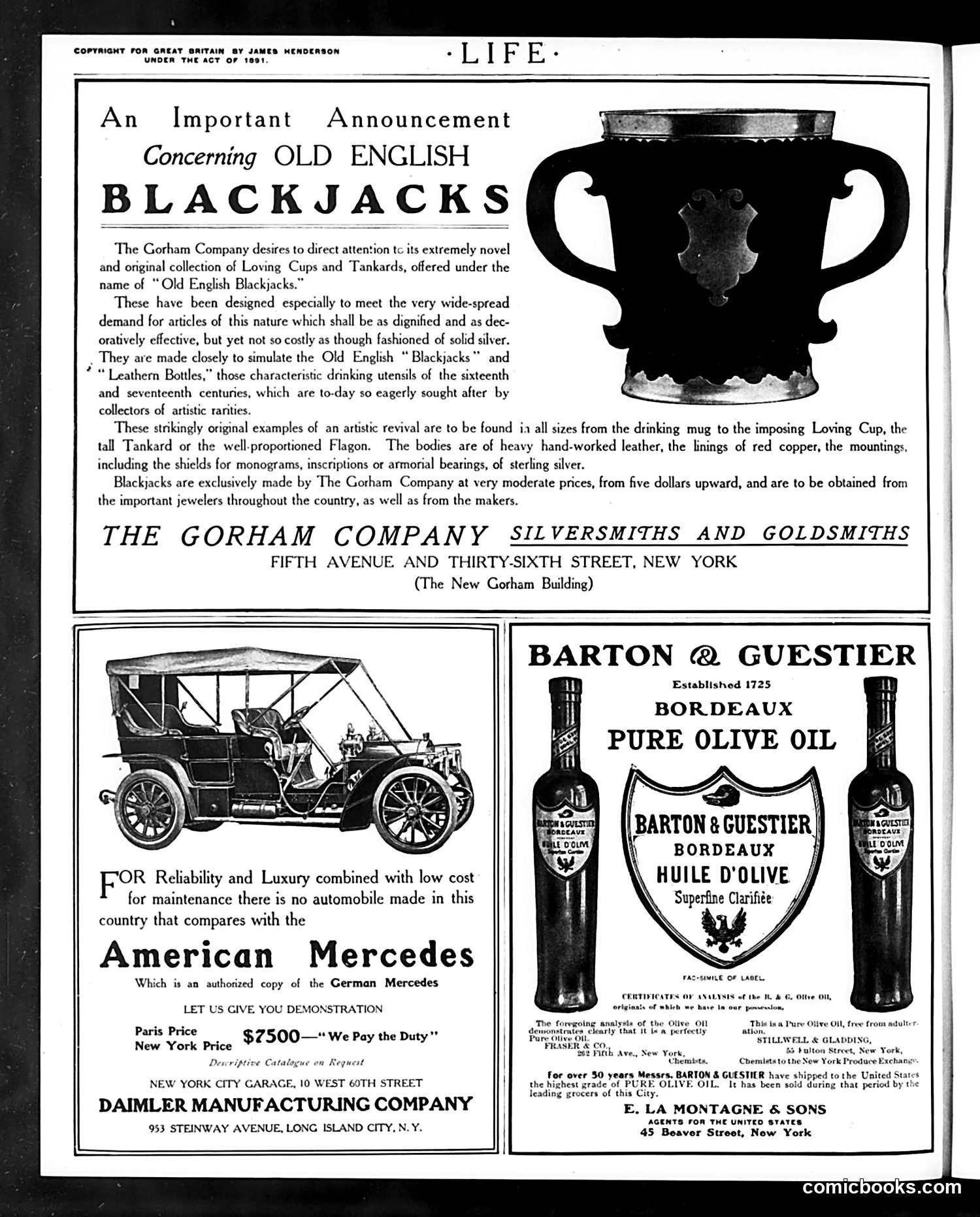
This page contains **no political cartoons or satire**. Instead, it features three luxury advertisements from the early 20th century: 1. **The Gorham Company** advertises "Old English Blackjacks"—decorative leather drinking vessels with copper linings and sterling silver mountings, priced from five dollars upward. 2. **Daimler Manufacturing Company** promotes the American Mercedes automobile, priced at $7,500, positioning it as a reliable luxury vehicle comparable to the German original. 3. **Barton & Guestier** advertises French pure olive oil from Bordeaux, established 1725, claiming over 50 years of U.S. shipments. The page reflects the commercial focus of *Life* magazine during this era—advertising luxury goods to affluent readers rather than publishing satirical commentary.
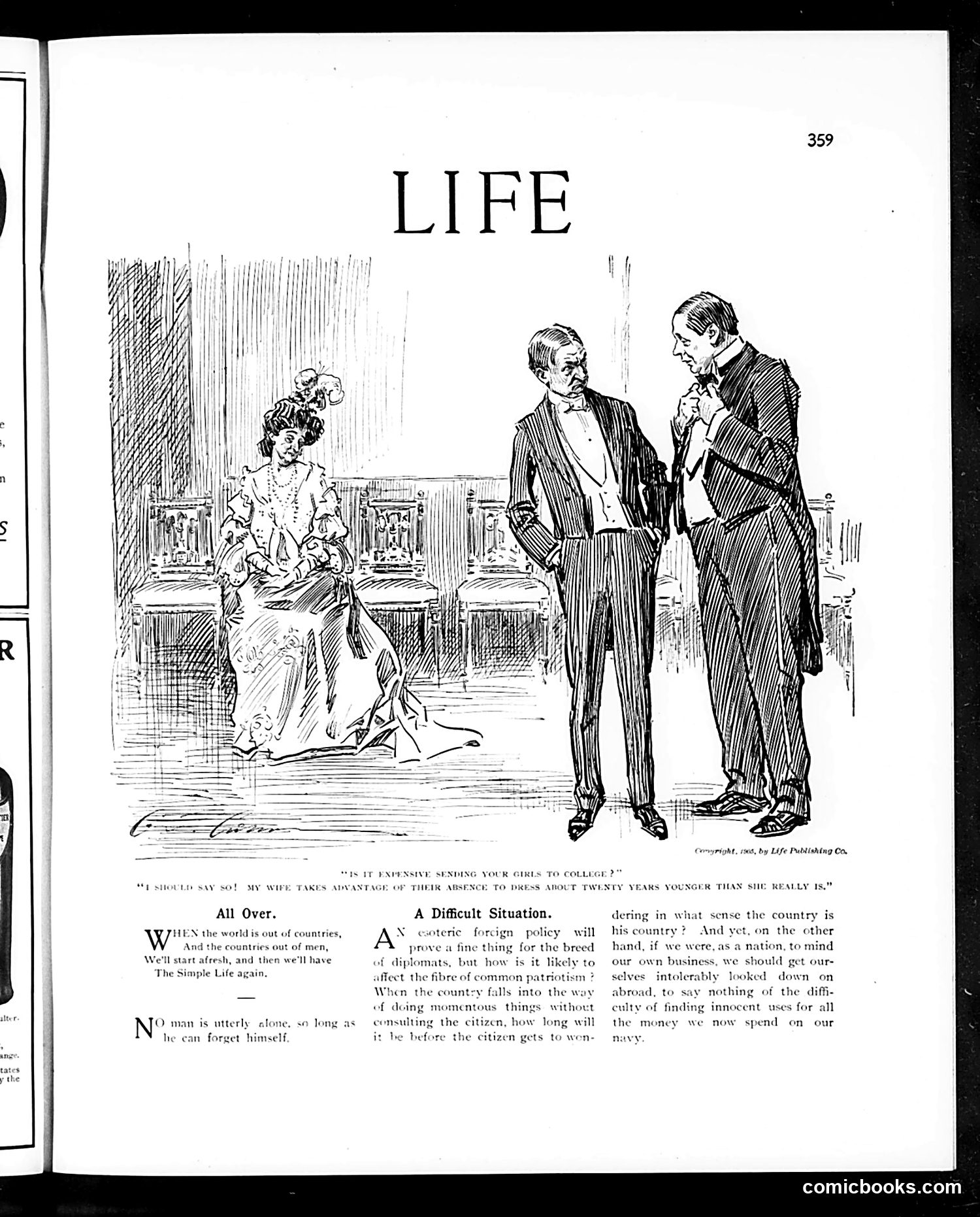
This page from *Life* magazine (page 359) contains a satirical cartoon and accompanying text pieces on early 20th-century themes. The main cartoon depicts a social scene: a well-dressed woman sits while two men in formal attire converse nearby. The caption reads: "Is it expensive sending your girls to college?" / "I should say so! My wife takes advantage of their absence to dress about twenty years younger than she really is." The joke satirizes changing gender dynamics—specifically, how women's education and independence (attending college) shifted family finances and social roles. The humor targets vanity and the economic burden of daughters' education, while implying wives used this opportunity to reinvent themselves fashionably. The accompanying text pieces—"All Over" and "A Difficult Situation"—appear to address broader post-war or political concerns, though OCR errors obscure exact meaning.
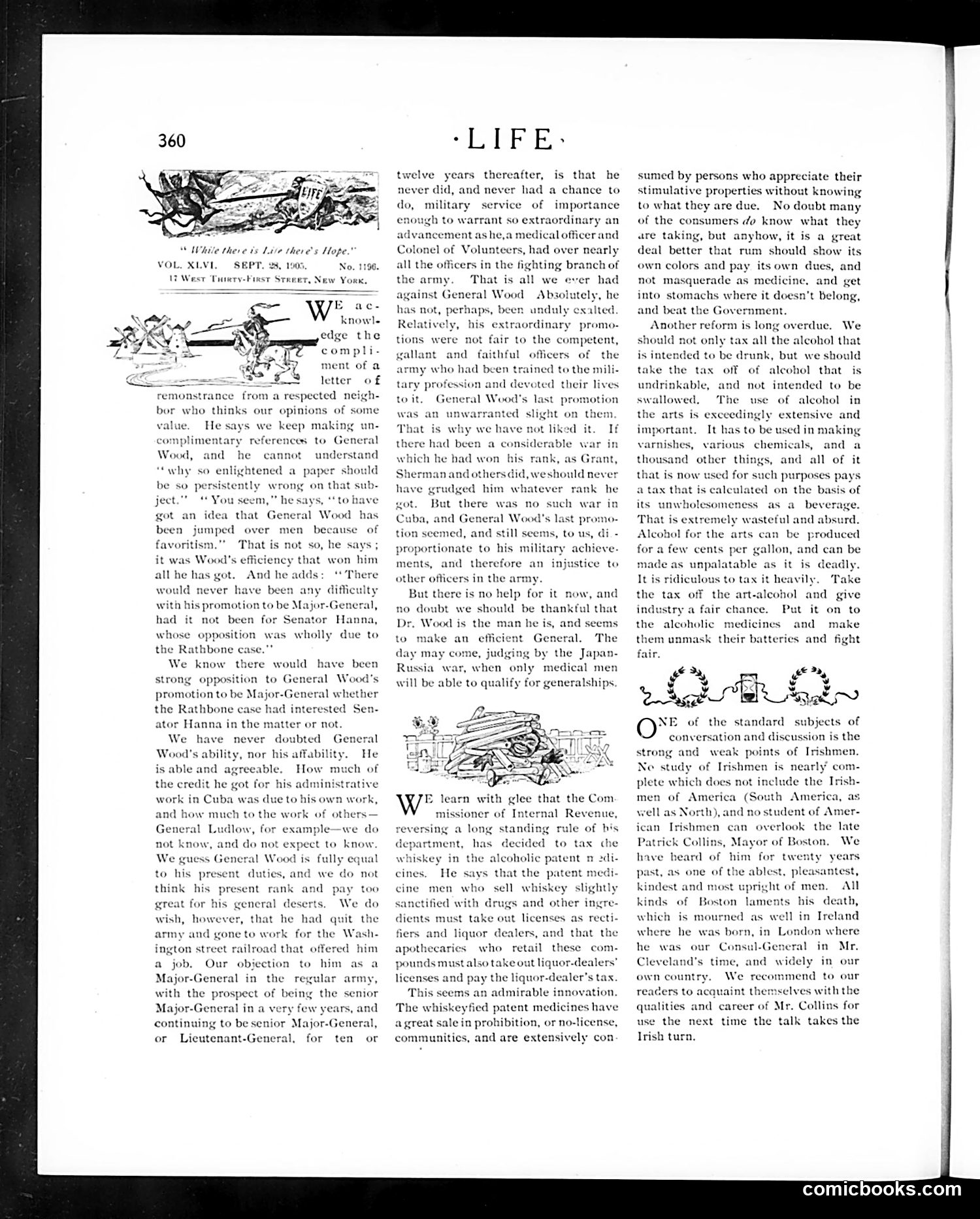
This page contains editorial commentary on General Leonard Wood's military career and promotion decisions, alongside discussion of Irish-American figures like Patrick Collins, Mayor of Boston. The two small cartoons illustrate satirical critiques: one depicts someone fallen or defeated (likely commenting on Wood's controversial standing), while another shows what appears to be a cart or vehicle, possibly referencing bureaucratic or political obstruction. The text defends Wood against accusations of favoritism while criticizing his decisions regarding officer promotions. There's extended commentary on alcohol taxation policy and patent medicines, suggesting broader Progressive-era regulatory debates. The Patrick Collins reference notes his reputation as "one of the ablest, pleasantest, kindest and most upright men" of Boston's Irish community, presenting him as exemplary of Irish-American achievement. The satire targets both military politics and governmental regulation circa 1896.
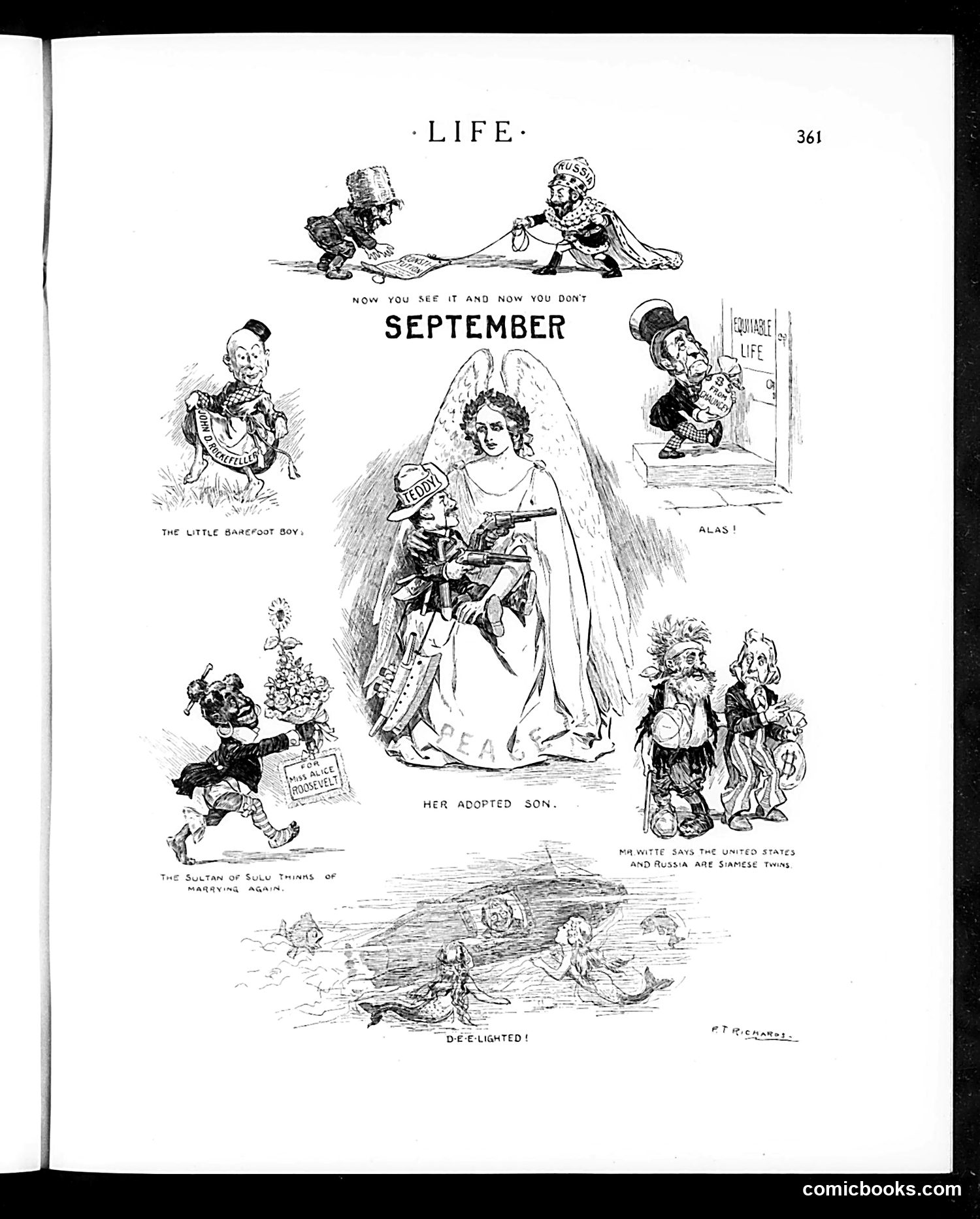
This September 1909 cartoon satirizes Theodore Roosevelt's recent African safari and return to American politics. The central figure—"Her Adopted Son"—depicts Columbia (America personified) cradling a gun-wielding child labeled "Teddy," suggesting Roosevelt remains America's political favorite despite leaving office. Surrounding vignettes mock various political figures and situations: "The Little Barefoot Boy" references rural/political concerns; "The Sultan of Sulu" alludes to colonial Philippines issues; and "Alas!" depicts a politician's disappointment. The top scene shows a magic trick ("Now You See It and Now You Don't"), likely referencing Roosevelt's shifting political influence. The bottom panel, "Delighted," appears satirical about public or diplomatic reactions. The overall thrust mocks Roosevelt's outsized influence on American politics even in retirement.
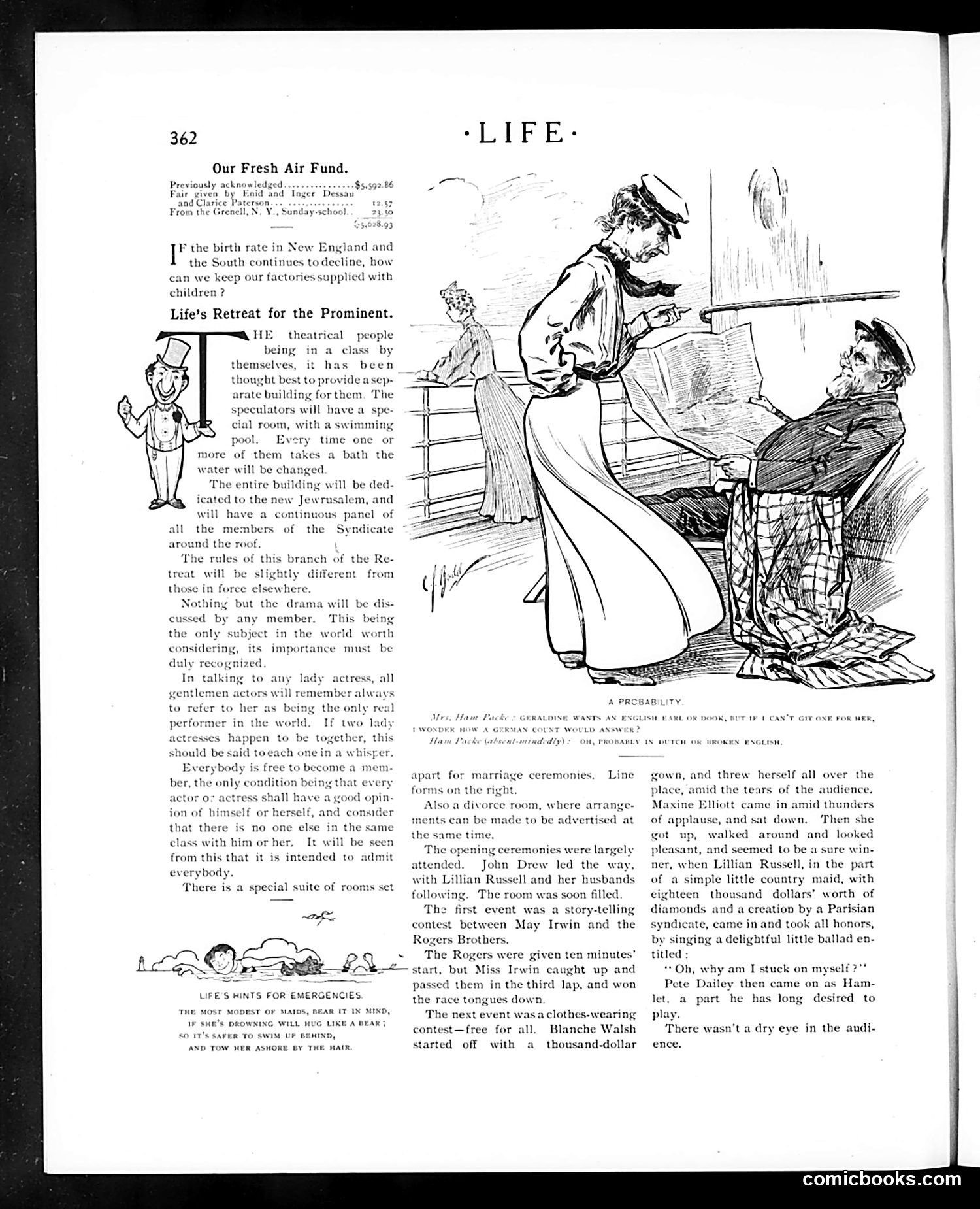
This page contains two main elements: **Main Article: "Life's Retreat for the Prominent"** discusses a proposed luxury retreat building for theatrical performers, featuring a special swimming pool and dedicated spaces. The article emphasizes exclusivity—only actors/actresses can join, and the facility will be managed by the Syndicate. **The Cartoon "Probability"** depicts a woman (labeled "Mrs. Haw Puck") confronting two men about English etiquette. The satire appears to mock pretentious social climbing and questions of proper conduct among aspiring elites. The woman's aggressive posture and the men's defensive reactions suggest ridicule of those obsessing over correct behavior or social standing. Both elements mock theatrical society's self-importance and exclusionary practices during this era of American entertainment.
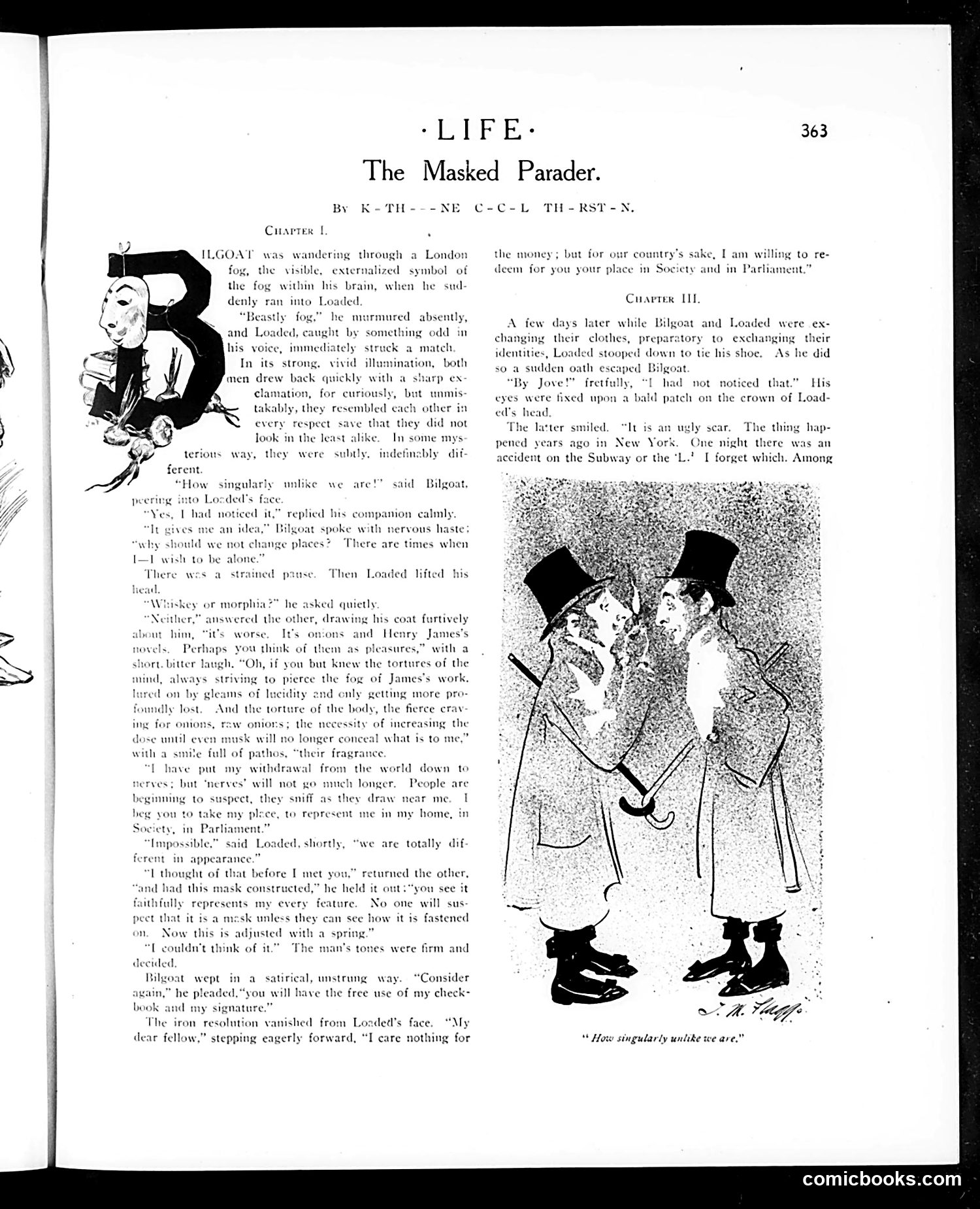
This is Chapter 1 of a serialized satirical story by K-the-ne C-C-L th-rst-n (author name obscured/encoded). The narrative follows two characters, Bilgoat and Loaded, who are wandering through London fog and discussing their identities and social positions. The main illustration shows two well-dressed men in top hats and overcoats—appearing to represent wealthy or aristocratic figures. The caption reads "How singularly unlike we are," which is ironic given their nearly identical appearance. The satire appears to target social pretension and class distinctions: despite claiming to be different, these masked figures are practically indistinguishable. The "mask" metaphor suggests people hide their true nature behind social performance and false personas to maintain their status.
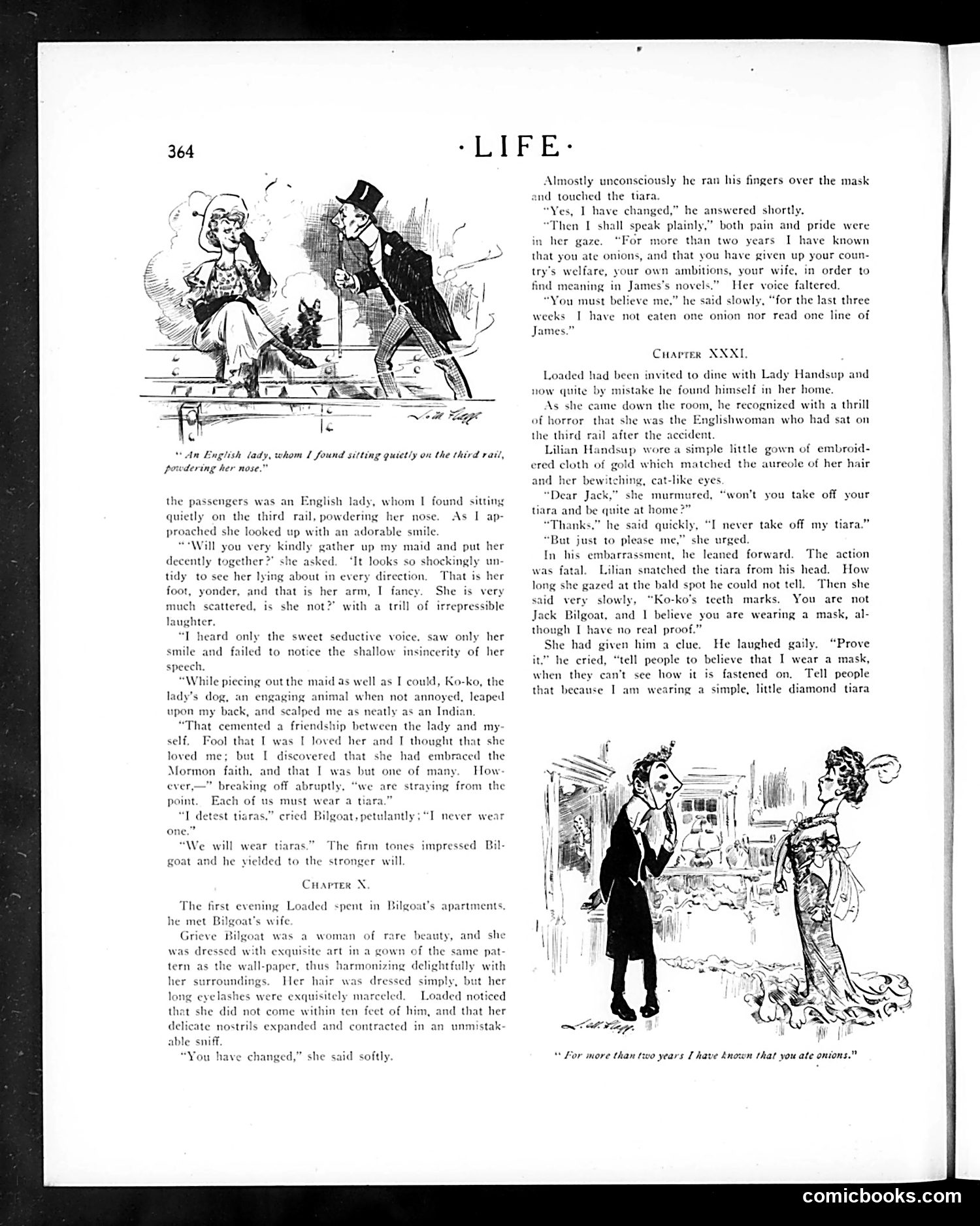
This page contains narrative text from what appears to be a serialized story, accompanied by two illustrations. The top cartoon shows a conversation between a gentleman in a top hat and a woman, with text indicating he's addressing an "English lady" he found on a train, suggesting social comedy about class and courtship. The lower illustration depicts a domestic scene with a woman gesturing toward a man, illustrating dialogue about wearing a tiara. The narrative references "Bilgoat" and concerns about tiaras being worn or removed, suggesting satire about social pretension and the absurdity of class affectations among the wealthy. The overall content appears to be humorous social commentary on British upper-class manners and matrimonial concerns, rather than direct political satire.
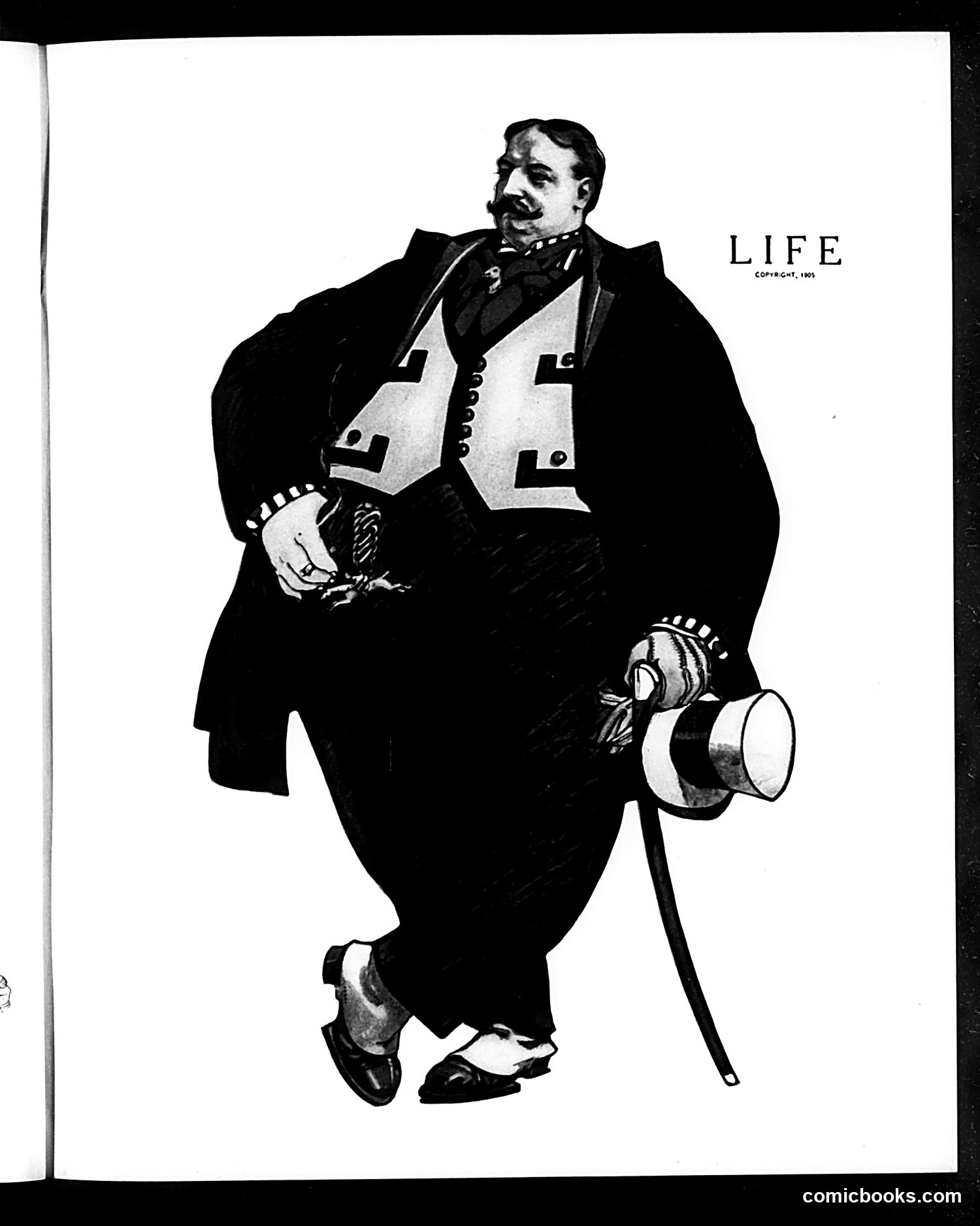
This is a **Life magazine cover** (copyright 1905) featuring a caricatured portly gentleman in formal evening wear—tailcoat, vest with decorative buttons, and holding a top hat and cane. The figure displays exaggerated facial features typical of period caricature. Without additional identifying text on the page itself, I cannot definitively name this specific figure or pinpoint the exact satirical target. However, the composition—a well-dressed, rotund man in formal attire—suggests commentary on wealth, status, or political power characteristic of early 1900s American satire. The artistic style and subject matter are consistent with Life's tradition of mocking prominent public figures or social types of that era. To identify the specific person or issue being satirized would require additional context beyond what's visible here.

I can see this is a blank or nearly blank white page from what appears to be a Life magazine publication, with only a small dot or mark visible in the center and "comicbooks.com" printed at the bottom right corner. Without visible cartoon imagery, text content, or other substantive material on this page, I cannot identify any figures, political references, or satirical points. This appears to be either a blank page from the original magazine, a page that did not scan clearly, or possibly a back cover or interstitial page containing no editorial content. To provide meaningful historical analysis of Life magazine's satire or commentary, I would need a page with actual visible cartoons or text content.
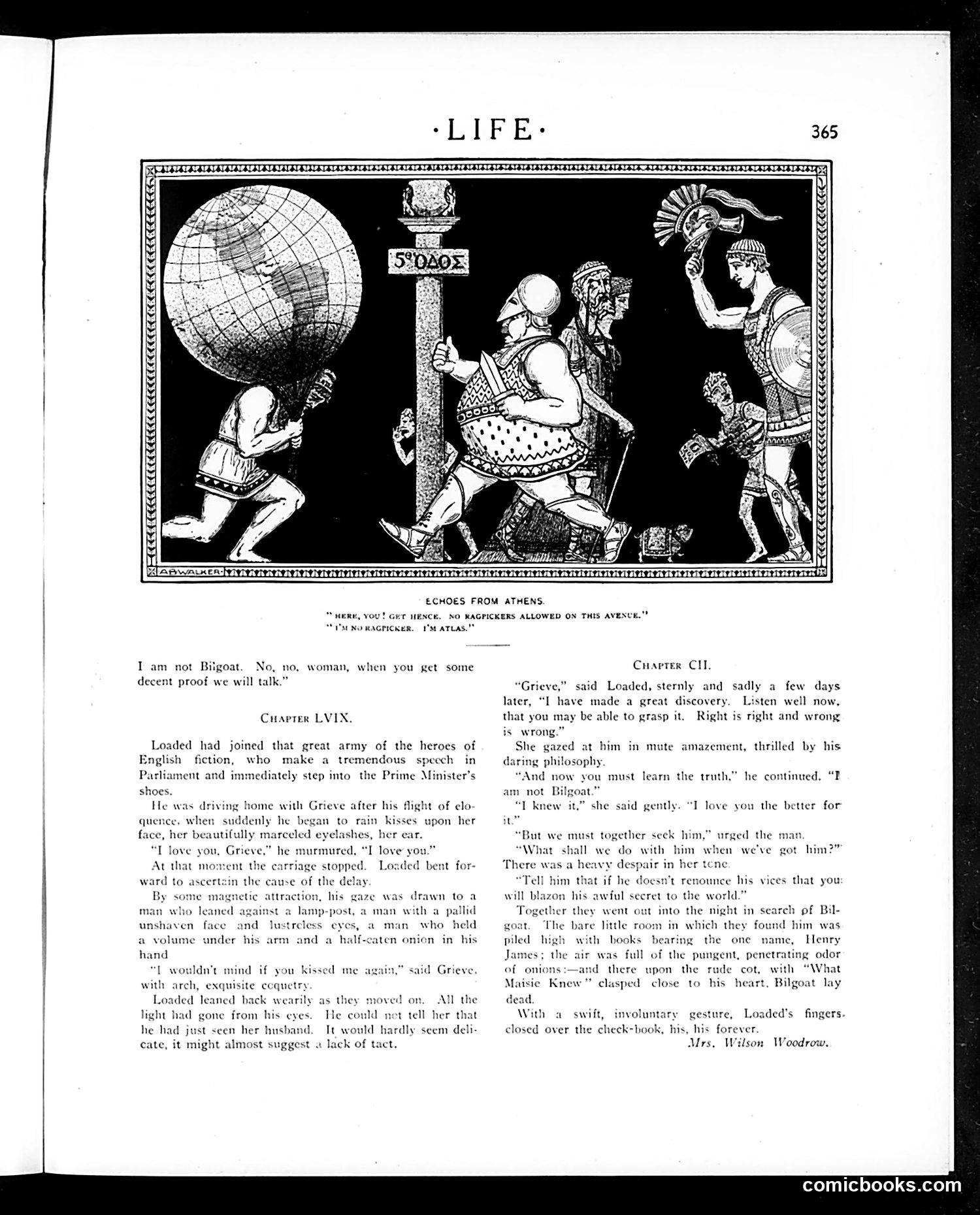
The illustration titled "Echoes from Athens" depicts classical Greek figures around a globe and a column labeled "ΣΔΟΣ" (appears to reference Greek concepts). The cartoon satirizes philosophical pretension through a dialogue where a character claims "I am not Bilgoat" while another insists on seeking truth and confronting vice. The accompanying text (Chapters LXIX-CII) continues a serialized narrative about characters named Loaded and Griece, involving moral discovery and confrontation with someone called Bilgoat. The story emphasizes philosophy, truth-seeking, and moral judgment. The classical Greek setting likely satirizes pseudo-intellectual posturing—characters invoking ancient philosophy while dealing with contemporary moral failings. The globe suggests universal pretension to wisdom. Without additional context about "Bilgoat," the full satirical target remains unclear.
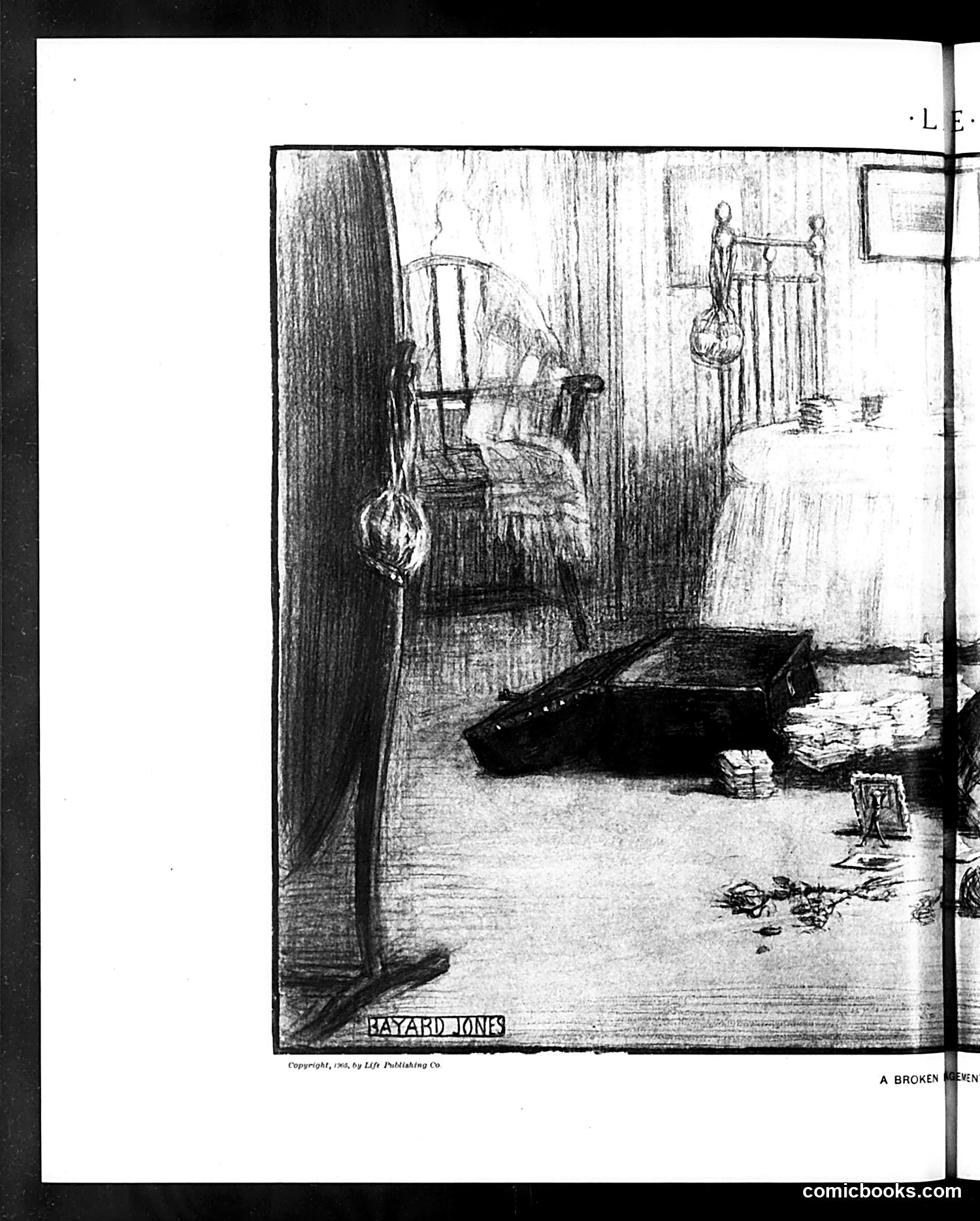
This sketch depicts a sparse, shabby bedroom—likely meant to represent poverty or destitution. The room contains minimal furnishings: a simple bed, chair, and scattered items on the floor. A figure sits dejected in the chair. The title "A Broken Dream" suggests commentary on failed aspirations or disappointed hopes, possibly social critique about economic hardship or unfulfilled promises. Without additional context about the publication date or accompanying text, the specific political or social target remains unclear. However, the artistic style and subject matter are consistent with *Life* magazine's satirical approach to American social conditions during the early 20th century. The image likely critiques either poverty conditions or the gap between idealistic expectations and harsh reality.
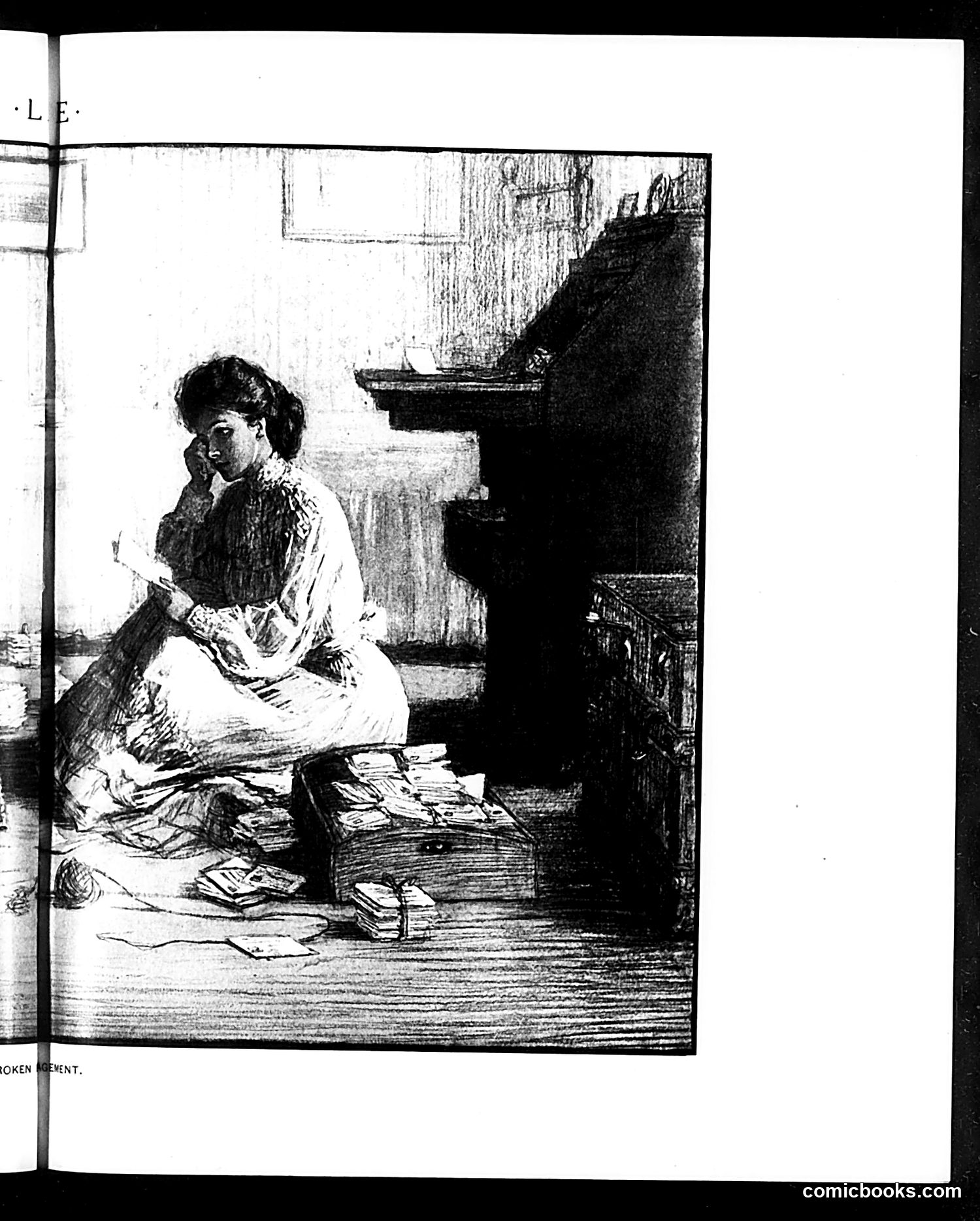
This appears to be a sketch or etching showing a young woman sitting on the floor surrounded by scattered papers or documents. She's dressed in early 20th-century clothing and appears to be reading or sorting through the papers with concentration. Without clearer text visible on the page or additional context, I cannot definitively identify the specific political or social commentary this image intends. The scattered papers might suggest themes of literacy, education, or administrative work, but the exact satirical point remains unclear from the image alone. The partial text visible ("OKEN" and "RRENT" at bottom) appears to be fragments of cut-off words, making it difficult to determine the article's subject or title. To accurately explain the cartoon's meaning to a modern reader, I would need either clearer OCR text or additional page context.
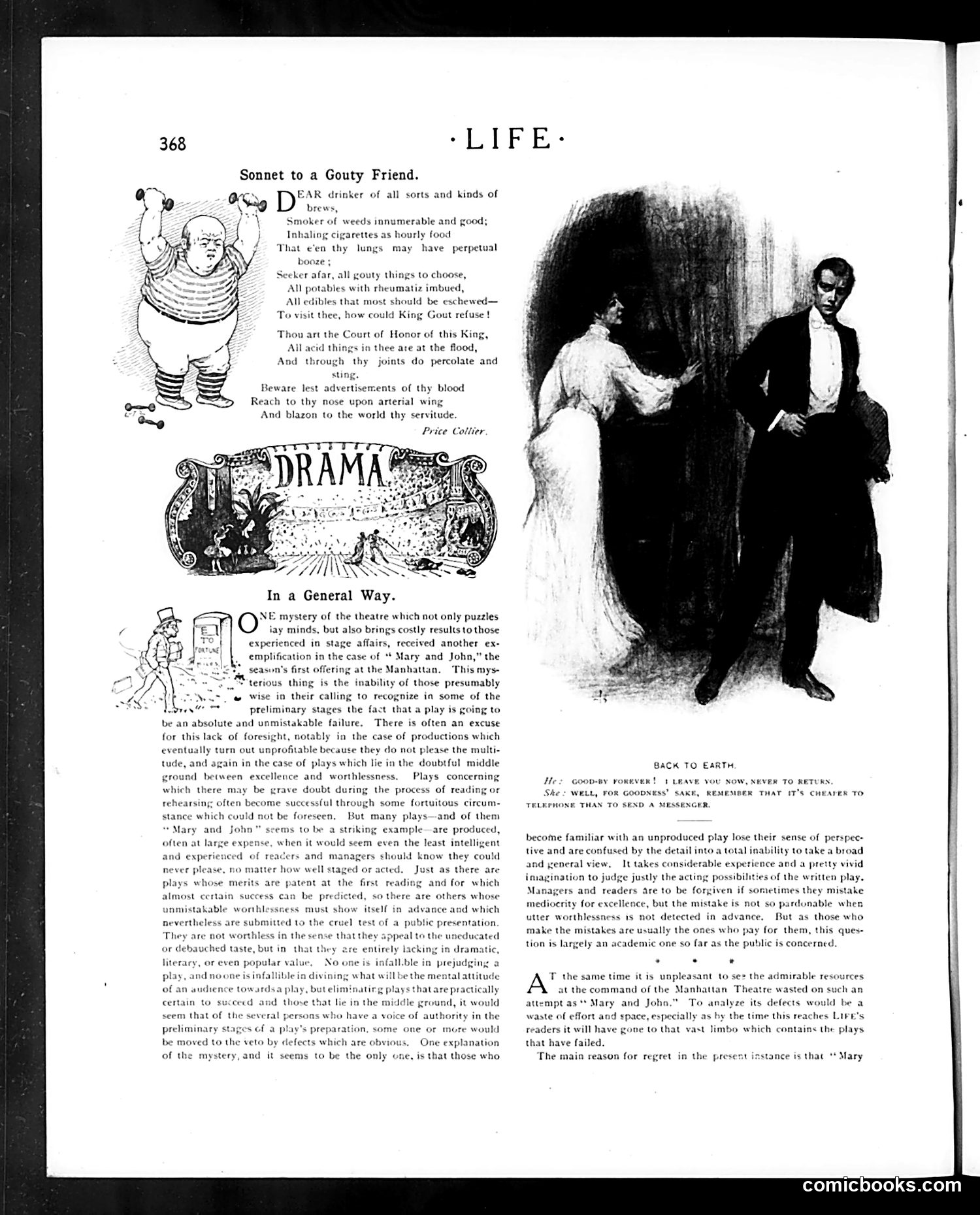
This page contains two distinct pieces: **"Sonnet to a Gouty Friend"** (top): A humorous poem by Price Collier mocking a friend's self-indulgent lifestyle. The "Gouty Friend" is someone who drinks excessively, smokes constantly, and consumes rich foods—all things that exacerbate gout (a painful joint disease). The satire is that despite knowing these habits cause his condition, he continues them, making himself "King Gout's" servant. It's gentle social mockery of excess and self-inflicted suffering. **"In a General Way"** (main article): Theater criticism discussing why Broadway producers fail to recognize doomed plays before investing heavily. The article critiques producers of "Mary and John" (apparently a recent flop) for lacking foresight. The point: experienced theater professionals inexplicably greenlight plays that any careful reader should recognize as worthless, likely because involvement in details clouds their judgment. **Bottom cartoon** shows a departing couple with the joke that telephoning is cheaper than sending messengers—a practical observation about emerging telephone technology.
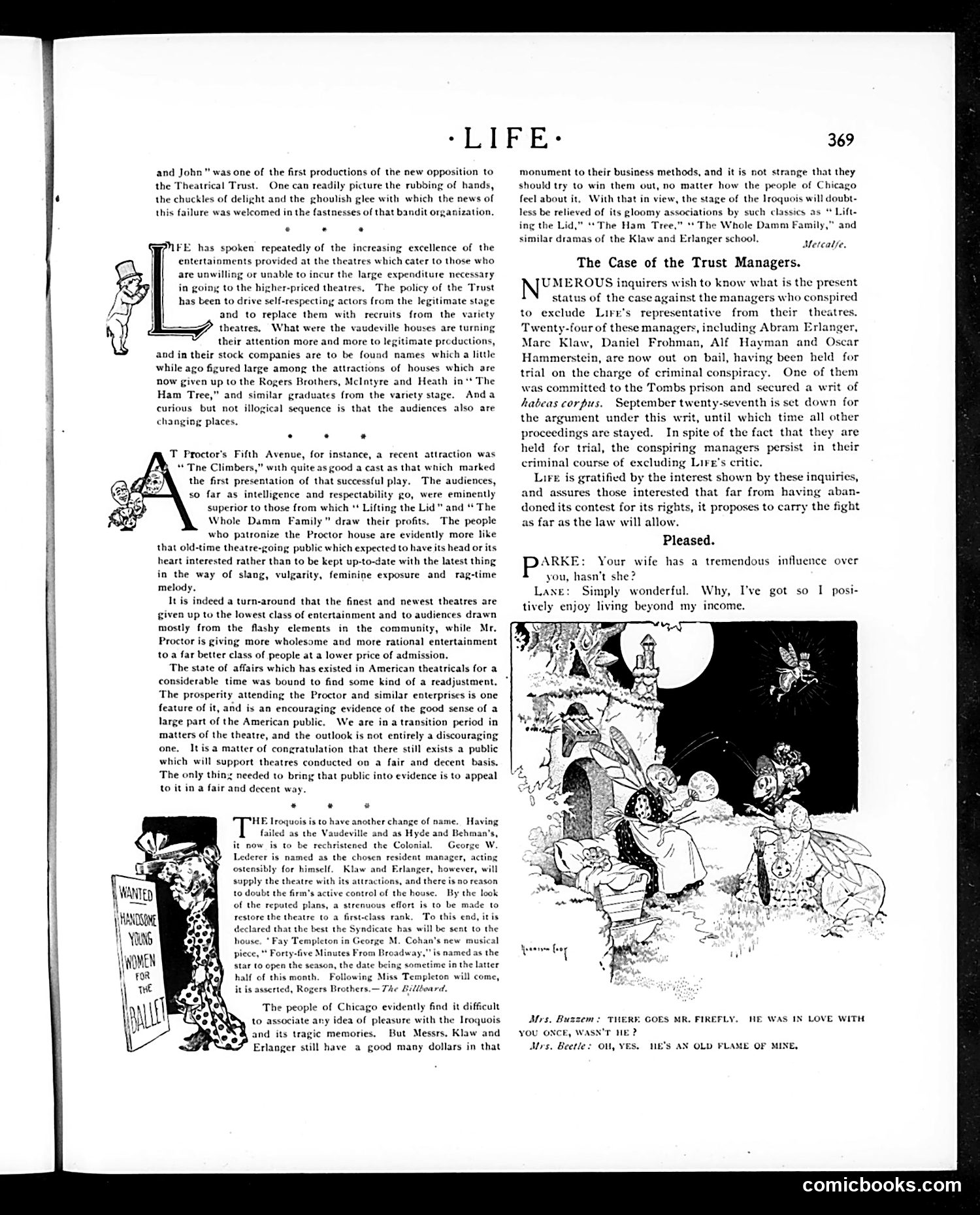
This page critiques the American theatrical landscape circa early 1900s, focusing on a power struggle between the "Theatrical Trust" (a monopoly controlling major theaters) and independent producers. The text praises theaters like Proctor's Fifth Avenue, which offer quality entertainment at lower prices to respectable audiences, contrasting this with Trust-controlled theaters that feature vaudeville acts and "rag-time melody" for lower-class patrons. The author celebrates this as evidence that the public still supports "fair and decent" theater. The left cartoon (showing a "Wanted" poster featuring a woman in theatrical costume) appears to satirize the Trust's control over performers and entertainment. The page also discusses the Iroquois Theater's repeated name changes and rebranding attempts under Trust management, implying corporate desperation. This reflects genuine early-1900s tensions between theatrical monopolies and independent producers fighting for control of American entertainment.
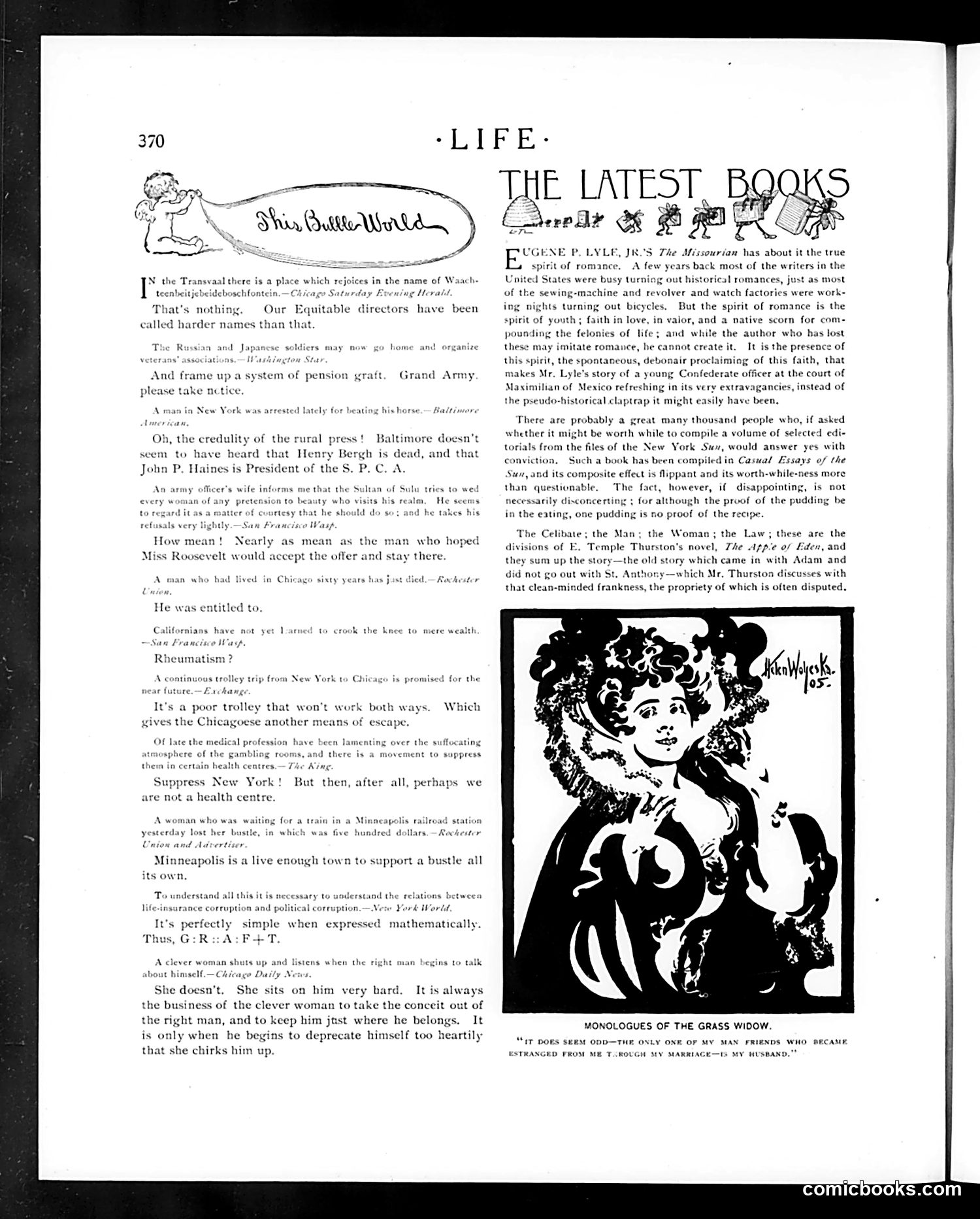
This page from *Life* magazine contains brief satirical commentary on contemporary issues rather than political cartoons. The main illustration is titled "Monologues of the Grass Widow," depicting a woman with an ornate hat and floral accessories—a visual reference to the "Gibson Girl" aesthetic popular in the era. The text snippets mock various subjects: ineffective animal protection laws (Henry Bergh's SPCA work), romantic foolishness regarding Miss Roosevelt, a failed trolley system between New York and Chicago, medical professionals complaining about gambling hall air quality, and a woman who lost a purse containing five hundred dollars. The illustration's caption references a woman estranged from her husband, suggesting the cartoon comments on marital discord or infidelity—common satirical targets. The overall page represents *Life*'s approach: brief, acidic observations about social foibles, incompetence in institutions, and romantic/marital mishaps, aimed at educated urban readers.
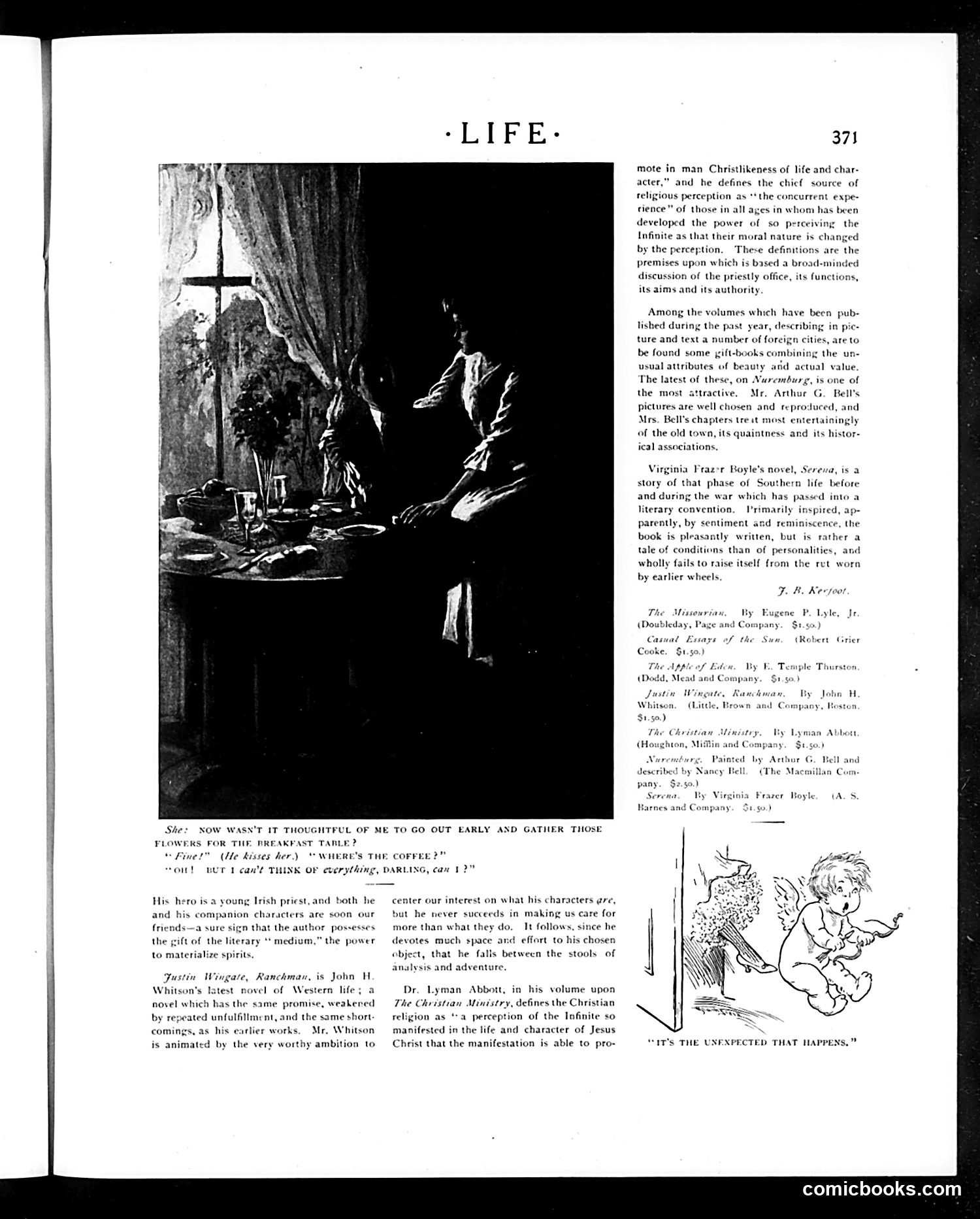
This page combines a domestic humor cartoon with book reviews. The small cartoon depicts a marital exchange: a wife proudly mentions gathering flowers for breakfast, then asks about coffee. The husband responds he "can't think of everything, darling"—a gentle satire on male obliviousness and the asymmetry of domestic labor. The joke assumes readers understand the irony: the wife *did* think of everything (flowers *and* implied other tasks), while the husband cannot manage even one thing. The cartoon illustrates early 20th-century gender dynamics—wives as homemakers managing multiple responsibilities while husbands are portrayed as helplessly forgetful about domestic details. It's mild satire rather than sharp criticism, reflecting Life's genteel humor for educated audiences. The page also reviews contemporary books on Christian ministry, Western fiction, and foreign travel guides—typical middlebrow cultural content for the period.
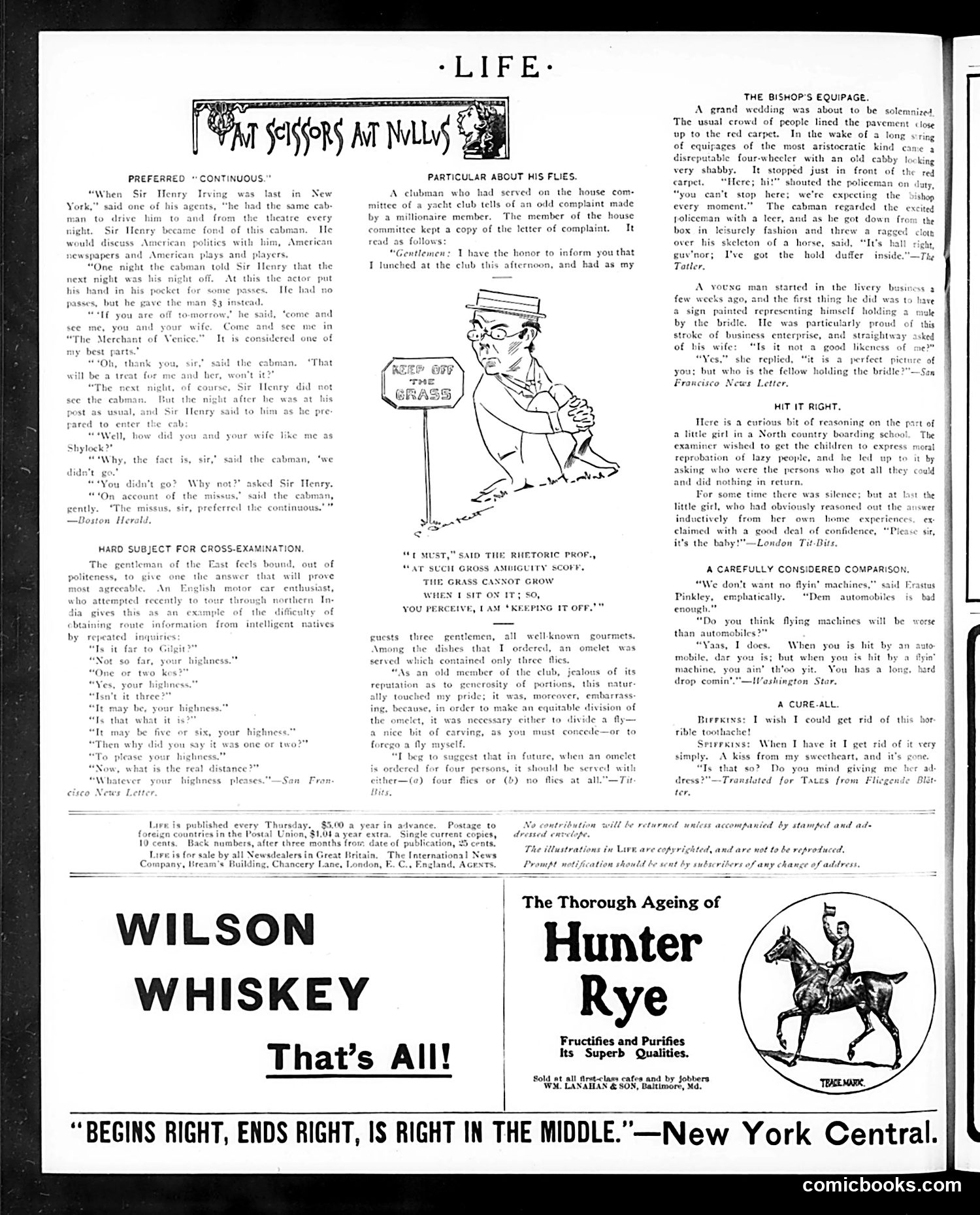
This page contains several humorous short stories satirizing social pretension and human folly, typical of Life magazine's satirical format. **"The Bishop's Equipage"** mocks class consciousness: a shabby old cab arrives at a grand wedding, and a policeman tries to shoo it away, assuming it's unimportant. But the cabman calmly reveals he's transporting the bishop—the very person everyone was expecting. The joke undercuts both the policeman's snobbery and the assumption that appearance indicates importance. **"Particular About His Flies"** shows Sir Henry Irving (a famous actor) praising his cabman's good taste, only to learn the man prefers Shakespeare to Irving's own performances—a gentle jab at artistic vanity. The remaining anecdotes follow similar patterns: reversing expectations (a child's innocent logic about "lazy" people, a rural man's pragmatic critique of flying machines). The humor depends on characters arriving at unexpected but logical conclusions, deflating pretension through common sense or innocent observations. The advertisements at bottom (whiskey, rye) were standard for the era.
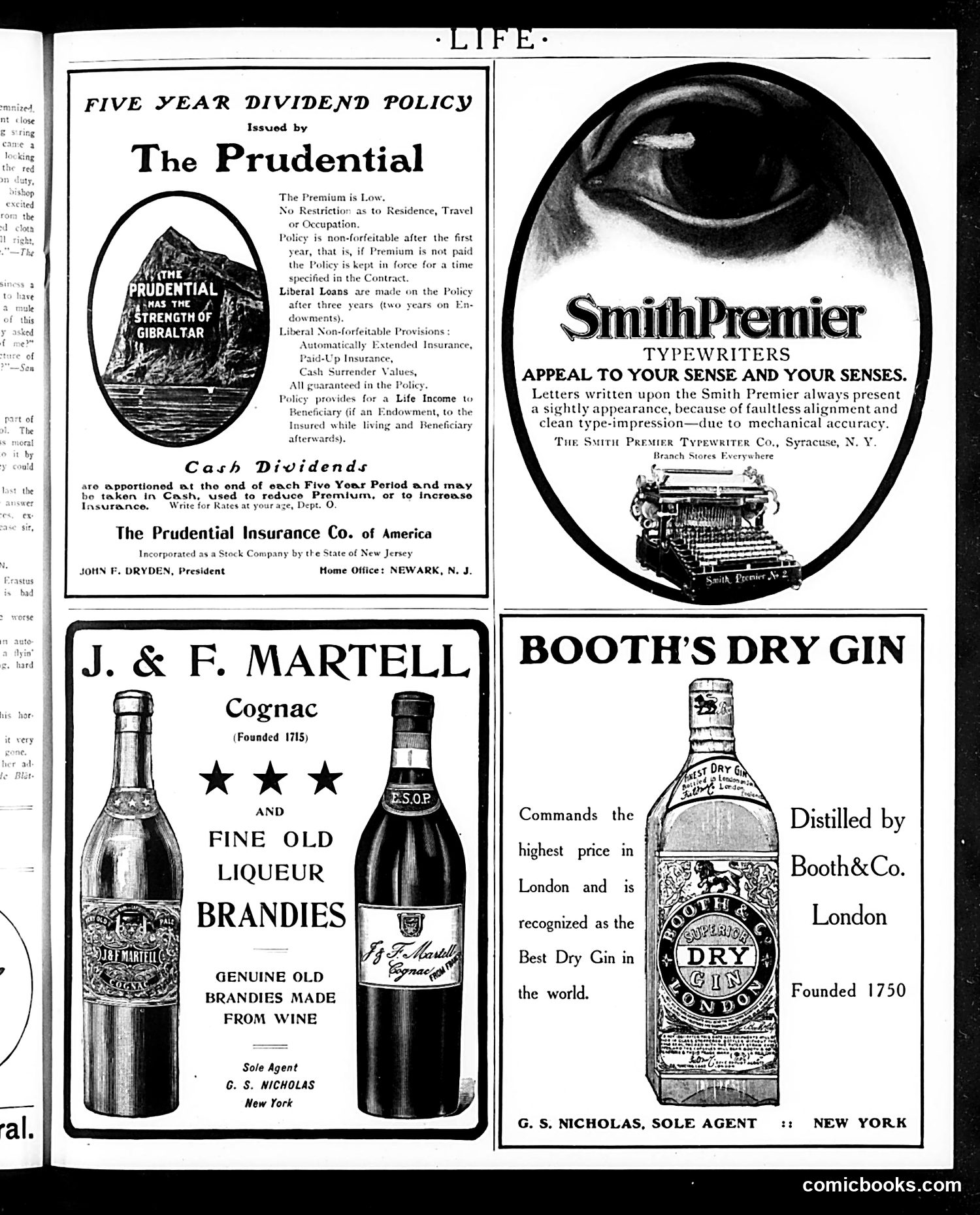
This is **not a satirical cartoon page**, but rather a **advertisements section** from Life magazine. The page contains four commercial ads: 1. **The Prudential Insurance** — promoting a five-year dividend life insurance policy with cash benefits and flexible terms 2. **Smith Premier Typewriters** — emphasizing mechanical precision and clean appearance of typed letters, appealing to business professionals 3. **J. & F. Martell Cognac** — advertising French brandy (founded 1715) as a premium liqueur through sole agent G.S. Nicholas in New York 4. **Booth's Dry Gin** — promoting London gin (founded 1750) as "the Best Dry Gin in the world," also sold through G.S. Nicholas The page reflects early 20th-century consumer culture, targeting affluent readers with luxury goods (spirits), business equipment (typewriters), and financial services (insurance). All advertisements use period typography and engravings typical of the era.
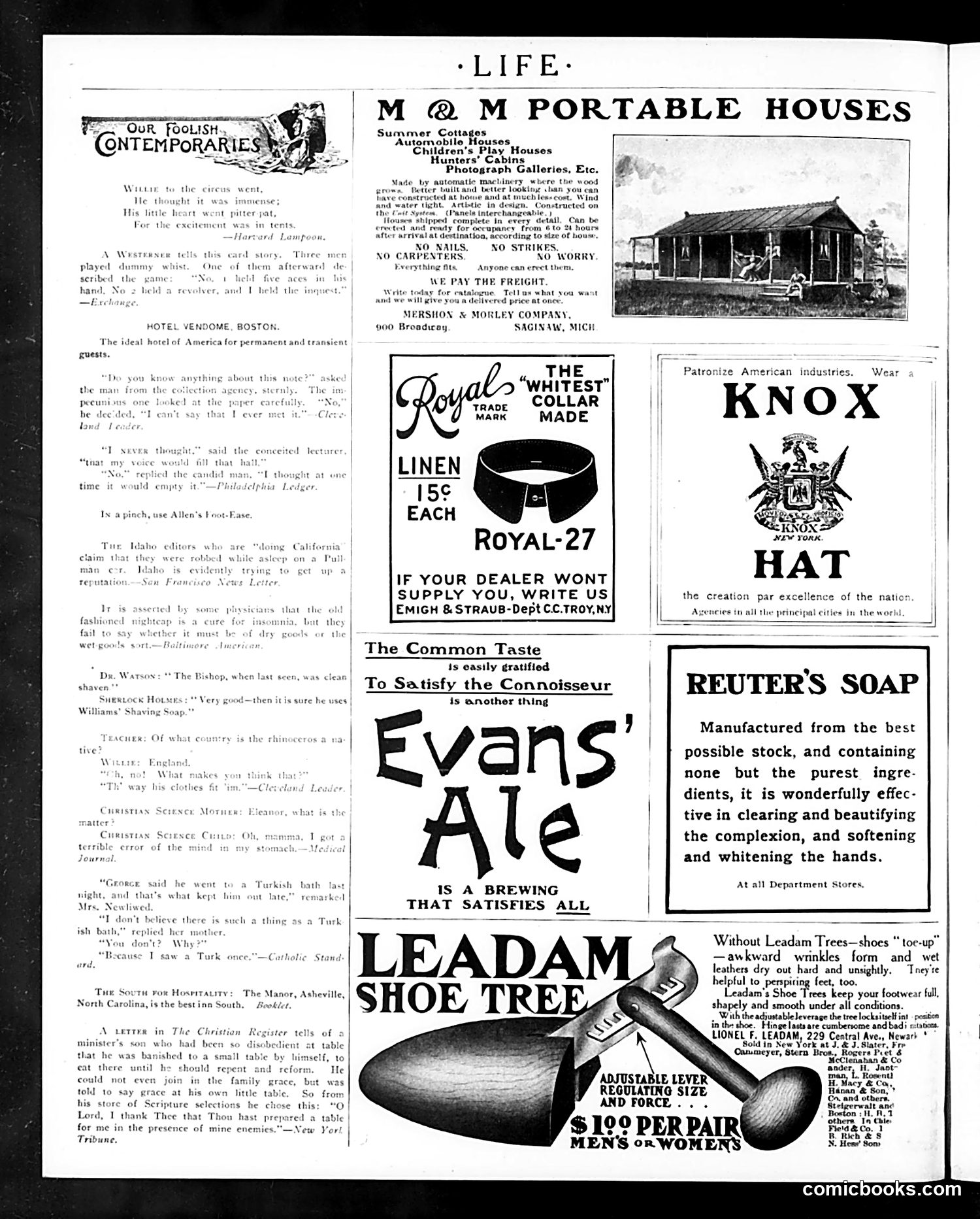
This is primarily an **advertising page** with minimal editorial content. The advertisements showcase consumer products from the early 20th century: portable houses, shirt collars, hats, ale, soap, and shoe trees. The few editorial pieces are brief humor columns: - **"Our Foolish Contemporaries"** presents short jokes mocking various professions (teachers, Christian Scientists, bishops) for illogical statements or behaviors—typical light satire of the era. - **Anecdotes** about Turkish baths and hospitality represent gentle, apolitical humor. The advertising reflects period concerns: practical home solutions, grooming products emphasizing cleanliness and appearance (notably Reuter's Soap promising skin-whitening), and shoe care for maintaining footwear quality. There are **no political cartoons or caricatures** on this page. It's a standard mixed-content humor and advertising issue typical of Life magazine's format during this era, before it evolved into a more serious publication.
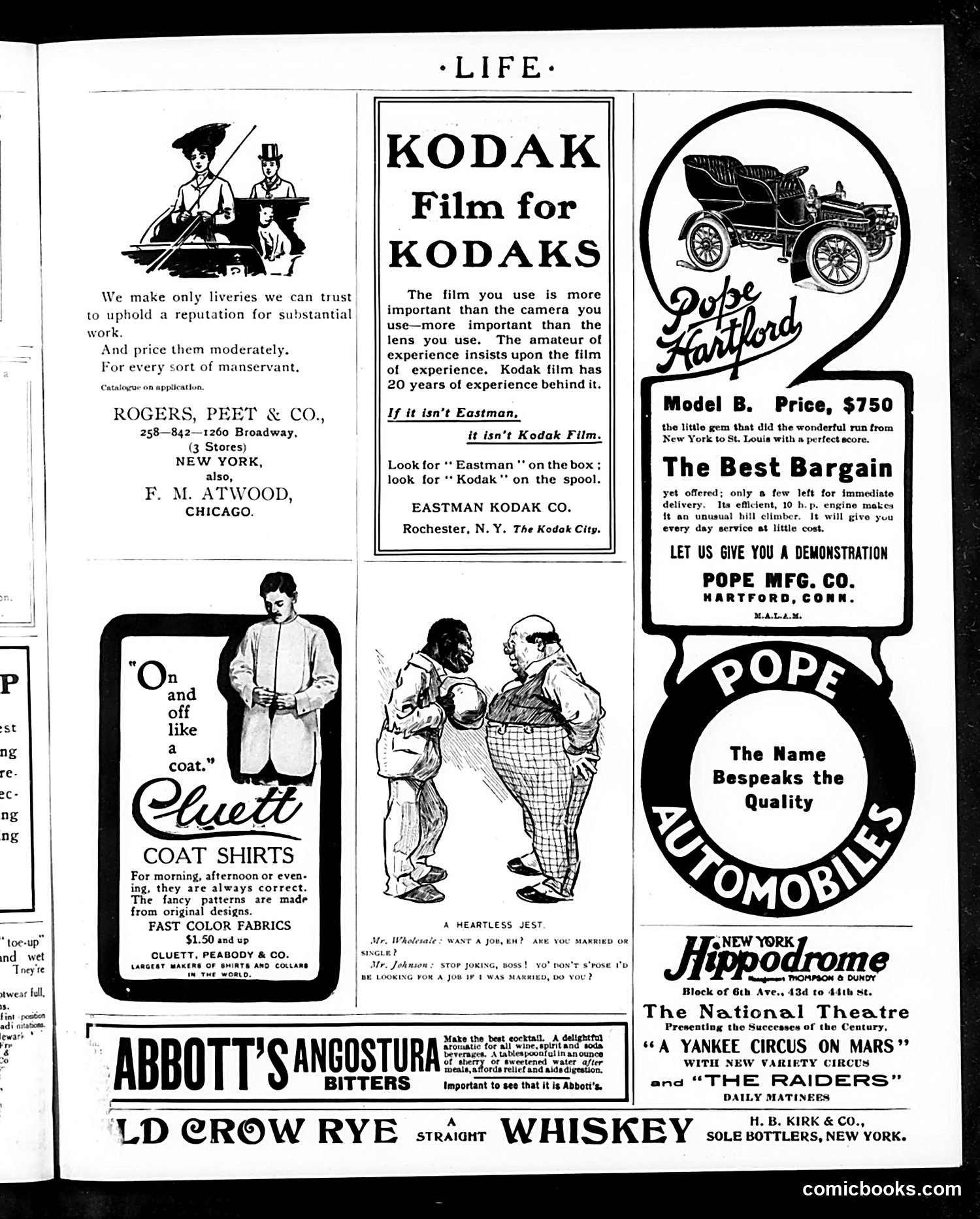
This page is primarily **advertising**, typical of early 1900s Life magazine. The notable cartoon is "A Heartless Jest," depicting a job interview scenario. A working-class man (appearing desperate for employment) asks a well-dressed employer for work, mentioning he's single. The employer responds callously with a joke: "Stop joking, boss! You don't suppose I'd be looking for a job if I was married, do you?" The satire critiques **employer indifference to workers' hardship** during economically uncertain times. The joke's "heartlessness" lies in the employer trivializing genuine unemployment and suggesting married men shouldn't seek jobs—implying only unmarried men should work, a contradictory and dismissive attitude toward jobseekers. The surrounding ads (Kodak film, Pope automobiles, Cluett shirts) represent consumer goods marketed to middle and upper-class readers, contrasting sharply with the working-man's desperation depicted in the cartoon.
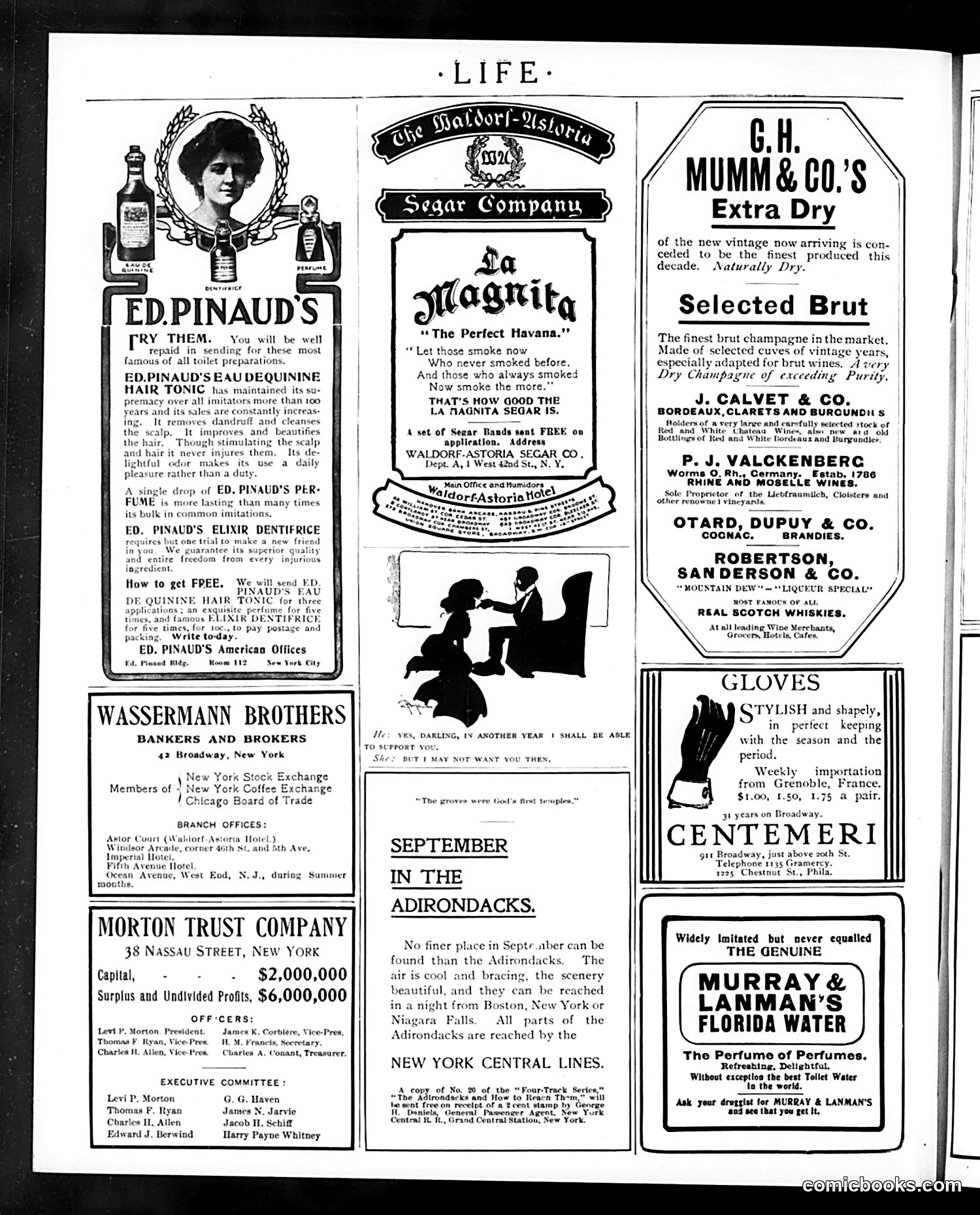
This page is **primarily advertising** with one small cartoon illustration. The main visual content shows a silhouetted couple in conversation, with the woman saying she may not want the man's support after another year, despite his promise to provide it—a mild social satire on romantic relationships and financial dependency. The advertisements represent luxury goods marketed to wealthy readers: French champagne (Mumm, Calvet), Scotch whisky (Robertson, Sanderson), cologne (Murray & Lanman's Florida Water), gloves from Centemerl, and various banking/financial services. Notable is the inclusion of **Levi P. Morton** in the Morton Trust Company masthead—he was a prominent Gilded Age banker and former U.S. Vice President, indicating this magazine's affluent readership. The ads emphasize European imports and premium quality, reflecting early 20th-century American upper-class consumer preferences and aspirations toward continental refinement.
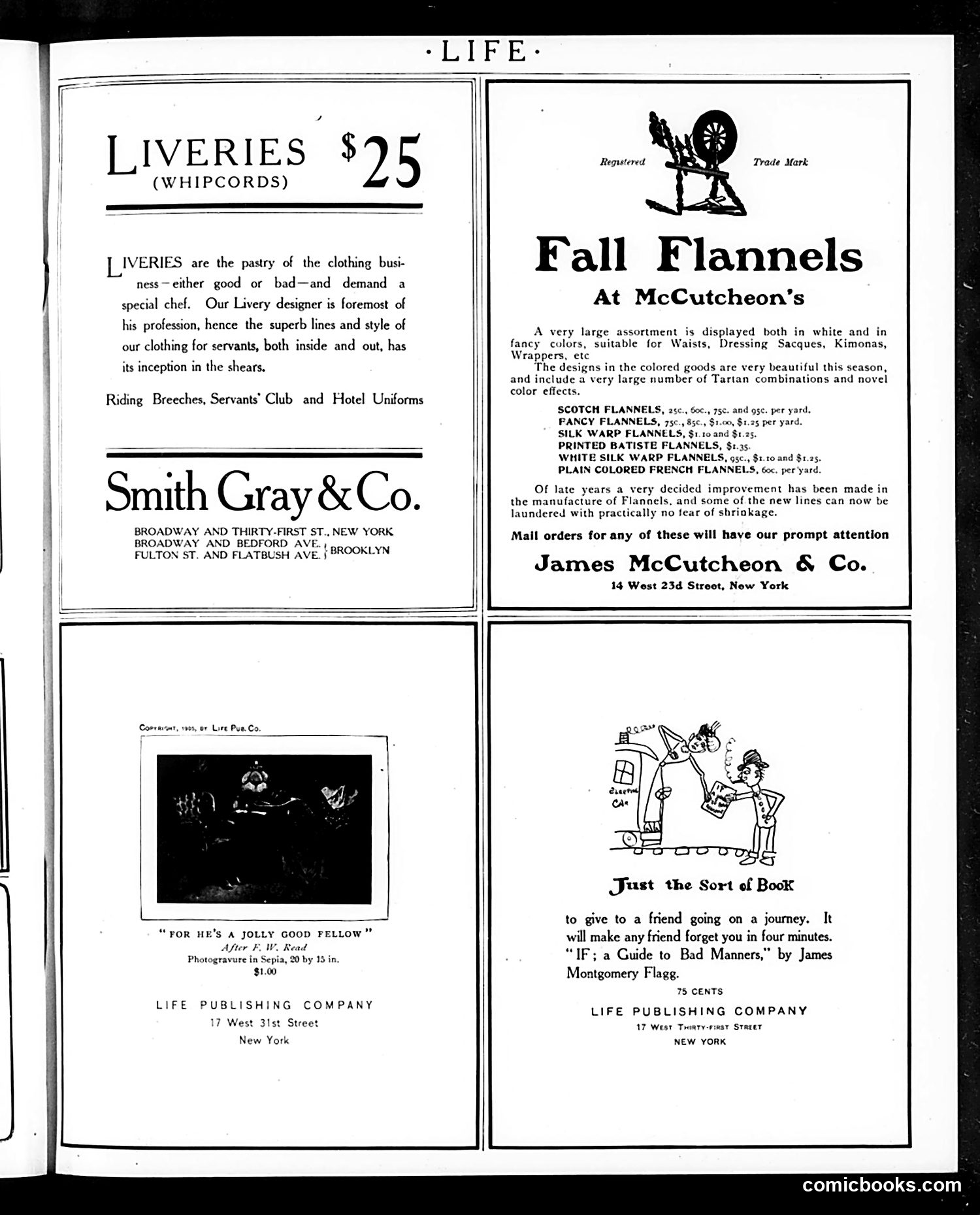
This page is primarily **advertising**, not political satire. It contains four commercial advertisements from a circa-1908 Life magazine: 1. **Smith Gray & Co.** sells liveries (servant uniforms) and riding clothes—targeting wealthy households needing staff outfits. 2. **James McCutcheon & Co.** advertises fall flannels in various qualities and prices for women's garments (waists, kimonos, wrappers). 3. **Life Publishing Company** promotes a photogravure print titled "For He's a Jolly Good Fellow" by F.W. Read. 4. **Life Publishing Company** also advertises a satirical book: *"IF; a Guide to Bad Manners"* by James Montgomery Flagg, with a cartoon showing figures in chaotic travel. The humor is straightforward—the ad jokes that giving this book to a departing friend will make them forget you in four minutes, playing on the notion of intentionally bad etiquette. The page reflects early 20th-century consumer culture targeting middle- and upper-class readers.
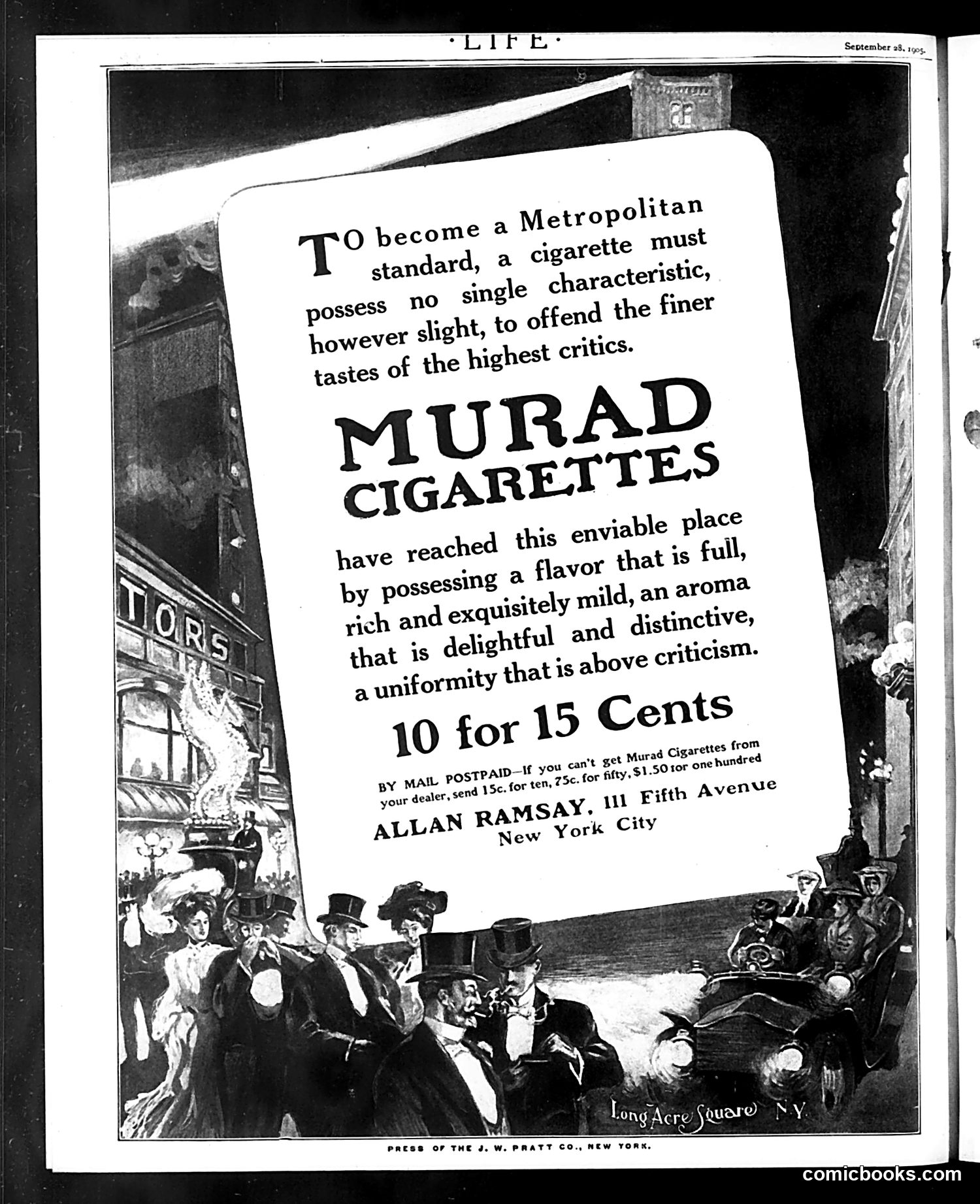
This is a **cigarette advertisement**, not political satire. The page appears from Life magazine (September 28, 1905) and promotes Murad cigarettes as a sophisticated, "Metropolitan standard" product. The illustration depicts elegant, formally-dressed urban figures in what appears to be a fashionable setting (Long Acre Square, NYC), establishing aspirational class associations. The ad's language emphasizes refinement—claiming Murad cigarettes possess qualities that won't "offend the finer tastes of the highest critics," suggesting cultural prestige. The pricing structure (10 for 15 cents, with mail-order options) indicates mass marketing disguised as luxury. The distributor, Allan Ramsay of Fifth Avenue, leverages New York's prestigious address. For modern readers: this represents early 20th-century tobacco marketing that associated smoking with sophistication and social status—a strategy now recognized as manipulative advertising that contributed to widespread nicotine addiction without health warnings.