
Life, 1905-09-28 · page 14 of 24
Life — September 28, 1905 — page 14: what you’re looking at
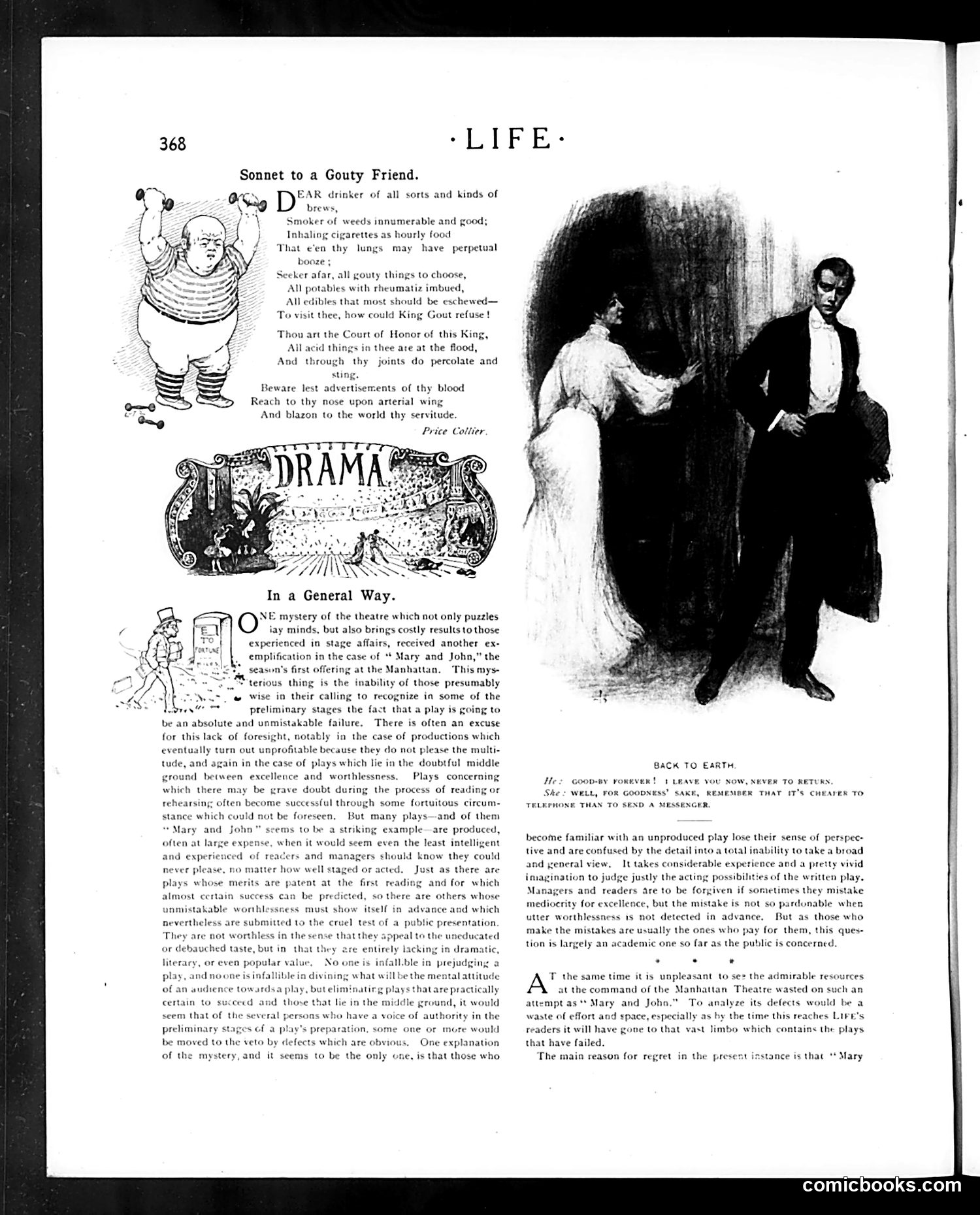
What you’re looking at
This page contains two distinct pieces: **"Sonnet to a Gouty Friend"** (top): A humorous poem by Price Collier mocking a friend's self-indulgent lifestyle. The "Gouty Friend" is someone who drinks excessively, smokes constantly, and consumes rich foods—all things that exacerbate gout (a painful joint disease). The satire is that despite knowing these habits cause his condition, he continues them, making himself "King Gout's" servant. It's gentle social mockery of excess and self-inflicted suffering. **"In a General Way"** (main article): Theater criticism discussing why Broadway producers fail to recognize doomed plays before investing heavily. The article critiques producers of "Mary and John" (apparently a recent flop) for lacking foresight. The point: experienced theater professionals inexplicably greenlight plays that any careful reader should recognize as worthless, likely because involvement in details clouds their judgment. **Bottom cartoon** shows a departing couple with the joke that telephoning is cheaper than sending messengers—a practical observation about emerging telephone technology.
📄 Transcribed text from this page (OCR, searchable)
Machine-transcribed from the original scan — historical spelling and the odd misread are preserved.
-LIFE- Sonnet to a Gouty Friend. EAR drinker of all sorts and kinds of Smoker of weeds innumerable and good; Inhaling cigarettes as hourly food That een thy lungs may have perpetual booze ; Seeker afar, all gouty things to choose, All potables with rheumatiz imbued, All edibles To visit the hould be eschewed— how could King Gout refuse ! Thou art the Court of Honor of this King, All acid things in thee are at the flood, And through thy joints do percolate and sting. Beware lest advertisements of thy blood Reach to thy nose upon arterial wing And blazon to the world thy servitude. Price Collier In a General Way. NE mystery of the theatre which not only puzzles iay minds, but also brings costly results to those experienced in stage affairs, received another ex- eof Mary and John,” the season’s first offering at the Manhattan. ‘This mys. emplification in the Serious thing is the inability of those presumably ‘© Wise in their calling to recognize in some of the preliminary stages the fact that a play is going to be an absolute and unmistakable failure. There is often an excuse for this lack of foresight, notably in the case of productions which eventually turn out unprofitable because they do not please the multi- tude, and again in th ground between excelle: case of plays which lie in the doubtful middle and worthlessness. Plays. concerning which there may be grave doubt during the process of reading or rehearsing often become success(ul through some fortuitous circum- stance which could not be for But many plays—and of them “Mary and in" scems to be a striking example—are produced, often at large exy when it wor m even the least intelligent and experienced of readers and managers should know they could > matter how well staged or acted, Just as there are plays whose merits are patent at the first reading and for which almost certain success can be pre . so there are others whose inmistakable worthlessness must show itself in advance and which nevertheless are submitted to the cruel te Mf a public presentation They are not worthless in tl © that they appeal to the uneducated or debauched taste, but in that they are entirely lacking in dramatic, literacy, or even popular value, No one is infall.ble in prejudg and noone is infallible in divining what will be the mental attitude udtence towardsa play, but eliminating plays that are practically certain to succecd and those that lie in the middle ground, it would ority in th seem that of the several persons who have a voice of au preliminary stages of a play’s preparation, some one or more wo: be moved to the veto by defects which are obvious, One explanation of the mystery, and it seems to be the only one, is that those who BACK TO EARTH GooD-BY YOREVEK! 1 LRAVE VOU NOW, NEVER TO RETURN. She: WELL, FOR GOODNESS’ SAKE, REMEMBER THAT IT'S CHEAPER TO TELEPHONE THAN TO SEND A MESSENGER become familiar with an unproduced play lose their sense of perspec- tive and are confused by the detail into a total inability to take a broad and general view, It takes considerable experience and a pretty vivid imagination to judge justly the acting possibilities of the written play. Managers and readers are to be forgiven if sometimes they mistake mediocrity for excellence, but the mistake is not so pardunable when utter worthlessness 15 not detected in advance, But as those who make the mistakes are usually the ones who pay for them, this ques- tion is largely an academic one so far as the public is concerned. . . . the same time it is unpleasant to se* the admirable resources at the command of the Manhattan Theatre wasted on such an tempt as waste of effort and spat Mary and Joho.” To analyze its defects would be a especially as by the time this reaches Line's readers it will have to that vast limbo which contains the plays that have failed. The main reason for regret in the present instance is that * Mary comicbooks.com