
Life, 1905-09-28 · page 15 of 24
Life — September 28, 1905 — page 15: what you’re looking at
What you’re looking at
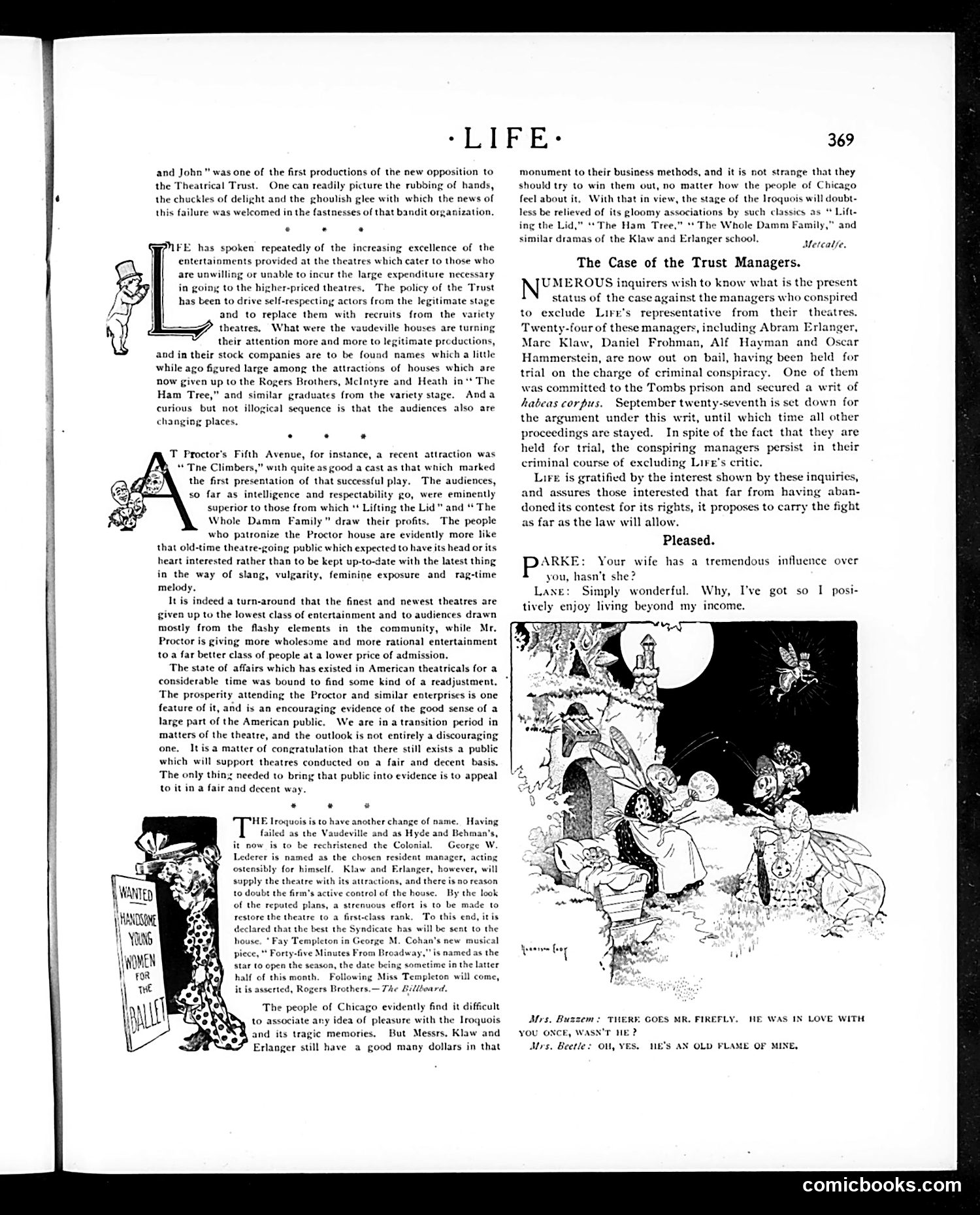
This page critiques the American theatrical landscape circa early 1900s, focusing on a power struggle between the "Theatrical Trust" (a monopoly controlling major theaters) and independent producers. The text praises theaters like Proctor's Fifth Avenue, which offer quality entertainment at lower prices to respectable audiences, contrasting this with Trust-controlled theaters that feature vaudeville acts and "rag-time melody" for lower-class patrons. The author celebrates this as evidence that the public still supports "fair and decent" theater. The left cartoon (showing a "Wanted" poster featuring a woman in theatrical costume) appears to satirize the Trust's control over performers and entertainment. The page also discusses the Iroquois Theater's repeated name changes and rebranding attempts under Trust management, implying corporate desperation. This reflects genuine early-1900s tensions between theatrical monopolies and independent producers fighting for control of American entertainment.
📄 Transcribed text from this page (OCR, searchable)
Machine-transcribed from the original scan — historical spelling and the odd misread are preserved.
LIFE: and John” was one of the first productions of the new opposition to the Theatrical Trust. One can readily picture the rubbing of hands, the chuckles of delight and the ghoulish glee with which the news of this failure was welcomed in the fastnesses of that bandit organization, . . . MEE has spoken repeatedly of the increasing excellence of the entertainments provided at the theatres which cater to those who are unwilling or unable to incur the large expenditure necessary in going to the higher-priced theatres, The policy of the Trust has been to drive self-respecting actors from the legitimate stage and to replace them with recruits from the variety AFH theatres. What were the vaudeville houses are turning = fo attention more and more to legitimate productions, and in their stock companies are to be found names which a little while ago figured large among the attractions of houses which are now given up to the Rogers Brothers, McIntyre and Heath in‘ The Ham Tree,” and similar graduates from the variety stage. Anda curious but not illogical sequence is that the audiences also are changing places, T Proctor's Fifth Avenue, for instance, a recent attraction was “The Climbers,” with quite as good a cast as that which marked the first presentation of that successful play. The audiences, so far as intelligence and respectability go, were eminently superior to those from which ** Lifting the Lid" and “ The Whole Damm Family" draw their profits. The people who patronize the Proctor house are evidently more like that old-time theatre-going public which expected to have its head or its heart interested rather than to be kept up-to-date with the latest thing in the way of slang, vulgarity, feminine exposure and rag-time melody. It is indeed a turn-around that the finest and newest theatres are given up to the lowest class of entertainment and to audiences drawn mostly from the flashy elements in the community, while Mr. Proctor is giving more wholesome and more rational entertainment toa far better class of people at a lower price of admission. The state of affairs which has existed in American theatricals for a considerable time was bound to find some kind of a readjustment, The prosperity attending the Proctor and similar enterprises is one feature of it, and is an encouraging evidence of the good sense of a large part of the American public. We are ina transition period in matters of the theatre, and the outlook is not entirely a discouraging one, It isa matter of congratulation that there still exists a public which will support theatres conducted on a fair and decent basis ‘The only thin needed to bring that public into evidence is to appeal to it ina fair and decent way. . * . HE Iroquois is to have another change of name. Having failed as the Vaudeville and as Hyde and Behman’s, it now is to be rechristened the Colonial. George W. Lederer is named as the chosen resident manager, acting ostensibly for himself. Klaw and Erlanger, however, will supply the theatre wit ttractions, and there is no reason By the look is to be to doubt the firm’s active control of the house. of the reputed plans, a strenuous effo nade to restore the theatre to a first-class rank. To this end, itis declared that the best the Syndicate has will be sent to the house. ‘Fay Templeton in George M. Cohan’s new musical orty-five Minutes From Broadway,” is named as the star (o open the season, the date being sometit half of this month, Following Miss Templeton will come, it is asserted, Rogers Brothers,— The Biliboard. piece, " the latter The people of Chicago evidently find it difficult to associate any idea of pleasure with the In its tragic memories, But Messrs, Klaw and Erlanger still have a good many dollars in that <quois 369 monument to their business methods, and it is not strange that they should try to win them out, no matter how the people of Chicago feel about it, With that in view, the stage of the Iroquois will doubt- less be relieved of its gloomy associations by such classics as “ Lift. ing the Lid,” ‘The Ham Tree,” * The Whole Damm Family,” and similar dramas of the Klaw and Erlanger school, Metcalfe. The Case of the Trust Managers. MEROUS inquirers wish to know what is the present status of the case against the managers who conspired to exclude Lire’s representative from their theatre: ‘Twenty-four of these managery, including Abram Erlanger, Mare Klaw, Daniel Frohman, Alf Hayman and Oscar Hammerstein, are now out on bail, having been held fe ial on the charge of criminal conspiracy. One of them committed to the Tombs prison and secured a writ of habeas corpus. September twenty-seventh is set down for the argument under this writ, until which time all other proceedings are stayed. In spite of the fact that they are held for trial, the conspiring managers persist in their criminal course of excluding Lire's critic. Lire is gratified by the interest shown by these inquirie: and assures those interested that far from having aban- doned its contest for its rights, it proposes to carry the fight as far as the law will allow. Pleased. ARKE: Your wife has a tremendous influence over you, hasn't she? Laxe: Simply wonderful. Why, I've got so I posi- tively enjoy living beyond my income. Mrs. Buzzem: THER. GOES MR. FIREFLY. YOU ONCE, WASN'T HE ? Ars. Beetle: OU, YES. ME HE WAS IN LOVE WITH AN OLD FLAME OF MINE, comicbooks.com