
Life, 1905-09-28 · page 4 of 24
Life — September 28, 1905 — page 4: what you’re looking at
What you’re looking at
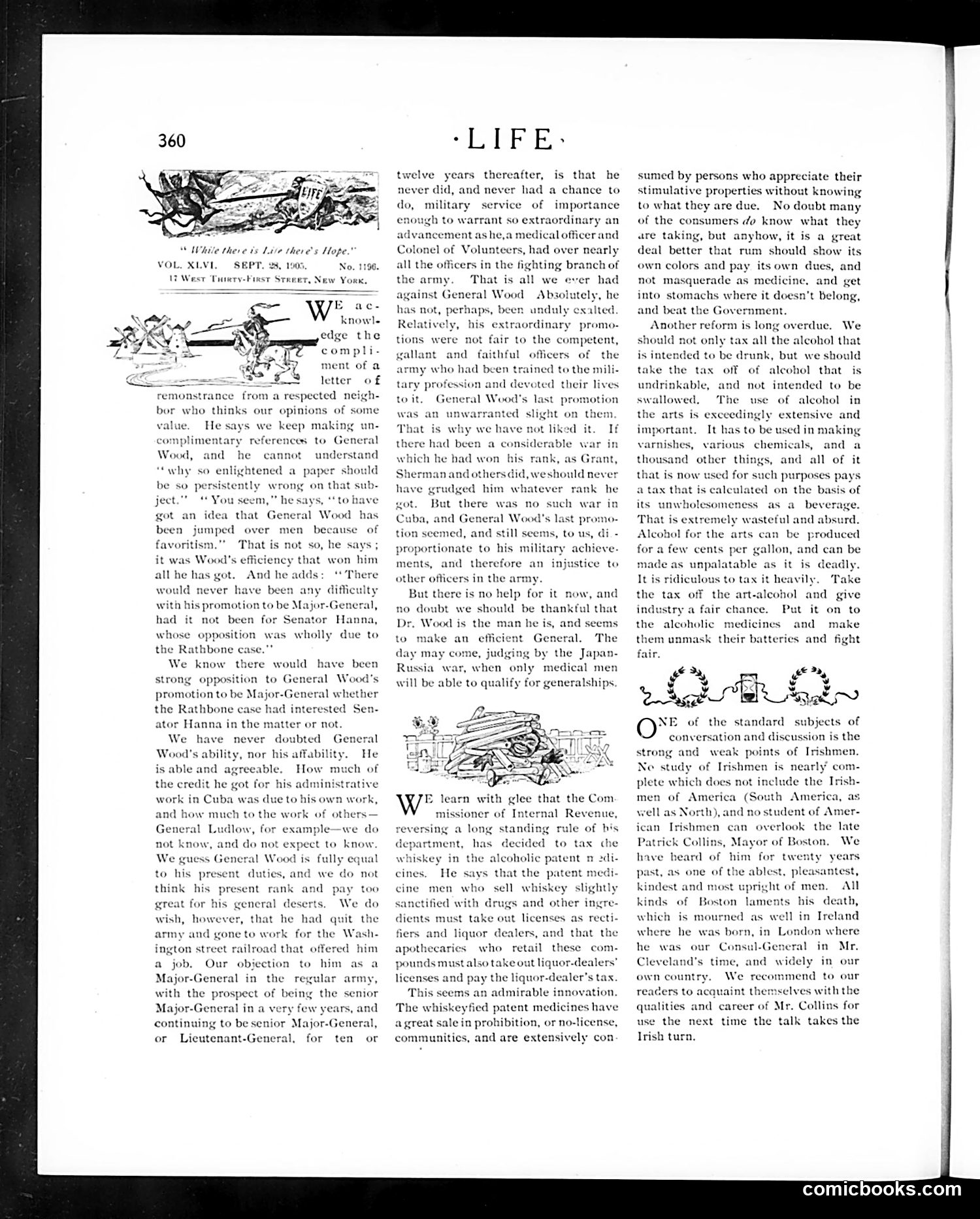
This page contains editorial commentary on General Leonard Wood's military career and promotion decisions, alongside discussion of Irish-American figures like Patrick Collins, Mayor of Boston. The two small cartoons illustrate satirical critiques: one depicts someone fallen or defeated (likely commenting on Wood's controversial standing), while another shows what appears to be a cart or vehicle, possibly referencing bureaucratic or political obstruction. The text defends Wood against accusations of favoritism while criticizing his decisions regarding officer promotions. There's extended commentary on alcohol taxation policy and patent medicines, suggesting broader Progressive-era regulatory debates. The Patrick Collins reference notes his reputation as "one of the ablest, pleasantest, kindest and most upright men" of Boston's Irish community, presenting him as exemplary of Irish-American achievement. The satire targets both military politics and governmental regulation circa 1896.
📄 Transcribed text from this page (OCR, searchable)
Machine-transcribed from the original scan — historical spelling and the odd misread are preserved.
“White there is Lave there's Hope.” VOL. XLVI. 17 West T. 28, 1905, No. 1196. kw York, (ery Kies Stee knowl- edge the compli- ment of a letter of bor who thinks our opinions of some an. value, He says we keep m references to General t understand uld be so persistently wrong on that sub- co plimentary Wood, “why so. enligt and he ca nn ened a paper st ject." You seem,” he says, got an idea that General Wood been jumped over men because of That is not so, he says ; favoritism. t won him it was Wood's efficiency th all he has got. And he adds: Id never have been any difficulty with his promotion to be Major-General, had it nator Hanna, “There we not been for w se opposition was wholly due to the Rathbone case.” We know t strong re would have been on to General Wood's ther opposi promotion to be Major-General w the Rathbone case had interested Se Hanna in the matter or not. never doubted General nor his affability, He How much of atc have ble. his administrative work in Cuba was due to his own work, to the work of others— 1 Ludlow, for example is able and agre the credit he got and h Gen not kr ww muc we do nw, and do not expect to know. neral Wood is fully equal Oo not We guess duties, and we nd pay too We do uit the Vash- © his prese: think his present rank his general deserts. that he had army and gone to work for the V ington street railroad that offered a job, Our objection to him as a Major-General in the regular army, with the prospect of being the senior Major-Ger inav years, and great for wish, however, him continuing to be senior Major-General, or Licutenant-General, for ten or ay Ee twelve years thereafter, is that he ever did, and never had a chance to do, military enough to warrant so extraordinary an advancement as he,a medical officer and Colonel of Volunteers, had over nearly all the officers in the fighting branch of the army. That is all we ever had against General Wood Absolutely, he has not, perhaps, been unduly exalted Relatively, his extraordinary promo- service of importance tions were not fair to the competent, allant and faithful army who had been trained t officers of ie: the mili- ich he had won his rank, as € Sherm: nt, nand othersdid, weshould never srudged him whatever rank he But there no such war in , and General Wood's last pre tion seemed, and still seems, to us, di - have was No- proportionate to his military achieve. tice to and there! ments, ore an inje other officers in the army But there is no help for it now, and no doubt we should be thankful that Dr. Wood is the man he is, and seems ke an efficient General. ‘The day may come, jud by the Jay Russia war, when only medical men will be able to qualify for generalships to - Ww learn with glee that the Com missioner of I ul Revenue, reversing a long standing rule of his department, has decided to tax che whiskey in the alcoholic patent nm 2di- cines. He says that the patent cine men who sell whiskey slightly pedi- sanctified with drugs and other ingre- t licenses as recti- dients must take ¢ fiers and liquor dealers, and that the apothecaries who retail pounds must also take out liquor-deale: licenses and pay the liquor-dealer’s tax. This seems an admirable inn i The whiskeyfied patent medicines have agreat sale in prohibition, or no-t communities, and are extensively con these com- sumed by persons who appreciate their stimulative properties without knowing to what they are due. No doubt many of the consumers do know what they are taking, but anyhow, it is a great deal better that rum should show its own colors and pay its own dues, and not masquerade as medicine, and get into stomachs where it doesn’t belong, and beat the Government. Another reform is long overdue. We should not only tax all the alcohol that is intended to be drunk, but we should take the tax off of alcohol that is undrinkable, and not intended to be swallowed, The use of alcohol in rts is exceedingly extensive and It has to be used in making var us chemicals, and a varnishes, thousand other things, and all of it that is now used for such purposes pays a tax that is calculated on the basis of its unwholesomeness as a beverage. That is extremely wasteful and absurd. Alcohol for the arts can be produced for a few cents per gallon, and can be made as unpalatable as it is deadly. It is ridiculous to tax it heavily. Take the tax off the art-alcohol and give industry a fair chance. Put it on to the alcoholic medicines and make them unmask their batteries and fight fair. x lal », Cag @*= of the standard subjects of conversation and discussion is the strong and weak points of Irishmen, Ne study of Irishmen is nearly’ com- plete which does not include the Irish- men of America (South Americ; well as North), and no student of Amer- the late We years Irishmen can overlook ick Collins, Mayor of Boston. have heard of him for twe the ablest, pleasantest, kindest and most upright of men, All kinds of Boston laments his death, which is mourned as well in Ireland where he was born, in London where our Consul-General in) Mr. and widely in our past, as one « he was Cleveland's tim We recommend to our own coun reacers to acquaint the qualities and career of Mr. Collins for use the next time the talk takes the Irish turn. elves with the comicbooks.com