
A complete issue · 42 pages · 1905
Life — September 7, 1905
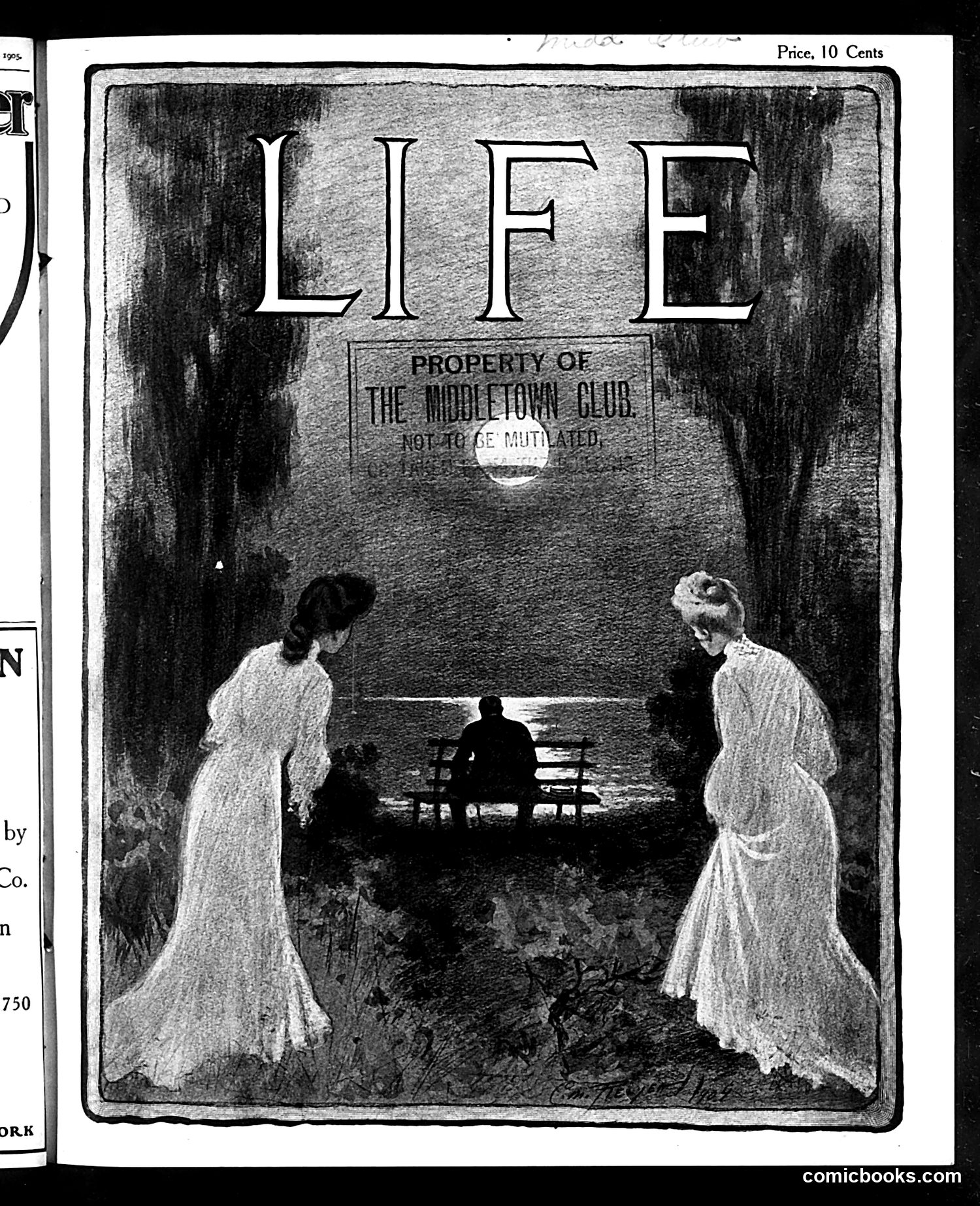
This appears to be a cover for *Life* magazine (price 10 cents), marked as "Property of The Middletown Club - Not to be Mutilated." The image depicts a dramatic nighttime scene with two women in long white dresses on either side of a silhouetted male figure seated on a bench. The theatrical composition—dark forest setting, ethereal female figures, solitary man—suggests a romantic or melodramatic narrative typical of early 20th-century illustrated fiction. Without additional text visible on this page, the specific satirical or political meaning is unclear. The image may reference a contemporary literary work, social commentary about romance or gender relations, or simply serve as cover art for a serialized story within the magazine. The staging evokes theatrical rather than overtly political content.
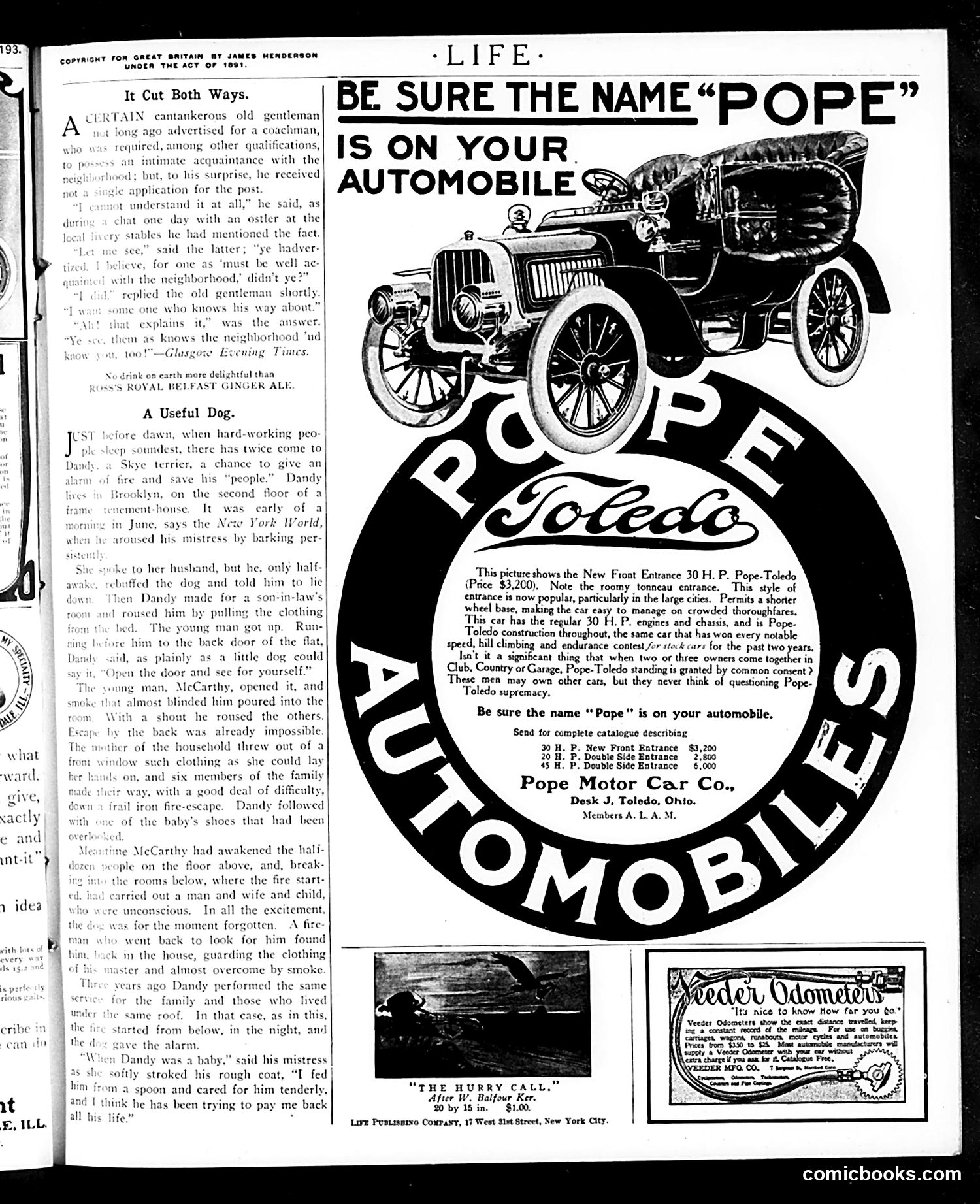
This page is primarily **advertising**, not political satire. The dominant content is a large Pope Motor Car advertisement occupying the right half of the page. The ad promotes the Pope-Toledo automobile manufactured in Toledo, Ohio, emphasizing its "New Front Entrance" design, 30 H.P. engines, and reliability. The circular design with "POPE AUTOMOBILES" text and the illustrated vehicle showcase the product. The left side contains two short fiction pieces: "It Cut Both Ways" (a humorous anecdote about a gentleman seeking a coachman) and "A Useful Dog" (a dramatic story about a dog alerting owners to fire). These are entertainment content typical of Life magazine's editorial mix during this era, not political commentary. The page also includes smaller advertisements for other products below.
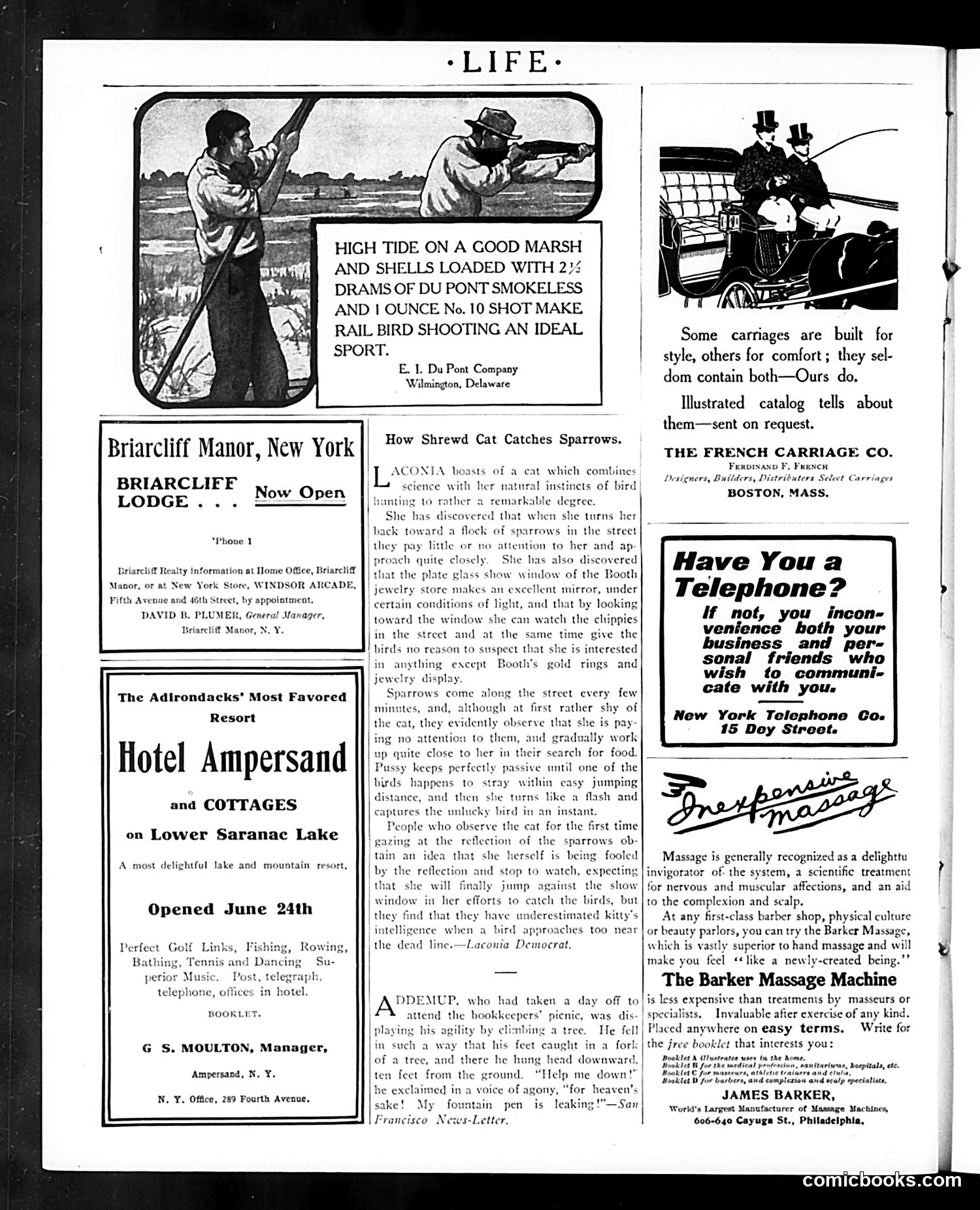
This page is primarily **advertising and editorial content**, not political satire. The main cartoon (top left) illustrates a Du Pont ammunition advertisement—showing duck hunting with text praising their smokeless powder shells for bird shooting. This is straightforward product marketing. The other content includes: - A humorous anecdote about a cat catching sparrows by observing their reflections in a jewelry store window - Resort advertisements (Hotel Ampersand, Briarcliff Lodge) - Service ads (French Carriage Co., New York Telephone, Barker Massage Machine) The page reflects **early 20th-century leisure culture** and consumer goods targeting affluent readers. There is **no apparent political commentary or satire**—it's a typical mixed-content page from Life's commercial era.
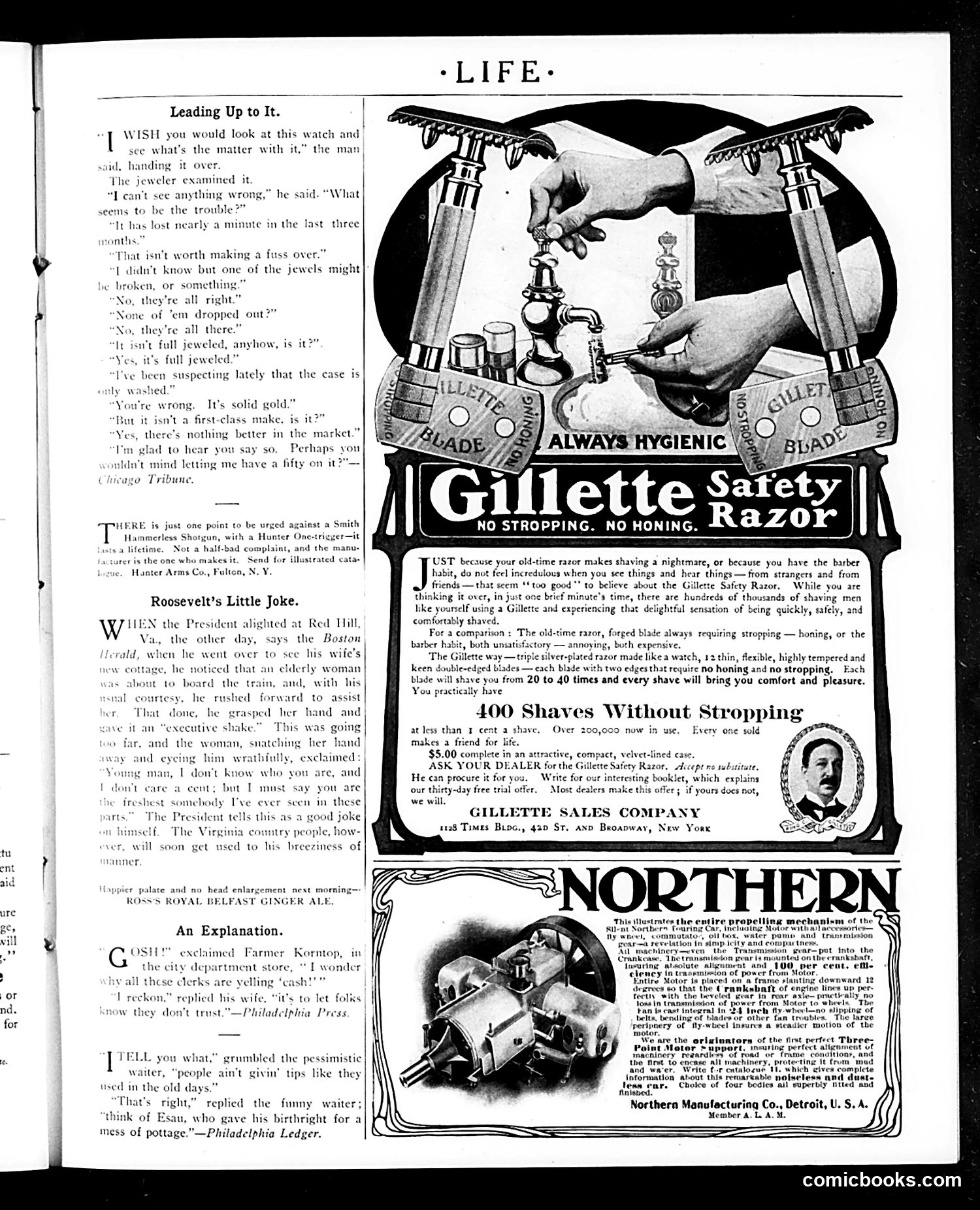
This page contains **two distinct sections**: editorial content on the left and advertisements on the right. The left side includes anecdotal humor pieces titled "Leading Up to It" and "Roosevelt's Little Joke," referencing President Theodore Roosevelt's visit to Red Hill and a witty remark he made about Virginia's poverty to his wife—typical satirical commentary on politics and social observation. The right side features two full-page advertisements: **Gillette Safety Razor** (emphasizing convenience over traditional straight razors requiring stropping/honing) and **Northern Manufacturing Co.** (promoting a three-cylinder motor engine). The content reflects early 1900s concerns: technological progress in personal grooming and automobiles, alongside political humor. No specific political cartoons appear; instead, the "satire" emerges through anecdotal jokes about public figures and consumer-culture advertising.
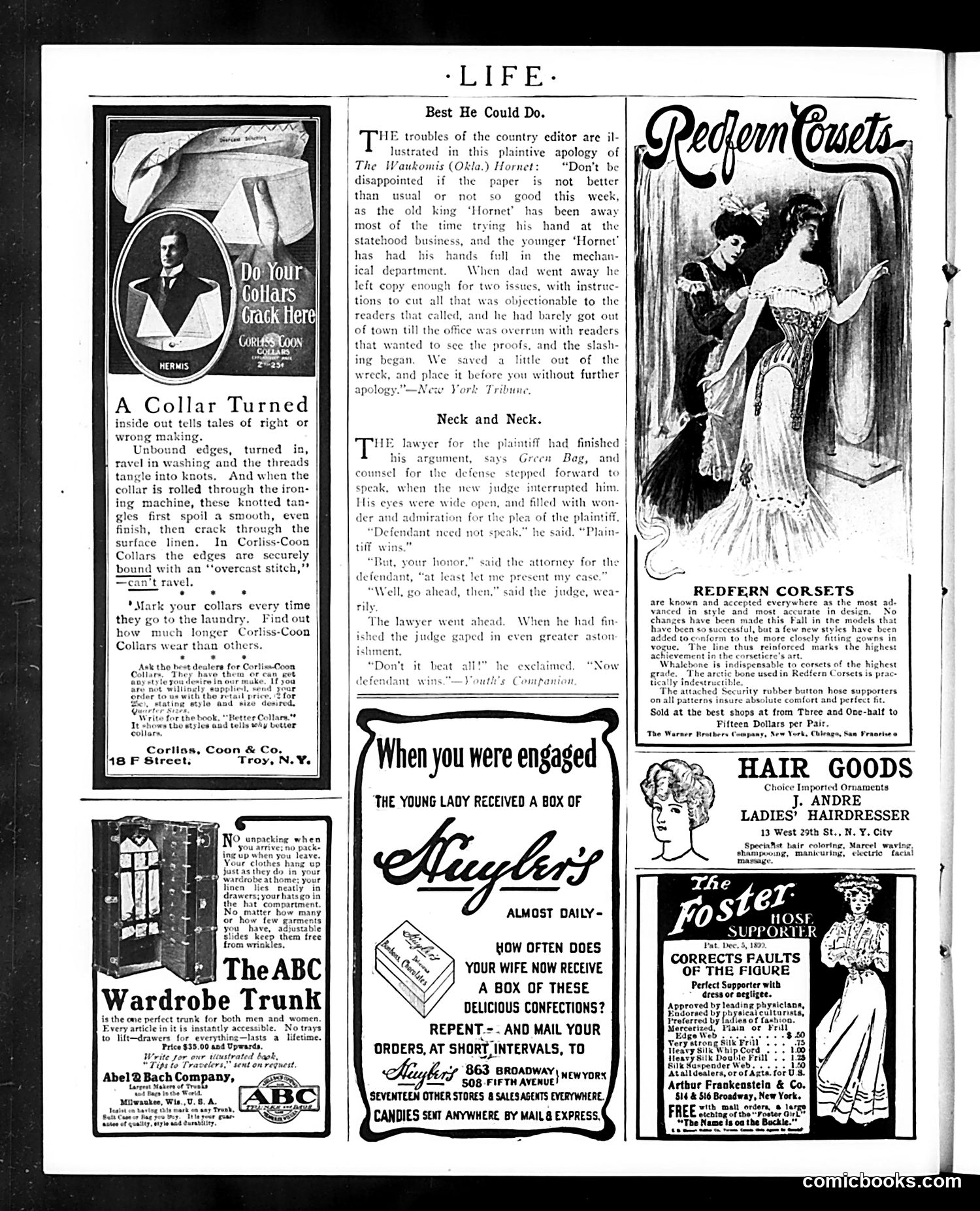
This page is primarily **advertising** with minimal editorial content. The top features a brief article titled "Best He Could Do," discussing the Waukonis (Oklahoma) Hornet newspaper's printing challenges—a light editorial comment rather than political satire. The dominant content comprises commercial advertisements for the era: Corless-Coon Collars, ABC Wardrobe Trunk, Redfern Corsets, Augier's candies, Ladies' Hairdresser services, and Foster Hose Supporter. There is **no discernible political cartoon** on this page. The visual elements are product illustrations and branding typical of early 20th-century magazine advertising. The page represents Life's revenue model: satirical editorial content subsidized by advertisements for clothing, accessories, and luxury goods marketed primarily to middle and upper-class readers.
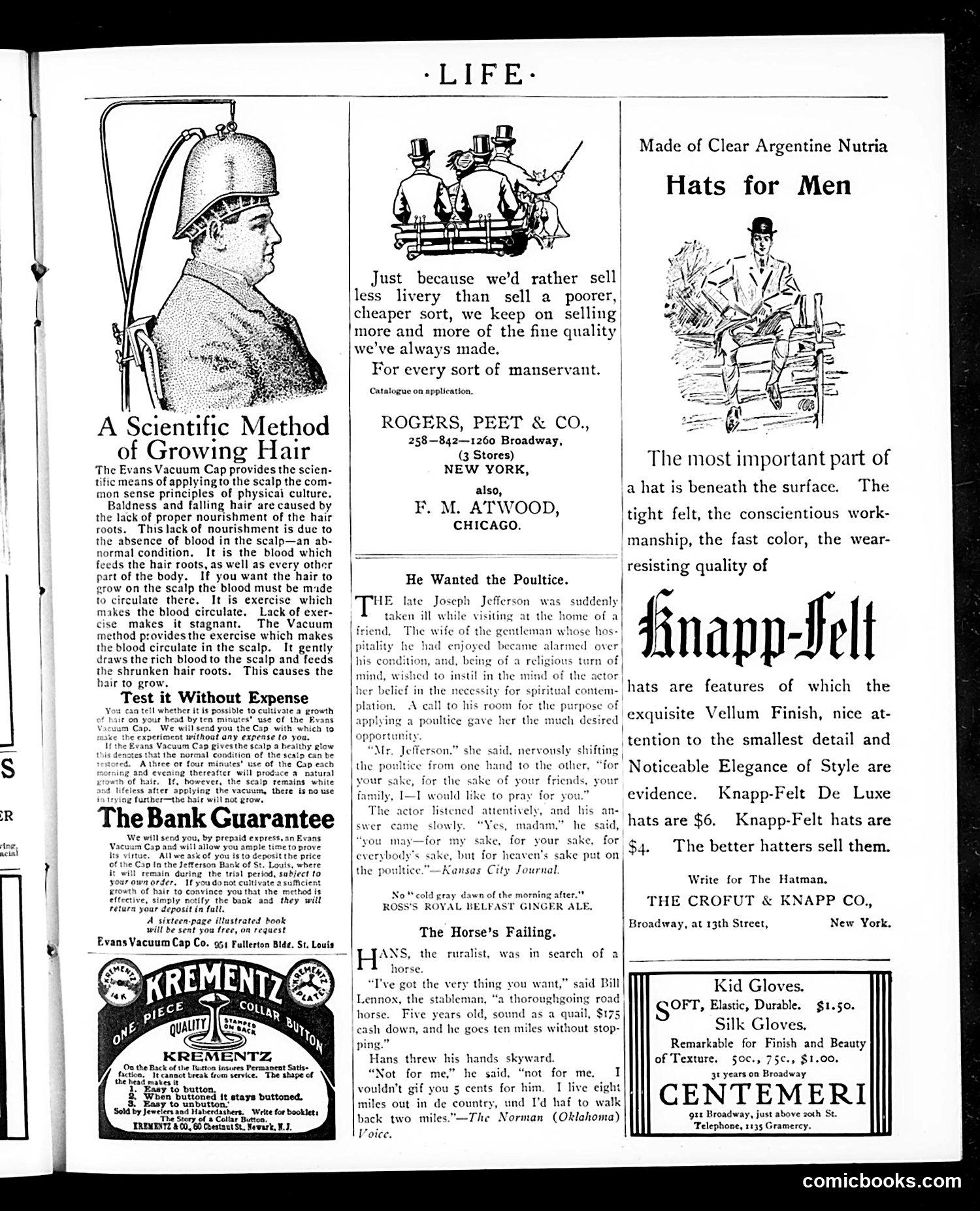
This page is **primarily advertising**, not satire or political commentary. The main content includes: 1. **Hair growth advertisement** ("A Scientific Method of Growing Hair") - promoting The Evans Vacuum Cap treatment for baldness 2. **Three distinct product ads**: Rogers, Peet & Co. (livery/hats), Knapp-Felt hats, and Krementz jewelry 3. **Short humorous anecdotes** (not political cartoons): - "He Wanted the Poultice" - a brief story about Joseph Jefferson (likely the 19th-century actor) visiting a friend - "The Horse's Failing" - a rural dialogue about a horse trader These stories appear to be light, satirical social humor typical of *Life* magazine's satirical tradition, but they target personal behavior and rural folk wisdom rather than politics. The page reflects early 20th-century concerns (baldness remedies, hat fashion) and entertainment conventions.
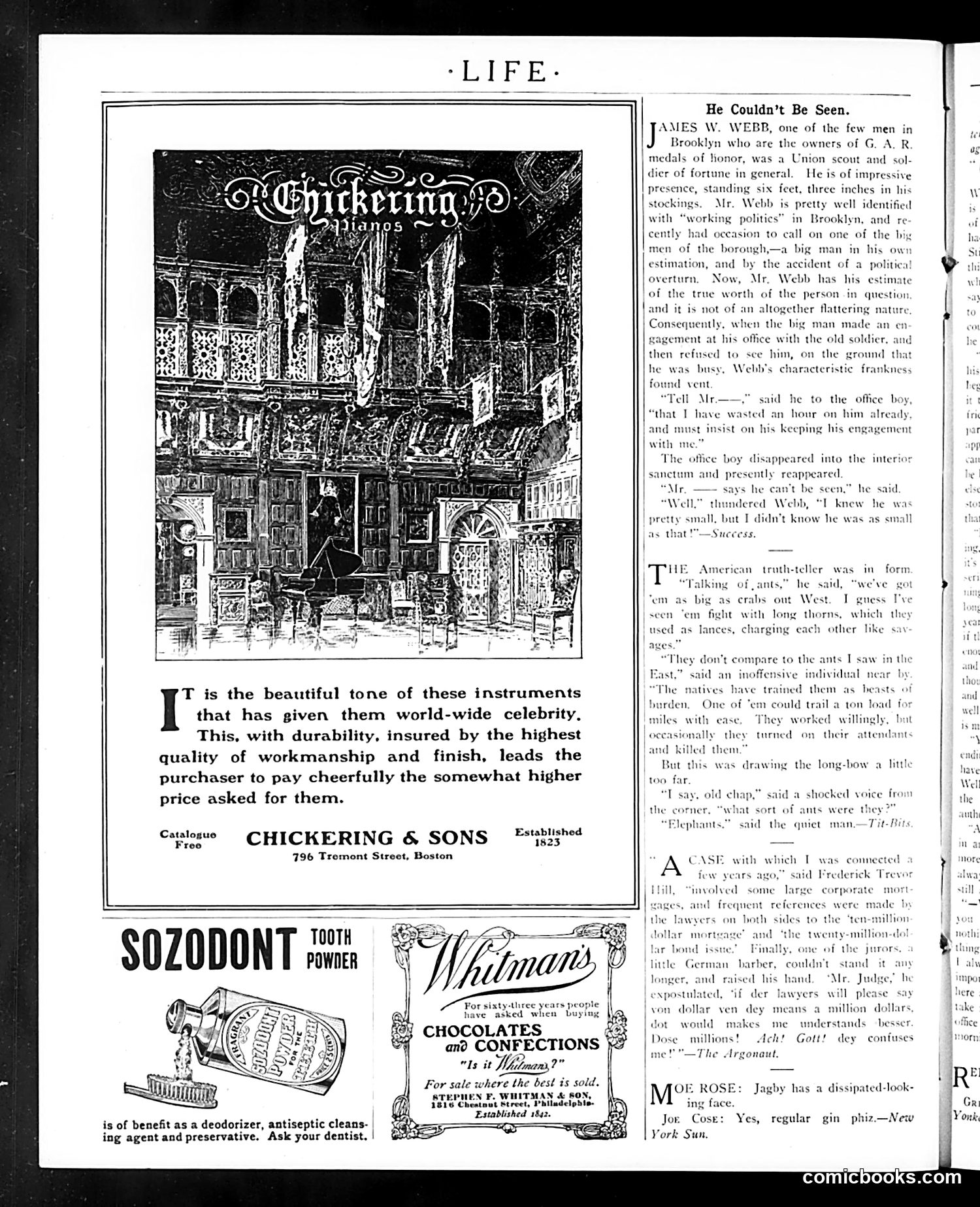
This page is primarily **advertising and satirical anecdotes**, not political cartooning. The main content includes: 1. **Chickering & Sons piano advertisement** — emphasizes the instrument's "beautiful tone" and durability, justifying higher prices through superior craftsmanship (established 1823). 2. **Sozodont tooth powder ad** — promotes a product as a deodorizer and antiseptic cleanser. 3. **Whitman's Chocolates and Confections advertisement**. 4. **"He Couldn't Be Seen"** — a humorous anecdote about James Webb, a Brooklyn Union soldier, who has his office boy deliver a message to a large general because the soldier claims the general is "too big" to notice him. The joke plays on social hierarchy and self-deprecation. 5. **Additional brief humorous exchanges** about ants, corporate mergers, and mistaken identity. This is typical satirical humor content of Life magazine rather than political commentary.
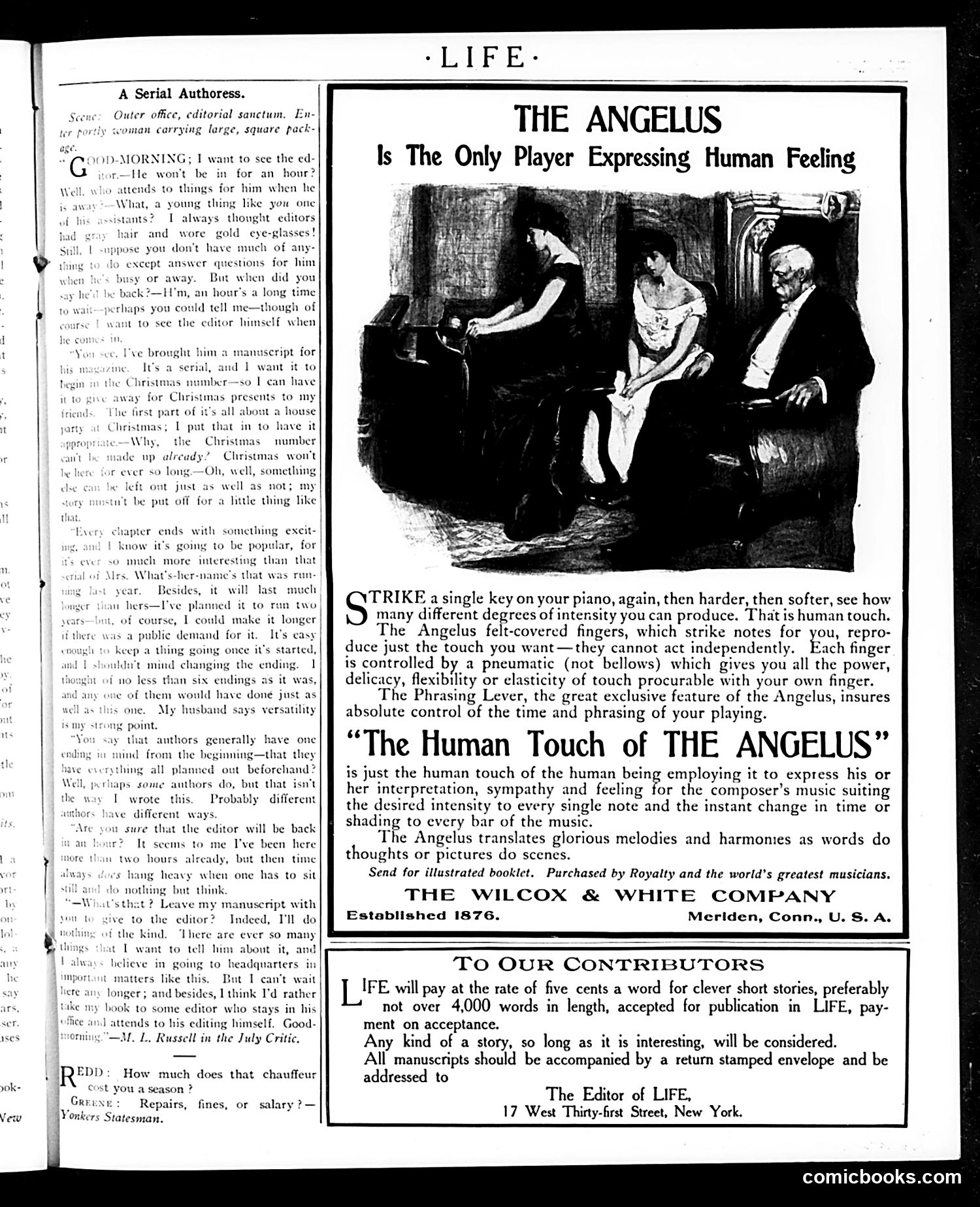
This page is primarily **advertising and editorial content** rather than political satire. The main feature is a full-page advertisement for "The Angelus," a piano brand by Wilcox & White Company (established 1876). The ad's illustration depicts a domestic scene with figures at a piano, emphasizing the instrument's "human touch" and ability to express feeling through nuanced key strikes. The marketing emphasizes how pianists can control emotional intensity—targeting affluent households valuing refined entertainment. The left column contains editorial correspondence about manuscript submissions and story preferences for Life magazine itself. The bottom section solicits short stories from contributors at five cents per word. This is **commercial publishing content**, not political commentary or satire.
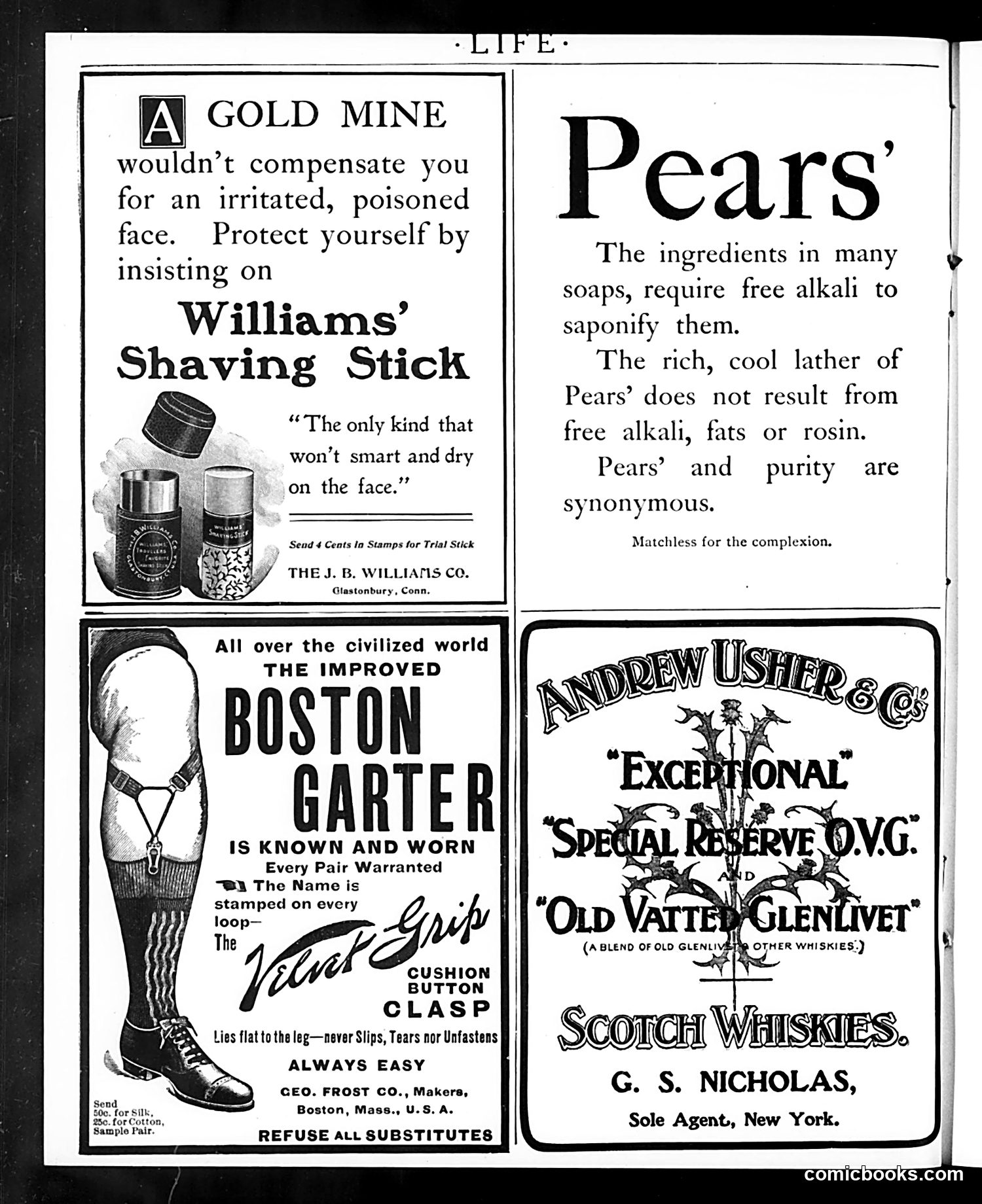
This page contains four advertisements, not political cartoons. The ads promote: 1. **Williams' Shaving Stick** — claims superiority by not drying or irritating the face 2. **Pears' Soap** — emphasizes purity and gentle lathering without harsh alkali 3. **Boston Garter** — hosiery with a "Velvet Grip" cushioned clasp, highlighting comfort and durability 4. **Andrew Usher & Co. Scotch Whisky** — advertises two premium brands The page reflects early-20th-century consumer marketing conventions: product comparisons emphasizing safety/comfort, testimonial-style claims, and appeals to respectability. The garter ad's leg illustration was standard for the era. These ads reveal period concerns about product quality and gentlemen's grooming standards.
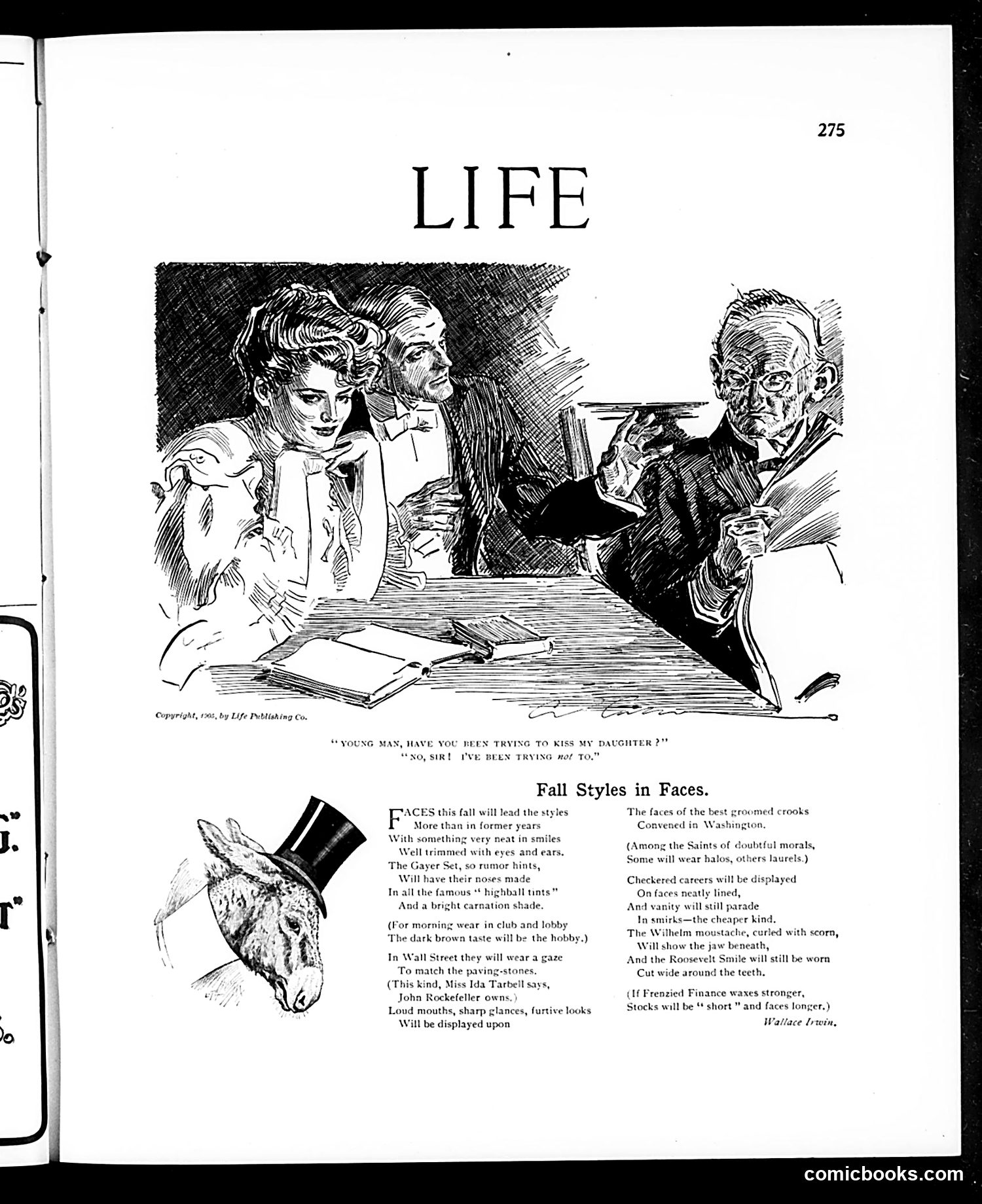
This page contains a satirical cartoon and accompanying poem about fall fashion trends. The top cartoon depicts a domestic scene where a young man is confronted by an older man (likely a father figure) and woman regarding kissing the daughter—a common "courtship" humor trope of the era. Below is a poem titled "Fall Styles in Faces" by Wallace Irwin, illustrated with a horse wearing a top hat. The poem satirizes how wealthy men will adopt affected mannerisms and fashionable facial expressions—including specific mustache styles, smirks, and expressions—as status symbols on Wall Street and in high society. It mocks the artificiality of upper-class affectation, suggesting that even facial expressions become commodified fashion statements among the wealthy.
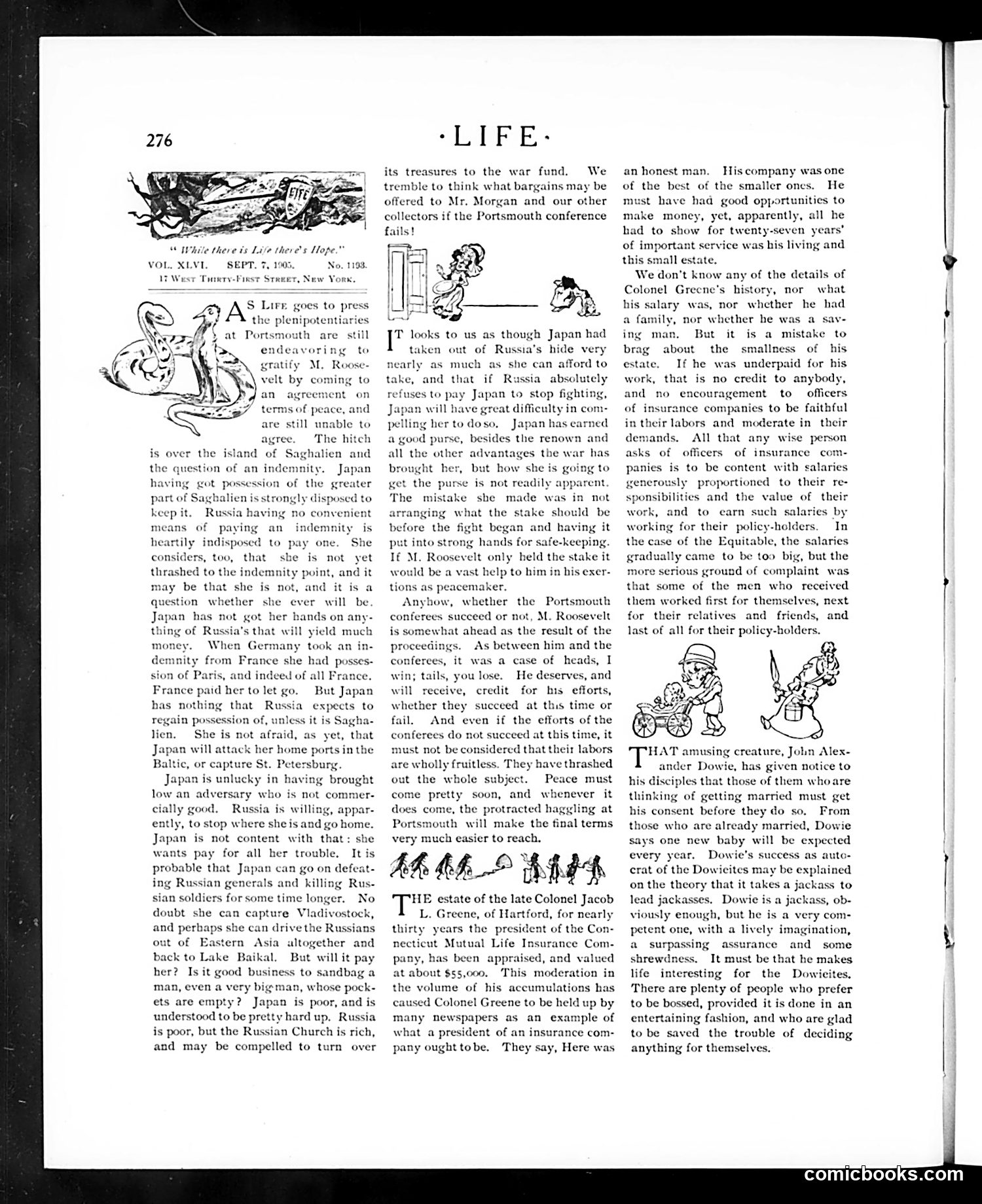
This page from Life magazine discusses post-Russo-Japanese War (1904-1905) geopolitical concerns. The text debates whether Japan will attack Russia again or seek peace, questioning Japan's financial capacity to sustain another war. The cartoons illustrate contemporary anxieties: one shows figures representing nations in conflict; another depicts a child (labeled "John Alexander Dowie") being told he needs parental consent before marriage—satirizing the actual Dowie, a controversial religious figure known for arranged marriages within his sect. The page's main satire targets both Japanese imperial ambitions and American religious extremism. The broader context reflects early-1900s anxiety about Asian military power and domestic concerns about cult leaders exploiting followers, particularly vulnerable populations like youth.
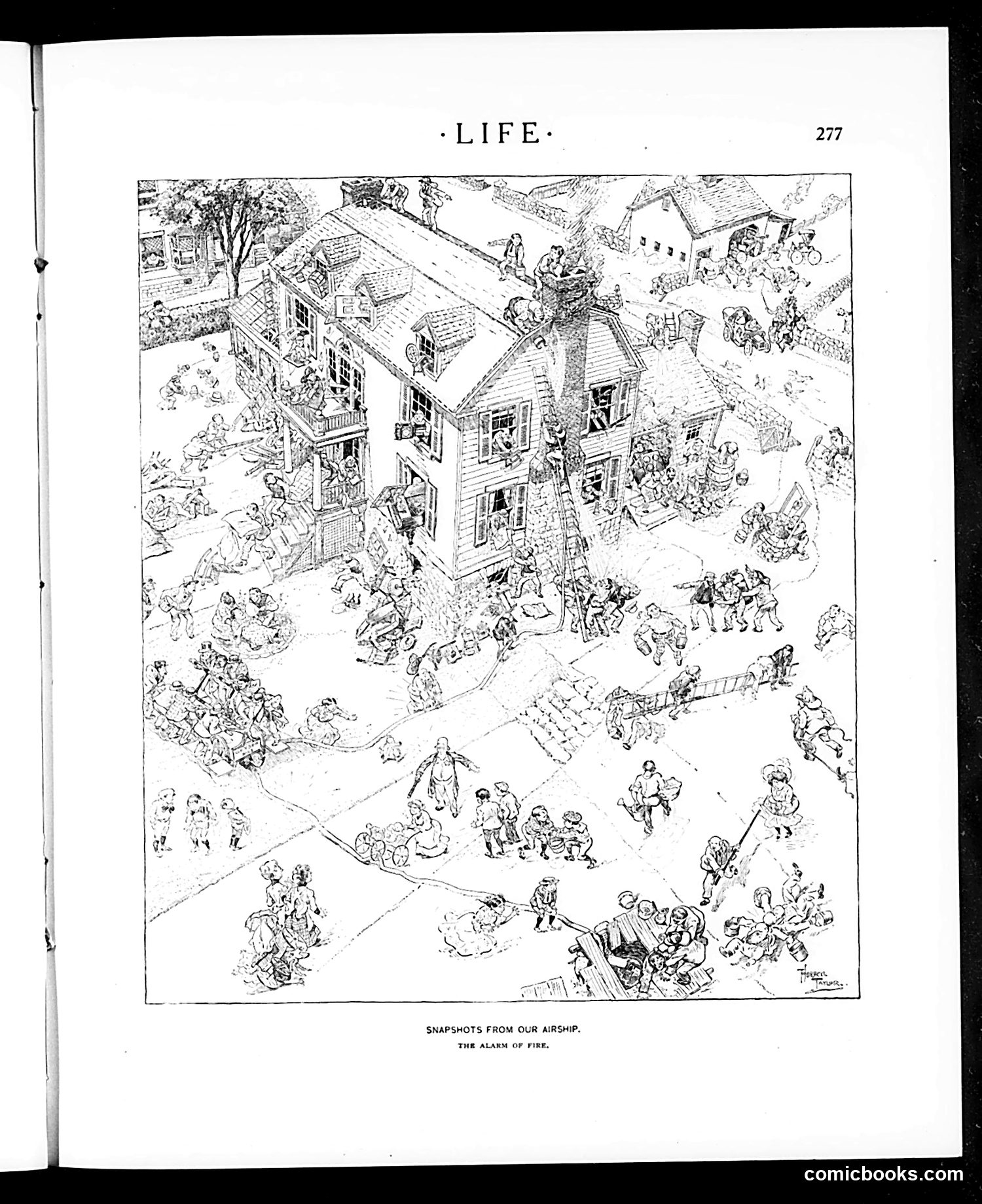
This is a bird's-eye view illustration titled "Snapshots from Our Airship: The Alarm of Fire," depicting a residential neighborhood experiencing what appears to be a fire emergency at a prominent two-story house in the center. The cartoon satirizes the chaotic community response to disaster. Dozens of figures swarm around the burning house—some fighting the fire, others appearing to panic, observe, or potentially loot. The detailed aerial perspective emphasizes the disorder: fire wagons, ladder-wielding firefighters, and scattered townspeople create visual comedy through their frantic, uncoordinated reactions. The satire likely mocks both the inefficiency of emergency response and human nature during crises—the mixture of heroic effort and opportunistic chaos.
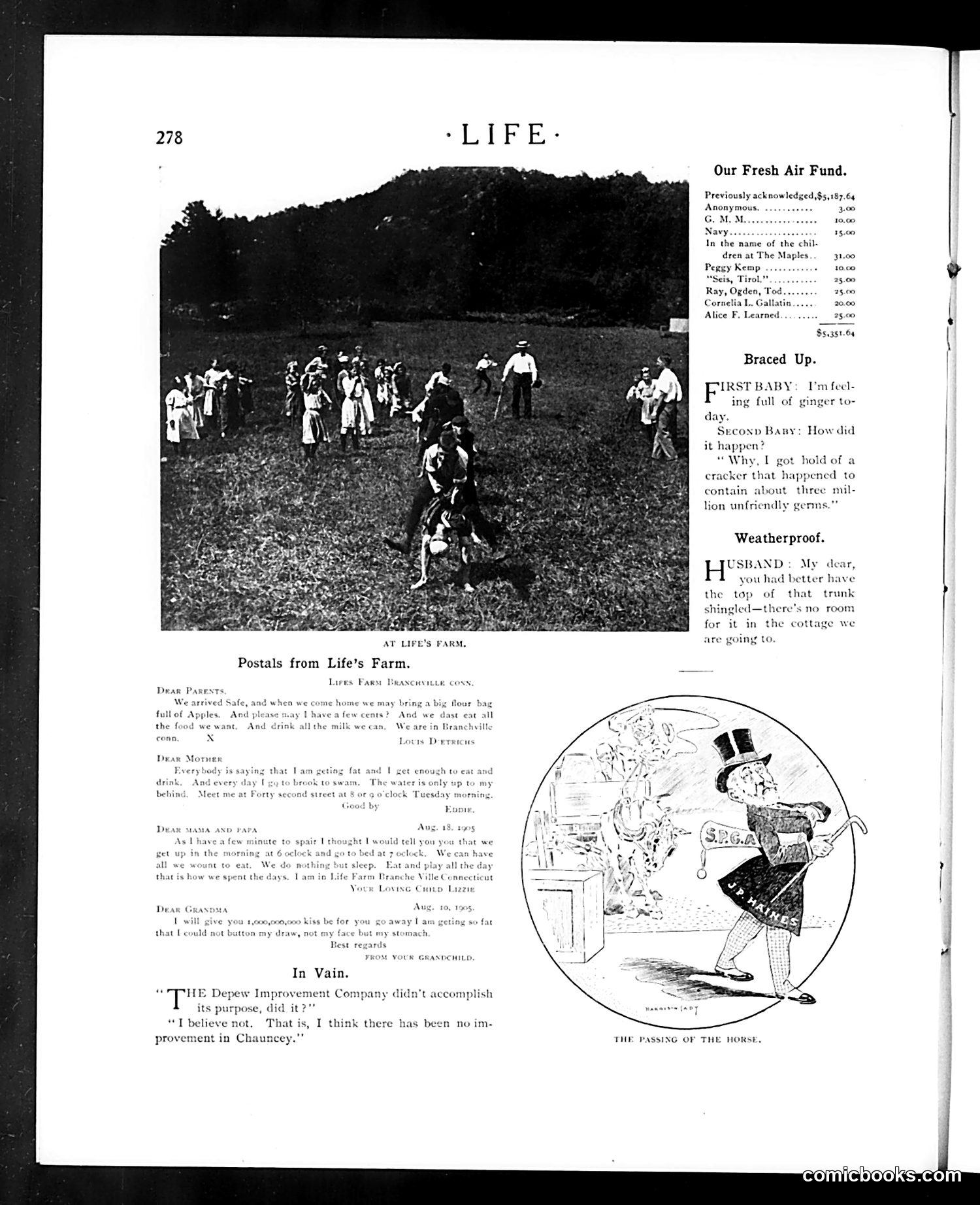
**Main Content:** This page features "Postals from Life's Farm"—postcards from children attending Life magazine's Fresh Air Fund program, which sent city children to rural areas for summer camps. **The Cartoons:** 1. **"Braced Up"** depicts two babies discussing feeling energetic because one consumed a cracker containing "three million unfriendly germs"—satirizing contemporary anxieties about invisible bacteria and the then-new germ theory of disease. 2. **"Weatherproof"** shows a husband suggesting his wife remove a trunk's top covering because it won't fit in their cottage—a domestic humor scenario about traveling with excessive luggage. 3. **"In Vain"** references "Depew Improvement Company" and "Chauncey," likely alluding to Chauncey Depew, a prominent Gilded Age businessman and politician, joking that no improvement has occurred in his character. The page also includes a fundraising list for the Fresh Air Fund, showing donors' contributions. **Context:** This represents turn-of-the-century American humor mixing social commentary (bacteria fears, class-conscious charity programs) with domestic situations.
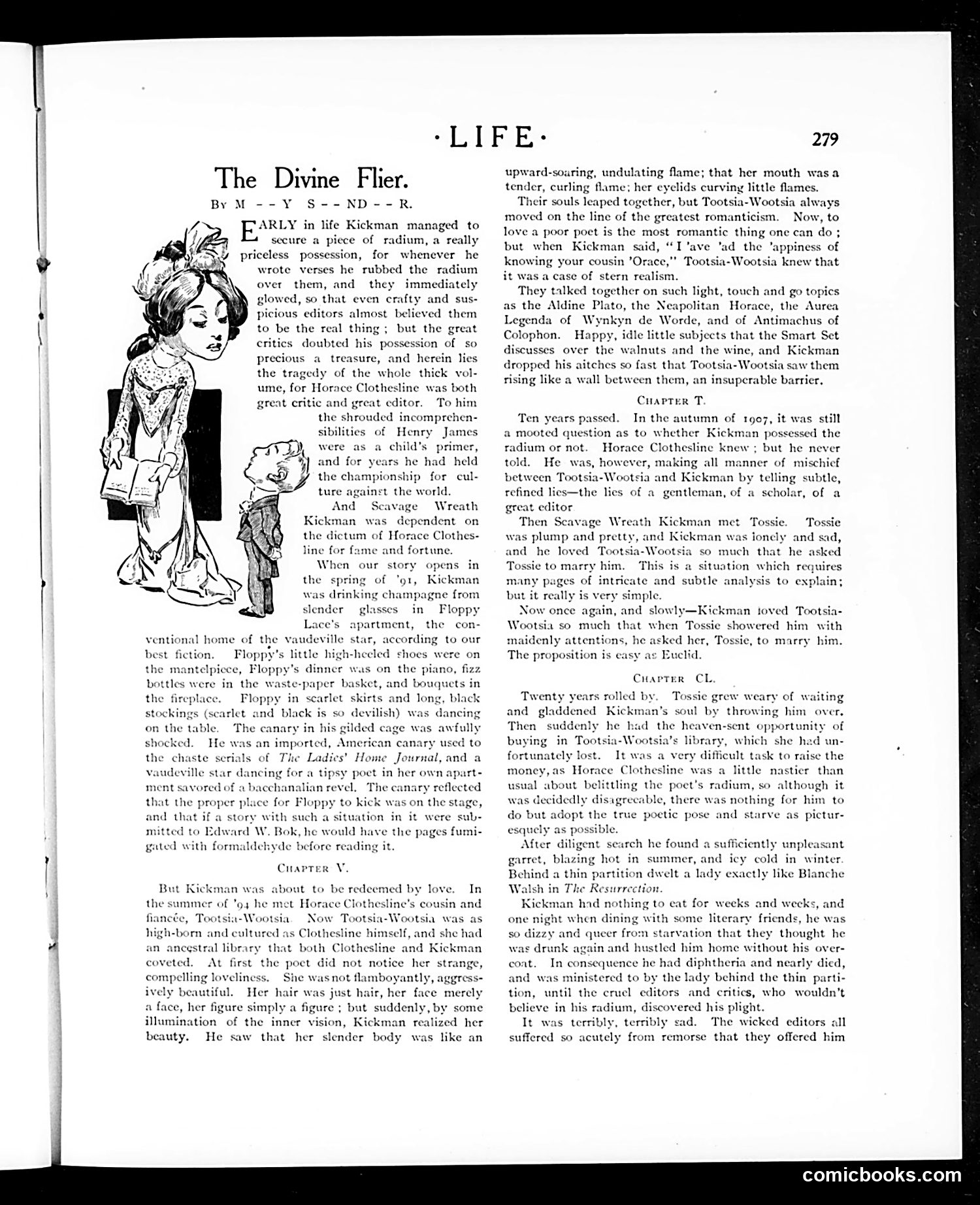
This is a satirical short story (not a political cartoon) mocking the literary world of early 1900s America. The plot ridicules pretentious poets and powerful editors: **The Setup:** Kickman, a struggling poet, supposedly possesses radium that makes his verses glow—a transparent metaphor for charlatans claiming special genius. The story satirizes how editors control writers' fates. **Key Targets:** - **Horace Clothesline** represents powerful, gatekeeping literary critics/editors who determine careers - **Tootsia-Wootsia** embodies romantic idealism versus practical reality—she loves Kickman but can't accept his lower social status (he drops his h's, lacks "breeding") - References to *The Ladies' Home Journal* and Edward W. Bok mock prudish American publishing standards **The Satire:** The impossibly contrived plot—radium verses, ten-year delays, mysterious withholding of truth—exaggerates how literature of the era often prioritized artificial beauty and social standing over genuine merit. The author mocks both pretentious writers and the snobbish literary establishment controlling them.
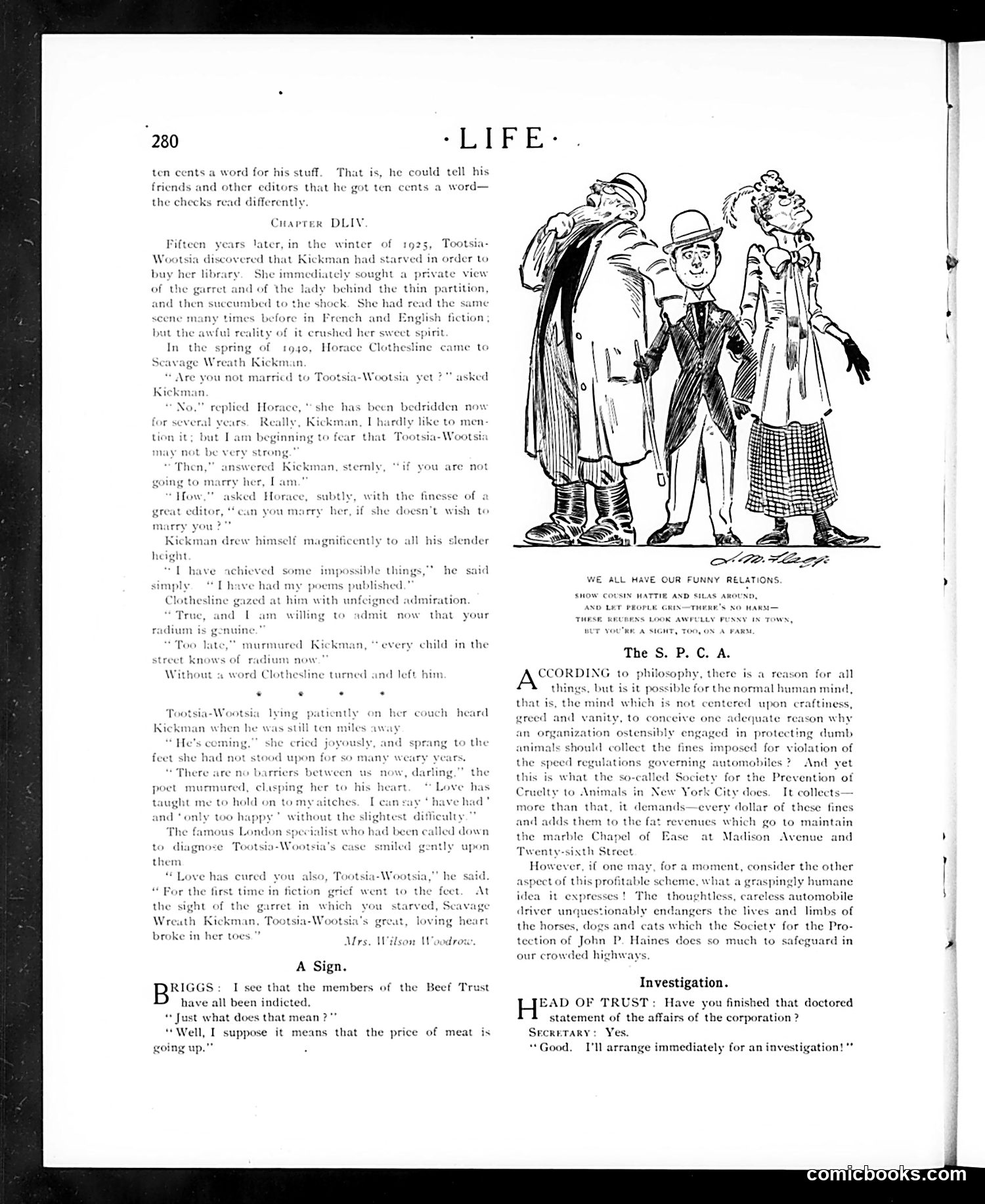
This page contains two distinct satirical pieces: **"The S.P.C.A." section** critiques the Society for the Prevention of Cruelty to Animals in New York City. The satire targets the organization's hypocrisy: while it claims to protect animals, it aggressively collects fines from traffic violators, enriching itself rather than genuinely preventing harm. The writer notes the irony that reckless automobile drivers—who endanger the very animals the S.P.C.A. claims to protect—go largely unregulated, while the organization profits from fines. The piece exposes the gap between the organization's humanitarian mission and its actual profit-driven operation. **"Investigation" dialogue** at the bottom mocks corporate corruption. A trust leader asks if a "doctored statement" of corporate affairs is ready, then says he'll "arrange immediately for an investigation"—implying he'll control the investigation's outcome. It satirizes how corporations manipulate investigations to appear legitimate while concealing misconduct. Both pieces critique institutional hypocrisy and corruption.
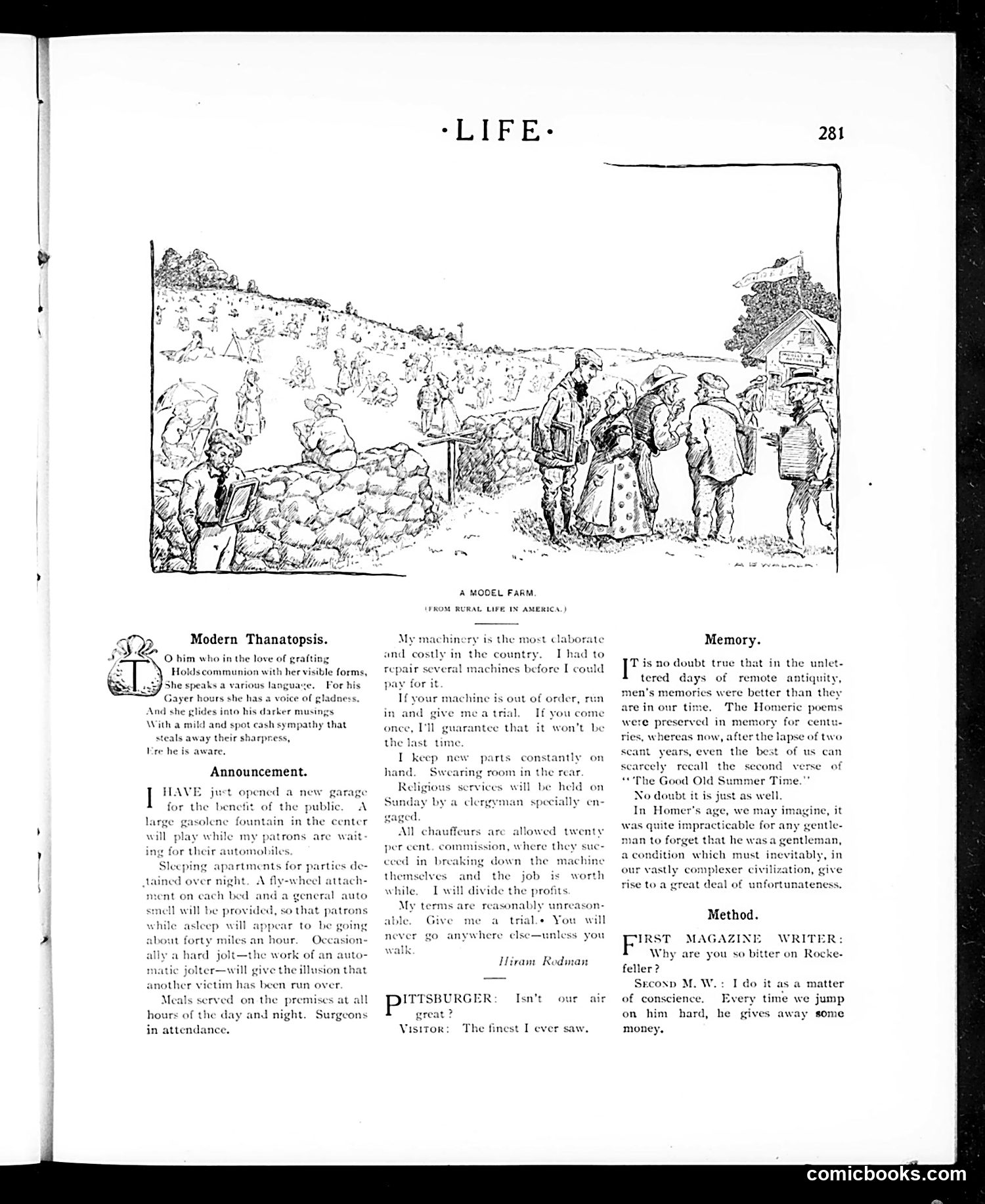
This page contains three separate satirical pieces mocking American modernization and hypocrisy: **"A Model Farm"** (top illustration): Shows a rural farmer boasting of elaborate, expensive machinery while his land appears chaotic. The satire targets farmers aspiring to industrial-scale agriculture despite lacking practical competence—the contradiction between aspirational modernism and actual capability. **"Announcement"** (garage advertisement): Absurdist satire on entrepreneurial excess. A garage owner advertises increasingly ridiculous amenities (fountain, sleeping apartments, a contraption that simulates being hit by a car, surgeons on-site). It mocks the era's obsession with commercial novelty and over-capitalization. **"Method"** (dialogue): A magazine writer admits he attacks Rockefeller cynically because each criticism prompts the tycoon to make a charitable donation—exploiting philanthropy for circulation. This exposes both sensationalist journalism and "conscience-washing" by the wealthy. The page satirizes Gilded Age contradictions: modern pretension masking incompetence, commercialism run amok, and corrupted morality cloaked in progress.
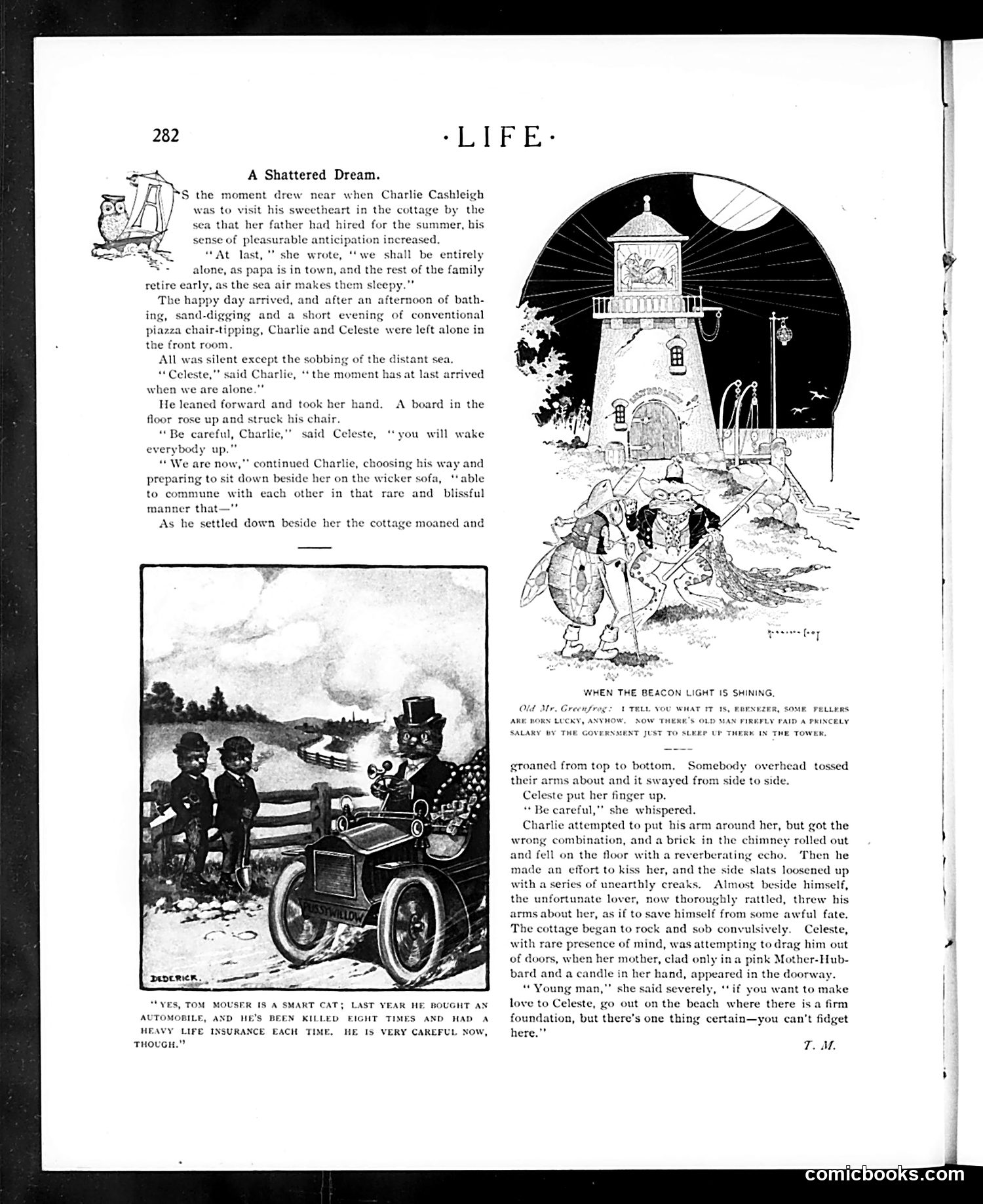
This is a humorous story about a young man, Charlie Cashleigh, who attempts a romantic encounter with his sweetheart Celeste at her seaside cottage. The joke relies on physical comedy: every time Charlie tries to embrace or kiss Celeste, he accidentally triggers the cottage's structural collapse—floorboards spring up, bricks fall from chimneys, doors swing open, and the building rocks convulsively. The satire mocks both romantic melodrama and shoddy construction. The cottage is so poorly built that intimate gestures cause catastrophic failures. The punchline comes when Celeste's mother interrupts, sardonically suggesting Charlie take his romance to the beach where there's "firm foundation"—implying the cottage itself is the real obstacle, not propriety. The accompanying cartoons about Tom Mouser the cat and "Old Man Firefly" appear to be separate humorous anecdotes typical of Life magazine's format.
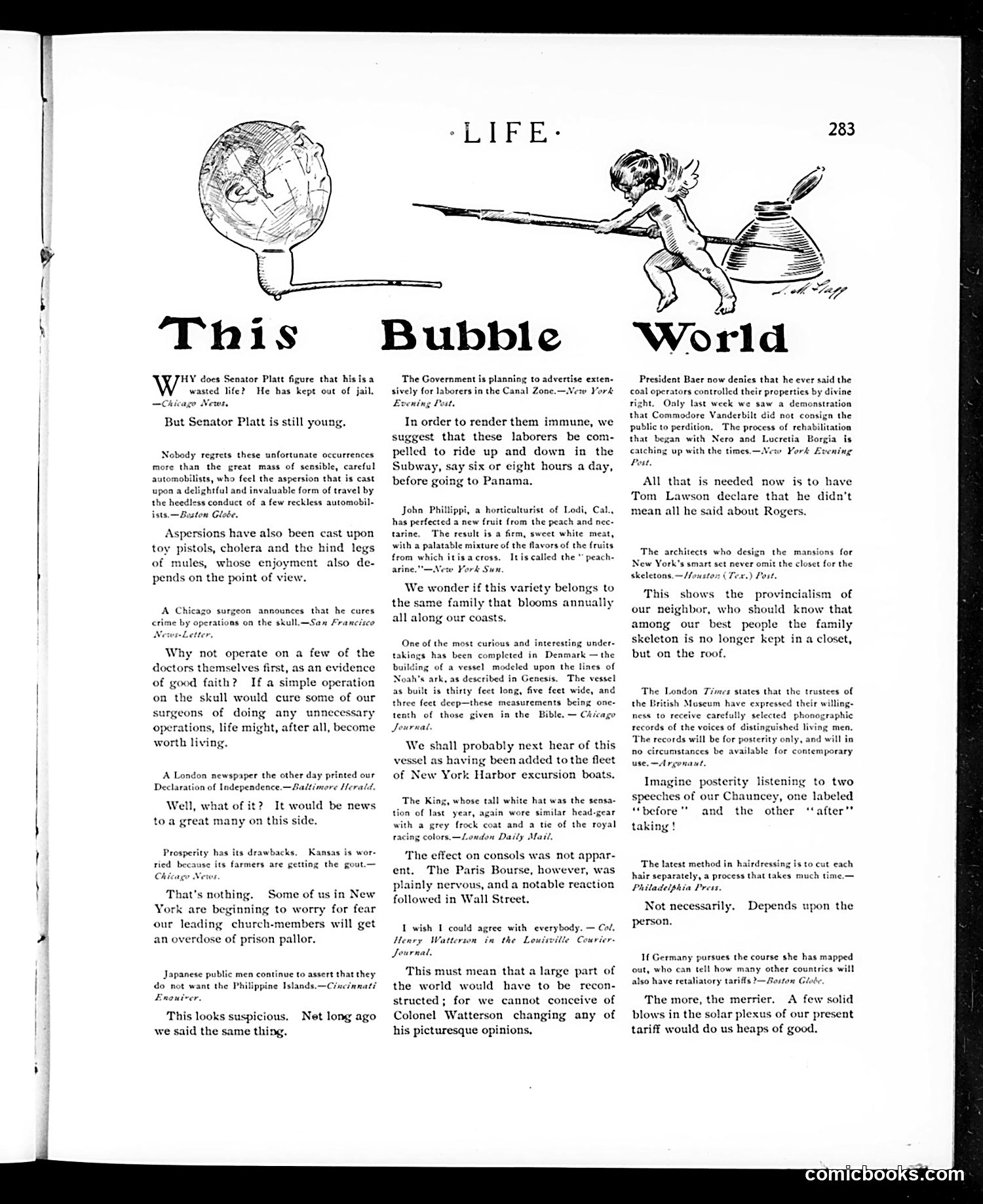
This page from *Life* magazine consists of brief satirical commentary on contemporary events and figures, anchored by the title cartoon depicting Cupid blowing bubbles at a globe. **Key satire targets include:** - **Senator Platt**: Mocked for avoiding jail, implying corruption is expected of politicians - **Automobiles**: Criticized for dangerous drivers casting aspersions on the technology itself - **Surgeons**: Sarcastically suggested to operate on themselves to cure unnecessary procedures - **Japanese denials about Philippine Islands**: Treated as transparent lies - **President Baer (coal operator)**: Denied claiming divine right over coal properties; the satire suggests his "rehabilitation" is as absurd as Nero's **The recurring theme**: American institutions—political, medical, industrial—are corrupt or dishonest, their denials and reforms merely cosmetic. The "bubble world" title suggests these assurances are insubstantial, likely to burst. The cartoons and quips reflect *Life's* role as a satirical publication critiquing Gilded Age American power structures and their representatives.
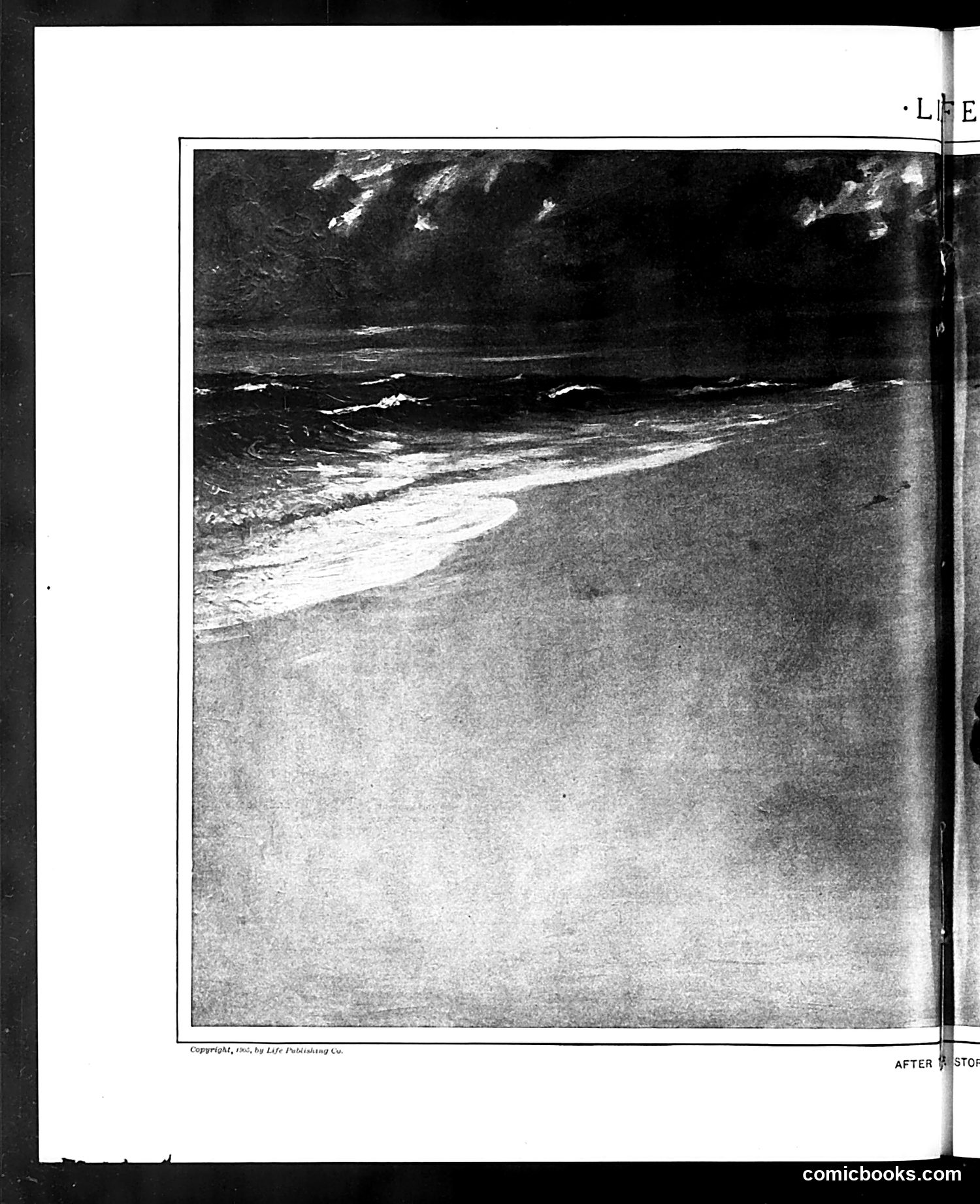
This page contains a black and white photograph of a beach scene rather than a political cartoon. The image shows a sandy beach with waves and a dark, stormy or heavily clouded sky above. There is a copyright notice at the bottom crediting "Life Publishing Co." Without visible text identifying the subject, location, or satirical intent, I cannot determine what specific political or social commentary this photograph was meant to convey in *Life* magazine's context. The dramatic weather and beach setting could relate to various contemporary events or metaphors, but the page itself provides insufficient information to identify them with certainty. Additional context or accompanying article text would be needed to explain the intended meaning.
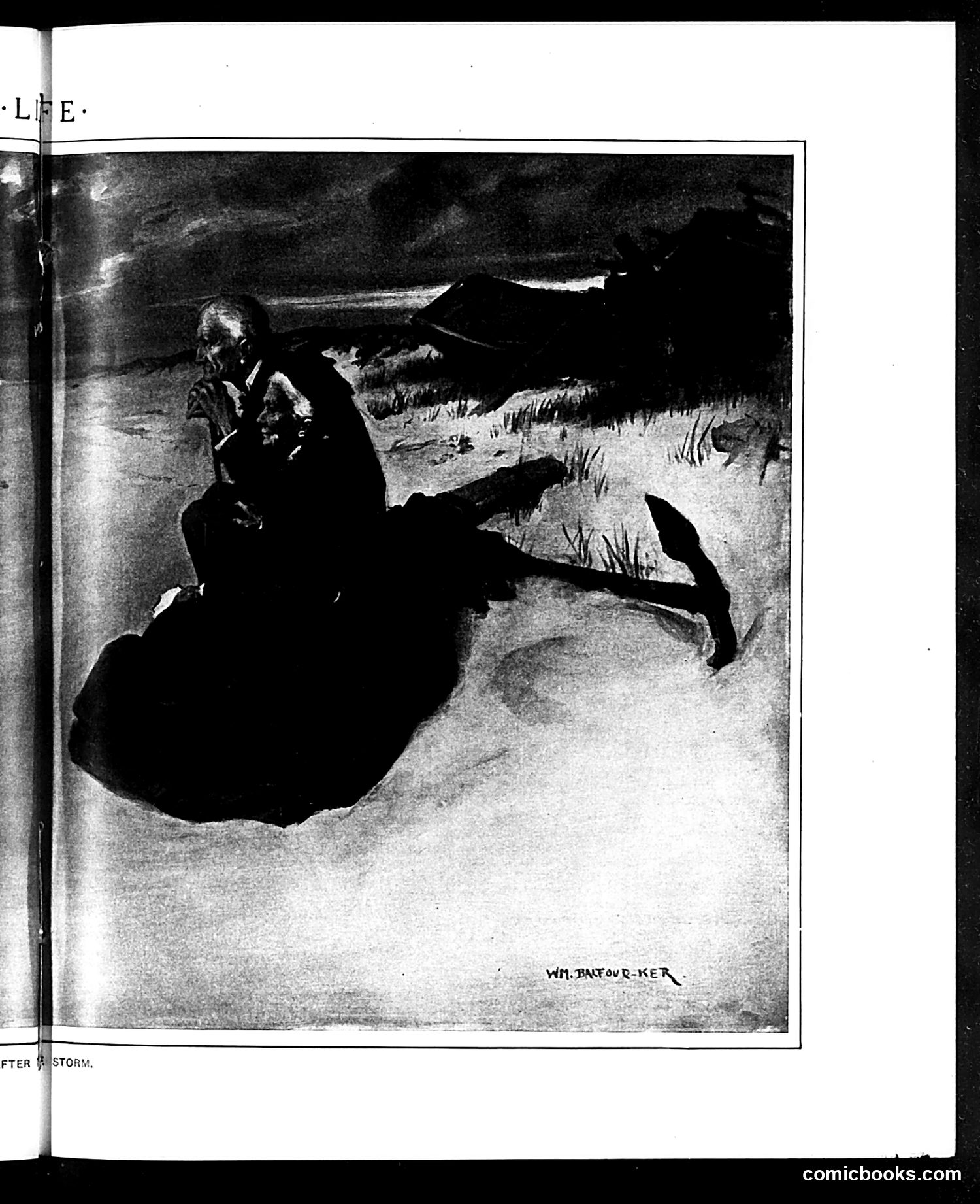
This appears to be a satirical illustration showing a figure who has been knocked down or is lying on the ground after what the caption indicates was a "storm." The signature reads "WH. Balfour-Ker" (the artist). The figure's dramatic pose—legs up, body sprawled—suggests humiliation or defeat. The barren landscape with sparse vegetation reinforces a sense of devastation or aftermath. Without clearer dating or additional context clues, I cannot definitively identify which historical political figure or event this references. The title "After a Storm" suggests commentary on political upheaval or scandal, but the specific subject remains unclear from the image alone. The style and printing quality suggest early-to-mid 20th century publication.
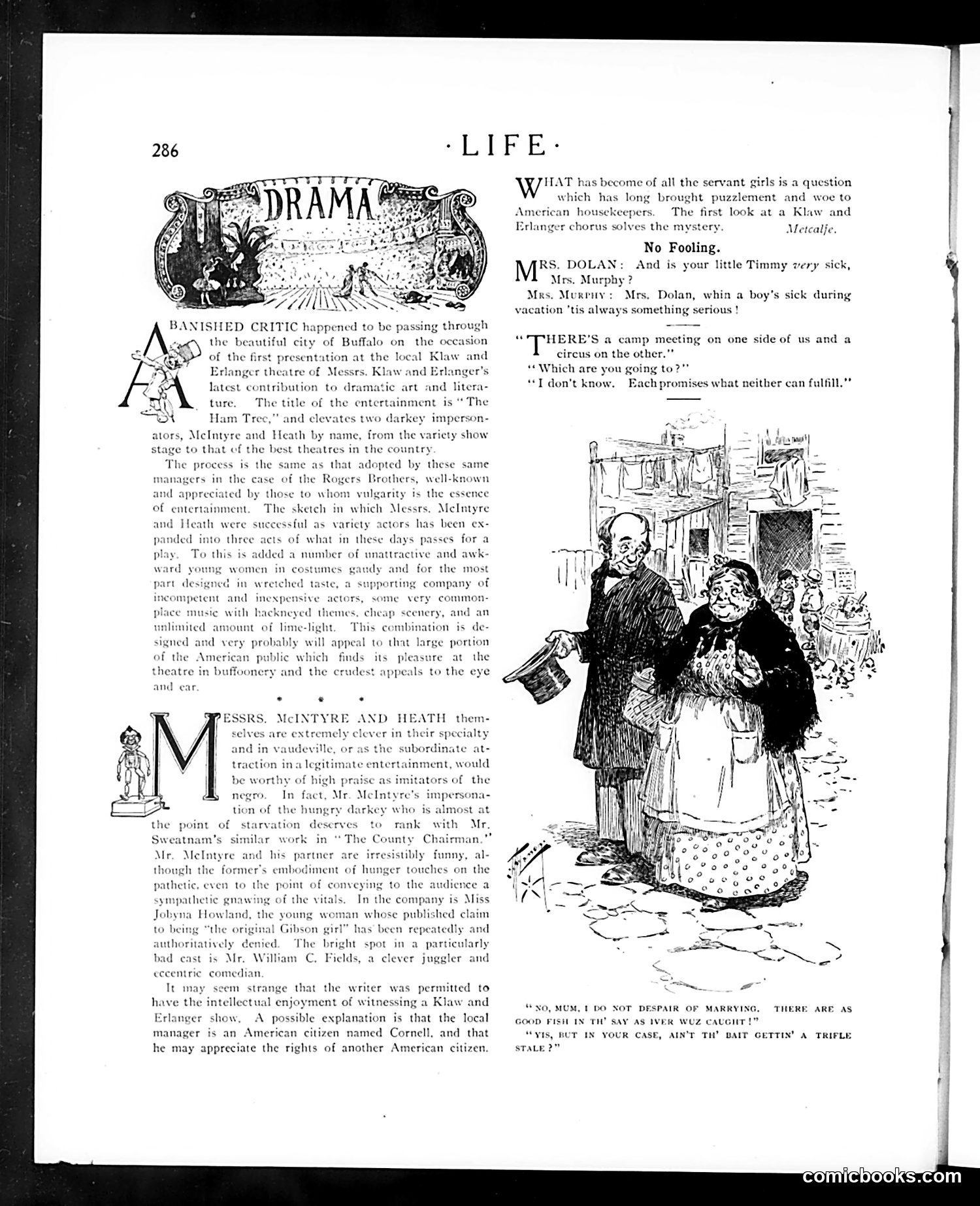
This page critiques a theatrical production called "The Ham Tree" featuring blackface performers McIntyre and Heath. The review's sarcastic tone condemns the show as vulgar entertainment designed for unsophisticated audiences—cheap scenery, "gaudy" costumes, and "crudest appeals to the eye and ear." The accompanying illustration depicts working-class Irish women (indicated by their accents in the dialogue) gossiping about marriage prospects. One woman jokes that another's "bait" (romantic appeal) is growing "stale"—a barbed comment on aging. **Key context for moderns:** This 1900s *Life* magazine was satirizing both blackface minstrelsy (then considered lowbrow entertainment) and working-class marriage anxieties. The magazine positioned itself as sophisticated and critical of popular taste, while the Irish-accented dialogue reflects period attitudes about immigrant communities. The satire assumes readers shared class-based disdain for both the theatrical production and its audiences.
This page consists entirely of **reader letters** responding to Life's editorial content—not original cartoons or satirical illustrations. The main debate concerns a Life cartoon titled "Tainted Money Returned" (July 13) that depicted **Andrew Carnegie alongside John D. Rockefeller**, implying moral equivalence between them. **The satire's point:** A writer defends Carnegie against this comparison, arguing he earned his fortune more honorably than Rockefeller (who faced accusations of monopolistic practices and labor violence, notably the Homestead strike of 1892). Carnegie, the letter argues, is a genuine philanthropist and intellectual—not a "money-mad" industrialist like Rockefeller. **Life's response:** The editor dismisses this defense, saying Carnegie remains fair game for "legitimate, humorous consideration" as a wealthy industrialist regardless of charitable intentions. **Context for modern readers:** This reflects Gilded Age anxieties about industrialists' wealth-gathering methods versus their public images through philanthropy—a debate that remains relevant today.
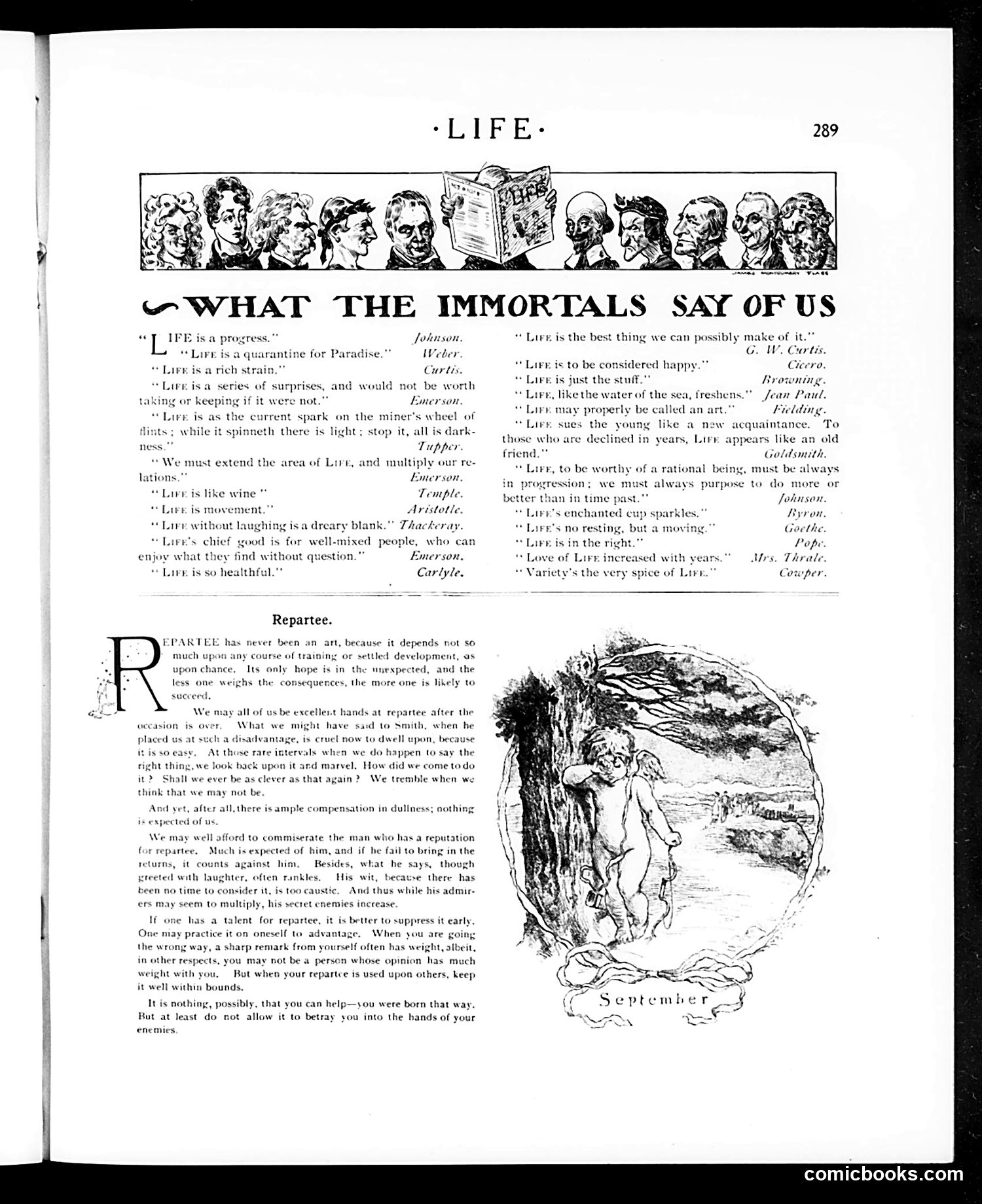
This page presents **philosophical quotations about life** rather than political satire. The top section, "What the Immortals Say of Us," collects brief aphorisms from famous historical figures—Johnson, Emerson, Carlyle, Thackeray, Byron, Pope, and others—offering varied perspectives on the nature and value of life itself. The lower section, titled "Repartee," is an essay discussing witty conversation as a social art. It argues that repartee is difficult to master because it depends on spontaneous cleverness rather than preparation. The piece cautions against using sharp wit as a weapon, warning that clever remarks—though applauded—often cause lasting resentment and can damage one's reputation and relationships. The decorative illustration labeled "September" shows a classical female profile, likely representing the month personified. **Context**: This reflects Victorian-era genteel humor and philosophy, emphasizing self-improvement, social etiquette, and the dangers of clever speech—concerns distant from modern sensibilities.
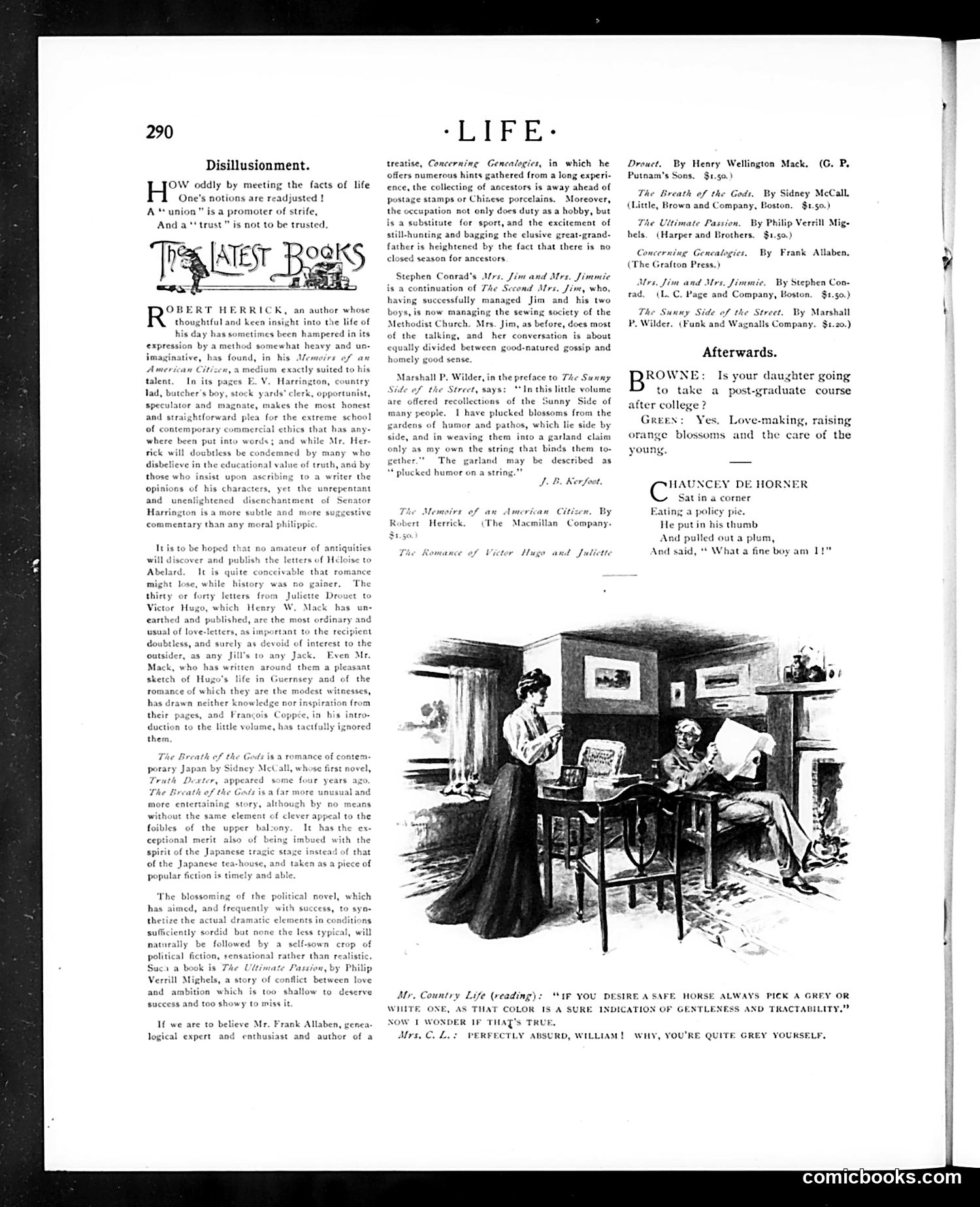
This page combines book reviews with satirical commentary on American social attitudes. The heading "Disillusionment" frames the content thematically. The main cartoon depicts a domestic scene where a woman reads to a man, illustrating the caption's joke: when told that grey horses indicate "gentleness and tractability," a woman responds that her husband is "quite grey" himself—sarcastically suggesting he lacks these qualities despite his coloring. The book reviews discuss contemporary novels examining American society's contradictions. Robert Herrick's *Memoirs of an American Citizen* follows a man's rise from butcher's boy to magnate, apparently critiquing how "unions" and "trusts"—ostensibly progressive institutions—actually promote selfishness and exploitation. The review suggests these social structures have "readjusted" people's idealistic notions about American life. Other reviews cover romance novels and Frank Allaben's genealogy treatise. The page reflects turn-of-century disillusionment with American capitalism and institutions, suggesting that financial success and social advancement corrupt rather than ennoble participants.
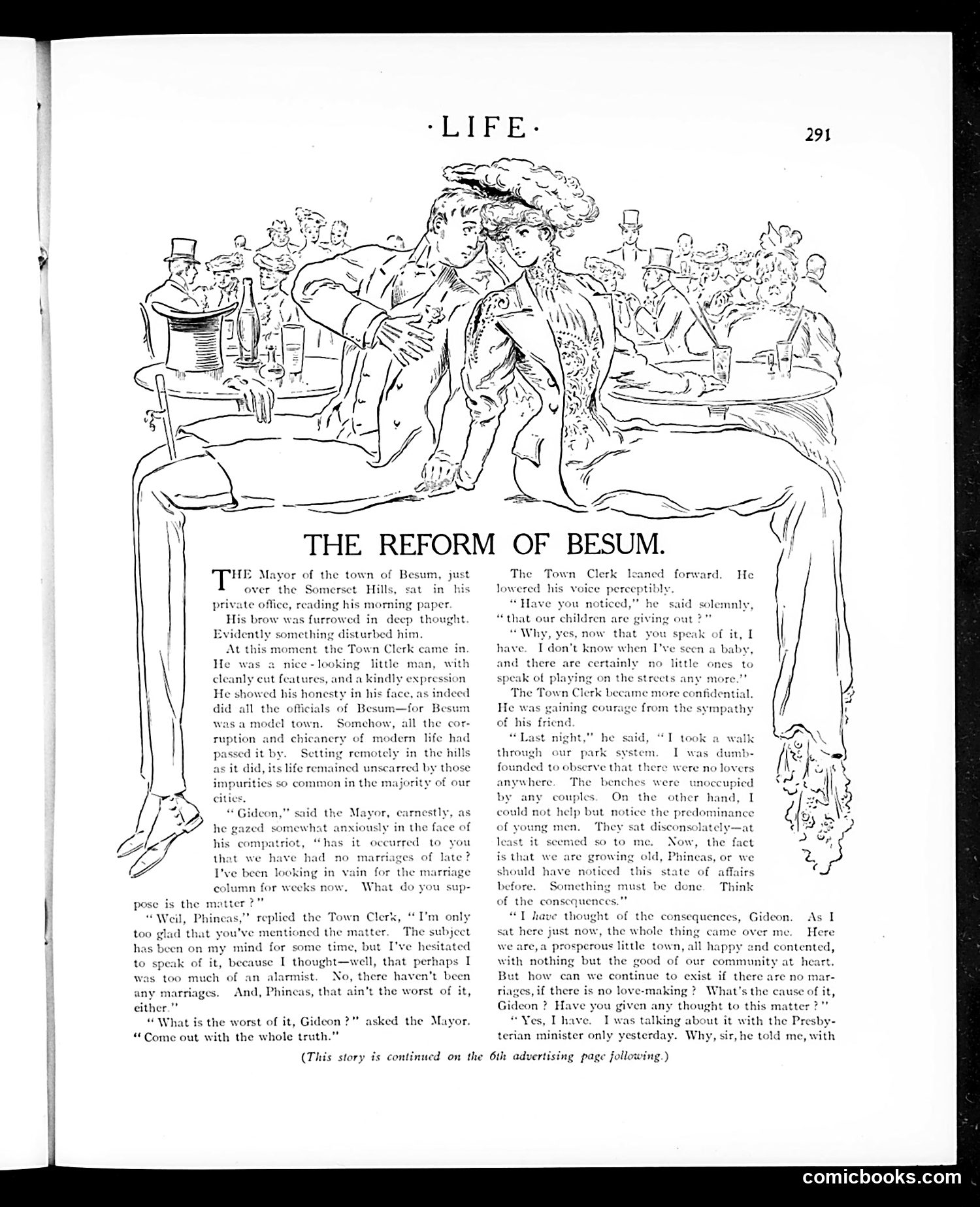
This is a satirical story about a small, model town troubled by a curious social problem: there are no marriages occurring because young people aren't courting or making love in public spaces like parks. The Mayor and Town Clerk—depicted as honest, well-meaning civic officials—discuss this crisis. The Town Clerk has observed that park benches sit empty of courting couples, and young men no longer loiter on streets. He consulted a Presbyterian minister about the cause. The satire targets Victorian-era anxieties about courtship, morality, and social order. The "problem" of declining romance reflects contemporary concerns about changing youth behavior and the loss of traditional matchmaking customs. By treating romance's disappearance as a civic crisis requiring reform, Life mocks both small-town moralism and the period's obsession with regulating public behavior and propriety. The gentle humor lies in presenting romantic decline as a municipal problem demanding official intervention.
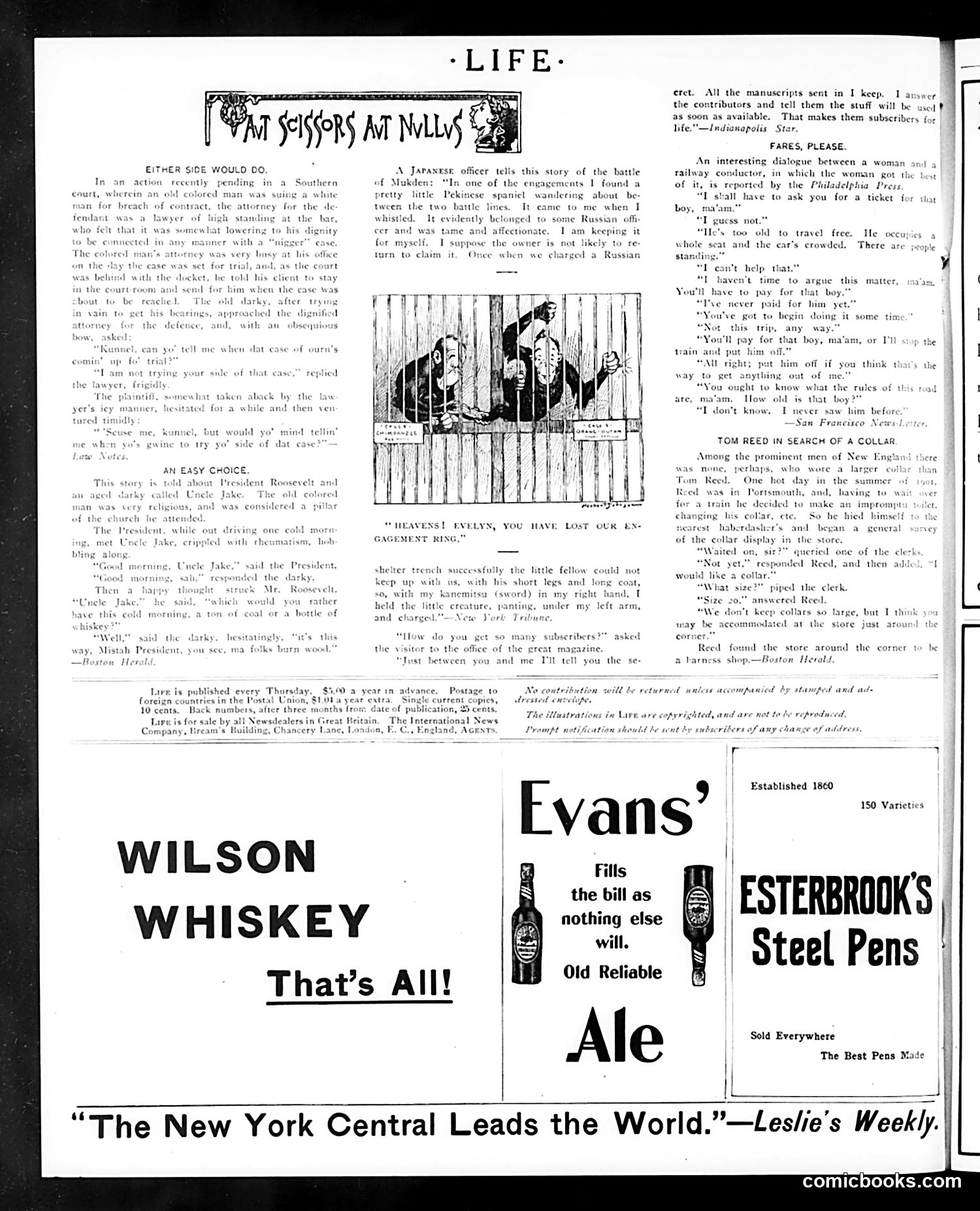
This page contains three separate humorous stories typical of Life's satirical content: **"Either Side Would Do"** depicts a courtroom scene where a defendant's attorney asks the judge when his case will be tried. The satire mocks legal delays and incompetence. **"Fares, Please"** shows a dialogue between a railway conductor and a woman with a young boy. The conductor demands a ticket for the child; she argues he's too old to travel free but too young to have ever paid. The joke plays on the absurdity of their circular logic about the boy's age and fare requirements. **"Tom Reed in Search of a Collar"** references a real public figure (likely Speaker of the House Thomas B. Reed, prominent circa 1890s-1900s). Reed apparently has such a large neck that he cannot find collars to fit, leading to a humorous search around town. The satire gently mocks his physical appearance. The page also contains period advertisements for Wilson Whiskey, Evans' Ale, and Esterbrook's Steel Pens, typical of the era's magazine format.
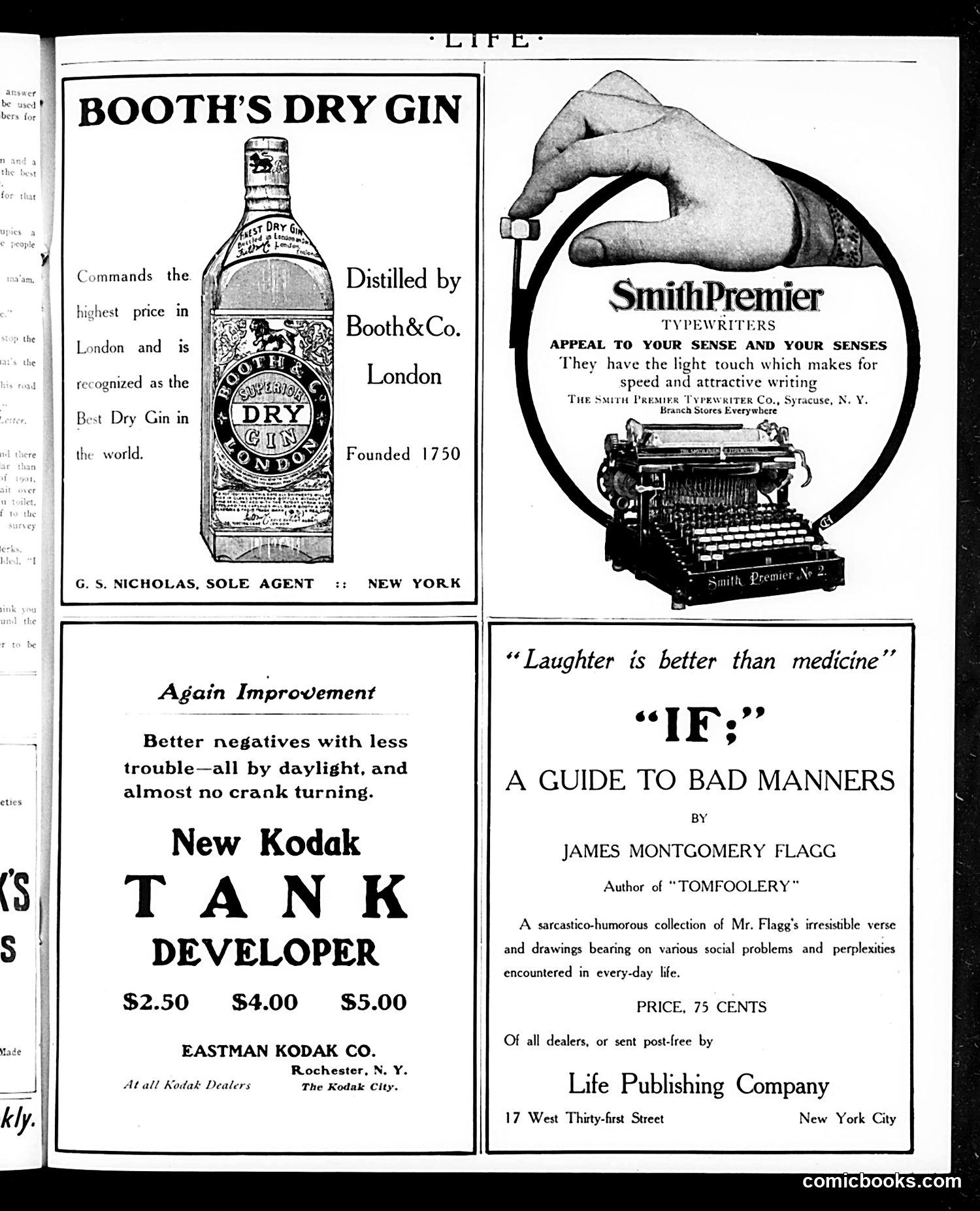
This is primarily an **advertising page** from Life magazine, not a satirical cartoon. It features four unrelated product advertisements typical of early 20th-century magazines: 1. **Booth's Dry Gin** — premium London gin marketed as the world's finest, sold through New York agent G.S. Nicholas 2. **Smith-Premier Typewriters** — emphasizing their "light touch" for speed and attractive writing, manufactured in Syracuse, NY 3. **Kodak Tank Developer** — photography equipment priced at $2.50-$5.00, highlighting daylight processing convenience 4. **"IF;" by James Montgomery Flagg** — a humorous book about bad manners, priced at 75 cents, published by Life Publishing Company The only satirical content is Flagg's book itself, described as "sarcastic-humorous" commentary on social etiquette problems. The page reflects early 1900s consumer culture and Life magazine's dual function as both satirical publication and advertising medium.
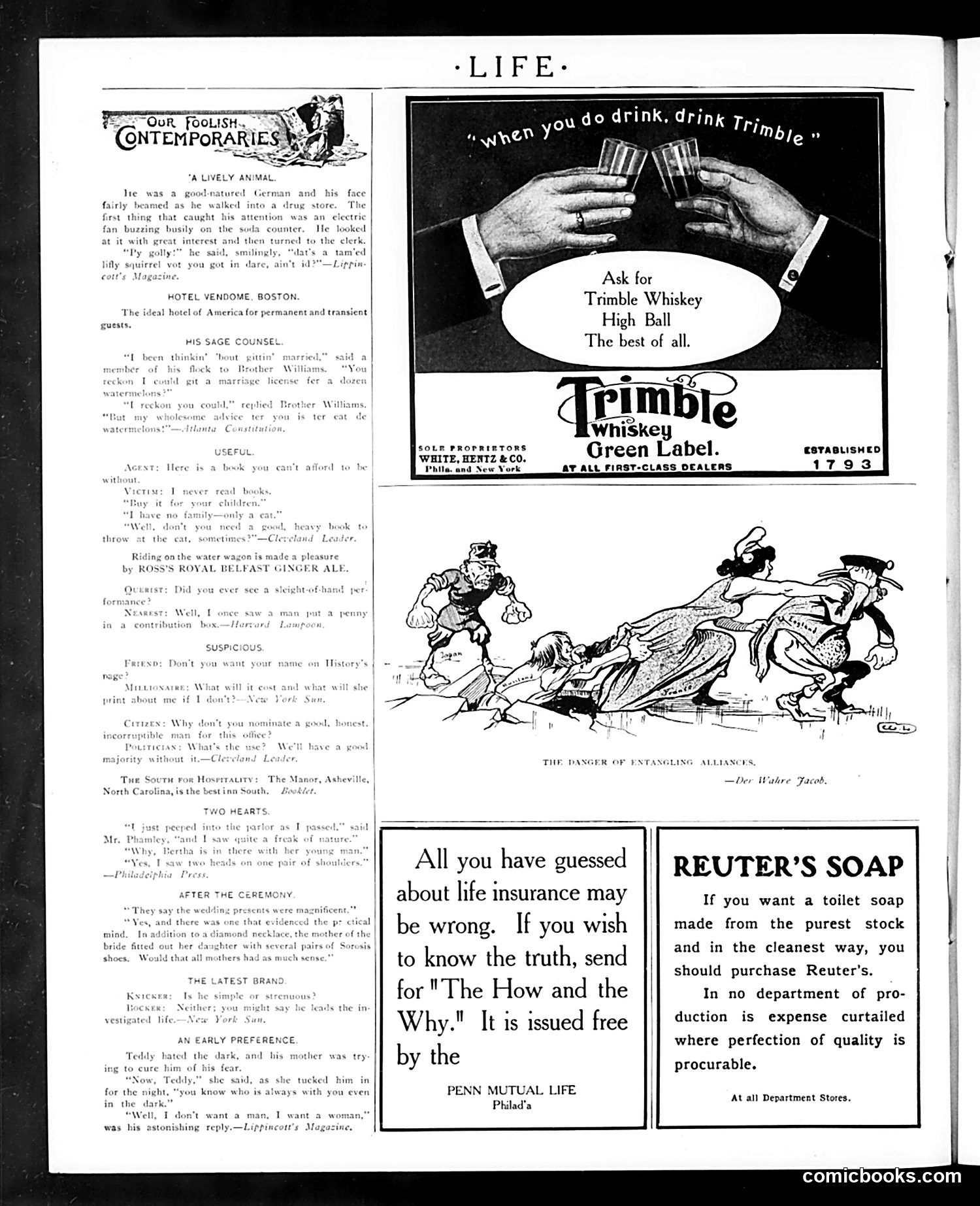
This is primarily an **advertising and humor page** from Life magazine's "Our Foolish Contemporaries" section, featuring satirical anecdotes and period advertisements. **The cartoons/humor:** - Small comic vignettes mock contemporary absurdities: a man impressed by an electric fan in a drugstore, advice about marriage ("reckon you could get a marriage license for a dozen watermelons"), a joke about throwing a cat at someone, and commentary on incorporating a good, honest man into business. - A larger cartoon titled "The Danger of Entangling Alliances" (credited to "Der Wahre Jacob") depicts figures in a tangled, chaotic scene—likely satirizing international political complications of the era, though specific figures aren't clearly identifiable. **The advertisements** promote Trimble Whiskey, Penn Mutual Life Insurance, and Reuter's Soap—typical early 20th-century products with earnest marketing claims about purity and quality. The page reflects Life's satirical approach: mocking social pretension and contemporary follies through brief, punchy humor alongside commercial appeals to readers.
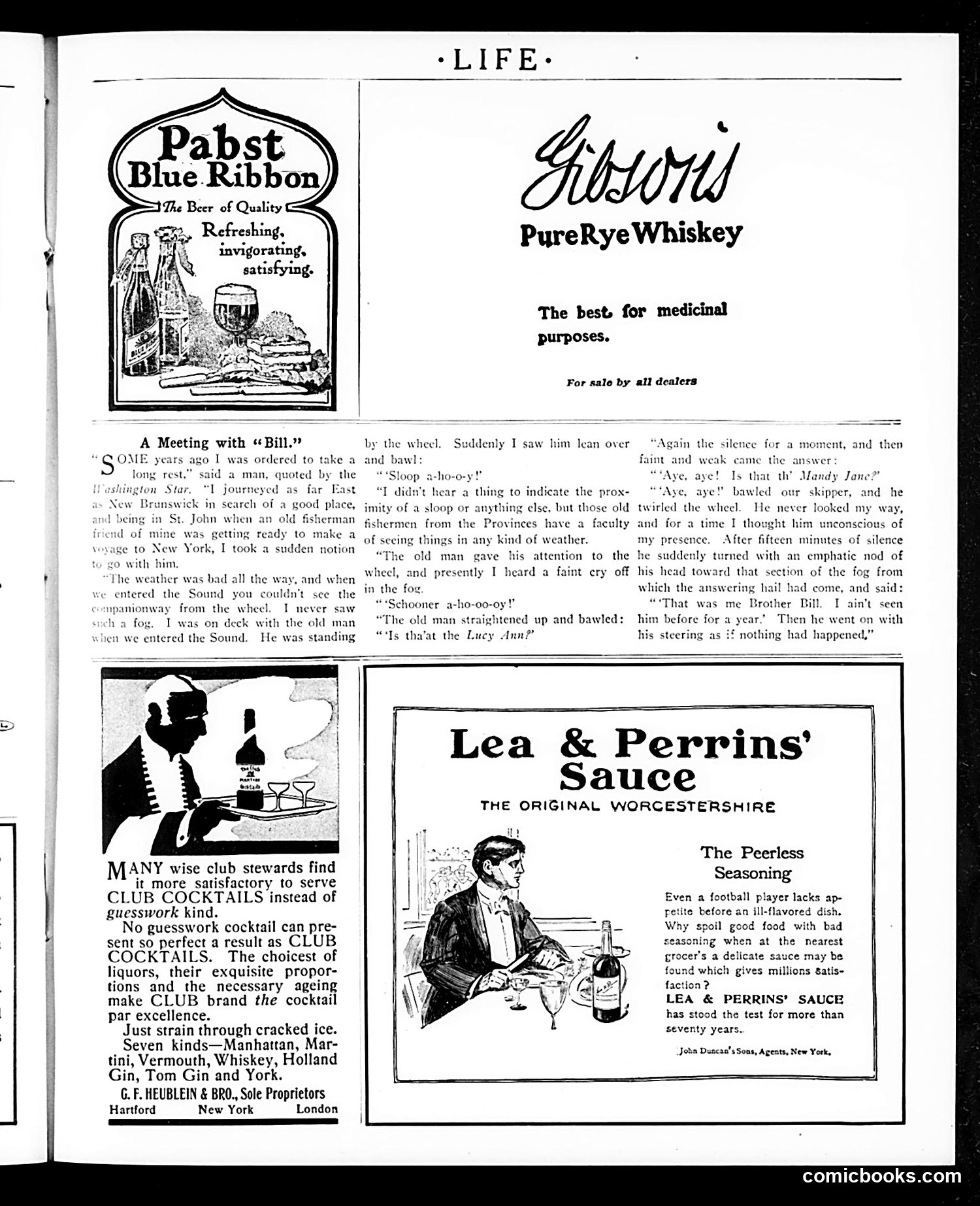
This page features a sentimental humorous story about an old fisherman captain encountering his estranged brother at sea during heavy fog. The captain hears a distant ship's horn call and, through coded maritime signals ("Schooner a-ho-oo-oy," "Is tha'at the Lucy Ann?"), realizes it's his brother Bill's vessel, the *Mandy Jane*. After fifteen minutes of silent recognition, he makes a knowing gesture toward the fog and remarks they haven't seen each other in a year—then calmly resumes steering as if nothing momentous occurred. The humor lies in the understated, stoic New England maritime tradition: an emotionally significant family reunion reduced to brief professional acknowledgment and a matter-of-fact return to duty. No tearful reunion—just old-fashioned taciturn practicality. The page is primarily **advertisements** (Pabst beer, Gideon's whiskey, Lea & Perrins sauce, Club Cocktails) interspersed with this one narrative cartoon/illustration.
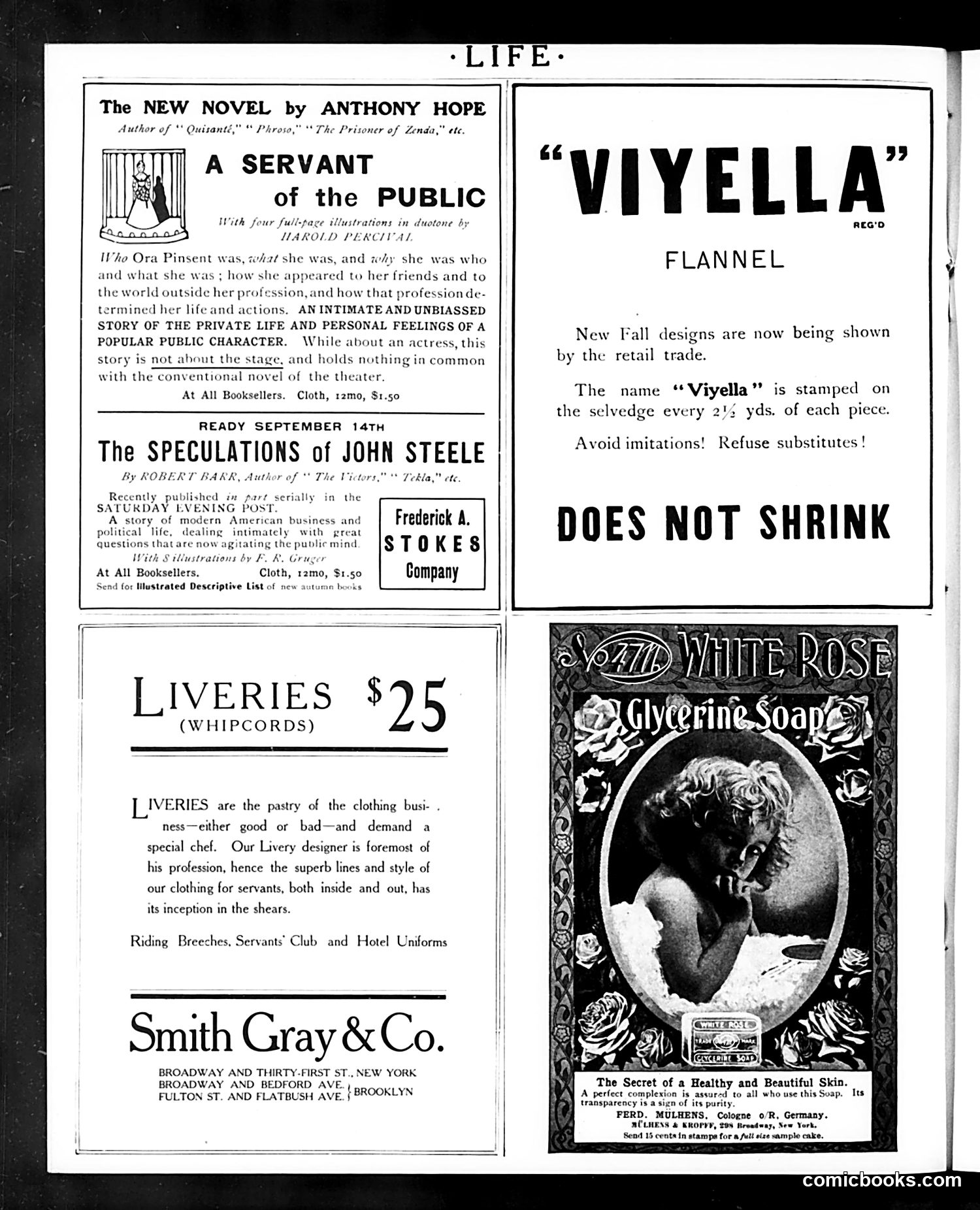
This page is primarily **advertising and book announcements**, not satirical content. It advertises: 1. **Two new novels**: Anthony Hope's "A Servant of the Public" (about an actress named Ora Pinsent) and Robert Barr's "The Speculations of John Steele" (about modern American business) 2. **Commercial products**: Viyella flannel fabric (emphasizing it "does not shrink"), Smith Gray & Co.'s servant liveries and uniforms, and White Rose glycerine soap claiming to produce healthy skin The page reflects **early 20th-century consumer culture** targeting both genteel readers (literary novels) and those concerned with servants' clothing and personal grooming products. The humor is mild—mainly in the soap advertisement's ornate Victorian styling and claims of beauty secrets. No political satire or caricatures are present; this is straightforward period advertising.
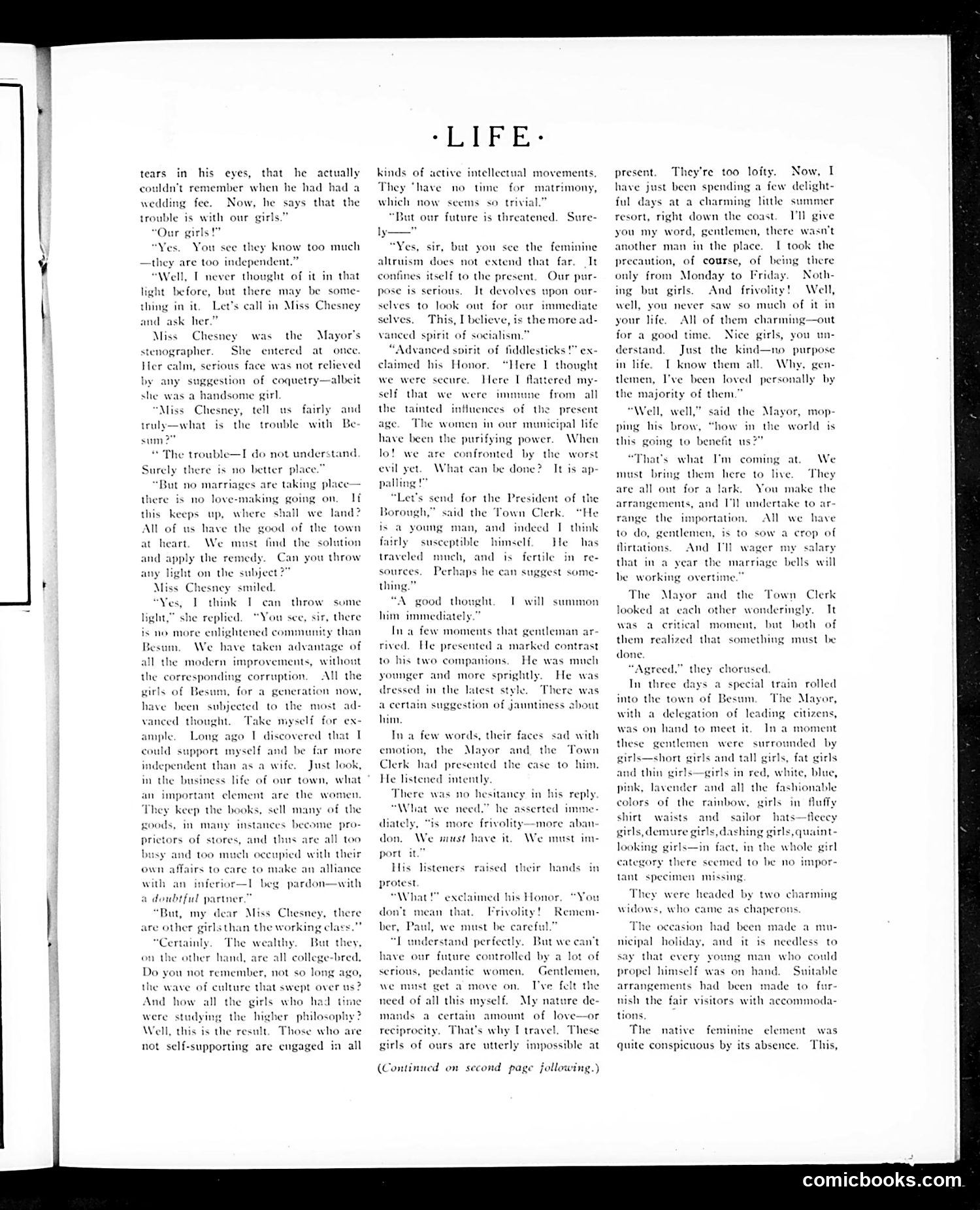
This page presents a satirical dialogue about the decline of courtship and marriage in the fictional town of Besum. A **Mayor and Town Clerk** express concern that no marriages are occurring. They consult **Miss Chesney**, the Mayor's stenographer, who diagnoses the problem: modern women have become economically independent through education and employment, making marriage less attractive. They pursue intellectual interests and careers rather than matrimony, which now "seems so trivial." The satire targets **late-19th/early-20th-century anxieties** about women's independence and suffrage. The "solution" proposed by a visiting **young President of the Borough** is darkly ironic: he recommends more "frivolity" and "abandonment"—suggesting women should abandon their independence and intellectual pursuits to restore traditional romance. The cartoon mocks both the paternalistic officials who view independent women as a social problem, and the shallow "solution" that would reverse women's progress. It's social commentary on resistance to female emancipation.
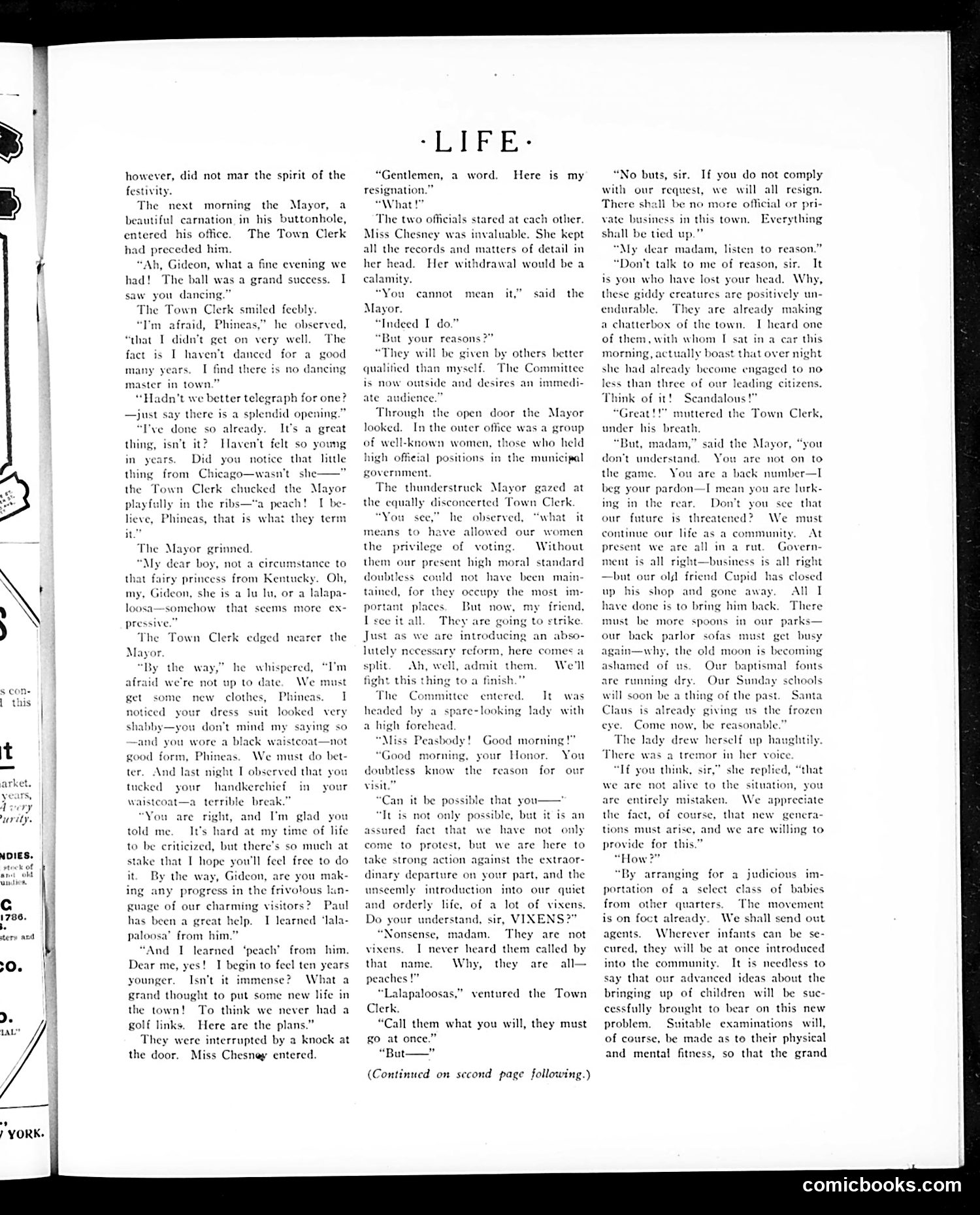
This appears to be a satirical story about small-town gender politics and women's suffrage. The plot centers on a mayor and town clerk who, after hosting a festive ball with visiting women, become enamored with modernizing their town—but this progressive impulse clashes with their traditional values. The satire peaks when Miss Peasbody leads a delegation of women (called "vixens") to demand the mayor's resignation, explicitly because he allowed women the vote. The mayor's contradictory position is the joke: he celebrates women's participation while simultaneously fearing their actual power and influence. The piece mocks both small-town conservatism and the tension between lip-service progressivism and genuine resistance to women's political equality. References to acquiring "new clothes," learning fashionable language from visitors, and installing golf links satirize provincial attempts at sophistication while their core attitudes remain reactionary. The text criticizes how women's suffrage threatens the "high moral standard" men claimed women provided—implying women's actual political voice undermines male authority structures.
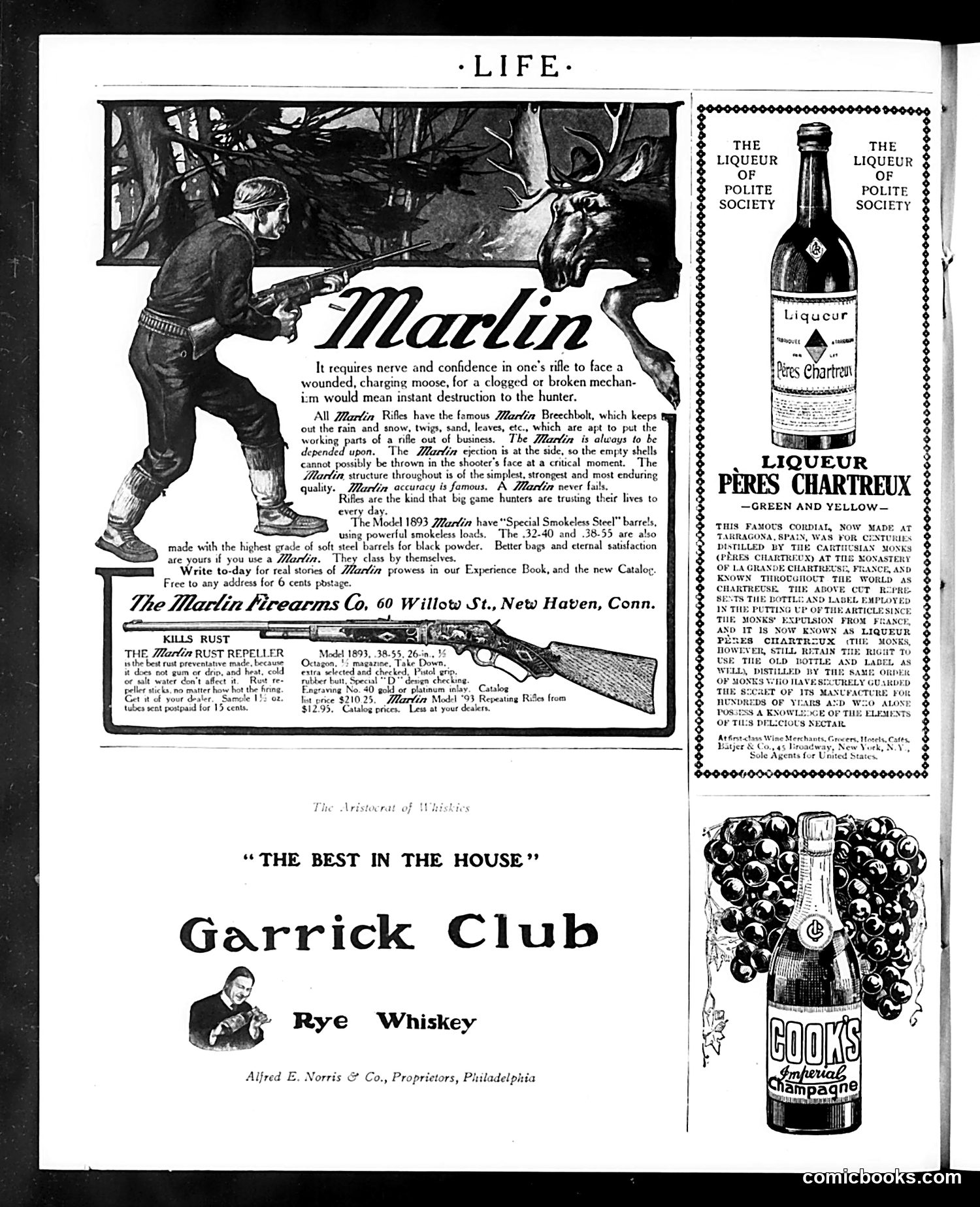
This page is primarily **advertising**, not satire or political commentary. The main advertisement features the **Marlin rifle**, positioned with an illustration of a hunter confronting a wounded moose. The copy emphasizes the rifle's mechanical reliability—specifically its breechbolt design that keeps out debris and its side-ejection system that won't throw empty shells in the shooter's face. The appeal is to big-game hunters who depend on their weapons for survival. Below this is the **Marlin Rust Repeller** advertisement, marketed as rust prevention for firearms. The right side features luxury product advertisements: **Pères Chartreux liqueur** (a green-and-yellow cordial made by Carthusian monks in France) and **Cook's Imperial Champagne**, both marketed as products of refined, "polite society." At the bottom is a **Garrick Club Rye Whiskey** advertisement. These ads reflect early 20th-century consumer culture targeting affluent readers interested in hunting equipment and imported luxury goods.
This page presents a serialized satirical story about a town's response to a **women's strike**—likely referencing early 20th-century labor activism and suffrage movements. The plot concerns a character named Paul who has encouraged female visitors to the town to recruit reinforcements for what appears to be a women's labor action. Male town officials (the Mayor, Town Clerk, and Paul) debate whether to resist or compromise with striking women workers who've abandoned their jobs. The satire targets **male anxiety about women's independence and organizing power**. The men dismiss the women as frivolous ("lovely creations in pink and white") while worrying their absence will corrupt civic life. Paul's strategy—enlisting "lonesome girls along the coast" as reinforcements—mocks both the seriousness of women's grievances and male fears of organized female power. The tone is light but pointed: the story ridicules male condescension toward women's strikes while depicting women as a formidable force the town cannot ignore. This reflects contemporary cultural anxieties about women's increasing public activism.
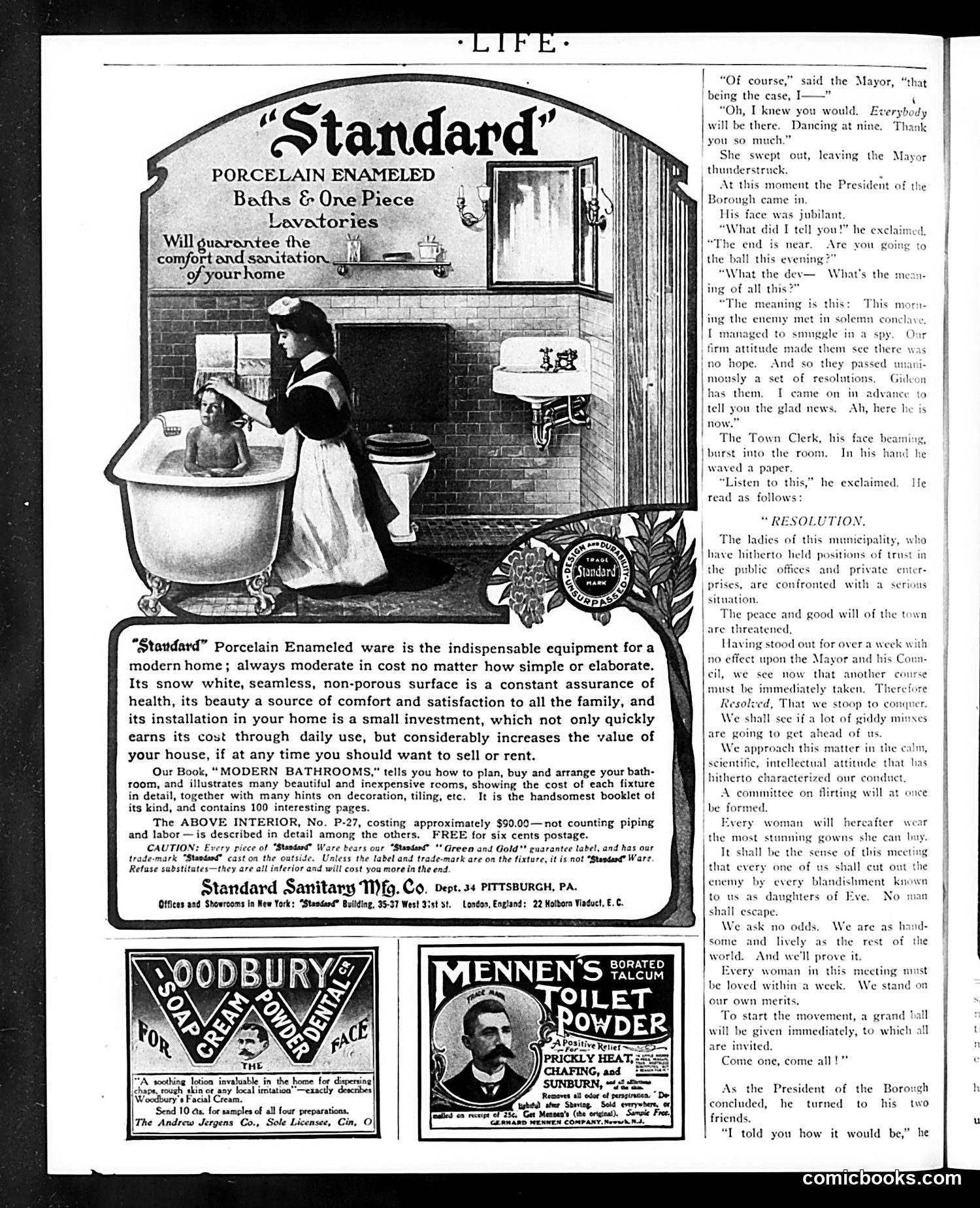
This page is primarily **advertising**, not political satire. The dominant content features a "Standard" porcelain bathroom fixtures advertisement showing a maid and child in a modern bathroom—promoting sanitized home interiors as status symbols and health improvements. The text narrative on the right appears to be a humorous **domestic/political story** (not a cartoon): a Mayor receives an invitation to a ball from a woman, then learns that the town's women have organized a resolution demanding attention after being ignored for a week. A "committee on flirting" will apparently use charm and fine gowns to win concessions from male officials. The joke plays on **gender politics of the era**—women leveraging social power and appearance as negotiating tools when formal petitions fail. The tone is lighthearted domestic comedy rather than serious satire. Bottom advertisements include Woodbury's Facial Cream and Mennen's Toilet Powder—typical period products marketed to women.
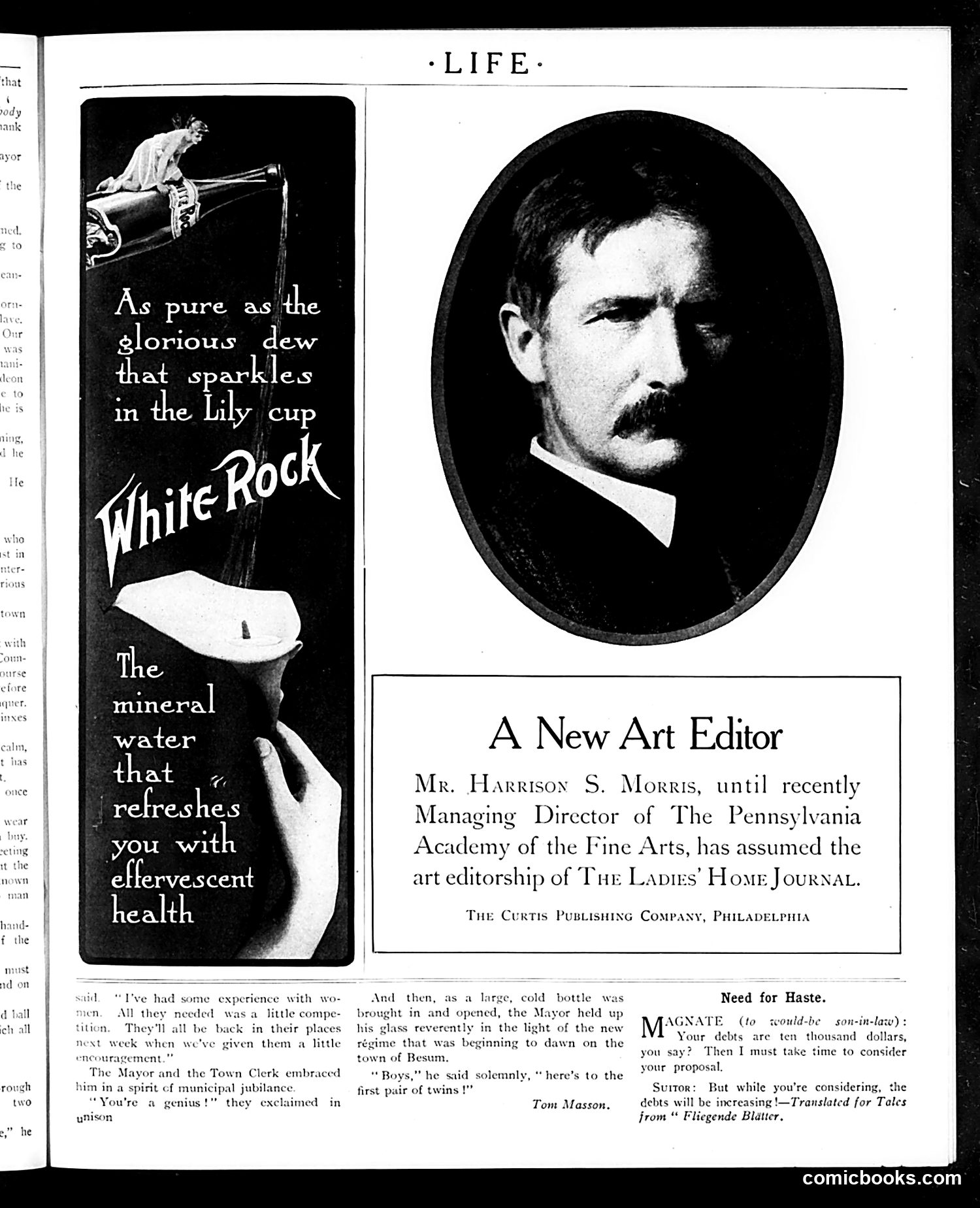
This page contains **three separate items**, not a unified cartoon: 1. **White Rock Mineral Water Advertisement** (left): A product ad using poetic language about purity and refreshment—typical early 20th-century marketing. 2. **"A New Art Editor" Announcement** (center): Professional news that Harrison S. Morris has become art editor of *The Ladies' Home Journal*, transitioning from directing the Pennsylvania Academy of the Fine Arts. This is straightforward institutional news, not satire. 3. **"Need for Haste" Joke** (bottom right): A brief comedic piece where a prospective father-in-law delays considering a poor suitor's marriage proposal, reasoning that while he deliberates, the man's debts accumulate—making the situation worse. It's a joke about procrastination backfiring, translated from a German humor publication. The page is **primarily advertising and announcements** rather than political satire. Only the small "Need for Haste" item qualifies as humor content.
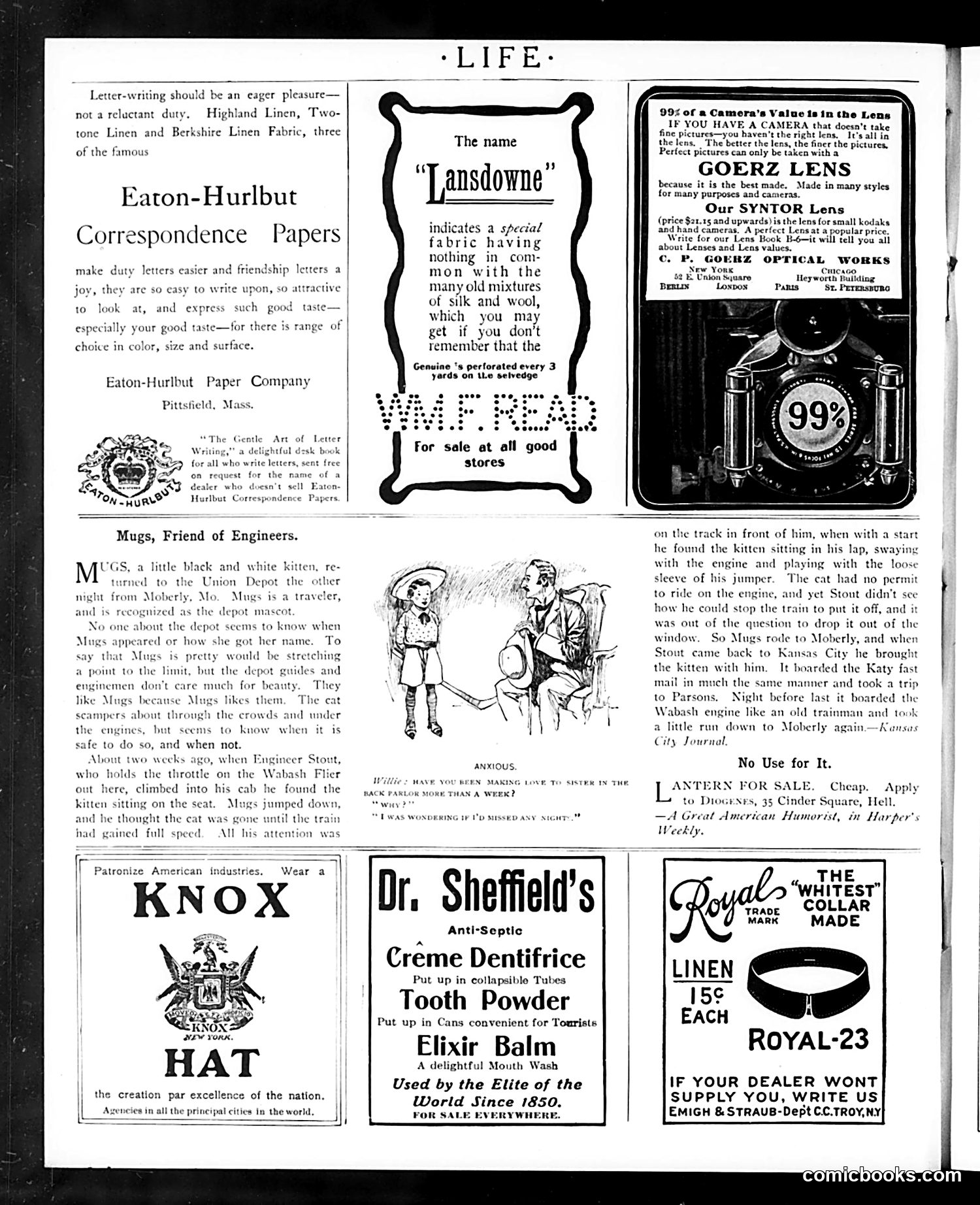
This page is primarily **advertising with one short humor piece** ("Mugs, Friend of Engineers"). ## The Main Story: "Mugs, Friend of Engineers" The illustrated narrative describes a stray cat that unexpectedly rides railroad engines between Missouri and Kansas. Engineer Stout finds the kitten sitting in his lap while operating the Wabash Flyer, then discovers it later boarding other trains independently. The story presents this as charming workplace folklore—the cat has become an unofficial mascot among depot workers who tolerate its presence despite lacking official permission. The accompanying illustration shows two railway workers discovering the kitten, capturing the surprise and amusement central to the anecdote. ## The Cartoons A small two-panel joke labeled "ANXIOUS" depicts a couple's domestic situation: the woman asks if her husband has been visiting the back parlor more than a week; he responds he was "wondering if I'd missed any night"—suggesting marital tedium or infidelity concerns through humorous understatement. The remaining content consists of period advertisements for writing paper, camera lenses, hats, toothpowder, and collars—typical early 20th-century magazine fare.
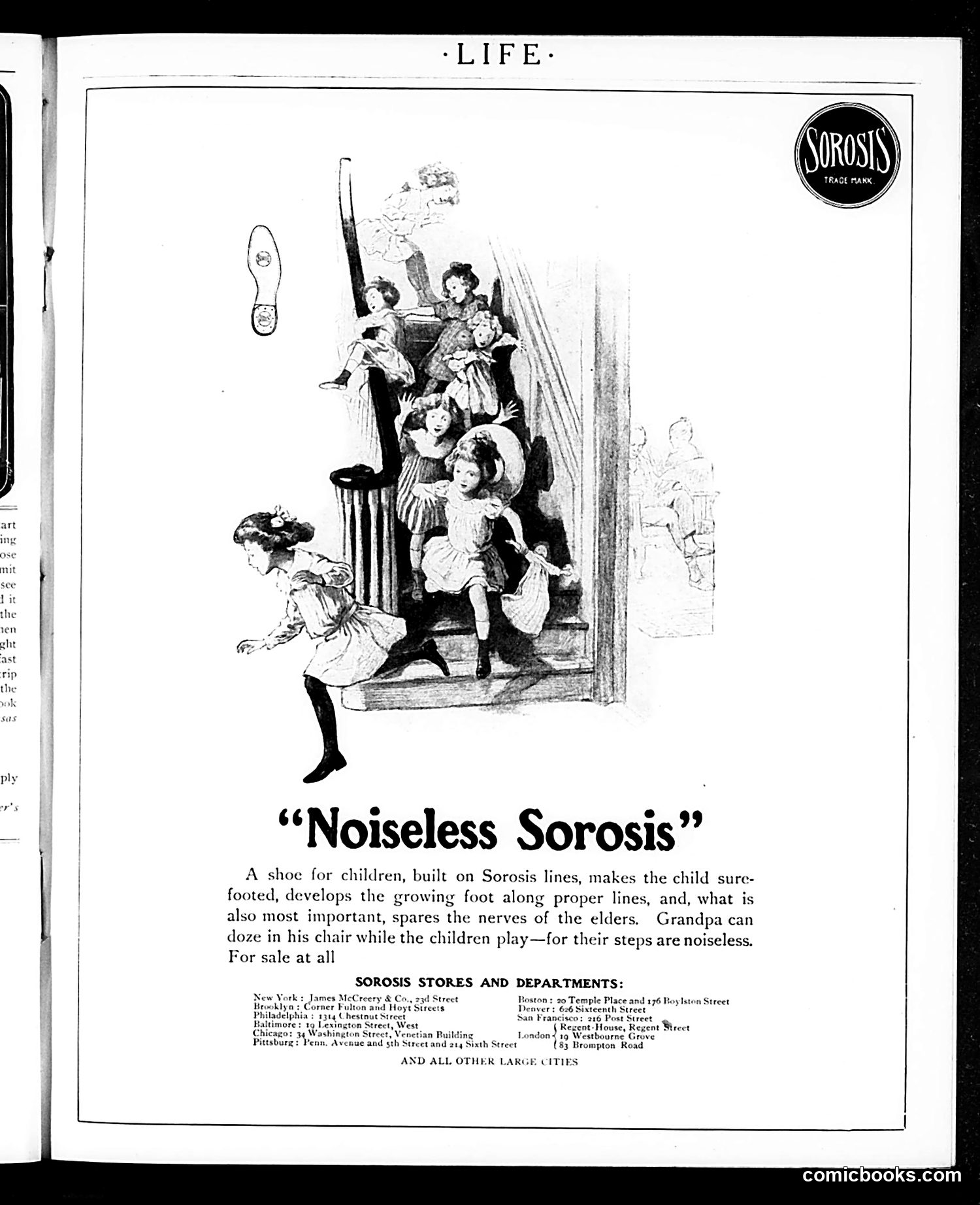
This is a **product advertisement**, not political satire. It promotes Sorosis brand children's shoes, marketed with a humorous domestic appeal rather than social commentary. The illustration shows a **grandfather sleeping in a chair** while **multiple children play energetically** nearby—the joke being that Sorosis shoes are so quiet they won't disturb his rest. The ad's humor targets tired adults: "Grandpa can doze in his chair while the children play—for their steps are noiseless." The appeal combines practical benefits (proper foot development) with emotional relief for exhausted parents and grandparents. This reflects early-20th-century consumer advertising that sold products by promising domestic peace and reduced parental stress. The multiple store locations listed indicate Sorosis was a established, national brand with department store presence across major American cities.
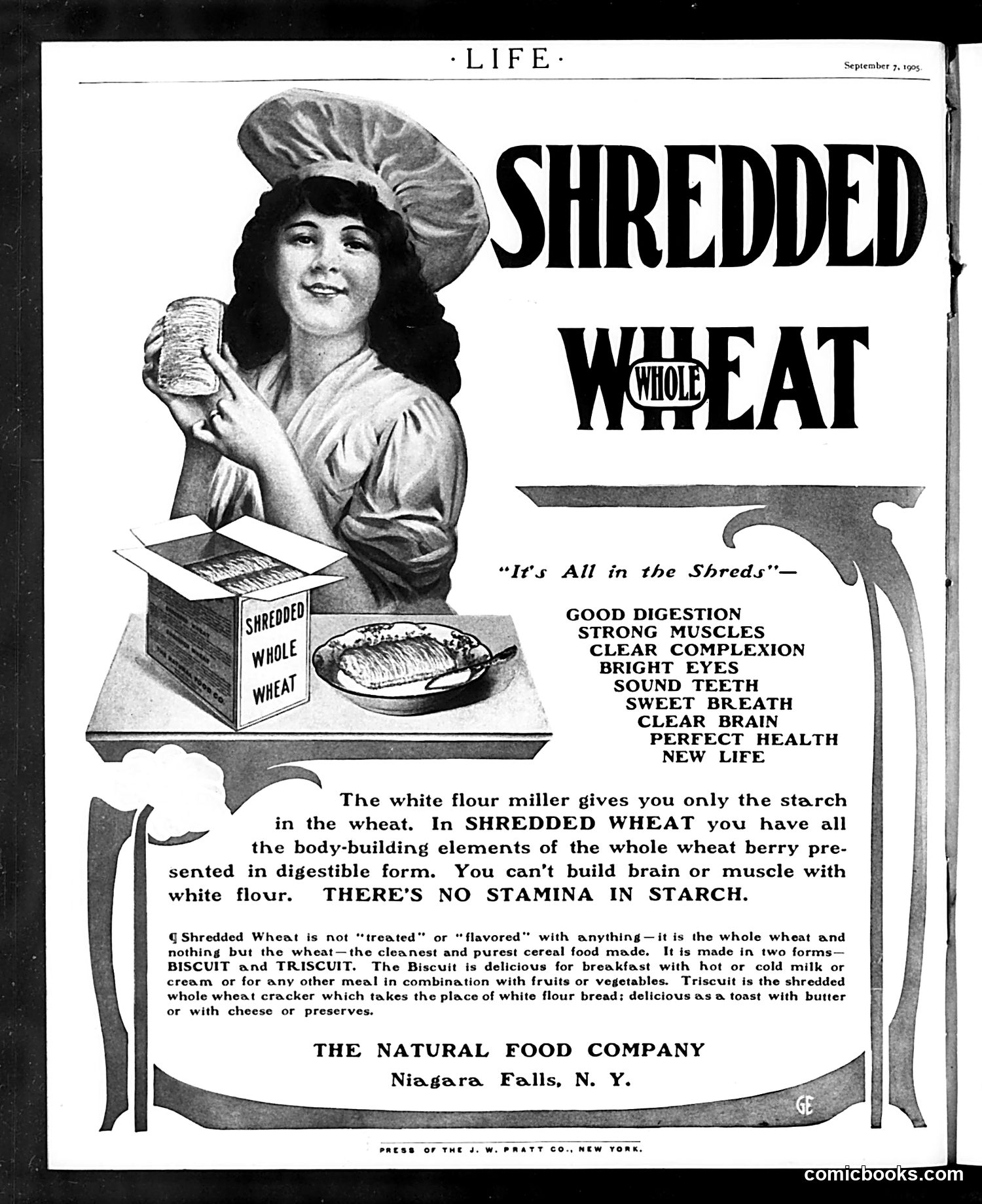
This is a commercial advertisement, not satire. It promotes Shredded Wheat cereal by contrasting whole wheat products against refined white flour. The ad features a woman in period dress holding a box of Shredded Wheat, positioned as an endorsement. The central claim attacks white flour as nutritionally deficient—containing only starch while lacking "body-building elements" needed for "brain or muscle." The list of promised benefits (good digestion, strong muscles, clear complexion, bright eyes, etc.) reflects early 1900s health marketing, when whole-grain foods were promoted as scientifically superior to refined carbohydrates. The company emphasizes their product is "untreated" and "pure"—marketing language addressing consumer concerns about food adulteration, a significant issue at that time. This represents period advertising that makes health claims now considered exaggerated or unsupported.