
Life, 1905-09-07 · page 23 of 42
Life — September 7, 1905 — page 23: what you’re looking at
What you’re looking at
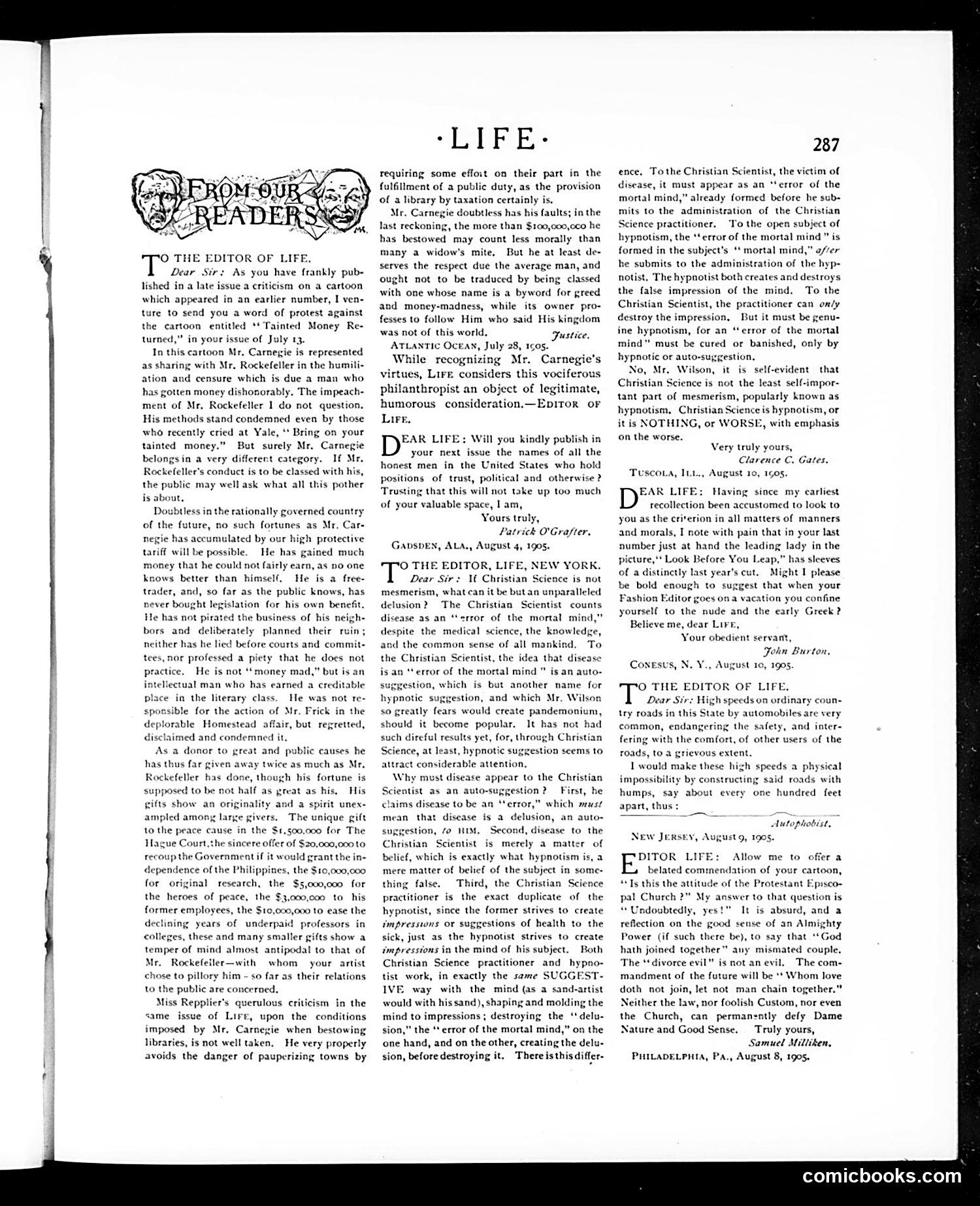
This page consists entirely of **reader letters** responding to Life's editorial content—not original cartoons or satirical illustrations. The main debate concerns a Life cartoon titled "Tainted Money Returned" (July 13) that depicted **Andrew Carnegie alongside John D. Rockefeller**, implying moral equivalence between them. **The satire's point:** A writer defends Carnegie against this comparison, arguing he earned his fortune more honorably than Rockefeller (who faced accusations of monopolistic practices and labor violence, notably the Homestead strike of 1892). Carnegie, the letter argues, is a genuine philanthropist and intellectual—not a "money-mad" industrialist like Rockefeller. **Life's response:** The editor dismisses this defense, saying Carnegie remains fair game for "legitimate, humorous consideration" as a wealthy industrialist regardless of charitable intentions. **Context for modern readers:** This reflects Gilded Age anxieties about industrialists' wealth-gathering methods versus their public images through philanthropy—a debate that remains relevant today.
📄 Transcribed text from this page (OCR, searchable)
Machine-transcribed from the original scan — historical spelling and the odd misread are preserved.
(0 THE EDITOR OF LIFE. Dear Sir: As you have frankly pub- lished in a late issue a criticism on a cartoon which appeared in an earlier number, I ven- ure to send you a word of protest against the cartoon entitled ‘Tainted Money Re- turned,” 1 of July 13. In this cartoon Mr, Carnegie is represented as sharing with Mr, Rockefeller in the humili- ation and censure which is due a man who has gotten money dishonorably. The impeach- ment of Mr, Rockefeller 1 do not question, His methods stand condemned even by those who recently cried at Yale,“ Bring on your tainted money.” But surely Mr. Carnegie belongs in a very different category. If Mr. Rockefeller's conduct is to be classed with his, the public may well ask what all this pother is about, Doubtless in the rationally governed country of the future, no such fortunes as Mr, Care negie has accumulated by our high protective tariff will be possible. He has gained much your iss money that he could not fairly earn, as no one knows better than himself, He is a free trader, and, so far as the public knows, has never bought legislation for his own benefit, He has not pirated the business of his neigh- bors and deliberately planned their rein; neither has he lied before courts and commit- nor professed a piety that he does not practice. He is not “money mad,” but is an intellectual man who has earned a creditable place in the literary class. He was not re- ible for the action of Mr. Frick in the deplorable Homestead affair, but regretted, jimed and condemned it. tee: spon’ dis As a donor to great and public causes he has thus far given away twice as much as Mr. ockefeller has done, though his fortune is supposed to be not half as great as his, His S ‘n originality and a spirit unex- ampled among large givers, The unique gift to the peace cause in th ts show $1,500,000 for The Hague Court, the sincere offer of $20,000,000 to recoup the Government if it would grant the in= dependence of the Philippines, the $10,000,000 for original research, the $5,000,000 for the heroes of peace, the $3,000,000 to his former employees, the $10,000,000 to ease the declining years of underpaid professors in these and many smaller gifts show a temper of mind almost antipodal to that of Mr, Rockefeller—with whom your artist chose to pillory him - so far as their relations to the public are concerned, Miss Repplier’s querulous criticism in the same issue of Lire, upon the conditions imposed by Mr. Carnegie when bestowing libraries, is not well taken, He very properly js the danger of pauperizing towns by col “DIF E= requiring some effoit on their part in the fulfillment of a public duty, as the provision of a library by taxation certainly Mr. Carnegie doubtless has his faults; in the last reckoning, the more than $100,000,0c0 he has bestowed may count less morally than many a widow's mite, But he at least de- serves the respect due the average man, and ought not to be traduced by being classed with one whose name is a byword for greed and money-madness, while its owner pro- fesses to follow Him who said His kingdom was not of this world, Justice. ATLANTIC Ocean, July 28, 1505. While recognizing Mr. Carnegie’s virtues, Lire considers this vociferous philanthropist an object of legitimate, humorous consideration,—Epitor oF Lirr. EAR LIFE: Will you kindly publish in your next issue the names of all the honest men in the United States who hold positions of trust, political and otherwise? Trusting that this will not take up too much of your valuable space, 1am, Yours truly, Patrick O'Grafter. , August 4, 1905. © THE EDITOR, LIFE, NEW YORK. Dear Sir: Mt Christ mesmerism, what can it be but an unparalleled delusion? The Christian Scientist counts disease as an “error of the mortal mind,” despite the medi and the common sense of all mankind, To the Christian Scientist, the idea that disease is an “error of the mortal mind ” is an auto- suggestion, which is but another name for Gavspex, AL jan Science is not al science, the knowledge, hypnotic suggestion, and which Mr. Wilson so greatly fears would create pandemonium, should it become popular, It has not had such direful results yet, for, through Christian Science, at least, hypnotic suggestion seems to attract cons attention, Why must disease appear to the Christian ion? First, he claims disease to be an “error,” which mst mean that disease is a delusion, an auto- suggestion, fo HIM, Second, disease to the Christian Scientist. is merely a matter of belief, which is exactly what hypnotism is, a mere matter of belief of the subject in some- thing false, Third, the Christian Science practitioner is the exact duplicate of the hypnotist, since the former strives to create impressions oF suggestions of health to the sick, just as the hypnotist strives to create impressions in the mind of his subject. Both Christian Science practitioner and hypno- tist work, in exactly the same SUGGE IVE. way with the mind (as a sand-artist would with hissand), shaping and molding the mind to impressions ; destroying the ‘delu- sion,” the error of the mortal mind,” on the ‘one hand, and on the other, creating the delu- sion, before destroying it. ‘There isthis differ- jeral Scientist as an auto-sugg: 287 ence, Tothe Christian Scientist, the victim of disease, it must appear as an “error of the mortal mind,” already formed before he sub- mits to the administration of the Christian Science practitioner. ‘To the open subject of hypnotism, the “error of the mortal mind " is, formed in the subject's * mortal mind,” a/fer he submits to the administration of the hyp- notist, The hypnotist both creates and destroys the false impression of the mind. To the Christian Scientist, the practitioner can on/y destroy the impression, But it must be genu- ine hypnotism, for an “error of the mortal mind” must be cured or banished, only by hypnotic or auto-suzgestion, No, Mr, Wilson, it is self-evident that Christian Science is not the least self-impor- tant part of mesmerism, popularly known as hypnotism, Christian Science is hypnotism, or it is NOTHING, or WORSE, with emphasis on the worse. Very truly yours, Clarence C, Gates. August 10, 1905. D™s LIFE: Having since my earliest recollection been accustomed to look to you as the criterion in all matters of manners and morals, I note with pain that in your last number just at hand the leading lady in the picture,‘ Look Before You Leap,” has sleeves of a distinctly last year’s cut, Might I please be bold enough to suggest that when your Fashion Editor goes ona vacation you confine yourself to the nude and the early Greek? Believe me, dear Lire, Your obedient servant, John Burton, Coxesus, N. Y., August 10, 1905, Tuscoa, It. 0 THE EDITOR OF LIFE, Dear Sir: High speeds on ordinary coun- try roads in this State by a ery common, endangering the safety, and inter- fering with the comfort, of other users of the roads, to a grievous extent, I would make these high speeds a physical impossibility by constructing said roads with omobiles are humps, say about every one hundred feet apart, thus : Autophobist, New Jersey, Augustg, DITOR LIFE: Allow me to offer a belated commendation of your cartoon, “Is this the attitude of the Protestant Episco- pal Church 2” My answer to that question is “Undoubtedly, yes!” It is absurd, and a reflection on the good sense of an Almighty Power (if such there be), to say that God hath joined together” any mismated couple, ‘The ‘divorce evil” is not an evil, The com- mandment of the future will be ** Whom love doth not join, let not man chain together." Neither the law, nor foolish Custom, nor even the Church, can permansntly defy Dame ‘ature and Good Sense, Truly yours, Samuel Milliken, Puttavetpnta, Pa., August 8, 1905. comicbooks.com