
A complete issue · 26 pages · 1905
Life — June 8, 1905
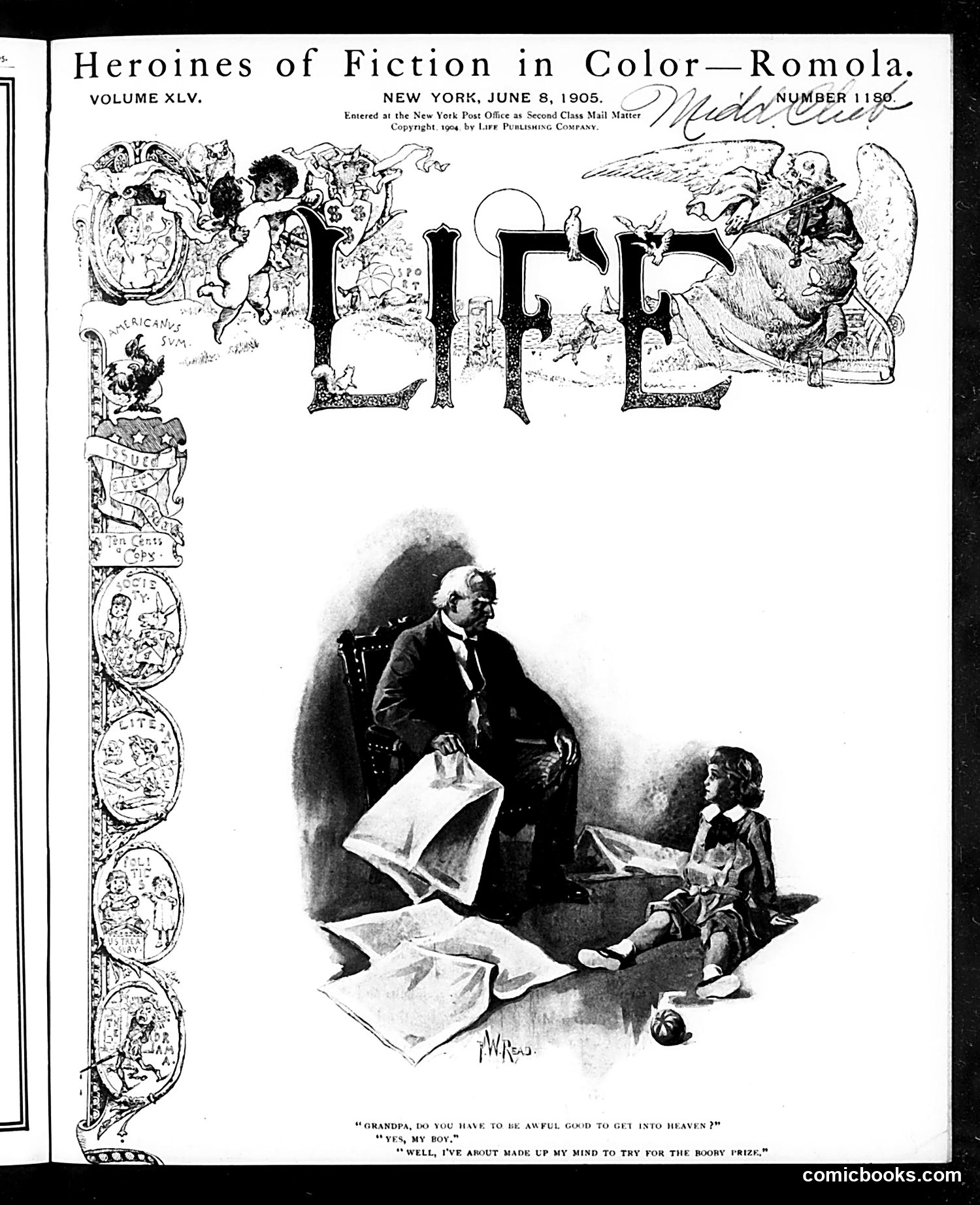
This page features a satirical cartoon about religious instruction and moral behavior. The central image shows an older gentleman (appearing to be a grandfather or authority figure) speaking with a young boy. The caption reads: "Grandpa, do you have to be awful good to get into Heaven?" to which he replies "Yes, my boy," followed by "Well, I've about made up my mind to try for the Booby Prize." The joke satirizes adult hypocrisy—the grandfather acknowledges heaven requires moral virtue but admits he's abandoned that pursuit, instead settling for a "booby prize" (a consolation award given mockingly). This mocks the disconnect between religious teachings about virtue and actual adult behavior, a common target of turn-of-the-century American satirical humor.
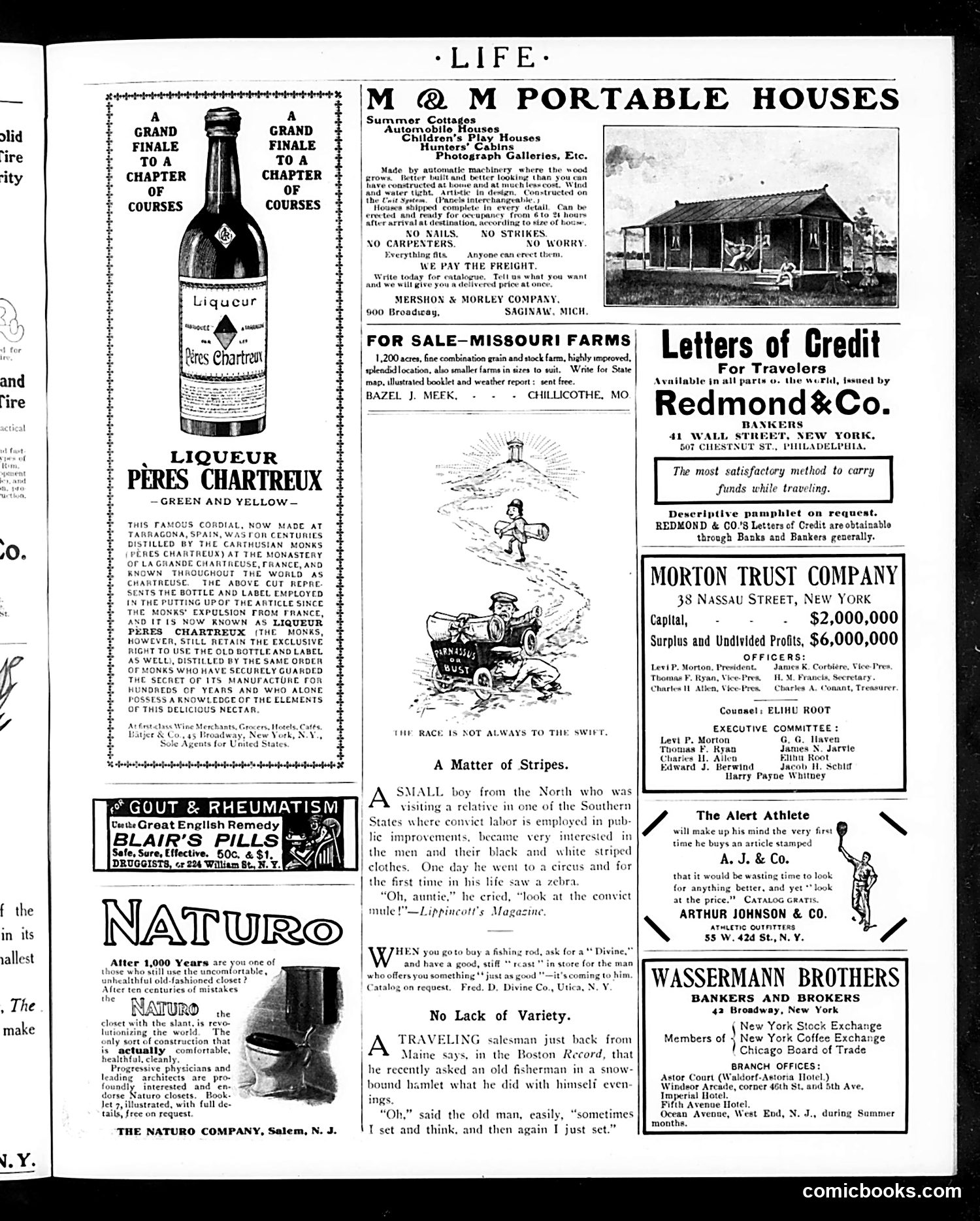
This page is primarily **advertising with minimal editorial content**. The advertisements include: - **Liqueur Pères Chartreux** (left): A lengthy historical advertisement for French liqueur - **M & M Portable Houses** (top right): Summer cottages and prefabricated housing - **Various financial services**: Redmond & Co. (letters of credit), Morton Trust Company, Wassermann Brothers (bankers) - **Consumer products**: Blair's Pills (gout remedy), Naturo clothing closets, Alert Athlete sportswear The only editorial content appears to be two brief humorous anecdotes titled "The Race Is Not Always to the Swift" and "No Lack of Variety"—light comedic pieces about a circus-visiting boy and a fishing salesman, typical of Life's gentle humor. The page reflects early 20th-century magazine composition: advertising heavily subsidized editorial content.
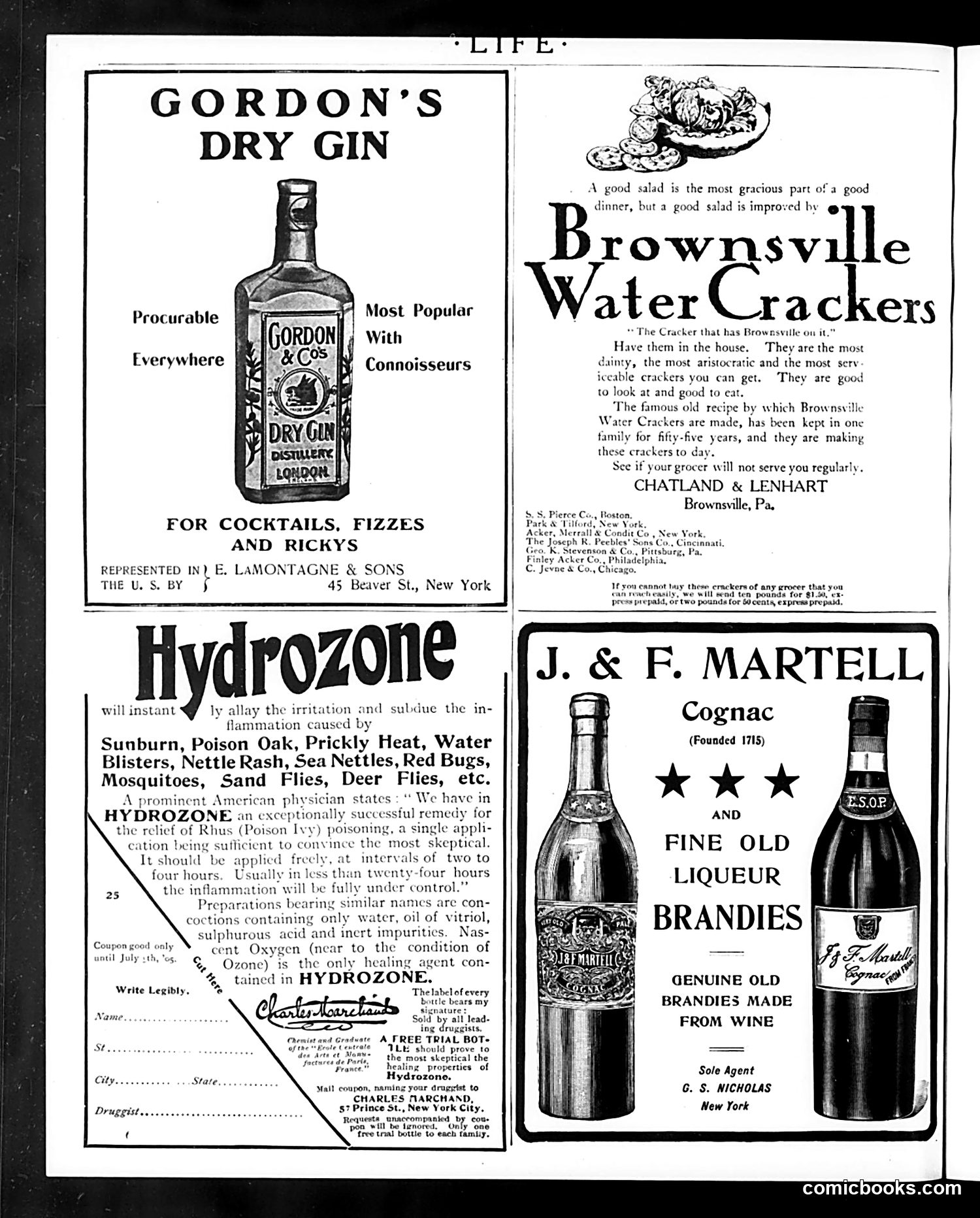
This page contains **no political cartoons or satirical content**. It is entirely composed of **four commercial advertisements** from what appears to be an early 20th-century issue of Life magazine: 1. **Gordon's Dry Gin** – promoting the London-distilled spirits brand 2. **Brownsville Water Crackers** – advertising artisanal crackers from Pennsylvania 3. **Hydrozone** – a medical remedy claiming to treat various skin conditions and insect bites 4. **J. & F. Martell Cognac** – promoting French brandy and liqueurs The page reflects the magazine's revenue model through luxury goods advertising rather than satirical commentary. The Hydrozone ad includes a coupon for trial bottles, typical of patent medicine marketing from this era.
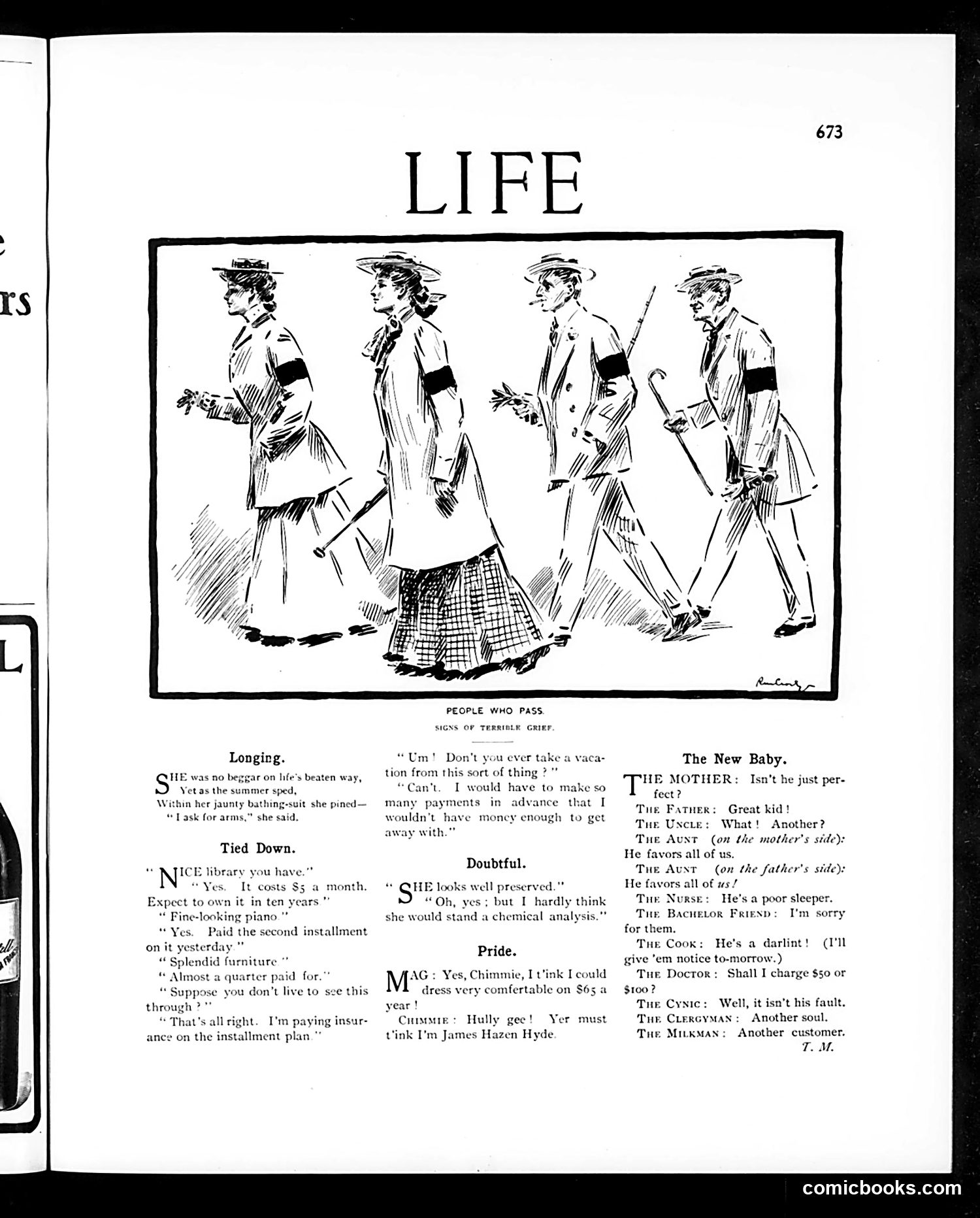
The main cartoon depicts four figures in mourning attire with black armbands, illustrating the caption "People Who Pass: Signs of Terrible Grief." Below are several satirical vignettes about financial hardship and social anxiety, likely from the early 20th century: - "Longing" and "Tied Down" mock those yearning for vacations while burdened by installment debt - "Doubtful" satirizes concerns about chemical analysis and preservation - "Pride" jokes about affording fashionable dress on limited means ($65/year) - "The New Baby" humorously depicts family responses to a newborn, with various relatives offering conflicting advice The overall theme satirizes middle-class financial anxieties, consumer culture, and domestic obligations of the era. The humor derives from recognizable social situations rather than specific political figures or events.
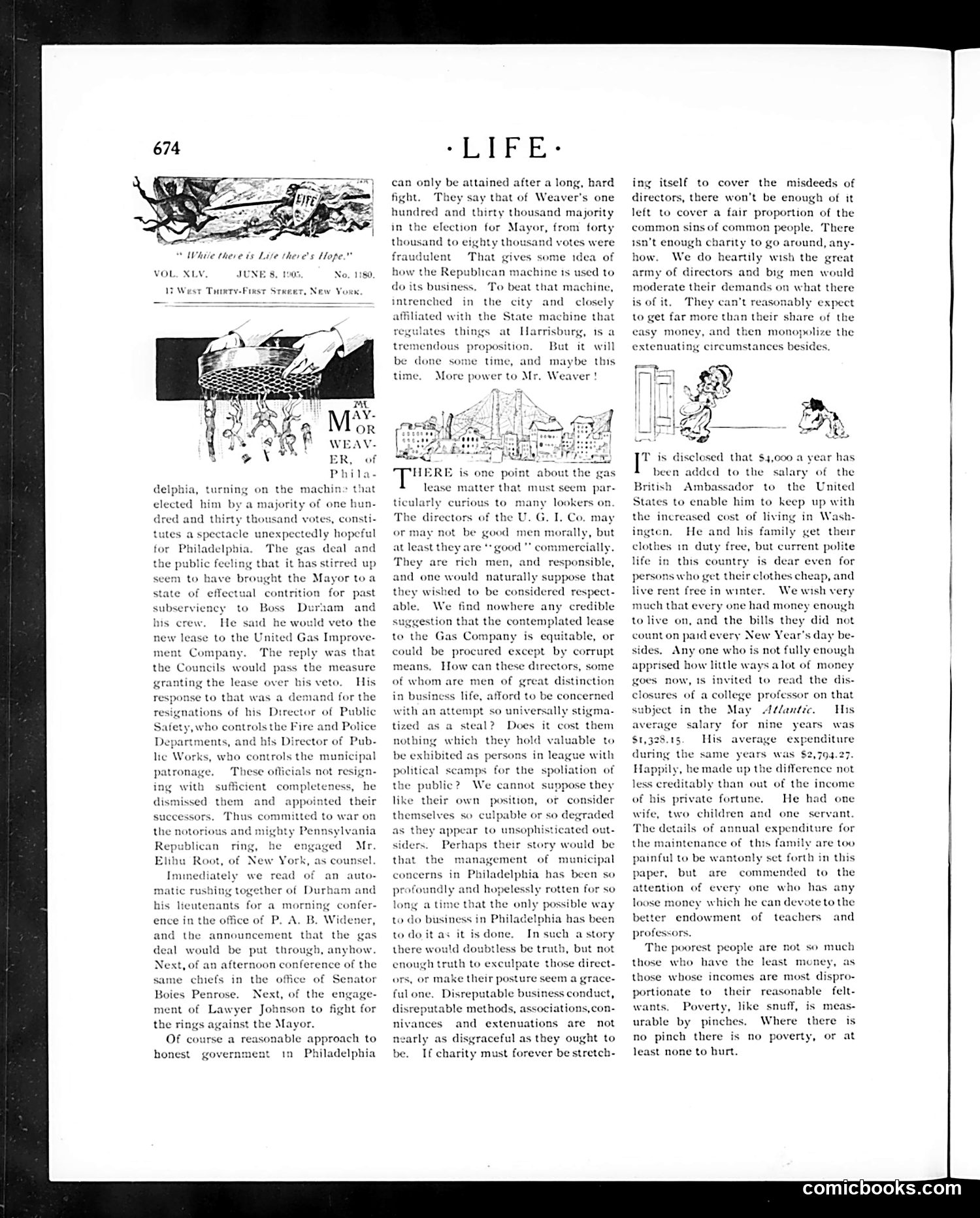
This page features editorial commentary on Philadelphia politics, specifically addressing Mayor Weaver's election victory and subsequent gas company lease negotiations. The main cartoon (top left) depicts the Republican political machine's power, illustrated with figures being controlled like puppets, referencing the "machine that elected him" with 130,000 votes. The central illustration shows a cityscape, likely Philadelphia, representing the urban political arena under discussion. The editorial criticizes the Gas Company lease deal as potentially corrupt, questioning whether the company directors—described as wealthy but morally questionable men—obtained it through improper means. The text suggests such "disreputable business conduct" undermines public trust in municipal government. The piece argues that honest government requires transparency and ethical conduct, not backroom dealings between political machines and corporate interests.
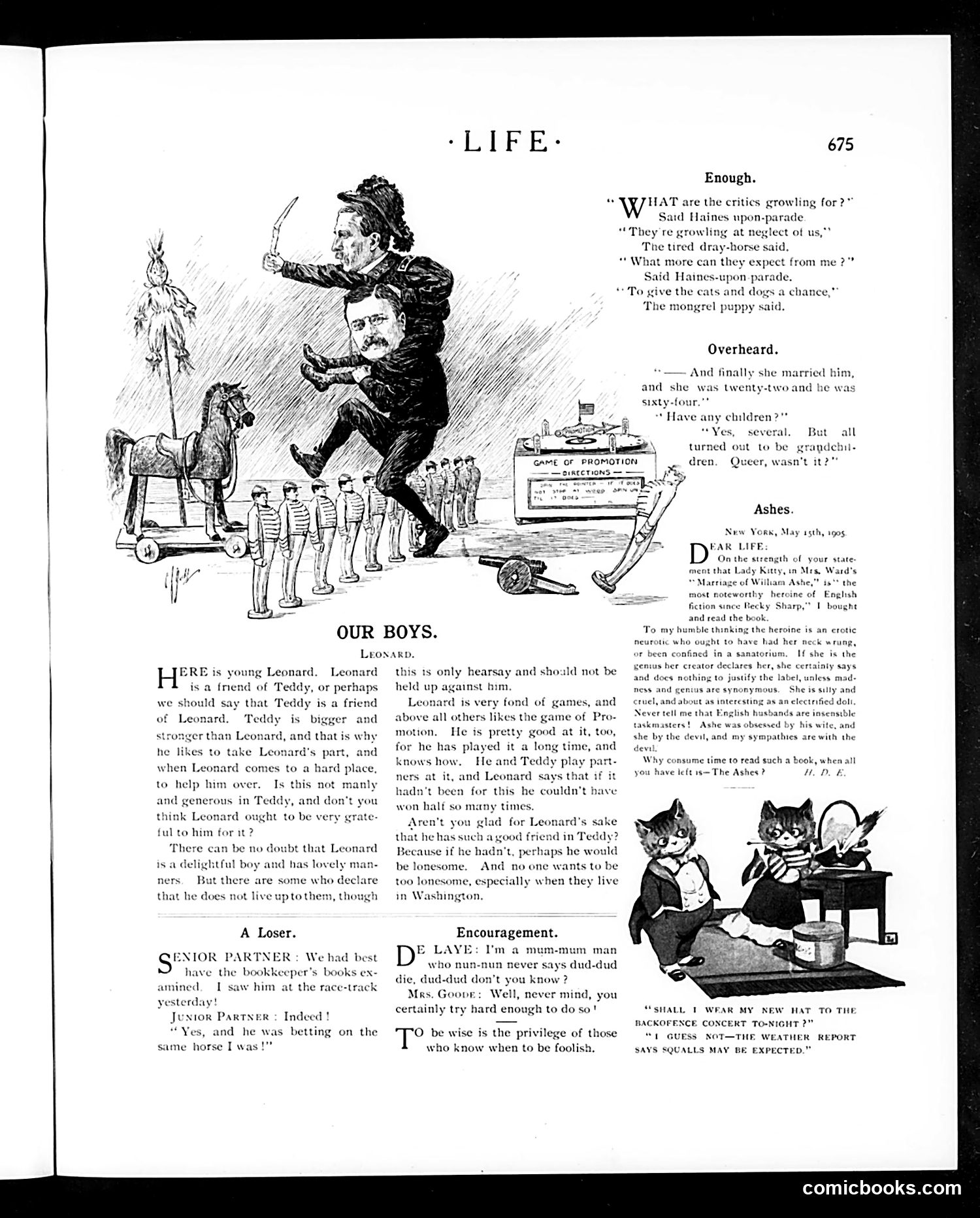
This page contains multiple short humor pieces and cartoons typical of Life magazine's satirical content. The main illustration depicts a man being thrown from a horse while holding a woman, with onlookers below—likely satirizing a specific political or social scandal, though the exact reference is unclear without additional context. The written sections include: - **"Our Boys"**: A dialogue about a boy named Leonard and his friendship with Teddy - **"A Loser"**: A brief exchange between partners about horse racing - **"Encouragement"**: A comic exchange about being "foolish" - **"Ashes"**: A letter criticizing a fictional character named Lady Kitty from English fiction The page represents Life's mix of visual and textual humor targeting contemporary figures, relationships, and social pretensions of early 1900s American society.
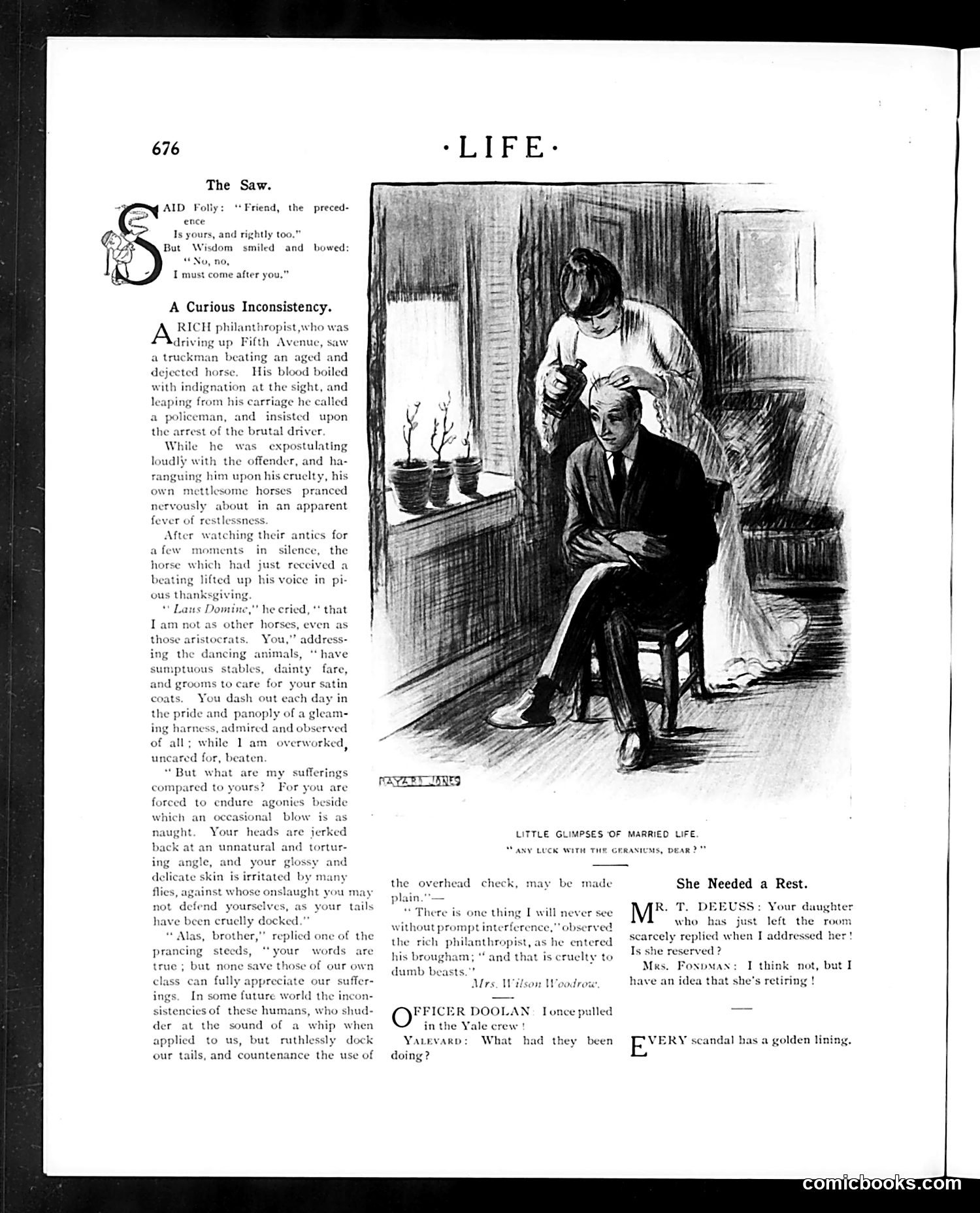
This page contains three distinct pieces of satirical content: 1. **"The Saw"** - A brief dialogue between characters named Folly and Wisdom, presenting contrasting perspectives on precedent and rules. 2. **"A Curious Inconsistency"** - A longer satirical story about a wealthy Fifth Avenue philanthropist who publicly denounces animal cruelty while his own horses are mistreated and nervously prancing. The story highlights hypocrisy: he lectures others about animal care while his own animals suffer from neglect and abuse. The horses themselves offer commentary on this moral contradiction. 3. **"Little Glimpses of Married Life"** - A cartoon illustration showing a domestic scene with accompanying humor about marriage. The page's overall theme satirizes Victorian-era hypocrisy, particularly among the wealthy elite regarding moral principles versus actual behavior.
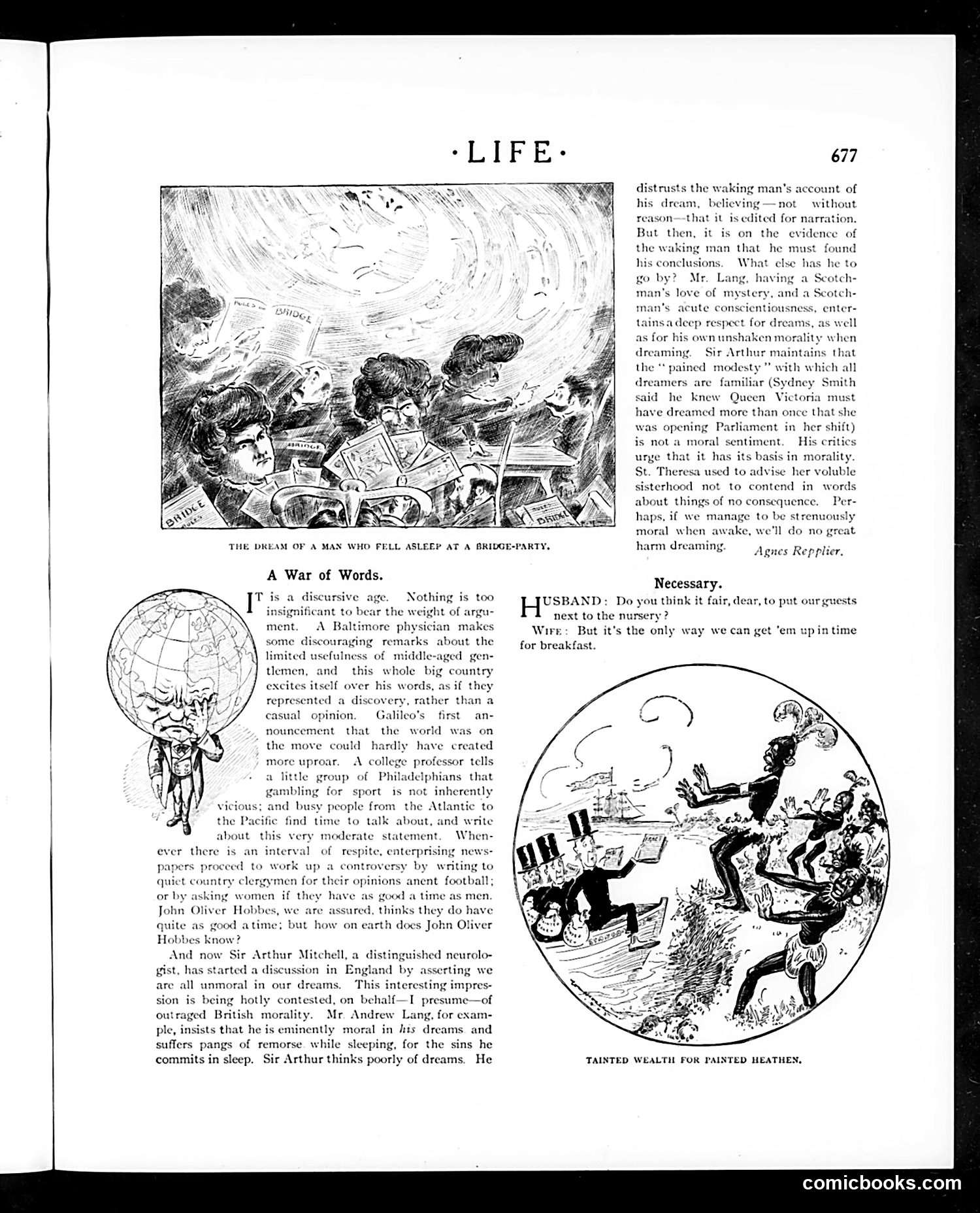
**"A War of Words"** section discusses how the era is "discursive"—people argue endlessly about everything from middle-aged gentlemen's usefulness to gambling and sports. The piece references Sir Arthur Mitchell's neurological discussion claiming people are immoral in dreams, and Andrew Lang's counter-argument that dreamers suffer moral pangs of remorse during sleep. The cartoon shows figures beneath a globe, apparently debating these abstract points. **"Necessary"** depicts a husband-wife disagreement about nursery placement, with the wife insisting guests must sit near the nursery so children can wake early for breakfast—a satirical jab at Victorian social pretensions and parenting practices. Both sections mock contemporary intellectual and domestic disputes as frivolous or absurd.
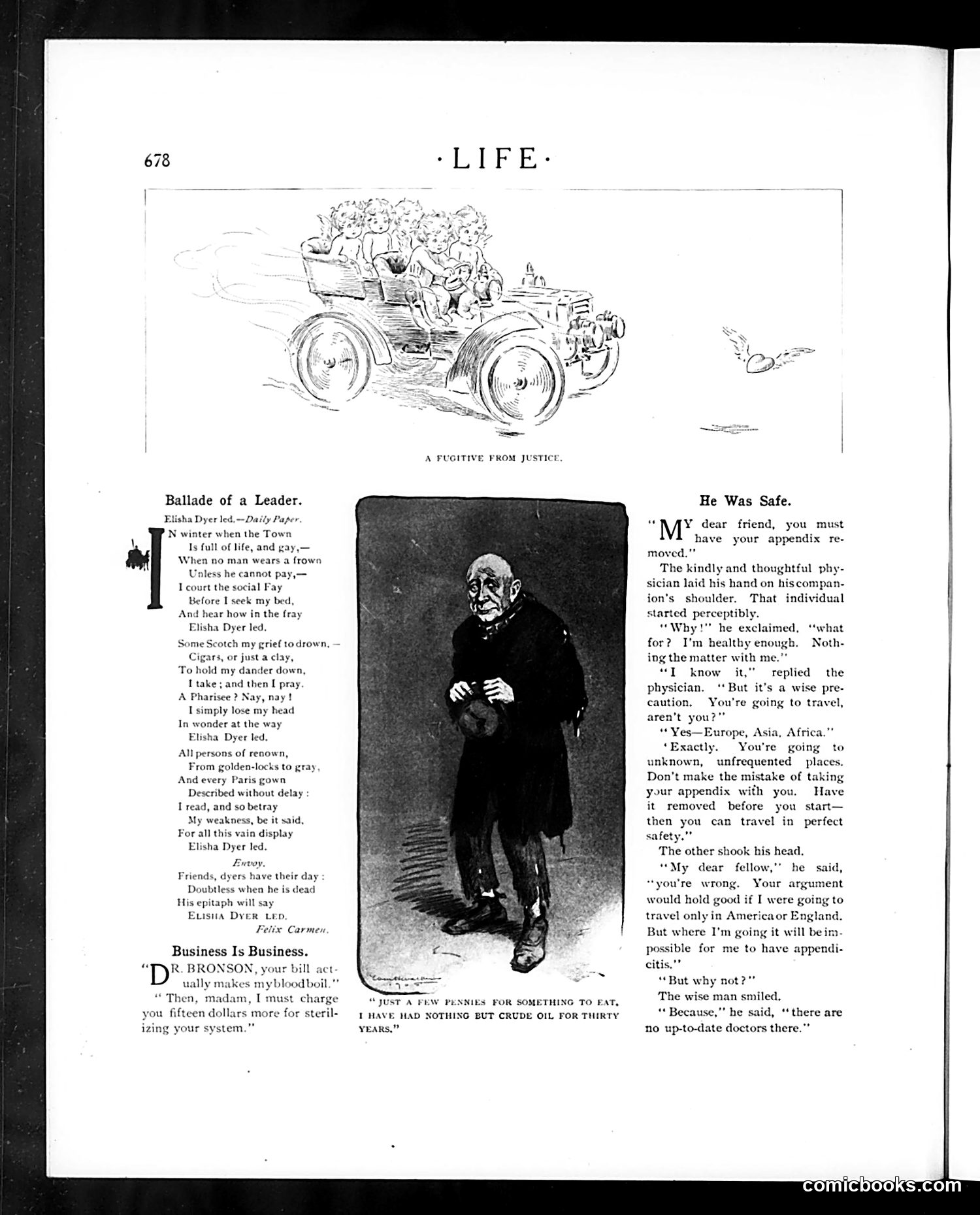
**Top Cartoon:** "A Fugitive from Justice" depicts a heavily-laden automobile overflowing with passengers fleeing at speed. The satire likely comments on contemporary social upheaval or political scandal, though the specific reference is unclear without additional context. **"Ballade of a Leader":** A poem by Elisha Dyer led., apparently a humorous or critical verse about a town leader's decline from power and influence. **"Business is Business":** A brief dialogue where a doctor charges a patient fifteen dollars to sterilize their system using crude oil—satirizing either medical quackery or exorbitant healthcare costs. **"He Was Safe":** A conversational piece where a physician advises a traveling friend to have his appendix removed preemptively before visiting unregulated foreign regions, joking about the absence of "up-to-date doctors" abroad.
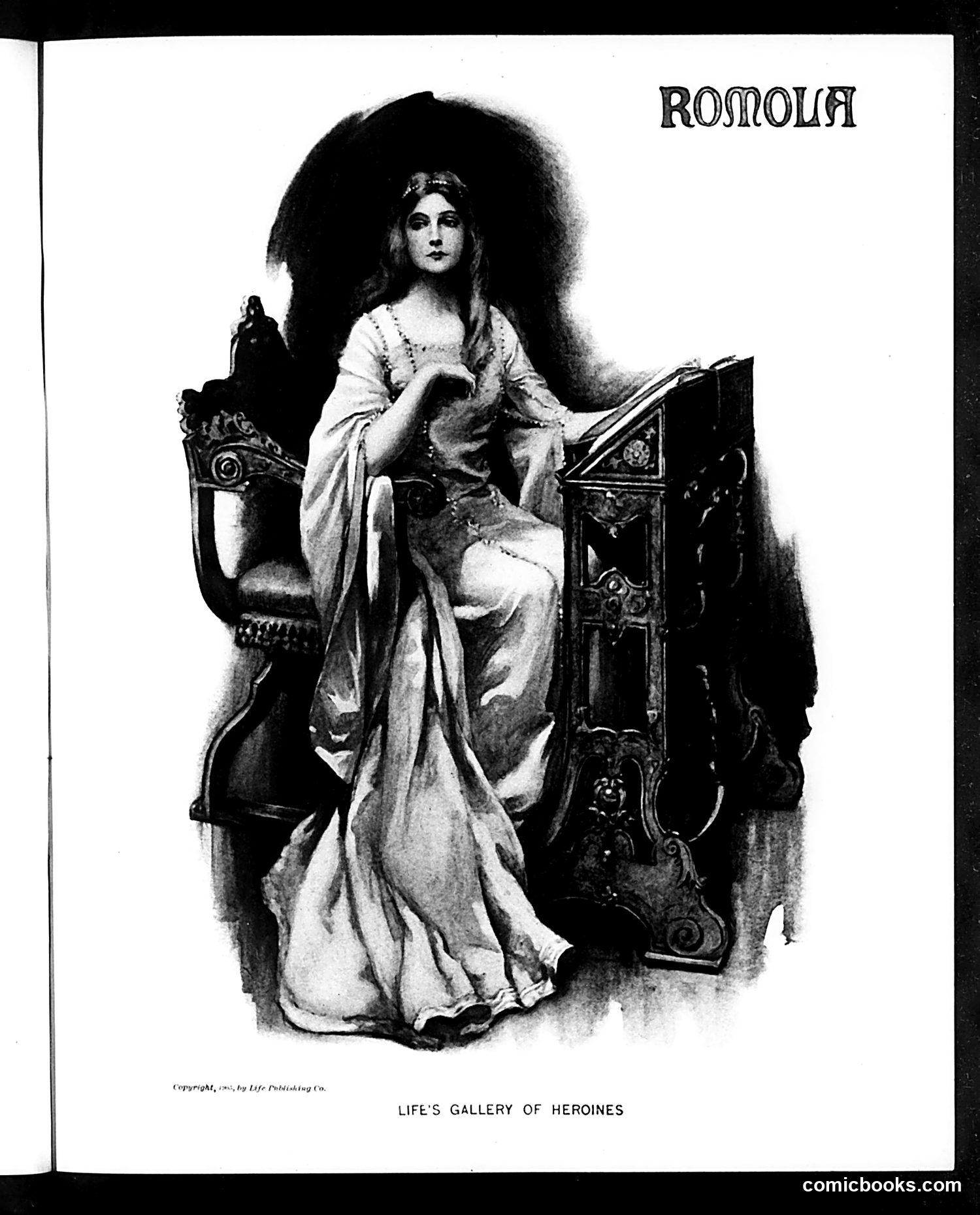
This page illustrates **Romola**, the heroine of George Eliot's 1863 novel set in Renaissance Florence. The image depicts a woman in classical dress seated beside ornate Renaissance furniture, wearing a headpiece and flowing robes. A shadowy figure appears in the background. The illustration accompanies Life magazine's "Gallery of Heroines" series, which featured famous literary female characters. Romola was a notable choice—Eliot's novel explored themes of conscience, sacrifice, and moral struggle through a educated woman navigating a corrupt society. By including Romola in their heroines gallery, Life positioned her as an exemplary female character worthy of contemporary admiration, emphasizing literature's role in celebrating women of principle and intelligence.

I can see this is a blank or nearly blank page from what appears to be a historical publication (indicated by the "comicbooks.com" watermark at the bottom). The page contains no visible text, cartoons, illustrations, or other readable content that I can analyze. Without any actual cartoon imagery, caricatures, political references, or satirical elements visible on this page, I cannot provide the historical context or explanation you're requesting. This appears to be either a blank page, a scanning error, or possibly the back of a page from the magazine. If you have a different page with actual cartoon content you'd like analyzed, I'd be happy to help explain its historical significance and satirical meaning.
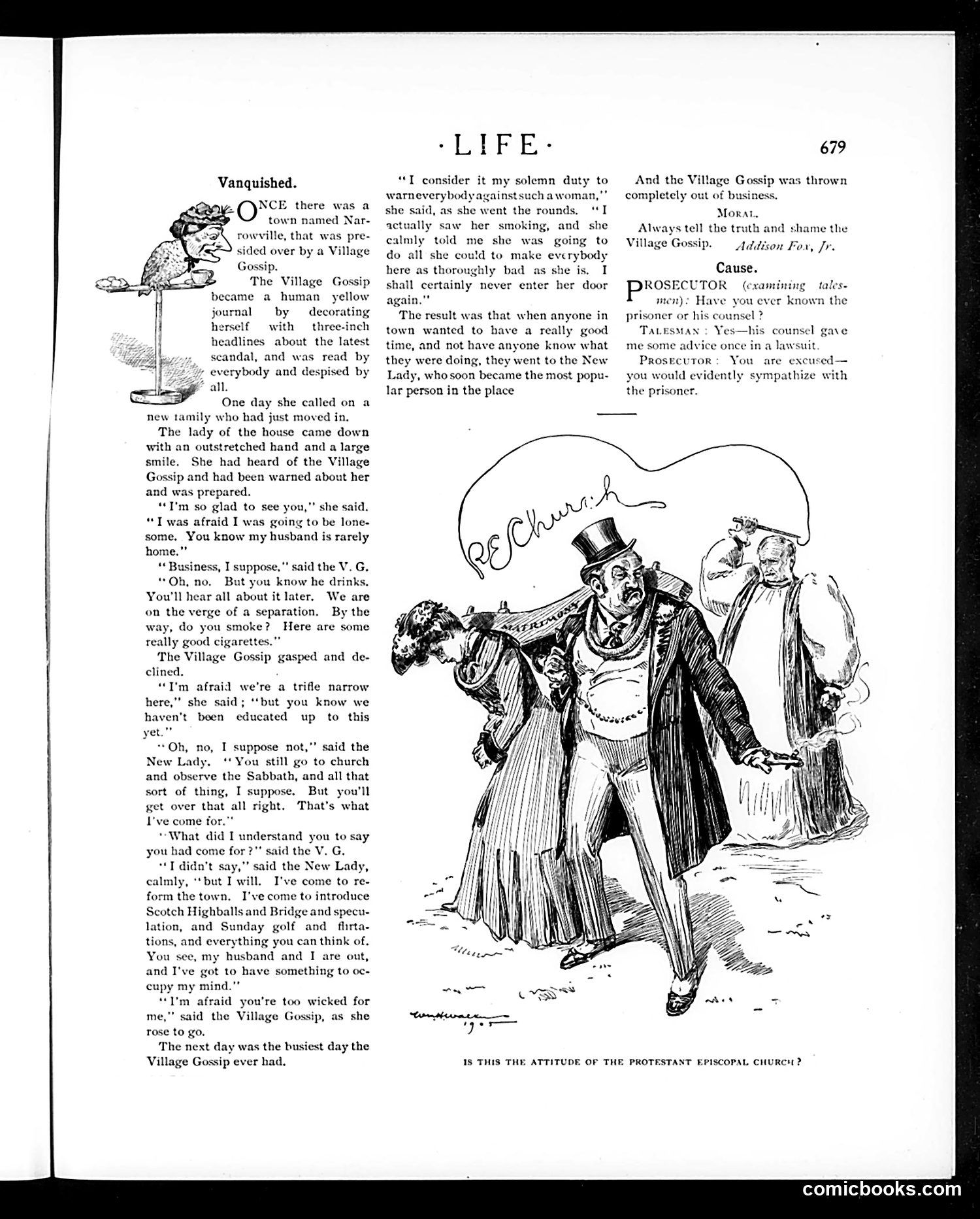
This page contains a two-part satire on hypocrisy and small-town morality: **Main Story ("Vanquished"):** A "Village Gossip"—a woman who spreads scandal and controls town reputation through rumor—meets her match in a new, sophisticated woman who openly admits to vices (drinking, smoking, gambling). The Gossip attempts to expose and shame her, but discovers the town actually *wants* these "wicked" activities. The scandal-monger loses her power when people prefer secret vice to public morality. The satire mocks towns that simultaneously condemn immorality while actively pursuing it. **Legal Cartoon ("Cause"):** Shows a prosecutor questioning a juror who admits receiving legal advice from the defendant's counsel, yet claims he'll remain unbiased. The satire ridicules this obvious conflict of interest—the man clearly *would* sympathize with the defendant, making fair judgment impossible. **Title reference:** The caption "Is This the Attitude of the Protestant Episcopal Church?" suggests the cartoon critiques institutional hypocrisy or selective justice.
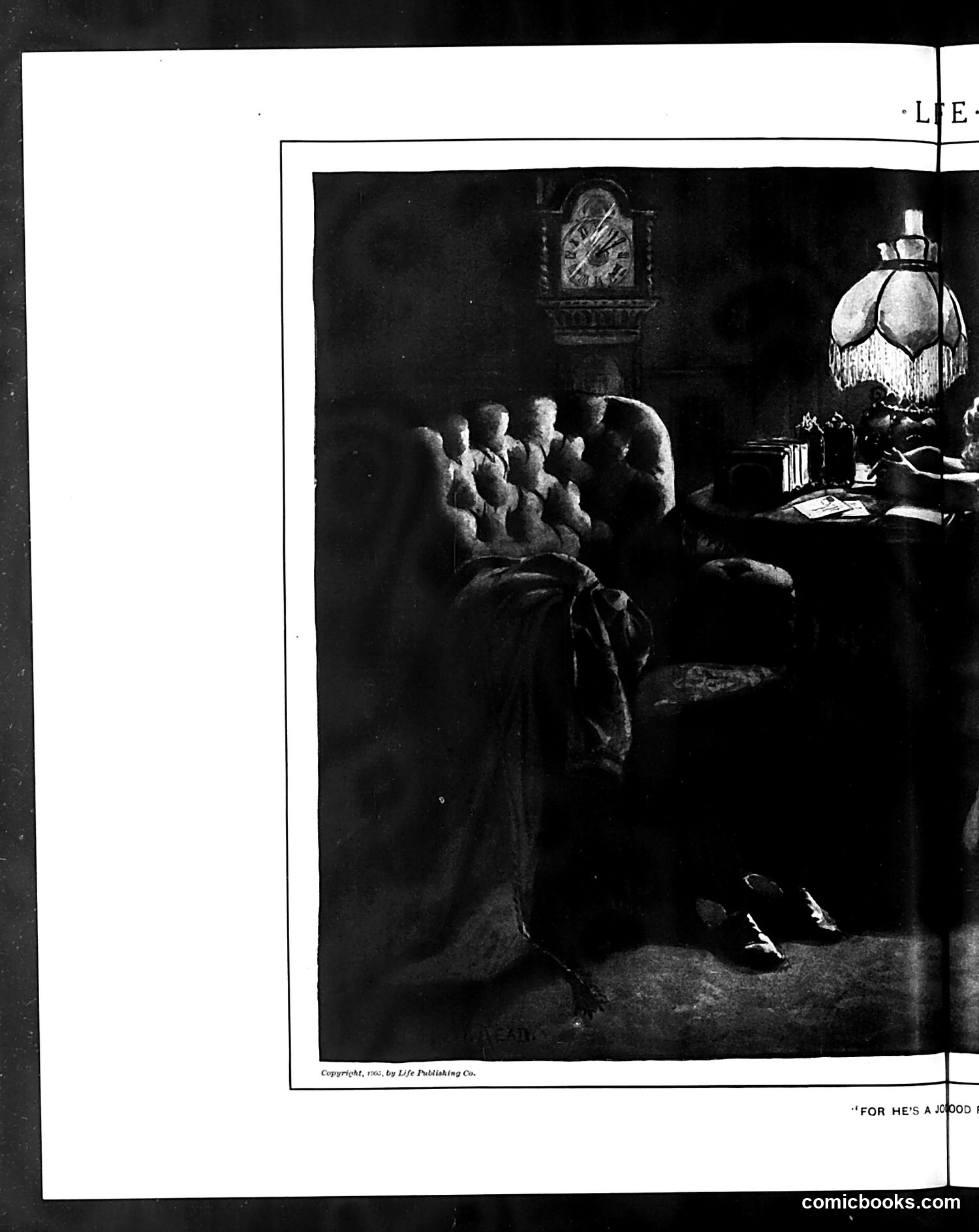
This appears to be a dramatic black-and-white illustration from Life magazine (copyright 1901, per the visible credit). The scene depicts a group of figures gathered in shadow around what appears to be a desk or table, with a lamp casting light on the right side. A clock is visible on the wall above. The caption fragment reads "FOR HE'S A GOOD..." (text cut off), suggesting this illustrates a satirical scene, possibly a gathering of political or social figures engaged in some conspiratorial or noteworthy activity. Without the complete caption and page context, the specific identities of the figures and the precise satirical target remain unclear. The dramatic lighting and secretive atmosphere suggest commentary on behind-the-scenes political maneuvering or institutional corruption typical of Life's satirical approach of that era.
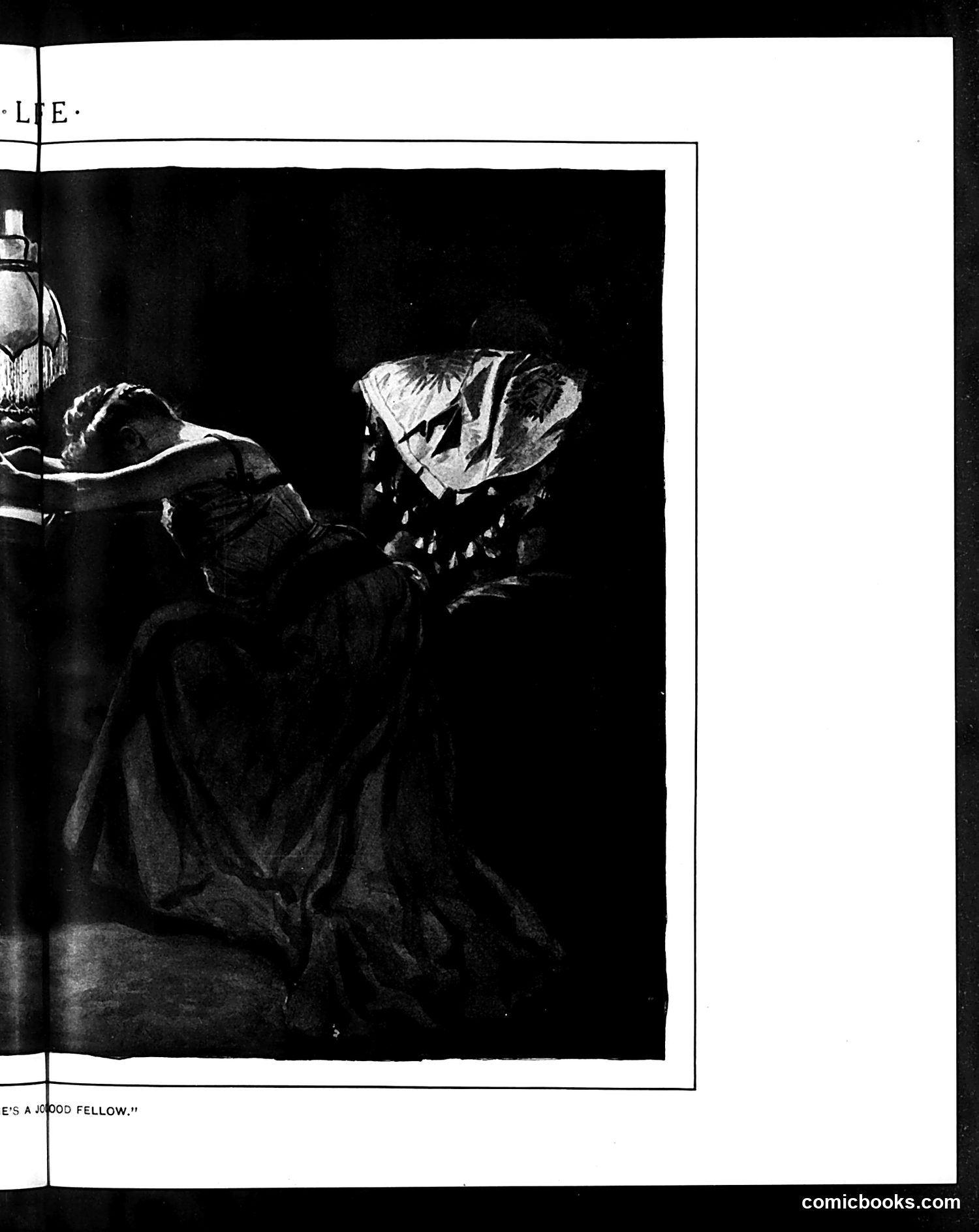
This appears to be a dramatic black and white illustration from Life magazine showing two figures in what looks like a dark, shadowy interior scene. One figure wears a white bonnet or head covering and dark clothing, while another figure is partially visible on the left. The visible caption reads "E'S A GOOD FELLOW" (likely "HE'S A GOOD FELLOW"), suggesting this depicts a character reference or commentary on someone's reputation or nature. Without the full page context, article title, or complete caption, I cannot definitively identify the specific figures, historical event, or satirical point being made. The dramatic chiaroscuro style and period styling suggest social or political commentary typical of Life's satirical content, but the specific reference remains unclear from this fragment alone.
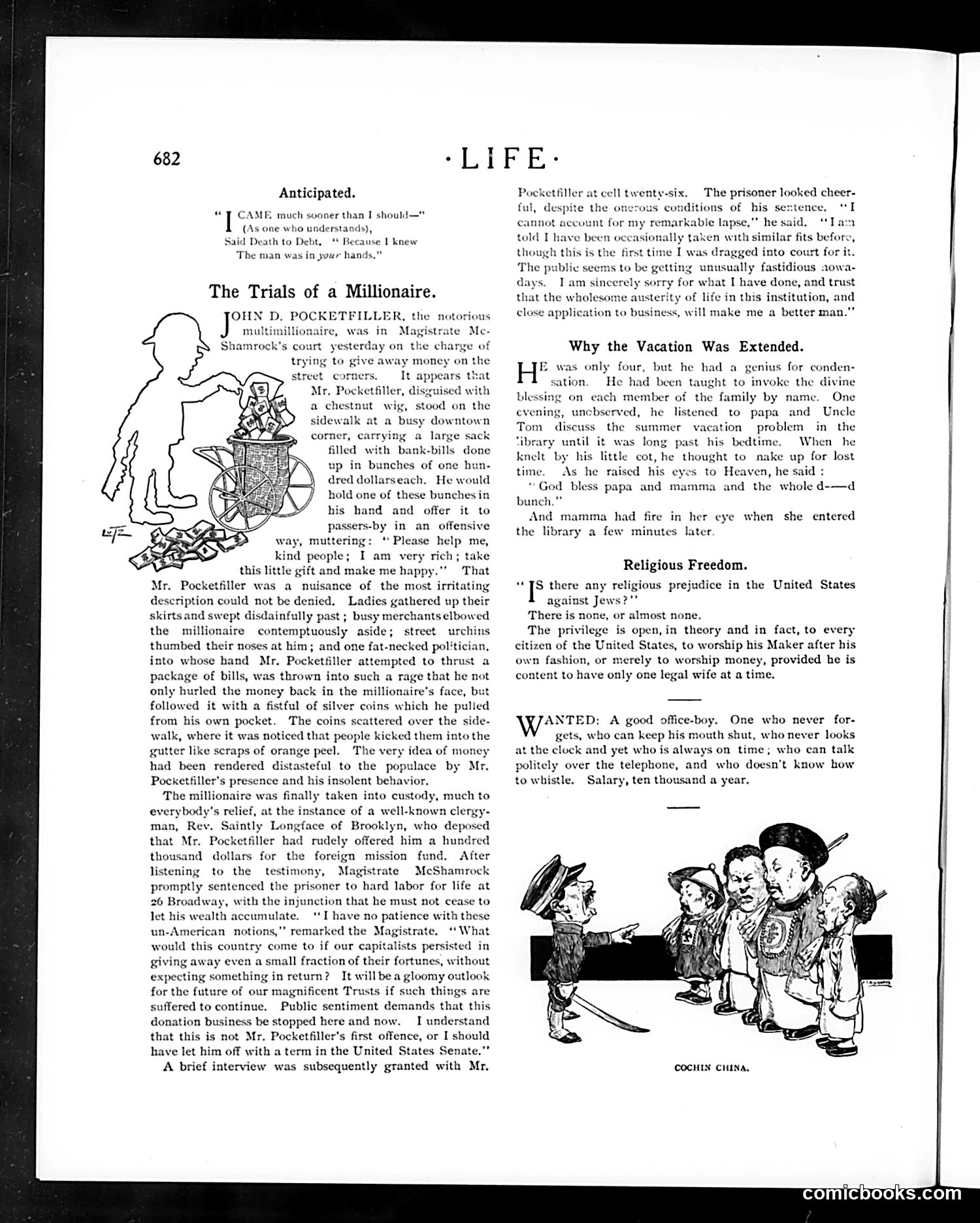
This satirical piece mocks wealthy industrialists and the Gilded Age's plutocratic values through the fictional "John D. Pocketfiller" (likely a caricature of real millionaires like Rockefeller). **The main cartoon**: Pocketfiller is arrested for the "crime" of *giving away money*—offering hundred-dollar bunches to poor people on the street. The joke's bitter irony: society rejects his charity with disgust, people literally kick his coins into gutters, and a magistrate sentences him to hard labor for life, scolding him that such "un-American notions" of philanthropy threaten capitalism and the Trusts. **The satire targets**: - The hypocrisy of wealthy elites who hoard fortunes while claiming moral superiority - Judges and politicians' defense of concentrated wealth - Public indifference to poverty coexisting with disdain for charity itself The smaller piece "Why the Vacation Was Extended" is an unrelated joke about a child's innocent profanity during prayer.
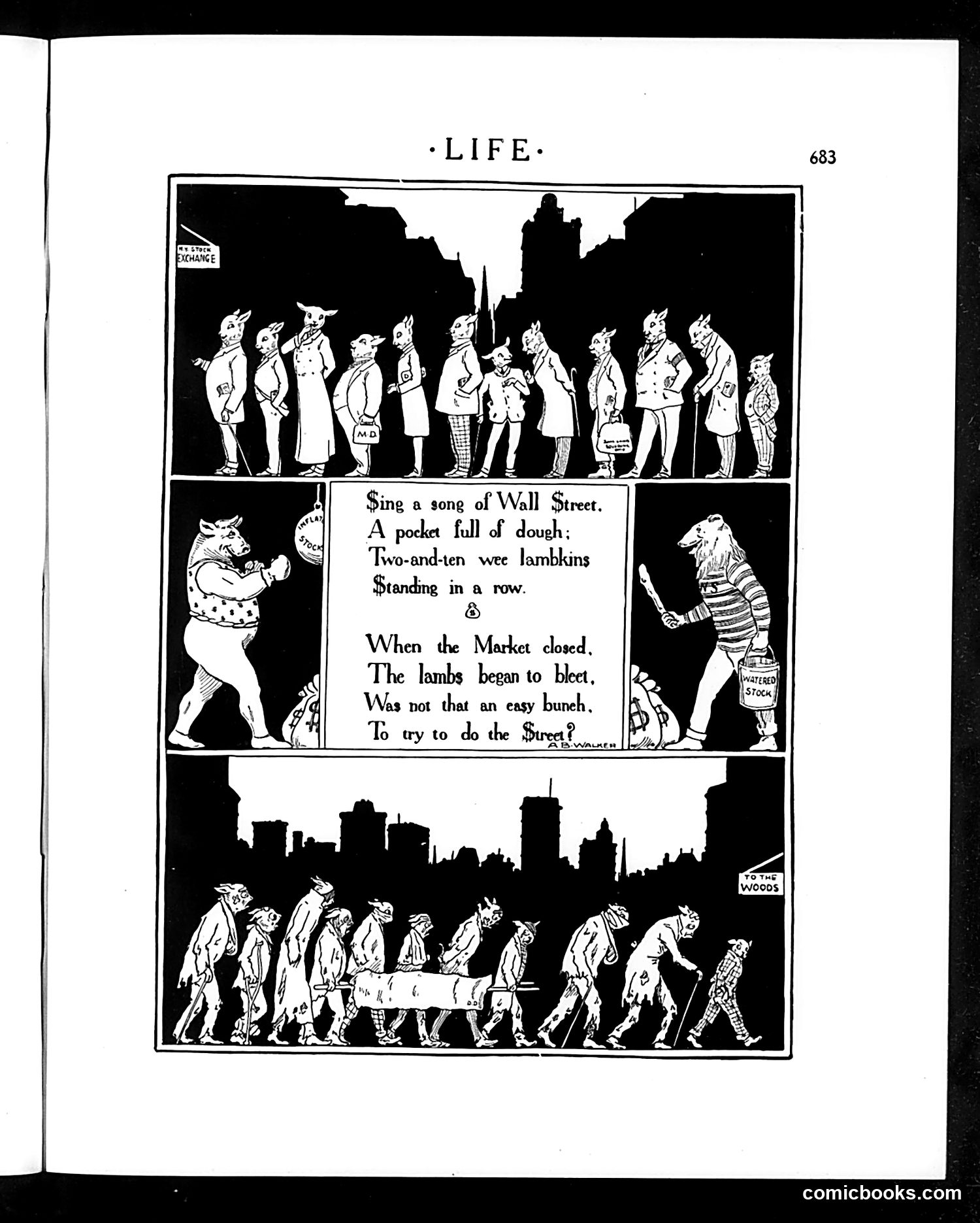
This appears to be a satirical commentary on Wall Street financial speculation, using anthropomorphic animals as metaphors. The top panel shows human businessmen; the middle panels feature a bull and bear—traditional symbols of rising and falling markets. The bottom panel depicts these animals herding something together under a city skyline. The text parodies a nursery rhyme, replacing "blackbirds" with "lambkins" (investors/victims) and "pocket full of rye" with "pocket full of dough." The joke criticizes how easily speculators ("an easy bunch") are manipulated—"bleating" when markets close, suggesting they're passive followers led by larger market forces (the bull and bear). This likely satirizes early 20th-century market volatility and investor vulnerability to manipulation by powerful financial interests.
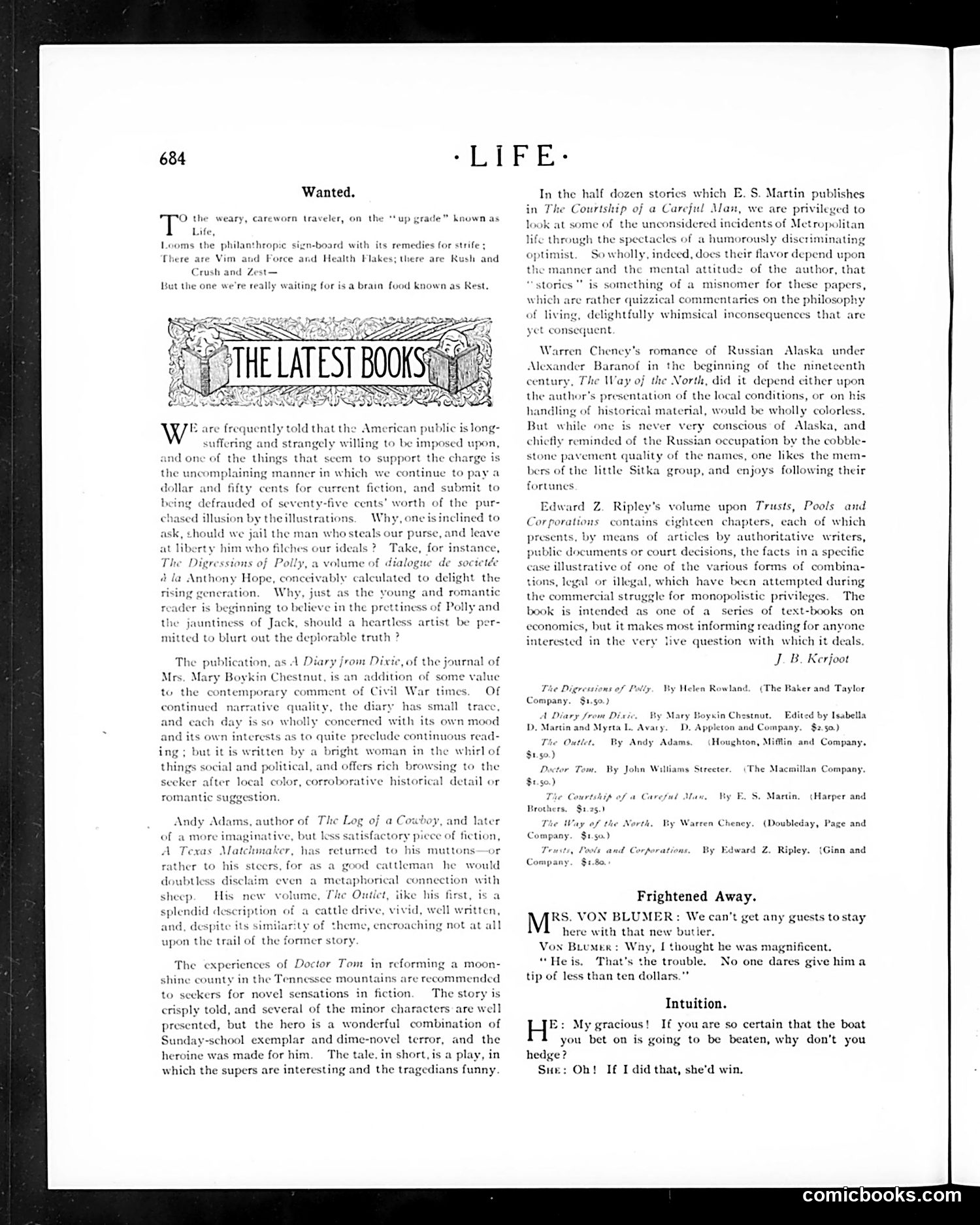
This page is primarily a **book review section** rather than a political cartoon. The title "Wanted" at top refers to satirical commentary about American society's exploitation of consumers. The opening poem mocks patent medicine advertising (referencing products like "Vim and Force and Health Flakes"), suggesting what travelers truly need is "Rest"—a brain food conspicuously absent from commercial offerings. The main text criticizes how Americans willingly accept being **defrauded by publishers**: we pay inflated prices for mediocre fiction, yet oddly prosecute petty theft more severely than intellectual swindling. The author questions this moral inconsistency—why jail a purse-stealer but permit "heartless artists" to sell us "deplorable" work? The remainder comprises **genuine book reviews** of contemporary works, including Civil War diaries, cowboy fiction, and Russian Alaskan romance novels. **Context for moderns**: This reflects Progressive-era concerns about **consumer protection, artistic integrity, and publishing industry ethics**—satirizing American gullibility and commercialism while defending cultural standards.
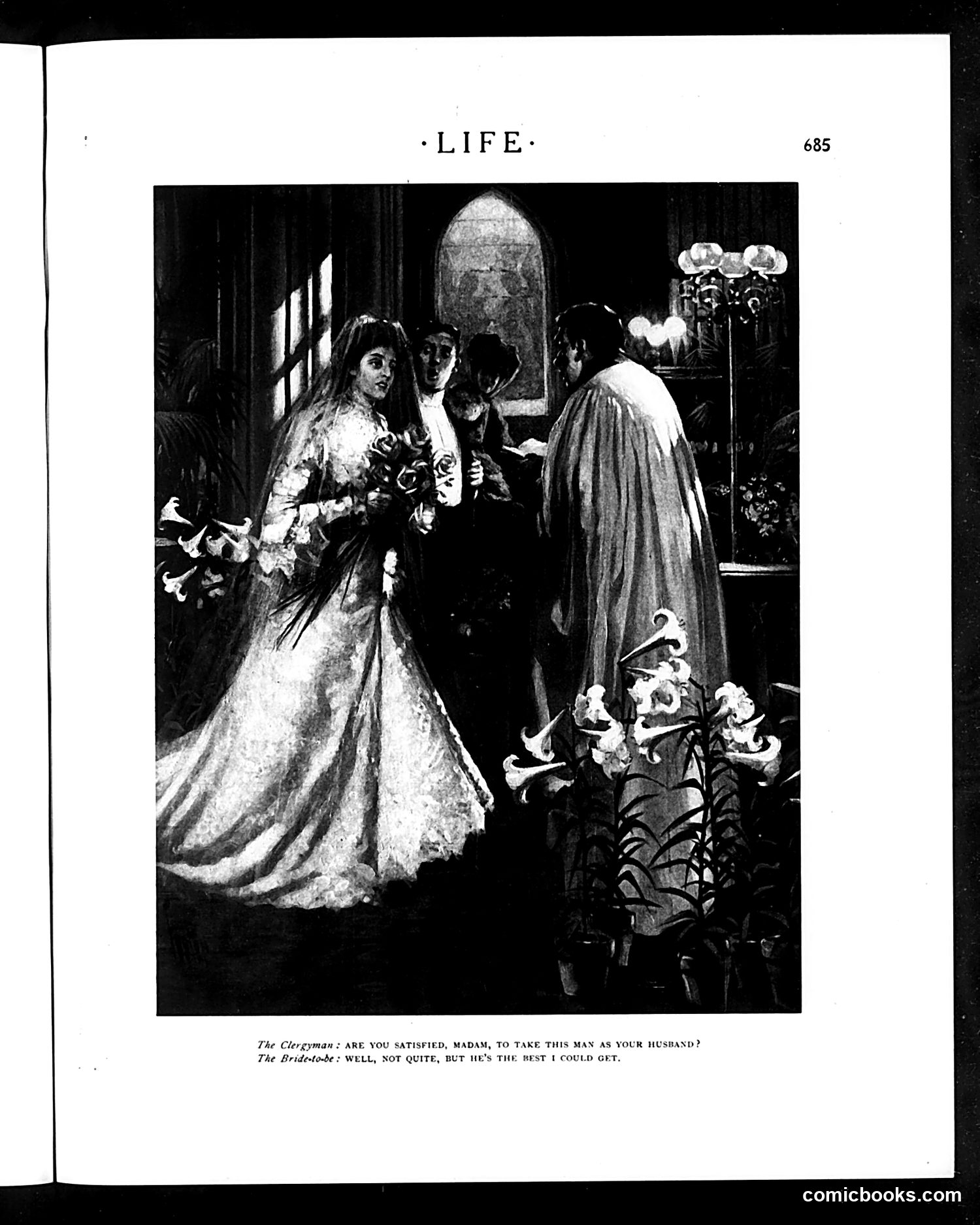
This is a wedding ceremony scene satirizing matrimonial compromise. A clergyman asks the bride the traditional vow question, and she responds with brutal honesty: she's settling for this groom because he's "the best I could get." The joke mocks the pragmatic rather than romantic nature of marriage, particularly during the era when women had limited economic independence and marriage was often a financial necessity rather than a love match. The bride's candid admission—that she's accepting a less-than-ideal husband due to limited options—exposes the gap between the idealized romantic tradition of weddings and the economic realities facing women. The cartoon satirizes both the artificial solemnity of marriage vows and women's constrained life choices.
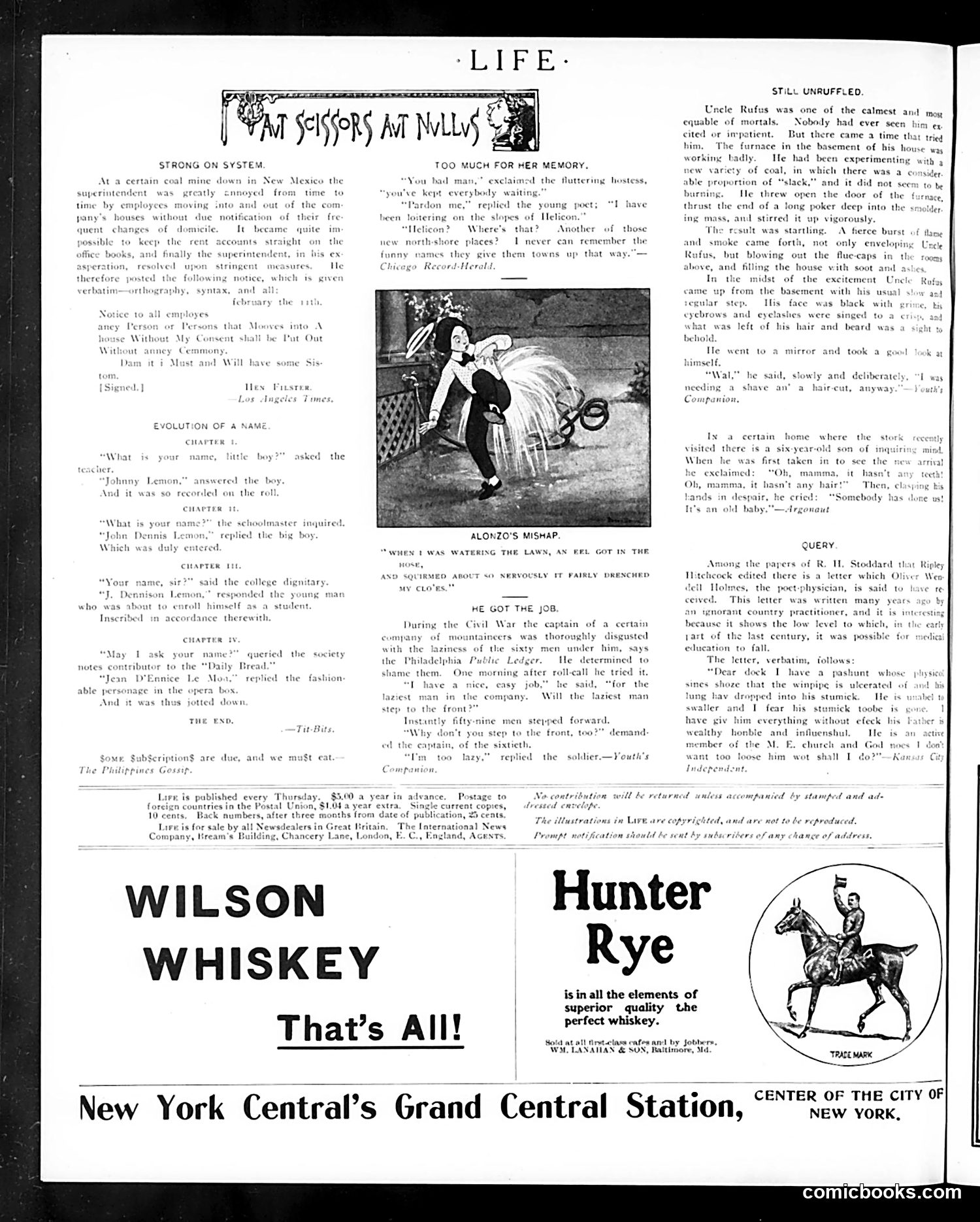
This page contains three humorous short stories typical of Life magazine's satirical humor: **"Still Unruffled"** depicts Uncle Rufus, a legendarily calm man who remains unflappable even after a furnace explosion covers him in soot and coal. The joke: his only complaint is needing "a shave an' a haircut." **"Evolution of a Name"** traces how "Johnny Lemon" becomes "John Dennis Lemon" becomes "J. Dennison Lemon" as the boy progresses through school—satirizing how institutions formalize and complicate simple identities. **"He Got the Job"** mocks Civil War-era military incompetence: a captain asks which lazy soldier wants an easy job; fifty-nine men step forward, revealing that laziness was universal even among soldiers supposedly fighting. The page also includes advertisements for Wilson Whiskey and Hunter Rye, reflecting common practice in early 20th-century magazines. These stories exemplify Life's gentle, domestic humor targeting middle-class readers rather than sharp political satire.
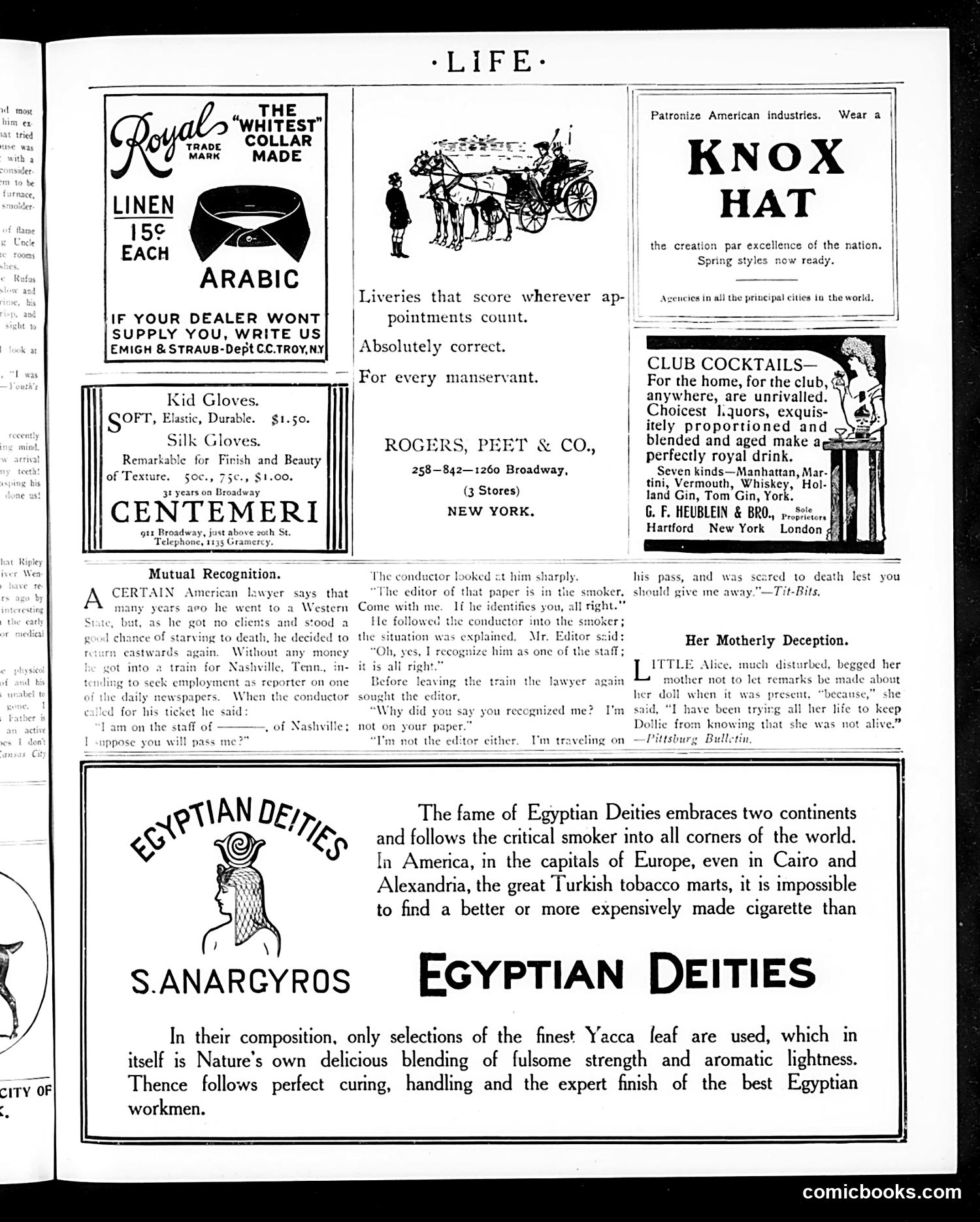
This page is primarily **advertisements** with two brief humorous anecdotes. The main satirical content is "Mutual Recognition"—a short joke about a lawyer traveling by train who claims to be from Nashville's newspaper staff to impress the conductor. When confronted, he admits he's not actually the editor but assumes the conductor will let him pass anyway. The humor mocks both social pretension (claiming false credentials) and the conductor's apparent gullibility or indifference. "Her Motherly Deception" is a sentimental domestic joke about a mother keeping a doll from her daughter to preserve it. The **advertisements** reveal period attitudes: Knox Hats promotes American manufacturing; Rogers, Peet & Co. sells formal attire; Centemeri offers gloves; and Egyptian Deities cigarettes advertises tobacco using orientalist imagery (the pharaoh head logo), reflecting early-20th-century exoticization of non-Western products as luxury goods. Club Cocktails advertises home drinking, typical of the pre-Prohibition era.
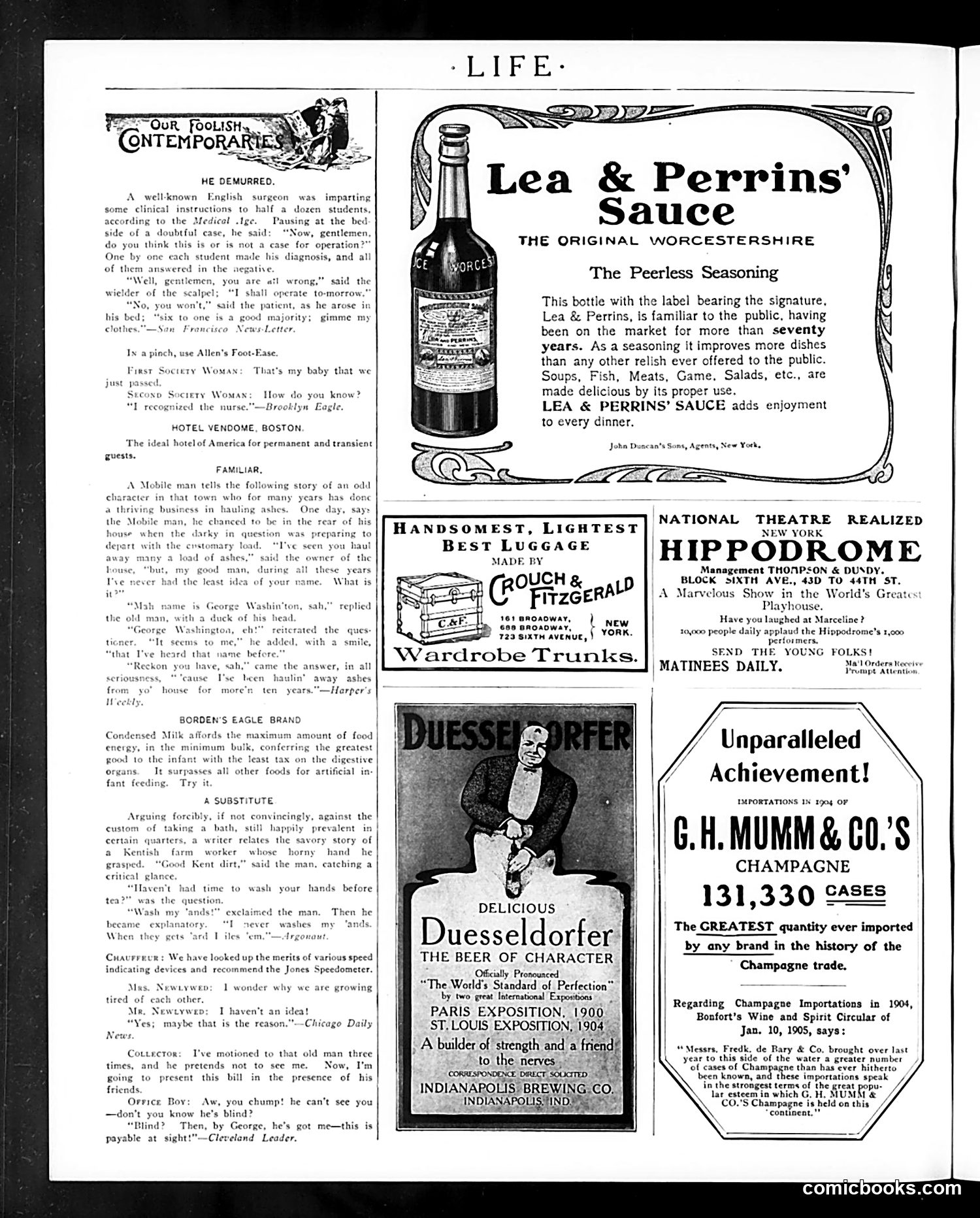
This page is primarily **advertising**, with brief satirical sketches interspersed. The main content includes: **Satirical Sketches:** - "He Demurred": A joke about a confident English surgeon instructing medical students on diagnosis, then operating despite patient objection—satirizing medical arrogance. - Several brief humorous anecdotes about laborers, housework, and marital discord, typical of the magazine's "Our Foolish Contemporaries" section. - A joke about a blind debt collector who can't see the creditor, so the bill is "payable at sight"—wordplay on financial terminology. **Advertisements:** The page features major ads for Lea & Perrins Worcestershire Sauce, Crouch & Fitzgerald luggage, the Hippodrome Theatre in New York, Duesseldorfer Beer, and G.H. Mumm Champagne (advertising record importation numbers). The satirical content reflects early-1900s American attitudes toward class, labor, and professional pretension, while advertisements showcase luxury goods marketed to Life's affluent readership.
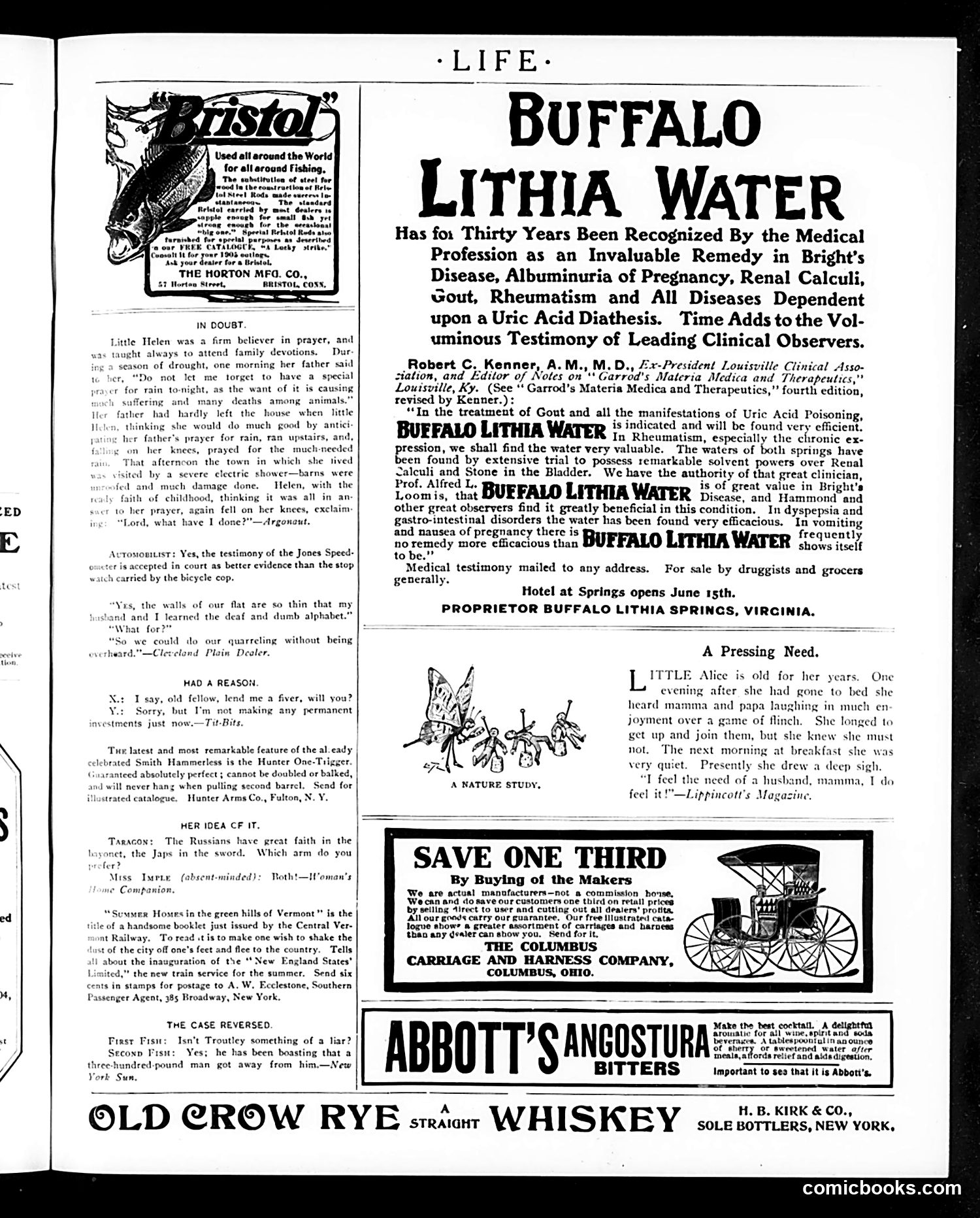
This page from *Life* magazine (early 1900s) is primarily **advertising and humorous short anecdotes**, not political satire. The main content includes: **"In Doubt"** — A joke about a girl who prays for rain during a drought. When a severe thunderstorm strikes, causing damage, she thanks God, apparently missing the irony that her prayer had unintended consequences. **Short humor pieces** — Brief jokes about thin apartment walls, borrowing money, and military preferences (Russians favoring bayonets vs. Japanese swords). **Large advertisement** — The dominant feature is a lengthy ad for "Buffalo Lithia Water," marketed as a medical cure for gout, kidney disease, rheumatism, and pregnancy-related ailments, citing doctors' testimonies. **Additional ads** — For Smith Hammerless rifles, carriages, Abbott's Angostura Bitters, and Old Crow Rye Whiskey. The page reflects early 20th-century magazine conventions: mixing light entertainment with dubious patent medicine claims presented as legitimate medical endorsements—practices that would later be heavily regulated.
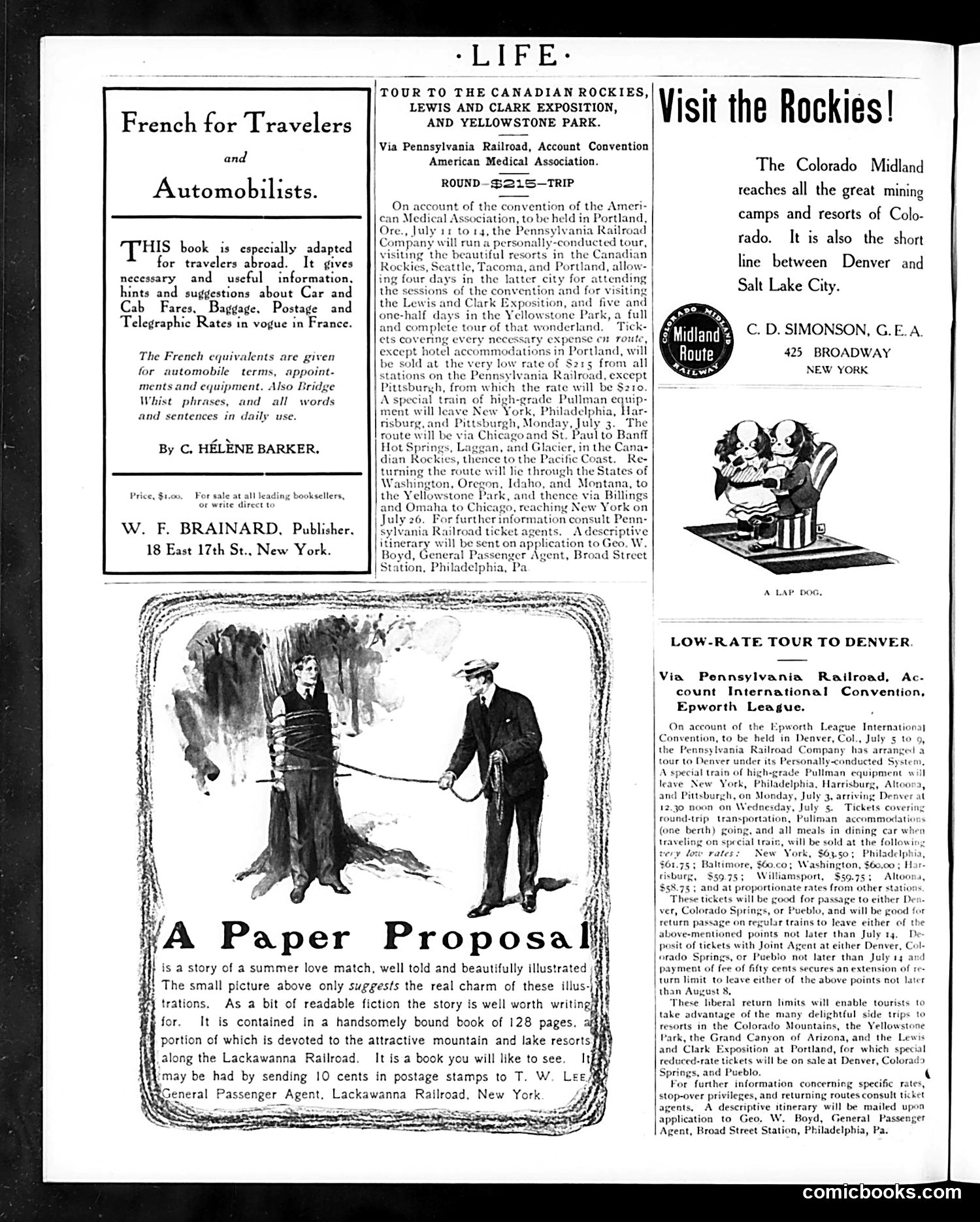
This page is primarily **advertising and travel promotions**, not political satire. It contains: **Main Content:** - Left: Advertisement for a French language phrasebook for travelers and automobilists by C. Hélène Barker - Center: Two railroad tour advertisements (Pennsylvania Railroad trips to Canadian Rockies/Yellowstone and to Denver) - Right: Colorado Midland railroad advertisement and an illustration labeled "A Lap Dog" **The "A Paper Proposal" illustration** depicts what appears to be a romantic scene—a man in formal attire with a woman—accompanying text describing it as "a story of a summer love match, well told and beautifully illustrated." This promotes a book available through the Lackawanna Railroad. **The "Lap Dog" illustration** shows a small dog, likely referencing a society pet or domestic companion, though its specific satirical point is unclear without additional context. The page reflects early 1900s travel culture, promoting rail tours to natural attractions and educational conventions, with an emphasis on comfort and Pullman accommodations.
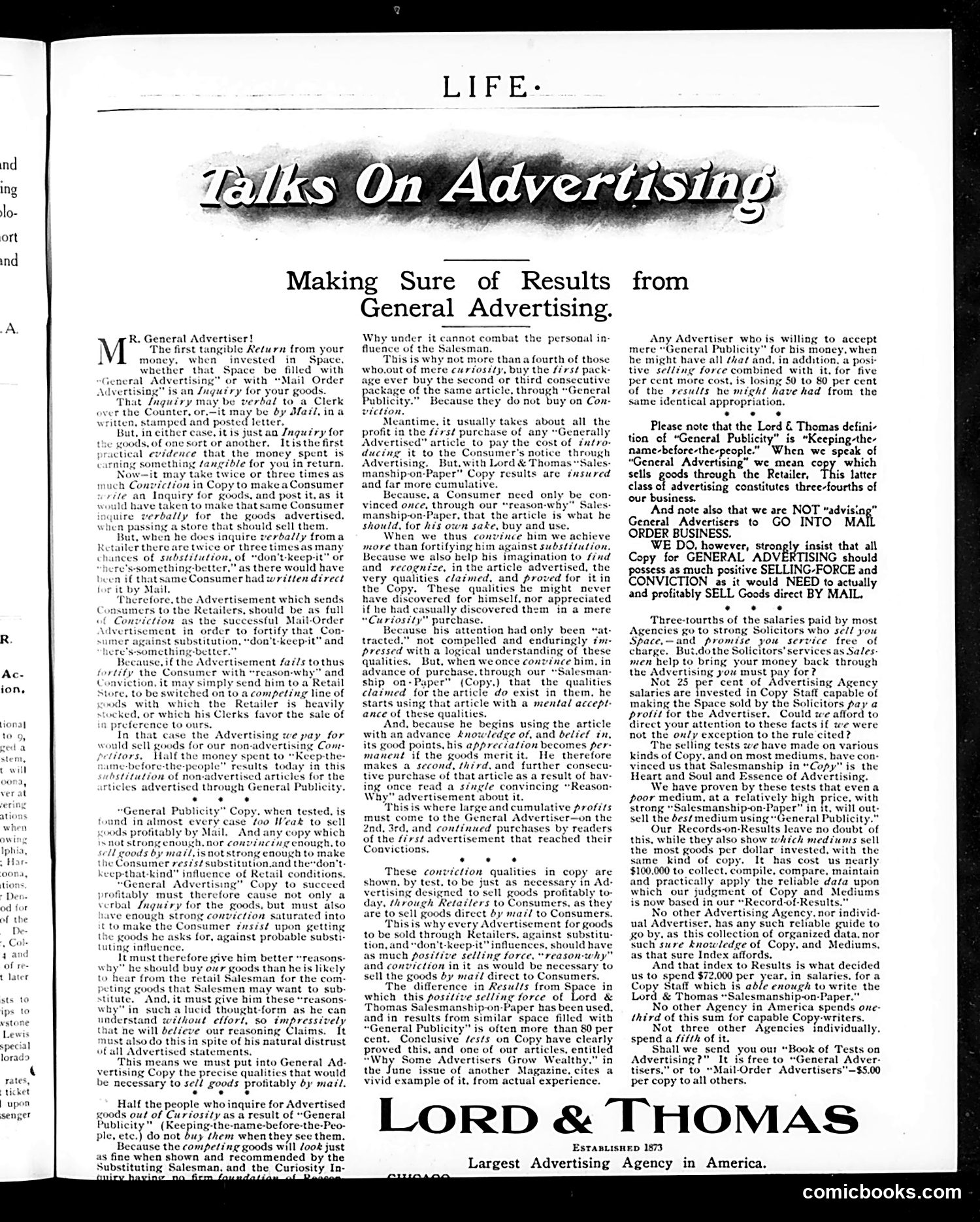
This is primarily **advertising and promotional content**, not a political cartoon. The page features Lord & Thomas, a major advertising agency, explaining their philosophy on effective advertising strategy. The main argument: General advertising must be as persuasive as mail-order advertising to overcome retail substitution—when salesmen steer customers toward competing brands. The agency contends that weak advertising fails because consumers won't insist on advertised products when store clerks recommend alternatives. Key claim: Successful advertising requires "conviction" and "reason-why" copy compelling enough that consumers will specifically request the advertised product despite a salesman's influence. At bottom, Lord & Thomas (est. 1873) promotes itself as "Largest Advertising Agency in America," implying their expertise can deliver results. **No political satire is present**—this is straightforward professional advertising advice dressed in educational rhetoric, aimed at potential clients.
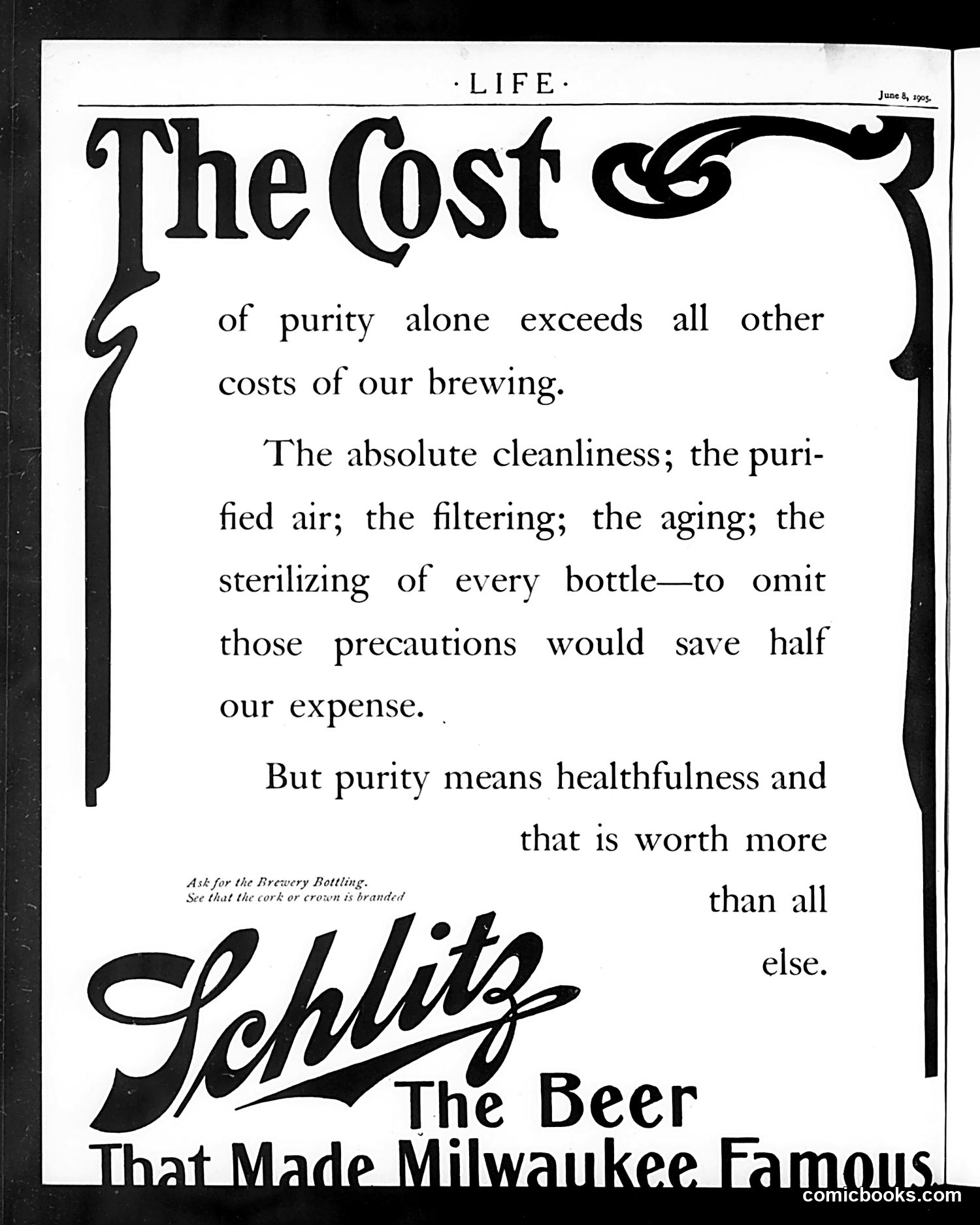
This is a **Schlitz beer advertisement**, not satire or political content. The ad promotes Schlitz as "The Beer That Made Milwaukee Famous" by emphasizing manufacturing purity and quality control—cleanliness, filtered air, aging, and bottle sterilization. The copy argues that while these costly precautions could be skipped to save expenses, Schlitz prioritizes purity because it ensures healthfulness, which is "worth more than all else." The ad instructs consumers to request brewery bottling and verify the cork or crown is branded. This reflects early 20th-century beer marketing that capitalized on public health concerns and germ theory awareness.