
Life, 1905-06-08 · page 9 of 26
Life — June 8, 1905 — page 9: what you’re looking at
What you’re looking at
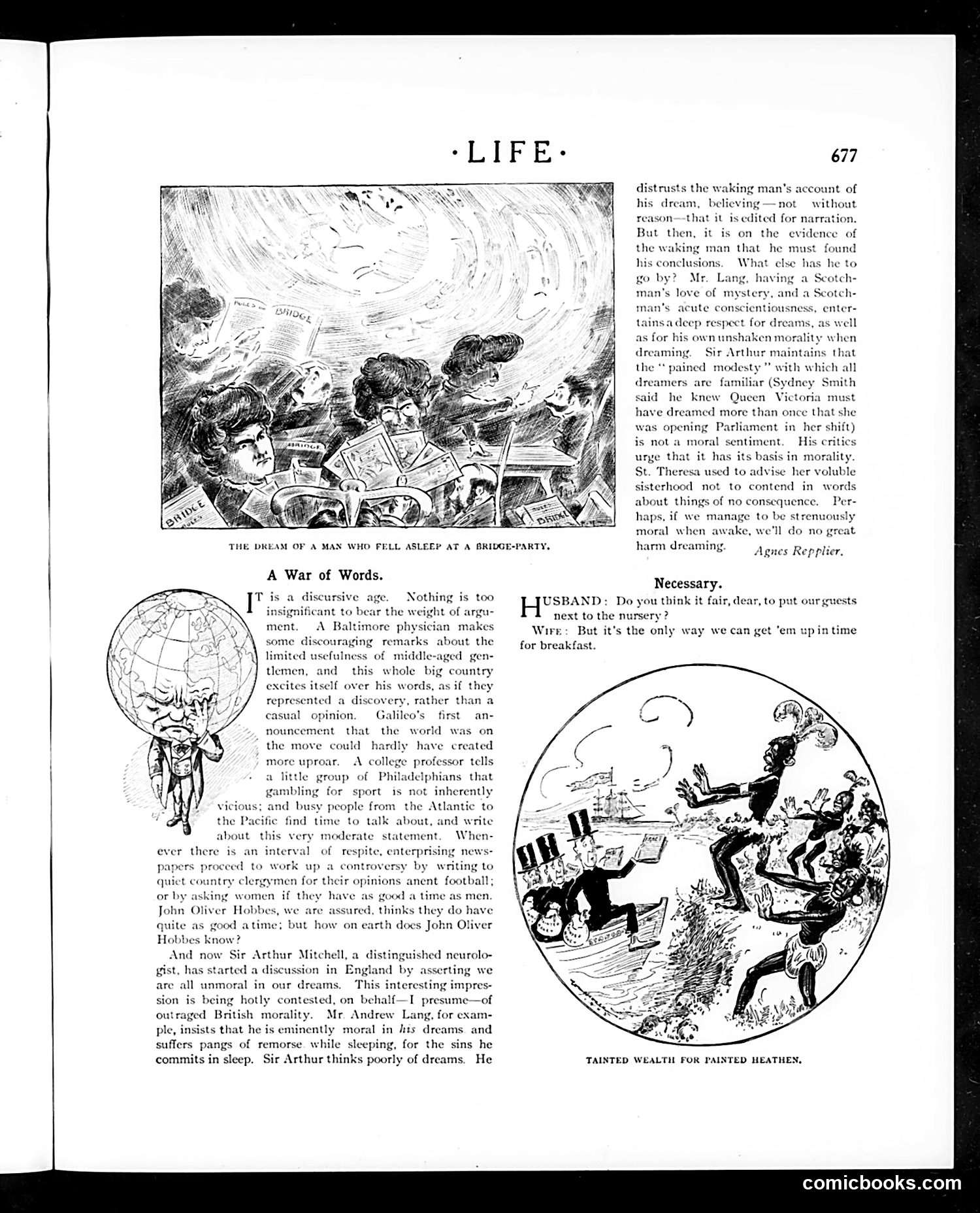
**"A War of Words"** section discusses how the era is "discursive"—people argue endlessly about everything from middle-aged gentlemen's usefulness to gambling and sports. The piece references Sir Arthur Mitchell's neurological discussion claiming people are immoral in dreams, and Andrew Lang's counter-argument that dreamers suffer moral pangs of remorse during sleep. The cartoon shows figures beneath a globe, apparently debating these abstract points. **"Necessary"** depicts a husband-wife disagreement about nursery placement, with the wife insisting guests must sit near the nursery so children can wake early for breakfast—a satirical jab at Victorian social pretensions and parenting practices. Both sections mock contemporary intellectual and domestic disputes as frivolous or absurd.
📄 Transcribed text from this page (OCR, searchable)
Machine-transcribed from the original scan — historical spelling and the odd misread are preserved.
677 THE DREAM OF A MAN WHO FELL ASLEEP AT A BRIDGE: A War of Words. if is a discursive age. Nothing is too insignificant to bear the weight of argu- ment. <A Baltimore physician makes some discouraging remarks about the limited usefulness of middle-aged gen- tlemen, and thi hole big country excites itself over his words, if they represented a discovery, rather than a casual opinion. Galileo's first an- the world wa: hardly have created nouncement that the move could on / more uproar. A college professor tells little group of Philadelphians that ambling for sport is not inherently and busy people from the Atlantic to the Pacific find time to talk abou d write about this very moderate statement. When- al of enterprising news- 1 to work up a controversy by writing to 1; or by asking women if they have as good a time as men. John Oliver Hobbes, we are assured, thinks they do have quite as good atime; but how on earth does John Oliver Hobbes know? And now Sir Arthur Mitchell, a distinguished neurolo- gist, has started a discussion in England by asserting we are all unmoral in our dreams. This interesting impres sion is being hotly contested, on behalf—I presume—of 1 British morality. Mr. Andrew Lang, for exam- ple, insists that he is eminently moral in his dreams. and suffers pangs of remorse while sleeping, for the sins he commits in sleep. Sir Arthur thinks poorly of dreams. He ever there is an inter respite Pp quiet country clergy fs proce en for their opinions anent footba distrusts the waking man’s account of his dream, believing —not without reason—that it is edited for narration. But then, it is on the evidence of the waking man that he mu ound his conclusions. Wh go by?) Mr. Lang, he n 's love of myste man's tainsadeep respect for dreams as for his own tinshaken morality when dreaming. Sir Arthur maintains that the * pained modesty dreamers are familiar (S: said he knew Queen Victoria must have dreamed more than once that she vas opening Parliament in her shift) s not a moral sentiment. His crit urge that it has its basis in morali St. Theresa used to advise her voluble sisterhood not to contend in words about things of no consequence. Per- haps, if we manage to be strenuously wake, we'll do no t else has cotch- otch- ving a and ; acute conscientiousness, enter- as well with w moral when harm dreaming. 3 Agnes Reppl Necessary. USBAND: Do you think it fair, dear, to put our guests nest to the nursery ? Wire: But it’s the only way we can get ‘em t for breakfast. in time TAINTED WEALTH FOR PAINTED HEATHEN, comicbooks.com