
Life, 1905-06-08 · page 25 of 26
Life — June 8, 1905 — page 25: what you’re looking at
What you’re looking at
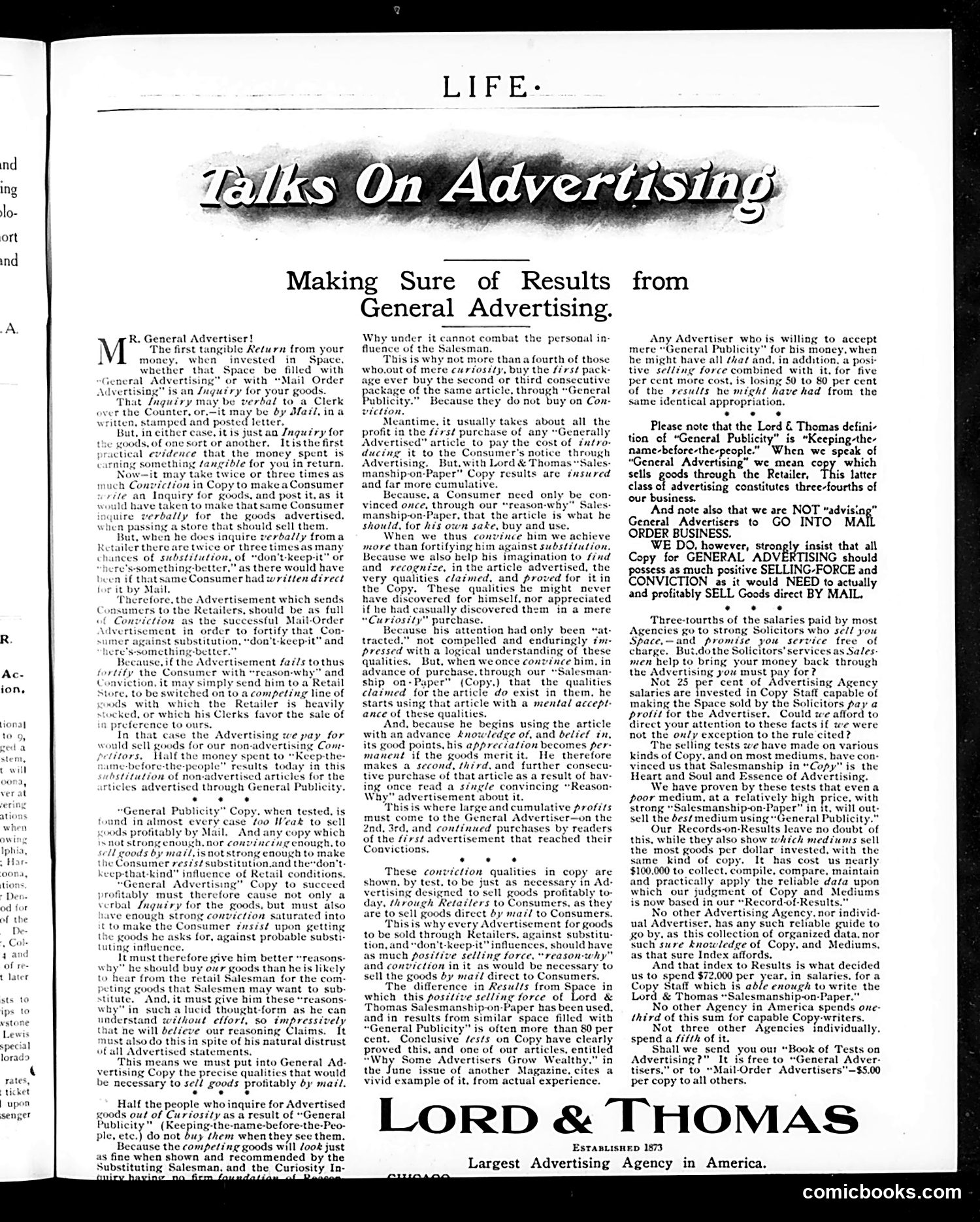
This is primarily **advertising and promotional content**, not a political cartoon. The page features Lord & Thomas, a major advertising agency, explaining their philosophy on effective advertising strategy. The main argument: General advertising must be as persuasive as mail-order advertising to overcome retail substitution—when salesmen steer customers toward competing brands. The agency contends that weak advertising fails because consumers won't insist on advertised products when store clerks recommend alternatives. Key claim: Successful advertising requires "conviction" and "reason-why" copy compelling enough that consumers will specifically request the advertised product despite a salesman's influence. At bottom, Lord & Thomas (est. 1873) promotes itself as "Largest Advertising Agency in America," implying their expertise can deliver results. **No political satire is present**—this is straightforward professional advertising advice dressed in educational rhetoric, aimed at potential clients.
📄 Transcribed text from this page (OCR, searchable)
Machine-transcribed from the original scan — historical spelling and the odd misread are preserved.
when Iphia, Har. ai of ree t later ips to Lewis special lorado 4 rates, ticket | upon senget Making Sure of Results R, General Advertiser! ‘The first tangible Return from your mone! when invested in Space. whether that Space be filled with General Advertising” or with “Mail Order vertising” is an Juguiry for your goods. That /nguiry may be verbal to’a Clerk over the Counter, or,-it may be by Mfail ina written, stamped and posted letter. But, in cither case, itis just an Zngurry for the goods, of one sort or another. Itis the first practical evédence that the money spent is Carning something faxg/b/e for you in return. d may take twice or three times as much Conviction in Copy to make a Consumer rite an Inquiry for goods, and post it,as it Id have taken to make that same Consumer inquire verbally for the goods advertised, when passing a store that should sell them. But, when he does inquire verbally froma Retailer there are twice or three timesas many chances of substitution, of “don't-keep-it” or re's-something-bet! ‘as there would have if that same Consumer had written direct it by Ma ‘Pherefore, the Advertisement which sends ners to the Retailers, should be as full { Conviction as the successful Mail-Order Advertisement in order to fortify that Con- sumer against substitution, “don't-keep-it™ and here's-something-better.”” Because, if the Advertisement fails tothus fortify the Consumer with “reason-why” and Conviction, it may simply send him to a Retail Store, to be switched on to a competing line of ods with which the Retailer is heavily stocked, or which his Clerks favor the sale of a preference to ours. In that case the Advertising we pay for uld sell goods for our non-advertising Com- petitors, Half the m spent to *Keep-the- ime-before-the-people” Tesults today in this substitution of non-advertised articles for the articles advertised through General Publicity. oe “General Publicity” Copy, when tested, is toand in case foo Weak to sell oods profitably by Mail. And any copy which Snot strong enough, nor conzinerng enough, to sell goods by mail,isnot strong enough to make he Consumer resi's/substitution.and thedon't influence of R 1 conditions. Seneral Advertising” Copy to succeed ably must therefore cause not onl verbal /nguiry for the goods, but must. also ave enough strong conviction saturated into the Consumer rasis¢ upon getting goods he asks for, against probable substi: luting influence Itmust therefore give him better “reasons: why” he should buy ov7 goods than he is likely to hear from the retail Salesman for the com- peting goods that Salesmen may want to sub- stitute. And, it must gi him these “reasons- why" in such a lucid thought-form as he can understand without effort, so impressively that ne will bedéeve our reasoning Claims. It must also do this in spite of his natural distrust ofall Advertised statements, This means we must put into General Ad- vertising Copy the precise qualities that would be necessary to sel? goods profitably by mail. Half the people who inquire for Advertised xoods out of Curtosity as a result of “General Publicity" (Keeping-the-name-before-the-Peo- ple, ete.) do not duy them when they sec them. Because the competing goods will ook just as fine when shown and recommended by the Substituting Salesman, and the Curiosity In- General Advertising. Why under it cannot combat the personal in- fluence of the Salesman. This is why not more than a fourth of those who.out of mere curiosity, buy the first pack age ever buy the second or third consecutive ickage of the same article, through “General ublicity.” Because they do not buy on Con- viction. Meantime, it usually takes about all the profit in the f/rs¢ purchase of any “Generally Advertised” article to pay the cost of tnfro- ducing it to the Consumer's notice through Advertising, But, with Lord & Thomas “Sales manship-on-Paper” Copy results are insured and far more cumulative. Because, a Consumer need only be con- vinced once, through our “reason-why" Sales: manship-on-Papcr, that the article is what he should, for his own sake, buy and use. When we thus convince him we achieve more than fortifying him against substitution. Because we also help his imagination to find and recognize, in the article advertised, the very qualities claimed, and proved for it in the Copy. These qualities he might never have discovered for himself, nor appreciated if he had casually discovered them in a mere “Curiosity” purchase. Because his attention had only been “at- tracted.” not compelled and enduringly #m- pressed with a logical understanding of these qualities, But, when we once convince bim, in advance of purchase, through our ‘Salesman: ship on-Paper™ (Copy.) that the qualities claimed for the article do exist in them, he starts using that article with a mental accept: ance of these qualities. ‘And, because he begins using the article with an advance knowledge of, and belief in, its good points, his apprecéation becomes per: manent if the goods meritit. He therefore a second, third. and further consecu- : purchase of that article as a result of hav- ing once read a single convincing “Reason Why" advertisement about it. This is where large and cumulative profits must come to the General Advertiser—on the id, 3rd, and continued purchases by readers of the f7rsf advertisement that reached their Convictions, o 8 6 These conviction qualities in copy are shown, by test. to be just as necessary in Ad- vertising designed to sell goods profitab! day, rough Retailers to Consumers, as the are to sell goods direct by mail to Consumer: ‘This is why every Advertisement for goods to be sold through Retailers, against substitu- tion, and “don't-keep-it" influences, should have s much positive selling force, “reason-why”" and conviction in it as would be necessary to sell the goods by mal direct to Consumers. The difference in Results from Space in which this positive selling force of rd & Thomas Salesmanship-on-Paper has been used. din results fro milar space filled with “General Publicity” is often more than 80 per cent. Conclusive /es/s on Copy have clearly proved this, and one of our articles. entitled “Why Some Advertisers Grow Wealthy.” in the June issue of another Magazine, cites a vivid example of it. from actual experience. Any Advertiser who is willing to accept mere “General Publicity” for bis money, when he might have all a? and, in addition, a posi- tive selling force combined with it, for five per cent more cost, is losing $0 to 80 per cent of the results he might have had {rom the same identical appropriation. o 8 Please note that the Lord & Thomas defini- tion of “General Publicity” is “Keeping-the- name-before-the-people.” When we speak of "General Advertising” we mean copy which sells Goods through the Retailer, This latter class of advertising constitutes three-fourths of our business. And note also that we are NOT “advising” General Advertisers to GO INTO MAI ORDER BUSINESS. WE DO, however, strongly insist that all Copy for GENERAL ADV! ISING should possess as much positive SELLING-FORCE and CONVICTION as it would NEED to actually and profitably SELL Goods direct BY MAIL. oe e Three-tourths of the salaries paid by most Agencies go to strong Solicitors who sell you pace,—and promise you service free of charge. Bui.dothe Solicitors’ services as Sales- men help to bring your money back through the Advertising you must pay for? Not 25 per cent of Advertising Agency salaries are invested in Copy Staff capable of making the Space sold by the Solicitors pay @ protit tor the Advertiser. Could we afford to direct your attention to these facts if we were not the on/y exception to the rule cited? ‘The selling tests we have made on various kinds of Copy, and on most mediums, have con- vinced us that Salesmanship in “Copy” is the Heart and Soul and Essence of Advertising. We have proven by these tests that even a poor medium, at a relatively high pr strong “Salesmanship-on-Paper” in it, will out: sell the bes¢ medium using “General Publicity.” Our Records-on-Results leave no doubt of this, while they also show which mediums sell the most goods per dollar invested, with the me kind of copy. It has cost us nearly $100,000 to collect. compile, compare, m and practically apply the reliable dafa upon which our judgment of Copy and Mediums is now based in our “Record-of-Result: No other Advertising Agency, nor individ- ual Advertiser, has any such reliable guide to xo by, as this collection of organized data, nor such sure knowledge of Copy, and Mediums, as that sure Index affords. And that index to Results is what decided us to spend $72,000 per year, in salaries, for a Copy Staff which is able enough to write the Lord & Thomas “Salesmanship-on-Paper.” No other Agency in America spends one- third of this sum for capable Copy-writers. Not three other Agencies individually, spend a fifth of it. Shall we send you out “Book of Tests on Advertising?” It is free to “General Adver- tisers.” or to “Mail-Order Advertisers"—$5.00 per copy to all other: LORD & THOMAS Esrantisnen 1873 Largest Advertising Agency in America. comicbooks.com