
A complete issue · 22 pages · 1905
Life — March 23, 1905
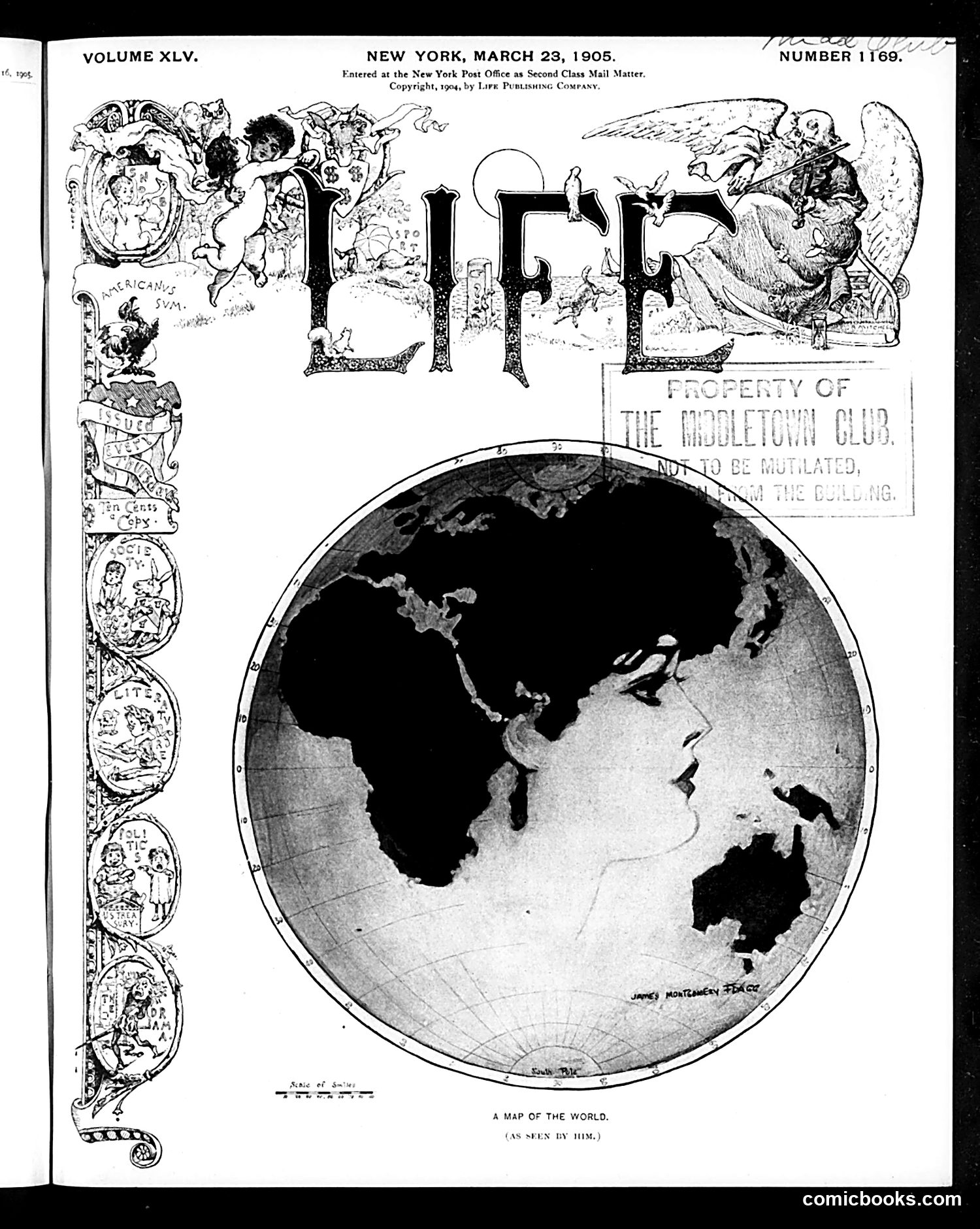
This issue's main feature is "A Map of the World (As Seen by Him)"—a satirical world map shown from an egocentric perspective. The cartography deliberately distorts global geography to reflect one individual's inflated self-importance, making his own location disproportionately large while other regions shrink or disappear. The ornamental left border contains zodiac-style medallions with various figures, likely representing different character types or social commentary typical of Life's satirical style. The elaborate decorative header with classical figures and cherubs frames the title "LIFE," emphasizing the magazine's sophisticated, artistic approach to humor and social commentary. Without identifying the specific "him" referenced, the map satirizes egotistical worldviews—a common target of early 20th-century American satire.
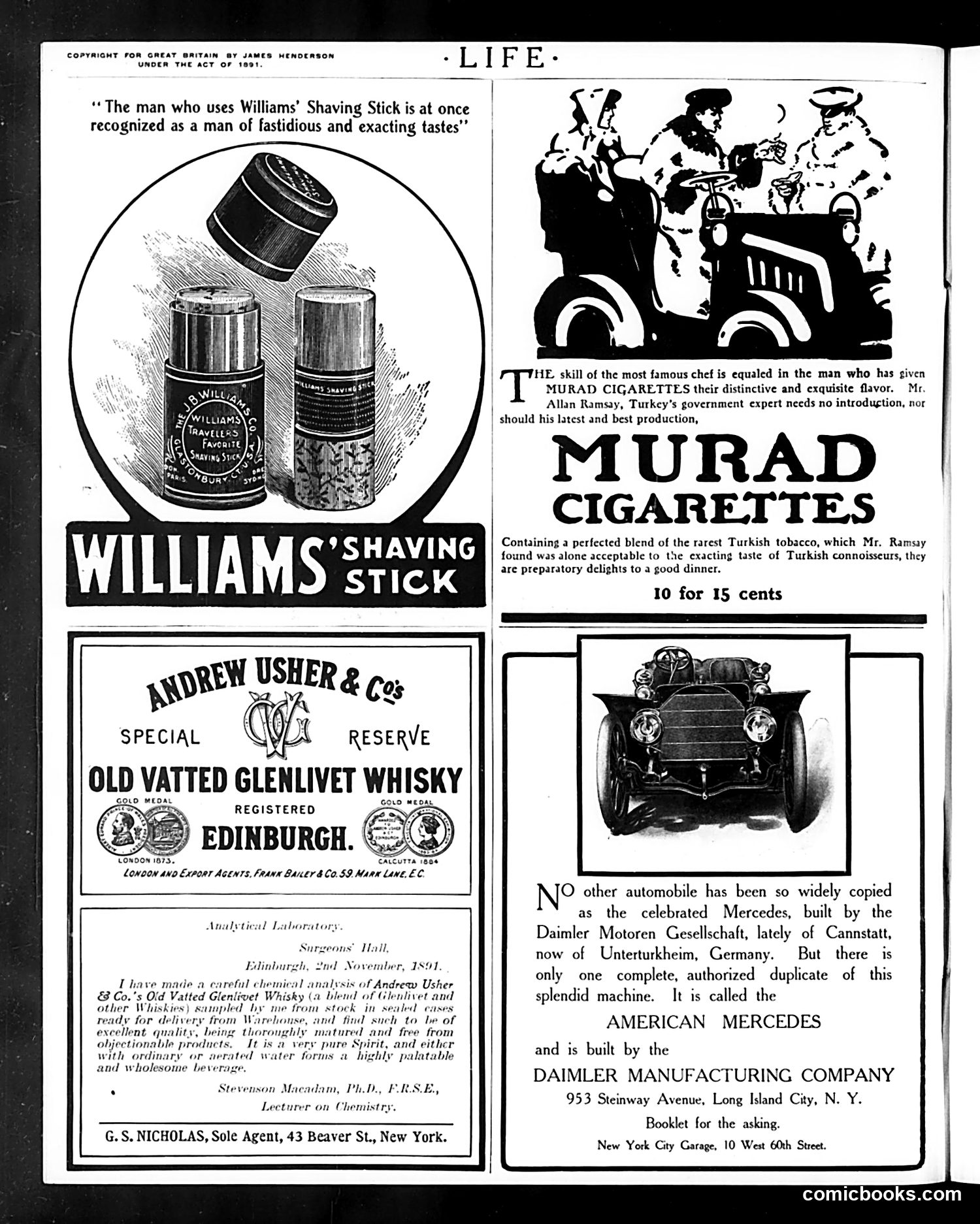
This page is primarily **advertising content** rather than editorial satire. It contains three advertisements: 1. **Williams' Shaving Stick** — promotes grooming products as markers of refined taste and social status 2. **Murad Cigarettes** — features a humorous illustration of well-dressed men in an early automobile, equating the cigarettes with culinary sophistication. The ad references Allan Ramsay and Turkish tobacco quality. 3. **Andrew Usher Whisky** and **American Mercedes automobiles** — luxury goods advertisements The cartoonish illustrations of fashionable gentlemen reflect early 20th-century consumer culture, where branded products signaled respectability and class. There is no evident political satire here—rather, these ads target affluent readers by associating products with refinement, good taste, and modern leisure.
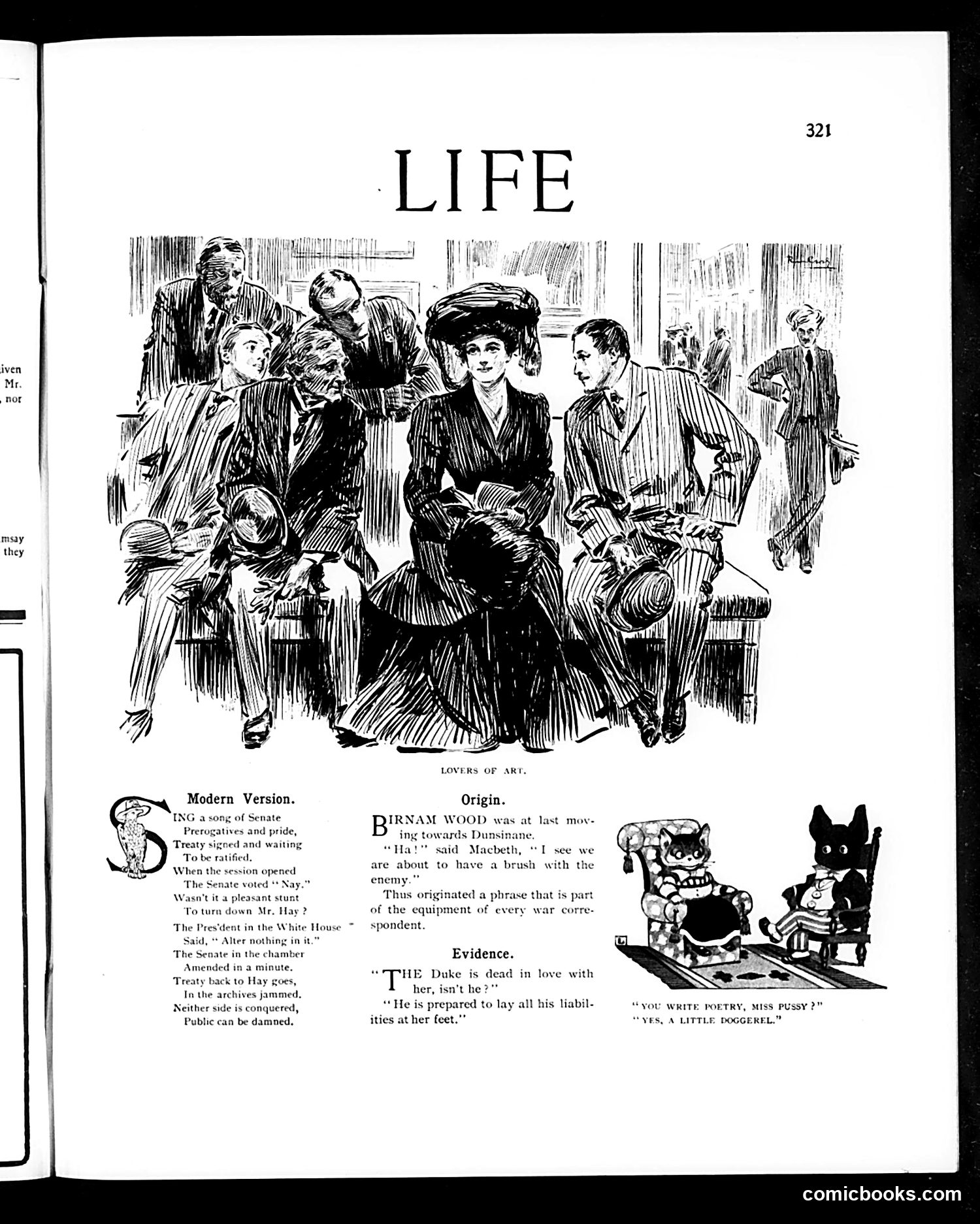
The main illustration shows a group of well-dressed people in what appears to be a Senate chamber or formal government setting. The title "Lovers of Art" is ironic—these figures represent senators engaged in legislative business, not actual art appreciation. The satire critiques Senate ineffectiveness. The "Modern Version" poem mocks how Senate proceedings accomplish nothing: treaties remain unsigned, sessions open without progress, and "neither side is conquered, / Public can be damned." The accompanying "Origin" section references Birnam Wood and Macbeth, suggesting senators make empty promises like Shakespeare's witches. The "Evidence" exchange implies senators prioritize appearance over substance—the Duke's love affair matters more than actual governance. The overall point: senators are theatrical performers playing at importance while accomplishing little.
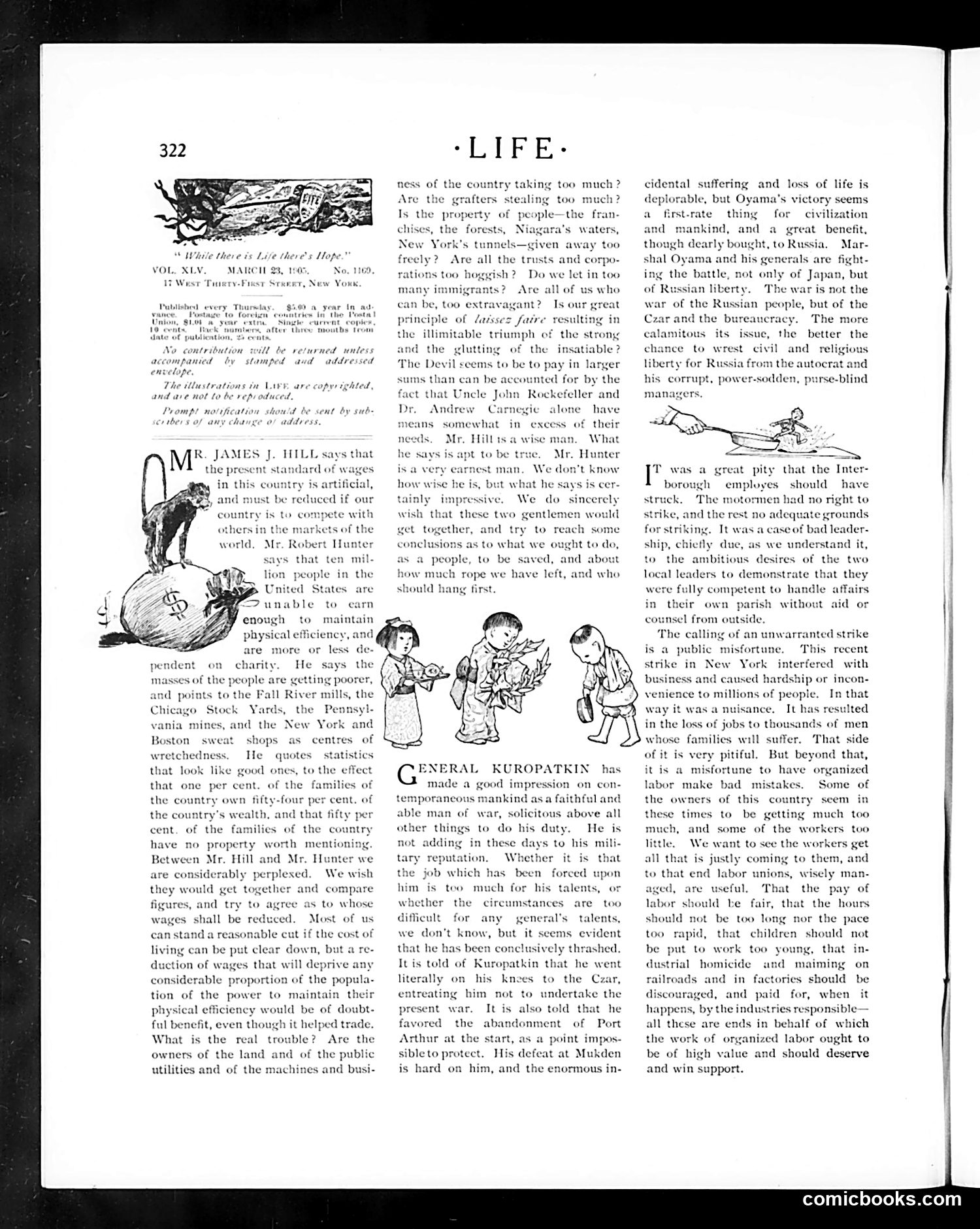
This page from *Life* magazine (March 23, 1902, based on the header) contains two distinct illustrations addressing labor and economic inequality. The left cartoon depicts a figure balancing on a globe, illustrating arguments about wealth distribution in America. The accompanying text by James J. Hill discusses whether the country can compete internationally while maintaining such disparity between rich and poor—referencing conditions in Chicago stockyards, Pennsylvania mines, and Boston sweatshops. The right illustration shows three children in worn clothing, accompanying discussion of General Kuropatkin (Russian military leader) and labor disputes. The text argues for fair wages, reasonable working hours, and opposing child labor in factories and railroads—framing these as patriotic duties. Both pieces critique economic inequality and labor exploitation as threats to American prosperity and values, typical Progressive Era concerns.
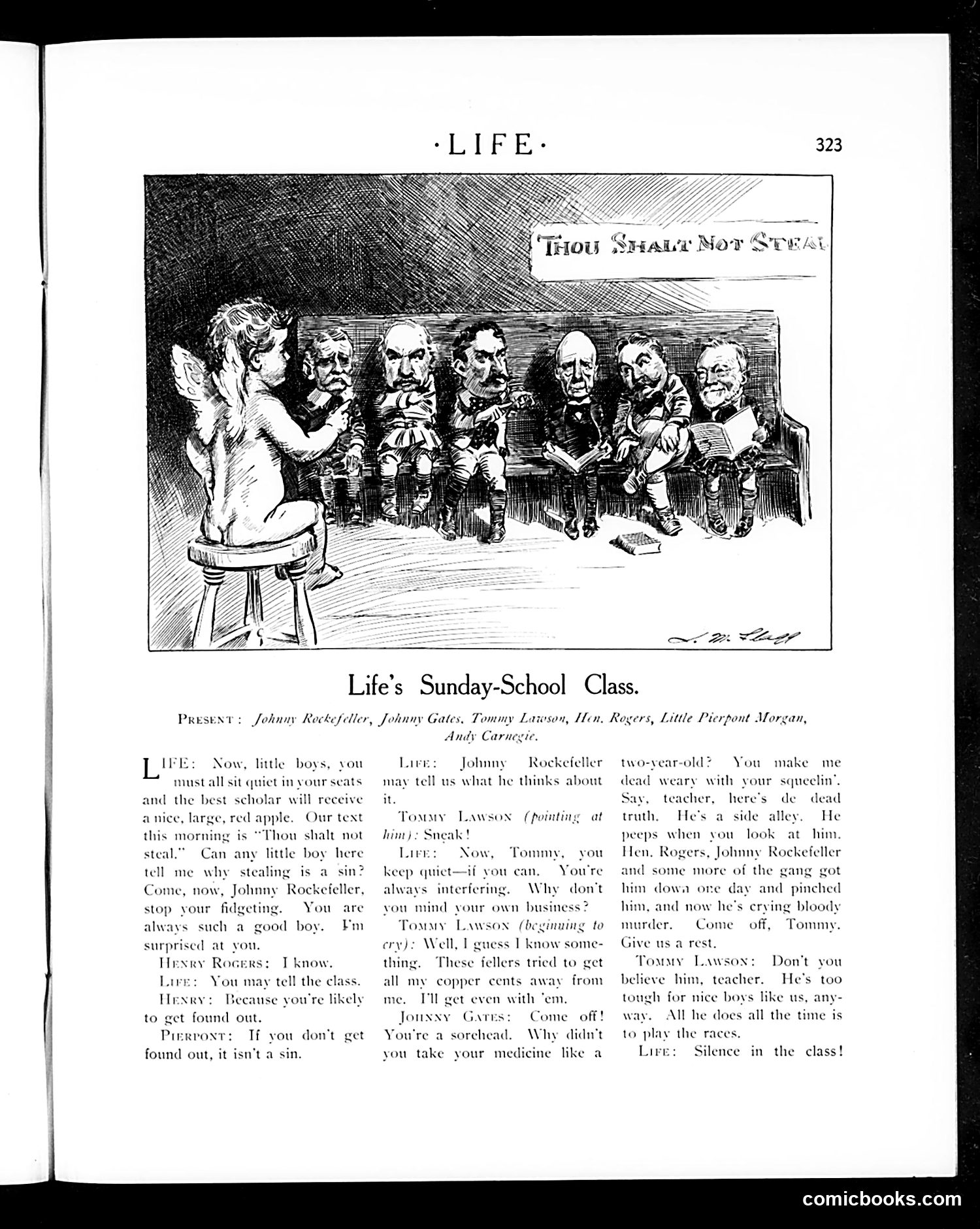
This satirical cartoon depicts a Sunday school lesson gone awry. An angelic teacher attempts to instruct six caricatured pupils—identified as prominent figures including Johnny Rockefeller, Tommy Lawson, Henry Rogers, Johnny Gates, and Andy Carnegie—about moral teachings like "Thou Shalt Not Steal." The joke targets wealthy industrialists and robber barons of the Gilded Age, portraying them as incorrigible misbehaviors who cannot be taught ethics. The boys argue that stealing copper cents and playing "the races" (gambling) are normal behavior. The satire suggests these wealthy men's actual practices—theft, embezzlement, and financial manipulation—make them unsuitable pupils for moral instruction, implying their fortunes were built on dishonest practices.
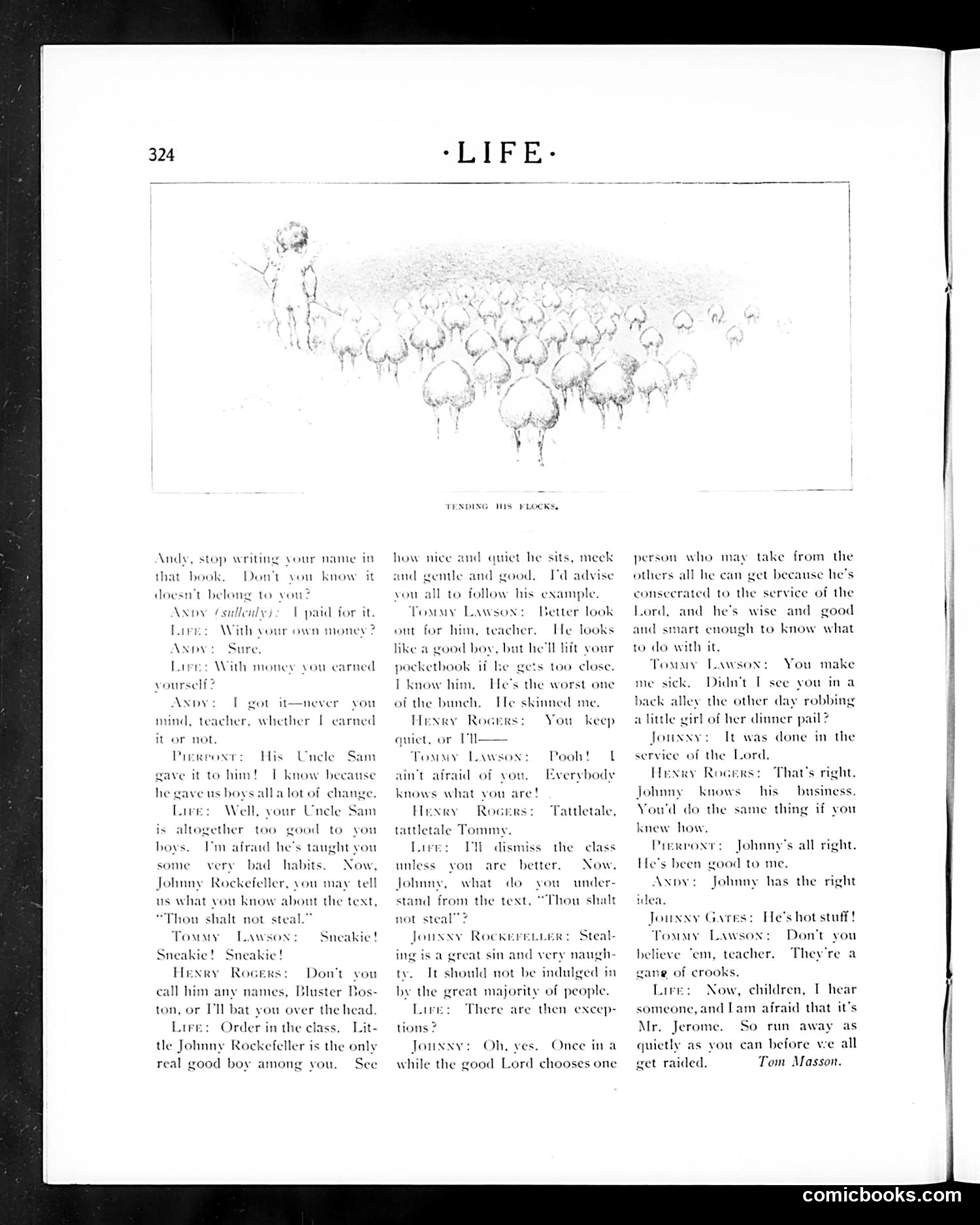
The illustration depicts a man (appears to be a teacher or authority figure) standing apart from a large group of sheep-headed figures, which is a satirical visual metaphor for students or the general population as mindless followers. The dialogue below mocks school discipline and authority, featuring characters like "Johnny Rockefeller" and "Henry Rogers"—likely references to wealthy industrialist families of the era. The satire critiques how schools indoctrinate children into obedience and conformity rather than critical thinking. The "flocks" metaphor suggests that authority figures (educators, clergy, or politicians) treat ordinary people as sheep to be herded and controlled. This reflects broader Progressive-era concerns about individuality being suppressed by institutional power structures.
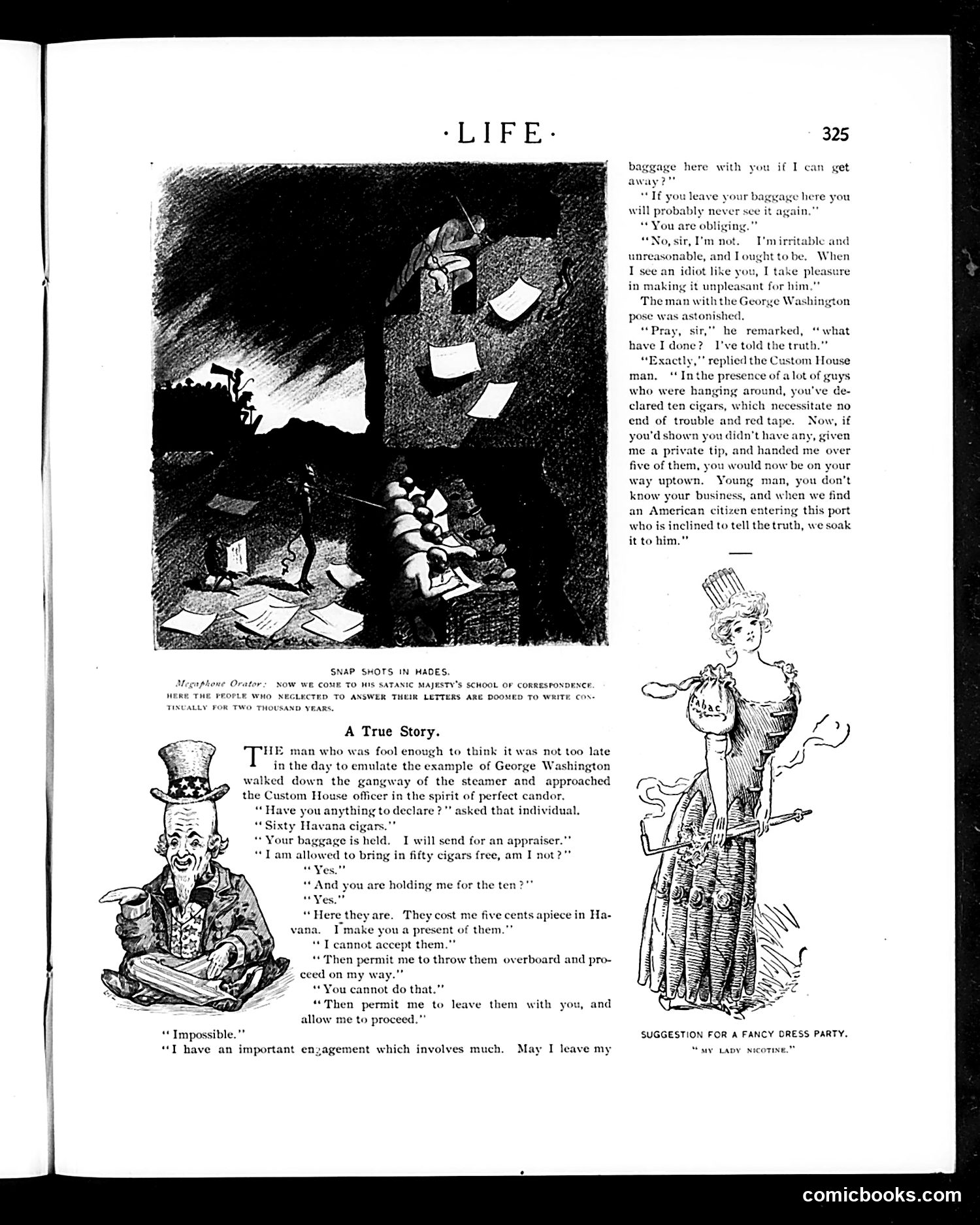
This page contains "A True Story," a satirical anecdote about a man attempting to emulate George Washington's integrity at a port customs inspection. The protagonist tries to declare cigars honestly, but the Custom House officer treats this as absurd and suspicious—offering increasingly ridiculous "deals" to make the declaration go away. The satire mocks **corruption in American customs enforcement**, where honest declaration was apparently so rare that officials viewed it as an obstacle rather than duty. The reference to Washington invokes the ideal of American virtue against contemporary institutional dishonesty. The accompanying illustrations—caricatured figures in exaggerated dress—and the section titled "Snap Shots in Hades" suggest darker satirical commentary on corruption in government and maritime trade.
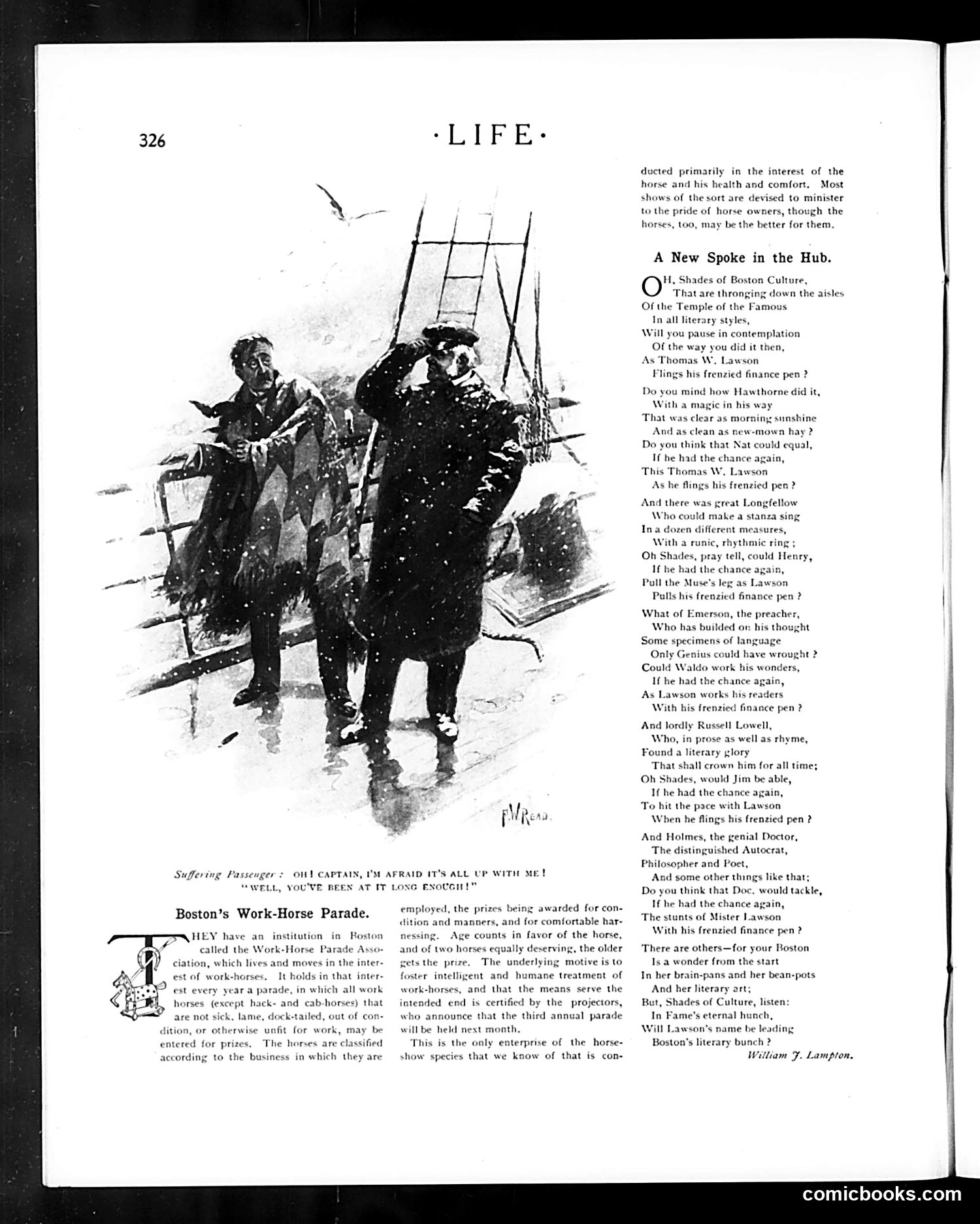
This page contains two distinct pieces: **1. The Cartoon** (left side): Shows two figures in a horse-drawn sleigh during winter. The caption reads "Suffering Passenger: 'Oh! Captain, I'm afraid it's all up with me!' / Cabby: 'Well, we're a'most at Long Enough!'" This appears to be a visual pun—the passenger fears they're dying during the cold ride, while the driver reassures them they're nearly at their destination (a place literally named "Long Enough"). The humor relies on wordplay and the contrast between the passenger's panic and the driver's literal interpretation. **2. The Text** (right side): "Boston's Work-Horse Parade" describes an institution where Boston inspects work horses annually. Horses are classified and awarded prizes based on condition and fitness for labor. The article emphasizes humane treatment of working animals—the parade showcases horses that are healthy, not sick or disabled.
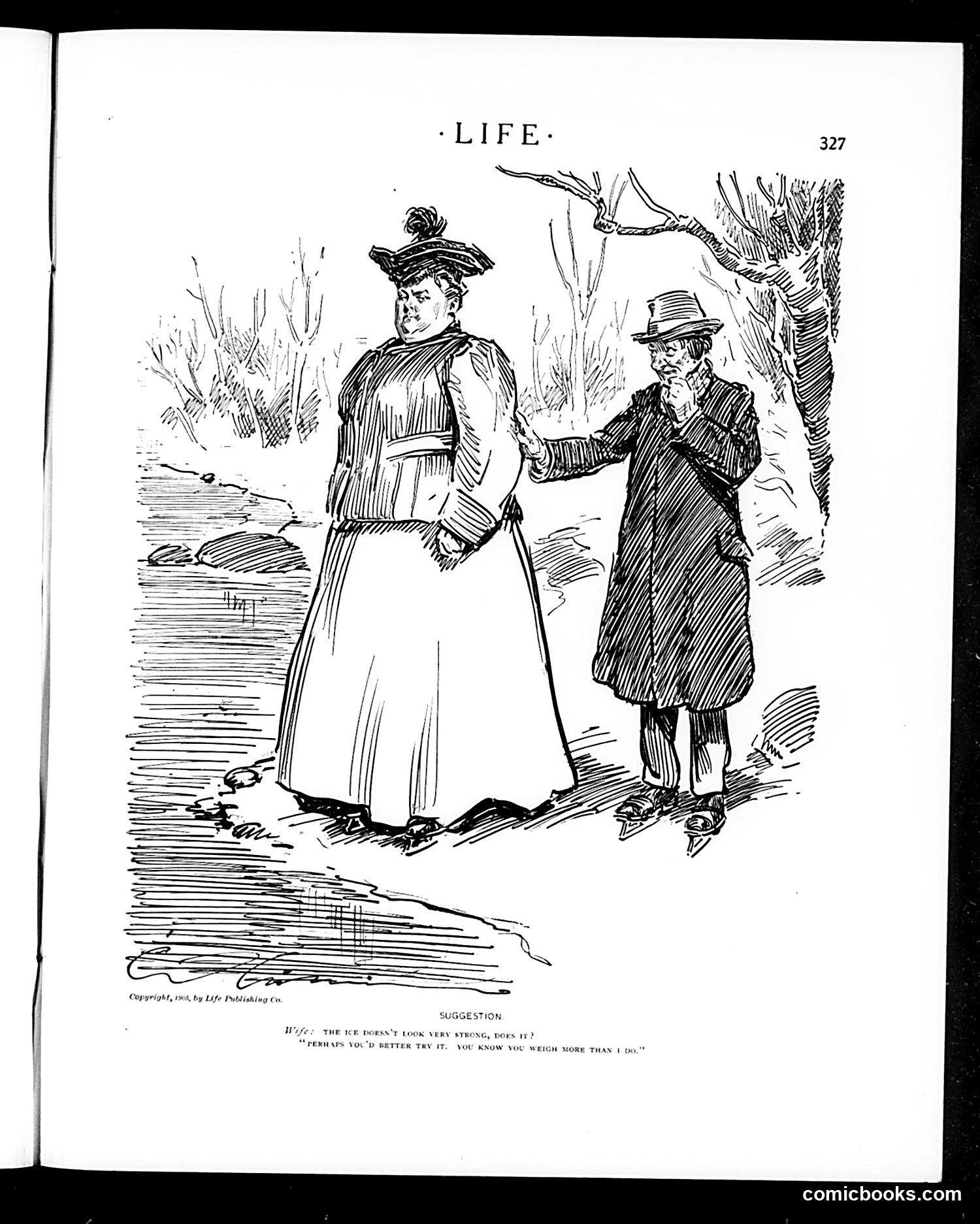
This single-panel cartoon titled "Suggestion" depicts a woman on ice with a man offering advice. The caption reads: "Wife: 'The ice doesn't look very strong, does it?' / Husband: 'Certain you'd better try it. You know you weigh more than I do.'" The satire plays on marital dynamics and body-shaming humor common to early 20th-century comedy. The husband suggests his wife test the ice's strength first, implying she's heavier and therefore more likely to break through—a backhanded "compliment" that mocks her weight while disguising his suggestion as concern for safety. The joke reflects era-typical satirical commentary on marriage relations and physical appearance, using dark humor about potential danger for comedic effect.
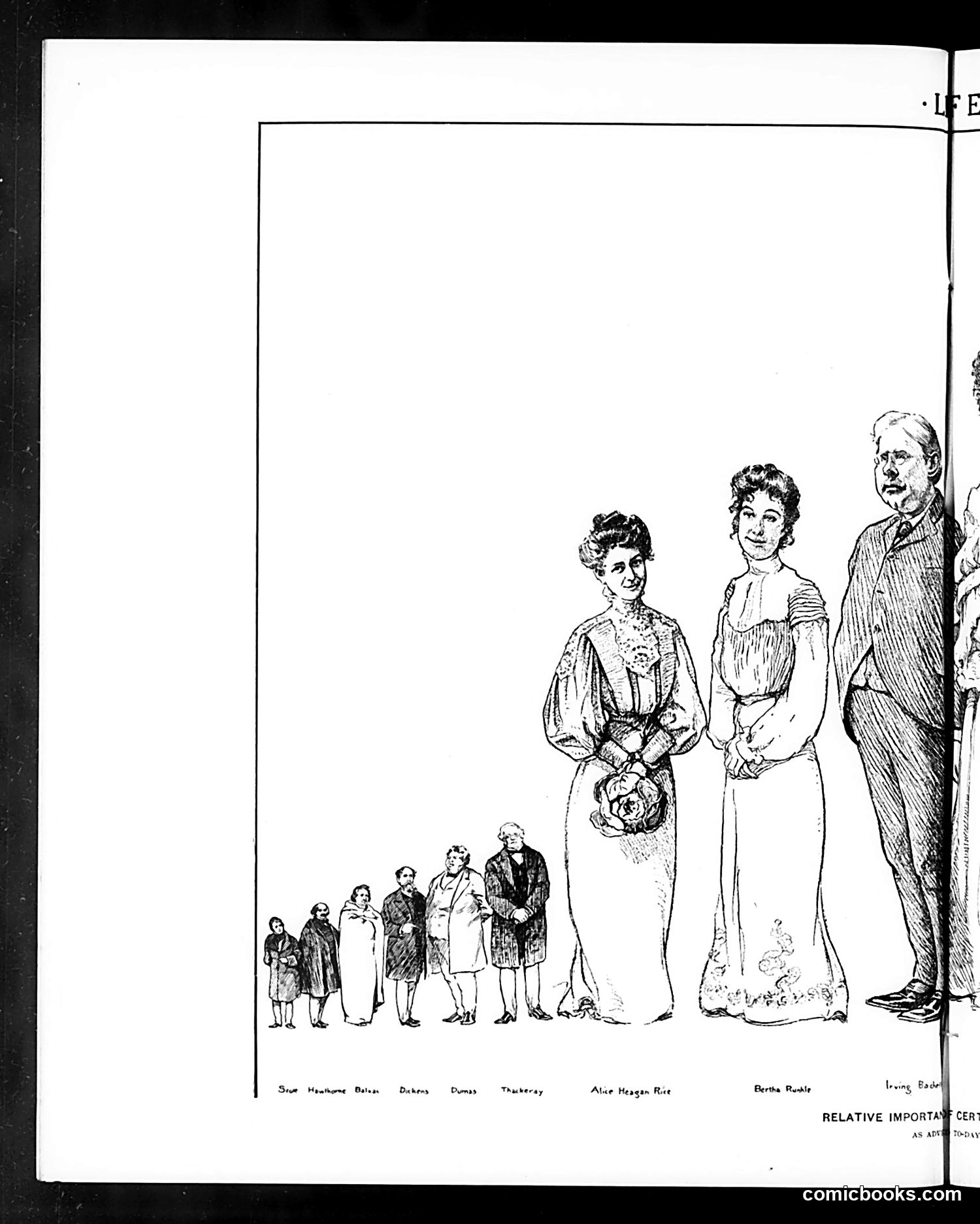
This is a satirical illustration comparing the relative heights and importance of various public figures, arranged in increasing order from left to right. The caption reads "RELATIVE IMPORTANCE OF CERTAIN PEOPLE AS APPRECIATED BY SOCIETY." The figures progress from tiny to towering, suggesting a commentary on how society disproportionately values certain individuals. Based on the visible labels (though some are difficult to read clearly), this appears to mock the outsized prominence given to celebrities or socialites compared to other citizens of arguably greater merit or importance. The exaggerated size differences emphasize Life magazine's critique of misplaced social priorities—the satire suggests society elevates trivial or superficial figures while diminishing those of genuine substance. This reflects early 20th-century satirical commentary on American celebrity culture and social values.
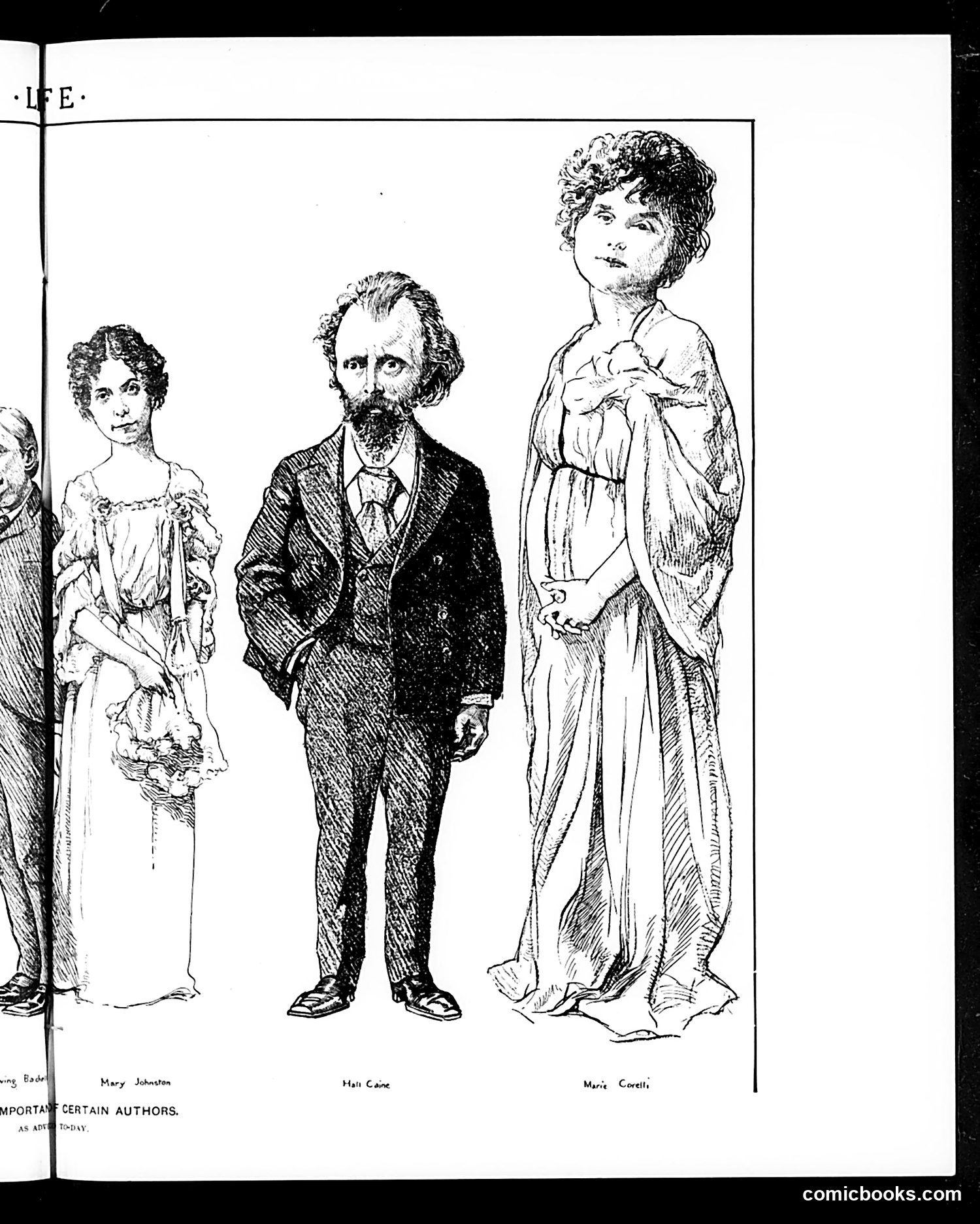
This page from *Life* magazine appears to be titled "Important Certain Authors as Appearing Today" and depicts three figures in a satirical illustration of contemporary authors. The visible names are: - **Mary Johnston** (left, in an elegant gown holding flowers) - **Hall Caine** (center, bearded man in formal suit) - **Marie Corelli** (right, in flowing classical-style drapery) The satire likely mocks these popular authors' public personas or literary pretensions—particularly Corelli's affected, theatrical presentation in classical garb, which contrasts with Johnston's and Caine's more conventional modern dress. The caption suggests *Life* is commenting on how these successful authors presented themselves to the public during this era, possibly critiquing their vanity or affectations. The specific satirical point remains unclear without additional context.
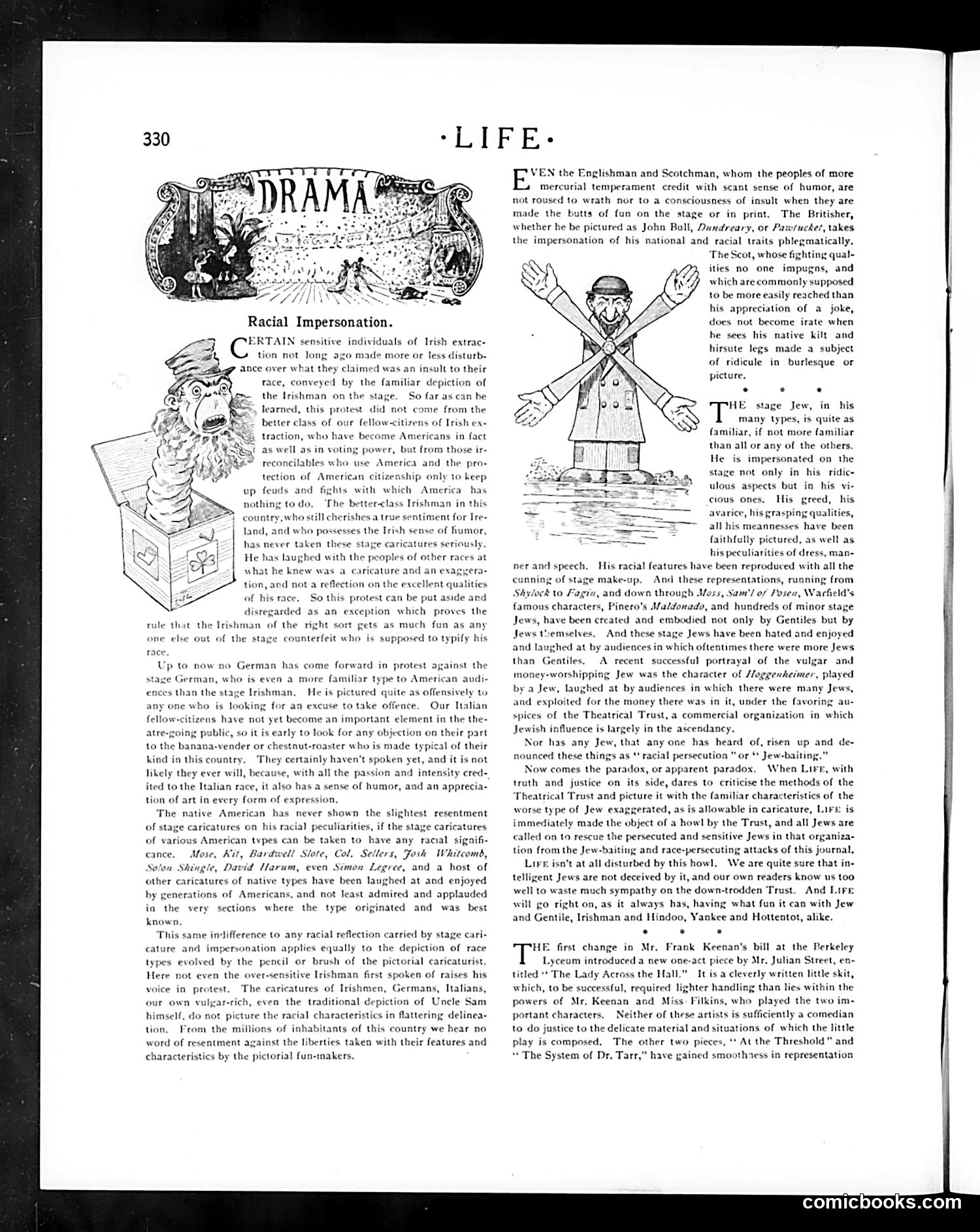
This page from *Life* magazine discusses how stage performers of various ethnicities were caricatured through racial stereotyping. The text critiques theatrical traditions where actors portrayed Irish, German, Italian, and Jewish characters through exaggerated, demeaning depictions. The article argues these caricatures—including the "stage Jew" with grotesque features and the stereotypical Irishman—were offensive but widely accepted entertainment. It notes that while American audiences generally hadn't protested such portrayals, the theatrical practice of racial impersonation was fundamentally unfair. The piece defends against charges of "Jew-baiting" by the *Theatrical Trust*, asserting that *Life* magazine itself had critiqued these stereotyping methods. The visible cartoon appears to show a theatrical character in exaggerated costume, exemplifying the satirical performance styles being discussed.
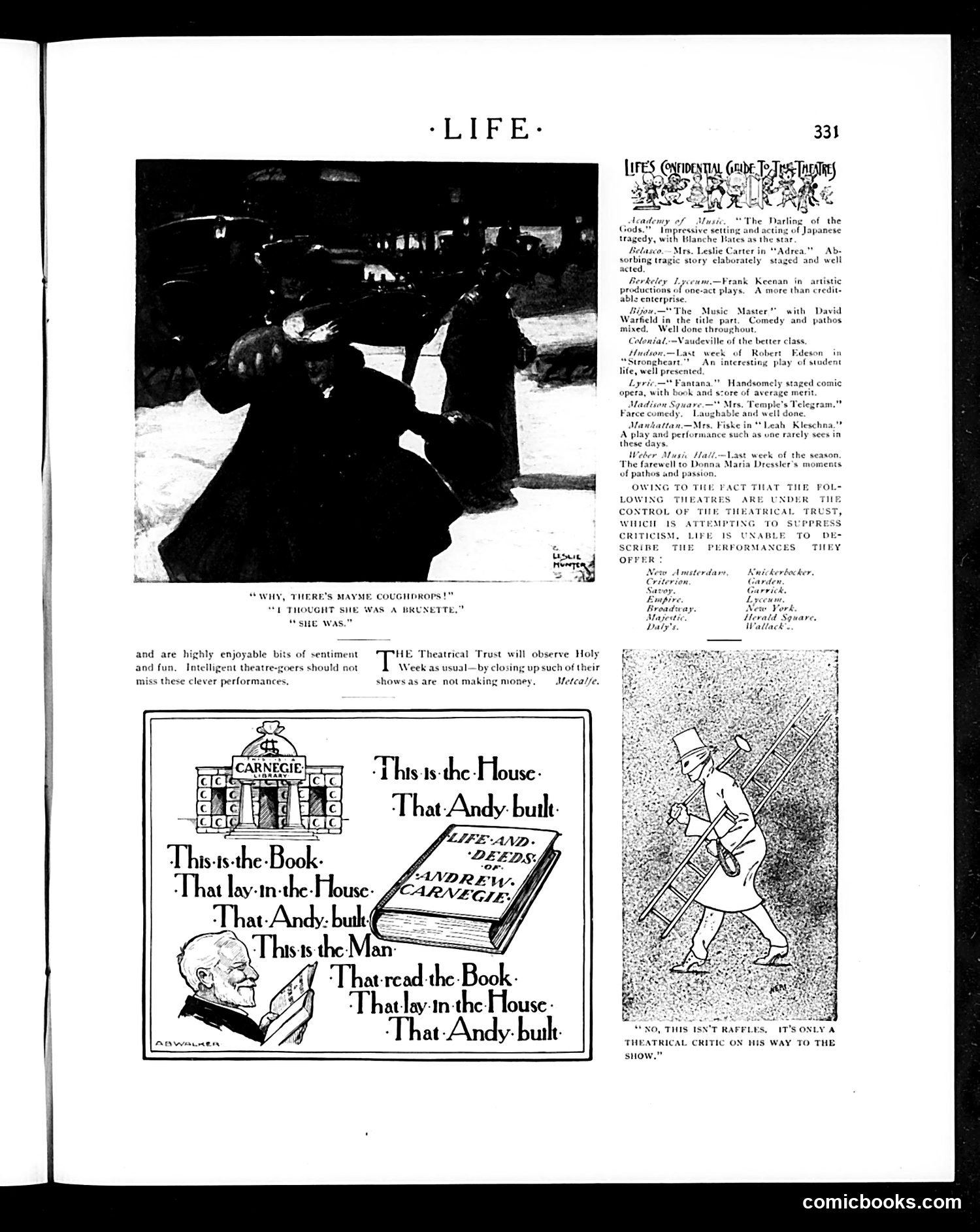
**Main Cartoon (center-left):** A playful illustrated poem following the "House That Jack Built" nursery rhyme format, celebrating Andrew Carnegie and the Carnegie library system he funded. It traces a chain: the book → the house (library) → the man who read it, all built by Carnegie's philanthropy. **Top photograph:** A theater scene captioned with dialogue about "Mayme Coughdrops" being a brunette, likely satirizing theatrical gossip or character inconsistencies. **Right cartoon:** A theatrical critic climbing a ladder toward a show, captioned as "not Raffles" (a reference to the gentleman burglar character), humorously depicting critics as intruders or outsiders sneaking into performances. **Key context:** The page's most significant element is the bold disclaimer stating certain theaters are controlled by "the Theatrical Trust" and that Life cannot review their performances due to censorship attempts. This references the real "Theatrical Syndicate" that monopolized American theater in this era and suppressed critical coverage. The satire condemns this suppression of free press criticism.
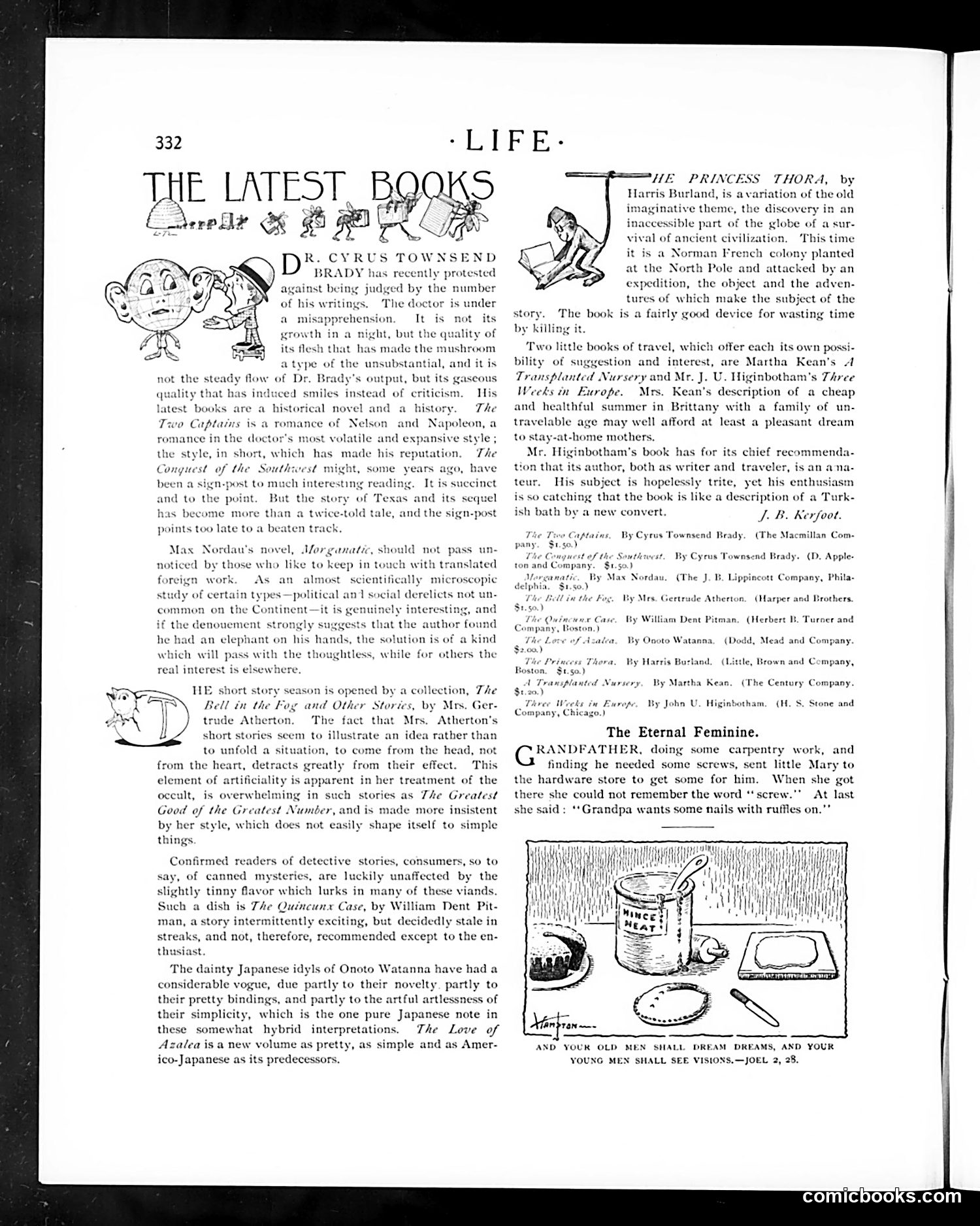
This page presents literary criticism of contemporary books, written in the caustic style typical of Life's book review section. The visible cartoons are decorative vignettes accompanying reviews of specific titles. The reviews critique authors' tendencies and trends: Dr. Cyrus Townsend Brady is defended against critics who judge him by prolific output rather than quality. Mrs. Gertrude Atherton's short stories are faulted for being overly cerebral and artificial rather than emotionally resonant. Detective fiction is dismissed as "tinny" but acknowledged as popular with devoted readers. The Japanese author Onoto Watanna is praised for delicate simplicity but gently mocked—her vogue attributed partly to "pretty bindings" rather than literary merit alone, suggesting her exotic appeal surpasses substance. The tone throughout is sophisticatedly dismissive of commercial and derivative works while defending serious authors against superficial judgment. This reflects Life's position as a magazine for educated, discriminating readers.
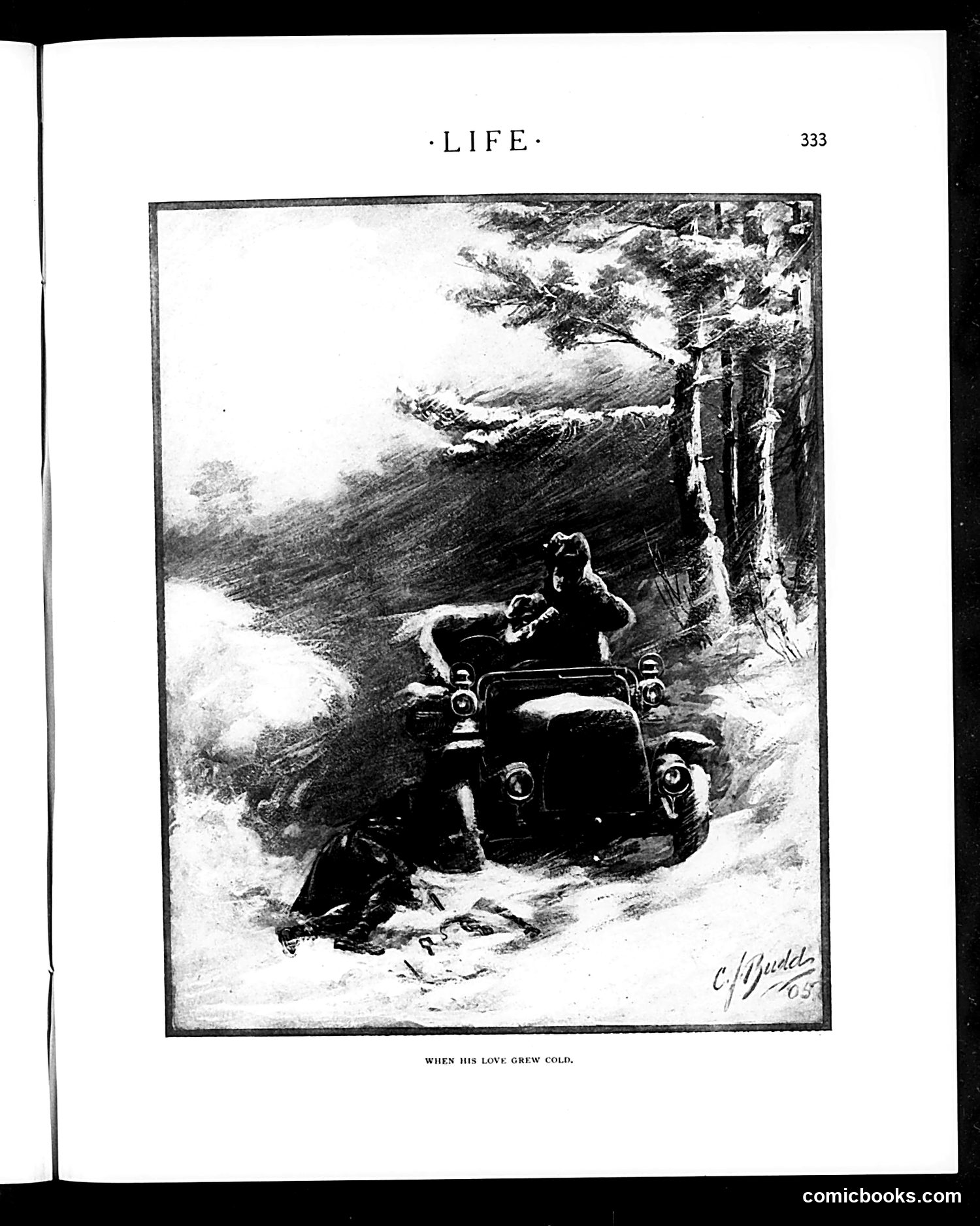
This illustration depicts a dramatic automotive accident on a mountain road. A car has crashed or overturned near a cliff edge, with two figures visible—one appears to be operating the vehicle while another sits beside them. The mountainous landscape and tall trees frame the scene. The caption "When His Love Grew Cold" suggests this is narrative illustration for a story about romantic betrayal or relationship deterioration resulting in tragedy. The specific plot is unclear without additional context from the accompanying article. The dramatic crash serves as visual metaphor for a love affair's destructive end. The artwork is signed by C. Mudel, dated '05 (likely 1905), and appears in Life magazine's satirical or literary content section.
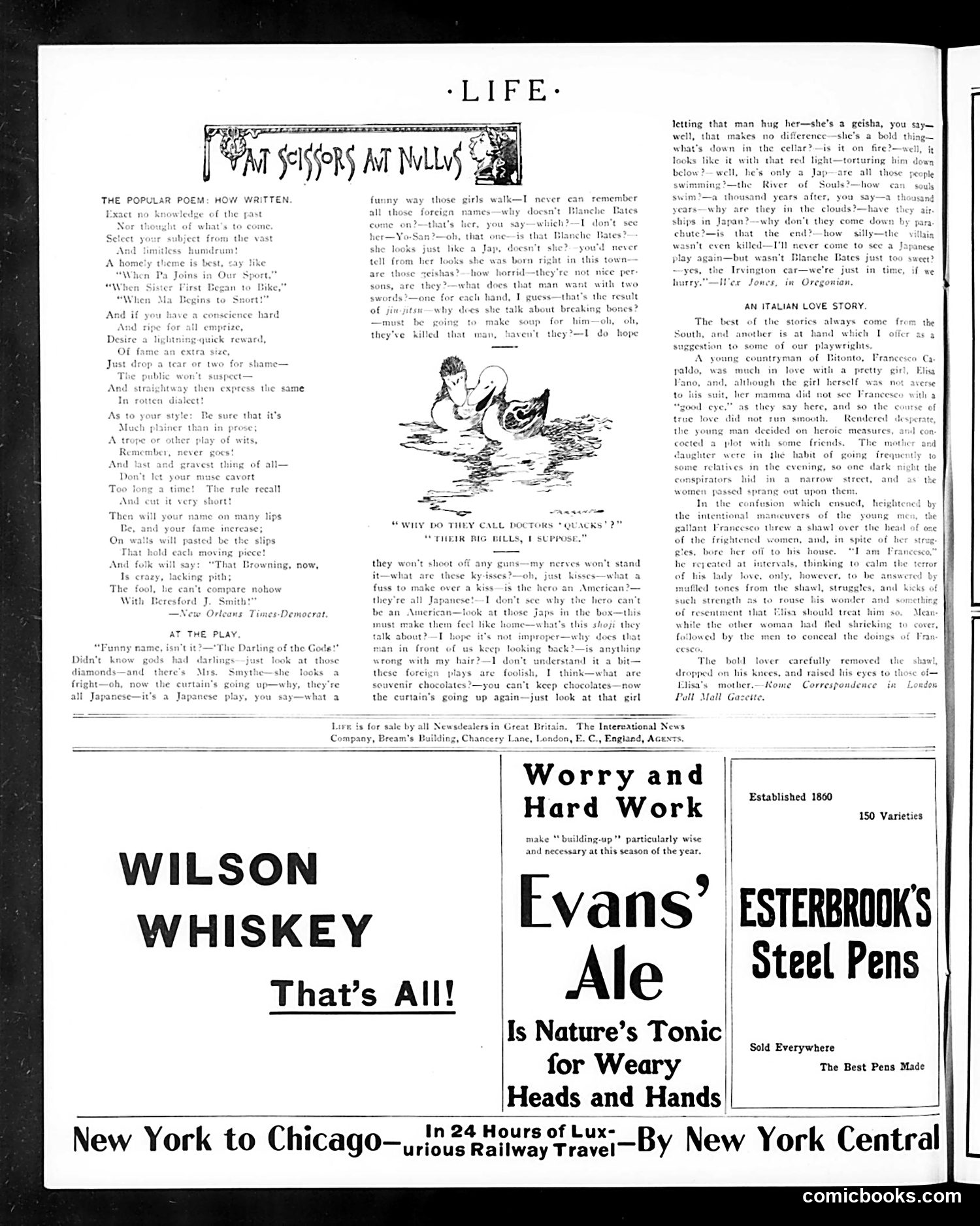
This page contains two satirical pieces and advertisements. The main content appears to be two short stories—"The Popular Poem: How Written" and "An Italian Love Story"—both poking fun at sentimental Victorian literature and theater. The poems mock the formulaic nature of popular verse: predictable romantic scenarios, clichéd language ("lightning-quick reward"), and artificial emotionality. The Italian story similarly ridicules melodramatic stage conventions—the beautiful heroine, scheming villains, tragic misunderstandings, and overwrought emotions typical of contemporary plays. The cartoon shows a couple by water, illustrating one of these overwrought scenarios. The humor targets both the stories' absurdity and contemporary audiences' appetite for such theatrical sentimentality. The advertisements (Wilson Whiskey, Evans' Ale, Esterbrook's Steel Pens, and New York Central Railway) are period-appropriate commercial placements, unrelated to the satire above.
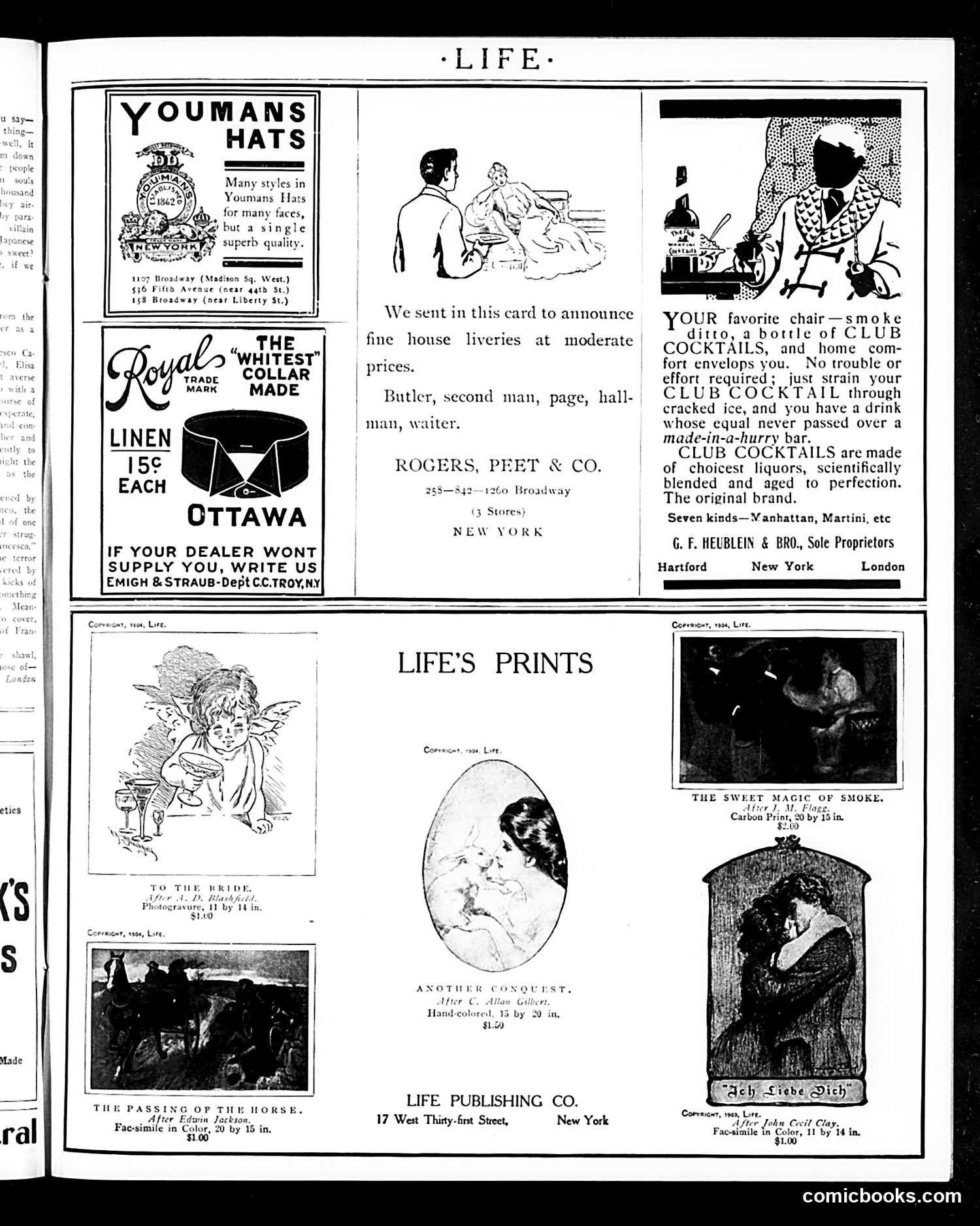
This is primarily an **advertising page** from Life magazine, not a satirical cartoon page. It features commercial advertisements for early 20th-century consumer goods and services: **Top section:** Ads for Youmans Hats, Royal linen collars (15¢), and Rogers Peet & Co. clothing stores in New York. **Center:** An announcement about house liveries (servant uniforms) at moderate prices, listing positions like butler and waiter. **Right side:** An ad for Club Cocktails, emphasizing leisurely home consumption—smoking, drinking, and comfort. This predates Prohibition (1920-1933), when such alcohol advertising was legal. **Bottom section:** "Life's Prints"—reproductions of artwork available for purchase, including romantic and domestic scenes ("To the Bride," "Another Conquest"). The page reflects **upper-class consumer culture** of the era: fine clothing, servants, cocktails, and art reproductions. There is no political satire visible—this is straightforward commercial promotion typical of Life's advertising content.
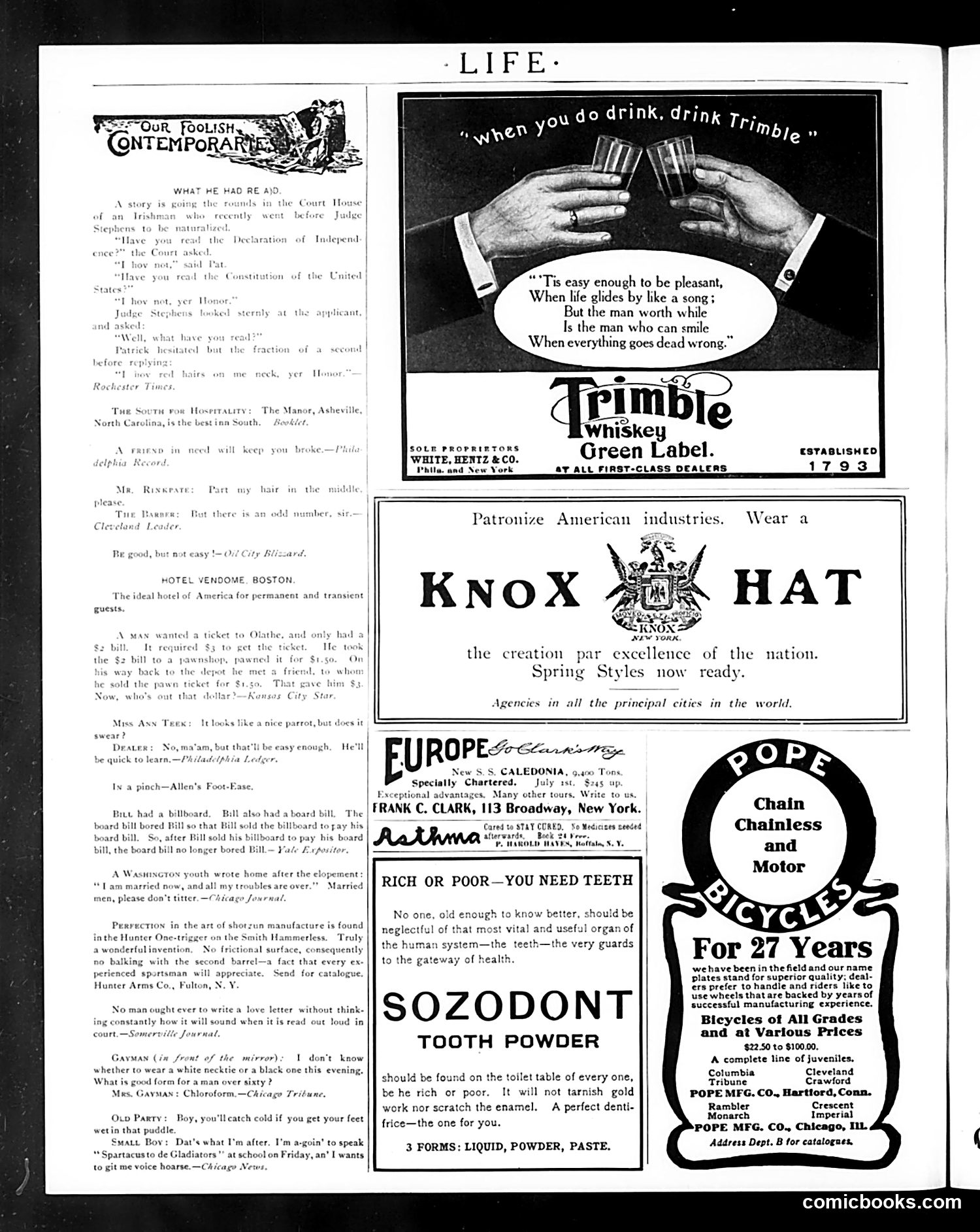
This page from *Life* magazine combines humor columns with period advertisements. The left side features short satirical anecdotes mocking contemporary society—including jokes about illiteracy (a man claiming to have "read" the Declaration of Independence but actually just having "red hairs on [his] neck"), marital complaints, and absurd logic puzzles involving bills and billboards. The right side advertises luxury goods: Trimble Whiskey (with a sentimental poem about perseverance), Knox Hats (appealing to nationalist "buy American" sentiment), Pope bicycles (emphasizing 27 years of manufacturing credibility), Sozodont tooth powder, and European steamship travel. The humor reflects early 20th-century middle-class anxieties: pretension, marital discord, and social climbing. The ads target affluent readers seeking status markers—quality hats, reliable bicycles, luxury travel. Together, the page satirizes the very consumer culture its advertisements promote, creating ironic commentary typical of *Life's* genteel satirical approach.
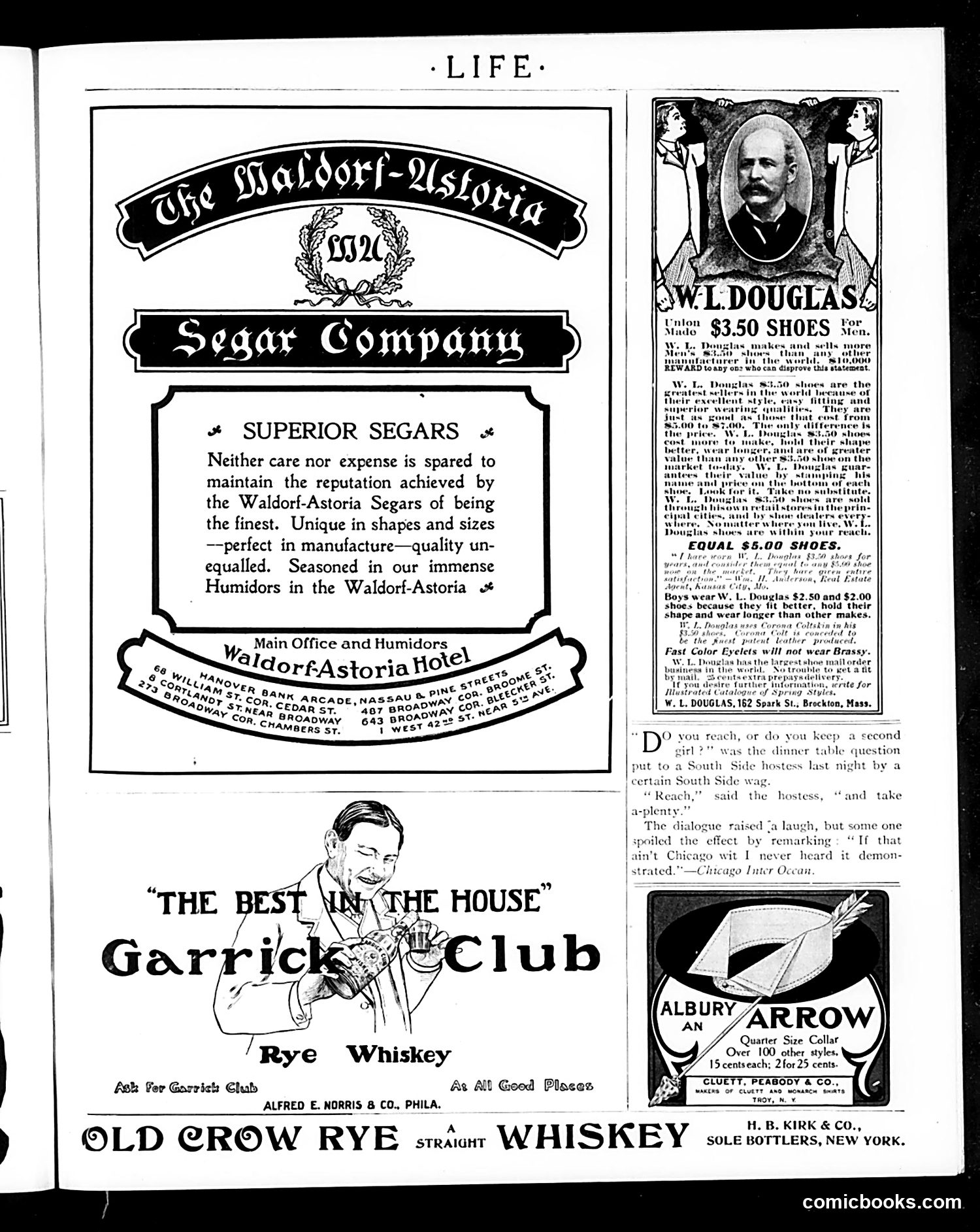
This page is primarily **advertising**, not political satire or comics. It contains four distinct advertisements: 1. **Waldorf-Astoria Segars** (cigars) — luxury product marketed through the prestigious hotel brand name 2. **W.L. Douglas $3.50 Shoes** — emphasizing quality and durability at a competitive price point 3. **Garrick Club Rye Whiskey** — positioned as "the best in the house" 4. **Albury Arrow Collar** — a shirt collar style, advertised as a quarter-size option 5. **Old Crow Rye Straight Whiskey** — bottom advertisement There is a brief humorous anecdote about a South Side hostess offering dinner guests seconds, with a punchline about Chicago etiquette. This appears unrelated to the advertisements and may be filler content typical of *Life* magazine's satirical nature, but it contains no identifiable political figures or social commentary beyond gentle humor about hosting practices.
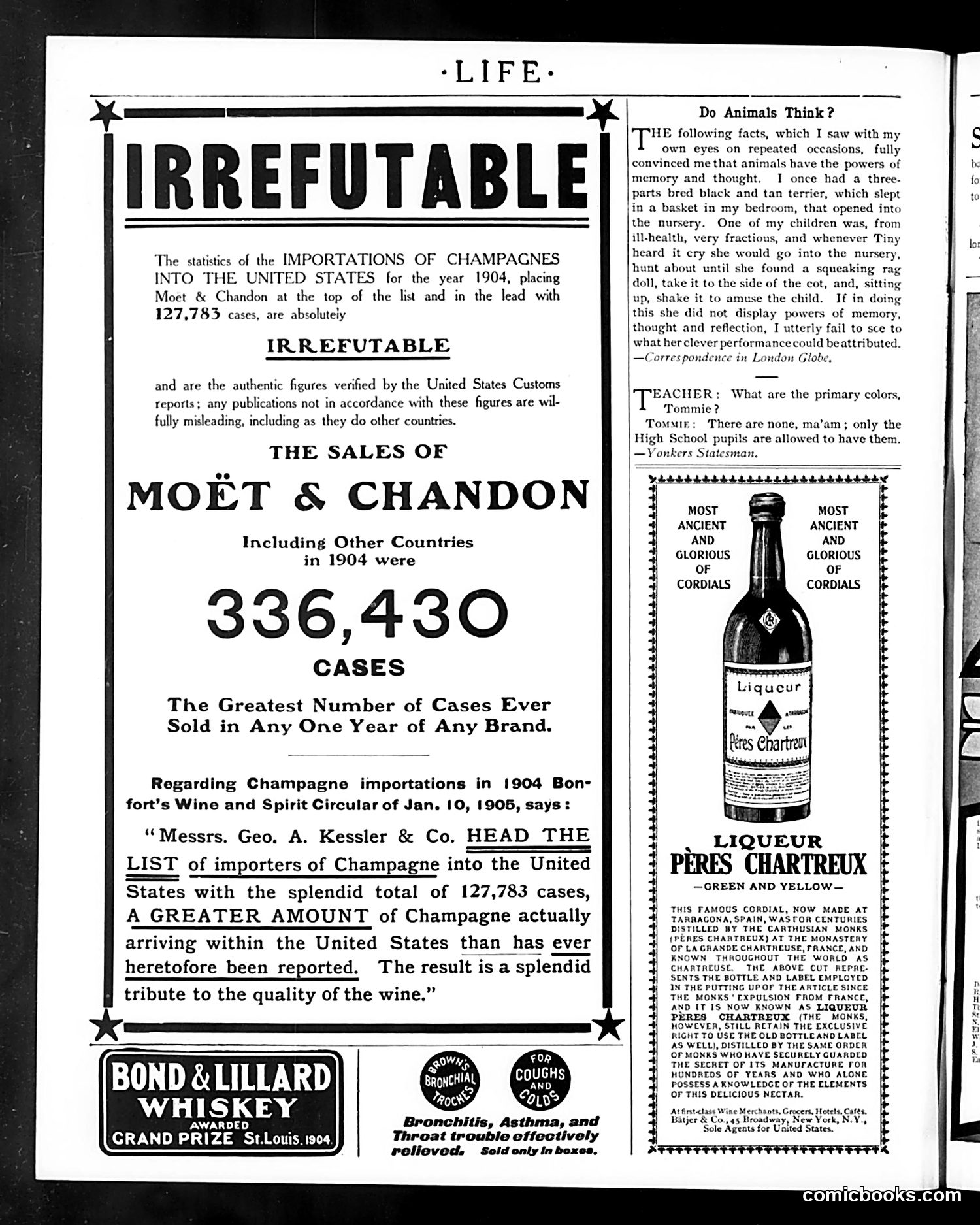
This page is primarily **advertising**, not satire or political commentary. The dominant content is a large advertisement for Moët & Chandon champagne, emphasizing that the brand led U.S. importations in 1904 with 127,783 cases—claimed as "irrefutable" statistics verified by U.S. Customs. The right column contains unrelated filler content: a brief essay on animal cognition (citing a dog's maternal behavior), a schoolroom joke about primary colors, and an advertisement for Pères Chartreux liqueur (a cordial made by Carthusian monks). Bottom left shows an advertisement for Bond & Lillard whiskey, promoted as a cure for respiratory ailments. There are **no cartoons or caricatures** on this page. The content reflects typical early-1900s magazine advertising practices: brands making dubious health claims and using statistics to establish market dominance.
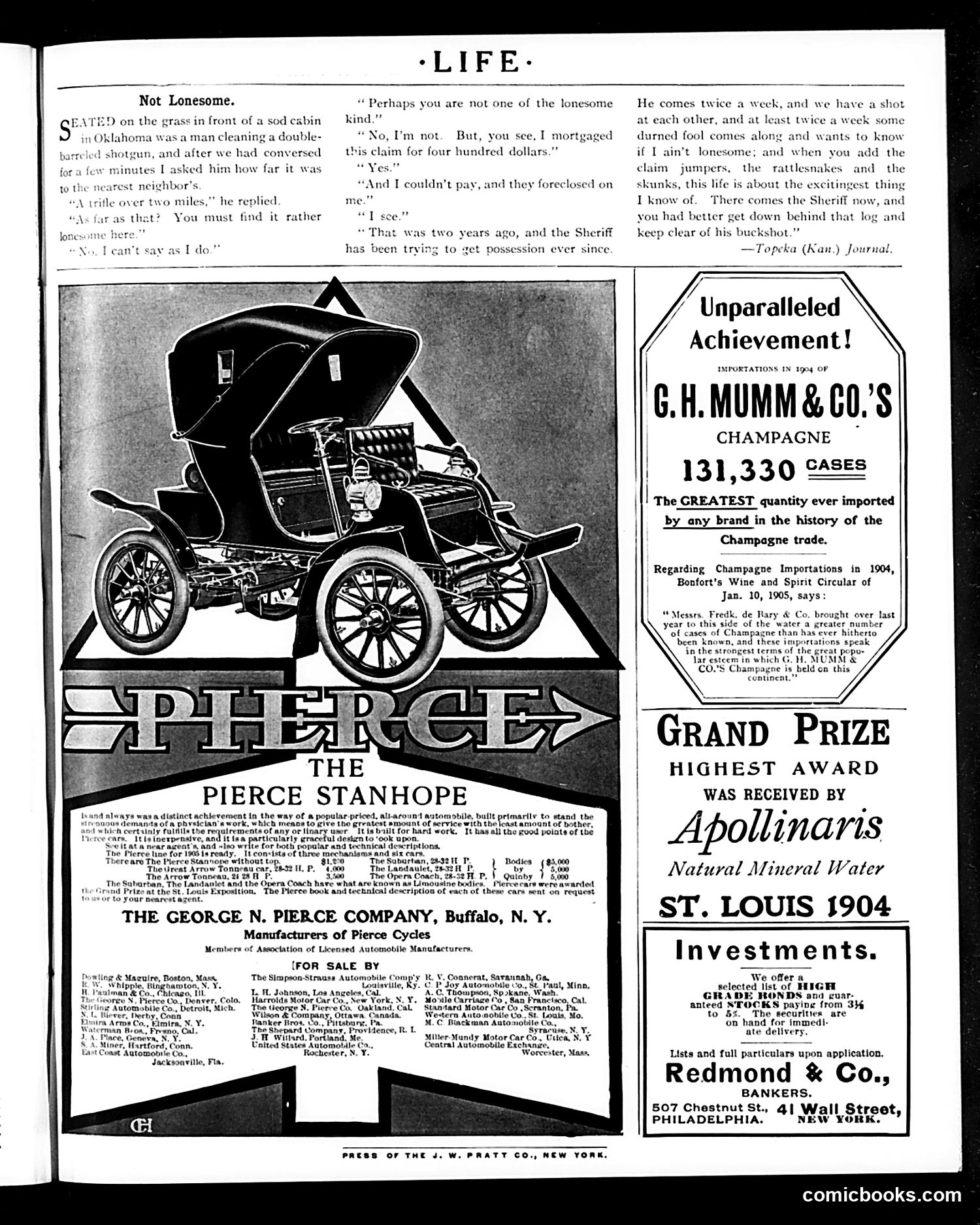
This page contains a humorous sketch titled "Not Lonesome" (left) and period advertisements (right). **The Cartoon:** The sketch presents a conversation between a visitor and an Oklahoma homesteader cleaning a shotgun. When asked if he's lonely, the man insists he's not—but his reasoning reveals the opposite. He's constantly bothered by the Sheriff (pursuing a mortgage foreclosure), claim jumpers, rattlesnakes, skunks, and strangers asking about his loneliness. The joke's irony: his life is so filled with *unpleasant* visitors and threats that he has no time to be lonely—though his circumstances are clearly miserable. This satirizes frontier life's harsh realities during the Oklahoma land rush era. **The Advertisements:** The right side features typical early-1900s ads for luxury goods: Pierce automobiles, G.H. Mumm champagne (131,330 cases imported in 1904), Apollinaris mineral water, and investment banking services—a stark contrast to the struggling homesteader's desperate situation depicted above.
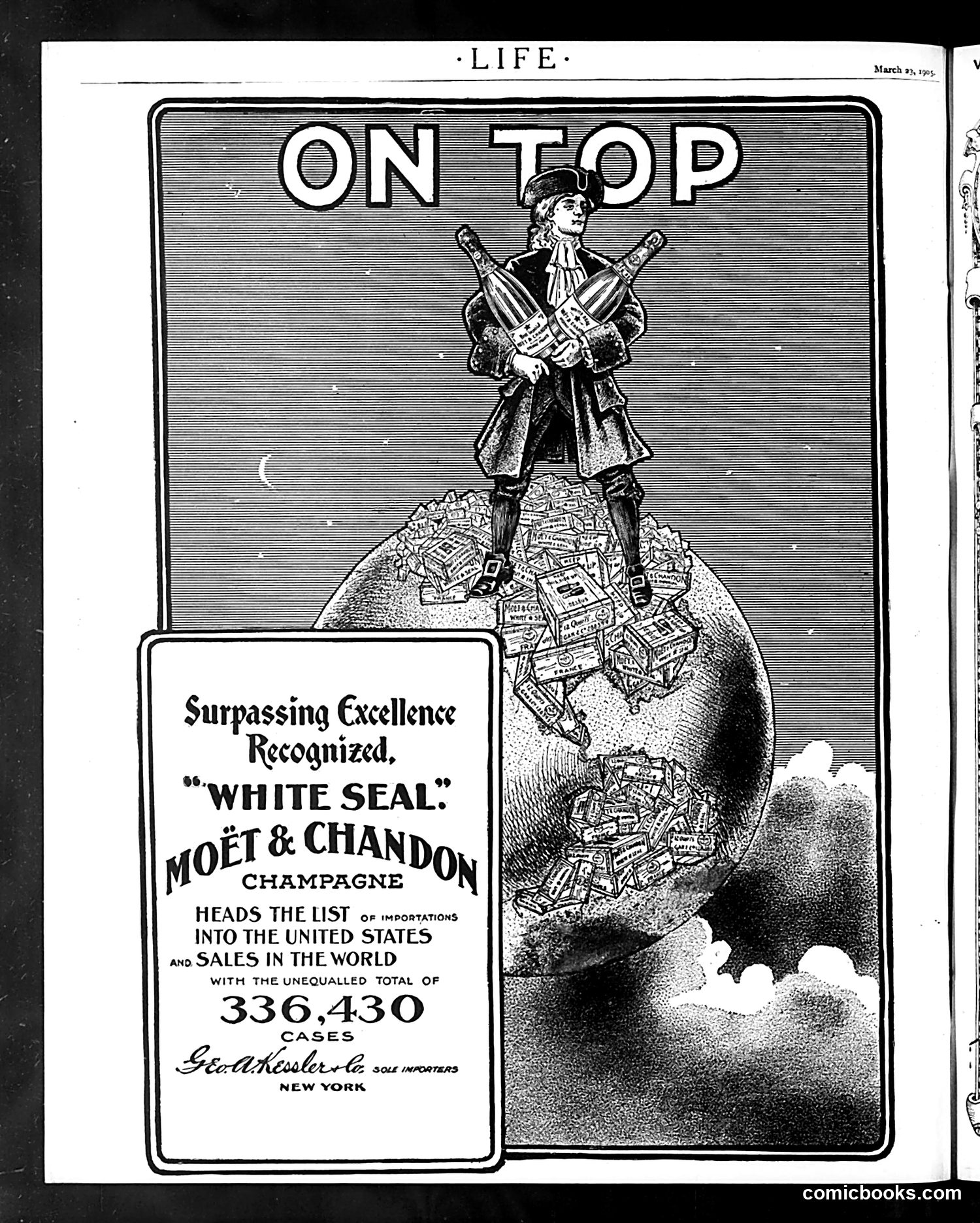
This is primarily a **champagne advertisement**, not satire. The illustration shows a conquering military figure standing triumphantly atop a globe, holding crossed bottles of Moët & Chandon "White Seal" champagne. The advertisement claims the champagne "heads the list of importations into the United States and sales in the world" with 336,430 cases sold. The military imagery—the figure in period military dress, the crossed bottles as weapons, the globe as conquered territory—uses imperialist/colonial visual language to suggest dominance and superiority in the champagne market. This appears to be a straightforward (if grandiose) commercial advertisement leveraging militaristic iconography common in early 20th-century advertising. The "conquest" metaphor positions Moët & Chandon as the dominant force in champagne sales.