
Life, 1905-03-23 · page 12 of 22
Life — March 23, 1905 — page 12: what you’re looking at
What you’re looking at
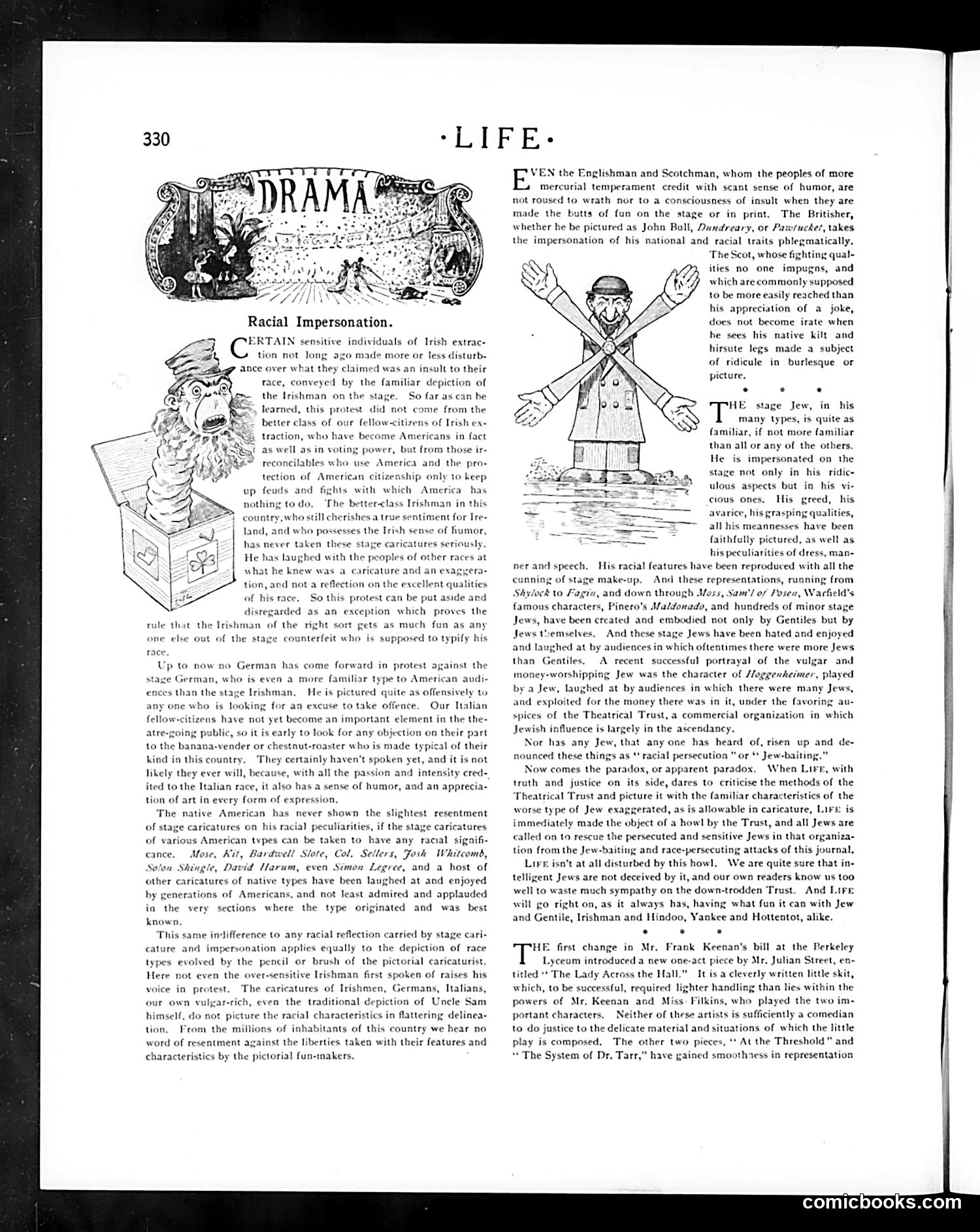
This page from *Life* magazine discusses how stage performers of various ethnicities were caricatured through racial stereotyping. The text critiques theatrical traditions where actors portrayed Irish, German, Italian, and Jewish characters through exaggerated, demeaning depictions. The article argues these caricatures—including the "stage Jew" with grotesque features and the stereotypical Irishman—were offensive but widely accepted entertainment. It notes that while American audiences generally hadn't protested such portrayals, the theatrical practice of racial impersonation was fundamentally unfair. The piece defends against charges of "Jew-baiting" by the *Theatrical Trust*, asserting that *Life* magazine itself had critiqued these stereotyping methods. The visible cartoon appears to show a theatrical character in exaggerated costume, exemplifying the satirical performance styles being discussed.
📄 Transcribed text from this page (OCR, searchable)
Machine-transcribed from the original scan — historical spelling and the odd misread are preserved.
*LIFE- Racial Impersonation. 3 ERTAIN sensitive individuals of Irish extrace z tion not long ago made more or less disturb. ance over what they claimed was an insult to their race, conveyed by the familiar depiction of the Irishman ont e. So far ascan be learned, this protest did not come from the better class of our fellow-citizens of Irish ex- traction, who have become Americans in fact as well as in voting power, but from those ir- reconcilables who use America and the pro- tection of Ameri up feuds and fights with which America has The better-class Irishman in th country, who still cherishes a true sentiment for In n citizenship only to keep nothing to do. land, and who possesses the Irish sense of humor, has never taken these stage caricatures seriously, He has laughed with the peoples of other races at what b tion, and not a reflection on the excellent qualities of his race, So this protest can be put aside and disregarded as an exception which proves the rule that the Irishman of the right sort gets as much fun as any knew was a caricature and an exagyer. one else out of the stage counterfeit who is supposed to typify his race. Up to now no German has come forward in protest against the eto Ame rman, who is even a more familiar ty an audi- ences than the stage Irishman, He is pictured quite as offensively to any one who is looking for an excuse to take offence. Our Malian fellow-citizens have not yet become an important element in the the- ing public, so it is early to look for any objection on their part e banana-vender or chestaut-roaster who is made typical of their a this country. ‘They certainly haven't spoken yet, and it is not likely they ever will, because, with all the passion and intensity cred- ited to the Italian race, it also has a sense of humor, and an apprecia- tion of art in every form of expression, The native American has never shown the slightest resentment of stage caricatures on his racial peculiarities, if the stage caricatures of various American types can be taken to have any racial signifi- cance. Mose, Kit, Bardwell Slote, Col. Sellers, Josh Whitcomb, Solon Shingle, David Harum, even Simon Legree, and a host of other caricatures of native types have been laughed at and enjoyed by generations of Americans, and not least admired and applauded in the very sections where the type originated and was best known, This same indifference to any racial reflection carried by stage cari- cature and impersonation applies equally to the depiction of race types evolved by the pencil or brush of the pictorial caricaturist Here not even the over-sensitive Irishman first spoken of raises his voice in protest. The caricatures of Irishmen, Germans, Italians, our own vulxar-rich, even the traditional depiction of Uncle Sam picture the racial characteristics in flattering delinea- tion, From the millions of inhabitants of this country we hear no himself, do n word of resentment against the liberties taken with their features and characteristics by the pictorial fun-inakers. VEN the Englishman and Scotchman, whom the peoples of more mercurial temperament credit with scant sense of humor, are not roused to wrath nor to a consciousness of insult when they are made the butts of fun on the stage or in print. The Britisher, whether he be pictured as John Bull, Dundreary, or Pawtucket, takes the impersonation of his national and racial traits phlegmatically. ‘The Scot, whose fighting qual- ities no one impugns, and which are commonly supposed to be more easily reached than his appreciation of a joke, does not become irate when he sees his native kilt and hirsute legs made a subject of ridicule in burlesque or picture, . . . HE stage Jew, in his familiar, if not more familiar than all or any of the others. He is impersonated on the stage not only in his ridic- ulous aspects but in his vi cious ones, His greed, his avarice, his grasping qualities, all his meannesses have been faithfully pictured, as well as his peculiarities of dress, man- ner and speech, His racial features have been reproduced with all the cunning of stage make-up. And these representations, running from Shylock to Fagin, and down through Moss, Sam'l of Posen, Warheld’s famous characters, Pinero’s Maldonado, and hundreds of minor stage Jews, have been created and embodied not only by Gentiles but by Jews themselves. And these stage Jews have been hated and enjoyed and laughed at by audiences in which oftentimes there were more Jews A recent successful portrayal of the vulgar and money-worshipping Jew was the character of /oggenheimer, played than Gentiles, by a Jew, laughed at by audiences in which there were many Jews, and exploited for the money there was in it, under the favoring au- spices of the Theatrical Trust, a commercial organization in which Jewish influence is largely in the ascendancy, Nor has any Jew, that any one has heard of, risen up and de- nounced these things as “racial persecution " or ** Jew-baiting.” Now comes the paradox, or apparent paradox. When Lire, with truth and justice on its side, dares to criticise the methods of the Theatrical Trust and picture it with the familiar characteristics of the worse type of Jew exaggerated, as is allowable in caricature, Lire is immediately made the object of a how! by the Trust, and all Jews are called on to rescue the persecuted and sensitive Jews in that orgal tion from the Jew-baiting and race-persecuting attacks of this journal, Lie: isn't at all disturbed by this howl, We are quite sure that in- telligent Jews are not deceived by it, and our own readers know us too well to waste much sympathy on the down-trodden Trust. And Lire will go right on, as it always has, having what fun it can with Jew and Gentile, Irishman and Hindoo, Yankee and Hottentot, alike. . . . HE first change in Mr. Frank Keenan's bill at the Perkeley Lyceum introduced a new one-act piece by Mr. Julian Street, en- titled “* The Lady Across the Hall.” It isa cleverly written little skit, which, to be successful, required lighter handling than lies within the powers of Mr. Keenan and Miss: Filkins, who played the two im- portant characters. Neither of these artists is sufficiently a comedian to do justice to the delicate material and situations of which the little play is composed. The other two pieces, ** At the Threshold" and “The System of Dr. Tarr,” have gained smoothes in representation comicbooks.com