
Life, 1905-03-23 · page 4 of 22
Life — March 23, 1905 — page 4: what you’re looking at
What you’re looking at
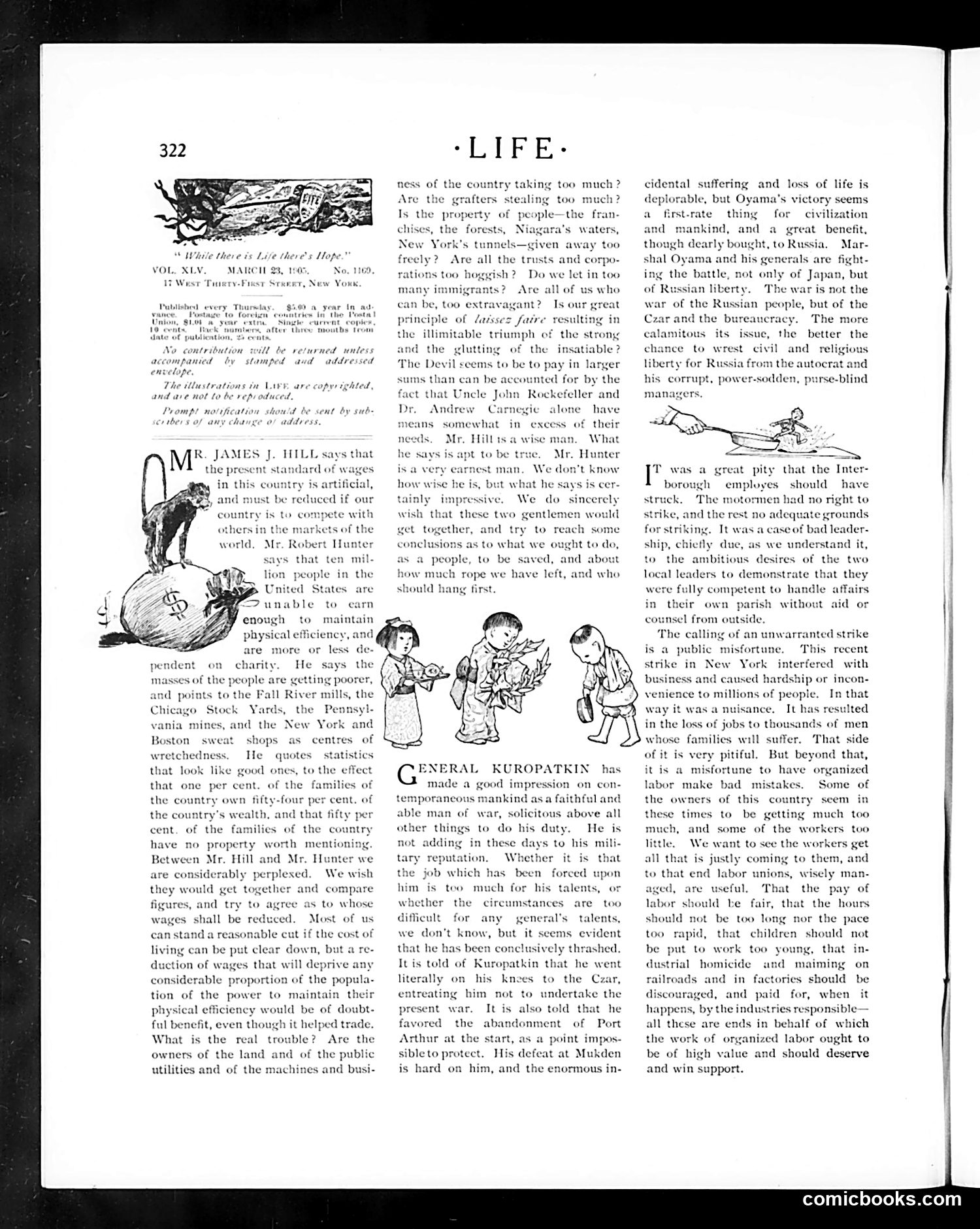
This page from *Life* magazine (March 23, 1902, based on the header) contains two distinct illustrations addressing labor and economic inequality. The left cartoon depicts a figure balancing on a globe, illustrating arguments about wealth distribution in America. The accompanying text by James J. Hill discusses whether the country can compete internationally while maintaining such disparity between rich and poor—referencing conditions in Chicago stockyards, Pennsylvania mines, and Boston sweatshops. The right illustration shows three children in worn clothing, accompanying discussion of General Kuropatkin (Russian military leader) and labor disputes. The text argues for fair wages, reasonable working hours, and opposing child labor in factories and railroads—framing these as patriotic duties. Both pieces critique economic inequality and labor exploitation as threats to American prosperity and values, typical Progressive Era concerns.
📄 Transcribed text from this page (OCR, searchable)
Machine-transcribed from the original scan — historical spelling and the odd misread are preserved.
VOL. XLV, MARCH 93, 1905 No. 1169, 17 Wesr Tinery-Fiast Srener, New Yous Published every Thurslay. $369 a year In ad. vance. Pu to forcan countries ie the Dost vn ar extn Singh nt cope 10 i fer th athe trom’ daw went ‘ats No contribution zwill be returned untess accompanied by stamped aud addressed envelope The illustrations in LA¥®, are copy? vompt notification should be sent by sub- ange of address. M® JAMES J. HILL says that the present standard of wage: in this cor cr ther § of any try is and t be reduced if our country is to compete with others in the markets of the world, Mr. Robert Hun says that ten mil- lion in the Un tes unable enough to maintain physical ¢ and are more or less ° oO earn icienc) pendent on charity, He says the masses of the people are getting poorer, and points to the Fall River mills, the Chicago Stock Yards, the Pennsyl- vania mines, and the New York and Boston sweat shops as centres of wretchedness. He quotes statistics that look like good ones, to the effect that one per cent the families of the country own fifty-four per cent. of fifty per milies of the country the country’s w cent. of the fa have no property worth ment Between Mr. Hill and Mr. Hunter we are considerably perplexed. We wish they would get together and compare figures, and try to whose wages shall be red can stand a reasonable cut if the cost of re ed. Most of us living can be put clear down, but a re- duction of wages that will depri considerable proportion of the popula- tion of the power to maintain their physical effici ld be of doubt- ful benefit, even though it helped trade. What is the real trouble? Are the owners of the land and of the publi utilities and of the machines and busi- e any ‘LIFE: ness of the country taking too much ? Are Is th chises, the forests, Nia; New York's tu freely? Are all the trusts and corpo- he grafters stealing too much? property of people—the fran- "s waters, nels—given aw ay too tions too he Do we let in too many immigr: Are all of us who can be, too extravagant? Is our great principle of Zassez faire resulting in the illimitable triumph « the strony ble? wer the insat and the glutting ‘The Devil seems to be to pay in sums than can be accounted for by the fact that Uncle John Rockefeller and Dr. Andrew Carnegie alone have nS Somewhat in excess of their needs. Mr. Hillis a wise man. What Mt to be tr Mr. Hunter is a very earnest man. We don’t know © says is @ how wise he is, but what he says is cer tainly impressive. We do sincerely wish that these two gentlemen would yet together, and try to reach some conclusions as to what we ought to do, aved, and abow as a people, to be nw much rope we have left, and who should hang first. GENERAL KUROPATKIN has made a good impression on con- temporancous mankind asa faithful and able man of war, solicitous above all other things to do his duty. He is not adding in these days to his mili- ion. Whether it is t job which has been forced upon tary repu is teo much for his talents, or her the circumstances are too difficult for « y general's talents, we don't know, but it scems evident that he has been conclusively thrashed. Itis told of Kuropatkin that he went literally on his knees to the Czar, entreating him not to undertake the present war. It is also told that he favored the abandonment of Port Arthur at the start, sible to protect. His deft nd the enormous in- sa point impos- at Mukden is hard on him, a cidental suffering and loss of life is deplorable, but Oy a first. sama's victory seems thing for civilization and nkind, and a great benefit, though dearly bought, to Russia. Mar- shal Oyama and his gen e fight- ing the battle, not only of n, but of Russian libert The war is not the war of the Russian people, but of the Czar and the bureaucracy. The more amitous its issuc, the better the ce to wrest civil from the autocrat his corrupt, power-sodden, purse-blind gers. nd religious liberty for Rus ma [® "88 4 steat pity that the Inter- borough employes should have it to strike, and the rest no adequate grounds struck. The motormen had no ri for striking. It was a caseof bad leader- ship, chiefly due, as we understand it, » the ambitious desires of the two local leaders to demonstrate that they were fully competent to handle affairs in their own parish without aid or counsel from outside. ‘The calling of an unwarranted strike isfortune. This recent is a public ike in Ni nd caused f w York interfered with ds st hip or incon- venience to millions of people, In that way ted in the loss of jobs to thousands of men twas a nuisance. It has res whose families will suffer. That side of it is very pitiful. But beyond that, it is a misfortune to have organized labor make bad mistakes. Some of the owners of this country seem in these times to be getting much too much, and some of the workers too little. We w: all that is just to see the workers get nd y coming to them, to that end labor unions, wisely man- aged, are useful. That the pay of labor should be fair, that the hours should not be too long nor the pace too rapid, that children should not be put to work too young, that in- dustrial homicide and maiming on lroads and in factories should be discouraged, and id for, when it happens, by the industries responsible— all these are ends in behalf of which the work of organized labor ought to be of high value and should deserve and win support. comicbooks.com