
Life, 1905-03-23 · page 14 of 22
Life — March 23, 1905 — page 14: what you’re looking at
What you’re looking at
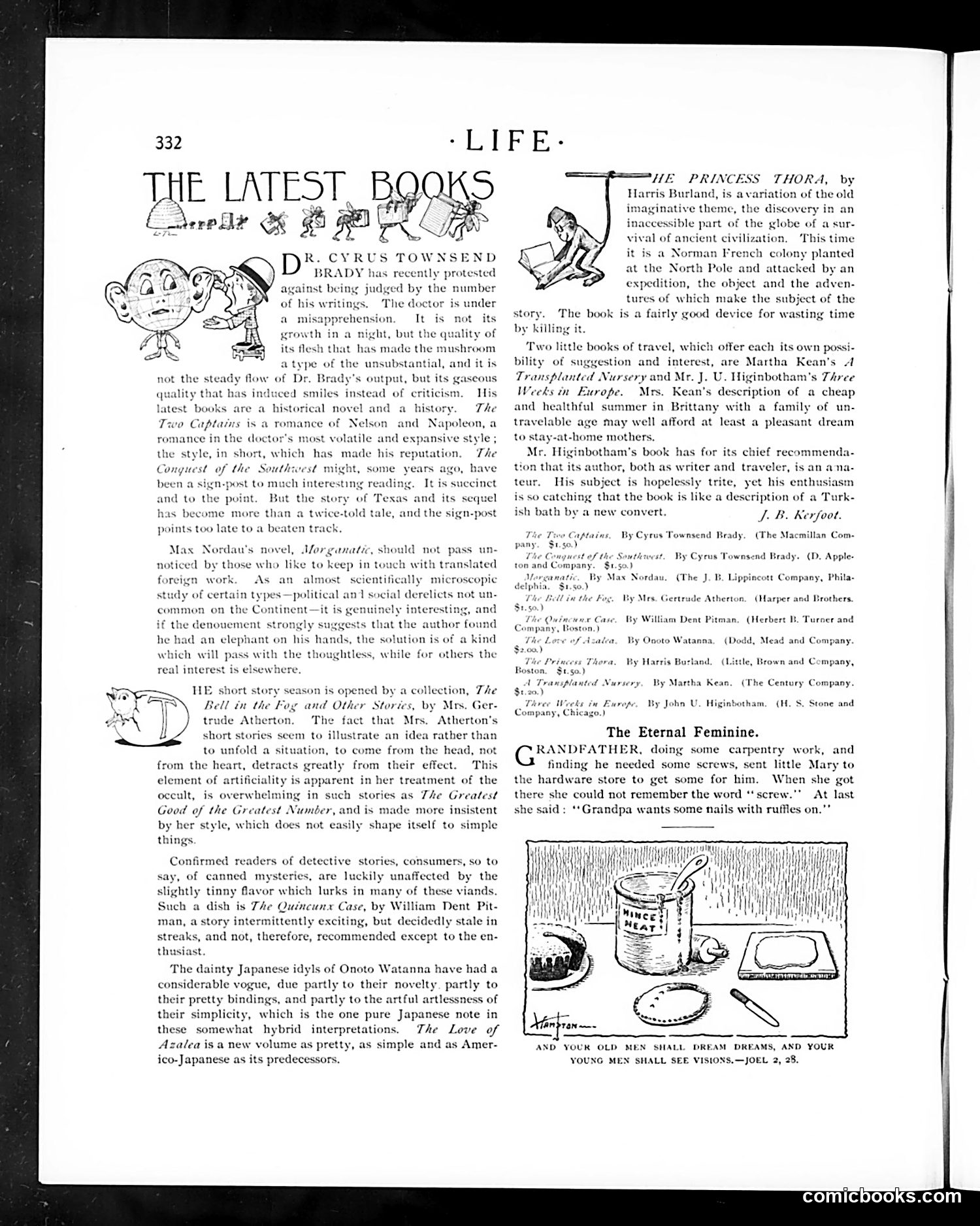
This page presents literary criticism of contemporary books, written in the caustic style typical of Life's book review section. The visible cartoons are decorative vignettes accompanying reviews of specific titles. The reviews critique authors' tendencies and trends: Dr. Cyrus Townsend Brady is defended against critics who judge him by prolific output rather than quality. Mrs. Gertrude Atherton's short stories are faulted for being overly cerebral and artificial rather than emotionally resonant. Detective fiction is dismissed as "tinny" but acknowledged as popular with devoted readers. The Japanese author Onoto Watanna is praised for delicate simplicity but gently mocked—her vogue attributed partly to "pretty bindings" rather than literary merit alone, suggesting her exotic appeal surpasses substance. The tone throughout is sophisticatedly dismissive of commercial and derivative works while defending serious authors against superficial judgment. This reflects Life's position as a magazine for educated, discriminating readers.
📄 Transcribed text from this page (OCR, searchable)
Machine-transcribed from the original scan — historical spelling and the odd misread are preserved.
332 D* CYRUS TOWNSEND BRADY has recently protested against being judged by the number The de a misapprehension is not its sth ina night, ality of ushroom al, and itis but its gaseous His novel and a The Nelson and Napoleon, a rst volatile which has Southwest w of his writings. is under a sped ot the unsubstan: not the steady flow of Dr. "s output, ality that has inc sced smiles instead of criticism a historical histo Two Captains is a romance romance in the doctor's 1 n sh atest. books are and e: his reputation. The », have pansive style ; the styl made Conyuest of the . Some years been a sign It is succinct and to th n-post to much interesting read: point. But the story of Texas and its sequel has become more than a twice-told tale, and the sign-post points too late to a beaten track. Max Nordau’s novel, Morganatic, should not pass un- forei: work. As an almost. scientiti study of certain types—political an soci common on the Continent—it is genu’ f the denouement strongly suggests that ‘the author found he had an elephant on his hands, the solution is o} which will pass with the th hitless, while for others the real interest is elsewhere. HE short story season is opened by a collection, The Bell in the Fog and Other Stories, by Mrs. Ger- fact that Mrs. Atherton’s eS scem to illustrate an idea rather than to unfold a situation, to come from the head, not from the heart, detracts greatly from their eff This ment of artificiality is apparent in her treatment of the occult, is overwhelming in such stories as The Greatest Good of the Greatest Number, and is made more insistent by her style, which does not things short stori ily shape itself to simple Confirmed readers of detective stories, consumers, so to ay, of canned mysteries, are luckily unaffected by the slightly tinny flavor which lurks in many of these viands. Such a dish is The Quéncunx Case, by William Dent Pit- man, a story intermittently exciting, but decidedly stale in streaks, and not, therefore, recommended except to the en- thusiast. The dainty Japanese idyls of Onoto Watanna have had a considerable vogue, due partly to their novelty. partly to their pretty bindings, and partly to the artful artlessness of their simplicity, which is the one pure Japanese note in these somewhat hybrid The Love of Azalea isa new volume s simple and as Amer- ico-Japanes interpretations. s pretty as its predecessors. HE PRINCE ris Burland, is av yinative theme, th cecessible part of THORA, by riation of the old discovery in an the globe of a sur- vival of ancient civilization. ‘This time i Norman French colony planted at the North Pole and attacked by an expedition, the object and the adven- tures of which make the subject of the The book is a fairly good device for wasting time by killing it. story. ‘Two little books of travel, which offer each its own possi- bility of sugyestion and interest, are Martha Kean’s A Transplanted Nur I Mr. J. U. Higinbotham’s Tiree Weeks in Europe. Mrs. Kean’s description of a cheap and healthful summer in Brittany with a family of un- a vell afford at least a pleasant dream -home mothers, iginbotham’s book has for its ief recommenda. tion that its author, both as writer and traveler, is an ana- His subject is hopelessly trite, yet his enthusiasm is so catching that the book is like a description of a Turk- ish bath by a new convert. J.B. Kerfoot. (The Macmillan Com- teur. The Two Captains By Cyrus Townsend Brady $1.50.) pany ton and Ci iy Ry Max Nordaw Ry Cyrus Townsend Brady. (D. Apple: Merganati $1.50.) (The J.B. Lip Company, Phila- By Mrs. Gertrude Atherton, (Harper and Brothers. By William Dent Pitman, (Herbert It. Turner and »Watanna, (Dodd, Mead and Company. By Harris Burland. (Little, Brown and Company, Boston, $1.50.) 1 Transplanted Nursery, Wy Martha Kean, (The Century Company. ) ks in Europe John U. Higinbotham, (H. S. Stone and The Eternal Feminine. RANDFATHER, doing some carpentry work, and finding he needed some screws, sent little Mary to the hardware store to get some for him. When she got there she could not remember the word “‘screw.’" At last she said: **Grandpa wants some nails with ruffles on."’ AND YOUK OLD MEN SHALL YOUNG ME: DREAM DREAMS, AND YOUR SHALL SEE VIStOXS.—JOEL 2, 28.