
A complete issue · 22 pages · 1905
Life — March 9, 1905
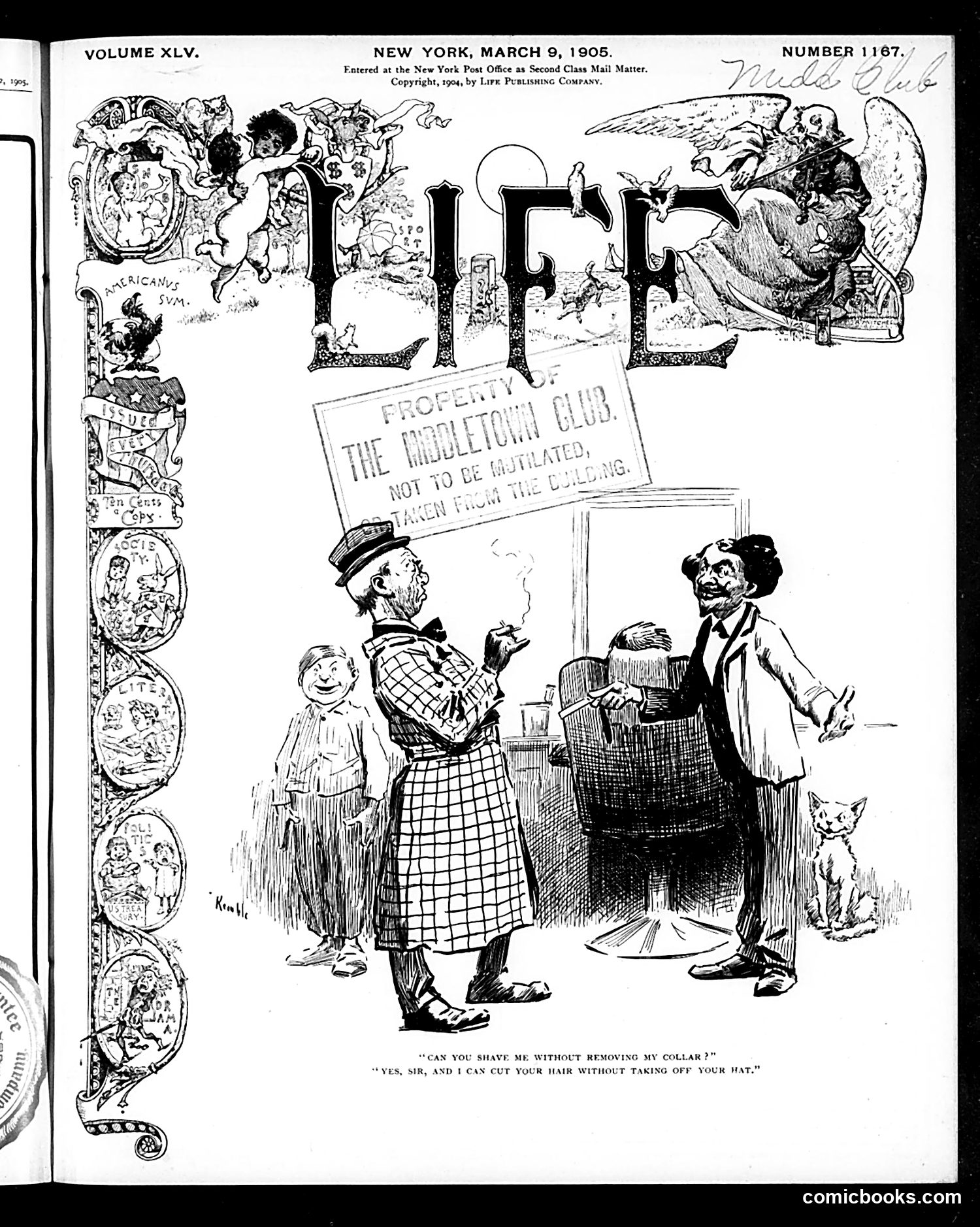
This cartoon satirizes the Middletown Club's exclusionary membership policies. A man holding a sign reading "Property of the Middletown Club—Not to be Circulated—Taken from the Building" confronts a barber and his assistant. The dialogue reveals the joke's point: when asked if he can shave the client "without removing my collar," the barber responds he can "cut your hair without taking off your hat"—suggesting the exclusive club member is so rigidly bound by club rules and pretensions that he cannot relax even for basic grooming. The satire mocks elite social clubs' absurd pomposity and their members' inability to behave naturally outside rigid social protocols. The caricatures and setting suggest the club attracts ridiculous, overly formal members.
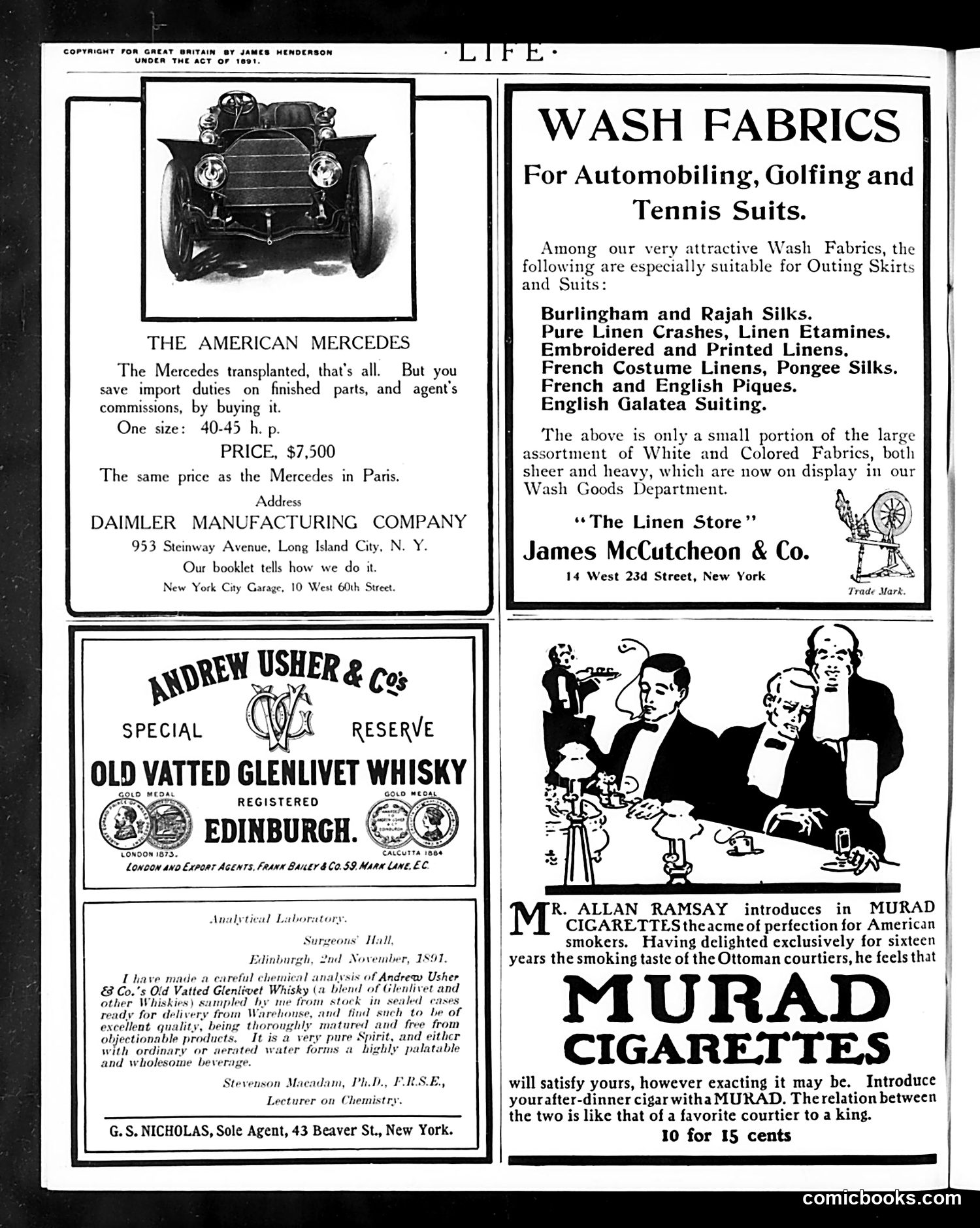
This page is primarily **advertising, not satire or political commentary**. It contains four advertisements: 1. **American Mercedes automobile** ($7,500) from the Daimler Manufacturing Company in Long Island City 2. **Wash Fabrics** for sporting wear from James McCutcheon & Co., "The Linen Store" 3. **Andrew Usher & Co's Old Vatted Glenlivet Whisky** from Edinburgh, with a chemical analysis testimonial 4. **Murad Cigarettes** (10 for 15 cents), featuring an illustration of well-dressed men at what appears to be a social gathering The only illustrated content beyond product images is the Murad ad's cartoon showing gentlemen socializing, which functions as lifestyle marketing rather than satire. There are no identifiable political figures or satirical commentary on this page.
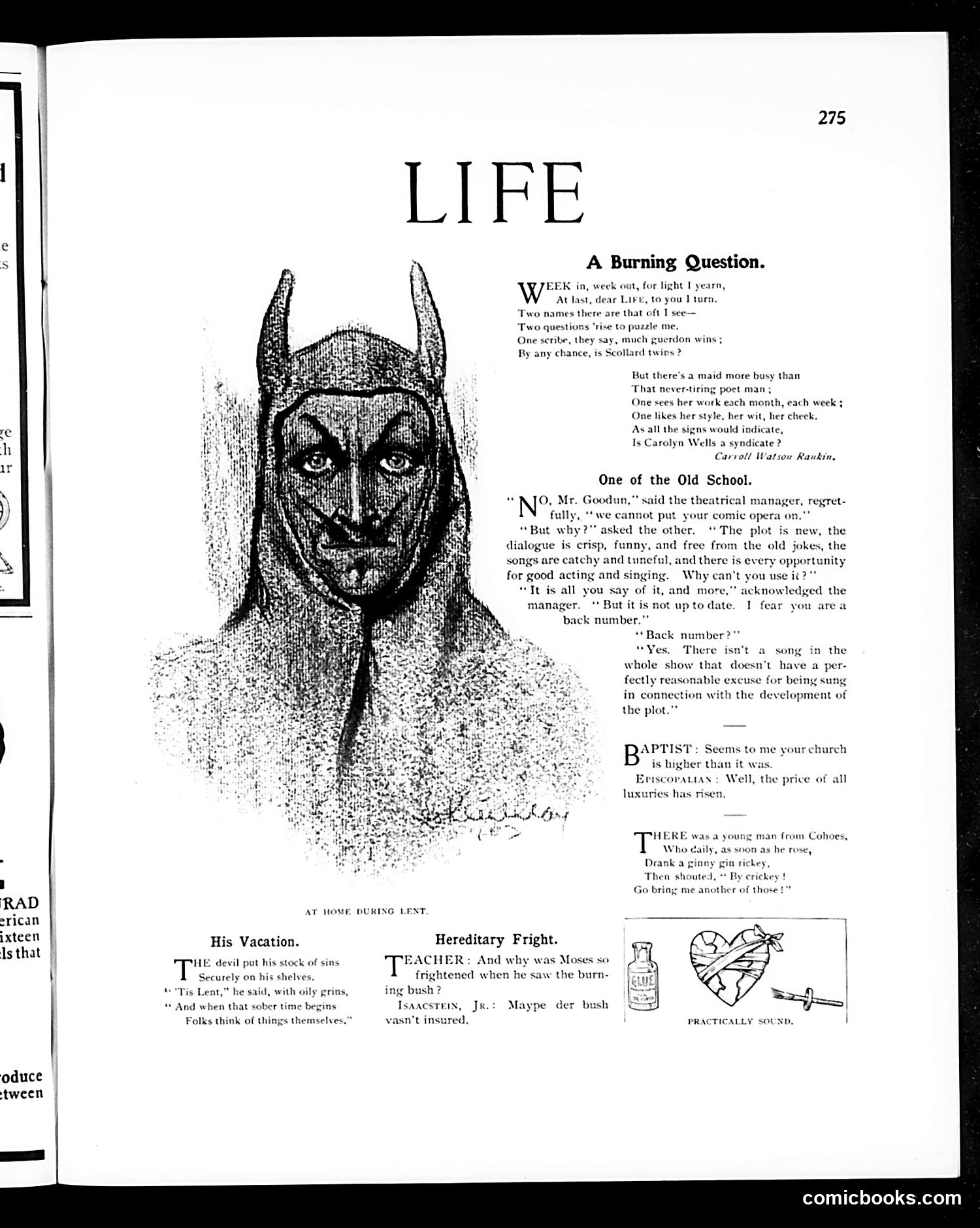
The large illustration shows a demonic or devilish figure labeled "AT HOME DURING LENT," likely satirizing hypocrisy during the Christian season of Lenten abstinence. The exaggerated horned visage suggests moral compromise or wickedness hiding beneath surface piety. The page contains several brief satirical pieces: "A Burning Question" debates whether a maid named Carolyn Wells is a scribe (writer); "One of the Old School" mocks theatrical managers rejecting modern comic operas; "His Vacation" jokes about the devil taking Lent off; and "Hereditary Fright" presents a teacher-student exchange about Moses and the burning bush. These short humor pieces typify Life's early satirical style, mixing social commentary with wordplay and visual mockery of Victorian conventions and pretense.
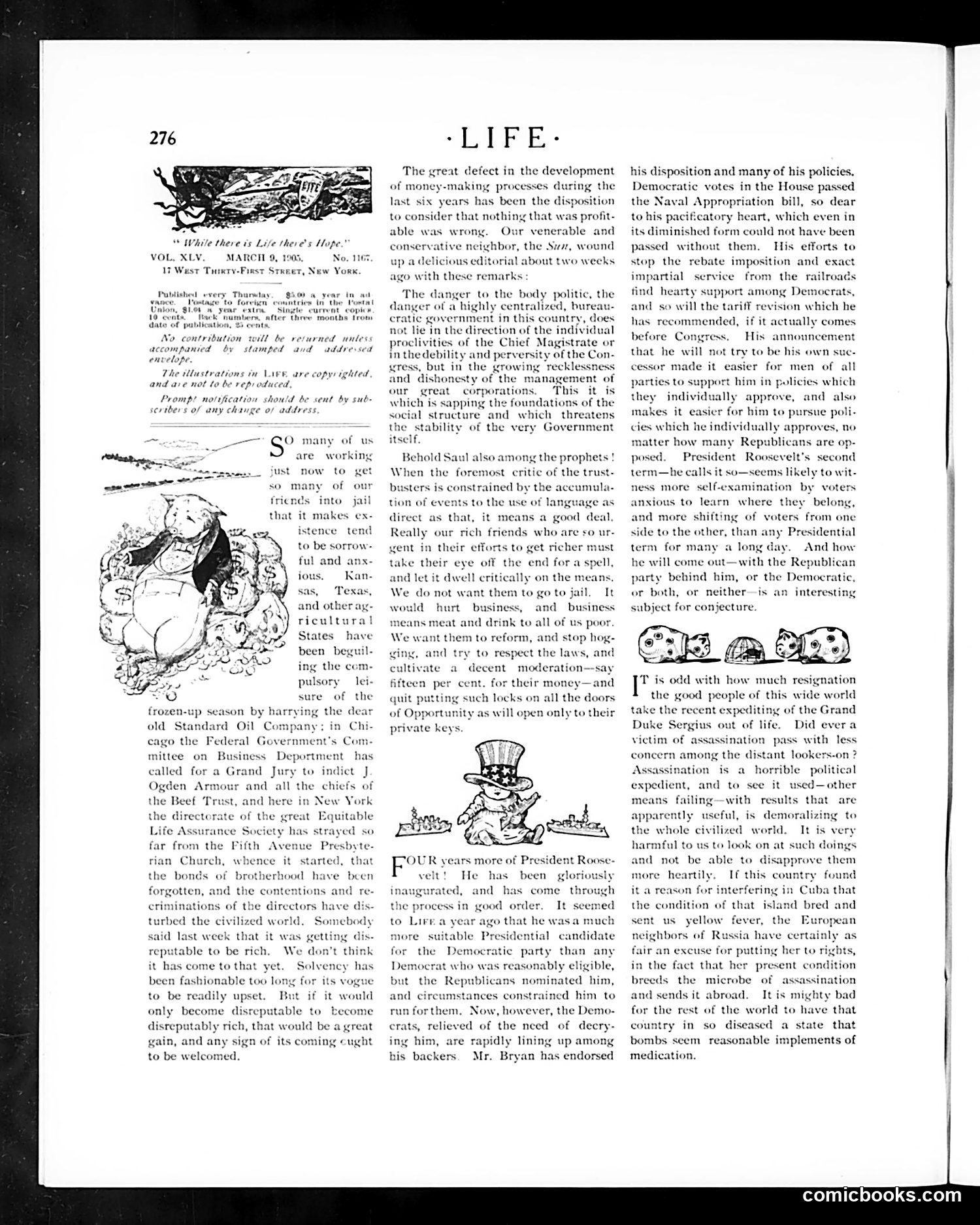
The main editorial discusses President Roosevelt's second term, praising his efforts on tariff reform and railroad regulation while noting Democratic criticism. The text expresses concern about assassination as a political tool, referencing Russian violence. The left cartoon depicts **Standard Oil Company** as a parasitic figure ("frozen-up season by harrying the dear old Standard Oil Company"), likely referring to Roosevelt's antitrust actions against monopolies—a major political issue of his presidency. The right cartoon shows a figure (appears to be **Uncle Sam** or a political authority) contemplating assassination, illustrating the editorial's concern about political violence becoming normalized as a means of opposition, contrasting American stability with Russian instability. The page critiques both corporate power and political extremism during Roosevelt's Progressive era.
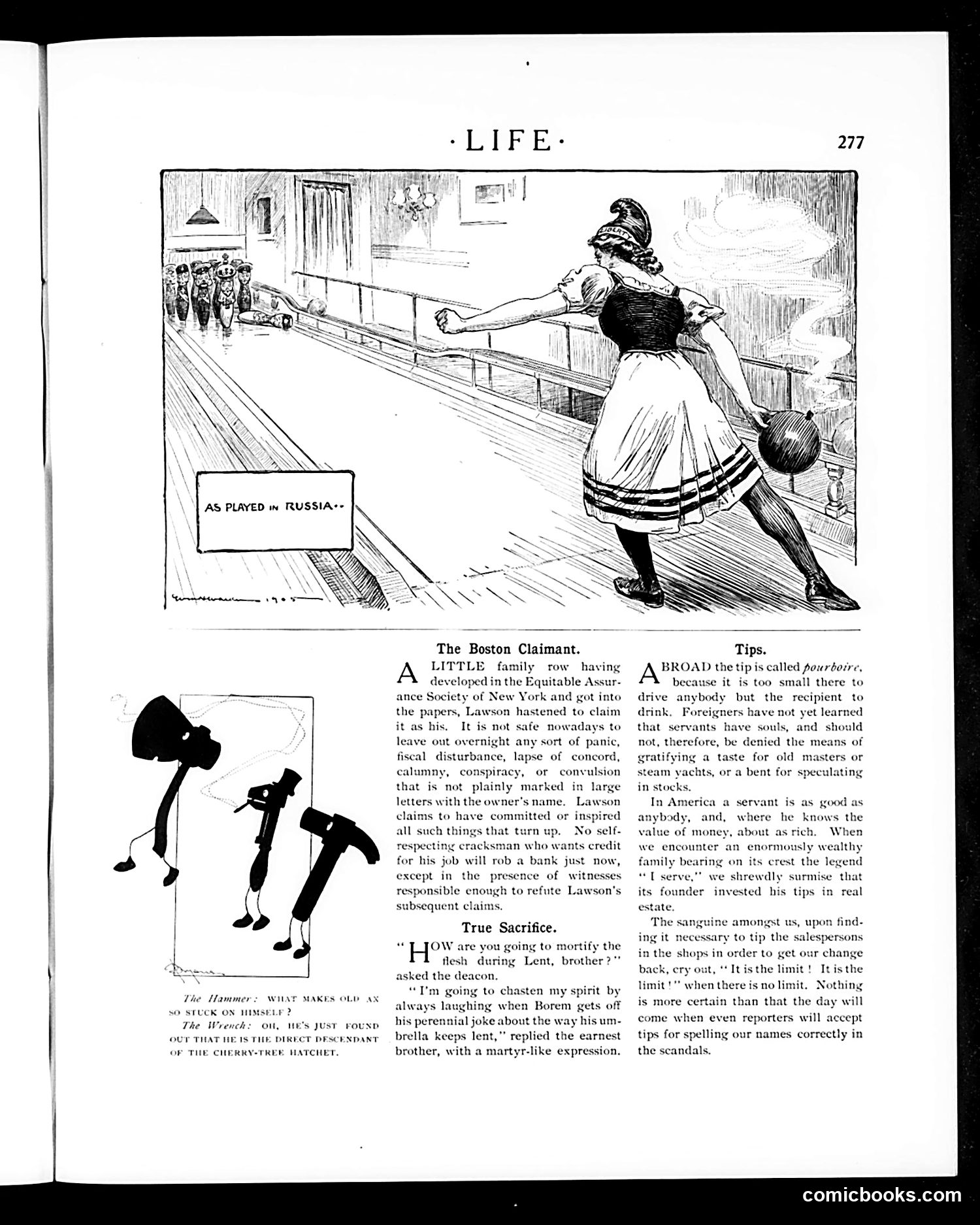
**Top Cartoon ("As Played in Russia"):** Shows a woman bowling with exaggerated Russian-style dress. The caption suggests this depicts how Americans imagine Russians play bowling—a satirical commentary on American stereotypes and fascination with Russian culture during the early 20th century. **Bottom Section ("The Boston Claimant" / "True Sacrifice"):** Text discusses a Lawson family claiming inherited wealth from an "Equitable Assurance Society of New York," with satirical commentary questioning the legitimacy of such claims. The accompanying cartoon ridicules someone obsessing over lineage and inheritance rights. **"Tips" Column:** Humorous advice about servant etiquette and wealth in America, mocking pretension among the wealthy and changing social norms around class and service.
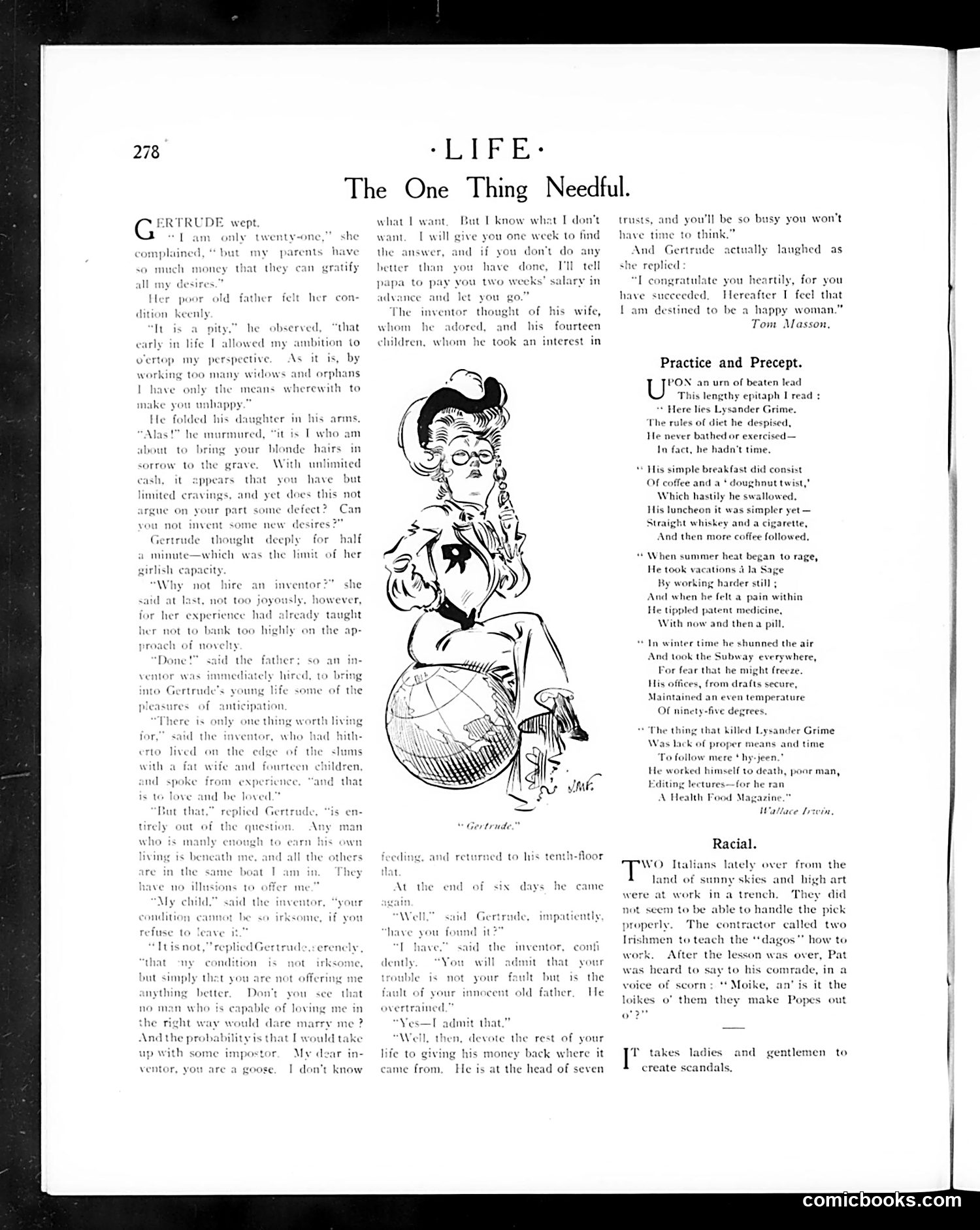
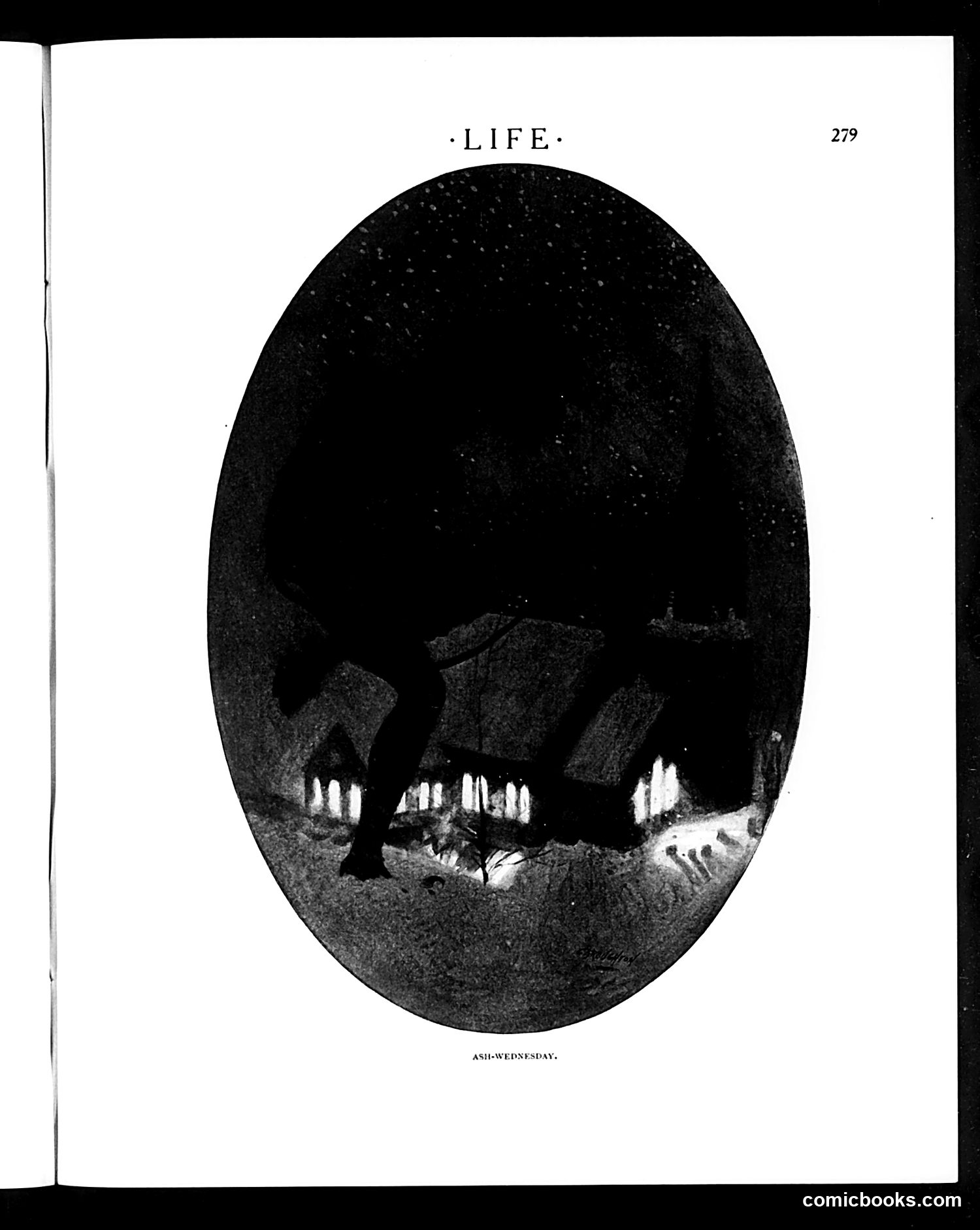
This appears to be a religious illustration rather than a political cartoon. The oval image shows what looks like a church interior during Ash Wednesday services, with candles lit and worshippers visible in silhouette. The title "ASH WEDNESDAY" at the bottom confirms this is depicting the Christian observance. The image illustrates a solemn religious ceremony where ashes are traditionally applied to foreheads as a symbol of penitence and mortality. The stark black-and-white composition and dramatic lighting emphasize the spiritual gravity of the occasion. Without additional context about Life magazine's satirical intent for this particular issue, it's unclear whether this serves as straightforward religious illustration or contains subtle social commentary about American religious practice.
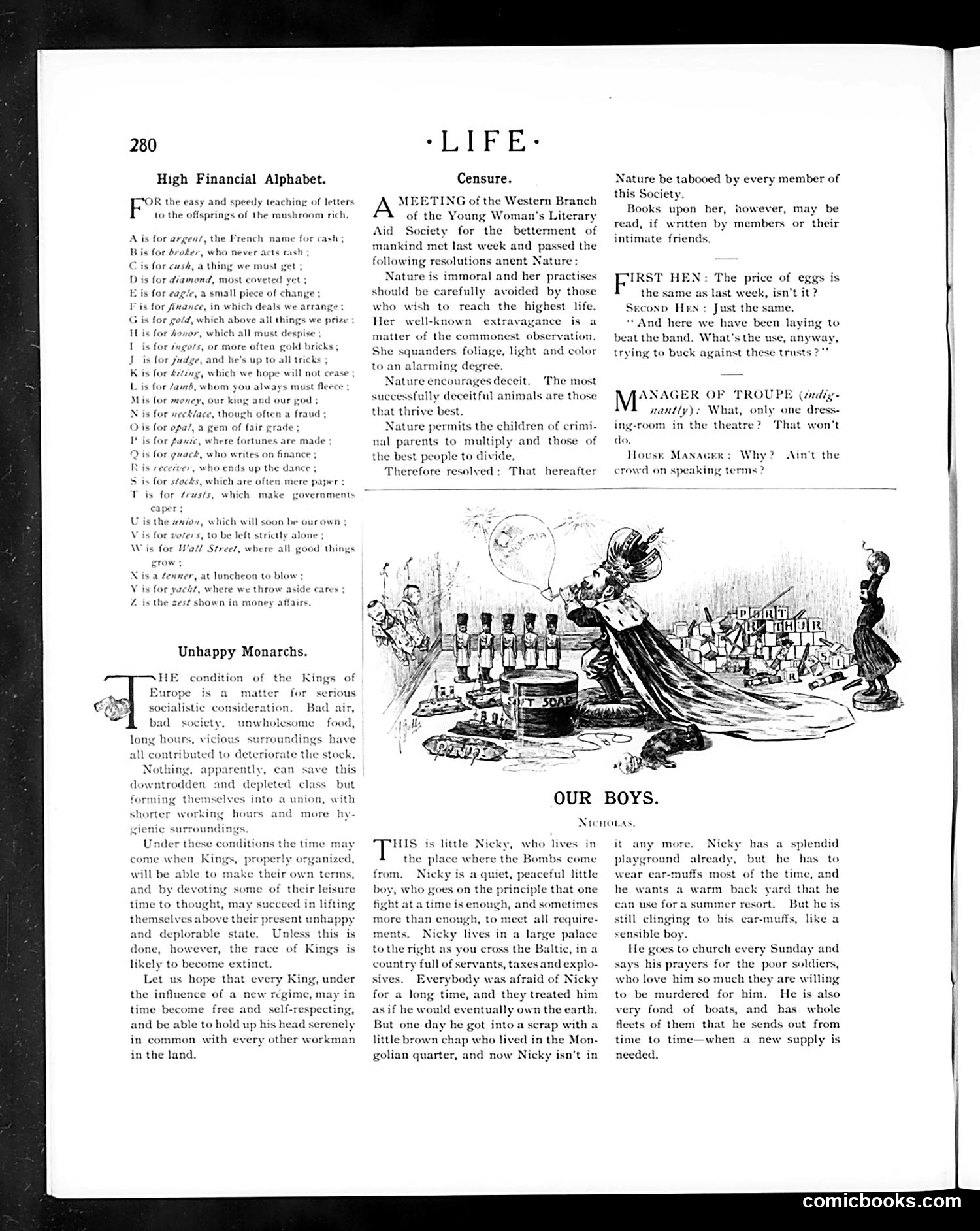
This page contains several satirical pieces from *Life* magazine (page 280). The main cartoon depicts an elaborate alchemical or chemical laboratory scene with bottles, apparatus, and a figure in theatrical costume—likely satirizing pseudo-scientific or fraudulent schemes popular in the era. The "High Financial Alphabet" is a humorous alphabetical list defining financial terminology through wordplay (e.g., "A is for *argent*" meaning silver/money). "Unhappy Monarchs" critiques European kings' poor living conditions and suggests unionization could improve workers' lives—reflecting turn-of-century socialist sentiment. "Our Boys: Nicholas" describes a wealthy boy's charitable work with poor soldiers and boat relief efforts, celebrating upper-class benevolence. The page reflects Edwardian-era concerns: financial satire, labor reform, science skepticism, and noblesse oblige.
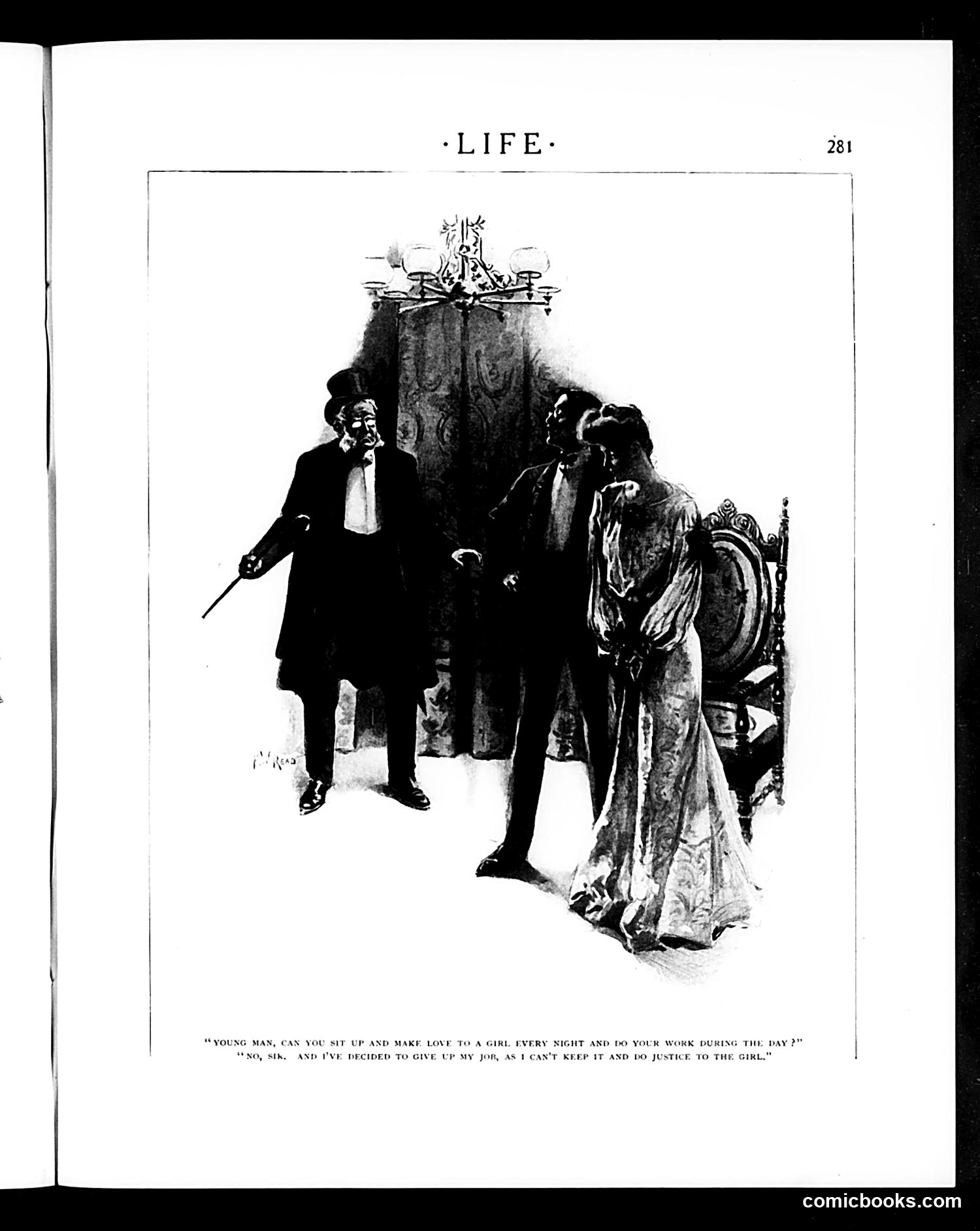
This illustration depicts a social satire about work-life balance and romantic commitment. An older gentleman (appearing to be an employer or authority figure) addresses a young working man, saying he's decided to give up his job because he cannot balance maintaining it while courting a girl—he wants to make love to her every night and work during the day. The cartoon satirizes the impracticality of Victorian-era romantic expectations alongside demanding employment. The woman in elaborate dress represents the object of his devotion. The satire targets the impossible standard placed on young men to be both industrious workers and devoted suitors simultaneously, suggesting that true romantic attention requires abandoning professional ambition entirely—an absurd proposition meant to highlight society's unrealistic expectations.
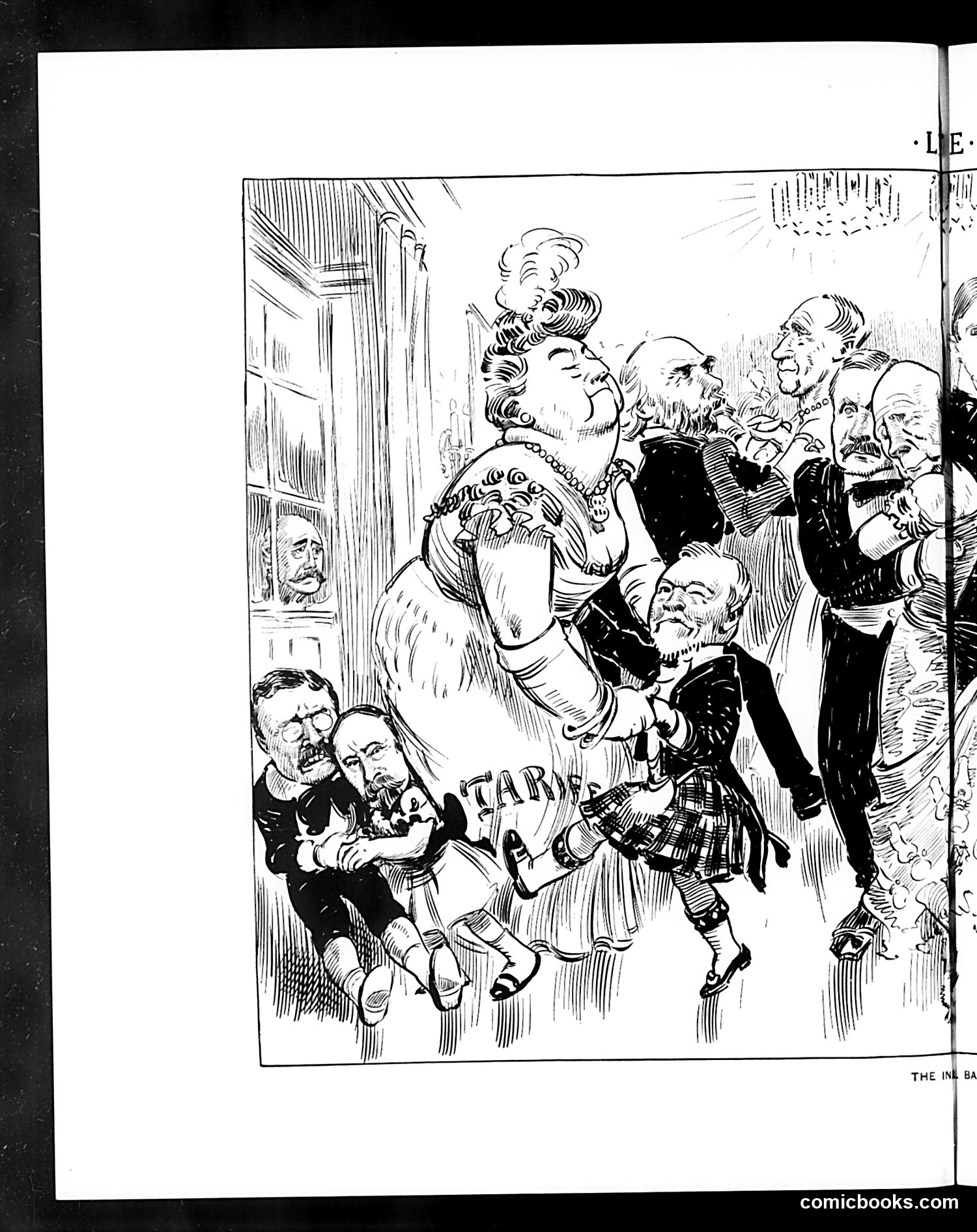
This satirical cartoon depicts a large woman (labeled "TARIFF") being physically carried and supported by multiple male figures in formal military and civilian dress. The woman appears grotesquely overweight and is being held aloft by the men, who strain under her weight. The satire criticizes how political leaders are propping up protectionist tariff policies. The exaggerated size of the "Tariff" figure suggests it has become a burden or bloated problem, yet these powerful men continue to support and carry it despite the strain. The cartoon likely comments on how politicians maintain unpopular or economically damaging tariff policies through political patronage, portraying this as an absurd, unsustainable practice that these leaders refuse to abandon.
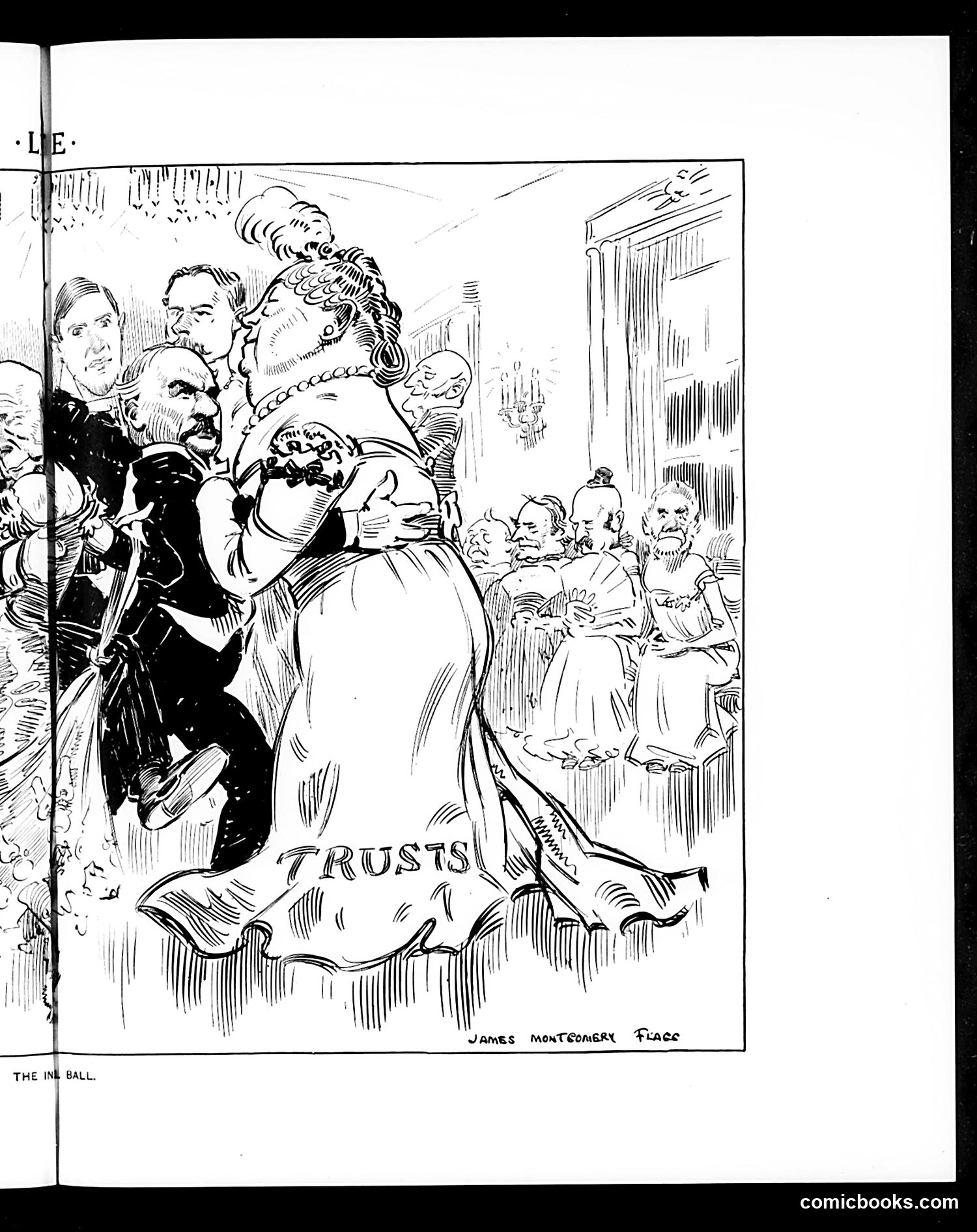
This cartoon by James Montgomery Flagg depicts a confrontation between military/political figures (left) and a rotund woman labeled "TRUSTS" surrounded by seated observers (right). The woman's elaborate dress and jewelry suggest wealth and excess. The "trusts" reference points to large business monopolies that dominated American industry in the early 20th century—a major political flashpoint. The military figures appear to be confronting or attempting to address this corporate power. The cartoon satirizes the tension between government authority and unchecked corporate monopolies. The woman's prominence and the gathered crowd suggest public concern about trusts' influence. The artist critiques either their power or government's perceived inability to control them effectively.
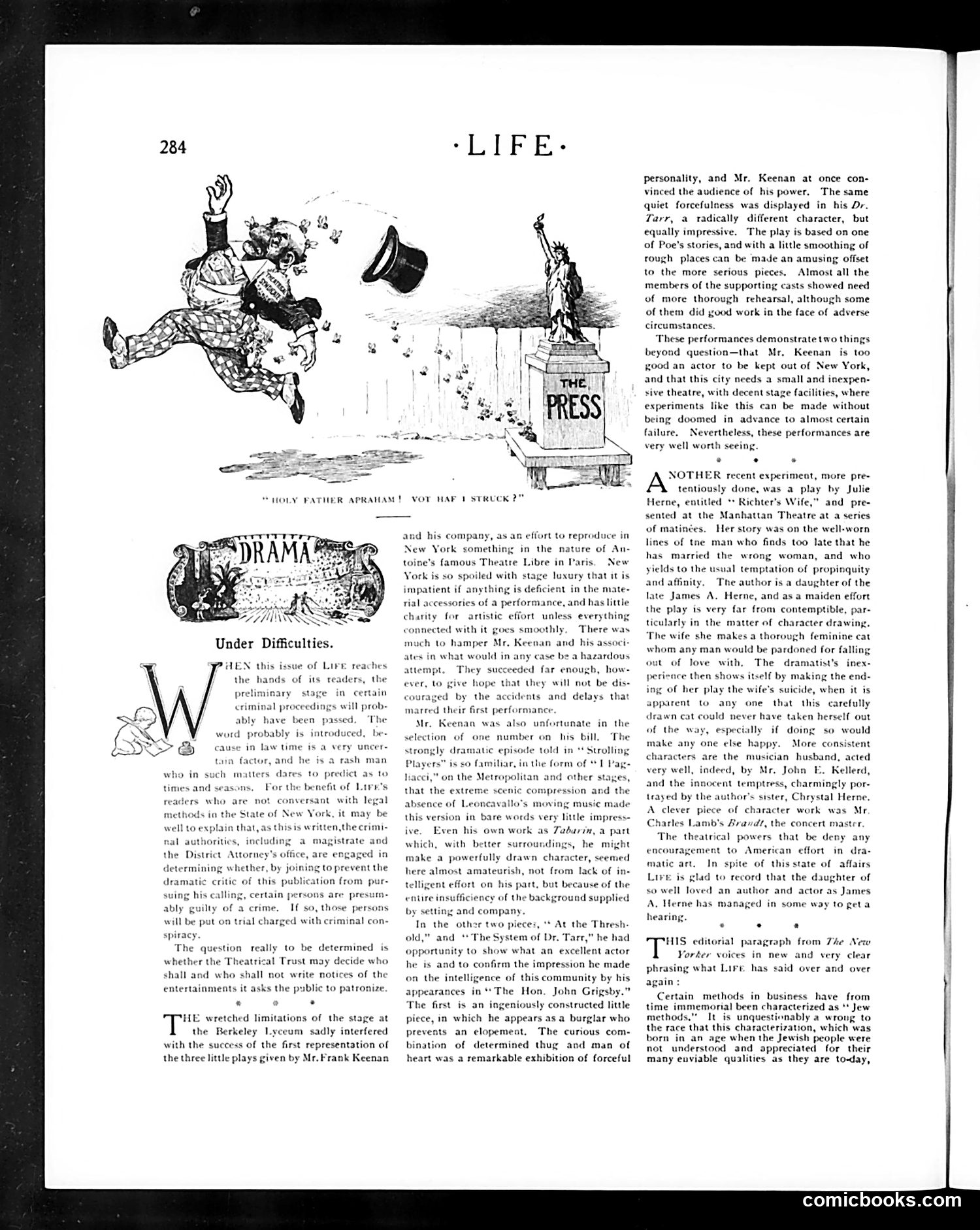
The main cartoon, titled "Holy Father Abraham! You Haf I Struck?" depicts a caricatured figure with exaggerated Jewish features being ejected violently from a pedestal labeled "THE PRESS." The imagery suggests antisemitic stereotyping common to the era. The surrounding text discusses theatrical productions and dramatic criticism, appearing unrelated to the cartoon's content. The page includes a "DRAMA" section header and discusses plays by various authors. **This represents the antisemitic editorial content Life magazine occasionally published during this period.** The exaggerated facial features and violent imagery reflect prejudicial attitudes toward Jewish people that were unfortunately normalized in American publications of that time, despite Life's general reputation as a more sophisticated satirical publication.
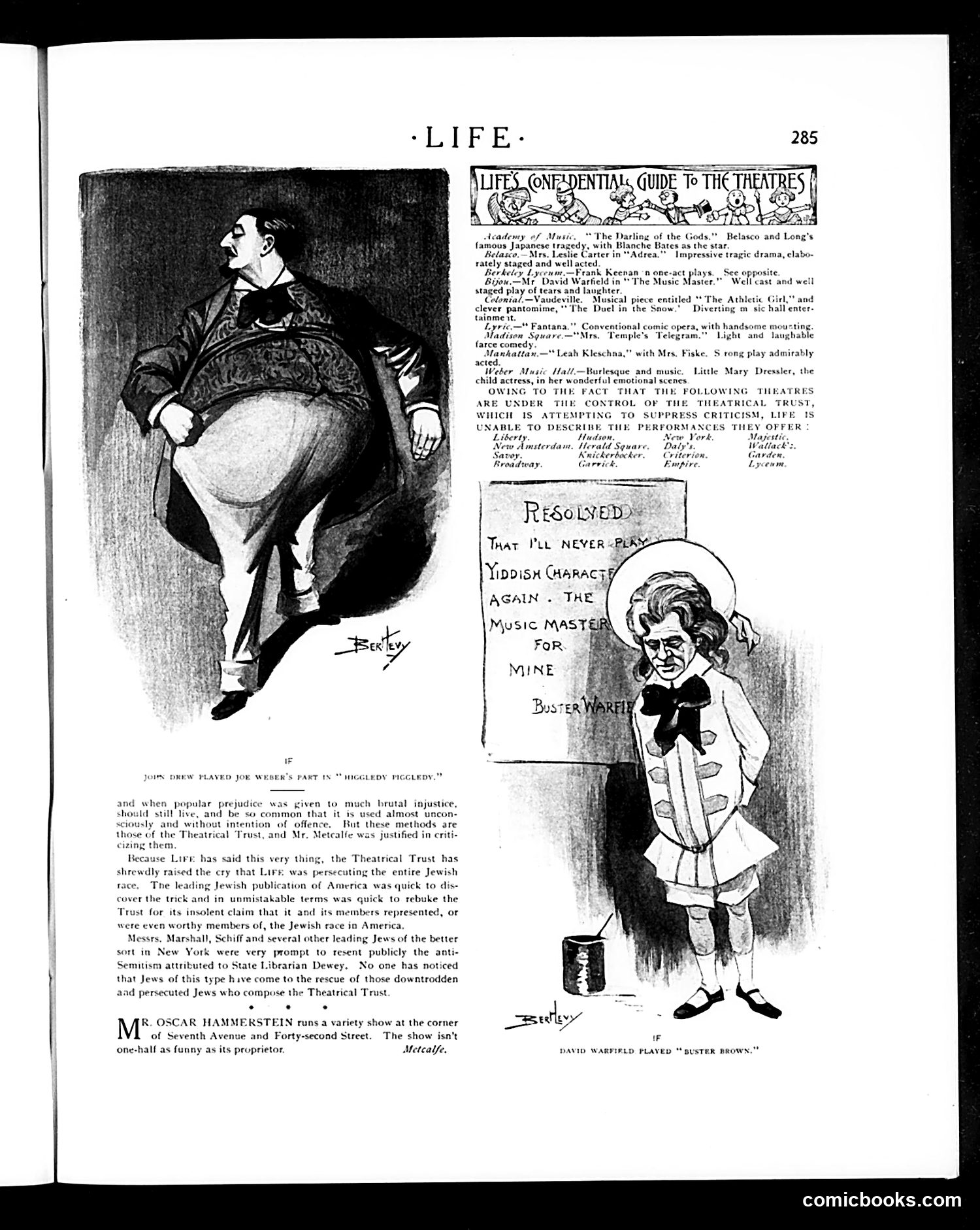
This page satirizes the **Theatrical Trust**, a monopolistic theater organization controlling major New York venues. The text describes how Life magazine criticized the Trust's methods, which the Trust then weaponized by falsely claiming Life was antisemitic and attacking "the entire Jewish race." The caricatures appear to depict **David Warfield** (left, as Joe Weber in "Jigglededy Piggledy") and a figure labeled as playing "Buster Brown" (right). The satire targets how the Trust exploited Jewish identity defensively—prominent Jewish leaders like Marshall and Schiff publicly supported the Trust, unwittingly defending a corrupt monopoly. The box listing theaters "under the control of the Theatrical Trust" explains Life cannot review their performances due to censorship pressure. **Context**: This reflects early 1900s battles over theatrical monopolies and how institutional power weaponized ethnic solidarity to suppress legitimate criticism.
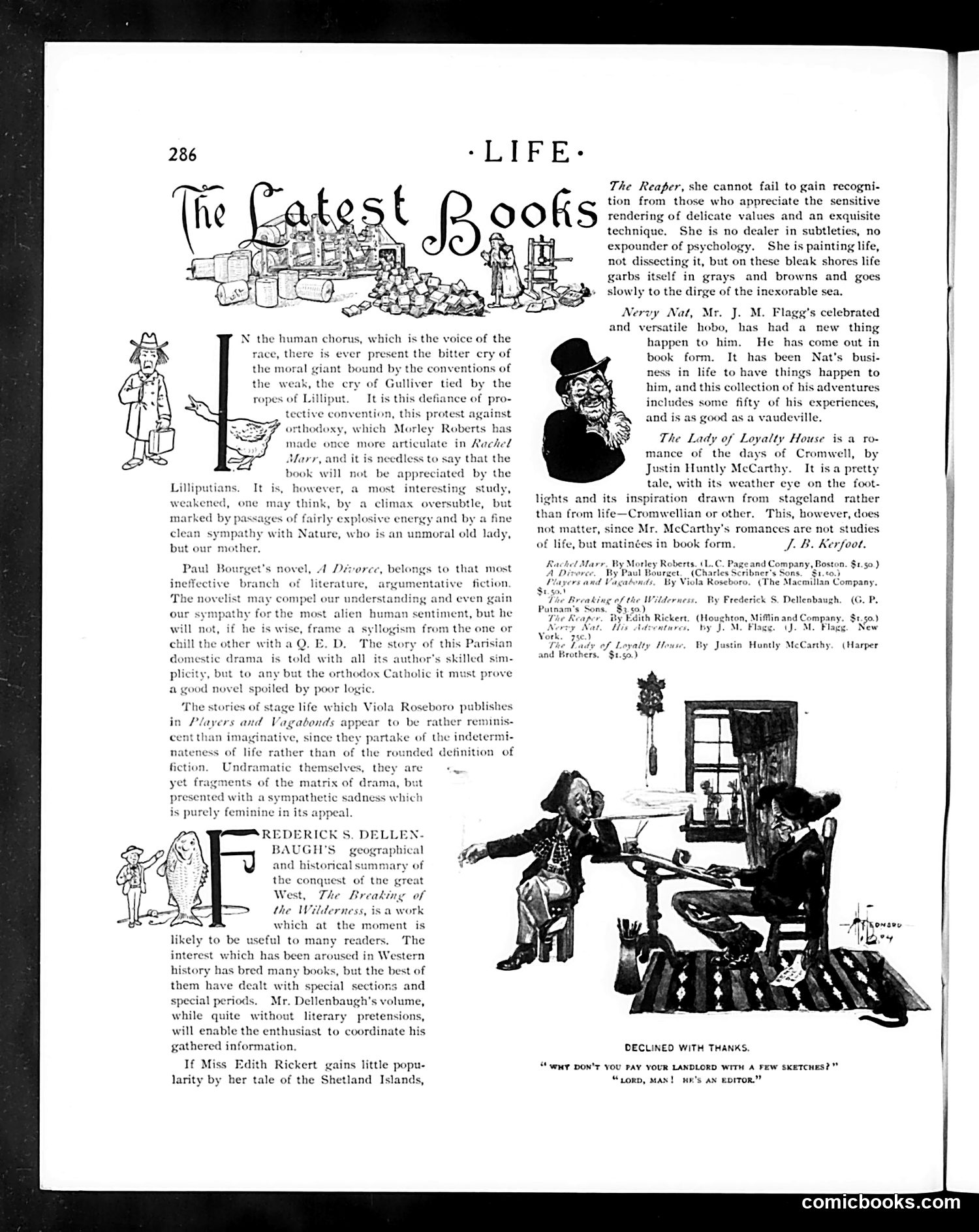
This is a book review section featuring illustrated critiques of contemporary novels. The main cartoon at bottom depicts an editor rejecting a starving artist's offer to pay rent with sketches—the editor responds "Lord, Man! He's an editor," a self-deprecating joke about editors' notoriously low pay and inability to afford art. The reviews discuss literary works including *A Divorce* by Paul Bourget, *Norry Nut* (J.M. Flagg's hobo character collection), and *The Lady of Loyalty House* (a Cromwell-era romance). The critics employ period-typical literary snobbery—dismissing some works as mere "matinées in book form" while praising others' "sensitive rendering." The decorative header illustration of "The Latest Books" shows period figures amid books and reading materials, establishing the genteel, intellectual tone Life magazine cultivated for its educated readership.
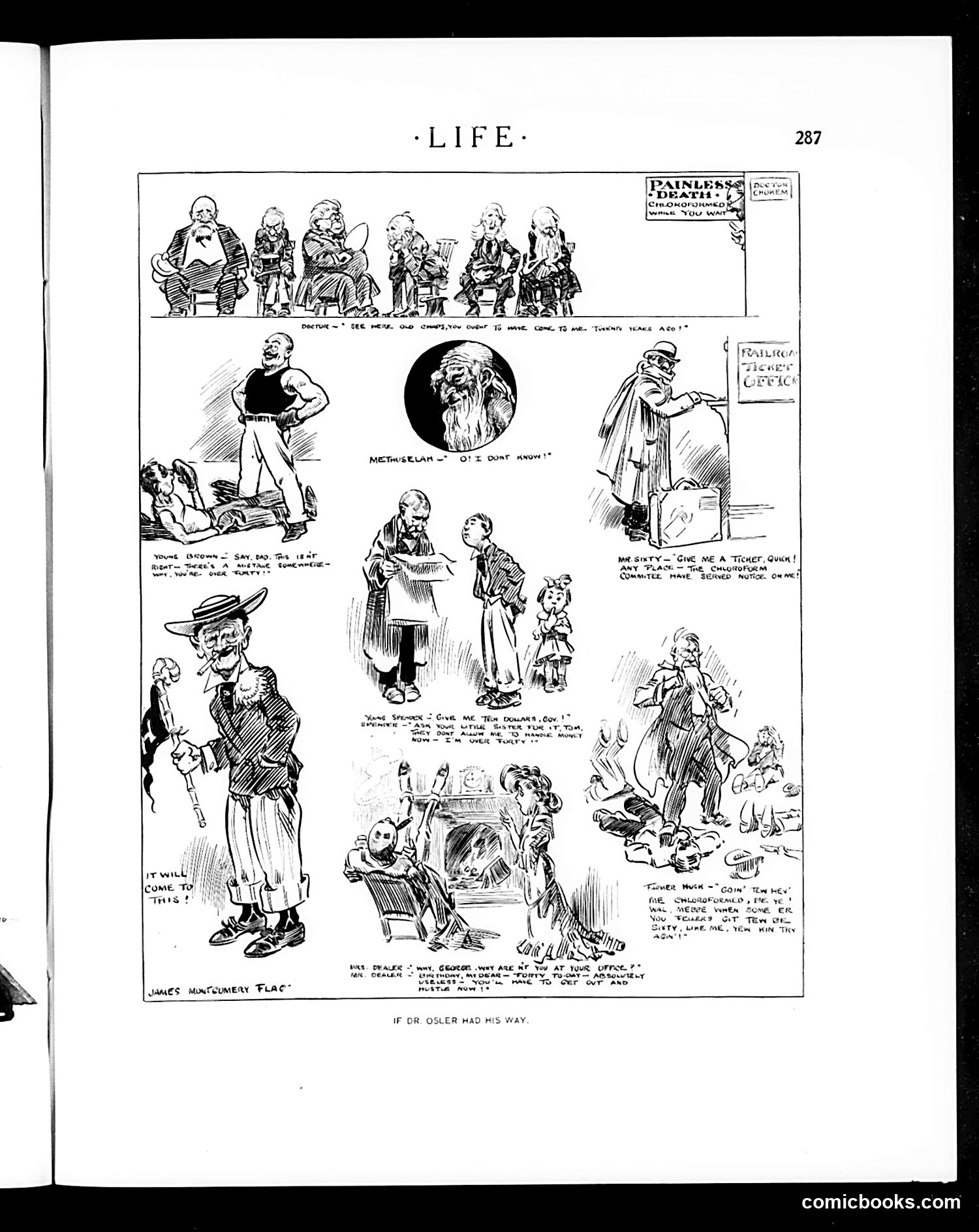
This page satirizes Sir William Osler, a prominent early-20th-century physician, likely referencing his controversial 1905 speech suggesting elderly people become less valuable and should be "chloroformed" (euthanized). The cartoon imagines how society would look under such a policy. The sketches depict various scenarios where elderly figures are removed or eliminated—shown holding "chloroform," being ejected from offices, or otherwise displaced. Characters labeled include "James Montgomery Flag" (the cartoonist) and references to age discrimination ("Say, Mos Here 1847"). The satire mocks Osler's utilitarian view of human life by showing the absurd, cruel outcomes if such ideas were actually implemented. It's a darkly humorous critique of ageism and devaluing the elderly, presenting the logical extreme of dismissing people based solely on age.
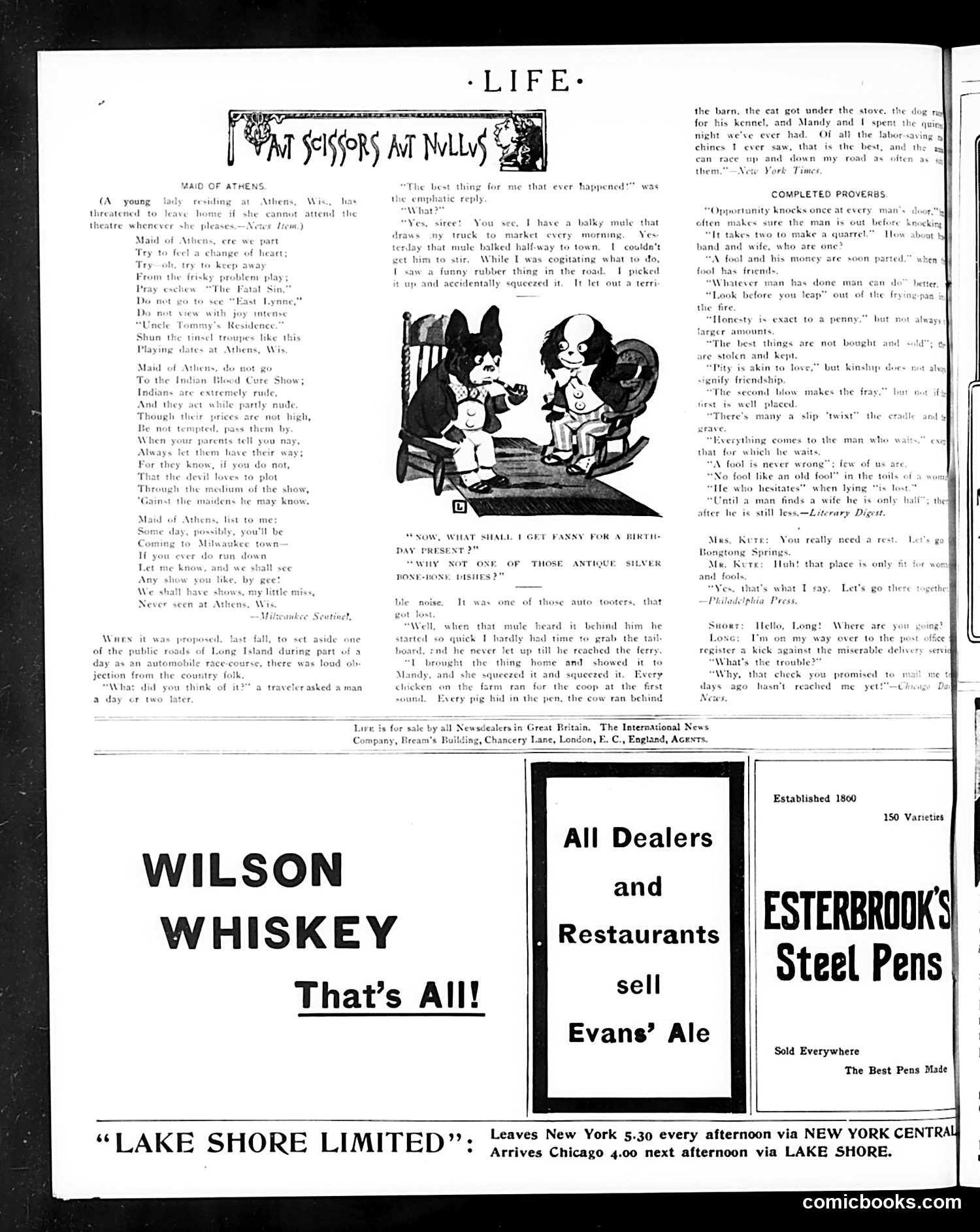
This page contains a humorous short story illustrated with a cartoon, surrounded by period advertisements. **The Main Story/Cartoon:** The narrative concerns a farmer who encounters a stubborn mule on a country road. The animal balks halfway to town, and when the frustrated farmer tries to move it, the mule "squeezed it and squeezed it"—apparently on the farmer's hand or arm. The mule then bolts home, causing panic among the farm animals (chickens, cows, pigs scatter in fear). **The Satire:** The joke relies on rural/pastoral humor common to early 20th-century American magazines—depicting farmers as comically incompetent when dealing with livestock. The mule's stubborn resistance to human control and the cascading chaos it causes is presented as absurd comedy. **Historical Context:** The advertisements (Wilson Whiskey, Evans' Ale, Esterbrook Steel Pens) and the Lake Shore Limited train reference date this to the early 1900s. The rural setting contrasts with advertising for urban goods and transportation, reflecting America's transition from agrarian to modern industrial society.
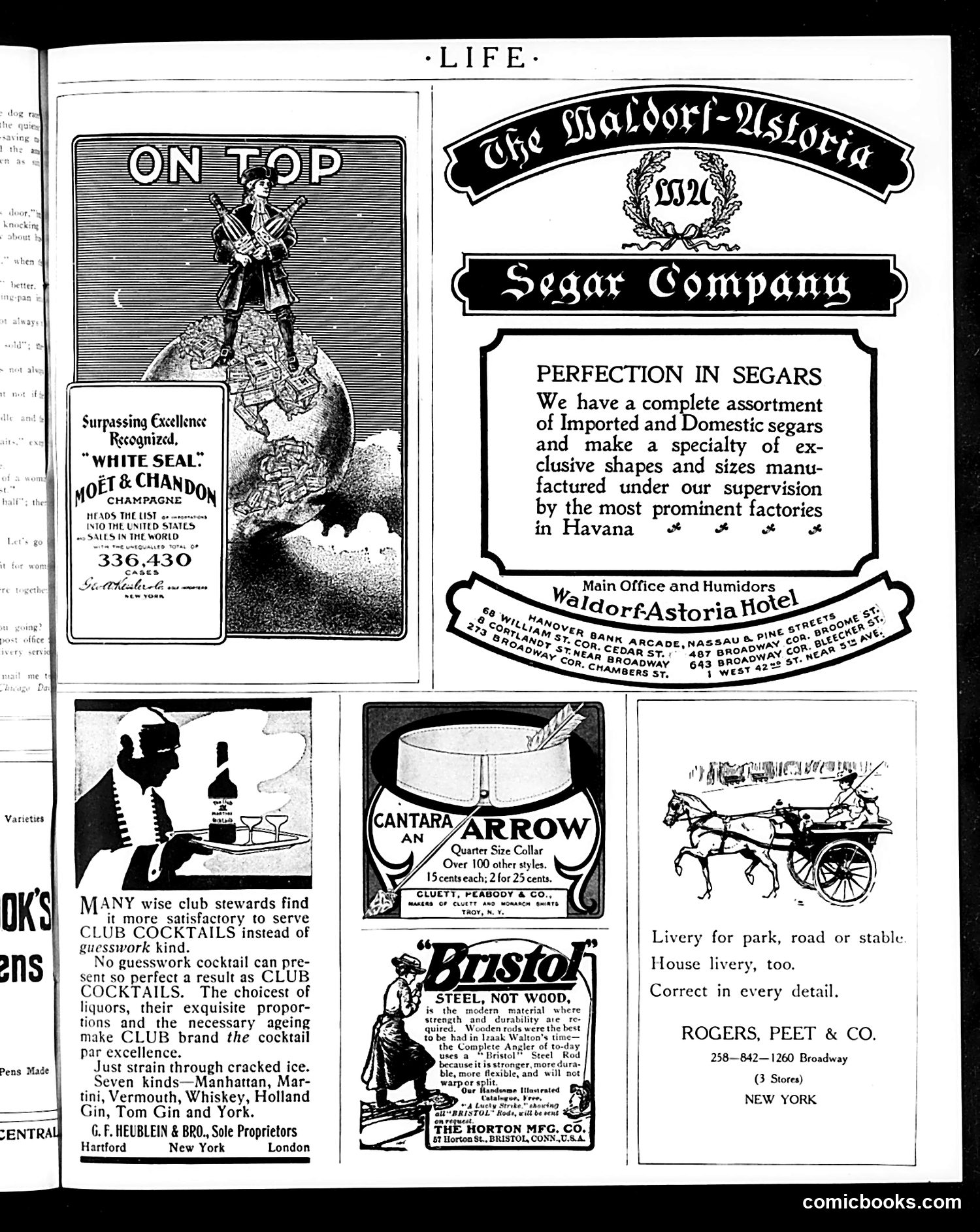
This page is **primarily advertising**, not political satire. It showcases early 20th-century luxury consumer goods: **Main advertisements:** - **Moët & Chandon champagne** ("White Seal") — positioned as superior, with sales figures (336,430 cases) - **Club Cocktails** — pre-mixed drinks marketed to "wise club stewards" as superior to homemade versions - **Waldorf-Astoria Segar Company** — imported and Cuban cigars - **Cantara Arrow collars** — quarter-size collars sold cheaply - **Bastoli steel collars** — "steel, not wood" construction - **Rogers, Peet & Co.** — livery services (horse-drawn carriages for hire) **The satire/humor** is minimal—mostly light mockery in the Club Cocktails ad, suggesting amateur bartenders produce inferior results. The page reflects **Gilded Age aspirational marketing**: champagne, cigars, fine dining, and servants represent wealth and sophistication for Life's affluent readership.
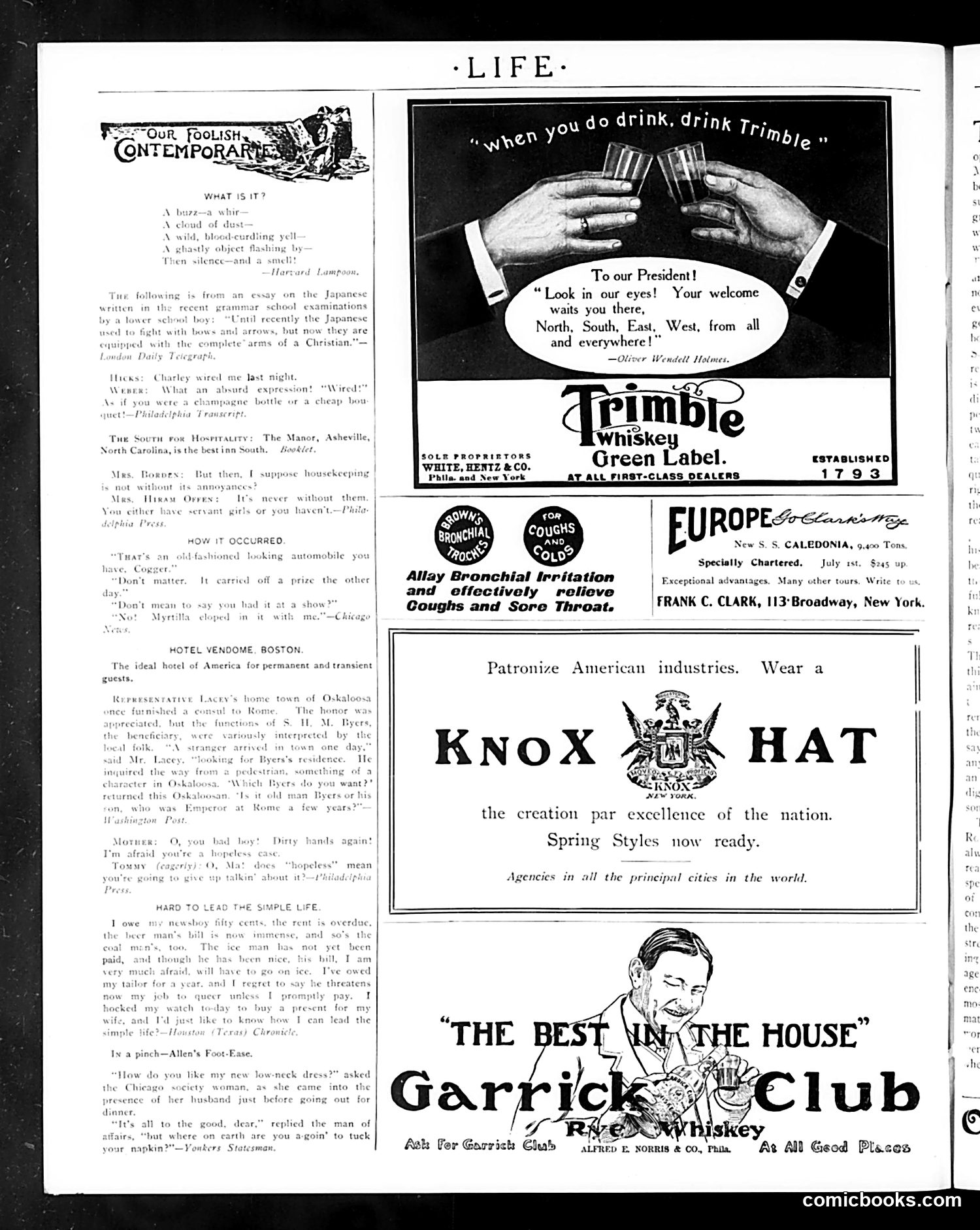
This page is primarily **advertising and light humor**, not political satire. The main content includes: **"Our Foolish Contemporaries"** column: Brief jokes mocking everyday absurdities—a man confused by telegraph terminology, hotel recommendations, etc. Standard satirical filler. **Major advertisements**: Trimble Whiskey (featuring a toast "To our President" with hands clinking glasses), Knox Hat ("creation par excellence of the nation"), and Garrick Club Rye Whiskey ("The Best in the House"). These represent typical early 20th-century product placement. **Minor ads**: Travel, cough medicine, and other commercial notices. The whiskey ad's presidential reference appears purely patriotic/celebratory rather than political commentary—a common sales tactic of the era. The page lacks identifiable political cartoons or caricatures of specific public figures. It reflects Life magazine's mixed format: satirical humor combined with revenue-generating advertisements, typical of American magazines from this period.
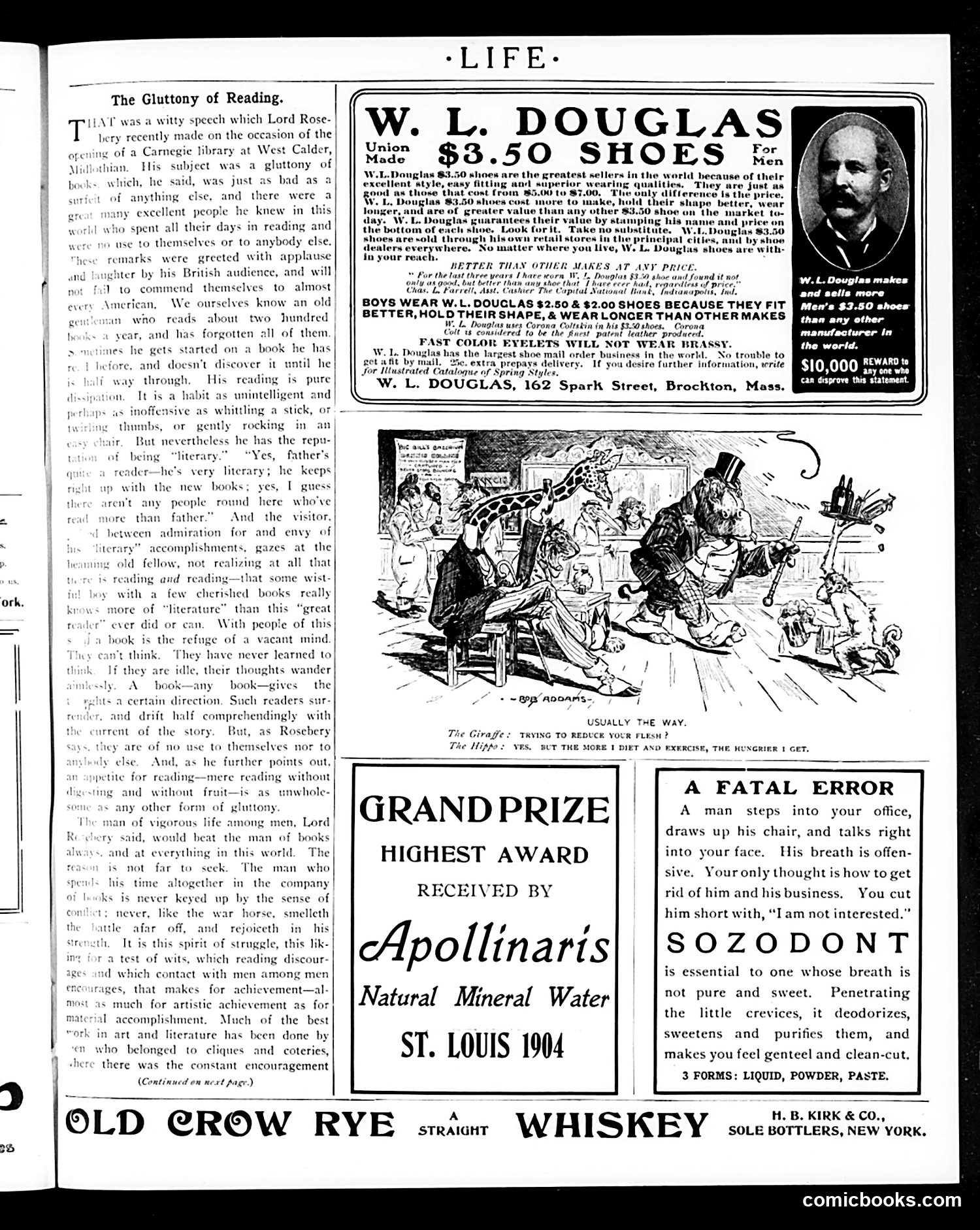
This page primarily contains **advertisements and editorial content** rather than political satire. The main essay, "The Gluttony of Reading," discusses Lord Rosebery's speech criticizing excessive, undiscriminating reading habits. The piece argues that mindlessly consuming books—reading without thought or selectivity—is as harmful as physical gluttony. Rosebery and the author contend that such readers drift passively through stories without intellectual engagement, making reading a form of mental dissipation rather than improvement. The page is dominated by **commercial advertisements**: W.L. Douglas shoes ($3.50), Apollinaris mineral water (promoted as a grand prize winner from the 1904 St. Louis World's Fair), and Sozodont toothpaste. The small cartoon titled "Usually the Way" depicts a giraffe and hippopotamus discussing dieting—a lighthearted joke about how exercise increases hunger rather than reducing it. **No significant political satire or caricature is evident** on this page; it reflects early 1900s consumer culture and attitudes toward reading and self-improvement.
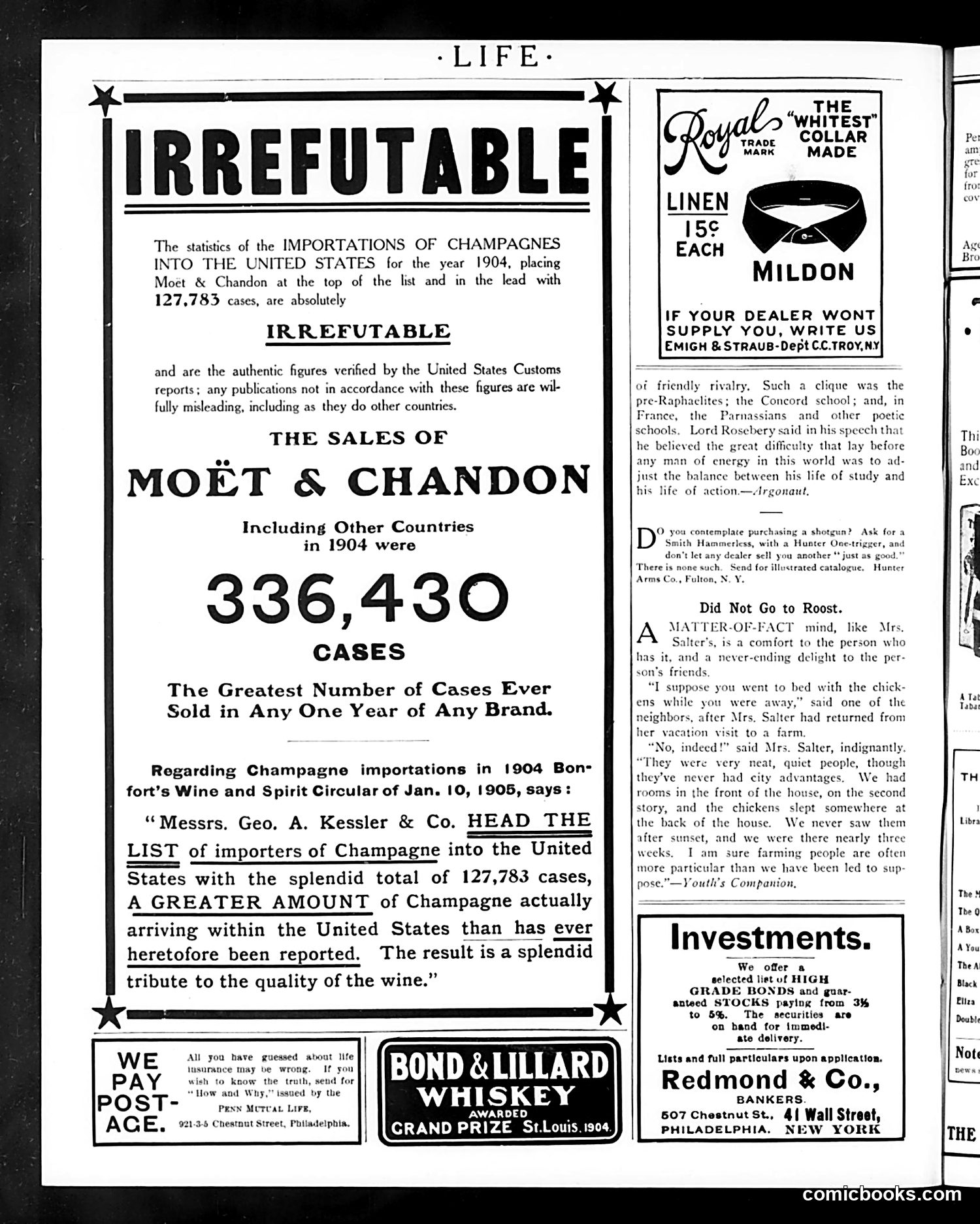
This page is primarily a **paid advertisement** for Moët & Chandon champagne, disguised as editorial content in Life magazine. The large "IRREFUTABLE" headline claims that Moët & Chandon's 1904 U.S. import statistics (127,783 cases) are absolutely authentic and verified by U.S. Customs—the "greatest number of cases ever sold in any one year of any brand." The satire lies in the **transparency of the claim itself**: the ad uses the word "irrefutable" repeatedly while citing selective statistics. It quotes a wine trade circular to support its dominance, but the contradictory figures (127,783 cases imported vs. 336,430 cases sold globally) hint at the self-serving nature of such "proof." For modern readers: This exemplifies early 1900s advertising where companies paid magazines to publish what *appeared* to be news rather than advertising, blurring editorial and commercial content—a practice that would eventually be regulated.
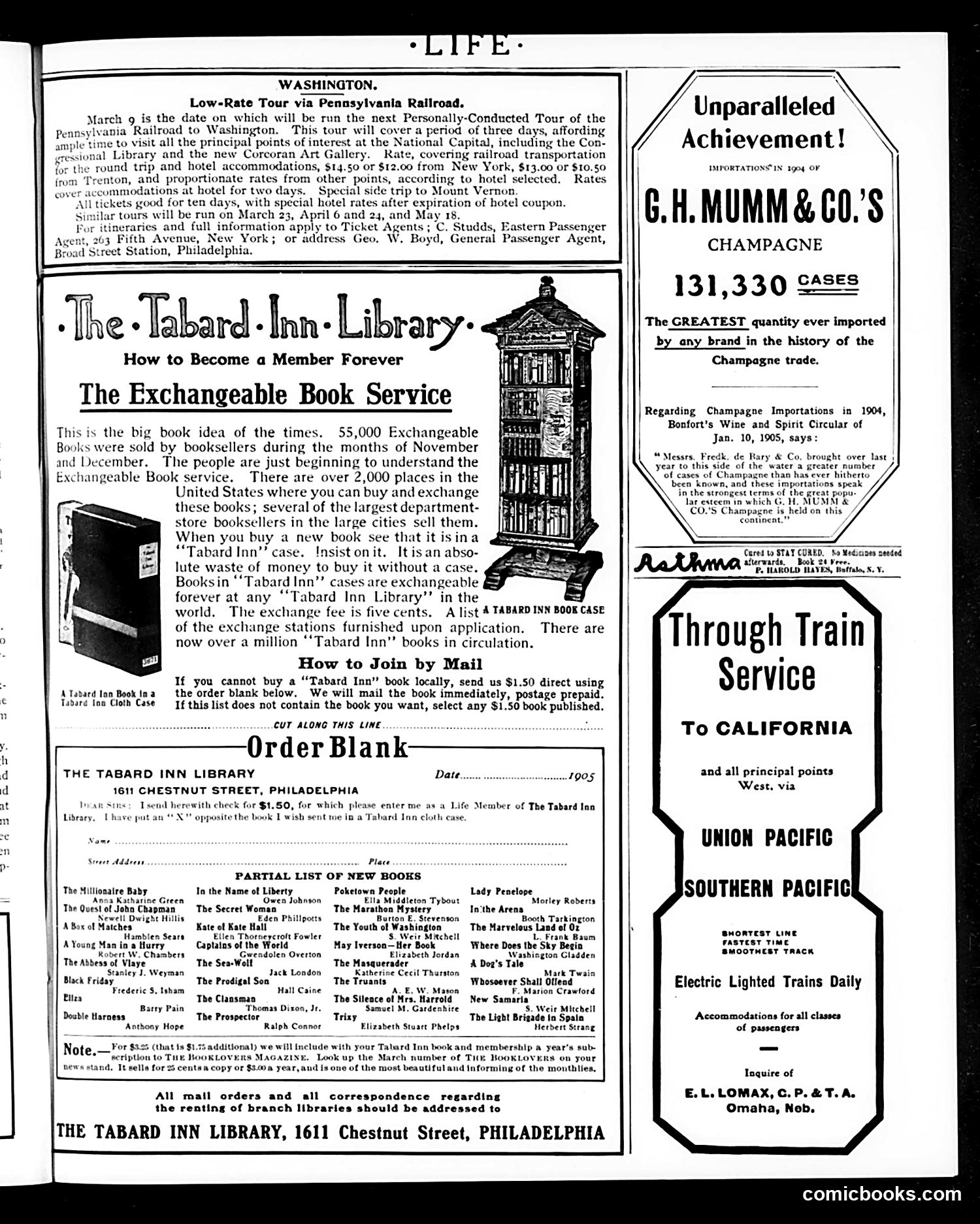
This is primarily a **commercial advertising page** from Life magazine (circa 1905), not a political cartoon or satire. The page contains three main advertisements: 1. **Pennsylvania Railroad tour** to Washington, D.C., promoting a three-day guided trip at discounted rates ($10.50-$14.50) 2. **The Tabard Inn Library** — a mail-order book exchange service allowing readers to buy books in cloth cases and swap them at 2,000+ locations nationwide for five cents. This was a novel early-1900s attempt to make reading affordable and sustainable through a rental/exchange model, pitched as "the big book idea of the times." 3. **Union Pacific and Southern Pacific Railways** advertising through-train service to California with electric-lit daily trains. The "Partial List of New Books" shows popular contemporary titles (Jack London's *The Sea-Wolf*, L. Frank Baum's *The Marvelous Land of Oz*, Mark Twain). This reflects Life's audience: educated, affluent urban readers interested in travel and literature.
This is a **beer advertisement**, not political satire. It promotes Schlitz Beer, a major Milwaukee brewery brand, emphasizing "purity" as its distinguishing feature—a key marketing claim for breweries in the early 20th century. The ad highlights manufacturing practices: premium ingredients (barley, hops, yeast), extended aging to prevent digestive problems ("biliousness"), and overall purity. This reflects contemporary concerns about food safety and quality control, when beer's healthfulness was genuinely advertised as a selling point. The ornate Art Nouveau border and bold typography are typical of the era's design. "The Beer That Made Milwaukee Famous" was Schlitz's actual slogan, positioning the brewery as Milwaukee's most prominent industry during America's brewing boom.