
Life, 1905-03-09 · page 14 of 22
Life — March 9, 1905 — page 14: what you’re looking at
What you’re looking at
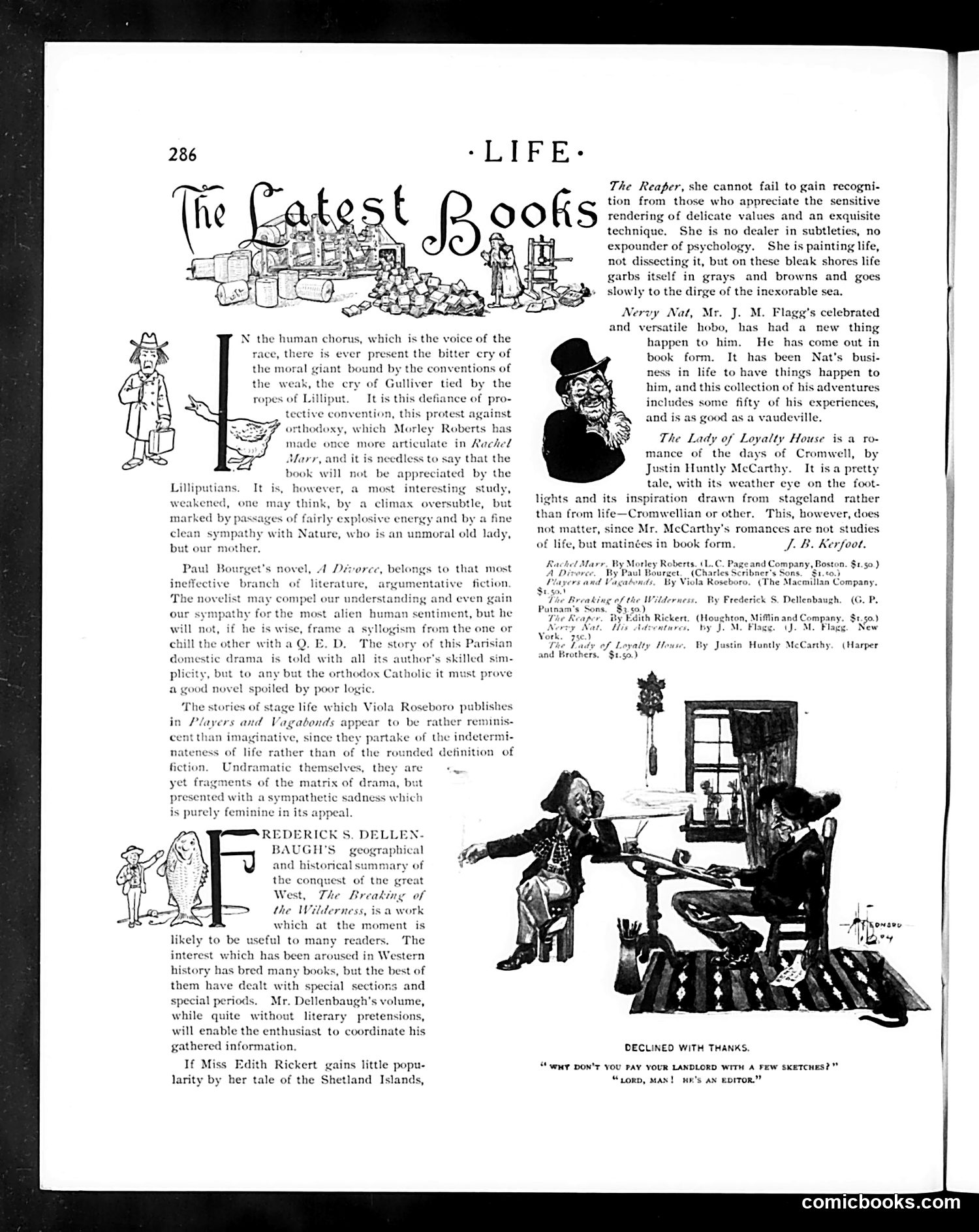
This is a book review section featuring illustrated critiques of contemporary novels. The main cartoon at bottom depicts an editor rejecting a starving artist's offer to pay rent with sketches—the editor responds "Lord, Man! He's an editor," a self-deprecating joke about editors' notoriously low pay and inability to afford art. The reviews discuss literary works including *A Divorce* by Paul Bourget, *Norry Nut* (J.M. Flagg's hobo character collection), and *The Lady of Loyalty House* (a Cromwell-era romance). The critics employ period-typical literary snobbery—dismissing some works as mere "matinées in book form" while praising others' "sensitive rendering." The decorative header illustration of "The Latest Books" shows period figures amid books and reading materials, establishing the genteel, intellectual tone Life magazine cultivated for its educated readership.
📄 Transcribed text from this page (OCR, searchable)
Machine-transcribed from the original scan — historical spelling and the odd misread are preserved.
The Reaper, she cannot fail to gain recogni- tion from those who appreciate the sensitive rendering of delicate values and an exquisite technique. She is no dealer in subtleties, no expounder of psychology. She is painting life, not dissecting it, but on these bleak shores life itself in grays and browns and goes slowly to the dirge of the inexorable sea. y Nat, Mr. J. M. Flagg’s celebrated atile hobo, has had a new thing happen to him. He has come out in book form. It has been Nat's busi- ness in life to have things happen to him, and this collection of his adventures include y of his experiences, and is as good as a vaudeville. N the human chorus, which is the voice of the race, there is ever present the bitter cry of id by the conventions of the weak, the cry of Gulliver tied b iput. It is this defiance of pro- the moral giant bc the ropes of L some fift inst tective convention, this protest aj Roberts has ate in Rachel that the by the study, but which Mo The Lady of Loyalty House is a ro- mance of the days of Cromwell, by Justin Huntly McCarthy. It isa pretty ale, with its weather eye on the foot- lights and its inspiration drawn from stageland rather | | | made once more articu arr, and it is needless to si book will not be appreciatec Lilliputians. It is, howev 1 most interest weakened, one may think, by a. climax. oversub’ from —Cromwellian or other. This, however, does not matter, since Mr. McCarthy's romances are not studies. ft of life, but matinées in book form. J.B. Kerfoot. marked by passages of fairly explosive energy and by a fine oral old lady, yw clean symp h Nature, who is ani but our mother, al Bou, ctive branch Roberts. (L.C. Page and wrget. (Charles Scri By Viola Roseboro. ( ompany, Boston. $1.50) Phe Macmillan Company. i to that most rature, i ne fiction s novel, A Dévorce, belon: ne novelist may compel : for th our un reaking of the Wilderness. 's Sons. 33.50.) th Rickert ty Frederick S. Dellenbaugh. (G. P. most alien human sentime our sympa ton, MiMin and Company JM. (J. M. Flagg. $150.) New if he is wise, frame a syllogism from the one or ther witha Q. E, D, The story of this Parisian drama is told with all its author's skilled sim- of Loyalty He $1.50) farthy, (Harper domest plicity, but to any but the orthodox Catholic it must pr« a good novel spoiled by poor los ‘The stories of stage life which Viola Roseboro publishes in Players and Vagabonds appear to be rather reminis- tthan imaginative, since they partake of the indete nateness of | the re led detinition of fiction. Undramatic themselv they are ow yet fragments of the matrix of drama, but presented with a sympathetic sadness which ce e rather than is purely feminine in its « REDERICK S. DELLEN- BAUGH’S g and historical sraphical ummary of the conquest of tne great West, The Breaking of the Wilder which at the moment is likely to be useful to many readers. The interest which has been aroused in Western history b the best of them have dealt with spe and special periods. Mr. Dellenbaugh’s volume, while quite without literary pretensions, will enable the enthusiast to coordinate his gathered information. DECLINED WITH THANKS. ness, iS a work s bred many books, t al sectior If Miss Edith Rickert gains little popu- “Mem DON'T YOU PAY YOUR LANDLORD WITH A FEW SKETCHES?" larity by her tale of the Shetland Islands, “torp, MAN! Mn’S AN EDITOR.” comicbooks.com