
A complete issue · 22 pages · 1905
Life — February 23, 1905
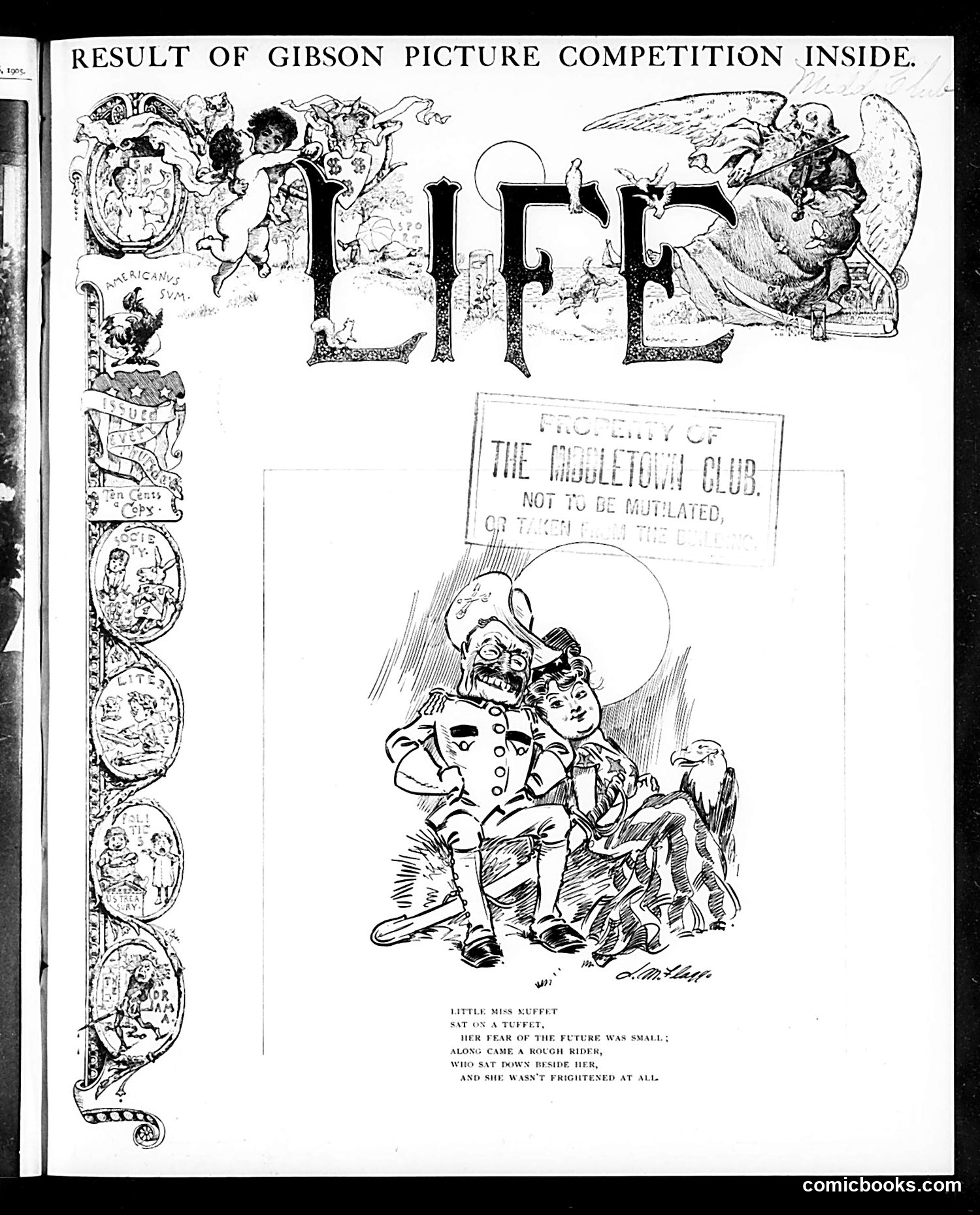
This page shows results of a "Gibson Picture Competition"—Life magazine solicited reader submissions based on Charles Dana Gibson's popular illustrated style (featuring idealized "Gibson Girl" imagery). The main cartoon depicts "Little Miss Buffet" sitting on a tuffet, a reference to the nursery rhyme. The accompanying verse notes her fearlessness about the future despite encountering "a rough rider" who sits beside her. The "rough rider" reference likely alludes to Theodore Roosevelt, known by that nickname. The joke appears to satirize both the famous nursery rhyme and contemporary political figures through Gibson's characteristic drawing style. The ornate left border contains small circular vignettes in classical style, typical of Life's decorative design aesthetic of the era.
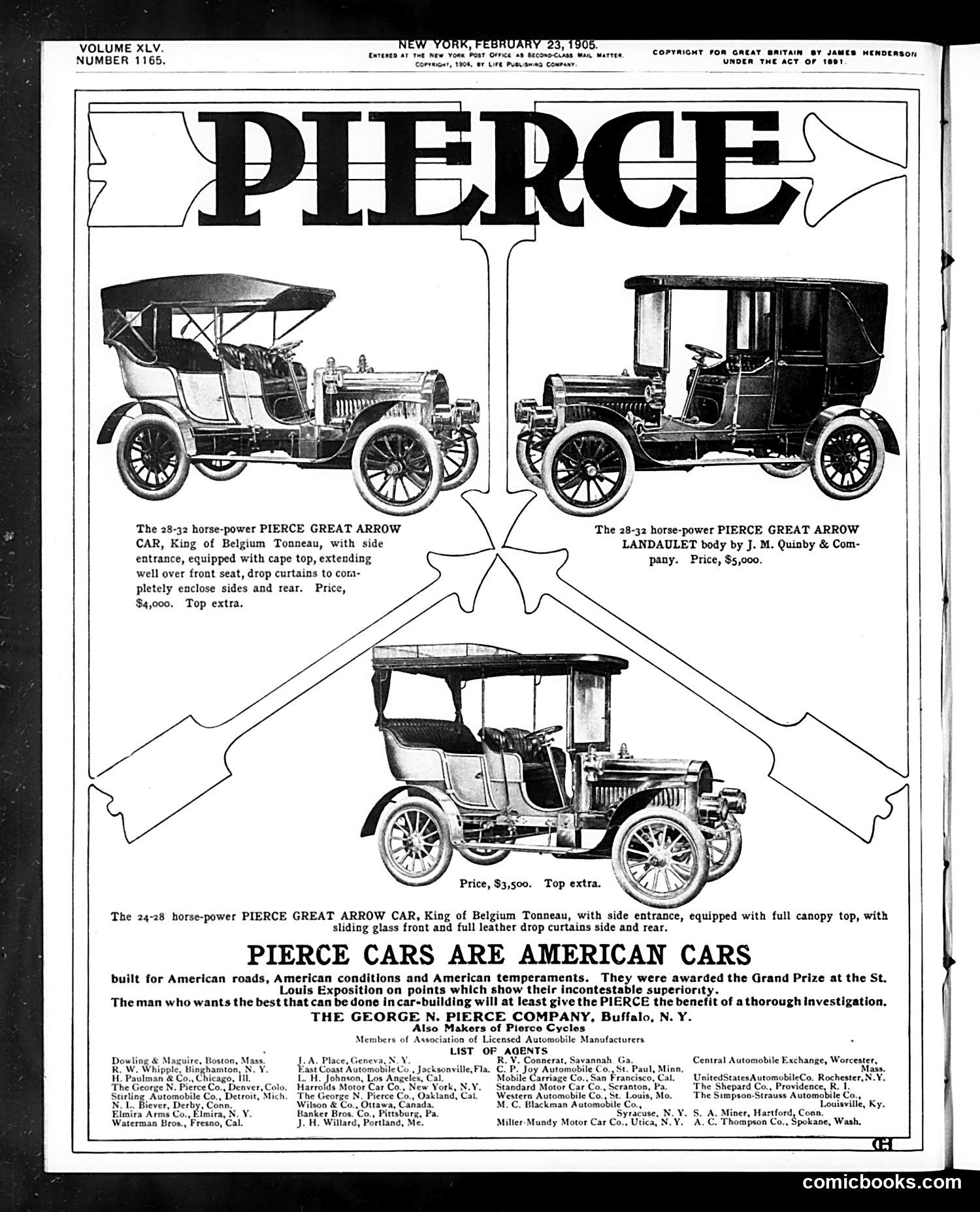
This page is **not a cartoon or satire**—it's a straightforward automobile advertisement from *Life* magazine, February 23, 1908. The page showcases three models of Pierce-Arrow automobiles manufactured by The George N. Pierce Company in Buffalo, New York. It displays: - A 28-32 horsepower "King of Belgium" tonneau with side entrance ($4,000) - A 28-32 horsepower landaulet body ($5,000) - A 24-28 horsepower car with full canopy top ($3,500) The headline "PIERCE CARS ARE AMERICAN CARS" emphasizes domestic manufacturing. The advertisement highlights the vehicles' features and competitive pricing, along with a list of authorized dealers nationwide. This is period advertising for luxury automobiles aimed at affluent readers.
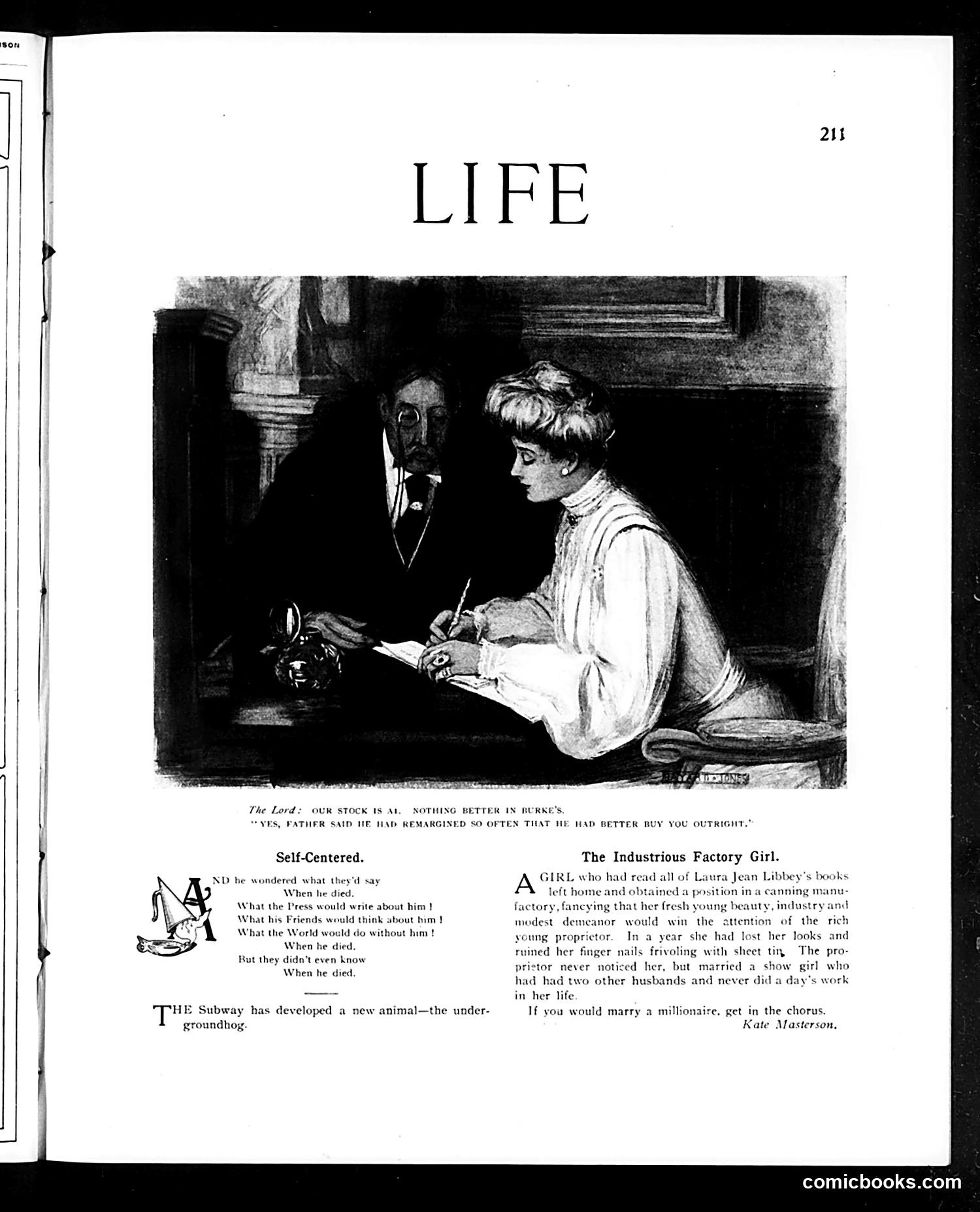
This page contains two separate satirical pieces: **"Self-Centered"** (left): A brief poem mocking someone's self-importance, suggesting they believed themselves irreplaceable—that newspapers, friends, and "the World" couldn't function without them. The humor lies in the deflating revelation: "But they didn't know / When he died." **"The Industrious Factory Girl"** (right): A story satirizing the gap between appearance and reality. A young woman reads Laura Jean Libbey novels (popular romance fiction), fantasizing about attracting a wealthy industrialist with her beauty and modest demeanor. The satire reveals her actual life: she's ruined her hands with factory work, lost her looks, and married twice without ever working—undermining the romantic fantasy the magazines sold to working-class readers. Both pieces critique American delusions.
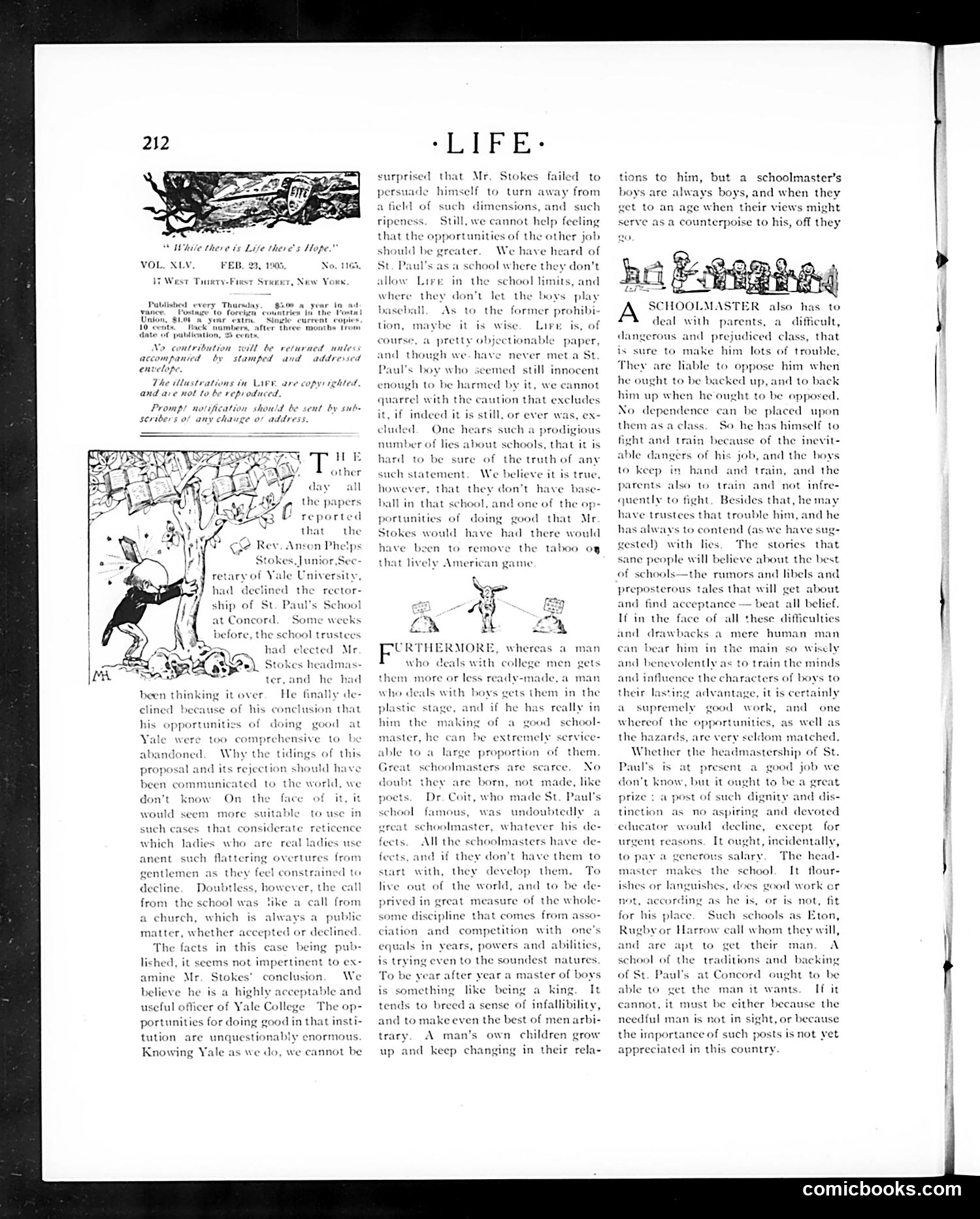
This page discusses schoolmasters and education, featuring illustrations of children and a figure labeled "Rev. Anson Phelps Stokes, Junior Sec-retary of Yale University." The text praises Stokes as a "highly acceptable and useful officer of Yale College," noting his role in education. The main satirical point appears to critique the difficulty of being a schoolmaster—dealing with "dangerous and prejudiced" students, unsupportive parents, and institutional constraints. The cartoons illustrate these challenges humorously, showing the physical and social demands placed on educators. The piece ultimately argues that good schoolmasters are rare and underappreciated, and that finding suitable candidates for such demanding positions is genuinely difficult work requiring both discipline and wisdom.
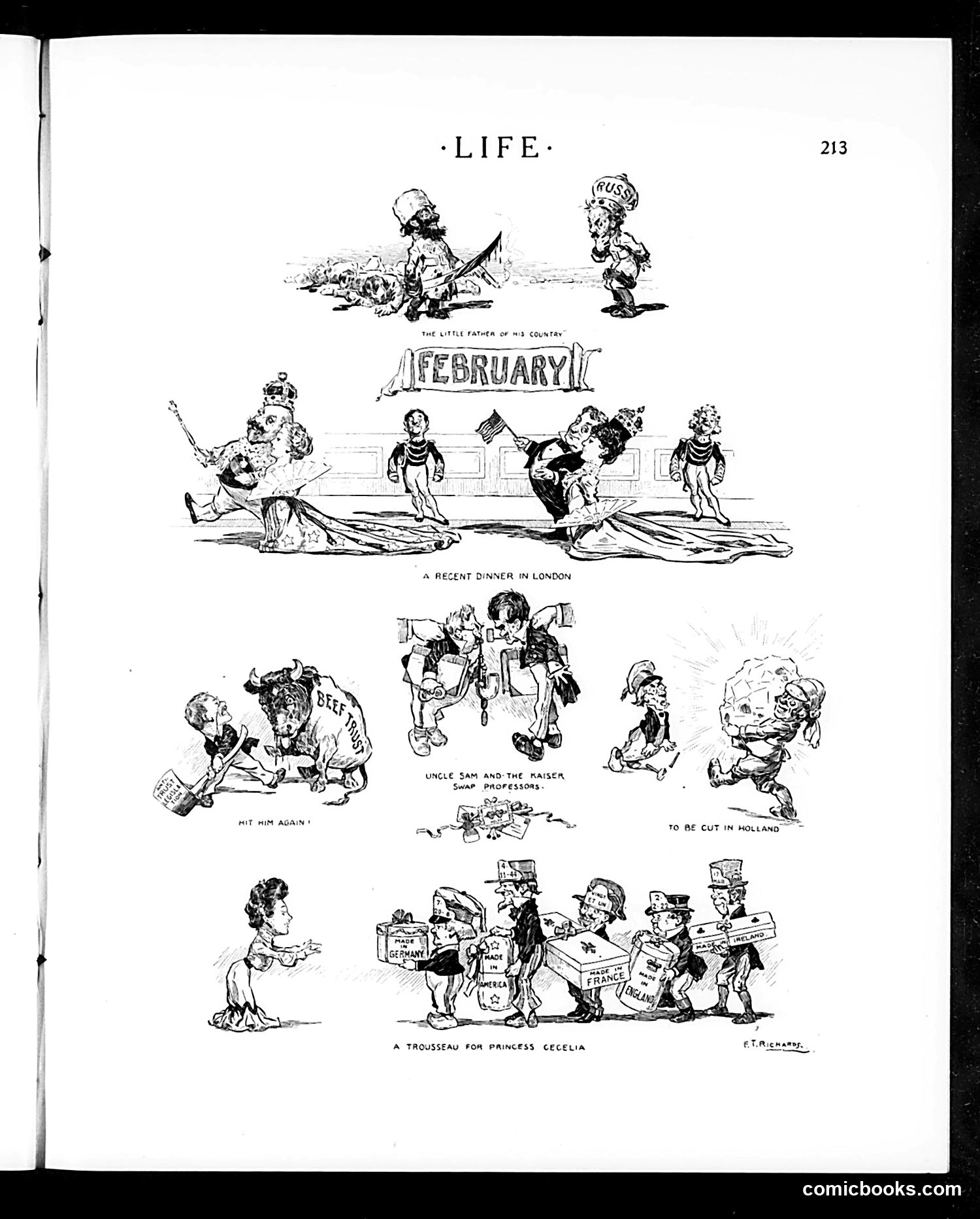
This page contains six political cartoons satirizing early 20th-century American and international affairs: **"The Little Father of His Country"** depicts two figures—likely representing Russia and a political leader—in a confrontational pose. **"A Recent Dinner in London"** shows figures on elongated forms, apparently satirizing diplomatic tensions. **"Hit Him Again"** references conflict involving beef interests and professions. **"Uncle Sam and the Kaiser"** depicts American and German leadership in discussion about "Swap Professions." **"To Be Cut in Holland"** shows a figure being divided—likely referencing territorial disputes. **"A Trousseau for Princess Cecelia"** depicts multiple figures with trade-related boxes, apparently satirizing European political marriages or alliances through commercialism. The cartoons appear to address pre-World War I diplomatic tensions and international trade conflicts, though specific events require additional historical context.
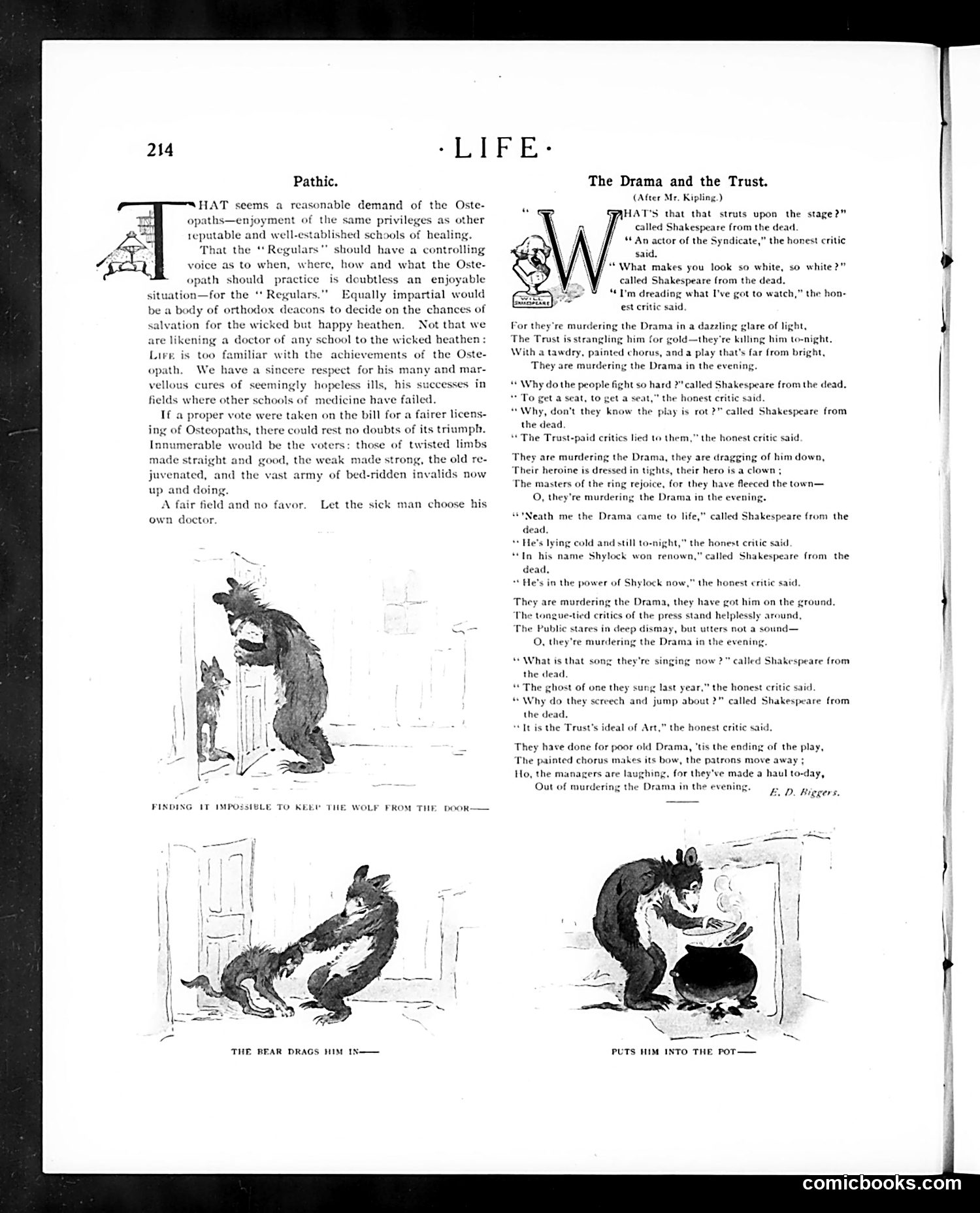
This page satirizes theatrical industry consolidation through a dialogue between Shakespeare (called from the dead) and an "honest critic." The text mocks a "Trust" that controls theater, monopolizing dramatic productions and profits. The three cartoons below illustrate the Trust's predatory practices using animal metaphors: a wolf threatening a book, a bear dragging in a victim, and a creature putting someone in a pot. These depict the Trust as literally consuming theatrical competitors and artists. The satire argues the Trust murders creative drama through monopolistic control, reducing theater to shallow commercial spectacle. The piece critiques how consolidated corporate power corrupts an art form, prioritizing profit over quality—a common Progressive Era complaint about industrial trusts.
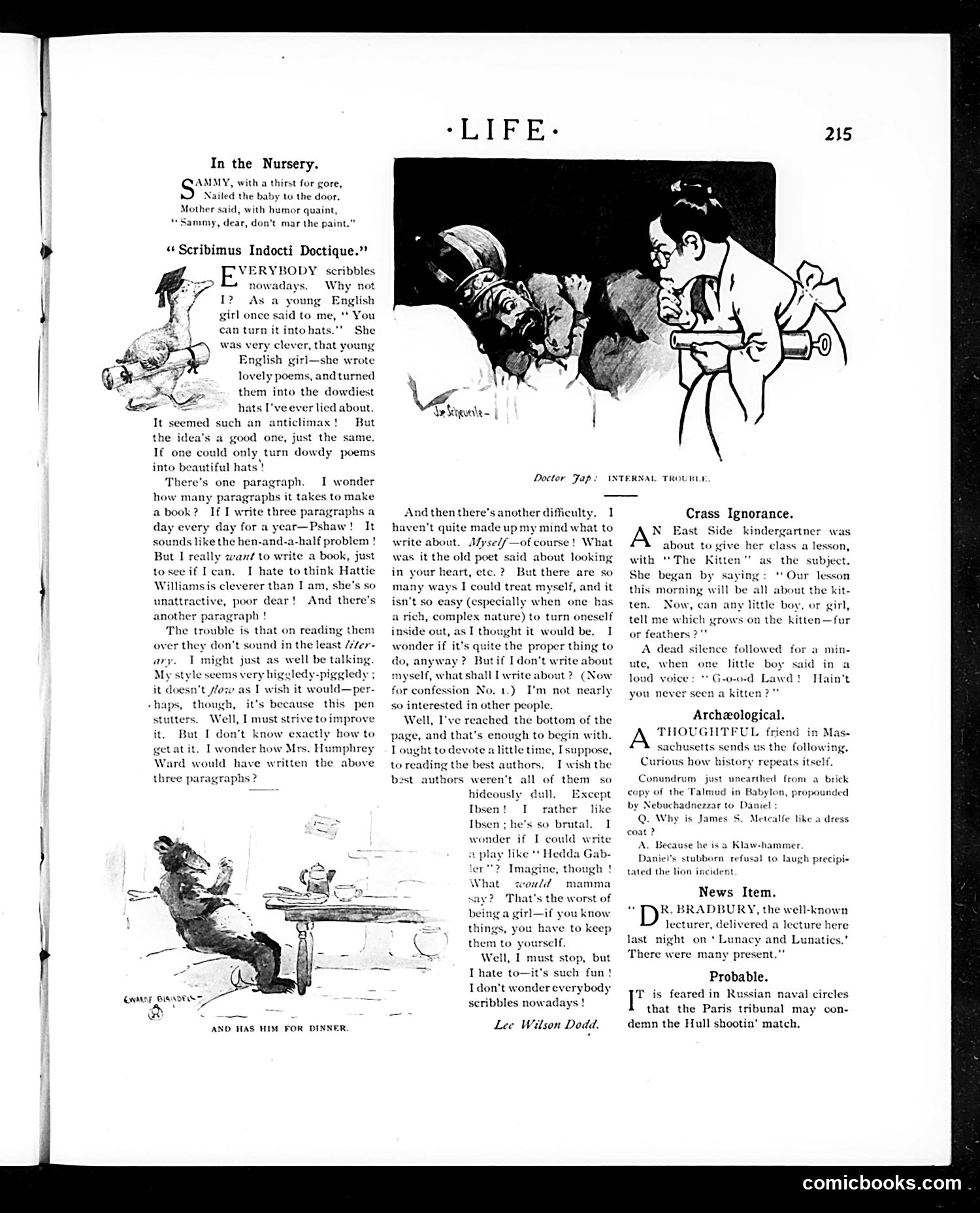
This page contains three distinct satirical pieces: **"In the Nursery"** features a duck teaching a baby to nail something, satirizing the absurdity of turning "dowdy poems into beautiful hats"—mocking the tendency to impose literary artifice on simple subjects. **"Doctor Tap"** (illustration, center-right) shows a doctor examining an infant, captioned "Internal Trouble," likely satirizing medical pretension or over-diagnosis of minor ailments in children. **"Crass Ignorance"** ridicules an East Side kindergartner who confuses "The Kitten" with actual kitten fur, mocking either the child's or the school's educational gaps. The remaining sections ("Archaeological," "News Item," "Probable") appear to be brief humorous commentary on contemporary events—references to Dr. Bradbury's lecture and Russian naval concerns are mentioned but lack sufficient context for detailed explanation.
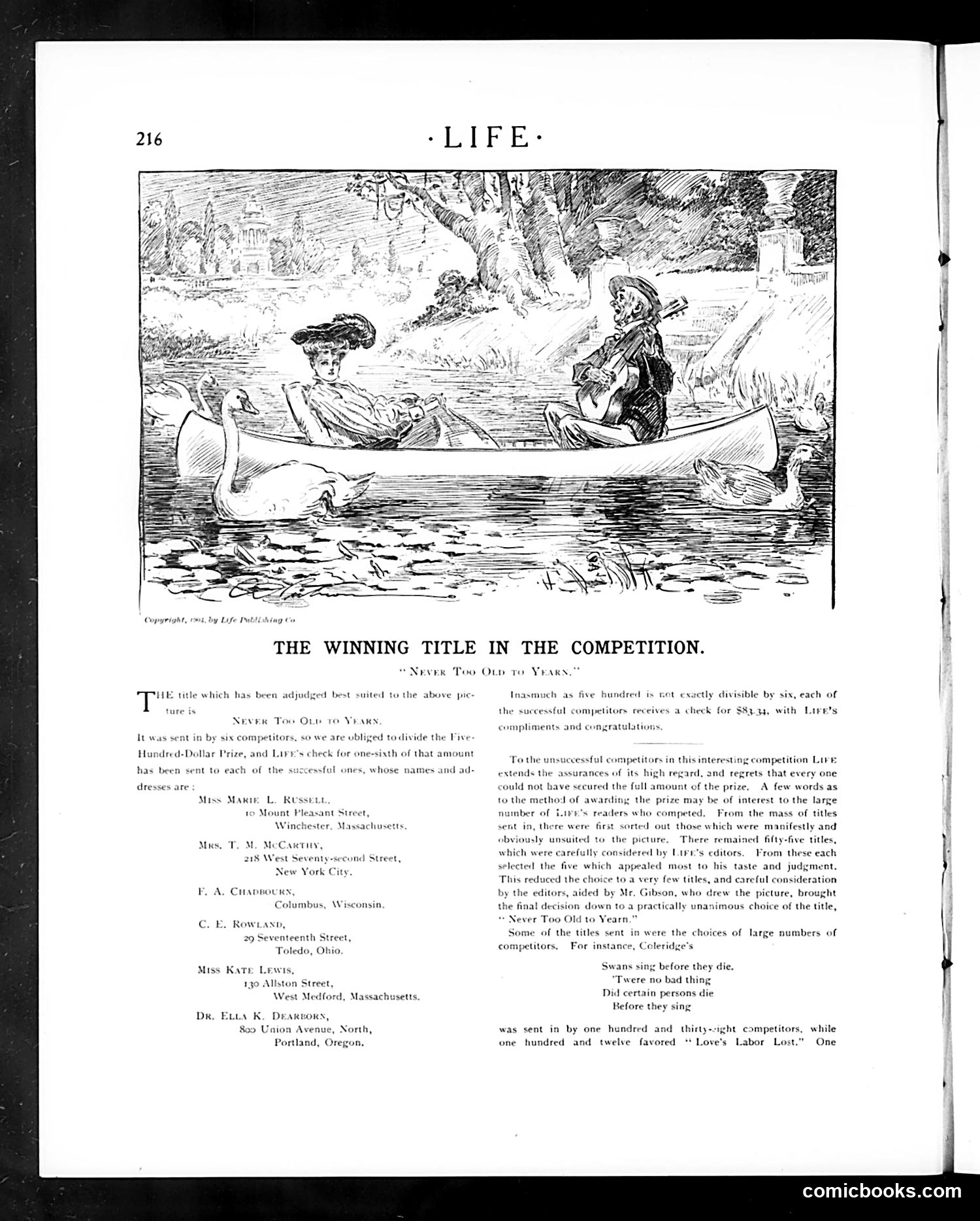
This page documents a **Life magazine contest** where readers submitted alternative titles for an illustration showing two figures in a boat serenading a woman. The winning title was **"Never Too Old to Years"** (likely meant to be "Never Too Old for Years"). The illustration depicts a romantic scene with musicians and a woman, suggesting the competition invited humorous or clever captions. Six competitors are listed with their addresses, each receiving a prize check for $84.34. The page explains that over 300 titles were submitted. Life's editors sorted through entries, selecting the most suitable candidate, though the final judgment was apparently "practically unanimous" on the winning choice. This reflects early 20th-century audience participation in magazine contests—a common form of reader engagement before digital media.
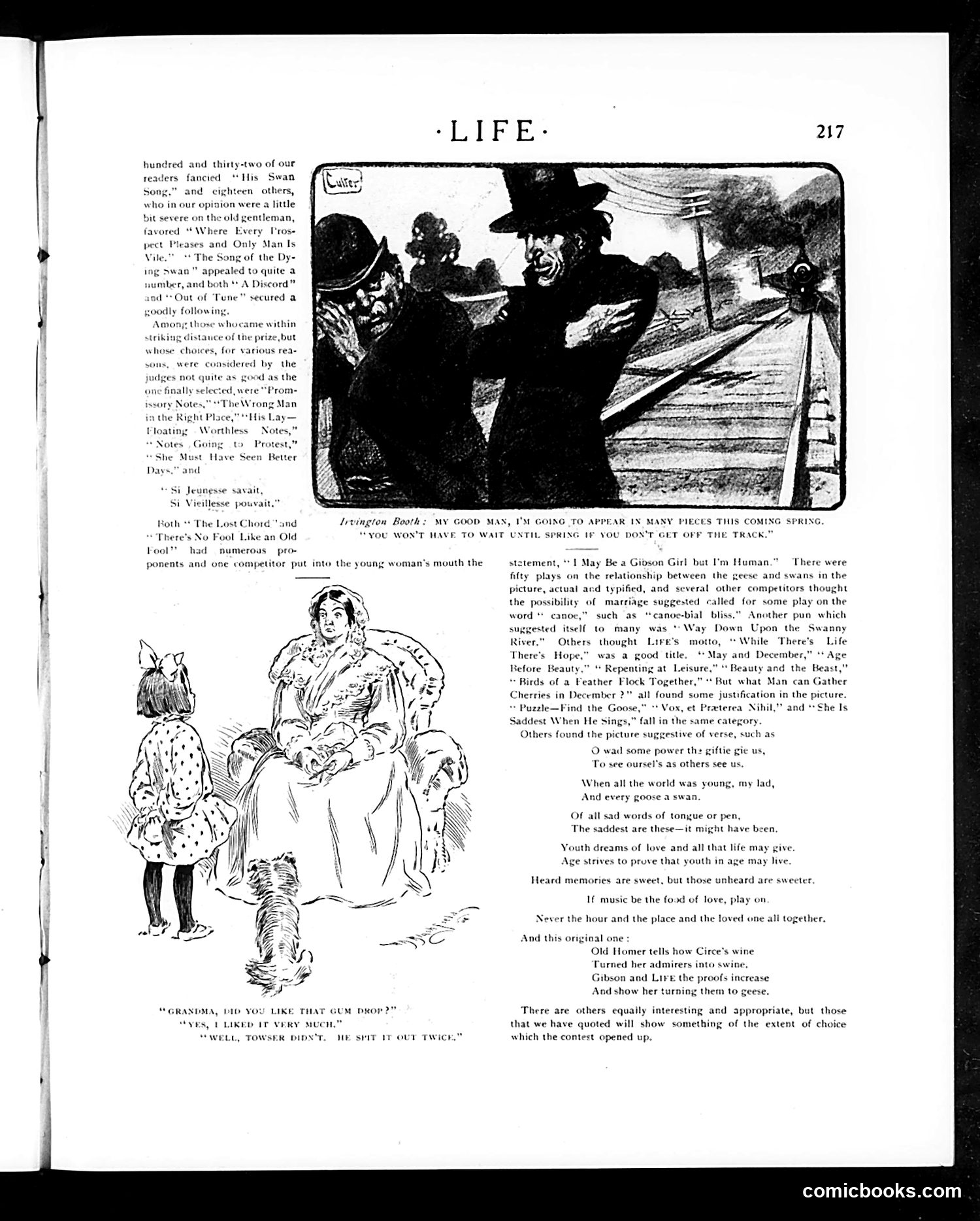
This page from *Life* magazine contains two unrelated items: **Top illustration**: A sketch labeled "Livingston Book" shows three figures on railroad tracks. The caption reads: "MY GOOD MAN, I'M GOING TO APPEAR IN MANY PIECES THIS COMING SPRING. YOU WON'T HAVE TO WAIT UNTIL SPRING IF YOU DON'T GET OFF THE TRACK." The joke appears to satirize theatrical overproduction or an actor's ambitious season schedule, using the threat of being hit by a train as dark humor. **Bottom illustration**: A domestic scene showing a woman with a child and animals (likely a dog and cat). The caption reads: "GRANDMA, DID YOU LIKE THAT GUM DROP?" "YES, I LIKED IT VERY MUCH." "WELL, TOSS ER BACK, HE SPIT IT OUT TWICE." This is simple family humor about a child's mischievous behavior with candy. Neither cartoon addresses major political issues—they're light satirical humor typical of *Life*'s style.
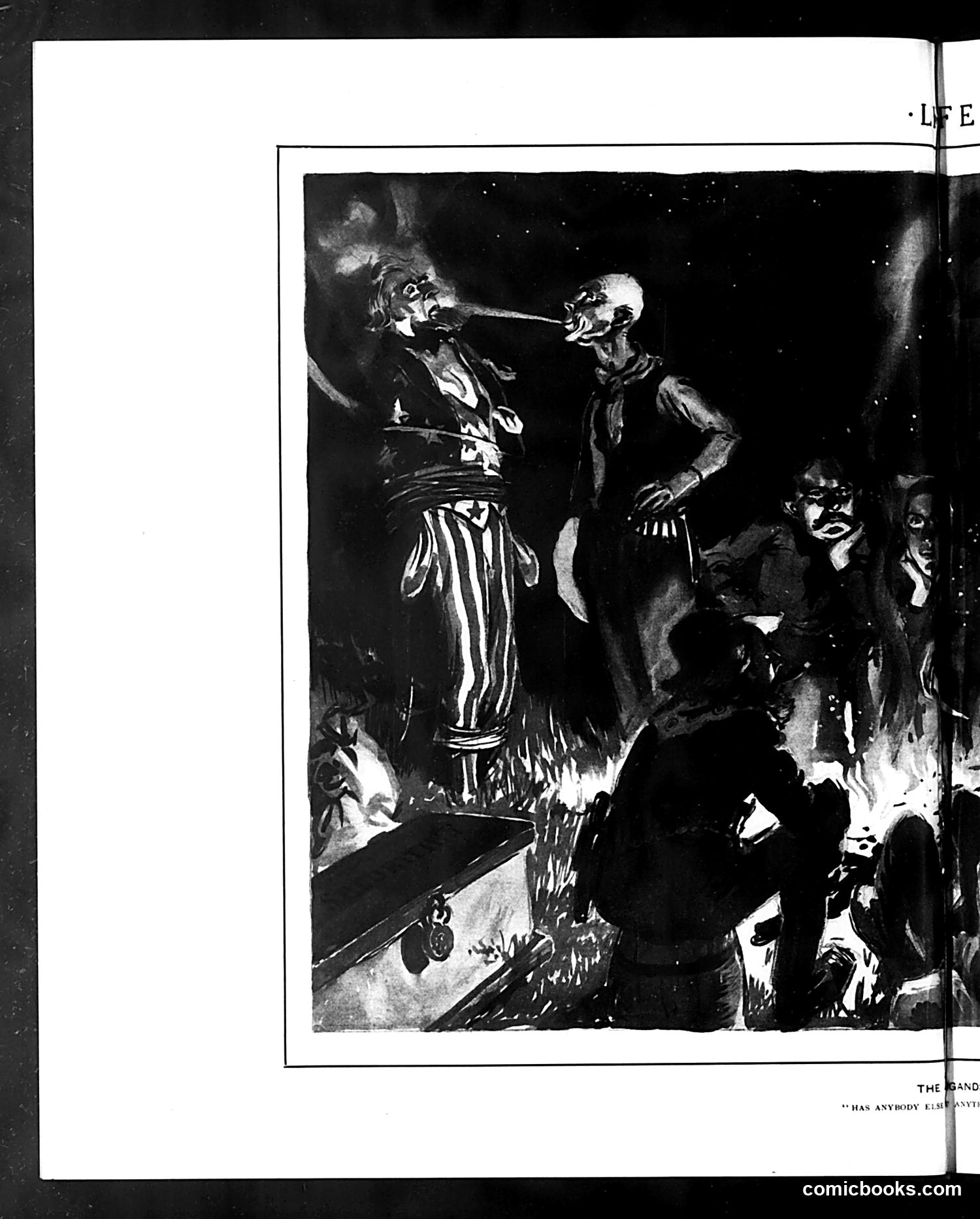
This appears to be a satirical illustration from Life magazine depicting a dramatic scene with exaggerated caricatured figures. The visible text fragment reads "HAS ANYBODY ELSE ANY..." suggesting dialogue or a caption that's partially cut off. The image shows what appears to be figures in period clothing engaged in some kind of confrontation or theatrical scene. The artistic style—heavy shadows, dramatic expressions, and caricatured features—is typical of early 20th-century satirical illustration. However, without the complete caption or title visible on this page, I cannot definitively identify which specific political figures, events, or social issues are being satirized. The partial OCR text is insufficient to determine the cartoon's intended meaning or its historical context. A clearer view of the full caption would be necessary for accurate interpretation.
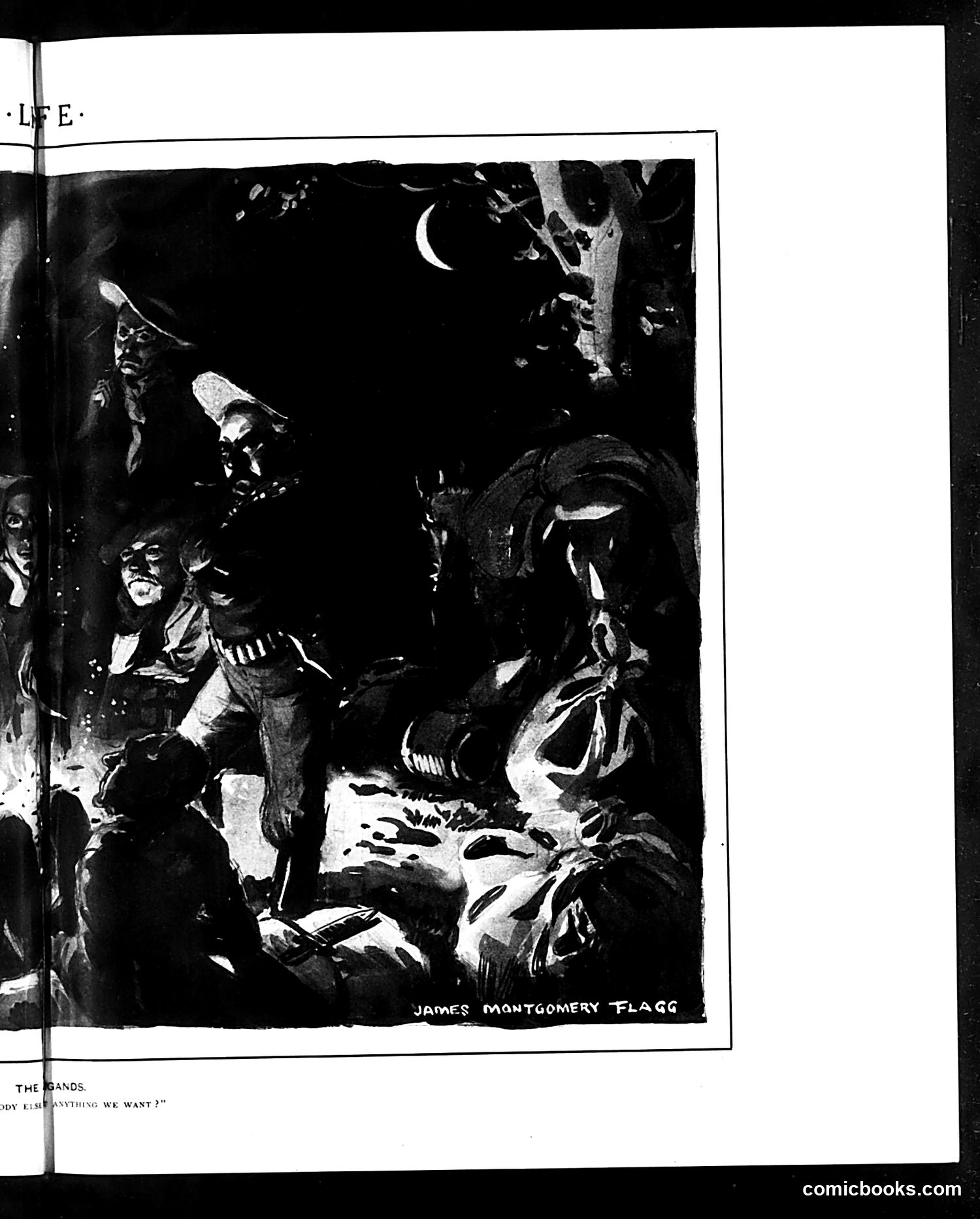
This page features artwork by **James Montgomery Flagg**, a prominent American illustrator. The image depicts a dramatic nighttime scene with a crescent moon, showing what appears to be military or political figures in period costume engaged in some kind of confrontation or gathering. The text reference "THE BANDS" and partial phrase "...OY FUN 'ANYTHING WE WANT?'" suggests this may relate to a political or social commentary, though the complete context is unclear from the visible OCR text. Without the full article text or clearer caption, the specific historical event or political figures being satirized cannot be definitively identified. The artistic style and military uniforms suggest early-to-mid 20th century subject matter, but the precise meaning requires additional source material.
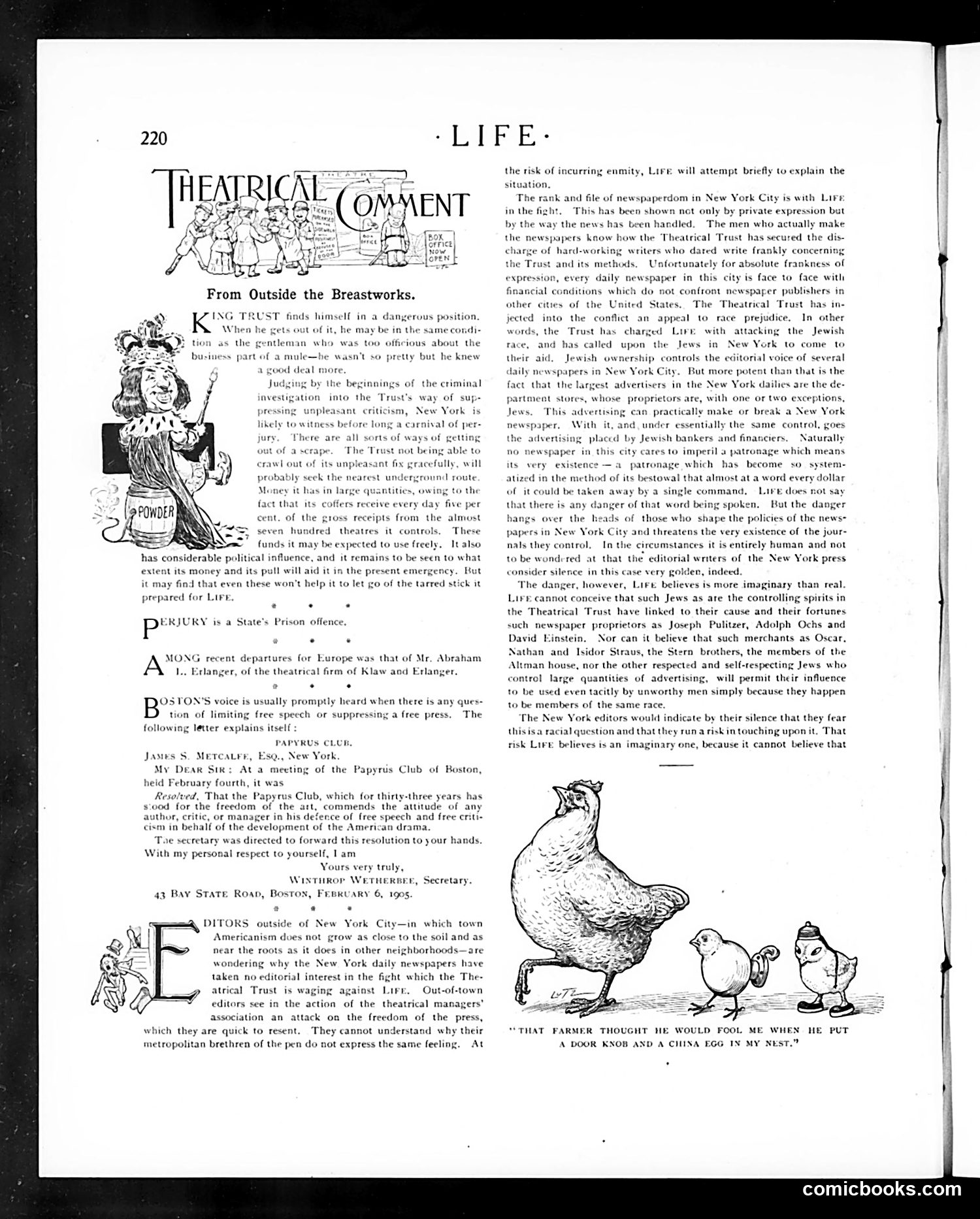
This page presents satirical commentary on New York newspaper control and Jewish ownership. The "Theatrical Comment" section attacks the Theatrical Trust's influence over newspapers, arguing that Jewish bankers and advertisers (naming Joseph Pulitzer, Adolph Ochs, David Lindheim, Nathan and Isidor Straus, and others) secretly control New York's press through advertising patronage. The cartoon at bottom depicts a hen with chicks and a door knob, illustrating the caption about a farmer fooling the hen—likely a metaphor for deception or gullibility. The editorial content expresses antisemitic conspiracy theories about Jewish control of media and advertising. A letter from the Papyrus Club defends free speech in theater against the Trust's censorship.
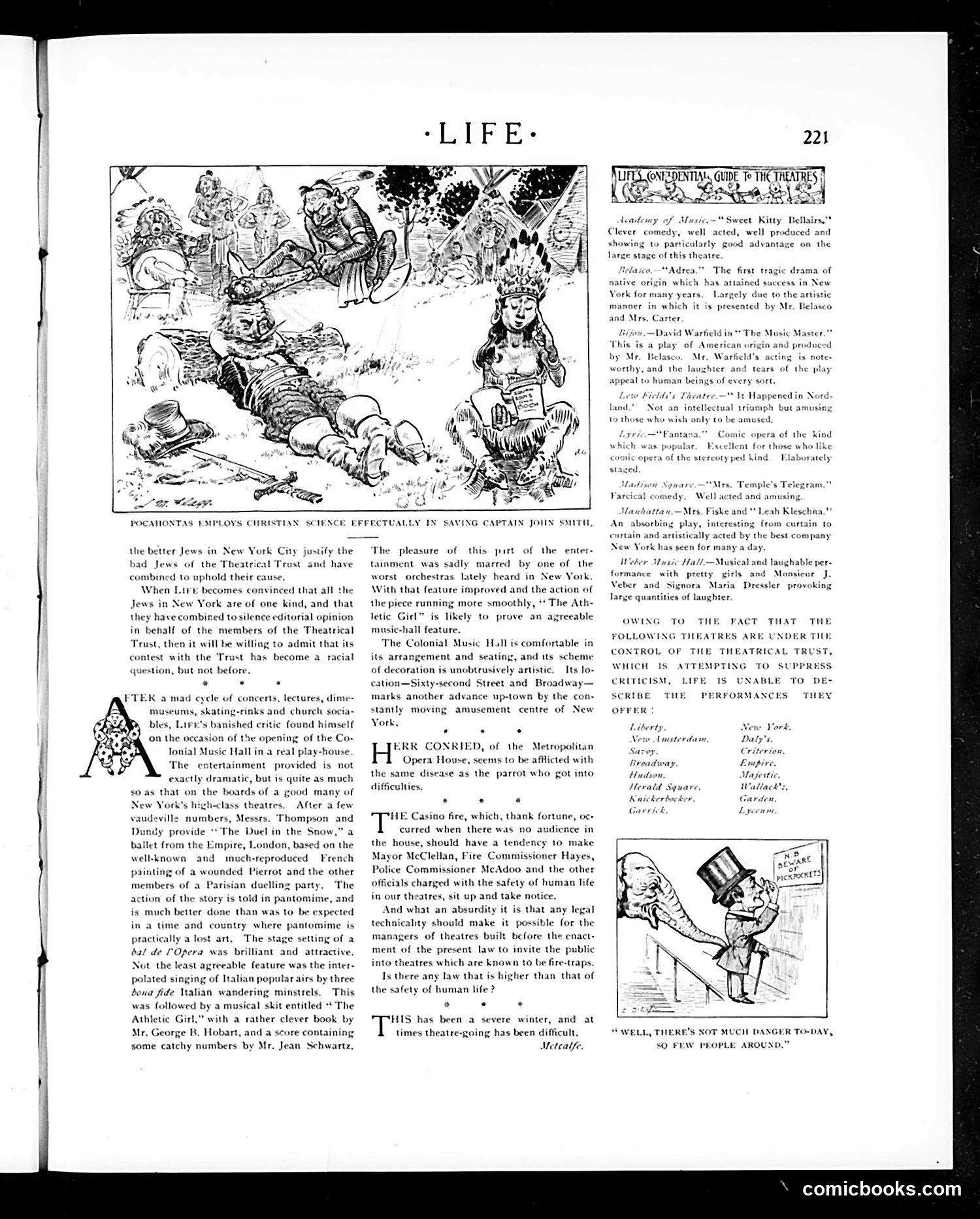
This page combines theatre reviews with satirical commentary. The main cartoon depicts **Pocahontas using Christian Science to heal Captain John Smith**—a absurdist joke mocking the then-popular Christian Science movement by literalizing its healing claims through a historical anachronism. The text discusses New York theatre controversies, particularly **criticisms of the "Theatrical Trust,"** a monopolistic organization controlling theatres. Life defends itself against accusations of antisemitism, arguing it opposes specific Trust members, not Jewish people generally—a defensive stance suggesting contemporary accusations of bias in Life's coverage. The page also reviews specific productions at various theatres (Colonial Music Hall, Academy of Music, Bijou) and criticizes fire safety violations in theatres, particularly regarding pre-existing structures exempted from modern building codes—a genuine public safety issue highlighted by recent theatre fires.
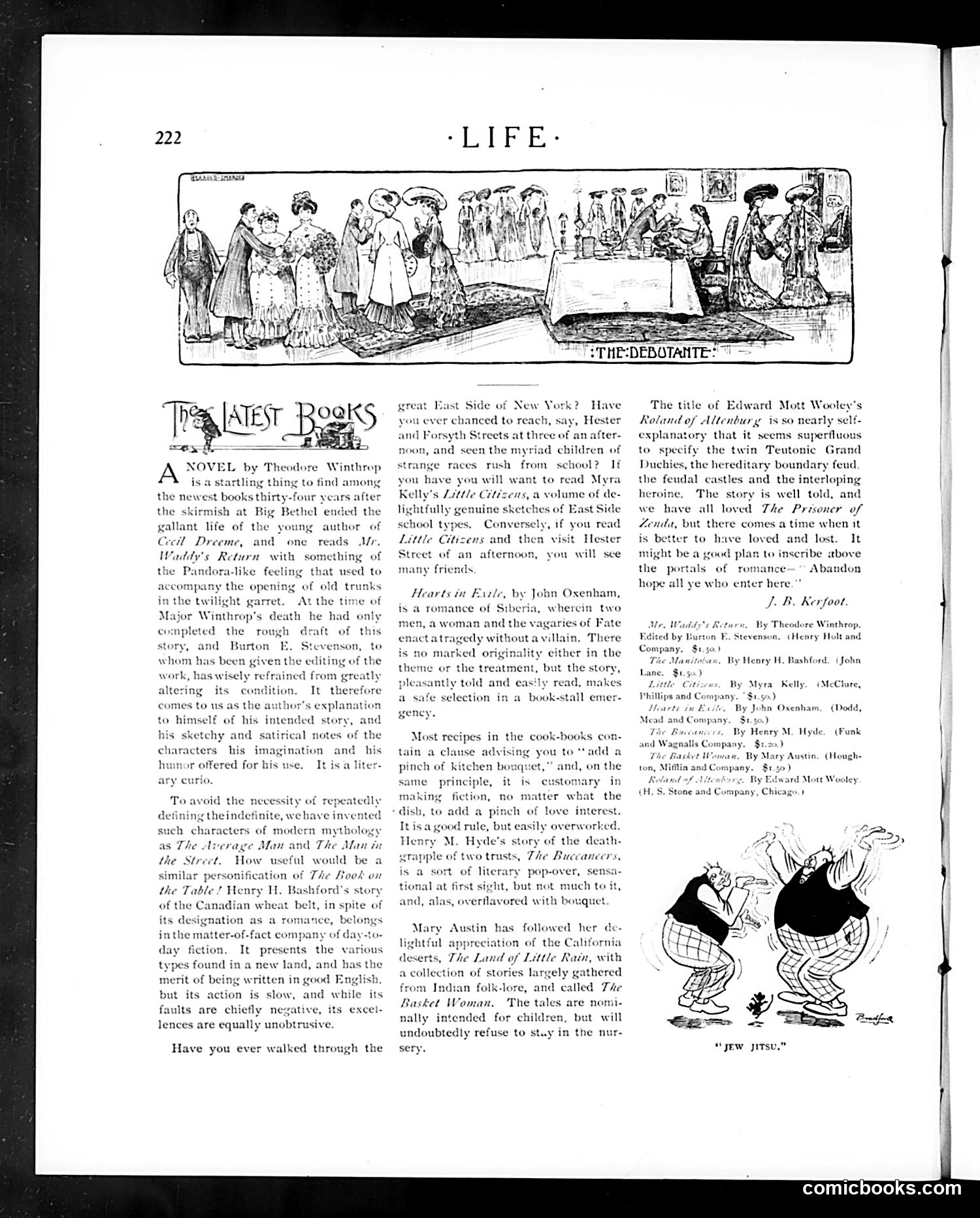
This is a book review section from Life magazine, featuring literary criticism rather than political satire. The page discusses several contemporary novels, including works by Theodore Winthrop and Myra Kelly's *Little Citizens*, which depicts East Side New York schoolchildren. The small cartoon at bottom right, captioned "yew yits," appears to be a humorous illustration of rough street children—likely related to Kelly's book about immigrant youth on the Lower East Side. The sketch captures contemporary anxieties about urban poverty and "street urchins" that were common subjects in American periodicals of this era. The page primarily serves as cultural criticism and advertising for new books, reflecting Life's dual role as both satirical magazine and literary arbiter for educated readers.
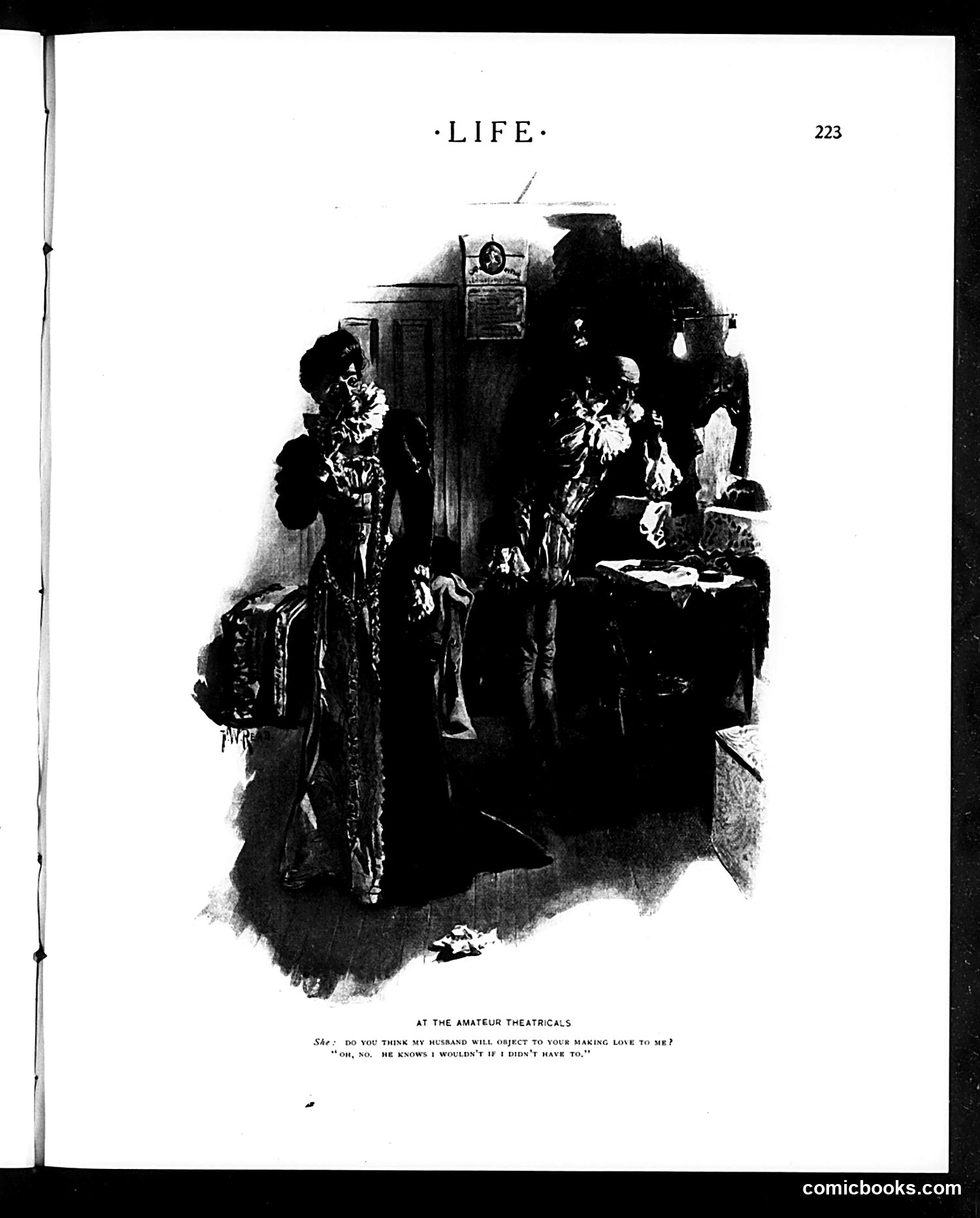
This is a satirical sketch depicting an amateur theatrical performance. The caption presents a domestic comedy scene where a woman asks her husband if he objects to her "making love" to another actor on stage. His response—"Oh, no, he knows I wouldn't if I didn't have to"—is the joke's punchline, suggesting resigned acceptance of theatrical necessity. The humor targets amateur dramatics, a popular Victorian and early 20th-century social activity among the middle class. The satire mocks both the pretentiousness of amateur theater and the awkwardness of domestic jealousy it might provoke. The elaborate period costumes visible in the sketch emphasize the amateur performers' earnest but possibly overwrought approach to their roles.
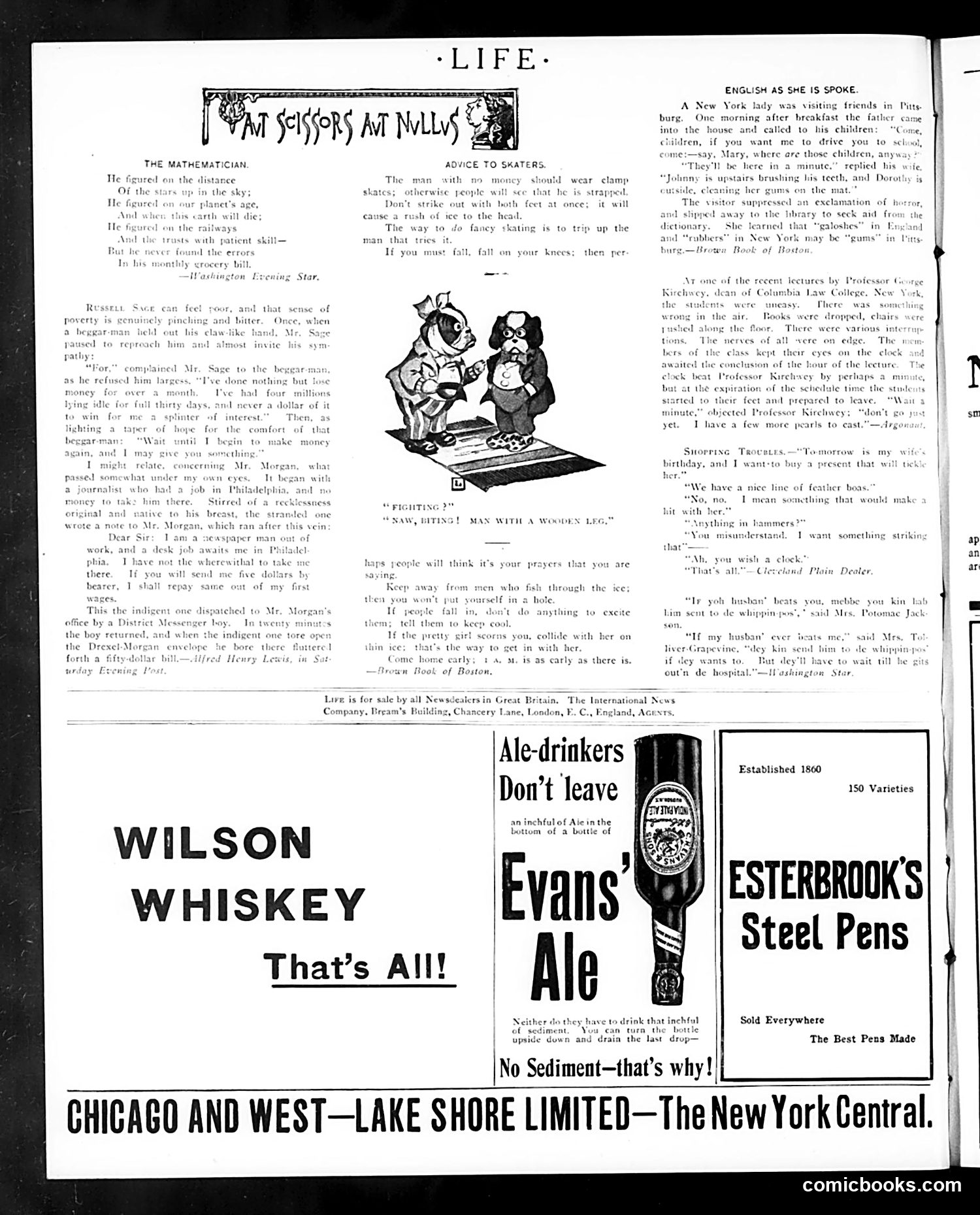
This page contains three distinct sections: **"Scissors and Mallets" Cartoon**: A humorous illustration showing two anthropomorphic animals (appearing to be dogs or similar creatures) engaged in physical combat or "fighting," with one wielding what looks like a wooden leg—a visual pun on the caption "Man with a Wooden Leg." **Advice Columns**: The page includes satirical "advice" pieces—"The Mathematician," "Advice to Skaters," and "English as She Is Spoke"—which gently mock common human follies: obsessive calculation, romantic mishaps, and awkward social interactions. These represent Life's typical light satirical humor targeting everyday middle-class life. **Advertisements**: The lower half features period advertisements for Wilson Whiskey, Evans' Ale, Esterbrook Steel Pens, and railroad service—typical of early 20th-century Life magazine. The overall tone is genteel Victorian/Edwardian-era satire: gentle mockery of respectable society rather than political commentary. The humor relies on wordplay, visual puns, and observations of social propriety that modern readers would find quaint rather than cutting.
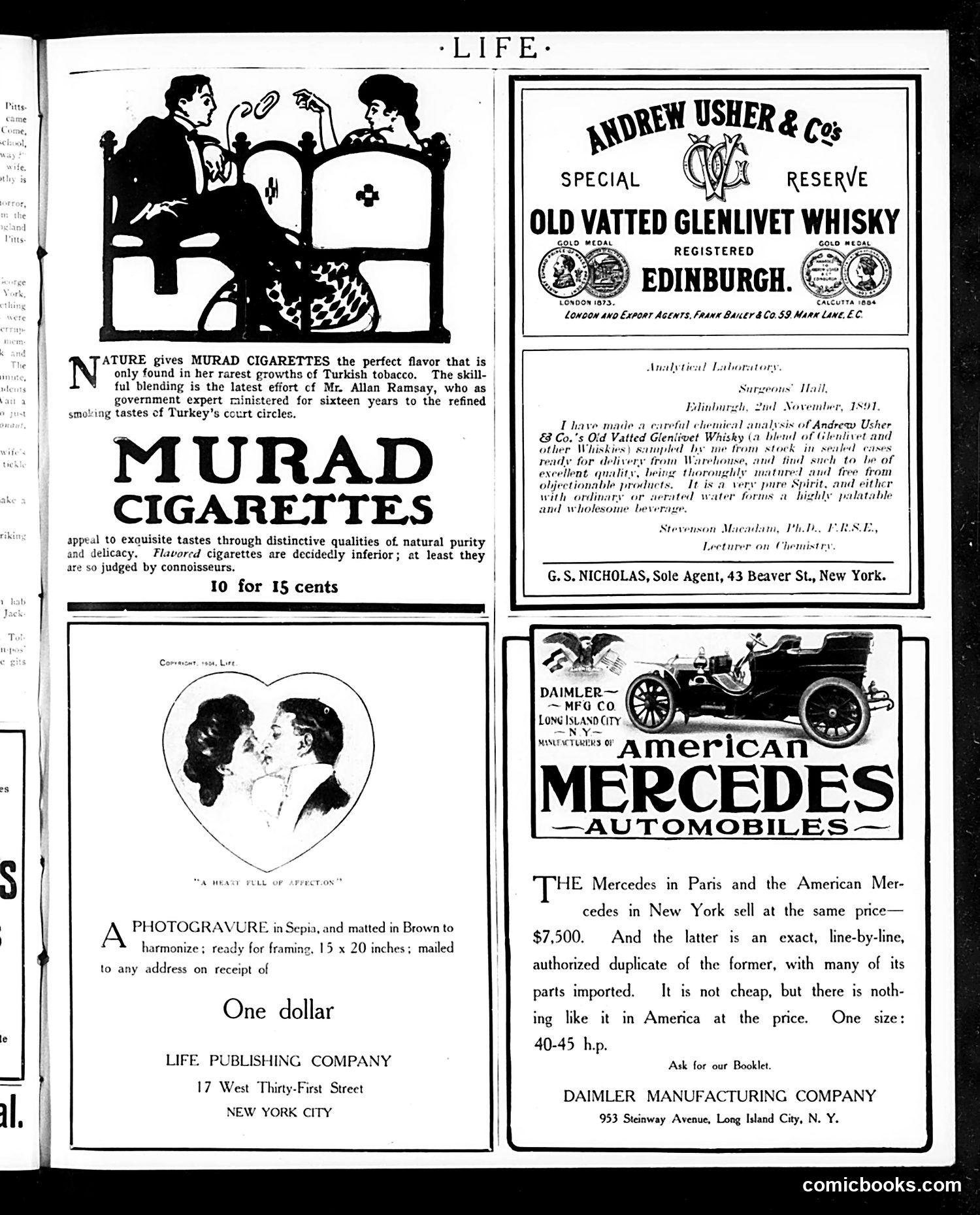
This page is primarily **advertising**, not satire or political commentary. The top cartoon depicts a couple in conversation, likely illustrating the social appeal of Murad Cigarettes—marketed as a refined, luxury product using Turkish tobacco blended by a former Turkish court expert. The ad targets "exquisite tastes" at 10 for 15 cents. Below that, a photogravure (sepia print) advertisement offers a romantic heart-shaped portrait for one dollar. The right side features two product endorsements: **Andrew Usher & Co.'s Old Vatted Glenlivet Whisky** (with an 1891 chemical analysis letter from a Scottish lecturer authenticating its purity), and the **American Mercedes automobile** ($7,500), which the ad proudly claims is an exact authorized duplicate of the Paris model—emphasizing American manufacturing capability and prestige. The page reflects early 1890s consumer culture, emphasizing quality, scientific verification, and imported luxury goods as status markers for affluent readers.
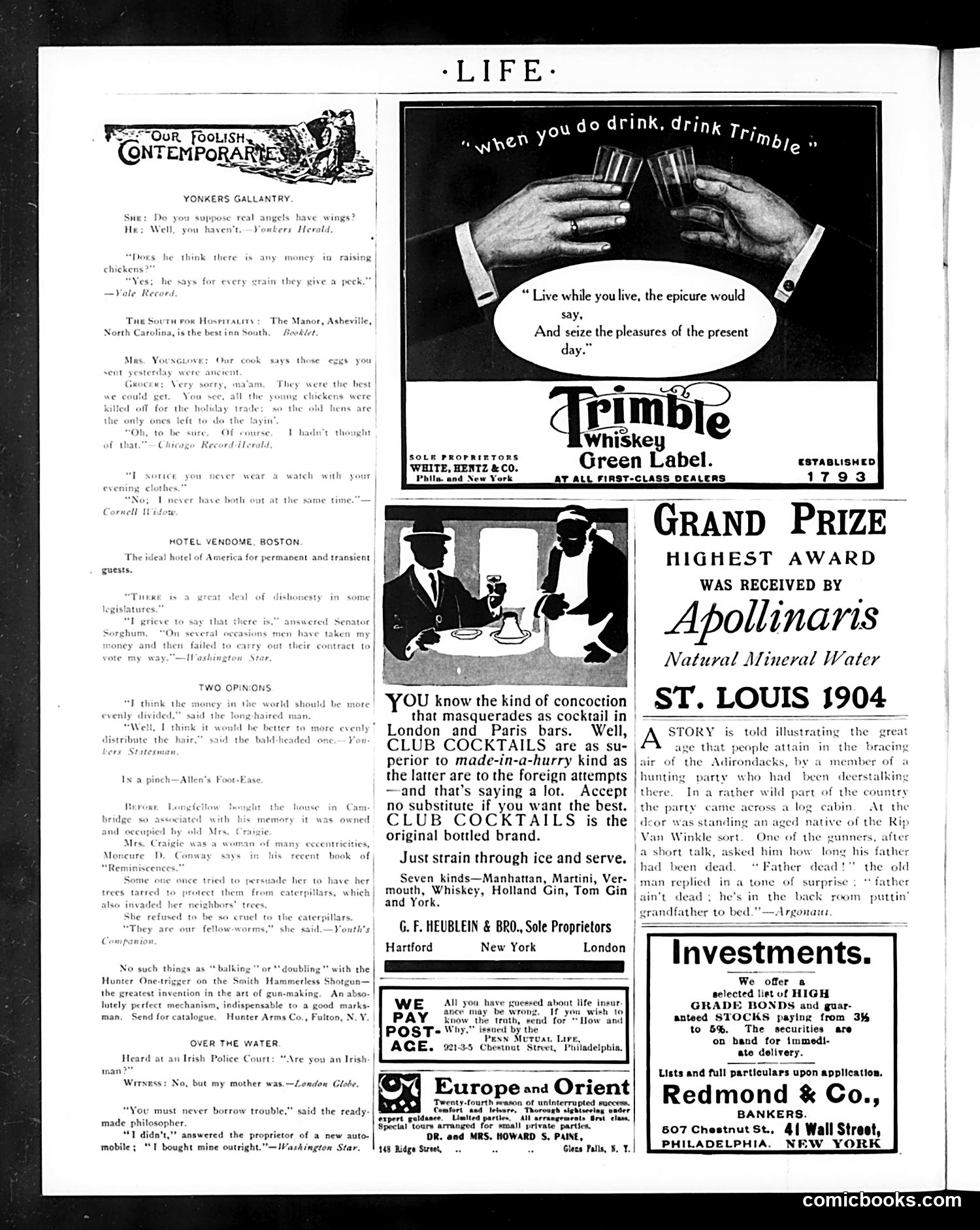
This page is primarily **advertising with embedded humor snippets** rather than a coherent cartoon narrative. The advertisements dominate: Trimble Whiskey (with an epicurean quote about seizing life's pleasures), Apollinaris mineral water (which won a 1904 St. Louis award), Club Cocktails, and financial investment services. The **satirical content** consists of short comedic anecdotes scattered throughout: - "Yonkers Gallantry" jokes about stingy farmers - "Hotel Vendôme" comments on dishonesty in business - Brief quips about money, borrowing trouble, and an Irishman's mother - A longer story about mountain hunters encountering an old Rip Van Winkle-type figure The humor is **gentle period satire**—poking fun at rural cheapskates, pretentious city life, and human nature generally. The "Club Cocktails" section satirizes inferior foreign cocktails versus superior American versions. No specific political figures or events are caricatured. This reflects Life's early 1900s approach: mixing light social commentary with commercial content rather than sharp political editorial cartooning.
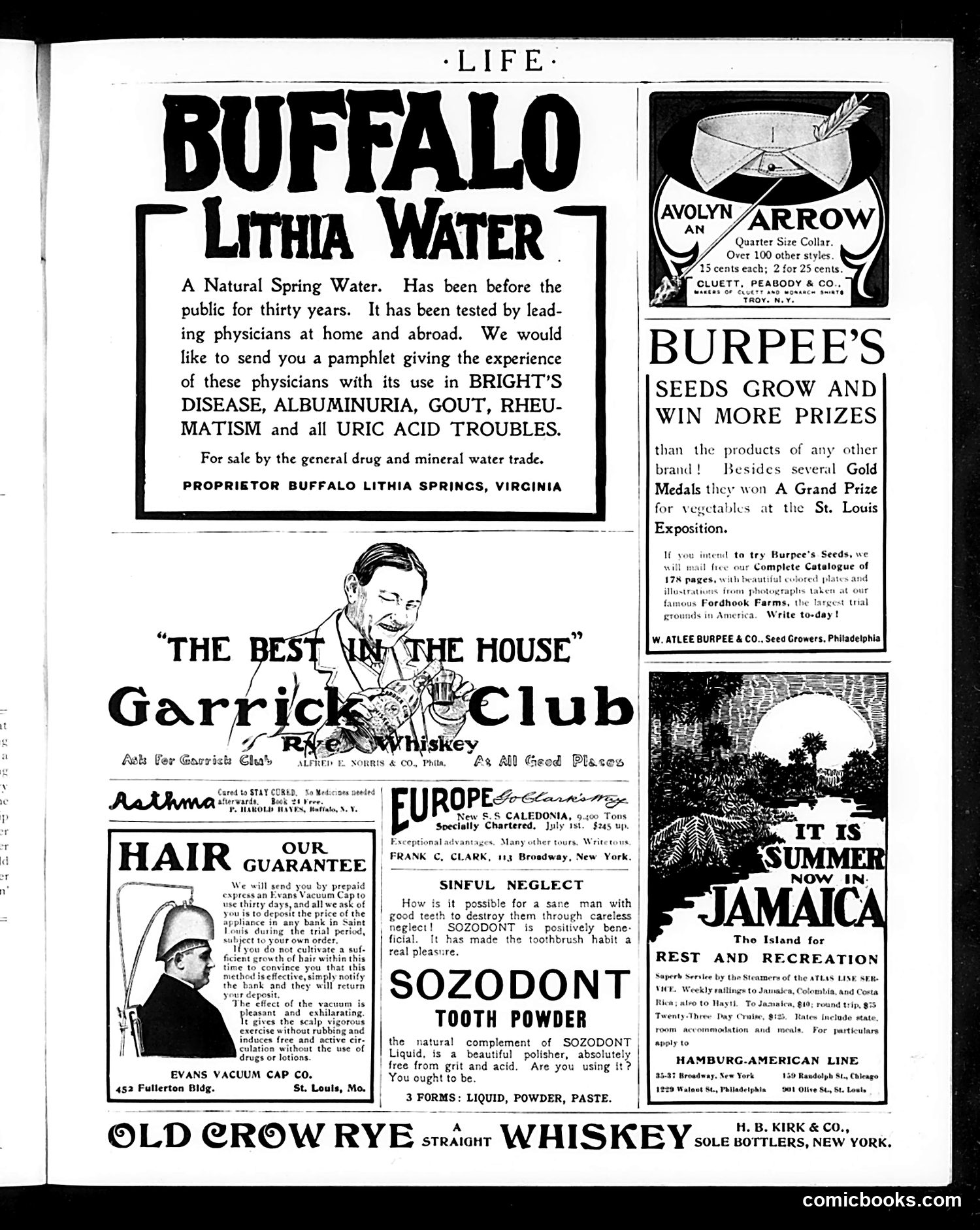
This is primarily a **commercial advertising page** rather than editorial content or satire. The page showcases patent medicines and consumer products typical of early 20th-century American marketing. Notable ads include: - **Buffalo Lithia Water**: Claims to cure serious diseases (Bright's disease, gout, rheumatism) through "natural spring water" tested by physicians—a common dubious health claim of the era before FDA regulation. - **Evans Vacuum Cap**: Advertises hair growth treatment, offering a 30-day trial for baldness—another unproven remedy marketed to consumers. - **Sozodont Tooth Powder**: Promotes teeth cleaning while criticizing "sinful neglect" of dental hygiene—relatively legitimate compared to other products here. - **Garrick Club Rye Whiskey**: Marketed as "the best in the house," reflecting alcohol's pre-Prohibition prominence in advertising. The page reflects an era of unregulated medical claims and aggressive marketing to vulnerable consumers seeking cures for common ailments.
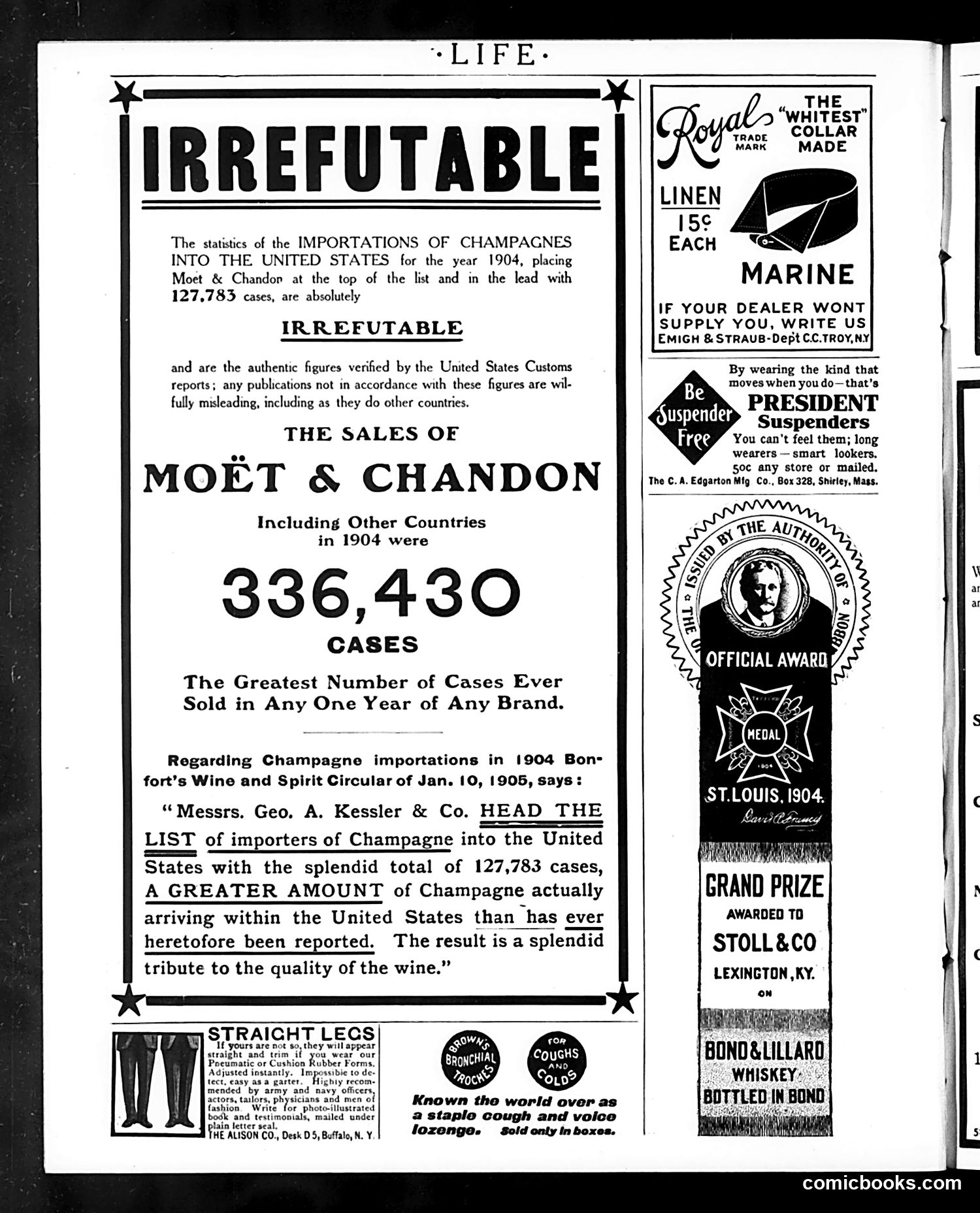
This page is primarily **advertisements**, not satire or editorial content. The main feature is a large ad for Moët & Chandon champagne, emphasizing that the brand imported 127,783 cases into the U.S. in 1904—supposedly "irrefutable" proof of its dominance, backed by U.S. Customs statistics. The surrounding ads are typical early-1900s product promotions: Royal Marine linen collars (15¢), President Suspenders, Bronchial Cough Lozenges, Stoll & Co whiskey (awarded a grand prize), and straight-leg trousers. There is **no political cartoon or satire** visible. This appears to be a standard advertising section from *Life* magazine's 1905 issue, where the publication sold space to various manufacturers. The "irrefutable" champagne claim is marketing hyperbole rather than satire—the advertiser is simply asserting superiority through sales figures.
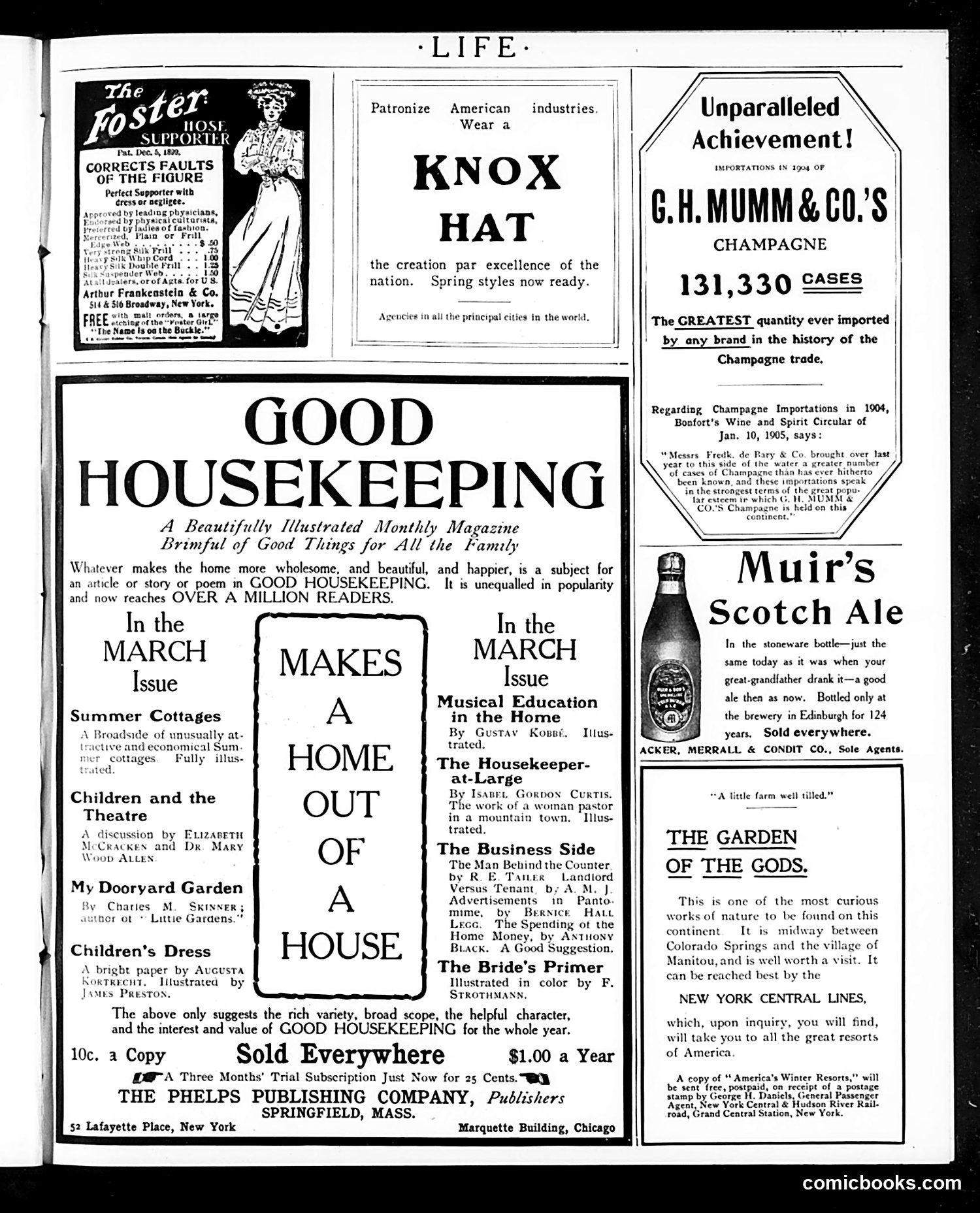
This is primarily an **advertising and promotional page** rather than a satirical cartoon page. The page showcases *Good Housekeeping* magazine's March issue offerings alongside various commercial advertisements. The main content advertises *Good Housekeeping*'s appeal to domestic life—featuring articles on summer cottages, children's theater, gardening, and home economics. The magazine positions itself as reaching "over a million readers" and addressing "good things for all the family." Surrounding advertisements promote luxury goods: Knox Hats (positioned as excellent American manufacture), Muir's Scotch Ale, C.H. Mumm & Co. Champagne (boasting record importation of 131,330 cases in 1904), and travel to natural attractions via New York Central Lines. **The satire is implicit rather than explicit**: the page reflects early-1900s consumer culture and aspirational domesticity—emphasizing that proper housekeeping, fashion, imported luxuries, and leisurely pursuits define middle-class respectability. There's no identifiable political commentary or caricatured figures.
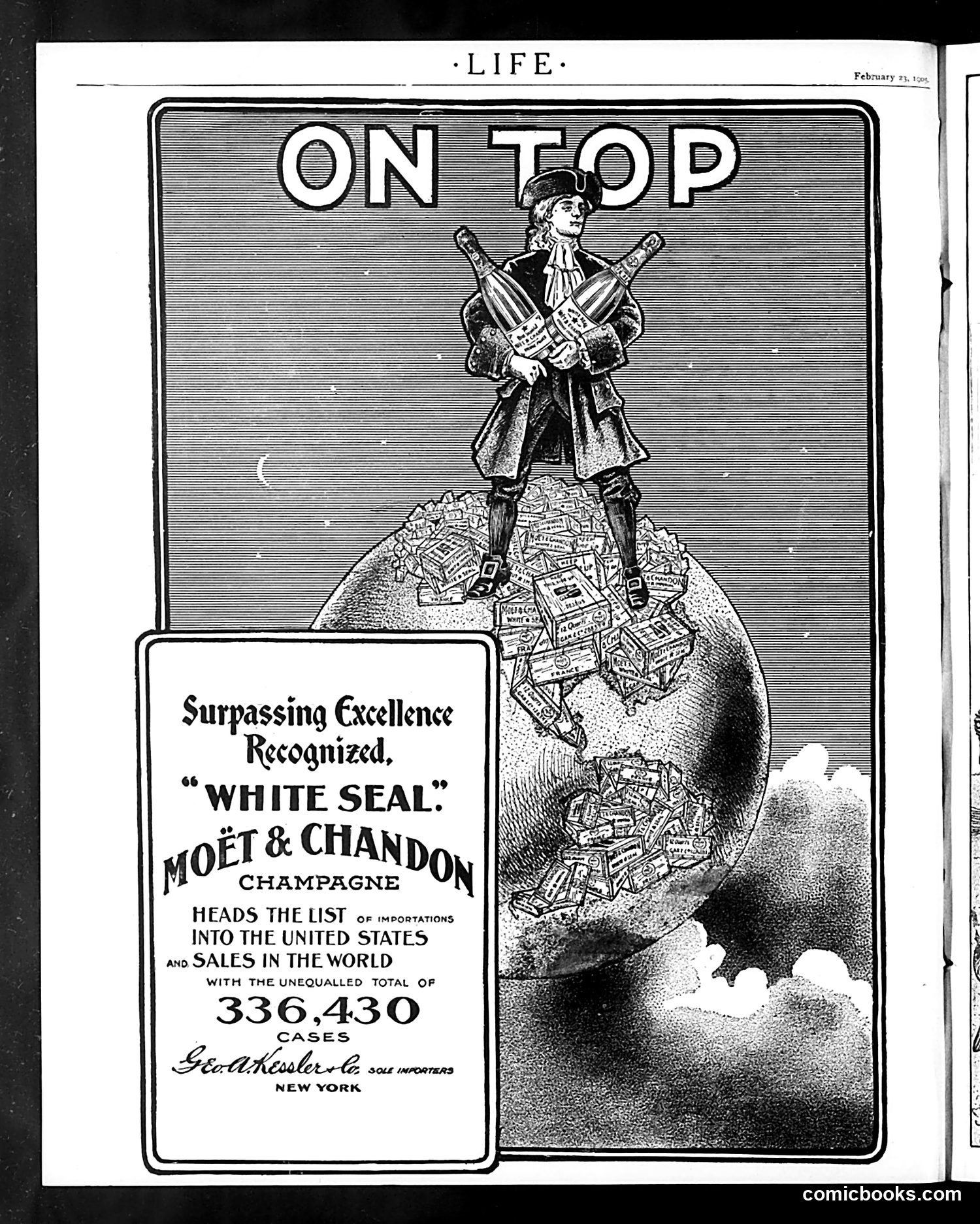
This page is primarily an advertisement rather than political satire. It's a full-page ad for "White Seal" Moët & Chandon Champagne, appearing in *Life* magazine (dated February 23, 1922). The imagery shows a triumphant figure standing atop a globe, holding crossed champagne bottles like weapons or trophies. This visual metaphor celebrates the champagne brand's commercial dominance—claiming it "heads the list" of champagne imports into the U.S. and leads in worldwide sales with 336,430 cases. The "on top" imagery emphasizes market supremacy. The advertiser (Schieffelin & Co., sole importers in New York) is using nationalist and competitive language to market luxury goods to American consumers. This reflects the post-Prohibition era when champagne became increasingly popular in the United States.