
Life, 1905-02-23 · page 13 of 22
Life — February 23, 1905 — page 13: what you’re looking at
What you’re looking at
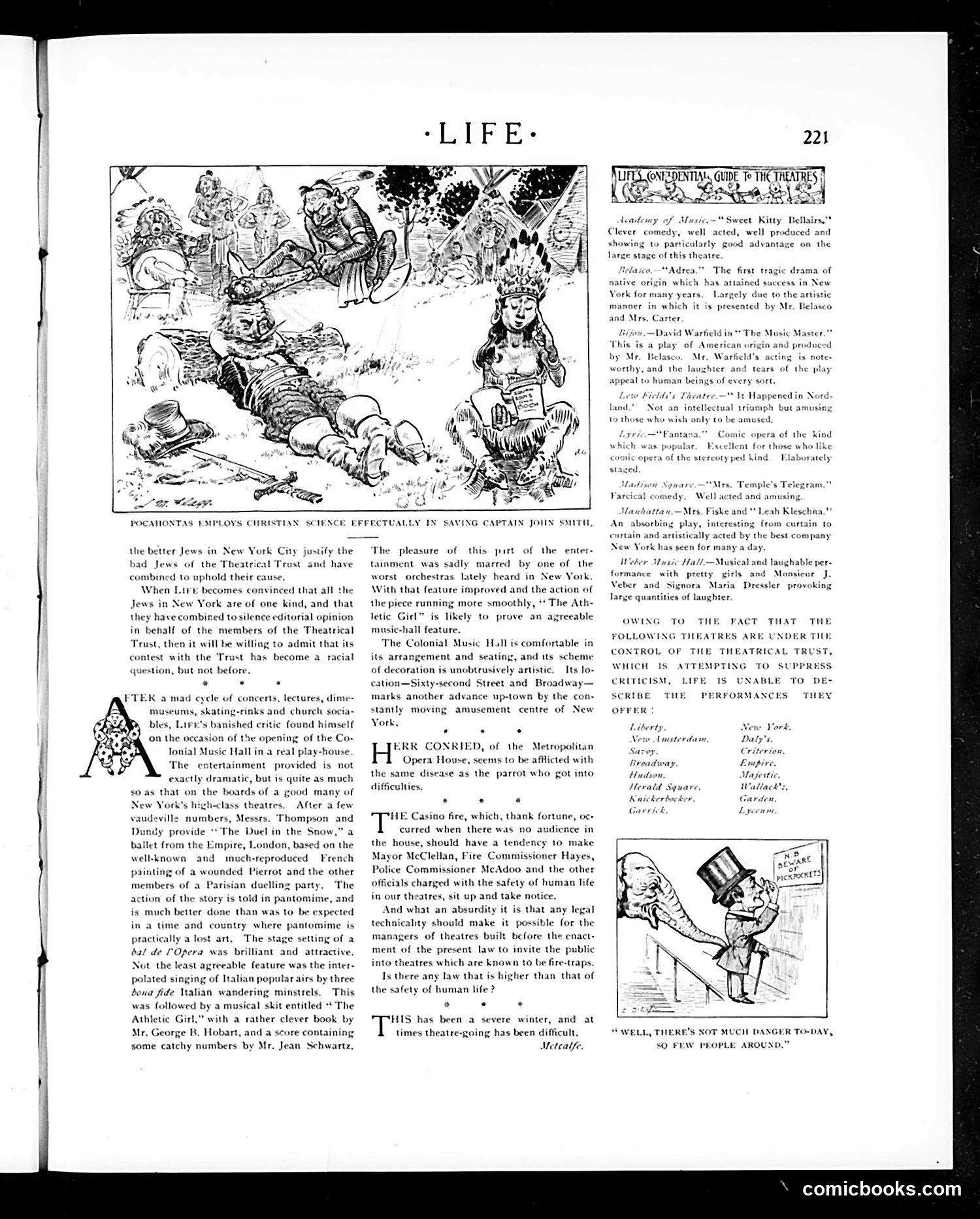
This page combines theatre reviews with satirical commentary. The main cartoon depicts **Pocahontas using Christian Science to heal Captain John Smith**—a absurdist joke mocking the then-popular Christian Science movement by literalizing its healing claims through a historical anachronism. The text discusses New York theatre controversies, particularly **criticisms of the "Theatrical Trust,"** a monopolistic organization controlling theatres. Life defends itself against accusations of antisemitism, arguing it opposes specific Trust members, not Jewish people generally—a defensive stance suggesting contemporary accusations of bias in Life's coverage. The page also reviews specific productions at various theatres (Colonial Music Hall, Academy of Music, Bijou) and criticizes fire safety violations in theatres, particularly regarding pre-existing structures exempted from modern building codes—a genuine public safety issue highlighted by recent theatre fires.
📄 Transcribed text from this page (OCR, searchable)
Machine-transcribed from the original scan — historical spelling and the odd misread are preserved.
ton wecepy: POCAHONTAS EMPLOYS CHRISTIAN SCIENCE EPFECTUALLY IN SAVING CAPTAIN JOHN SMITH, the better Jews in New York City justify the ir combined to uphold their cause, bad Jews of the Theatrical Trust and have When Litre becomes convinced that all the Jews in New York are of one kind, and that they have combined to silence editorial opinion in behalf of the members of the Theatrical Trust, then it will be willing to admit tha contest with the Trust has become a racial question, but not before. TER a mad cycle of concerts, lectures, dime- museums, skating-rinks and church socia- bles, Life's banished critic found himself of the Co- lonial Music Hall in a real play-house on the occasion of the openir ‘The cotertainment provided is not exactly dramatic, but is quite as much so as that on the boards of a g 1 many of New York’s high-class theatres. After a few vaudeville numbers, Messrs. Thompson and Dundy provide “The Duel in the Snow,” a ballet from the Empire, London, based on the wellknown and tnuch-reproduced French painting of a wounded Pierrot and the other members of a Parisian duelling party, The action of the story is told in pantomime, and is much better done than was to be expected in a time and country where pantomime is practically a lost art, The stage setting of a bal de ’Opera was brilliant and attractive, Not the least agreeable feature was the inter- polated singing of It bona fide Malian wandering minstrels, This was followed by a musical skit entitled * The Athletic Girl,” with a rather clever book by Mr. George B, Hobart, and a score containing some catchy numbers by Mr. Jean Schwartz, lian popular airs by three ‘The pleasure of this part of the enter- tainment was sadly marred by one of the worst orchestras lately heard in New York With that feature improved and the action of the piece running more smoothly, The Ath- letic Girl” is likely to prove an agreeable music-hall feature, The Colonial Music Hull is comfortable in its arrangement and seating, and its scheme of decoration is unobtrusively artistic. Its lo- cation—Sixty-second Street and Broadway— marks another advance up-town by the con- stantly moving amusement centre of New York. CONRIED, of the Metropolitan E H Opera House, seems to be afflicted with the same disease as the parrot who got into iculties, HE Casino fire, which, thank fortune, oc+ curred when there was 0 audie ce in the house, should have a tendency to make Mayor McClellan, Fire Commissioner Hayes, Police Commissioner McAdoo and the other officials charged with the safety of human life in our theatres, sit up and take notice. And what an absurdity it is that any legal ty should make it possible for the ers of theatres built before the enact- techni manag ment of the present law to invite the public into theatres which are known to be fire-traps. Is there any law that is higher than that of the safety of human life ? ® . . HIS has been a severe winter, and at times theatre-going has been difficult, Metcalfe 221 ES Ns Te THCINENIRES | Kew Bee rd teademy of Music Clever com airs,” juced and Sweet Kitty dy, well acted, well pr showing to particularly good advantage on the { this the: o.—“Adrea.”” The first tragic drama of ped New ly due to the artistic sented by Mr. Belasco native origin which has atta York for many years. Le manner in which it is p and Mrs, Carter Bijou. —David Warfield in The Music Master."* This is a pl nd prodvesd by Mr, Belasco, Mr, Warfield’s acting ix note- worthy, and the laug! y of American origin ter and tears of the play hu n beings of every sort, Lew Fields's Theatre." Vt Mapp lad." Not an intellectual tri Jin Nord. ph but amusing to those who wish only to be amused. Lyric — "Fant Comic opera of the kind which was popular, Excellent for those whe like comic opera of the stereotyped hind. Elaborately staged Madison Sguare.—"Mrs. Temple's Tele se Farcical comedy. Well acted and amusing. Manhattax.—Mrs, Fiske and * Leah Kleschn An absorbing play, interest 1g from curtain to d by the best cc ya day Weber Music Halt.—Musical rmance with pretty girls an »pany J laughable per- Monsieur J. Veber and Signora Maria Dressler provoki lange quantities of laughter. OWING TO THE PACT THAT THE FOLLOWING THEATRES ARE UNDER TILE CONTROL OP THE THEATRICAL TRUST, WHICH IS ATTEMPTING TO SUPPRESS CRITICISM, LIFE 1S TO DE SCRIBE THE PERFORMANCES THEY OFrER Liberty ay. Empire. Vork Brow Huds Majestic Herald Square, Wallack':, Knickerbocker Carden. Carrick Lyceum “WELL, THERE'S NOT MUCIE DANGER TO-DAY, SO FEW PEOPLE AROUND.” ‘ comicbooks.com