
Life, 1905-02-23 · page 12 of 22
Life — February 23, 1905 — page 12: what you’re looking at
What you’re looking at
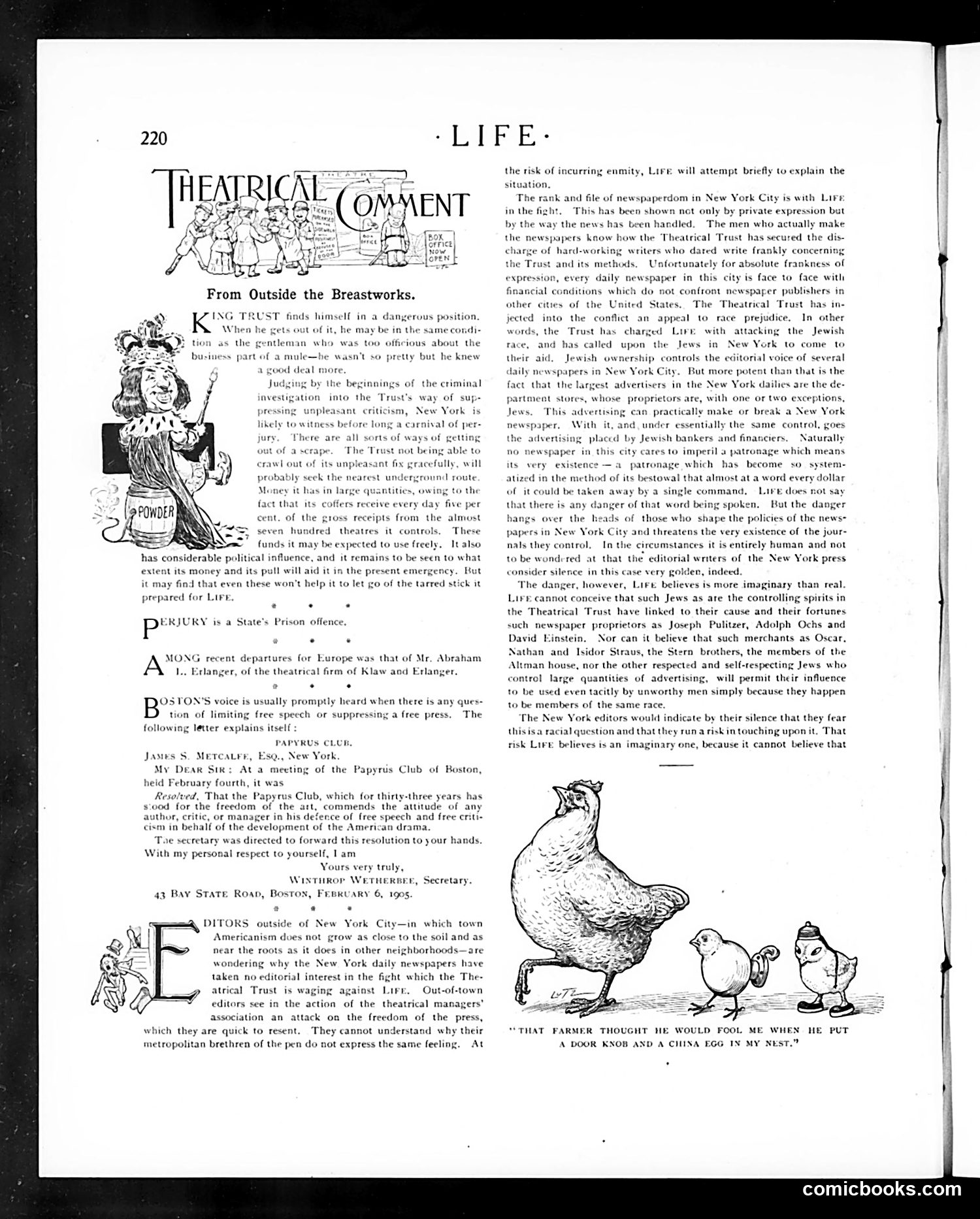
This page presents satirical commentary on New York newspaper control and Jewish ownership. The "Theatrical Comment" section attacks the Theatrical Trust's influence over newspapers, arguing that Jewish bankers and advertisers (naming Joseph Pulitzer, Adolph Ochs, David Lindheim, Nathan and Isidor Straus, and others) secretly control New York's press through advertising patronage. The cartoon at bottom depicts a hen with chicks and a door knob, illustrating the caption about a farmer fooling the hen—likely a metaphor for deception or gullibility. The editorial content expresses antisemitic conspiracy theories about Jewish control of media and advertising. A letter from the Papyrus Club defends free speech in theater against the Trust's censorship.
📄 Transcribed text from this page (OCR, searchable)
Machine-transcribed from the original scan — historical spelling and the odd misread are preserved.
From Outside the Breastworks. Kits TRUST finds himself in a dangerous position, When he gets out of it jay be in the same condi- tion as the ntleman who was too officious about the business part of a mule—be wasn't so pretty but he knew 1 good deal more Judging by the beginnings of the criminal nvestigation imto the Trust's way of sup- pressing unpleasant cism, New York is likely to witness before long a carnival of pi jury. There are all sorts of ways of getting be. The T its unpleasant fix g {not being able to crawl out acefully, will probably seek the ne ind re Money i est undery ntities, owin, fact that i u s receive every day five per cent. of the gross receipts from the almost » hundred th funds it may be expected to use freely, It also sev eatres it controls, Thes has considerable political influence, and it remains to be seen to what nt its money and its pull will aid it in the present emergency. But y find that even these won't help it to let go of the tarred stick it itm: prepared for LiFe P' RJURY is a Stat + Prison offence, MONG recent departures for Europe was that of Mr, Abraham A 1.. Erlanger, of the theatrical firm of Klaw and Erlanger. Bosross voice is usually promptly heard when there is any que tion of limiting free speech or suppressing a free press. The fol owing letter explains itself: PAPYRUS CLUB. James S. Meteatrr, Esg., New York My Dear Ste: Ata meeting of the Papyrus Club of Boston, heid February fourth, it was Resolved, That the Papyrus Club, which for thirty-three years has siood for the freedom of the att, commends the attitude of any author, critic, or manager in his defence of free speech and free criti- cism in behalf of the development of the American drama, Toe secret. y was directed to forward this resolution to your hands. With my personal respect to yourself, Lam Yours very truly, Wixtiror WeTHeRnrt 43 Bay STATE Roap, Bostox, FEBRUARY 6, 1903. Secretary. DITORS Americanism does not grow as close to the soil and as outside of New York City—in which town near the roots as it does in other neighborhoods—are wondering why th taken no editorial interest in the fight which the The- atrical Trust is waging against Lire, Out-of-town editors see in the action of the theatrical managers’ association an attack oa the freedom of the press, New York daily newspapers have which they are quick to resent. They cannot understand why their metropolitan brethren of the pen do not express the same feeling. At ye the risk of incurring enmity, LiFe will attempt briefly to explain the situation, rank and file of newspaperdom in New York City is with Lire This has been shown not only by private expression but by the way the news has been handled. The men who actually make ¢ newspapers know how the Theatrical Trust has secured the dis- charge of hard-working writers who dated write frankly concerning ods, Unt wspaper in this city is face to face with e Trust and its m ately for absolute frankness of expression, every daily financial conditions wh other cities of the United States, The Theatrical Trust has in- jected into the conflict an appeal to race prejudice, In other not confront newspaper publishers in words, the Trust has charged Lire with attacking the Jewish race, and has called upon the Jews in New York to come to their aid, Jewish o} ip controls the editorial voice of several daily newspapers in New York City. But more potent than that is the fact that the largest advertisers in the New York dailies are the de- partment stores, whose proprietors are, with one of two exceptions, Jews. T newspaper. With it, and, under essentially the same control, goes placed by Jewish bankers and financiers. Naturally which means s advertising can practically make or break a New York the adv 0 wspaper in this city cares to imperil a patrona its very existence — a patronage which has become so. system- atized in the method of its bestowal that almost at a word every dollar of it could be tal je command, Lire does that there is any danger of that word being sf But the danger Js of those who shape the policies of the news en away by a si say hangs over the | papers in New York Cit and threatens the very existence of the jour nals they control. In the circumstances it is entirely human and not 1 the editorial writers of the New York press pdeed. to be wondered at th. consider sil The dange Lire cannot conceive that such Jews as are the controlling spirits in the Theatrical Trust have linked to their cause and their fortunes tors as Joseph Pulitzer, Adolph Ochs and David Einstein, Nor can it believe that such merchants as Oscar, athan and Isidor Straus, the Stern brothers, the members of the Altman house, nor the other respected and self-respecting Jews who rol large quantities of advertising, will permit their influence to be used even tacitly by unworthy men simply because they happen n this case very golden, nce wever, Lift believes is more imaginary than real. such newspaper propr to be members of the same race. The New York editors would indicate by their silence that they fear racial question and that they run a risk in touching upon it. 17 risk LiFe believes is an imaginary one, because it cannot believe that thisis “THAT FARMER THOUGHT HE WOULD FOOL ME HE PUT A DOOR KNOB AND A CILINA EGG IN MY NEST, comicbooks.com