
A complete issue · 20 pages · 1905
Life — January 12, 1905
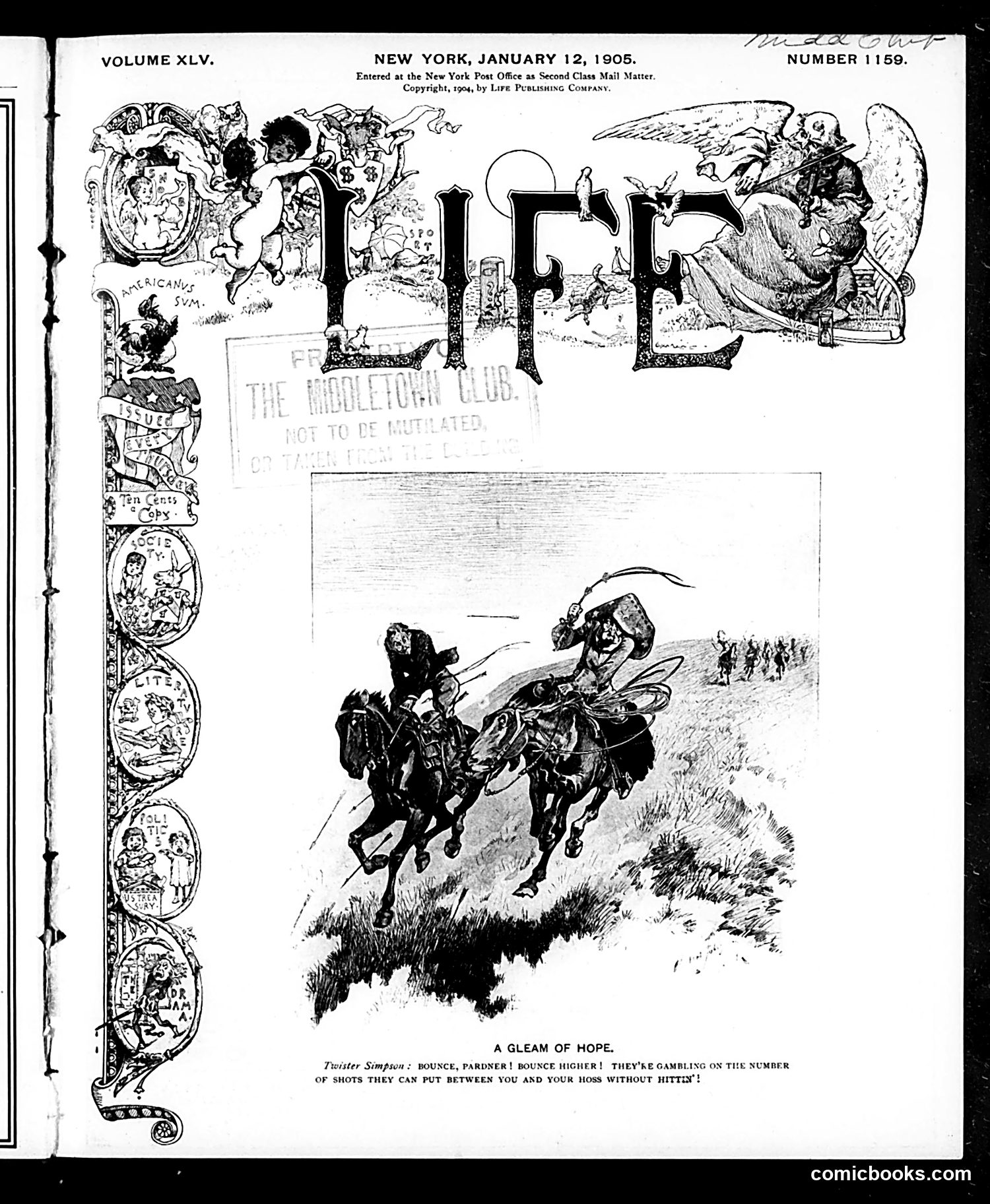
This is the cover of Life magazine, a satirical publication. The main illustration, titled "A Gleam of Hope," depicts two horsemen in what appears to be a competitive or confrontational scene. The caption credits "Twister Simpson" and references "Bounce, Pardner! Bounce higher!" with mention of gambling on "the number of shots they can put between you and your hoss without hittin'!" The imagery and language suggest this is political satire about early 1900s American politics, likely involving competition or conflict between political figures. The "Western" setting and rough-and-tumble language reflect period conventions for portraying political rivalries. However, without clearer identification of the specific figures or political events referenced, the exact political meaning remains unclear to modern readers unfamiliar with 1905 political context.
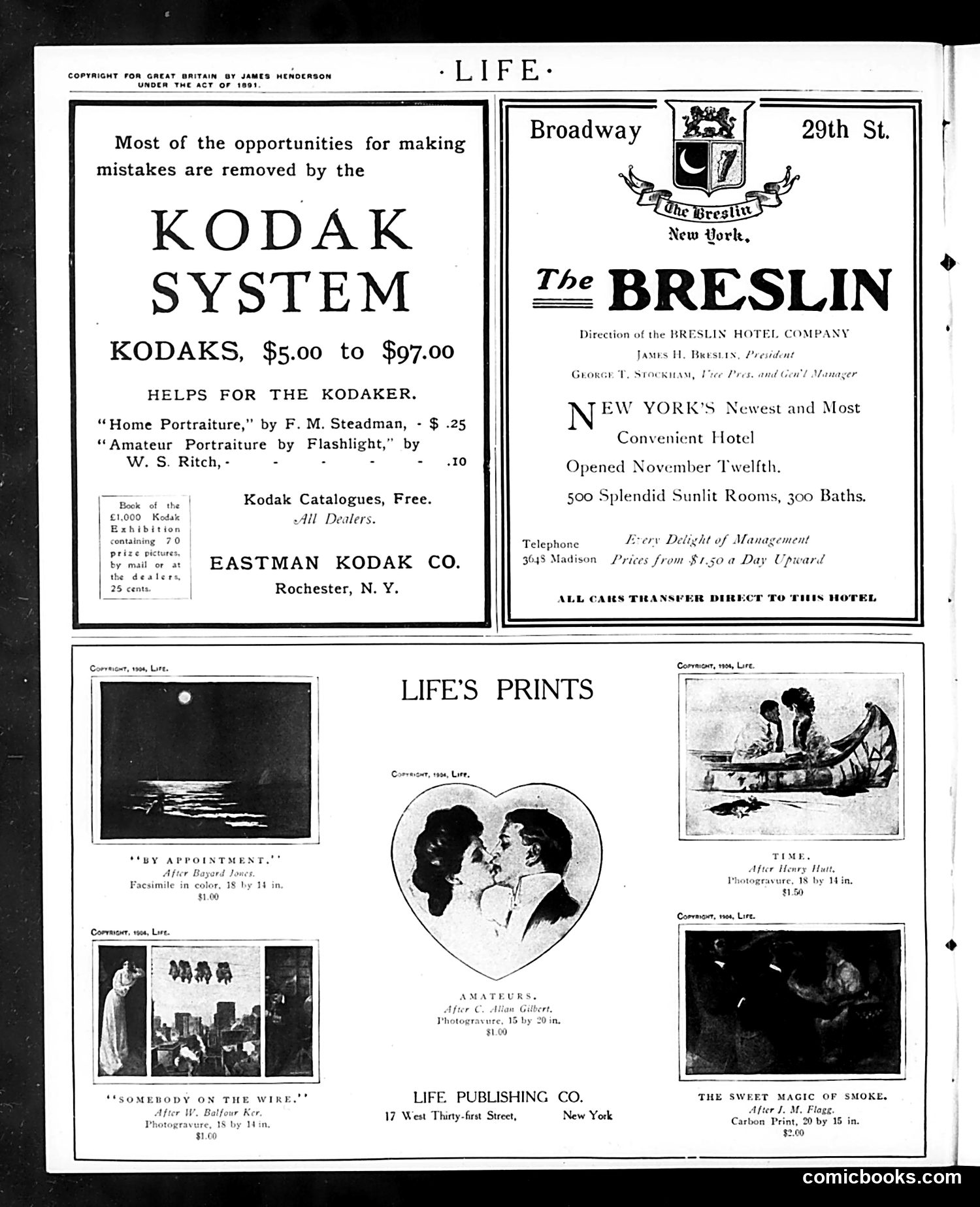
This page is primarily **advertising**, not satirical content. It contains: 1. **Kodak System ad** (top left): Promotes Kodak cameras ($5-$97) with instruction books for amateur photographers. 2. **The Breslin Hotel ad** (top right): Advertises a newly opened New York hotel on Broadway and 29th Street, boasting 500 rooms and 300 baths, with rates from $1.50/day. 3. **Life's Prints section** (bottom): Showcases artwork available for purchase from Life Publishing Co., including photographs and prints with titles like "By Appointment," "Time," and "The Sweet Magic of Smoke"—priced from $1-$2. No political cartoons or satire appear on this page. It's a standard turn-of-the-century magazine advertisement section.
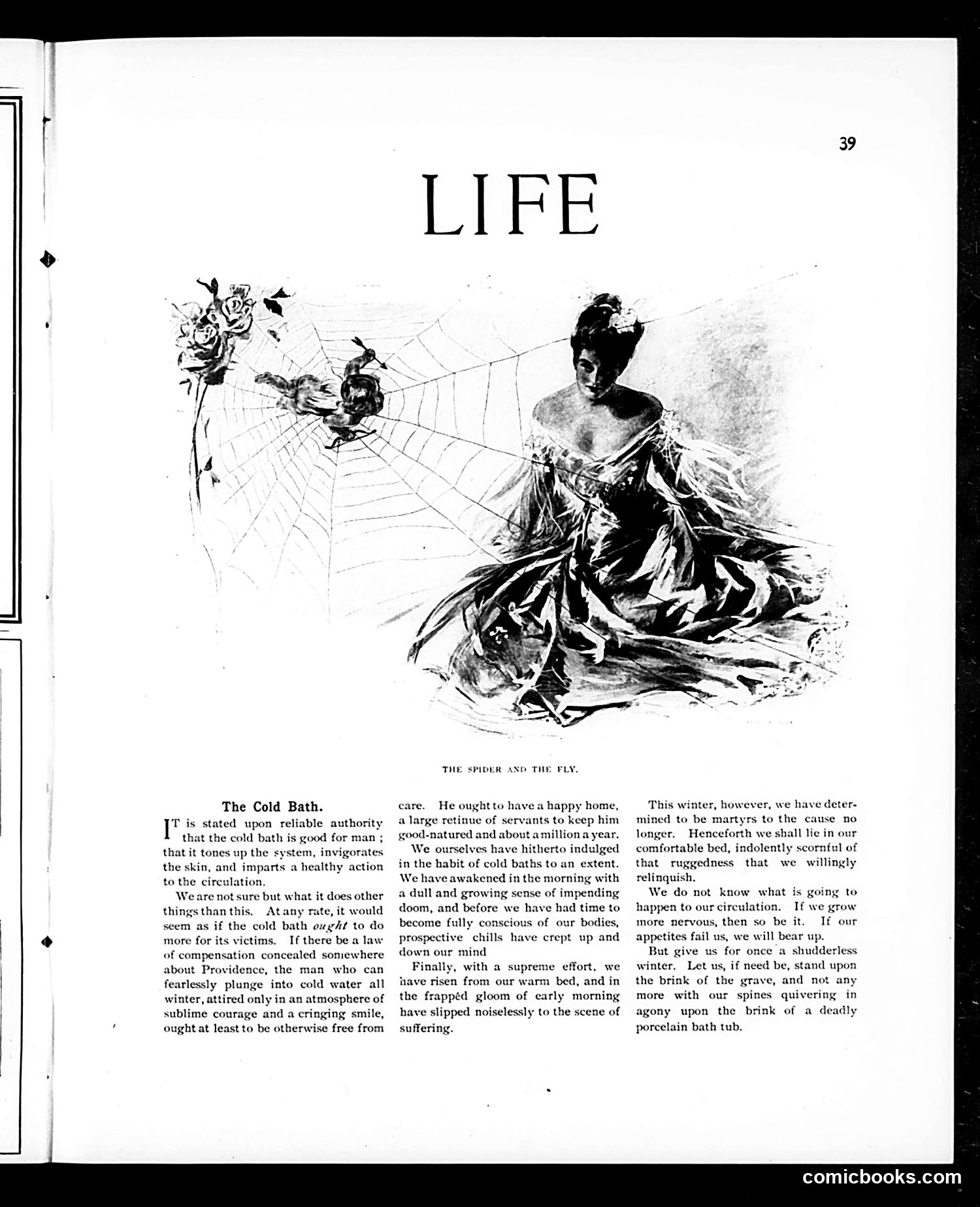
**The Illustration:** "The Spider and the Fly" depicts a woman in elaborate dress observing a spider web with trapped insects, serving as visual commentary on the accompanying text. **"The Cold Bath" Article:** This is a satirical essay about the health practice of taking cold baths. The author discusses the supposed benefits while acknowledging the discomfort—describing the experience as requiring "sublime courage" and comparing it to facing mortality. The piece mocks the Victorian obsession with cold-water bathing as a health cure, using darkly humorous language about "dying" and "porcelain bath tubs." The cartoon likely reinforces the essay's theme: the image of trapped prey parallels humans caught in fashionable but torturous health practices of the era.
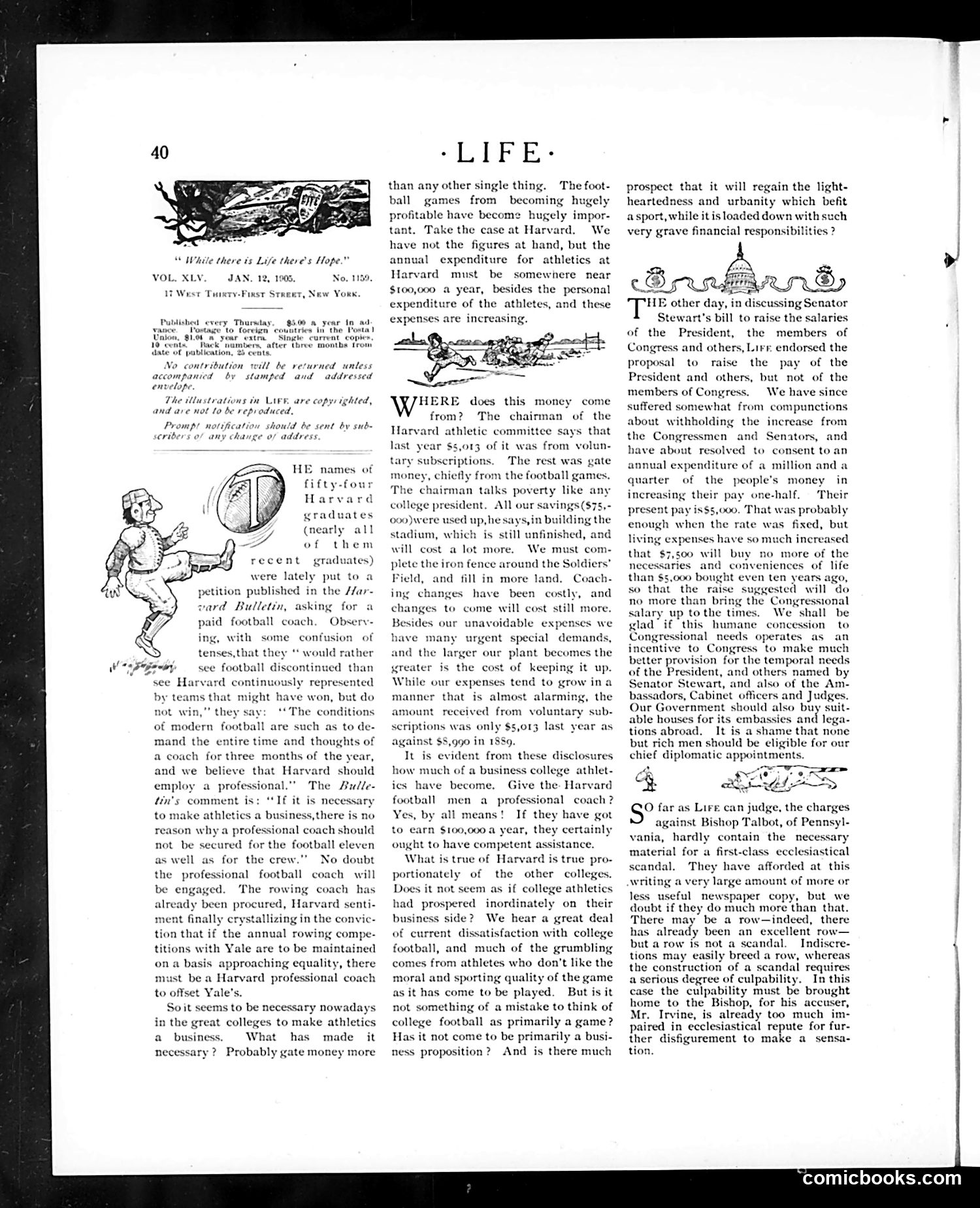
This page critiques Harvard University's athletic spending and professionalization of college football. The text discusses Harvard's substantial annual athletics budget (approximately $100,000) and debates whether hiring a professional football coach is appropriate for an educational institution. The small cartoon at left shows a football player in action, illustrating the athletic focus under discussion. The main satire targets the contradiction between Harvard's academic mission and its increasingly business-like approach to sports. The author argues that while gate receipts are necessary, the university shouldn't sacrifice its "light-heartedness and urbanity" by becoming a purely commercial athletic enterprise. The page also references Senator Stewart's proposal to raise Congressional salaries and criticizes a scandal involving Bishop Talbot of Pennsylvania, using these to suggest that financial impropriety affects multiple institutions.
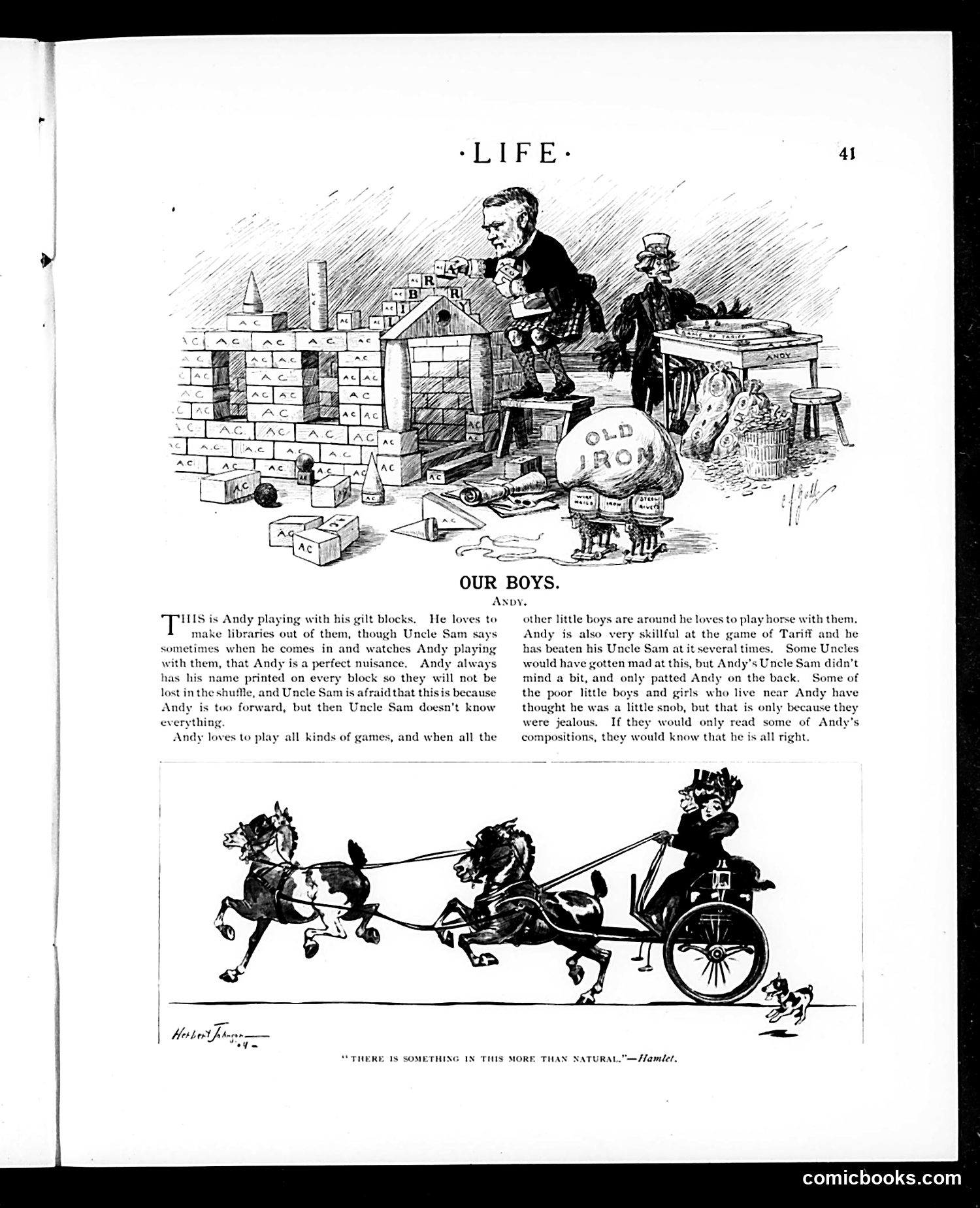
This page presents two satirical cartoons about childhood and character. The top illustration shows a boy named Andy playing with building blocks and toys, accompanied by explanatory text. The piece gently mocks Andy's precocious behavior—he's described as a "perfect nuisance" who is "too forward," yet Uncle Sam indulges him anyway. The humor derives from Andy's skill at games and his tendency to boast about beating other children. The lower cartoon depicts dogs pulling a child in a cart, captioned with a Hamlet reference about something being "more than natural." This appears to be satirizing either parental indulgence or childhood misbehavior more broadly. Both pieces use humor to critique mid-twentieth-century parenting attitudes, suggesting parents were too permissive with unruly children. The specific identity of "Andy" or whether he represents a particular public figure remains unclear.
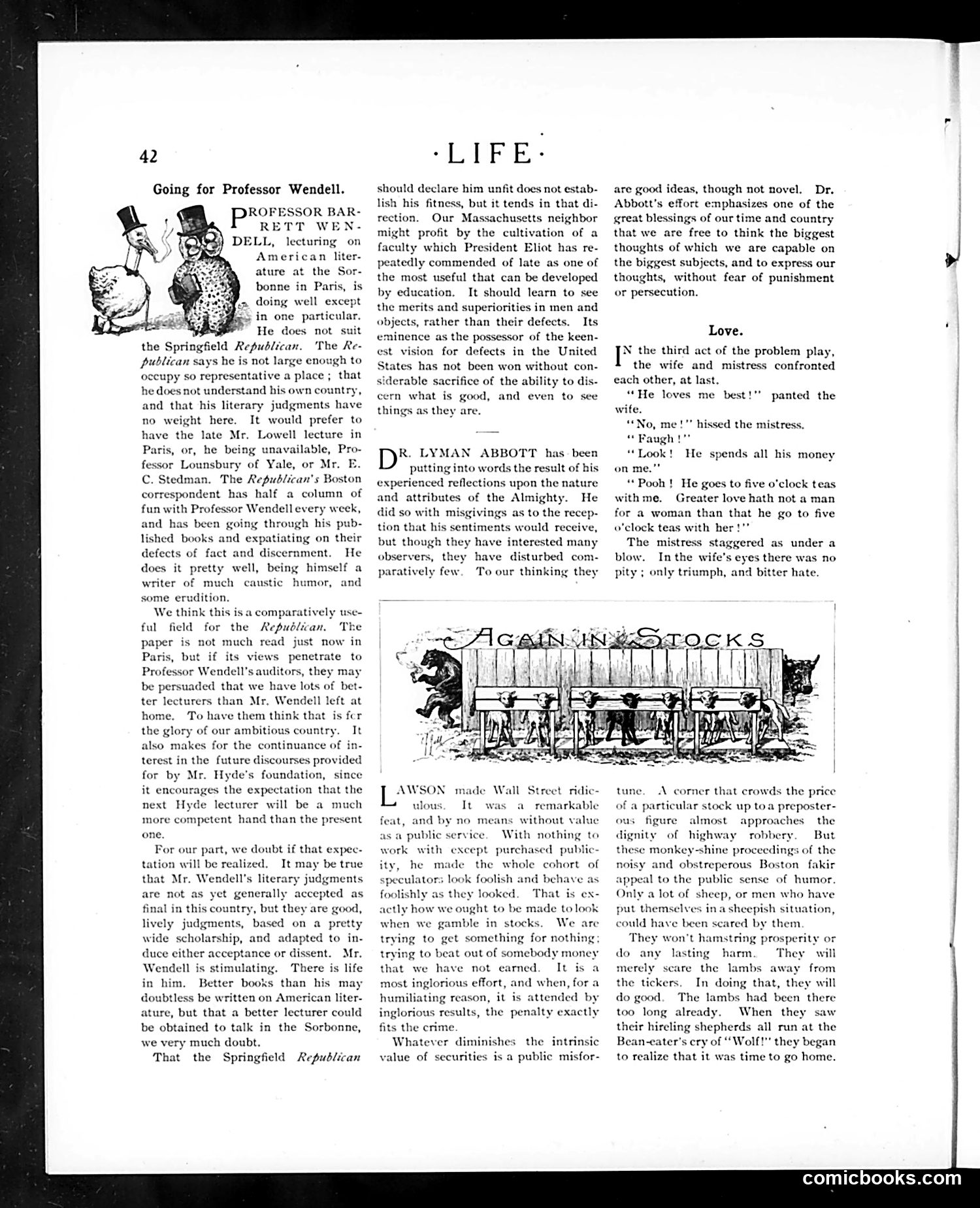
**Top Section ("Going for Professor Wendell"):** The illustration caricatures Professor Barrett Wendell, a prominent American literature lecturer at Harvard. The text criticizes his effectiveness as an educator, noting he's well-known but questions whether his fame translates to actual teaching ability. The piece humorously suggests the Springfield *Republican* newspaper found him overrated, implying his literary judgments aren't universally accepted and that he may be better suited to writing about literature than teaching it. **Bottom Section ("Again in Stocks"):** This cartoon satirizes Wall Street speculation and stock market gambling. It depicts investors as foolish animals (appearing ape-like) trading stocks recklessly. The text criticizes public participation in speculative markets, suggesting ordinary people lose money attempting to beat professional manipulators, comparing them to sheep being fleeced.
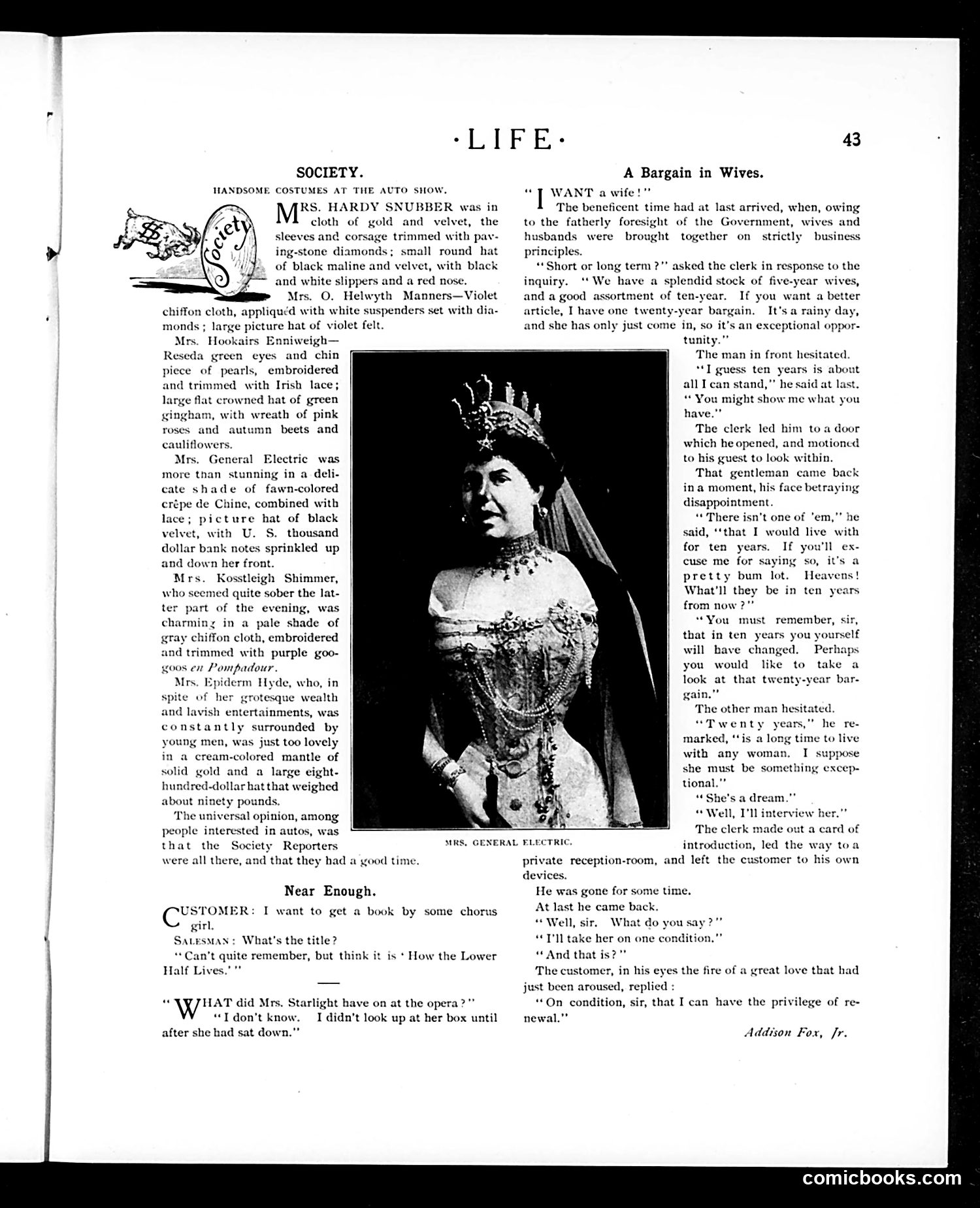
This page contains two distinct sections: **Left side** ("Society" / "Handsome Costumes at the Auto Show"): A fashion commentary describing elaborate costumes worn by wealthy women at an automobile show, featuring specific details about jewels, fabrics, and accessories. The humor lies in the extravagant excess—diamonds, pearls, ermine, and thousand-dollar hats—satirizing high society's competitive display of wealth. **Right side** ("A Bargain in Wives"): A short story about a man shopping for a wife, apparently from a marriage broker. The satire treats matrimony as a commercial transaction, with the clerk offering a "twenty-year bargain" wife. The humor critiques both mercenary marriage practices and male attitudes toward women as purchasable commodities—a common satirical target in early 20th-century publications. Both sections mock wealthy society's materialism and questionable values.
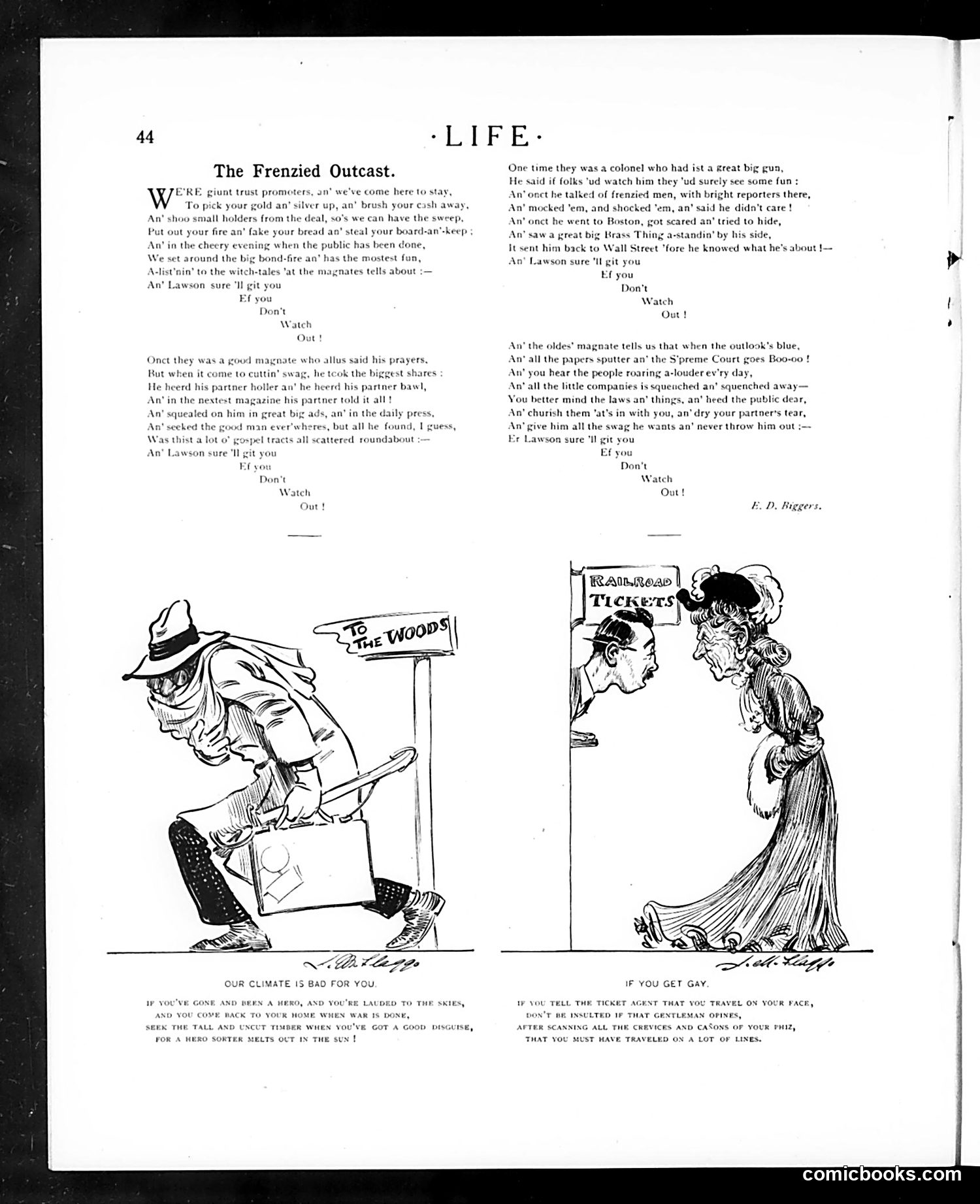
This page contains a poem by E.D. Biggert titled "The Frenzied Outcast" warning against lawless behavior—"Don't Watch Out!"—and two cartoons illustrating cautionary tales. **Left cartoon**: A disheveled man at a "To the Woods" signpost, captioned "Our Climate is Bad for You." The accompanying verse suggests a fugitive hiding after some disgrace, hoping wilderness concealment will restore his reputation. **Right cartoon**: A woman at a "Railroad Tickets" booth, titled "If You Get Gay." The text warns that excessive travel and socializing leaves a woman's reputation damaged—she'll be seen as having "traveled on a lot of lines." Both pieces satirize turn-of-century morality anxieties: social disgrace, respectability, and particularly women's vulnerability to reputation damage through perceived impropriety or excessive public visibility.
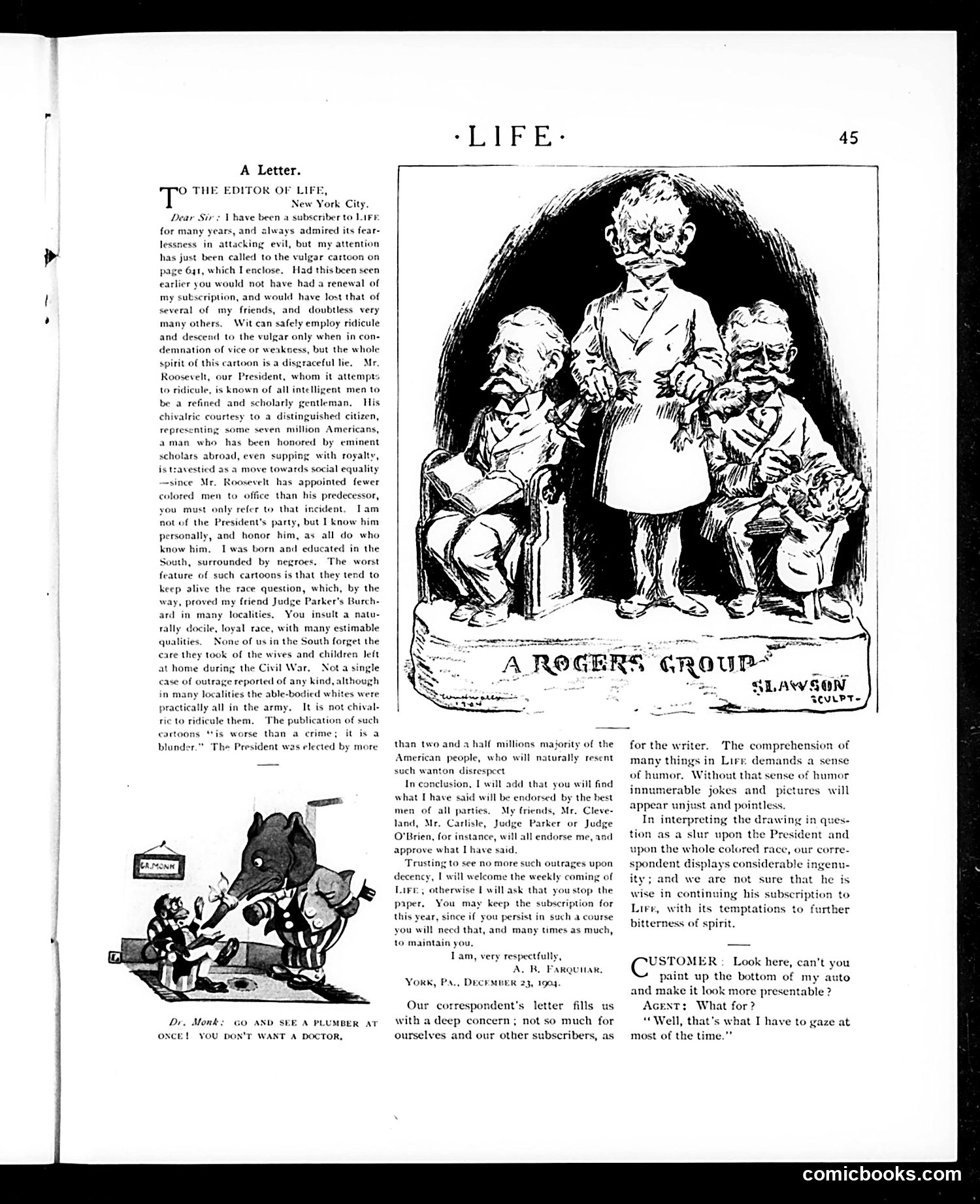
The main cartoon, credited to Slawson, depicts President Theodore Roosevelt as a grotesque demon-like figure presiding over three smaller, distorted men labeled "A Rogers Group." The accompanying letter criticizes Roosevelt for appointing fewer Black men to office than his predecessor, contradicting his reputation as a reformer. The cartoonist argues this undermines Roosevelt's claim to be a "refined and scholarly gentleman" and that such caricatures keep alive divisive racial questions. The satire targets Roosevelt's hypocrisy: while presenting himself as progressive and honorable, his actual policies disappointed civil rights advocates. The grotesque rendering of the President suggests moral corruption beneath his civilized image.
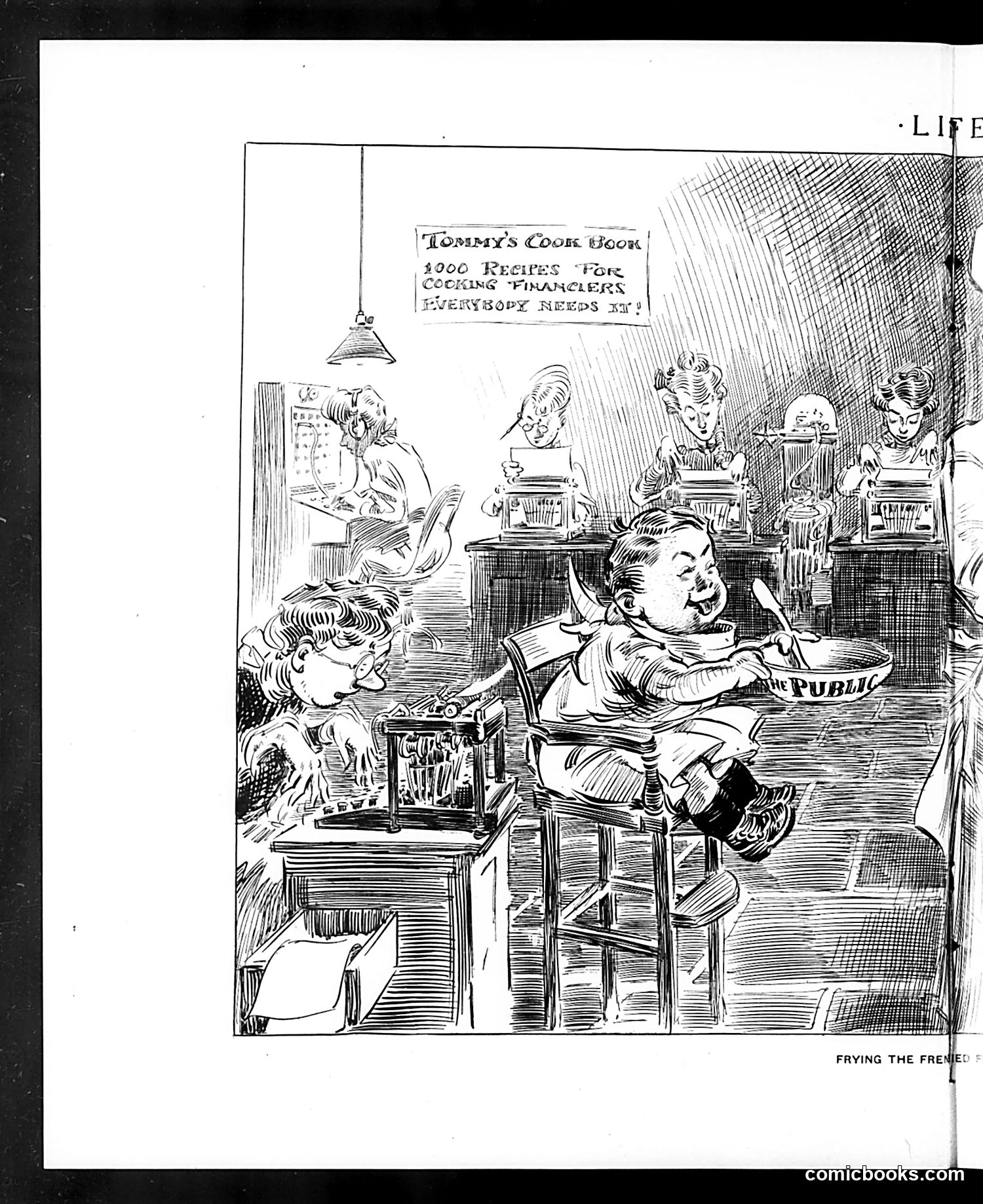
This satirical cartoon depicts a cooking class scene with a book advertisement for "Tommy's Cook Book: 1000 Recipes for Cooking Financiers Everybody Needs It!" The humor plays on a double meaning: "frying the French" refers both to cooking French cuisine and to a hostile action against French people or interests. The financiers being "cooked" in the advertisement likely references French financiers or French financial interests—a topical jab suggesting they're being figuratively "fried" or destroyed. The scene shows well-dressed figures in a kitchen setting, with an affluent man prominently featured, suggesting this targets wealthy financial interests. The satire appears to mock either anti-French sentiment or criticism of French financial dealings, presenting them humorously as ingredients for consumption. The exact historical context requires knowing Life magazine's publication date.
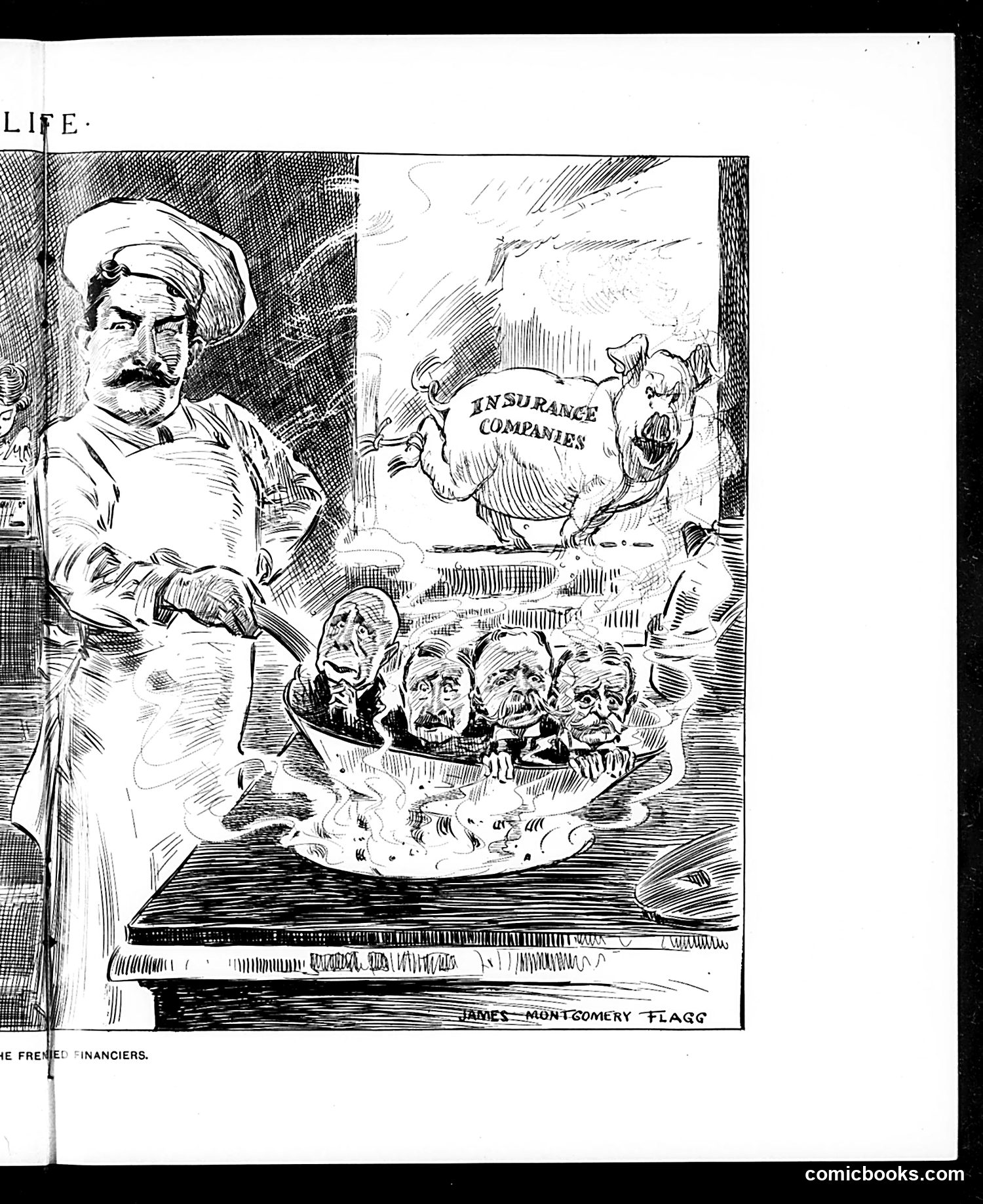
This is a satirical cartoon by James Montgomery Flagg titled "The French Financiers" (visible at bottom left). It depicts a large Turkish or Ottoman figure (identifiable by the turban) as a butcher or cook, holding what's labeled "Insurance Companies" above a cauldron. Several distressed human heads emerge from boiling liquid below. The satire appears to target insurance company practices—suggesting they "cook" or exploit their customers, reducing people to victims in a deadly scheme. The Turkish figure likely represents foreign or "Eastern" financial interests exploiting Western markets. This reflects early 20th-century American anxieties about insurance fraud, predatory financial practices, and foreign economic influence on domestic institutions. The grotesque imagery emphasizes the perceived moral corruption of these enterprises.
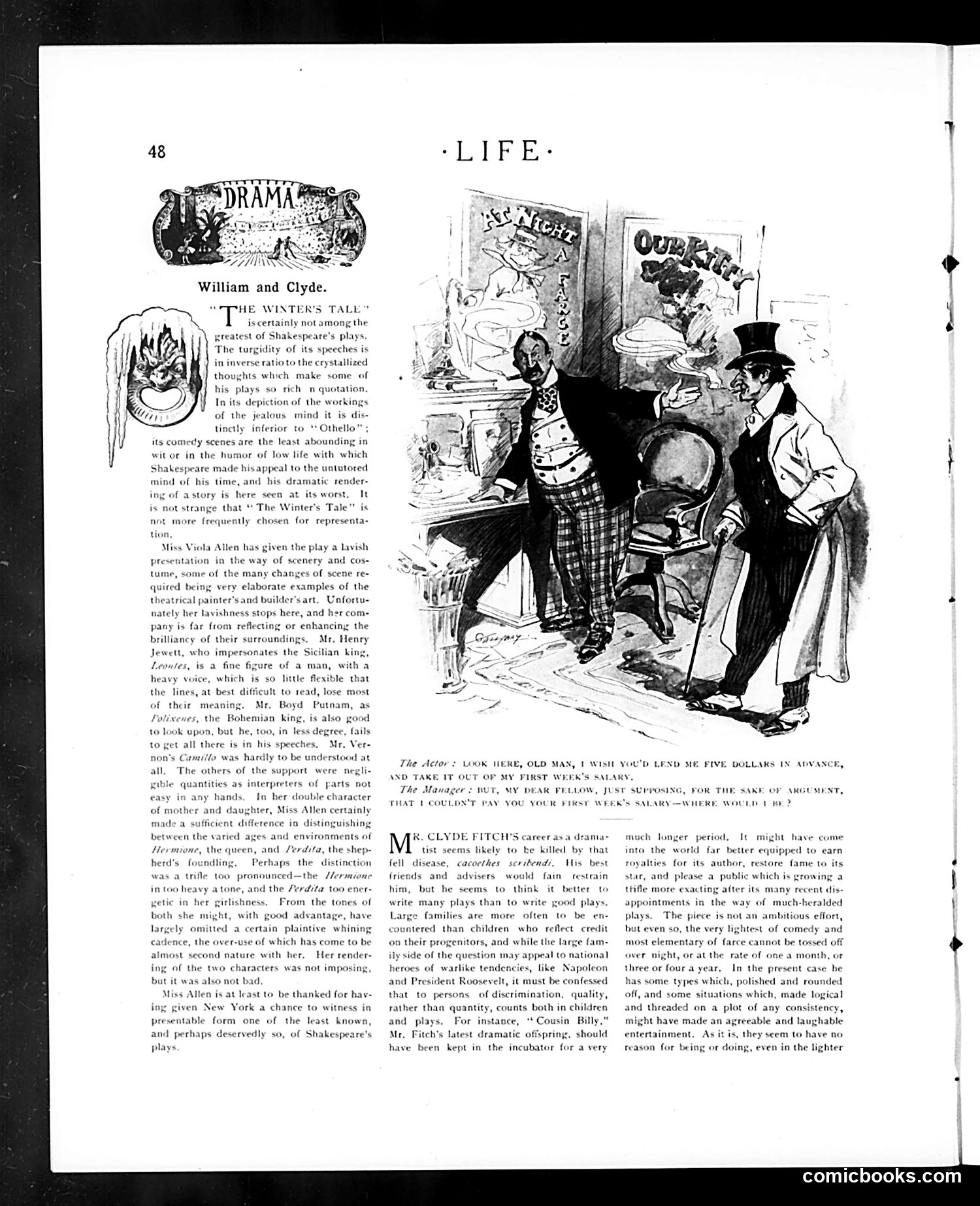
This page discusses theatrical productions of Shakespeare's "The Winter's Tale" and Mr. Clyde Fitch's plays. The illustration depicts a comedic scene between an actor and a theater manager negotiating a salary advance. The cartoon's satire centers on the financial struggles of theatrical productions and actors. The manager refuses the actor's request for a five-dollar advance on his first week's salary, claiming he "couldn't pay you your first week's salary—where would I be?" This reflects early 20th-century theater's precarious economics, where even modest productions operated on tight budgets and actors frequently faced financial hardship. The joke targets the absurdity of theater management excusing their inability to pay wages while expecting performers to work—a common exploitation in the entertainment industry of that era.
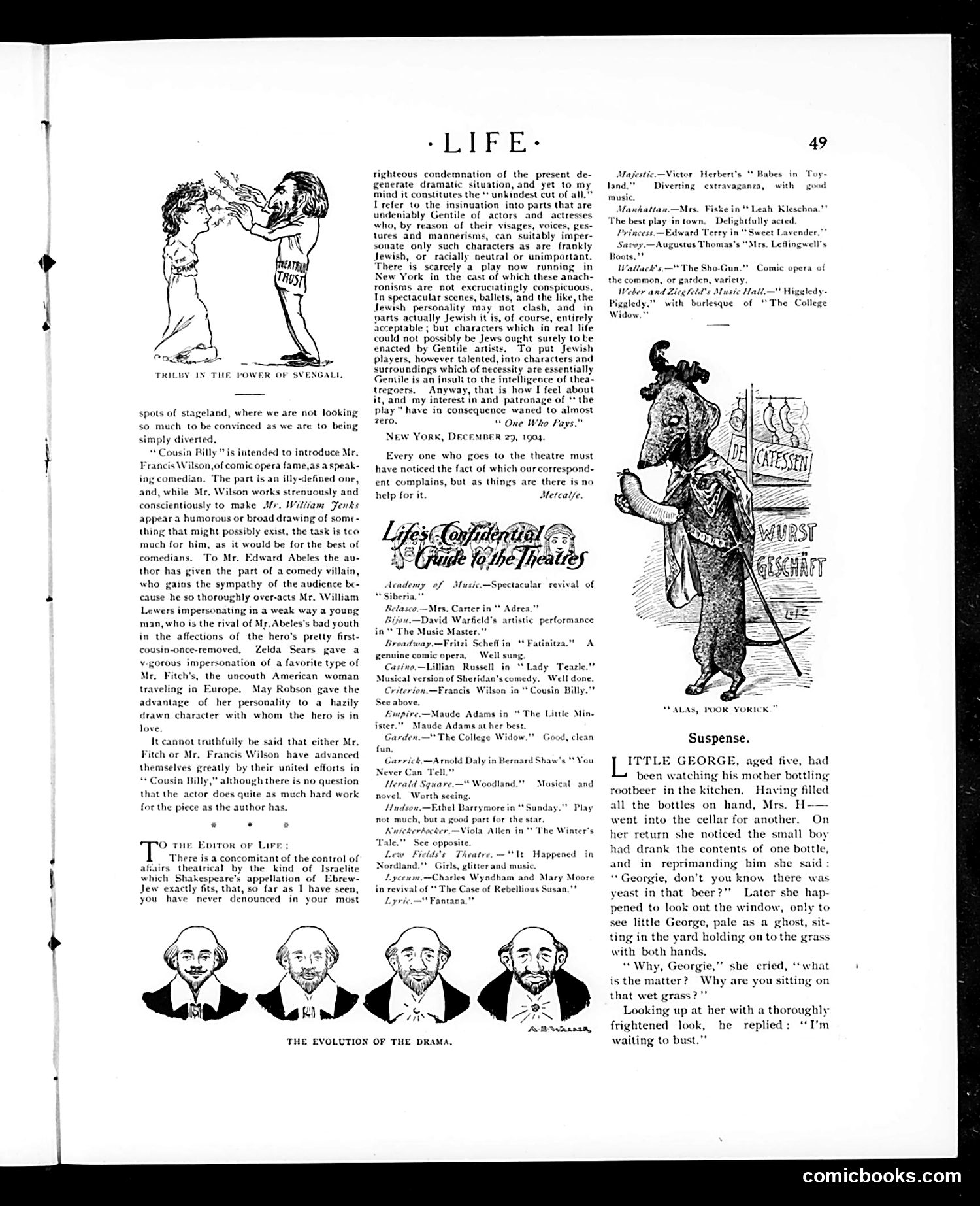
This page contains a letter to the editor complaining about Jewish actors being cast in roles written for Gentile characters. The author argues this creates "anachronisms" and insults theatrical audiences' intelligence, claiming Jewish actors' "visages, voices, gestures and mannerisms" suit only Jewish roles. **The context we'd miss today:** This reflects early-20th-century theatrical discrimination and antisemitic assumptions about ethnic casting. The complainant—signing as "One Who Pays"—represents a period when explicit racial restrictions in theater were considered acceptable public discourse. Notably, the magazine's theater critic "Metcalfe" acknowledges the complaint but dismissively states "there is no help for it." The illustration "Trilby in the Power of Svengali" (top left) references the 1894 novel featuring a villainous Jewish hypnotist character, reinforcing period stereotypes. The page otherwise contains routine theater reviews and advertisements.
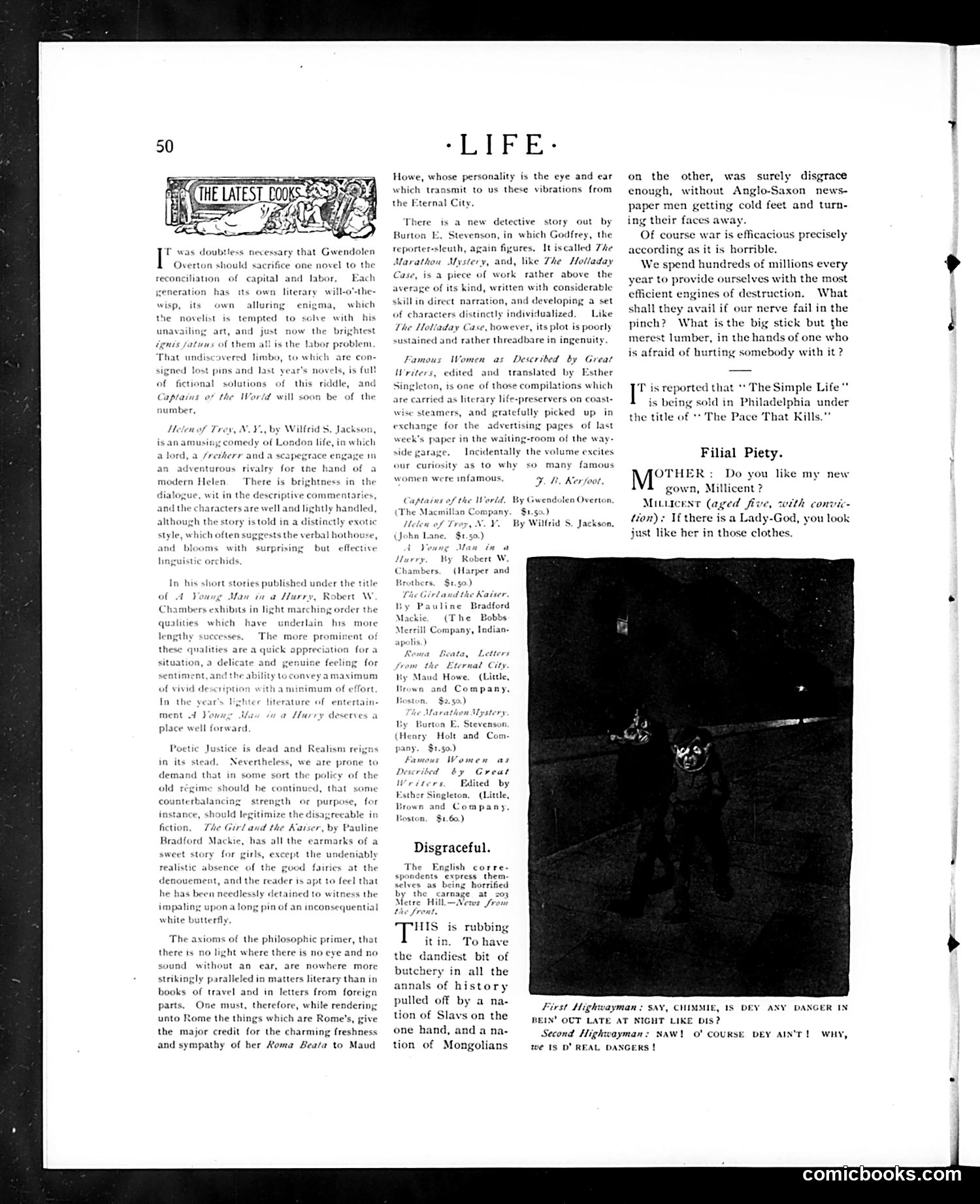
This page from Life magazine (circa early 1900s) contains literary reviews and social commentary rather than traditional political cartoons. The main visual element is a small illustration accompanying a section titled "Filial Piety"—a domestic humor piece where a mother compliments her son's new suit, and he replies that he borrowed it from a Lady-God figure, suggesting he's wearing women's clothing. The joke relies on period embarrassment about cross-dressing. The dominant text discusses the "labor problem" in fiction and critiques contemporary novels for their treatment of class conflict and social realism. The satire mocks both sentimental literature that ignores hard truths and overly realistic depictions that spoil genteel entertainment. References to war's "efficacy" being dependent on public nerve suggest anxiety about American military capability and civilian willpower—likely reflecting early 20th-century concerns about industrial strength and national character.
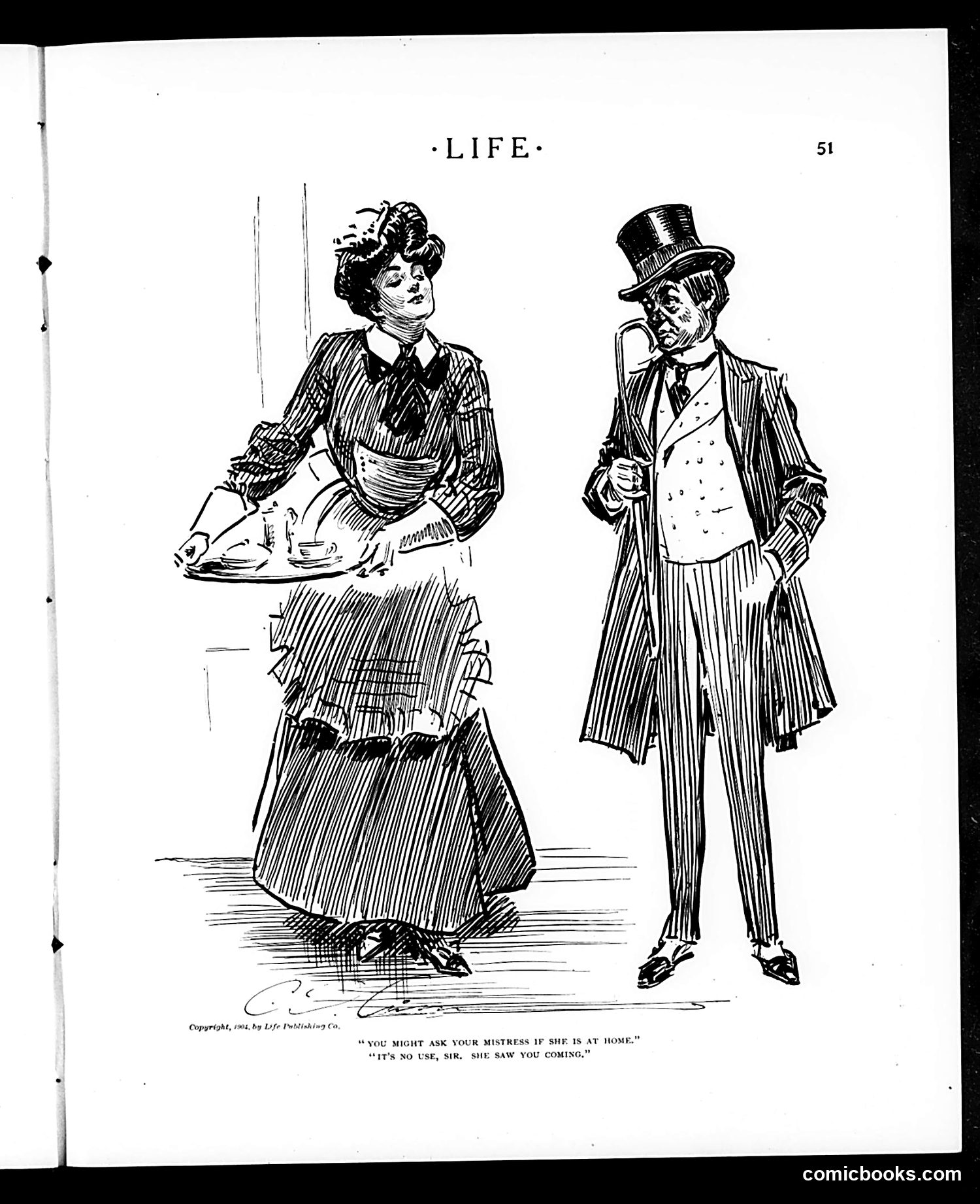
This single-panel cartoon depicts a gentleman in formal attire (top hat, morning coat) speaking to a maid or servant woman. The caption reads: "You might ask your mistress if she is at home." / "It's no use, sir. She saw you coming." The satire targets the social hypocrisy of the era regarding domestic life and infidelity. The man appears to be a visitor attempting to call on a woman, but her servant reveals that the "mistress" deliberately avoided him—suggesting either an unwanted suitor or illicit affair. The humor lies in the servant's frank exposure of the deception, undermining the gentleman's attempt at maintaining propriety. This reflects early 20th-century Life magazine's focus on satirizing middle and upper-class social conventions and the gap between public appearance and private reality.
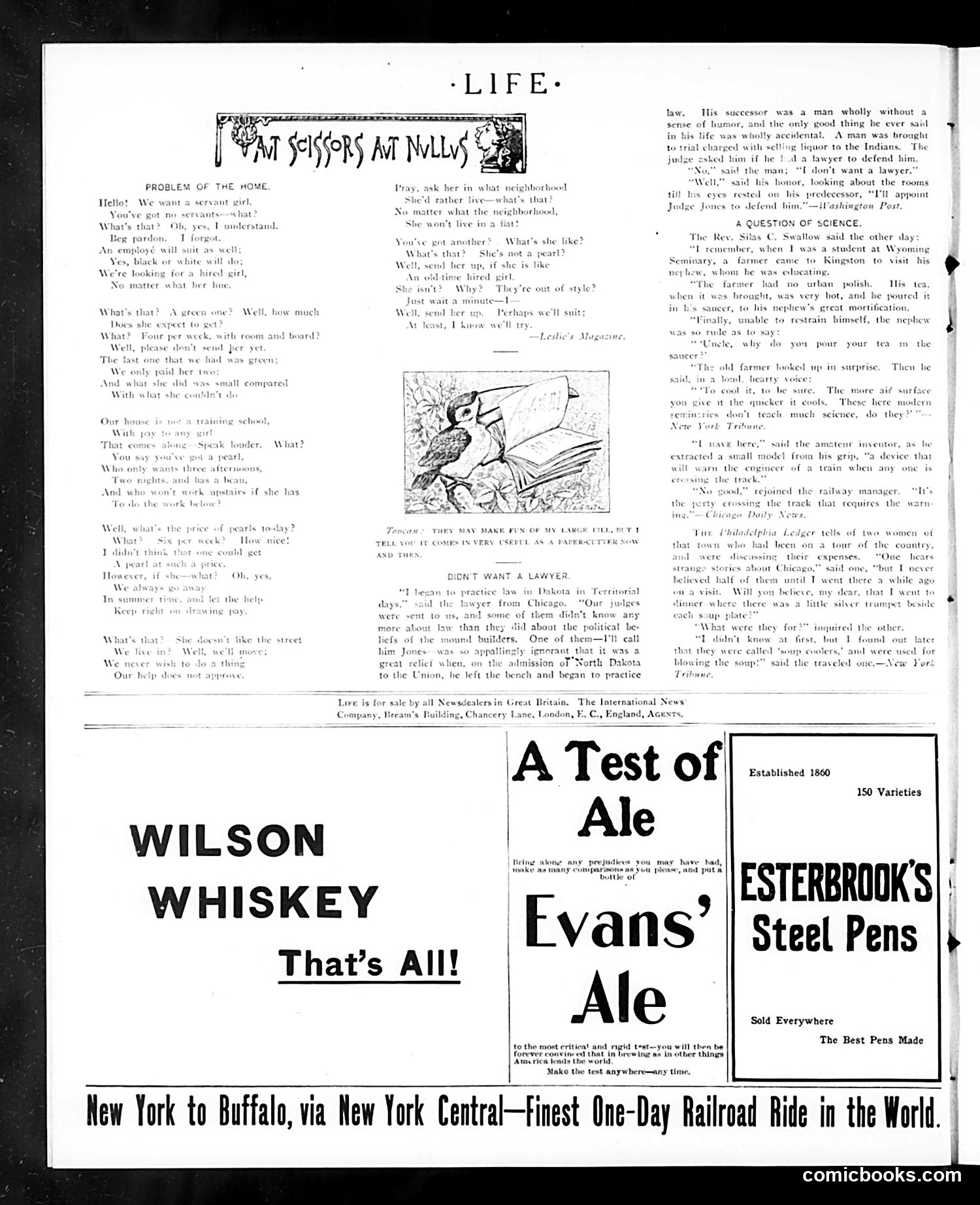
This page contains three humorous sketches satirizing domestic and social awkwardness: **"Problem of the Home"** depicts the challenge of hiring servant girls—employers ask detailed questions about appearance and background while candidates deflect or give evasive answers, capturing the absurdity of employment interviews. **"A Question of Science"** shows an old farmer pouring hot tea into his saucer to cool it, then defending the practice to his educated nephew by demonstrating it works faster—mocking rural practicality versus modern scientific pretension. The joke is that common sense sometimes outperforms "education." **"Didn't Want a Lawyer"** (referenced in text) concerns a man charged with selling liquor to Indians who refuses legal representation, declaring he doesn't want a lawyer—suggesting either ignorance or stubborn pride in frontier justice. The page is primarily **advertisements** for Wilson Whiskey, Evans' Ale, Esterbrook's Steel Pens, and New York Central Railroad, with satirical content filling remaining space—typical of Life's format as a humor/advertising hybrid publication.
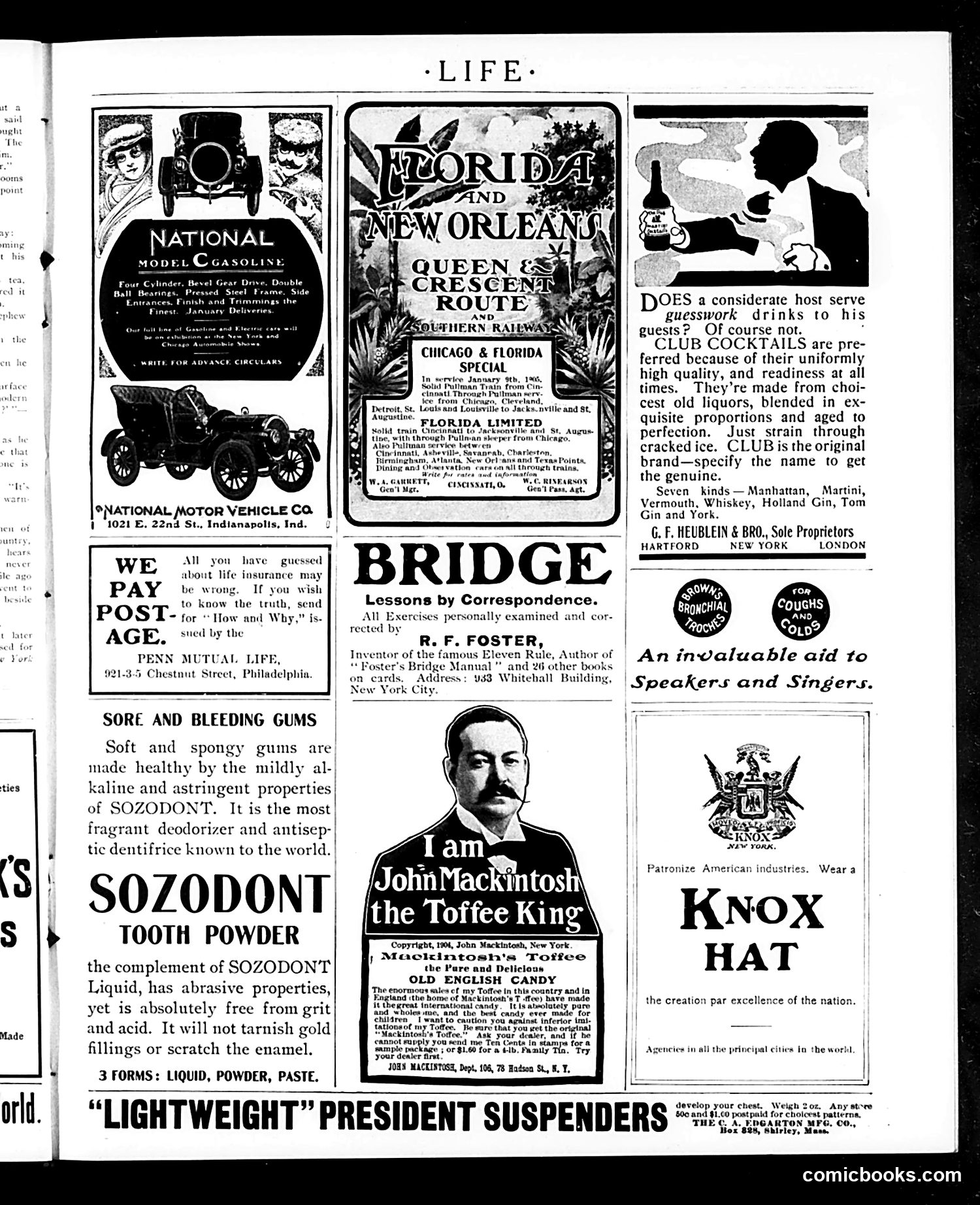
This is primarily an **advertising page** from Life magazine, not a political cartoon. The page contains various product advertisements typical of the early 1900s, including automobiles, insurance, bridge lessons, cocktails, dental products, candy, and haberdashery. The only figure of note is **John Mackintosh**, presented as "the Toffee King" in his candy advertisement. This appears to be a genuine commercial endorsement rather than satire—Mackintosh was a real British confectioner promoting his toffee product in the American market. The "considerate host" cocktail advertisement contains mild social satire, suggesting that serving pre-made "Club Cocktails" rather than homemade drinks demonstrates better hospitality and consistency. The page's implicit satire is typical of Life's era: advertisements assume readers are aspirational consumers who want to project sophistication through correct product choices—from proper cocktails to American-made hats.
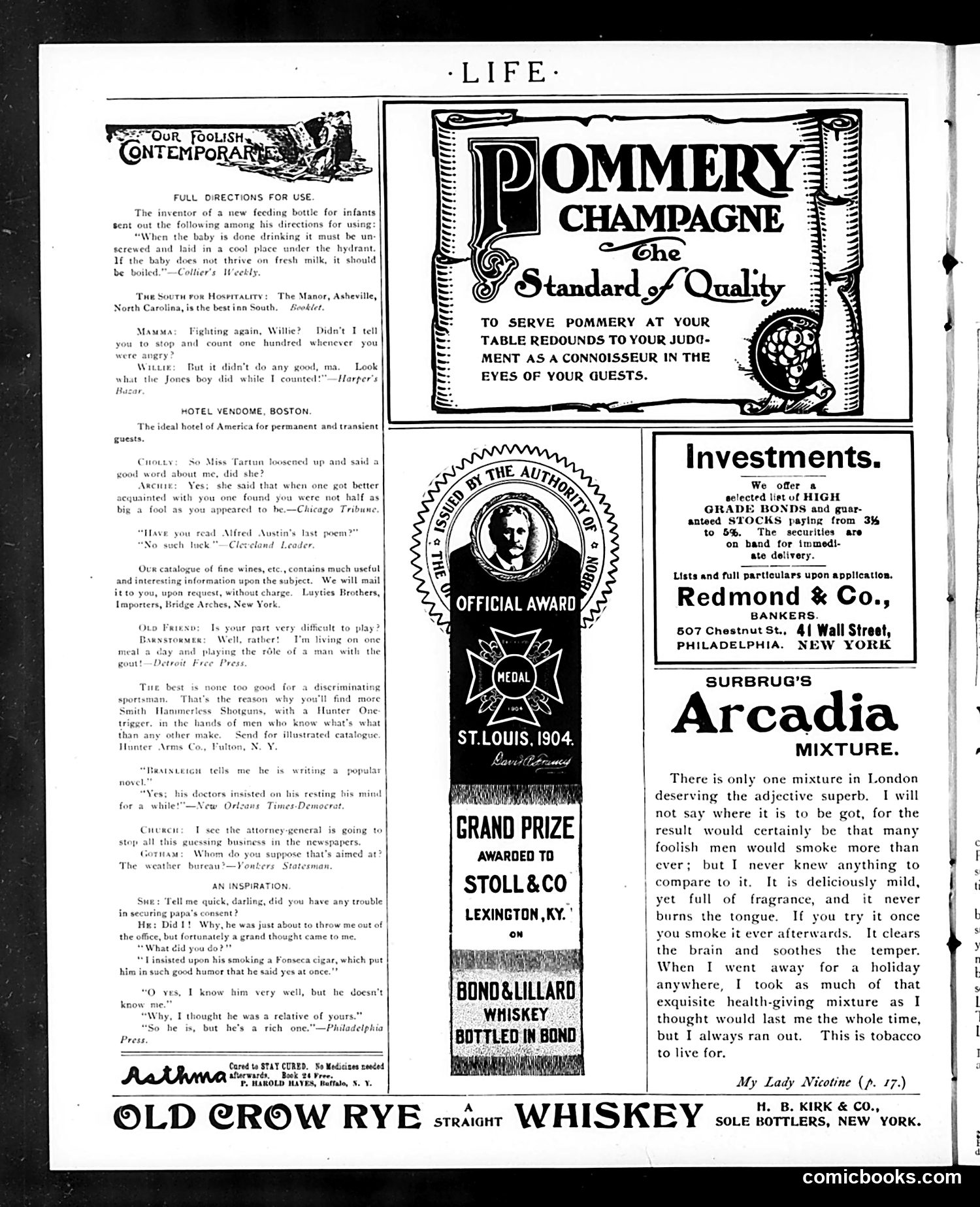
This page is primarily **advertising**, with minimal editorial content. The layout features various product advertisements interspersed with brief satirical anecdotes in Life's characteristic style. **Key Content:** The anecdotes are short humor pieces mocking social pretension and absurdity—a baby-bottle inventor's failed product, a woman's obsession with counting, references to literary figures like Alfred Austin. These are typical Life magazine filler jokes. **Notable Advertisements:** - **Pommery Champagne**: Positioned as a status symbol for entertaining guests - **Stoll & Co. Whiskey**: Advertises a "Grand Prize" award from St. Louis, 1904 - **Redmond & Co. Bankers**: Offering high-grade bonds and stocks - **Surbrug's Arcadia tobacco**: An extended testimonial praising the product's qualities The page reflects early 1900s consumer culture where luxury goods (champagne, fine tobacco, investments) signaled social respectability. The advertisements target affluent readers, while the satirical anecdotes gently mock human vanity and gullibility—Life's standard editorial approach.
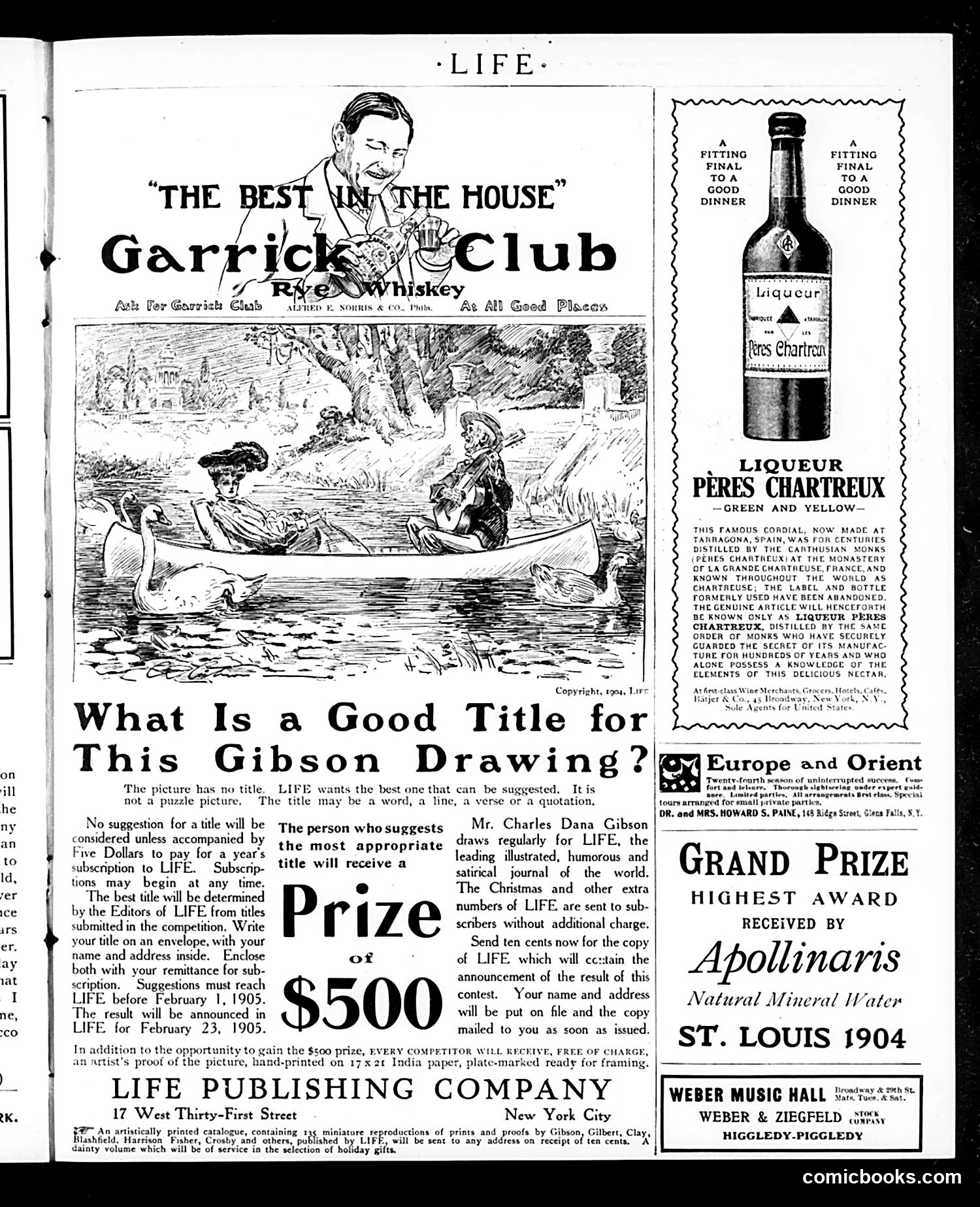
This is primarily a **contest announcement** rather than political satire. Life magazine is running a competition asking readers to suggest the best title for a **Charles Dana Gibson drawing** (visible center-left) depicting two elegantly dressed figures in a rowboat. The prize is $500—substantial for 1904—plus a free year's subscription. Gibson was Life's premier illustrator, famous for his "Gibson Girl" aesthetic. The drawing itself appears to be a romantic or comedic scene typical of his work, but without a title, its satirical point is unclear to modern viewers. The page also contains **period advertisements**: Garrick Club Rye Whiskey ("The Best in the House"), Pères Chartreux liqueur, Apollinaris mineral water, Weber Music Hall, and a European tour service. These ads are standard commercial content, not satire. The contest reflects how Life engaged readers as active participants in creating meaning around Gibson's ambiguous illustrations.
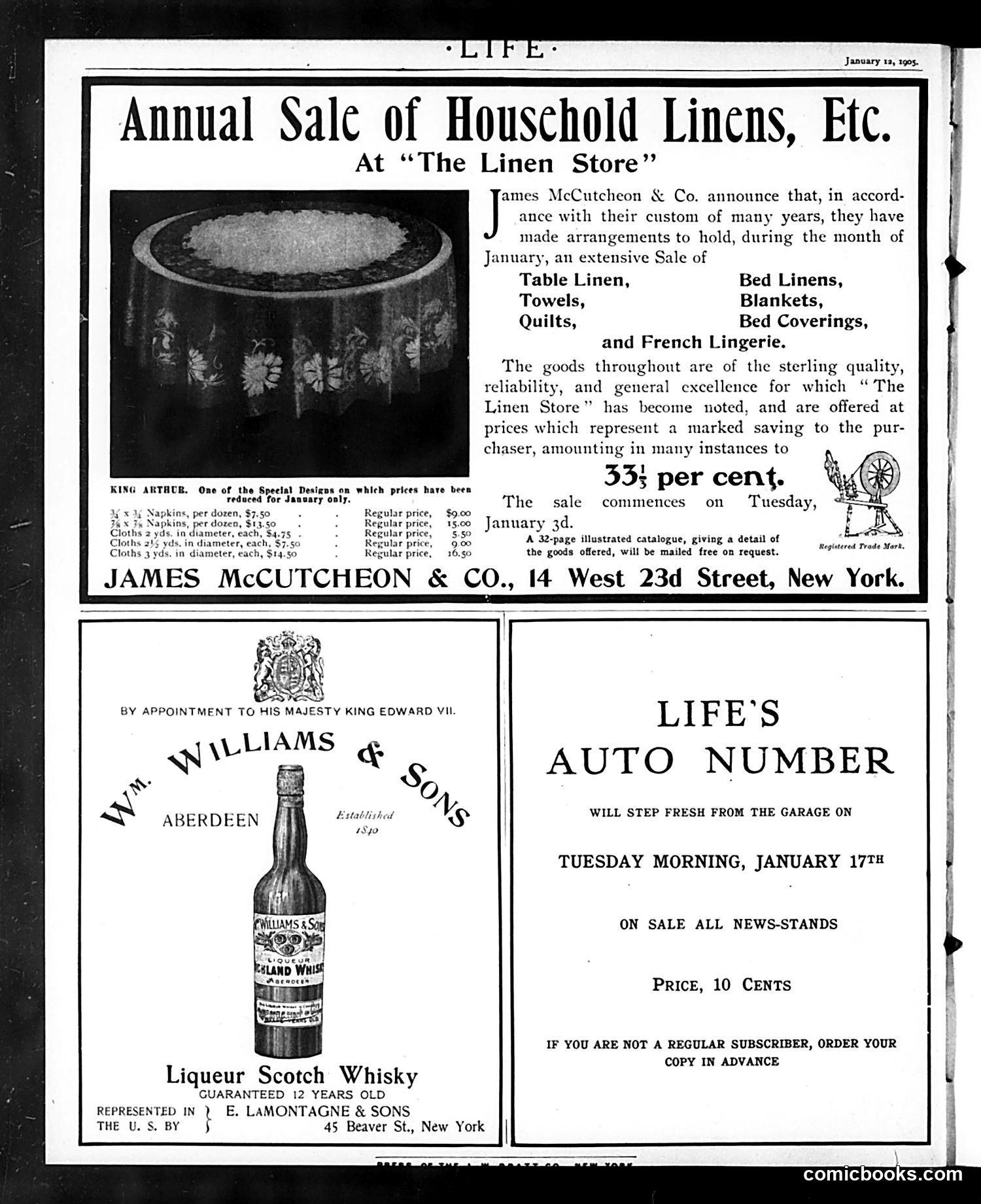
This is primarily a **commercial advertising page**, not a political cartoon. It contains three advertisements with no satirical content: 1. **James McCutcheon & Co.** announces their January linen sale, offering household textiles (table linens, towels, quilts, blankets, and French lingerie) at discounts up to 33⅓ percent. The featured item is "King Arthur," a decorative design. 2. **W.M. Williams & Sons** advertises Scottish whisky imported from Aberdeen, represented in the U.S. by a New York distributor. 3. **Life's Auto Number** promotes an upcoming special issue focused on automobiles, to be released January 17th at newsstands for 10 cents. The page reflects early 1900s consumer culture and Life magazine's role as both satirical publication and advertising vehicle. The "Auto Number" reference shows the growing prominence of automobiles in American life during this era.