
Life, 1905-01-12 · page 6 of 20
Life — January 12, 1905 — page 6: what you’re looking at
What you’re looking at
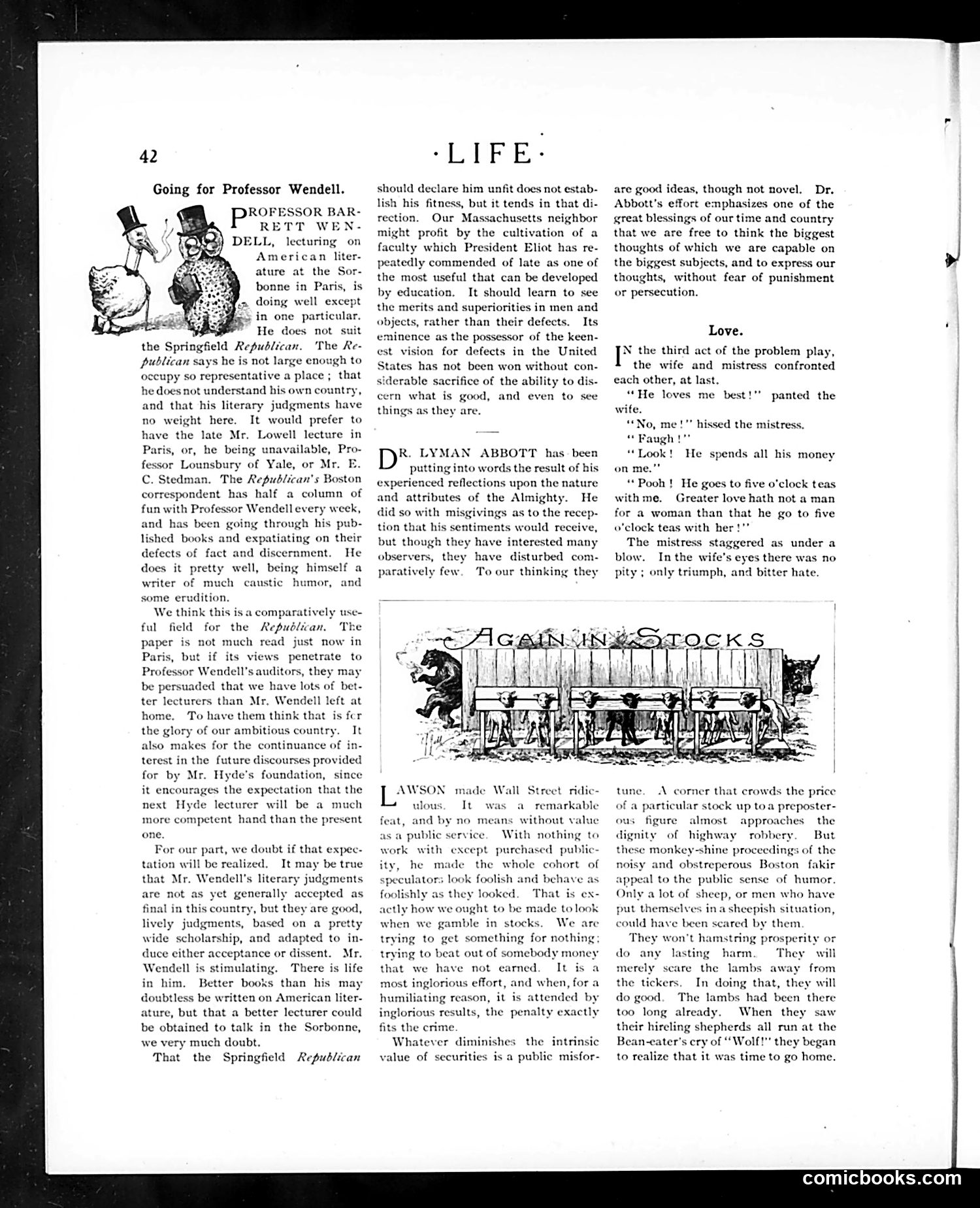
**Top Section ("Going for Professor Wendell"):** The illustration caricatures Professor Barrett Wendell, a prominent American literature lecturer at Harvard. The text criticizes his effectiveness as an educator, noting he's well-known but questions whether his fame translates to actual teaching ability. The piece humorously suggests the Springfield *Republican* newspaper found him overrated, implying his literary judgments aren't universally accepted and that he may be better suited to writing about literature than teaching it. **Bottom Section ("Again in Stocks"):** This cartoon satirizes Wall Street speculation and stock market gambling. It depicts investors as foolish animals (appearing ape-like) trading stocks recklessly. The text criticizes public participation in speculative markets, suggesting ordinary people lose money attempting to beat professional manipulators, comparing them to sheep being fleeced.
📄 Transcribed text from this page (OCR, searchable)
Machine-transcribed from the original scan — historical spelling and the odd misread are preserved.
42 Going for Professor Wendell. ROFESSOR BAR- RETT WEN- ae) DELL, lecturing on CRA American liter. ature at the Sor- bonne in Paris, ii y. doing well except =< in one particular. He does not suit the Springfield Republican. The Re- publican says he is not large enough to occupy so representative a place ; that he does not understand his own country and that his literary judgments have no weight here. It would prefer to have the late Mr. Lowell lecture in or, he being unavailable, Pro- fessor Lounsbury of Yale, or Mr. E. C. Stedman. The Repudlican's Boston correspondent has half a column of fun with Professor Wendellevery week, and has been going through his pub- lished books and expatiating on their defects of fact and discernment. He does it pretty well, being himself a writer of much caustic humor, and some erudition. We think this is a comparatively use- ful field for the Repuélican, The paper is not much read just now in Paris, but if its WS penetrate to Professor Wendell’s auditors, they ma: be persuaded that we have lots of bet- ter lecturers than Mr, Wendell left at home. To have them think that is fer the glory of our ambitious country. It kes for the continuance of in- terest in the future discourses provided for by Mr. Hyde’s foundation, since it encourages the expectation that the next Hyde lecturer will be a much more competent hand than the present also ma one. For our part, we doubt if that expec- tation will be realized. It may be true that Mr. Wendell’s literary judgments are not as yet generally accepted as final in this country, but they are good, lively judgments, based on a pretty wide scholarship, and adapted to in- duce either acceptance or dissent. Mr. Wendell is stimulating. There is life in him. Better books than his may doubtless be written on American liter- ature, but that a better lecturer could be obtained to talk in the Sorbonne, we very much doubt. That the Springfield Republican LIFE should declare him unfit does not estab- ish his fitness, but it tends in that di- ion. Our Massachusetts neighbor might profit by the cultivation of a faculty which President Eliot has re- peatedly commended of late as one of the most useful that can be developed by education. It should learn to see the merits and superiorities in men and objects, rather than their defects. Its eminence as the possessor of the keen- est vision for defects in the United States has not been won without con- siderable sacrifice of the ability to dis- cern what is good, and even to see things as they are. D*® LYMAN ABBOTT has been putting into words the result of his experienced reflections upon the nature and attributes of the Almighty. He did so with misgivings as to the recep- tion that his sentiments would receive, but though they have interested many observers, they have disturbed com- paratively few. ‘To our thinking they Ls SON made Wall Street ridic- ulous It was a remarkable at, and by no means without value as a public service. With nothing to work with except pure! ity, he made the whole cohort of ased_ public- culators look foolish and behave as foolishly as they looked. Th actly when we gamble in stocks. We are how we ought to be made to look trying to get something for nothing trying to beat out of somebody money that we have not earned. It is 4 most inglorious effort, and when, for a humiliating reason, it is attended by Inglorious results, the penalty exactly fits the crime. Whatever diminishes the intrinsic value of securities is a public misfor- are good ideas, though not novel. Dr. Abbott's effort emphasizes one of the great blessings of our time and country that we are free to think the biggest thoughts of which we are capable on the biggest subjects, and to express our thoughts, without fear of punishment or persecution, Love. N the third act of the problem play, the wife and mistress confronted each other, at last. “He loves me best!" panted the wife. 0, me !"" hissed the mistress. © Baugh!" “Look! He spends all his money on me.”" “Pooh | He goes to five o'clock teas with me. Greater love hath not a man for a woman than that he go to five o'clock teas with her!" The mistress staggered as under a blow. In the wife’s eyes there was no pity ; only triumph, and bitter hate. tune. Ac mer that crowds the price a particular stock up toa preposter- ous figure almost. approaches the dignity of highway robbery. But these monkey-shine proceedings of the noisy and obstreperous Boston fakir appeal to the public sense of humor. Only a lot of sheep, or men who have put themsel ina sheepish situation, could have been scared by them hey won't hamstring prosperity or do any lasting harm. They will are the lambs away from the tickers, In doing that, they will do good. The lambs had been there too long already. When they saw their hircling shepherds all run at the Bean-eater’s cry of “Wolf!” they began to realize that it was time to go home. merely s comicbooks.com