
Life, 1905-01-12 · page 14 of 20
Life — January 12, 1905 — page 14: what you’re looking at
What you’re looking at
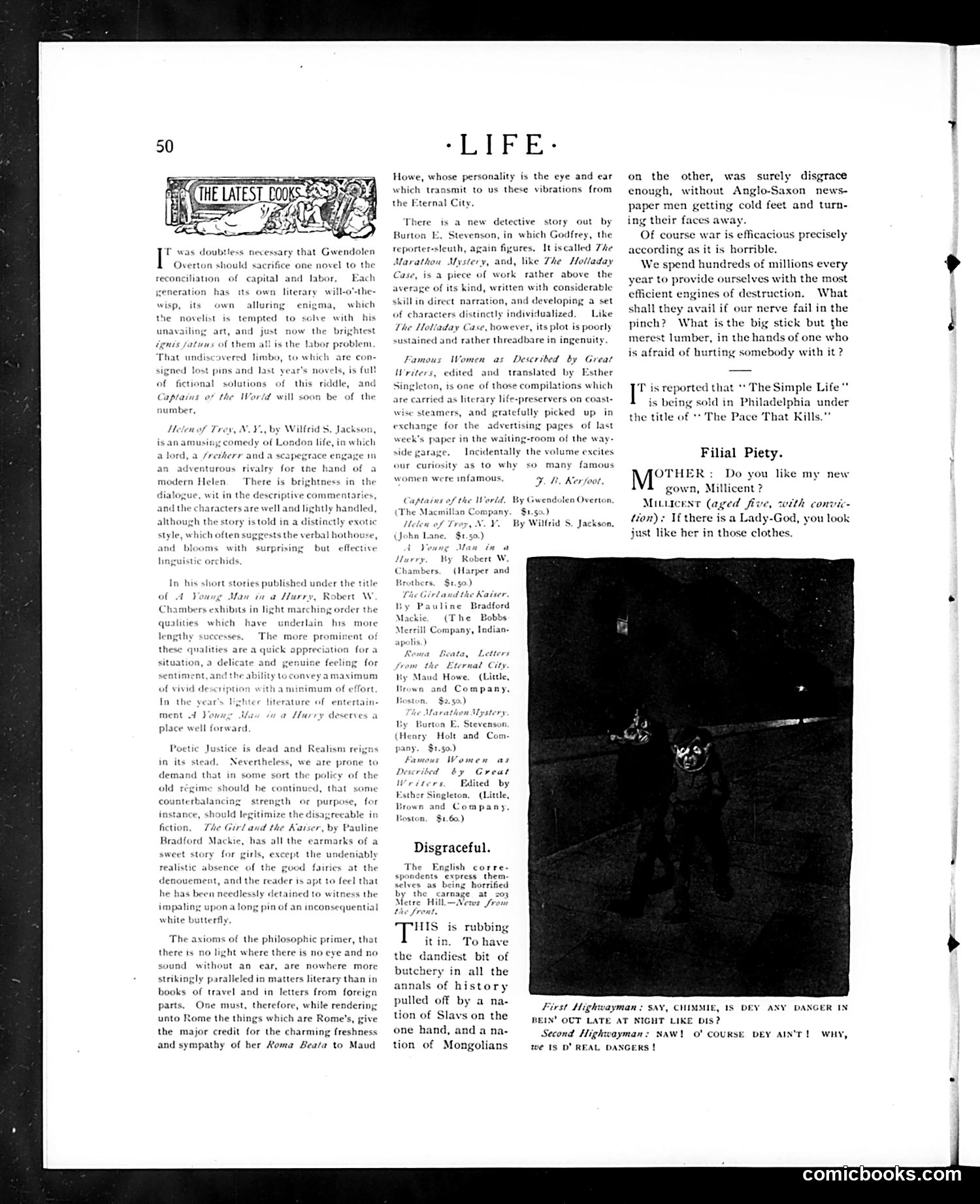
This page from Life magazine (circa early 1900s) contains literary reviews and social commentary rather than traditional political cartoons. The main visual element is a small illustration accompanying a section titled "Filial Piety"—a domestic humor piece where a mother compliments her son's new suit, and he replies that he borrowed it from a Lady-God figure, suggesting he's wearing women's clothing. The joke relies on period embarrassment about cross-dressing. The dominant text discusses the "labor problem" in fiction and critiques contemporary novels for their treatment of class conflict and social realism. The satire mocks both sentimental literature that ignores hard truths and overly realistic depictions that spoil genteel entertainment. References to war's "efficacy" being dependent on public nerve suggest anxiety about American military capability and civilian willpower—likely reflecting early 20th-century concerns about industrial strength and national character.
📄 Transcribed text from this page (OCR, searchable)
Machine-transcribed from the original scan — historical spelling and the odd misread are preserved.
| was doubtless necessary that Gwendolen Overton should sacri ¢ one novel to the labor, Each the- reconciliation of capital generation has its own lite wisp, its own all which the novelist is tempted to solve with his unavailing art, and just now the brightest fgnis jatuus of them all is the labor problem That undiscovered limbo, to which are con- signed lost pins and last year's novels, is (ul! of fictional solutions this riddle, and Captains of the World will soon be of the number, Hetenof Trey, N.¥., by Wilftid S. isanamusing comedy of Londo: a lord, a /retherr and a scapegrace engage m an adventurous rivalry for the hand of a modern Helen. ‘There is brightness in dialogue, wit in the descriptive com tly handled, a distinct taries and the characters are well a although the story istold i style, which often suggests the verbs and blooms with surprising but effective lin hids. t stories published under the title of Young Man in a Hurry, Robert W Chambers exhibits in light marching order the qualities which have underlain his mote lengthy successes. The more prominent of these qualities are a quick appreciation fora sit for veyamaximum sentiment, and the of vivid description with a minimum of effort In the year’s lighter literature of entertain ment 4 don a Murry deserves a place well forward tice is dead and Realism reigns 1, Nevertheless, we are pre hat in some sort the policy of the ne should be continued, that some counterbalanci: strength or purpose, for ¢, should legitimize the fiction, The Girl and the Kaiser, by Paulin Bradford Mackie, has all the earmarks of a sagrecable ir sweet story for girls, except the undeniably reali ence of the good fairies at the denouement, and the re der is apt to feel th t he has been needlessly detained to witness the impaling upon a long pin of an inconsequential white butterfly The axioms of the philosophic primer, that there ts no light where there is no eye and sound without an ear, are nowhere more strikingly paralleled in matters literary than in books of travel and in letters from foreign parts, One m unto Rome the t the major credit for the charming freshness and sympathy of her Koma Bea/a to Maud therefore, while rendering ings which are Rome's, give -LIFE- Howe, whose personality is the eye and ear on the other, was surely disgrace which transmit to us these vibrations from enough, without Anglo-Sa the Eternal City. There is a new detective story out by ing their Stevenson, in which Godfrey, the Of course war is efficacious precisely gures, Iisealled The according as it is horrible. rathon Mystery, and, like The Holladay is a piece of work Burton I reporter-sleuth, aj verage of its k of characters distinctly i The Holladay Case, howen ) k and rather threadbare in ingenuity. merest Lumber, in the hands of one who sustai Famous Women as , written with considerable I in direct narration, and developing a set Described by Great on news paper men getting cold feet and turn- cs We spend hundreds of millions every > year to provide ourselves with the most efficient engines of destruction. What shall they avail if our nerve fail in the pinch? What is the big stick but the } rather above the Jividualized its ple is afraid of hurting somebody with it ? Writers, edited and translated by Esther —_— are carried as lite life-preservers on coast- «steamers, and gratefully picked up in gleton, is one of those compilations which JP is reported that * The Simple Life" is being sold in Ph the title of ** The Pace lelphia under That Kills.”" exchange for the advertising pages of last week's J side gara women were infamous, ld. Captains of the W The Macm n of Troxy NY n Lane. $t.50.) Yeung Man in a Hurry. Wy Robert W. Chambers. (Harper and Brothers, Tie Gir Kaiser by Pauline Bradford Mackie. (The Bobbs ly Maud Howe, (Little, Brown and Company, Ly Barton E. Stevenso (Henry Holt and Com: Famous Women as Described 6 Writers Great Edited by Esther Singleton, (Little, 1 n and Company, ston. $1.60.) Disgraceful. The English corre selves as being horri by the carnage at Metre Hill 2 frow HIS is rubbing itin. To have the dandiest bit of butchery in all the annals of history pulled off by a na- tion of Slavs on the one hand, and a na- tion of Mongolians per in the waiting-room of the way- e. Incidentally the volume excites Filial Piety. our curiosity as to why so many famous 7: Ny Reo MOTHER Do you like my new gown, Millicent? By GwendotenOverton, — Mutuacent (aged five, with convic- sy Wiltrid S. Jackaon, #072)¢ If there is a Lady-God, you look just like her in those clothes. First Highwayman : Ss¥, CMIMMIE, 1S DEY ANY DANGER IN BEIN' OUT LATE AT NIGHT LIKE DIS? Second Highwayman: Naw\ ' COURSE DEY AIN'T! WHY, we 18 D' REAL DANGERS | comicbooks.com