
Life, 1905-01-12 · page 12 of 20
Life — January 12, 1905 — page 12: what you’re looking at
What you’re looking at
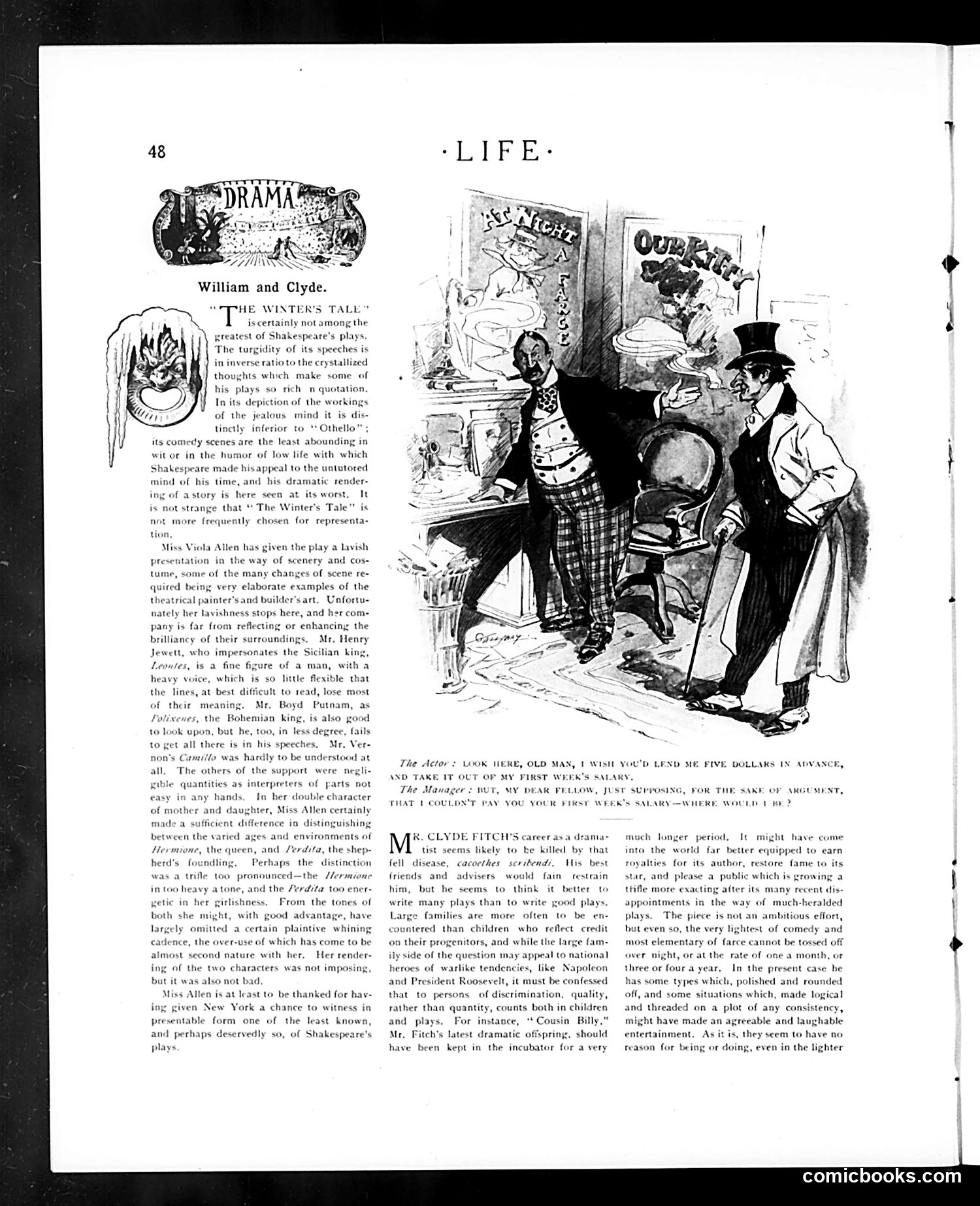
This page discusses theatrical productions of Shakespeare's "The Winter's Tale" and Mr. Clyde Fitch's plays. The illustration depicts a comedic scene between an actor and a theater manager negotiating a salary advance. The cartoon's satire centers on the financial struggles of theatrical productions and actors. The manager refuses the actor's request for a five-dollar advance on his first week's salary, claiming he "couldn't pay you your first week's salary—where would I be?" This reflects early 20th-century theater's precarious economics, where even modest productions operated on tight budgets and actors frequently faced financial hardship. The joke targets the absurdity of theater management excusing their inability to pay wages while expecting performers to work—a common exploitation in the entertainment industry of that era.
📄 Transcribed text from this page (OCR, searchable)
Machine-transcribed from the original scan — historical spelling and the odd misread are preserved.
William and Clyde. HE WINTER'S TALE” is certainly not among the gre: 1 of Shakespeare's plays. The turgidity of its speech thoughts which make some of in inverse ratio to the crystallizs his plays so rich n quotation. In its depiction of the workings of the jealous mind it is dis- tinctly inferior to * Othello scenes are the least abound gin witor in the humor of low life with which St Je hisappeal to the untutored mind of bis time, an kespeare m. his dramatic render- ing of astory is here seen at its worst, It is not strange that * The Winter's Tale” is n more frequently chosen for representa- tion, Miss Viola Allen has given the play a lavish presentation in the way of scenery and cos- tui eof the many changes of scene re- quired be ng very elaborate examples of the theatrical painter's and builder'sart. Unfortu- nately her lavis! ss stops here, and her com- n reflecting or enh, pany is far fre cing the brilliancy of their surroundings. Mr. Henry Jewett, who impersonates the Sicilian king, Leontes, is a fine figure of a man, with a heavy voice, which is so little flexible that the lines of their 4 xg. Mr, Boyd Putnam, as Polixenes, the Bohen d to look upon, but he, too, in less dey fails at best difficult to read, lose most n king, is also gi to get all there is in his speech: non’s Camel all, The ble quantities as interpr » was hardly to be understood others of the support were negli- parts not easy in any hands. In her F, Miss Al made a sufficient difference in distinguishin, uracter of mother and dav n certainly between the varied ages and environments of Hermione, th herd’s foundling. Perhaps the distinction een, and Serdita, the shep- was a trifle too pronounced—the /ermion in too heavy atone, and the Perdita too ener- tic in her girlishness. From the tones of largely omitted a h she might, with good advantage, have rtain plaintive whining cadence, the over-use of which has come to be almost second nature with her, Her render- ing of the two characters was not imposing, but it was also not bad Miss Allen is at least to be thanked for hav- ing given New York a chance to witness in le presentable form one of the least known, and perhaps deservedly so, of Shakespeare's plays FHAT 1 COULDN'T PAY YOU CLYDE FITCH'S car but he seems write many plays than to write good plays. Large families are mor ered than children who reflect credit he large fam- y side of the questi n may appeal to national s, like Napoleon Roosevelt, it must be confessed heroes of warlike tendenci of discrimination, quality, than quantity, counts both in children “Cousin Billy,” Mr, Fitch's latest dramatic offspring, should For instance, n kept in the incubator for a very The Actor: LoOK WERE, OLD MAS, 1 WISH YOU'D LEND ME FIVE DOLLARS IN ADVANCE, \ND TAKE IT OUT OF MY FIRST WEEK'S SALARY, WW, JUST SUPPOSING, FOR THE SAKE OF ARGUMENT, YOUR FIRST WEEK'S SALARY WHERE WOULD 1 HH? ich longer period, It might have come into the world far better equipped to earn royalties for its author, restore fame to its star, and please a public which is growing a tkifle more exacting after its many recent dis aided pbitious effort, appointments in the way of muc plays. The piece is not a but even so, the very lightest of comedy and most elementary of farce cannot be tossed off over night, or at the rate of one a month, or three or four a year, In the present case he has some types which, polished and rounded off, and some situations which, made logical and threaded on a plot of any consistency, able entertainment. As it is, they seem to have no might have made an agreeable and la reason for being or doing, even in the lighter comicbooks.com